1
Kaizen
Introduction : Kaizen, a term of Japanese origin, translates
to "change for the better" or "continuous improvement." Derived
from the words "Kai" (change) and "Zen" (good), Kaizen
encapsulates the philosophy of ongoing enhancement in
processes and systems. This concept is a cornerstone of lean
manufacturing culture, introduced by Toyota in the 20th century,
and has since been adopted across various industries. This
assignment delves into the Kaizen concept, exploring its history,
processes, tools, applications, and its broader implications for
business and individual development.
2
History of Kaizen : Kaizen originated during the Japanese
Industrial Revolution and has evolved through several phases:
• 1920s-1930s : Walter Stewart of Bell Laboratories
developed statistical control charts, leading to the PDCA
(Plan-Do-Check-Act) cycle. This marked the first systematic
approach to process standardization.
• 1940s-1950s : W. Edwards Deming expanded on Shewart’s
work, emphasizing leadership in operations and pioneering
Total Quality Management (TQM). He introduced the PDCA
cycle to Japanese industries after World War II, laying the
groundwork for Kaizen principles.
• 1950s to Date : The Toyota Production System (TPS),
credited to Taichi Ohno, introduced lean manufacturing with
continuous improvement as its core. Key innovations
include Single Minute Exchange of Die (SMED) and the
Pull System.
3
• 1960s onwards : Masaaki Imai popularized Kaizen
globally and founded the Kaizen Institute in 1985, bringing
Japanese industrial success strategies to the world stage.
• 1990-2010 : James Womack and co-authors
documented lean manufacturing and Kaizen in "The
Machine That Changed the World," solidifying its global
relevance.
The Kaizen Process : Kaizen fosters continuous productivity
improvements by empowering employees at all organizational
4
levels to identify, resolve, and standardize issues. This philosophy
emphasizes:
• Identifying and eliminating waste in operations.
• Solving numerous small problems instead of focusing solely
on large-scale issues.
• Empowering frontline employees to highlight and address
productivity challenges.
Key principles include :
1. Know Your Customer : Understand and address customer
interests to deliver superior value.
2. Let It Flow : Empower employees to create
value and eliminate waste.
3. Go to the Gemba : Observe challenges firsthand at the
source.
4. Empower People : Respect and enable all employees to
contribute to system improvements.
5. Be Transparent : Set measurable performance standards.
5
Kaizen encourages organizations to adopt a culture of proactive
problem-solving, where every employee contributes to
continuous improvement.
Implementing Kaizen
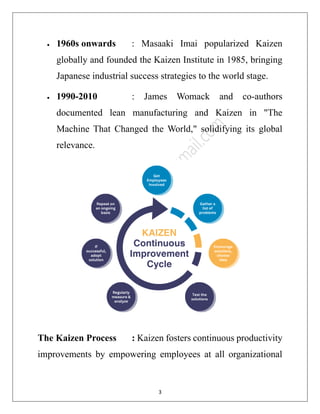
PDCA Cycle : Central to Kaizen, the PDCA cycle
involves:
• Plan : Identify and strategize solutions for a
problem.
• Do : Implement solutions on a pilot scale.
• Check : Analyze results.
• Act : Standardize successful solutions or
revisit planning if results are unsatisfactory. This cycle is
iterative for continuous improvement.
SQDCM Framework : Categorizes issues into Safety, Quality,
Delivery, Cost, and Morale, ensuring structured problem-solving
and accountability.
6
Continuous Improvement Board: Tracks issues with categories,
open/close dates, required actions, statuses, and individual
responsibilities. Daily reviews involve all stakeholders, ensuring
consistent progress.
Tools for Kaizen Implementation
1. Fishbone Diagram : Identifies root causes of
process flaws through a cause-and-effect approach. This
diagram, also known as the Ishikawa diagram, visually
organizes potential causes into categories for detailed
analysis.
2. Value Stream Mapping (VSM) : Visualizes processes to
identify and eliminate waste, optimizing production cycle
times. It provides a holistic view of workflow, enabling the
elimination of inefficiencies like overproduction and
bottlenecks.
3. 5S System : Originating from
Toyota, this system standardizes workplace organization:
o Sort: Identify necessary items.
7
o Set in Order: Categorize materials.
o Shine: Clean and maintain.
o Standardize: Document procedures.
o Sustain: Continuously implement practices.
4. Pareto Analysis : Applies the 80/20 rule
to identify and prioritize problems that have the greatest
impact. This tool highlights the "vital few" issues that
require immediate attention.
Additional tools like Kanban, takt time calculations, and Overall
Equipment Effectiveness (OEE) further enhance the Kaizen
process by refining operations and aligning workflows with
organizational goals.
Comparison with Other Methodologies
1. Lean Manufacturing :
o Originated from the Toyota Production System.
o Focuses on Jidoka (quality assurance at the source) and
Just-in-Time (JIT) production.
8
o Kaizen supports lean manufacturing by driving
continuous improvements and reinforcing the pillars of
lean systems.
2. Six Sigma :
o Developed by Bill Smith of Motorola.
o Aim to reduce production variability and defects (3.4
per million units).
o Utilizes statistical tools, control charts, and failure
analysis.
While Lean emphasizes process efficiency, Six Sigma targets
defect reduction. Kaizen complements both by fostering a culture
of continuous improvement.
Applications of Kaizen :
1. IT/Software Development :
o Agile methodology, Scrum, and Standup meetings
embody Kaizen principles.
9
o Focus on iterative improvements in product quality and
client satisfaction.
o Continuous feedback loops, akin to PDCA, ensure
adaptability and responsiveness.
2. Healthcare :
o Standardizes operations and empowers healthcare
workers to resolve operational challenges.
o Tools like Value Stream Mapping and Continuous
Improvement Boards enhance efficiency.
o Kaizen principles address patient safety, service quality,
and cost management.
3. Other Industries :
o Aviation : Streamlines maintenance operations
and improves safety protocols.
o Consulting : Enhances client engagement strategies
and project management efficiency.
o Retail : Optimizes inventory management and
enhances customer service.
10
Measuring Kaizen Success : Kaizen’s benefits often
manifest gradually, making financial ROI metrics less relevant in
the short term. It generally takes three or more years to observe
significant improvements. Success metrics include operational
efficiency, employee engagement, and customer satisfaction
rather than immediate financial gains. Organizations must adopt
qualitative and quantitative measures to track progress
effectively.
Broader Implications of Kaizen : Beyond industrial
applications, Kaizen’s principles resonate in personal
development. Individuals can integrate Kaizen into daily life by
focusing on incremental improvements. This approach fosters
discipline, adaptability, and resilience. For example, habits like
time management, fitness routines, and skill enhancement can be
honed using Kaizen’s continuous improvement philosophy.
Significance of kaizen :
11
● Kaizen is similar to methods improvement studies undertaken
by industrial
engineers.
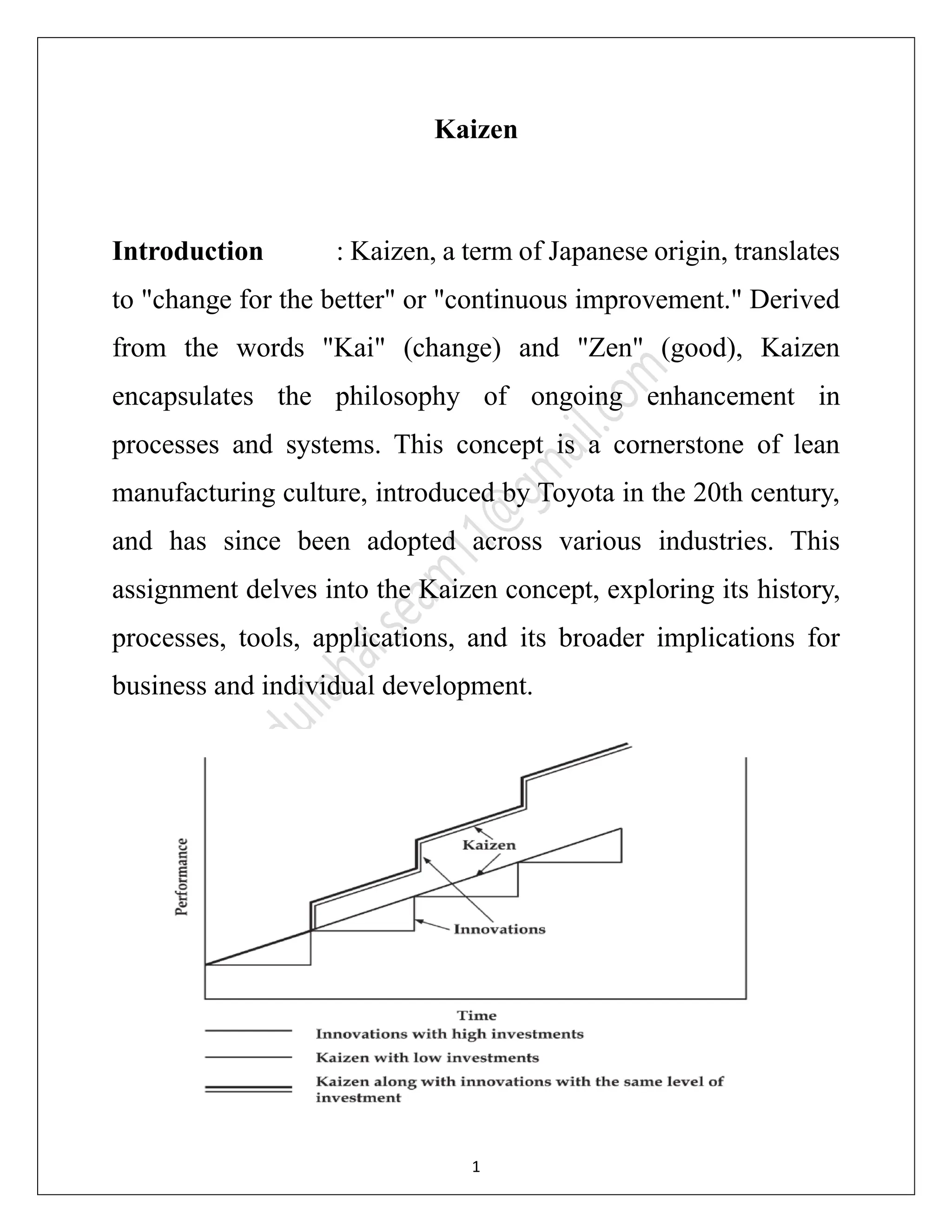
● It is a continuous improvement tool and not a one-time
approach.
● Its motto is “Do 100 things 1% better, than doing 1 thing 100%
better.”
● It does not involve substantial investment.
● It aims at excellence at the shop floor level.
● It involves everyone in the factory.
● It involves identification of wastes involved in the production
processes and
operations.
Conclusion : Kaizen’s philosophy of
continuous improvement transcends industries and is relevant in
both organizational and individual development. Its integration
into daily practices can drive long-term success and adaptability.
12
As stated in 1 Timothy 4:15, "Take pains with these things; be
absorbed in them, so that your progress will be evident to all," the
essence of Kaizen lies in its relentless pursuit of progress through
small, consistent steps.

Kaizen and Continuous Improvement...pdf

  • 1.
    1 Kaizen Introduction : Kaizen,a term of Japanese origin, translates to "change for the better" or "continuous improvement." Derived from the words "Kai" (change) and "Zen" (good), Kaizen encapsulates the philosophy of ongoing enhancement in processes and systems. This concept is a cornerstone of lean manufacturing culture, introduced by Toyota in the 20th century, and has since been adopted across various industries. This assignment delves into the Kaizen concept, exploring its history, processes, tools, applications, and its broader implications for business and individual development.
  • 2.
    2 History of Kaizen: Kaizen originated during the Japanese Industrial Revolution and has evolved through several phases: • 1920s-1930s : Walter Stewart of Bell Laboratories developed statistical control charts, leading to the PDCA (Plan-Do-Check-Act) cycle. This marked the first systematic approach to process standardization. • 1940s-1950s : W. Edwards Deming expanded on Shewart’s work, emphasizing leadership in operations and pioneering Total Quality Management (TQM). He introduced the PDCA cycle to Japanese industries after World War II, laying the groundwork for Kaizen principles. • 1950s to Date : The Toyota Production System (TPS), credited to Taichi Ohno, introduced lean manufacturing with continuous improvement as its core. Key innovations include Single Minute Exchange of Die (SMED) and the Pull System.
  • 3.
    3 • 1960s onwards: Masaaki Imai popularized Kaizen globally and founded the Kaizen Institute in 1985, bringing Japanese industrial success strategies to the world stage. • 1990-2010 : James Womack and co-authors documented lean manufacturing and Kaizen in "The Machine That Changed the World," solidifying its global relevance. The Kaizen Process : Kaizen fosters continuous productivity improvements by empowering employees at all organizational
  • 4.
    4 levels to identify,resolve, and standardize issues. This philosophy emphasizes: • Identifying and eliminating waste in operations. • Solving numerous small problems instead of focusing solely on large-scale issues. • Empowering frontline employees to highlight and address productivity challenges. Key principles include : 1. Know Your Customer : Understand and address customer interests to deliver superior value. 2. Let It Flow : Empower employees to create value and eliminate waste. 3. Go to the Gemba : Observe challenges firsthand at the source. 4. Empower People : Respect and enable all employees to contribute to system improvements. 5. Be Transparent : Set measurable performance standards.
  • 5.
    5 Kaizen encourages organizationsto adopt a culture of proactive problem-solving, where every employee contributes to continuous improvement. Implementing Kaizen PDCA Cycle : Central to Kaizen, the PDCA cycle involves: • Plan : Identify and strategize solutions for a problem. • Do : Implement solutions on a pilot scale. • Check : Analyze results. • Act : Standardize successful solutions or revisit planning if results are unsatisfactory. This cycle is iterative for continuous improvement. SQDCM Framework : Categorizes issues into Safety, Quality, Delivery, Cost, and Morale, ensuring structured problem-solving and accountability.
  • 6.
    6 Continuous Improvement Board:Tracks issues with categories, open/close dates, required actions, statuses, and individual responsibilities. Daily reviews involve all stakeholders, ensuring consistent progress. Tools for Kaizen Implementation 1. Fishbone Diagram : Identifies root causes of process flaws through a cause-and-effect approach. This diagram, also known as the Ishikawa diagram, visually organizes potential causes into categories for detailed analysis. 2. Value Stream Mapping (VSM) : Visualizes processes to identify and eliminate waste, optimizing production cycle times. It provides a holistic view of workflow, enabling the elimination of inefficiencies like overproduction and bottlenecks. 3. 5S System : Originating from Toyota, this system standardizes workplace organization: o Sort: Identify necessary items.
  • 7.
    7 o Set inOrder: Categorize materials. o Shine: Clean and maintain. o Standardize: Document procedures. o Sustain: Continuously implement practices. 4. Pareto Analysis : Applies the 80/20 rule to identify and prioritize problems that have the greatest impact. This tool highlights the "vital few" issues that require immediate attention. Additional tools like Kanban, takt time calculations, and Overall Equipment Effectiveness (OEE) further enhance the Kaizen process by refining operations and aligning workflows with organizational goals. Comparison with Other Methodologies 1. Lean Manufacturing : o Originated from the Toyota Production System. o Focuses on Jidoka (quality assurance at the source) and Just-in-Time (JIT) production.
  • 8.
    8 o Kaizen supportslean manufacturing by driving continuous improvements and reinforcing the pillars of lean systems. 2. Six Sigma : o Developed by Bill Smith of Motorola. o Aim to reduce production variability and defects (3.4 per million units). o Utilizes statistical tools, control charts, and failure analysis. While Lean emphasizes process efficiency, Six Sigma targets defect reduction. Kaizen complements both by fostering a culture of continuous improvement. Applications of Kaizen : 1. IT/Software Development : o Agile methodology, Scrum, and Standup meetings embody Kaizen principles.
  • 9.
    9 o Focus oniterative improvements in product quality and client satisfaction. o Continuous feedback loops, akin to PDCA, ensure adaptability and responsiveness. 2. Healthcare : o Standardizes operations and empowers healthcare workers to resolve operational challenges. o Tools like Value Stream Mapping and Continuous Improvement Boards enhance efficiency. o Kaizen principles address patient safety, service quality, and cost management. 3. Other Industries : o Aviation : Streamlines maintenance operations and improves safety protocols. o Consulting : Enhances client engagement strategies and project management efficiency. o Retail : Optimizes inventory management and enhances customer service.
  • 10.
    10 Measuring Kaizen Success: Kaizen’s benefits often manifest gradually, making financial ROI metrics less relevant in the short term. It generally takes three or more years to observe significant improvements. Success metrics include operational efficiency, employee engagement, and customer satisfaction rather than immediate financial gains. Organizations must adopt qualitative and quantitative measures to track progress effectively. Broader Implications of Kaizen : Beyond industrial applications, Kaizen’s principles resonate in personal development. Individuals can integrate Kaizen into daily life by focusing on incremental improvements. This approach fosters discipline, adaptability, and resilience. For example, habits like time management, fitness routines, and skill enhancement can be honed using Kaizen’s continuous improvement philosophy. Significance of kaizen :
  • 11.
    11 ● Kaizen issimilar to methods improvement studies undertaken by industrial engineers. ● It is a continuous improvement tool and not a one-time approach. ● Its motto is “Do 100 things 1% better, than doing 1 thing 100% better.” ● It does not involve substantial investment. ● It aims at excellence at the shop floor level. ● It involves everyone in the factory. ● It involves identification of wastes involved in the production processes and operations. Conclusion : Kaizen’s philosophy of continuous improvement transcends industries and is relevant in both organizational and individual development. Its integration into daily practices can drive long-term success and adaptability.
  • 12.
    12 As stated in1 Timothy 4:15, "Take pains with these things; be absorbed in them, so that your progress will be evident to all," the essence of Kaizen lies in its relentless pursuit of progress through small, consistent steps.