Submitted by :Shadab 1020331Sanghamitra 1020353				Flavia 1020344				Thomas 1020334				Vinika 1020357Sweta  1020356                                                                               				 Divya 1020343
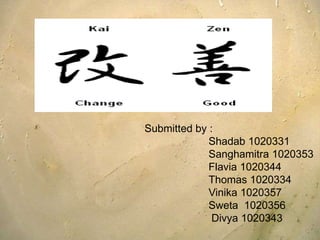
Definition Kaizen is a system that involves all employees from strategic management to labourers to bring a little change by improving productivity, effectiveness and reducing waste.It is the philosophy or practices that focus upon continuous improvement of processes in manufacturing, engineering, and business management. In the business sense and applied to the workplace, kaizen refers to activities that continually improve all functions, and involves all employees from the CEO to the assembly line workers.  
KAIZEN is a culture of sustained continuous improvement focusing on eliminating waste in all systems and processes of an organization. It begins and ends with people.It is a method that strives toward perfection by eliminating waste (MUDA) in the work place (GEMBA).
It eliminates waste by empowering people with tools and provides methodology for uncovering improvement opportunities and making small changes.
This is also a low cost approach, using simple quality control tools: Pareto, Ishikawa diagrams and PDCA cycle.The 5 main elements of kaizen:Teamwork
Personal Discipline
Improved Morale
Quality Circle
Suggestions for ImprovementOther Definitions Kaizen• A Japanese term meaning gradual unending improvement by doing little things better and setting and achieving increasingly higher standards                                                          ~ Lean Lexicon, ASQ    • Small improvements generated by hands-on workers through the application of a variety of structured, low-technology methods                                                             ~ Office Kaizen, ASQ
History of Continuous Improvement After, world war II, Japan had to rebuild Experts from US visited Japan on an advisory role, including Dr. W. Edwards Deming.Problems of low morale, lack of funds, raw materials, etc prevailed in Japan. Based on his recent experience in reducing waste in U.S. war manufacture, advised the country. Taught Japanese businesses to concentrate their attention on processes rather than results.Many companies took the advice, including Toyota, and Introduced the concept of JIT and TQM.
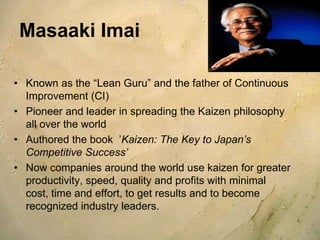
Masaaki ImaiKnown as the “Lean Guru” and the father of Continuous Improvement (CI)Pioneer and leader in spreading the Kaizen philosophy all over the world Authored the book  ’Kaizen: The Key to Japan’s Competitive Success’Now companies around the world use kaizen for greater productivity, speed, quality and profits with minimal cost, time and effort, to get results and to become recognized industry leaders.
Basic Kaizen concepts   Kaizen typically deals with• Quality assurance• Cost reduction• Meeting production quotas• Meeting delivery schedules• Safety on the job• New product development• Productivity improvement• Supplier management
7 types of MUDAMUDA of over-productionMUDA of motionMUDA of waitingMUDA of InventoryMUDA of processingMUDA of transportationMUDA of production rejects
Kaizen CycleThe cycle of kaizen activity can be defined as:Standardize an operationMeasure the standardized operation Gauge measurements against requirementsInnovate to meet requirements and increase productivityStandardize the new, improved operationsContinue cycle
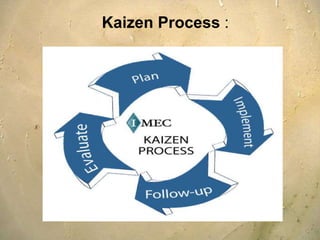
Kaizen Process :
Kaizen Process :Kaizen implementation allows for building of lean culture and also helps improve company performance. The four processes involved in Kaizen process are :   Plan :
 High level planning : Enterprise lean deployment strategy to the specific purpose that needs to be improvd and takes into consideration the timeline in which the improvement has to occur.
Answers the questions of :
What are the critical needs
 How to focus on our resources
 How to motivate and involve the team
 How to sustain the improvements made.	 Middle level planning : Value stream mapping :
 Enables the company to identify and eliminate the waste.
 Helps in stream lining the process, cutting down the waste and thus cutting lead times, increasing the quality, etc.
Event Level Planning :
 Checklist and other documents to ensure that everything is in place and that each kaizen activity is conducted successfully. Kaizen processSelect a business process area in which Kaizen will be implemented.Create appropriate goals for the team.Ensure that relevant area personnel are informed of the Kaizen plans.Ensure availability of relevant area personnel for participation on the Kaizen team.Provide a suitable working area.Ensure timely review and approval of the Kaizen team's recommendations.Ensure timely implementation of approved recommendations. 
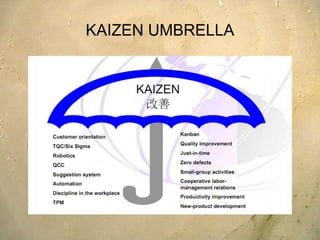
KAIZEN UMBRELLA
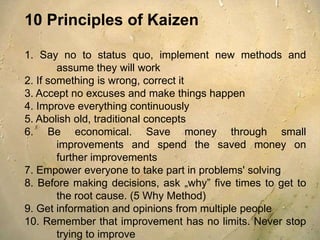
10 Principles of Kaizen1. Say no to status quo, implement new methods and 	assume they will work2. If something is wrong, correct it3. Accept no excuses and make things happen4. Improve everything continuously5. Abolish old, traditional concepts6. Be economical. Save money through small 	improvements and spend the saved money on 	further improvements7. Empower everyone to take part in problems' solving8. Before making decisions, ask „why” five times to get to 	the root cause. (5 Why Method)9. Get information and opinions from multiple people10. Remember that improvement has no limits. Never stop 	trying to improve
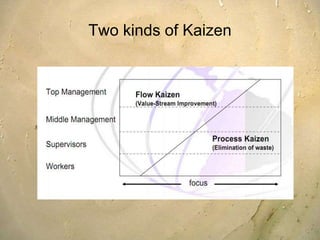
Two kinds of Kaizen
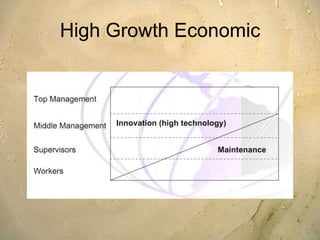
High Growth Economic
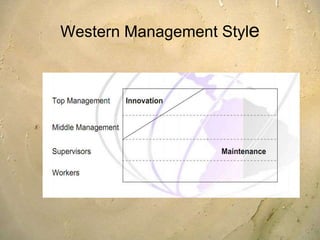
Western Management Style

TQM kaizen modified

  • 1.
    Submitted by :Shadab1020331Sanghamitra 1020353 Flavia 1020344 Thomas 1020334 Vinika 1020357Sweta 1020356 Divya 1020343
  • 2.
    Definition Kaizen isa system that involves all employees from strategic management to labourers to bring a little change by improving productivity, effectiveness and reducing waste.It is the philosophy or practices that focus upon continuous improvement of processes in manufacturing, engineering, and business management. In the business sense and applied to the workplace, kaizen refers to activities that continually improve all functions, and involves all employees from the CEO to the assembly line workers.  
  • 3.
    KAIZEN is aculture of sustained continuous improvement focusing on eliminating waste in all systems and processes of an organization. It begins and ends with people.It is a method that strives toward perfection by eliminating waste (MUDA) in the work place (GEMBA).
  • 4.
    It eliminates wasteby empowering people with tools and provides methodology for uncovering improvement opportunities and making small changes.
  • 5.
    This is alsoa low cost approach, using simple quality control tools: Pareto, Ishikawa diagrams and PDCA cycle.The 5 main elements of kaizen:Teamwork
  • 6.
  • 7.
  • 8.
  • 9.
    Suggestions for ImprovementOtherDefinitions Kaizen• A Japanese term meaning gradual unending improvement by doing little things better and setting and achieving increasingly higher standards ~ Lean Lexicon, ASQ • Small improvements generated by hands-on workers through the application of a variety of structured, low-technology methods ~ Office Kaizen, ASQ
  • 10.
    History of ContinuousImprovement After, world war II, Japan had to rebuild Experts from US visited Japan on an advisory role, including Dr. W. Edwards Deming.Problems of low morale, lack of funds, raw materials, etc prevailed in Japan. Based on his recent experience in reducing waste in U.S. war manufacture, advised the country. Taught Japanese businesses to concentrate their attention on processes rather than results.Many companies took the advice, including Toyota, and Introduced the concept of JIT and TQM.
  • 11.
    Masaaki ImaiKnown asthe “Lean Guru” and the father of Continuous Improvement (CI)Pioneer and leader in spreading the Kaizen philosophy all over the world Authored the book  ’Kaizen: The Key to Japan’s Competitive Success’Now companies around the world use kaizen for greater productivity, speed, quality and profits with minimal cost, time and effort, to get results and to become recognized industry leaders.
  • 12.
    Basic Kaizen concepts Kaizen typically deals with• Quality assurance• Cost reduction• Meeting production quotas• Meeting delivery schedules• Safety on the job• New product development• Productivity improvement• Supplier management
  • 13.
    7 types ofMUDAMUDA of over-productionMUDA of motionMUDA of waitingMUDA of InventoryMUDA of processingMUDA of transportationMUDA of production rejects
  • 14.
    Kaizen CycleThe cycleof kaizen activity can be defined as:Standardize an operationMeasure the standardized operation Gauge measurements against requirementsInnovate to meet requirements and increase productivityStandardize the new, improved operationsContinue cycle
  • 15.
  • 16.
    Kaizen Process :Kaizenimplementation allows for building of lean culture and also helps improve company performance. The four processes involved in Kaizen process are : Plan :
  • 17.
    High levelplanning : Enterprise lean deployment strategy to the specific purpose that needs to be improvd and takes into consideration the timeline in which the improvement has to occur.
  • 18.
  • 19.
    What are thecritical needs
  • 20.
    How tofocus on our resources
  • 21.
    How tomotivate and involve the team
  • 22.
    How tosustain the improvements made. Middle level planning : Value stream mapping :
  • 23.
    Enables thecompany to identify and eliminate the waste.
  • 24.
    Helps instream lining the process, cutting down the waste and thus cutting lead times, increasing the quality, etc.
  • 25.
  • 26.
    Checklist andother documents to ensure that everything is in place and that each kaizen activity is conducted successfully. Kaizen processSelect a business process area in which Kaizen will be implemented.Create appropriate goals for the team.Ensure that relevant area personnel are informed of the Kaizen plans.Ensure availability of relevant area personnel for participation on the Kaizen team.Provide a suitable working area.Ensure timely review and approval of the Kaizen team's recommendations.Ensure timely implementation of approved recommendations. 
  • 27.
  • 28.
    10 Principles ofKaizen1. Say no to status quo, implement new methods and assume they will work2. If something is wrong, correct it3. Accept no excuses and make things happen4. Improve everything continuously5. Abolish old, traditional concepts6. Be economical. Save money through small improvements and spend the saved money on further improvements7. Empower everyone to take part in problems' solving8. Before making decisions, ask „why” five times to get to the root cause. (5 Why Method)9. Get information and opinions from multiple people10. Remember that improvement has no limits. Never stop trying to improve
  • 29.
  • 30.
  • 31.
  • 33.
  • 37.
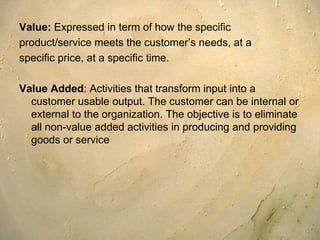
    Value: Expressed interm of how the specific product/service meets the customer’s needs, at a specific price, at a specific time.Value Added: Activities that transform input into a customer usable output. The customer can be internal or external to the organization. The objective is to eliminate all non-value added activities in producing and providing goods or service
  • 38.
  • 40.
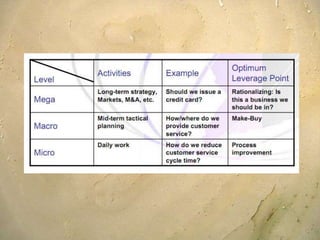
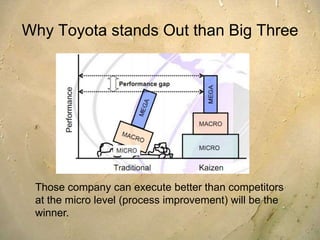
    Why Toyota standsOut than Big ThreeThose company can execute better than competitors at the micro level (process improvement) will be the winner.
  • 41.
    Kaizen MethodologyClear objectivesTeamprocessTight focus on timeQuick & simpleNecessary resources immediately availableImmediate results (new process functioning by end of week)Use of various planning tools to accomplish results
  • 42.
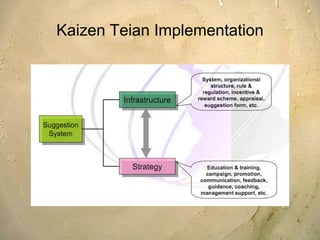
    Two common KaizenTools1.Kaizen Teian (Suggestion System)• To solicit creative ideas from all employees at workplace• To instill involvement and accountability2.Kaizen Event• To be a DNA or culture for process continual improvement • To utilize knowledge and know-how of people at gemba.
  • 43.
    Kaizen Teian Objectives1.Employeesinvolvement & empowerment • Encourage employee to participate2.Employee skill development for enhancing job performance (On-the-job-training) • Optimize employee capability and creative power3.Achieve benefits • Emphasis the benefits from the suggestions
  • 44.
  • 45.
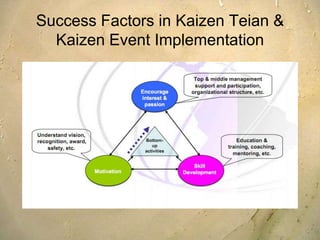
    Success Factors inKaizen Teian & Kaizen Event Implementation
  • 46.
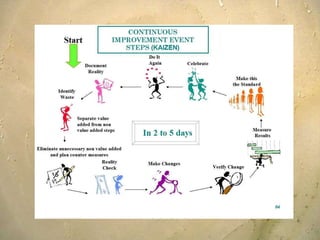
    Kaizen Event• Afew days, highly structured and coached intense attack on waste in a process or work area by a small groupWhen to use Kaizen• Waste sources have been identified (Low-hanging fruits)• The scope of a problem is clearly defined• Results are immediate and risk is minimal
  • 47.
    Kaizen to Toyota is the elimination of three basic things like:Muri (Overburden on employees)
  • 48.
  • 49.