What is Kaizen? Stephen R Depoe
Kaizen Tools Kaizen is Japanese for revolutionary improvement Kaizen is the organized use of common sense to improve cost, quality, delivery, and responsiveness to customer needs. A Kaizen blitz involves a Kaizen activity in a specific area within a short time period. The Kaizen blitz, using cross-functional teams in a three to five day period, results in a rapid workplace change on a project basis.
Kaizen Terminology Kaizen  – Incremental change for the better Kaikaku  – Radical change 3 M’s Muda Waste Mura Abnormality Muri Strain or Stress Jidoka  – Automating the detection of any abnormal product or condition Takt Time  – The pace at which the customer is demanding product
Muda is Waste Waste Comes in many forms, described using the “Seven Wastes”: Transportation (moving material/product from one place to another) Inventory (material/product/information waiting to be processed) Motion (excess movement and/or poor ergonomics) Waiting (delays caused by shortages, approvals, downtime)  Overproduction (producing more than is needed) Over processing (adding more value than the customer is paying for) Defects/Rework (doing the same job/task more than once)
Expectations of reducing Muda Less Labor Requirements Less Space Requirements Increased Flexibility Decreased Costs Improved Quality Improved Responsiveness Increased Innovation Increased Employee Enthusiasm
When to use Kaizen? When the scope and boundaries of  a problem are clearly defined and understood When results are needed immediately – i.e., capacity constraints, setup reduction, acute quality problems, safety/ergonomic issues In the early stages of a project to gain momentum and build credibility As a change agent when there is resistance to stimulate change As a project launching tool leading to multiple follow-on projects Always use Kaizen as a continuous improvement tool
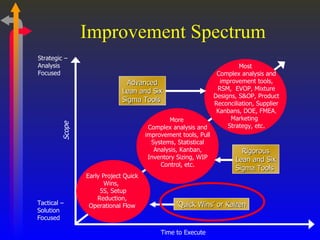
Improvement Spectrum Time to Execute Early Project Quick Wins,  5S, Setup Reduction, Operational Flow More  Complex analysis and improvement tools, Pull Systems, Statistical Analysis, Kanban, Inventory Sizing, WIP Control, etc. Most  Complex analysis and improvement tools, RSM,  EVOP, Mixture Designs, S&OP, Product Reconciliation, Supplier Kanbans, DOE, FMEA ,  Marketing  Strategy, etc. Strategic –  Analysis  Focused Tactical –  Solution Focused Scope ‘ Quick Wins’ or Kaizen Rigorous Lean and Six Sigma Tools  Advanced Lean and Six Sigma Tools
The Approach The Kaizen Approach is composed of 3 segments: Pre-event Prep:  Identify and plan narrowly scoped events Reducing defects in order entry Implementing marketing metrics Performing customer surveys to get VoC Kaizen Event:  measure, analyze, implement, and control improvements in one week Follow-up Actions:  remaining action items must be completed within four weeks after event
The Prep-work Develop Kaizen Mandate Data Collection/Analysis Team Selection/Notified Scope Identified $$ Savings Determined Process Map Resources Alerted Create “Specialized” Training Logistics Arranged Preparation Phase (1-2 weeks before start of event)
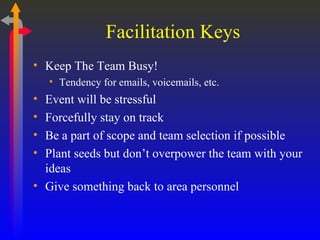
Keep The Team Busy! Tendency for emails, voicemails, etc. Event will be stressful Forcefully stay on track Be a part of scope and team selection if possible Plant seeds but don’t overpower the team with your ideas Give something back to area personnel Facilitation Keys
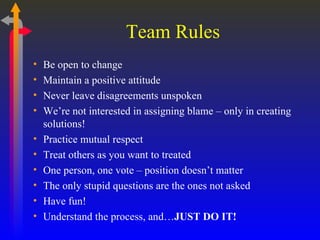
Team Rules Be open to change Maintain a positive attitude Never leave disagreements unspoken We’re not interested in assigning blame – only in creating solutions! Practice mutual respect Treat others as you want to treated One person, one vote – position doesn’t matter The only stupid questions are the ones not asked Have fun! Understand the process, and… JUST DO IT!
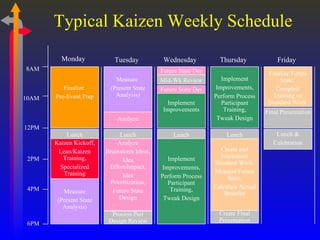
Typical Kaizen Weekly Schedule Finalize  Pre-Event Prep Kaizen Kickoff, Lean/Kaizen Training, Specialized Training Measure (Present State Analysis) Measure  (Present State Analysis) Analyze Lunch Lunch Analyze Brainstorm Ideas, Idea Effort/Impact, Idea Prioritization, Future State Design Mid-Wk Review Process Part Design Review Future State Des Future State Des Implement Improvements, Perform Process Participant Training, Tweak Design Implement Improvements Lunch Lunch Lunch & Celebration Final Presentation Implement Improvements, Perform Process Participant Training, Tweak Design Create and Implement Standard Work, Measure Future State, Calculate Actual Benefits Create Final Presentation Finalize Future State,  Complete Training on Standard Work  8AM Monday Tuesday Wednesday Thursday Friday 12PM 4PM 6PM 10AM 2PM
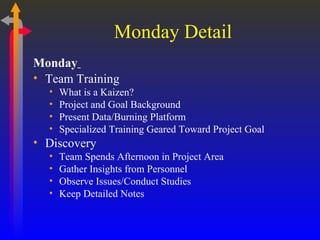
Monday Detail Monday   Team Training What is a Kaizen? Project and Goal Background Present Data/Burning Platform Specialized Training Geared Toward Project Goal Discovery Team Spends Afternoon in Project Area Gather Insights from Personnel Observe Issues/Conduct Studies Keep Detailed Notes
Tuesday Detail Tuesday  Area Discovery (Cont.) Team Spends Morning in Project Area Gather Insights from Personnel Observe Issues/Conduct Studies Back to Room to Brainstorm Issues What was learned? Write down ideas Evaluate Studies
The Tools Any tool may be used to aid the team during a Kaizen event from a Process Map to a Designed Experiment.  Bottom line is you use any tool that is needed, as long as it can be successfully employed in the time given! Pareto Fishbone Process map Spaghetti Diagram Lead Time/Takt Time NVA Analysis  Time Studies
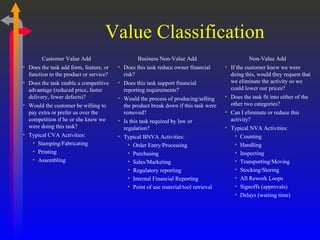
Value Classification Customer Value Add  Does the task add form, feature, or function to the product or service? Does the task enable a competitive advantage (reduced price, faster delivery, fewer defects)? Would the customer be willing to pay extra or prefer us over the competition if he or she knew we were doing this task? Typical CVA Activities: Stamping/Fabricating Printing Assembling Non-Value Add  If the customer knew we were doing this, would they request that we eliminate the activity so we could lower our prices? Does the task fit into either of the other two categories? Can I eliminate or reduce this activity? Typical NVA Activities: Counting Handling Inspecting Transporting/Moving Stocking/Storing All Rework Loops Signoffs (approvals) Delays (waiting time) Business Non-Value Add  Does this task reduce owner financial risk?  Does this task support financial reporting requirements?  Would the process of producing/selling the product break down if this task were removed?  Is this task required by law or regulation? Typical BNVA Activities: Order Entry/Processing Purchasing Sales/Marketing Regulatory reporting Internal Financial Reporting Point of use material/tool retrieval
Wednesday Detail Wednesday   Brainstorm Issues Capture Ideas/Solutions Evaluate Studies Reduce and Prioritize Ideas Affinitize Ideas/Solutions Utilize Effort vs. Impact Matrix Assign Numbers Based on Effort and Impact Midweek Status Meeting
Process Improvements Remember Lean Expert Principles   One Piece Flow  Variation Is The Enemy Single Minute Exchange of Die (SMED) Visual Controls Kanban 5-S Workplace Organization  Standard Work Quality Imperative Total Productive Maintenance Defect Prevention (Poka-Yoke)
Thursday Detail Thursday   Implement Solutions Each team member acts on their assignments Review Progress AM review of assignments Noon review of progress PM review of progress
Friday Detail Friday   Continue to implement solutions Each team member acts on their assignments Establish metrics to monitor performance Team presentation to management Celebrate
Takeaways Focused, dedicated teams (3-4 dedicated days for entire team) can identify large opportunities – quickly Active follow-up must take place after sessions end to ensure projects are completed Many participants, when given the chance, will have great implementable ideas Tooling, maintenance, IT (as necessary) should be on call to implement Kaizen team ideas Communication to management and the team celebration are important Having a Champion own the process will help drive results and sustainment of the process
Takeaways Use of simple, relatable examples helps drive results Can require considerable follow up work for Maintenance, IT, Cost Accounting, Production Control, etc. The Champion should work with Management to prioritize and align projects to strategic plan Top management must be involved (active in sessions) and supportive to sustain continuous improvement Great tool to launch projects and gain momentum Kaizen schedule is intensive – yet fun.

Conducting Kaizen Events

  • 1.
    What is Kaizen?Stephen R Depoe
  • 2.
    Kaizen Tools Kaizenis Japanese for revolutionary improvement Kaizen is the organized use of common sense to improve cost, quality, delivery, and responsiveness to customer needs. A Kaizen blitz involves a Kaizen activity in a specific area within a short time period. The Kaizen blitz, using cross-functional teams in a three to five day period, results in a rapid workplace change on a project basis.
  • 3.
    Kaizen Terminology Kaizen – Incremental change for the better Kaikaku – Radical change 3 M’s Muda Waste Mura Abnormality Muri Strain or Stress Jidoka – Automating the detection of any abnormal product or condition Takt Time – The pace at which the customer is demanding product
  • 4.
    Muda is WasteWaste Comes in many forms, described using the “Seven Wastes”: Transportation (moving material/product from one place to another) Inventory (material/product/information waiting to be processed) Motion (excess movement and/or poor ergonomics) Waiting (delays caused by shortages, approvals, downtime) Overproduction (producing more than is needed) Over processing (adding more value than the customer is paying for) Defects/Rework (doing the same job/task more than once)
  • 5.
    Expectations of reducingMuda Less Labor Requirements Less Space Requirements Increased Flexibility Decreased Costs Improved Quality Improved Responsiveness Increased Innovation Increased Employee Enthusiasm
  • 6.
    When to useKaizen? When the scope and boundaries of a problem are clearly defined and understood When results are needed immediately – i.e., capacity constraints, setup reduction, acute quality problems, safety/ergonomic issues In the early stages of a project to gain momentum and build credibility As a change agent when there is resistance to stimulate change As a project launching tool leading to multiple follow-on projects Always use Kaizen as a continuous improvement tool
  • 7.
    Improvement Spectrum Timeto Execute Early Project Quick Wins, 5S, Setup Reduction, Operational Flow More Complex analysis and improvement tools, Pull Systems, Statistical Analysis, Kanban, Inventory Sizing, WIP Control, etc. Most Complex analysis and improvement tools, RSM, EVOP, Mixture Designs, S&OP, Product Reconciliation, Supplier Kanbans, DOE, FMEA , Marketing Strategy, etc. Strategic – Analysis Focused Tactical – Solution Focused Scope ‘ Quick Wins’ or Kaizen Rigorous Lean and Six Sigma Tools Advanced Lean and Six Sigma Tools
  • 8.
    The Approach TheKaizen Approach is composed of 3 segments: Pre-event Prep: Identify and plan narrowly scoped events Reducing defects in order entry Implementing marketing metrics Performing customer surveys to get VoC Kaizen Event: measure, analyze, implement, and control improvements in one week Follow-up Actions: remaining action items must be completed within four weeks after event
  • 9.
    The Prep-work DevelopKaizen Mandate Data Collection/Analysis Team Selection/Notified Scope Identified $$ Savings Determined Process Map Resources Alerted Create “Specialized” Training Logistics Arranged Preparation Phase (1-2 weeks before start of event)
  • 10.
    Keep The TeamBusy! Tendency for emails, voicemails, etc. Event will be stressful Forcefully stay on track Be a part of scope and team selection if possible Plant seeds but don’t overpower the team with your ideas Give something back to area personnel Facilitation Keys
  • 11.
    Team Rules Beopen to change Maintain a positive attitude Never leave disagreements unspoken We’re not interested in assigning blame – only in creating solutions! Practice mutual respect Treat others as you want to treated One person, one vote – position doesn’t matter The only stupid questions are the ones not asked Have fun! Understand the process, and… JUST DO IT!
  • 12.
    Typical Kaizen WeeklySchedule Finalize Pre-Event Prep Kaizen Kickoff, Lean/Kaizen Training, Specialized Training Measure (Present State Analysis) Measure (Present State Analysis) Analyze Lunch Lunch Analyze Brainstorm Ideas, Idea Effort/Impact, Idea Prioritization, Future State Design Mid-Wk Review Process Part Design Review Future State Des Future State Des Implement Improvements, Perform Process Participant Training, Tweak Design Implement Improvements Lunch Lunch Lunch & Celebration Final Presentation Implement Improvements, Perform Process Participant Training, Tweak Design Create and Implement Standard Work, Measure Future State, Calculate Actual Benefits Create Final Presentation Finalize Future State, Complete Training on Standard Work 8AM Monday Tuesday Wednesday Thursday Friday 12PM 4PM 6PM 10AM 2PM
  • 13.
    Monday Detail Monday Team Training What is a Kaizen? Project and Goal Background Present Data/Burning Platform Specialized Training Geared Toward Project Goal Discovery Team Spends Afternoon in Project Area Gather Insights from Personnel Observe Issues/Conduct Studies Keep Detailed Notes
  • 14.
    Tuesday Detail Tuesday Area Discovery (Cont.) Team Spends Morning in Project Area Gather Insights from Personnel Observe Issues/Conduct Studies Back to Room to Brainstorm Issues What was learned? Write down ideas Evaluate Studies
  • 15.
    The Tools Anytool may be used to aid the team during a Kaizen event from a Process Map to a Designed Experiment. Bottom line is you use any tool that is needed, as long as it can be successfully employed in the time given! Pareto Fishbone Process map Spaghetti Diagram Lead Time/Takt Time NVA Analysis Time Studies
  • 16.
    Value Classification CustomerValue Add Does the task add form, feature, or function to the product or service? Does the task enable a competitive advantage (reduced price, faster delivery, fewer defects)? Would the customer be willing to pay extra or prefer us over the competition if he or she knew we were doing this task? Typical CVA Activities: Stamping/Fabricating Printing Assembling Non-Value Add If the customer knew we were doing this, would they request that we eliminate the activity so we could lower our prices? Does the task fit into either of the other two categories? Can I eliminate or reduce this activity? Typical NVA Activities: Counting Handling Inspecting Transporting/Moving Stocking/Storing All Rework Loops Signoffs (approvals) Delays (waiting time) Business Non-Value Add Does this task reduce owner financial risk? Does this task support financial reporting requirements? Would the process of producing/selling the product break down if this task were removed? Is this task required by law or regulation? Typical BNVA Activities: Order Entry/Processing Purchasing Sales/Marketing Regulatory reporting Internal Financial Reporting Point of use material/tool retrieval
  • 17.
    Wednesday Detail Wednesday Brainstorm Issues Capture Ideas/Solutions Evaluate Studies Reduce and Prioritize Ideas Affinitize Ideas/Solutions Utilize Effort vs. Impact Matrix Assign Numbers Based on Effort and Impact Midweek Status Meeting
  • 18.
    Process Improvements RememberLean Expert Principles One Piece Flow Variation Is The Enemy Single Minute Exchange of Die (SMED) Visual Controls Kanban 5-S Workplace Organization Standard Work Quality Imperative Total Productive Maintenance Defect Prevention (Poka-Yoke)
  • 19.
    Thursday Detail Thursday Implement Solutions Each team member acts on their assignments Review Progress AM review of assignments Noon review of progress PM review of progress
  • 20.
    Friday Detail Friday Continue to implement solutions Each team member acts on their assignments Establish metrics to monitor performance Team presentation to management Celebrate
  • 21.
    Takeaways Focused, dedicatedteams (3-4 dedicated days for entire team) can identify large opportunities – quickly Active follow-up must take place after sessions end to ensure projects are completed Many participants, when given the chance, will have great implementable ideas Tooling, maintenance, IT (as necessary) should be on call to implement Kaizen team ideas Communication to management and the team celebration are important Having a Champion own the process will help drive results and sustainment of the process
  • 22.
    Takeaways Use ofsimple, relatable examples helps drive results Can require considerable follow up work for Maintenance, IT, Cost Accounting, Production Control, etc. The Champion should work with Management to prioritize and align projects to strategic plan Top management must be involved (active in sessions) and supportive to sustain continuous improvement Great tool to launch projects and gain momentum Kaizen schedule is intensive – yet fun.