Chemistry 31


    Isomerism
     UNIVERSITY OF THE PHILIPPINES MANILA
            Padre Faura, Ermita, Manila
                 SS, 2009 – 2010
              Ms. Anjelyn del Rosario

                      chem31 adr            1
Isomerism
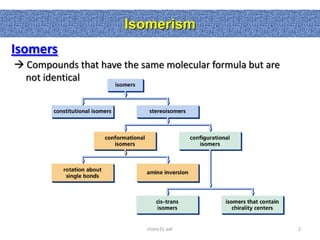
Isomers
 Compounds that have the same molecular formula but are
  not identical


                            chem31 adr                     2
Isomerism
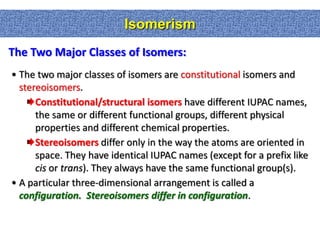
The Two Major Classes of Isomers:
• The two major classes of isomers are constitutional isomers and
  stereoisomers.
      Constitutional/structural isomers have different IUPAC names,
      the same or different functional groups, different physical
      properties and different chemical properties.
      Stereoisomers differ only in the way the atoms are oriented in
      space. They have identical IUPAC names (except for a prefix like
      cis or trans). They always have the same functional group(s).
• A particular three-dimensional arrangement is called a
  configuration. Stereoisomers differ in configuration.
Isomerism

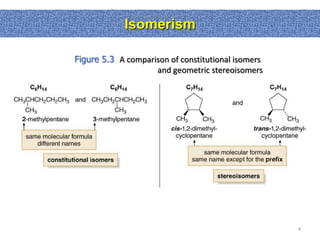
Figure 5.3 A comparison of constitutional isomers
                    and geometric stereoisomers


                                                    4
Constitutional Isomers

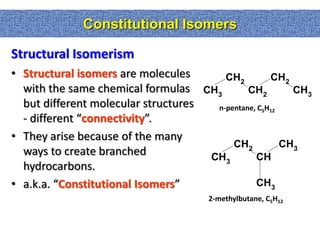
Structural Isomerism
• Structural isomers are molecules      CH2         CH2
  with the same chemical formulas CH3         CH2        CH3
  but different molecular structures  n-pentane, C5H12
  - different “connectivity”.
• They arise because of the many
                                          CH2          CH3
  ways to create branched            CH3        CH
  hydrocarbons.
• a.k.a. “Constitutional Isomers”               CH3
                                       2-methylbutane, C5H12
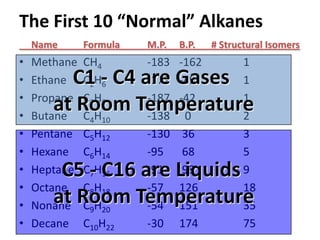
The First 10 “Normal” Alkanes
    Name      Formula   M.P.   B.P.   # Structural Isomers
•   Methane   CH4       -183   -162          1
•        C1 - C4 are Gases
    Ethane    C2H6      -172   -89           1
•   Propane   C3H8      -187   -42           1
•
       at Room Temperature
    Butane    C4H10     -138    0            2
•   Pentane   C5H12     -130    36           3
•   Hexane    C6H14     -95     68           5
•       C5 - C16 are Liquids
    Heptane   C7H16     -91     98           9
•   Octane    C8H18     -57    126           18
•
       at Room Temperature
    Nonane    C9H20     -54    151           35
•   Decane    C10H22    -30    174           75
Constitutional Isomers
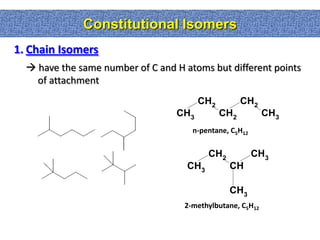
1. Chain Isomers
   have the same number of C and H atoms but different points
    of attachment
                                        CH2         CH2
                                  CH3         CH2           CH3
                                      n-pentane, C5H12

                                           CH2           CH3
                                     CH3         CH

                                                 CH3
                                    2-methylbutane, C5H12
Constitutional Isomers
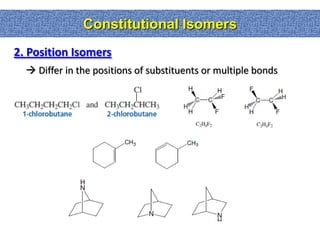
2. Position Isomers
   Differ in the positions of substituents or multiple bonds
Constitutional Isomers
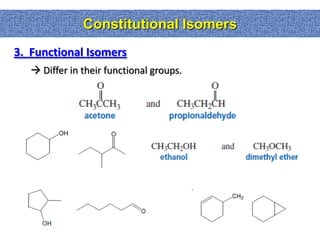
3. Functional Isomers
    Differ in their functional groups.
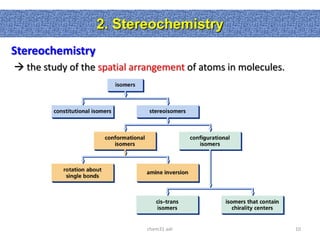
2. Stereochemistry
Stereochemistry
 the study of the spatial arrangement of atoms in molecules.


                              chem31 adr                        10
Stereochemistry

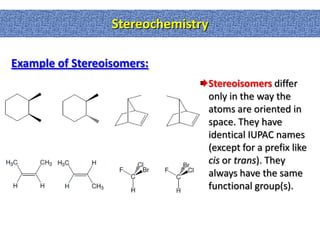
Example of Stereoisomers:
                                    Stereoisomers differ
                                    only in the way the
                                    atoms are oriented in
                                    space. They have
                                    identical IUPAC names
                                    (except for a prefix like
                                    cis or trans). They
                                    always have the same
                                    functional group(s).
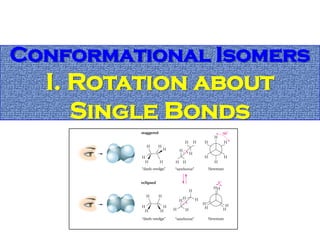
Conformational Isomers
  I. Rotation about
     Single Bonds
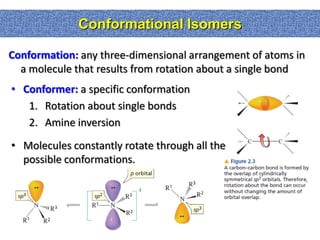
Conformational Isomers

Conformation: any three-dimensional arrangement of atoms in
  a molecule that results from rotation about a single bond
• Conformer: a specific conformation
   1. Rotation about single bonds
   2. Amine inversion
• Molecules constantly rotate through all the
  possible conformations.
Conformational Isomers: Rotation about Single Bonds

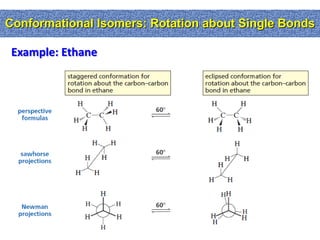
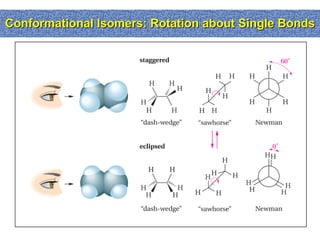
 Example: Ethane
Conformational Isomers: Rotation about Single Bonds

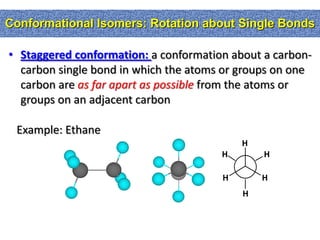
• Staggered conformation: a conformation about a carbon-
  carbon single bond in which the atoms or groups on one
  carbon are as far apart as possible from the atoms or
  groups on an adjacent carbon

 Example: Ethane
                                           H
                                       H       H

                                       H       H
                                           H
Conformational Isomers: Rotation about Single Bonds

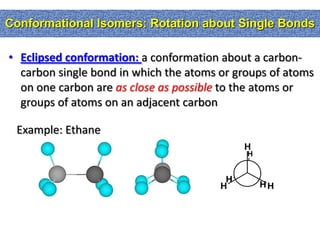
• Eclipsed conformation: a conformation about a carbon-
  carbon single bond in which the atoms or groups of atoms
  on one carbon are as close as possible to the atoms or
  groups of atoms on an adjacent carbon

 Example: Ethane
                                             H
                                             H


                                         H
                                        H        HH
Conformational Isomers: Rotation about Single Bonds

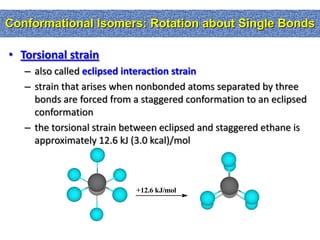
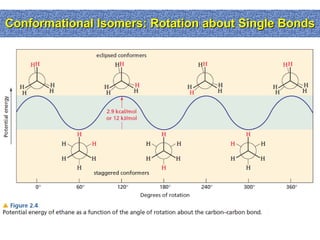
• Torsional strain
   – also called eclipsed interaction strain
   – strain that arises when nonbonded atoms separated by three
     bonds are forced from a staggered conformation to an eclipsed
     conformation
   – the torsional strain between eclipsed and staggered ethane is
     approximately 12.6 kJ (3.0 kcal)/mol


                           +12.6 kJ/mol
Conformational Isomers: Rotation about Single Bonds

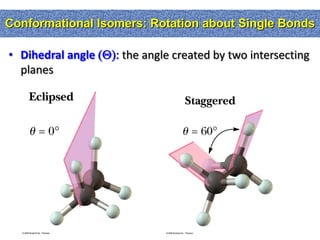
• Dihedral angle (Q): the angle created by two intersecting
  planes
Conformational Isomers: Rotation about Single Bonds

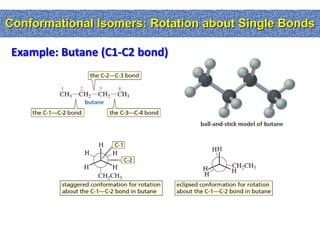
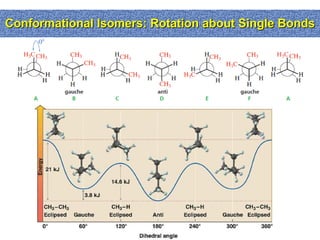
 Example: Butane (C1-C2 bond)
Conformational Isomers: Rotation about Single Bonds

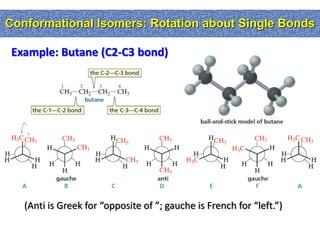
 Example: Butane (C2-C3 bond)


   (Anti is Greek for “opposite of ”; gauche is French for “left.”)
Conformational Isomers: Rotation about Single Bonds

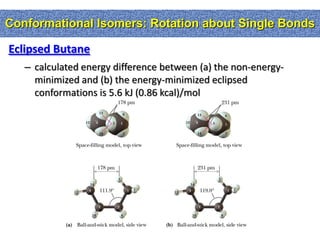
Eclipsed Butane
   – calculated energy difference between (a) the non-energy-
     minimized and (b) the energy-minimized eclipsed
     conformations is 5.6 kJ (0.86 kcal)/mol
Conformational Isomers: Rotation about Single Bonds


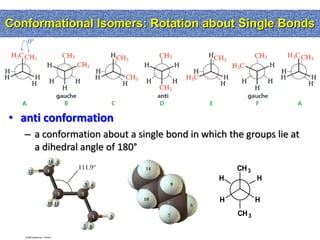
• anti conformation
   – a conformation about a single bond in which the groups lie at
     a dihedral angle of 180°
                                                   CH 3
                                               H          H

                                               H          H
                                                   CH 3
Conformational Isomers: Rotation about Single Bonds

 Angle strain
  the strain induced in a molecule when the bond angles are
   different from the ideal tetrahedral bond angle of 109.5°.

 Torsional strain
  the strain caused by repulsion between the bonding electrons of
   one substituent and the bonding electrons of a nearby
   substituent.

 Steric strain
  strain caused by atoms or groups of atoms approaching each
   other too closely.
Conformational Isomers: Rotation about Single Bonds
Conformational Isomers: Cycloalkanes
Cycloalkanes: Ring Strain
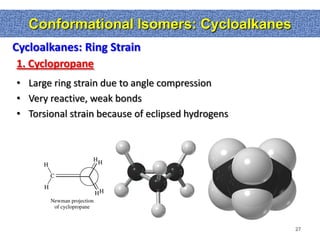
1. Cyclopropane
• Large ring strain due to angle compression
• Very reactive, weak bonds
• Torsional strain because of eclipsed hydrogens


                                                   27
Conformational Isomers: Cycloalkanes
Cycloalkanes: Ring Strain
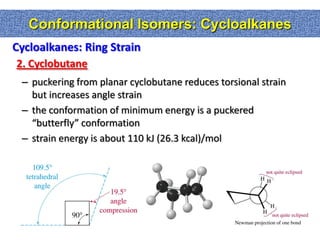
2. Cyclobutane
 – puckering from planar cyclobutane reduces torsional strain
   but increases angle strain
 – the conformation of minimum energy is a puckered
   “butterfly” conformation
 – strain energy is about 110 kJ (26.3 kcal)/mol
Conformational Isomers: Cycloalkanes
Cycloalkanes: Ring Strain
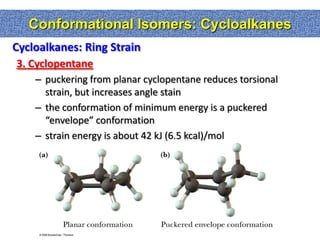
3. Cyclopentane
    – puckering from planar cyclopentane reduces torsional
      strain, but increases angle stain
    – the conformation of minimum energy is a puckered
      “envelope” conformation
    – strain energy is about 42 kJ (6.5 kcal)/mol
Conformational Isomers: Cycloalkanes
Cycloalkanes: Ring Strain
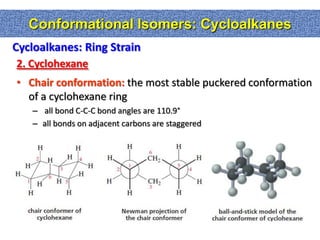
2. Cyclohexane
• Chair conformation: the most stable puckered conformation
  of a cyclohexane ring
   – all bond C-C-C bond angles are 110.9°
   – all bonds on adjacent carbons are staggered
Conformational Isomers: Cycloalkanes
Cycloalkanes: Ring Strain
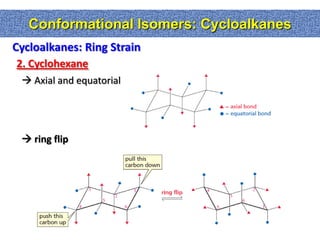
2. Cyclohexane
  Axial and equatorial


  ring flip
Conformational Isomers: Cycloalkanes
Cycloalkanes: Ring Strain
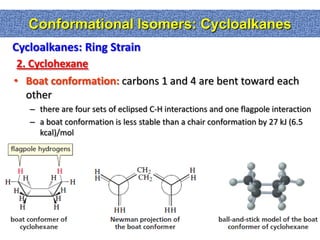
 2. Cyclohexane
• Boat conformation: carbons 1 and 4 are bent toward each
   other
   – there are four sets of eclipsed C-H interactions and one flagpole interaction
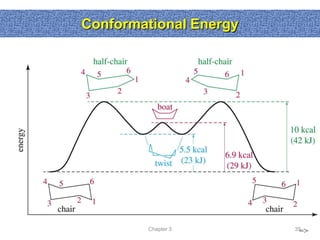
   – a boat conformation is less stable than a chair conformation by 27 kJ (6.5
     kcal)/mol
Conformational Isomers: Cycloalkanes
Cycloalkanes: Ring Strain
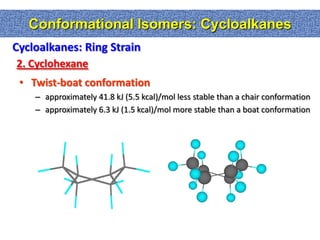
2. Cyclohexane
 • Twist-boat conformation
    – approximately 41.8 kJ (5.5 kcal)/mol less stable than a chair conformation
    – approximately 6.3 kJ (1.5 kcal)/mol more stable than a boat conformation
Conformational Isomers: Cycloalkanes
Cycloalkanes: Ring Strain
2. Cyclohexane
 • Half-chair conformation
Conformational Energy


        Chapter 3       35
                         =>
Conformational Isomers
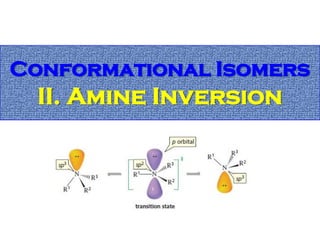
  II. Amine Inversion
Conformational Isomers
Amine Inversion
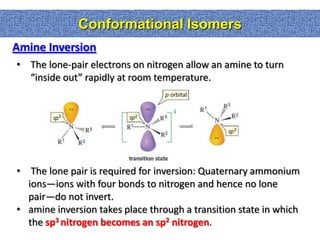
• The lone-pair electrons on nitrogen allow an amine to turn
  “inside out” rapidly at room temperature.


• The lone pair is required for inversion: Quaternary ammonium
  ions—ions with four bonds to nitrogen and hence no lone
  pair—do not invert.
• amine inversion takes place through a transition state in which
  the sp3 nitrogen becomes an sp2 nitrogen.
Configurational Isomers
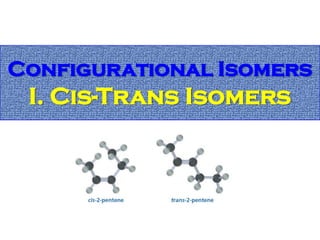
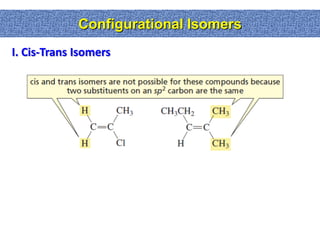
 I. Cis-Trans Isomers
Configurational Isomers
I. Cis-Trans Isomers
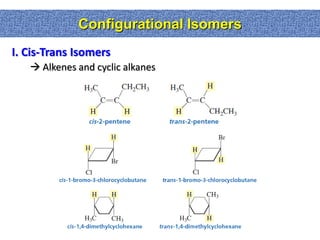
    Alkenes and cyclic alkanes
Configurational Isomers
I. Cis-Trans Isomers
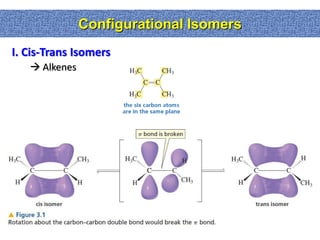
    Alkenes
Configurational Isomers
I. Cis-Trans Isomers
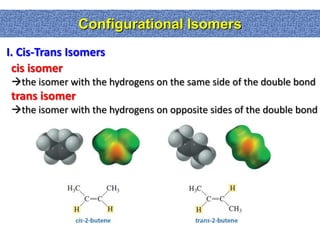
 cis isomer
the isomer with the hydrogens on the same side of the double bond
trans isomer
the isomer with the hydrogens on opposite sides of the double bond
Configurational Isomers
I. Cis-Trans Isomers
Configurational Isomers

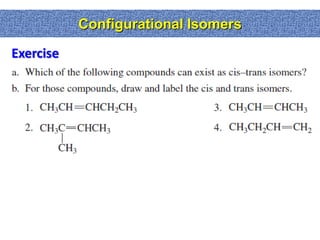
Exercise
Configurational Isomers
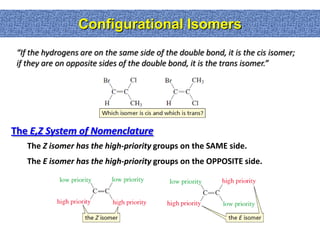
 “If the hydrogens are on the same side of the double bond, it is the cis isomer;
 if they are on opposite sides of the double bond, it is the trans isomer.”


The E,Z System of Nomenclature
    The Z isomer has the high-priority groups on the SAME side.
    The E isomer has the high-priority groups on the OPPOSITE side.
Configurational Isomers
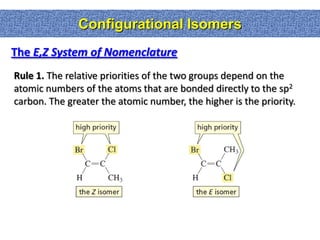
The E,Z System of Nomenclature
Rule 1. The relative priorities of the two groups depend on the
atomic numbers of the atoms that are bonded directly to the sp2
carbon. The greater the atomic number, the higher is the priority.
Configurational Isomers
The E,Z System of Nomenclature
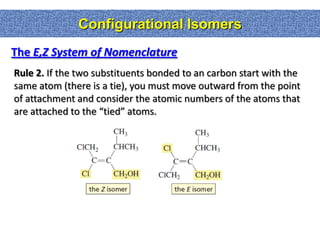
Rule 2. If the two substituents bonded to an carbon start with the
same atom (there is a tie), you must move outward from the point
of attachment and consider the atomic numbers of the atoms that
are attached to the “tied” atoms.
Configurational Isomers
The E,Z System of Nomenclature
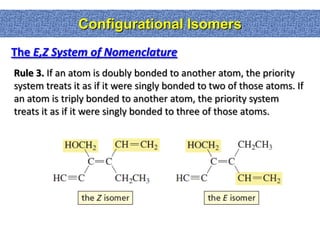
Rule 3. If an atom is doubly bonded to another atom, the priority
system treats it as if it were singly bonded to two of those atoms. If
an atom is triply bonded to another atom, the priority system
treats it as if it were singly bonded to three of those atoms.
Configurational Isomers
The E,Z System of Nomenclature
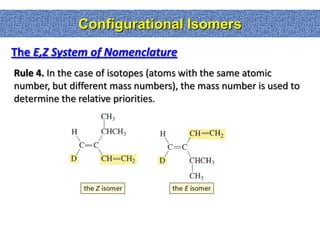
Rule 4. In the case of isotopes (atoms with the same atomic
number, but different mass numbers), the mass number is used to
determine the relative priorities.
Configurational Isomers
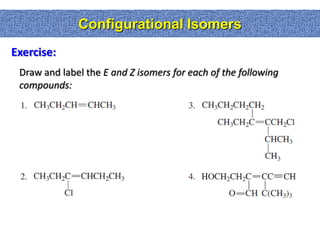
Exercise:
 Draw and label the E and Z isomers for each of the following
 compounds:
Configurational Isomers
I. Cis-Trans Isomers
    cyclic alkanes

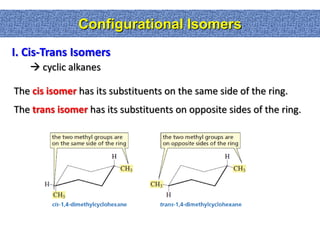
The cis isomer has its substituents on the same side of the ring.
The trans isomer has its substituents on opposite sides of the ring.
Configurational Isomers
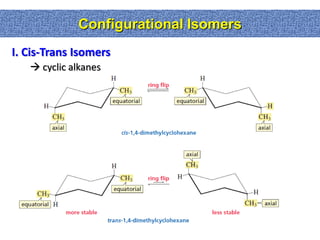
I. Cis-Trans Isomers
    cyclic alkanes
Configurational Isomers
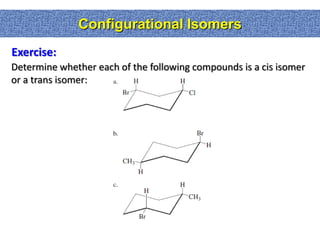
Exercise:
Determine whether each of the following compounds is a cis isomer
or a trans isomer:

4.stereochem1

  • 1.
    Chemistry 31 Isomerism UNIVERSITY OF THE PHILIPPINES MANILA Padre Faura, Ermita, Manila SS, 2009 – 2010 Ms. Anjelyn del Rosario chem31 adr 1
  • 2.
    Isomerism Isomers  Compounds thathave the same molecular formula but are not identical chem31 adr 2
  • 3.
    Isomerism The Two MajorClasses of Isomers: • The two major classes of isomers are constitutional isomers and stereoisomers. Constitutional/structural isomers have different IUPAC names, the same or different functional groups, different physical properties and different chemical properties. Stereoisomers differ only in the way the atoms are oriented in space. They have identical IUPAC names (except for a prefix like cis or trans). They always have the same functional group(s). • A particular three-dimensional arrangement is called a configuration. Stereoisomers differ in configuration.
  • 4.
    Isomerism Figure 5.3 Acomparison of constitutional isomers and geometric stereoisomers 4
  • 5.
    Constitutional Isomers Structural Isomerism •Structural isomers are molecules CH2 CH2 with the same chemical formulas CH3 CH2 CH3 but different molecular structures n-pentane, C5H12 - different “connectivity”. • They arise because of the many CH2 CH3 ways to create branched CH3 CH hydrocarbons. • a.k.a. “Constitutional Isomers” CH3 2-methylbutane, C5H12
  • 6.
    The First 10“Normal” Alkanes Name Formula M.P. B.P. # Structural Isomers • Methane CH4 -183 -162 1 • C1 - C4 are Gases Ethane C2H6 -172 -89 1 • Propane C3H8 -187 -42 1 • at Room Temperature Butane C4H10 -138 0 2 • Pentane C5H12 -130 36 3 • Hexane C6H14 -95 68 5 • C5 - C16 are Liquids Heptane C7H16 -91 98 9 • Octane C8H18 -57 126 18 • at Room Temperature Nonane C9H20 -54 151 35 • Decane C10H22 -30 174 75
  • 7.
    Constitutional Isomers 1. ChainIsomers  have the same number of C and H atoms but different points of attachment CH2 CH2 CH3 CH2 CH3 n-pentane, C5H12 CH2 CH3 CH3 CH CH3 2-methylbutane, C5H12
  • 8.
    Constitutional Isomers 2. PositionIsomers  Differ in the positions of substituents or multiple bonds
  • 9.
    Constitutional Isomers 3. FunctionalIsomers  Differ in their functional groups.
  • 10.
    2. Stereochemistry Stereochemistry  thestudy of the spatial arrangement of atoms in molecules. chem31 adr 10
  • 11.
    Stereochemistry Example of Stereoisomers: Stereoisomers differ only in the way the atoms are oriented in space. They have identical IUPAC names (except for a prefix like cis or trans). They always have the same functional group(s).
  • 12.
    Conformational Isomers I. Rotation about Single Bonds
  • 13.
    Conformational Isomers Conformation: anythree-dimensional arrangement of atoms in a molecule that results from rotation about a single bond • Conformer: a specific conformation 1. Rotation about single bonds 2. Amine inversion • Molecules constantly rotate through all the possible conformations.
  • 14.
    Conformational Isomers: Rotationabout Single Bonds Example: Ethane
  • 15.
    Conformational Isomers: Rotationabout Single Bonds • Staggered conformation: a conformation about a carbon- carbon single bond in which the atoms or groups on one carbon are as far apart as possible from the atoms or groups on an adjacent carbon Example: Ethane H H H H H H
  • 16.
    Conformational Isomers: Rotationabout Single Bonds • Eclipsed conformation: a conformation about a carbon- carbon single bond in which the atoms or groups of atoms on one carbon are as close as possible to the atoms or groups of atoms on an adjacent carbon Example: Ethane H H H H HH
  • 17.
  • 18.
    Conformational Isomers: Rotationabout Single Bonds • Torsional strain – also called eclipsed interaction strain – strain that arises when nonbonded atoms separated by three bonds are forced from a staggered conformation to an eclipsed conformation – the torsional strain between eclipsed and staggered ethane is approximately 12.6 kJ (3.0 kcal)/mol +12.6 kJ/mol
  • 19.
    Conformational Isomers: Rotationabout Single Bonds • Dihedral angle (Q): the angle created by two intersecting planes
  • 20.
  • 21.
    Conformational Isomers: Rotationabout Single Bonds Example: Butane (C1-C2 bond)
  • 22.
    Conformational Isomers: Rotationabout Single Bonds Example: Butane (C2-C3 bond) (Anti is Greek for “opposite of ”; gauche is French for “left.”)
  • 23.
    Conformational Isomers: Rotationabout Single Bonds Eclipsed Butane – calculated energy difference between (a) the non-energy- minimized and (b) the energy-minimized eclipsed conformations is 5.6 kJ (0.86 kcal)/mol
  • 24.
    Conformational Isomers: Rotationabout Single Bonds • anti conformation – a conformation about a single bond in which the groups lie at a dihedral angle of 180° CH 3 H H H H CH 3
  • 25.
    Conformational Isomers: Rotationabout Single Bonds Angle strain  the strain induced in a molecule when the bond angles are different from the ideal tetrahedral bond angle of 109.5°. Torsional strain  the strain caused by repulsion between the bonding electrons of one substituent and the bonding electrons of a nearby substituent. Steric strain  strain caused by atoms or groups of atoms approaching each other too closely.
  • 26.
  • 27.
    Conformational Isomers: Cycloalkanes Cycloalkanes:Ring Strain 1. Cyclopropane • Large ring strain due to angle compression • Very reactive, weak bonds • Torsional strain because of eclipsed hydrogens 27
  • 28.
    Conformational Isomers: Cycloalkanes Cycloalkanes:Ring Strain 2. Cyclobutane – puckering from planar cyclobutane reduces torsional strain but increases angle strain – the conformation of minimum energy is a puckered “butterfly” conformation – strain energy is about 110 kJ (26.3 kcal)/mol
  • 29.
    Conformational Isomers: Cycloalkanes Cycloalkanes:Ring Strain 3. Cyclopentane – puckering from planar cyclopentane reduces torsional strain, but increases angle stain – the conformation of minimum energy is a puckered “envelope” conformation – strain energy is about 42 kJ (6.5 kcal)/mol
  • 30.
    Conformational Isomers: Cycloalkanes Cycloalkanes:Ring Strain 2. Cyclohexane • Chair conformation: the most stable puckered conformation of a cyclohexane ring – all bond C-C-C bond angles are 110.9° – all bonds on adjacent carbons are staggered
  • 31.
    Conformational Isomers: Cycloalkanes Cycloalkanes:Ring Strain 2. Cyclohexane  Axial and equatorial  ring flip
  • 32.
    Conformational Isomers: Cycloalkanes Cycloalkanes:Ring Strain 2. Cyclohexane • Boat conformation: carbons 1 and 4 are bent toward each other – there are four sets of eclipsed C-H interactions and one flagpole interaction – a boat conformation is less stable than a chair conformation by 27 kJ (6.5 kcal)/mol
  • 33.
    Conformational Isomers: Cycloalkanes Cycloalkanes:Ring Strain 2. Cyclohexane • Twist-boat conformation – approximately 41.8 kJ (5.5 kcal)/mol less stable than a chair conformation – approximately 6.3 kJ (1.5 kcal)/mol more stable than a boat conformation
  • 34.
    Conformational Isomers: Cycloalkanes Cycloalkanes:Ring Strain 2. Cyclohexane • Half-chair conformation
  • 35.
    Conformational Energy Chapter 3 35 =>
  • 36.
    Conformational Isomers II. Amine Inversion
  • 37.
    Conformational Isomers Amine Inversion •The lone-pair electrons on nitrogen allow an amine to turn “inside out” rapidly at room temperature. • The lone pair is required for inversion: Quaternary ammonium ions—ions with four bonds to nitrogen and hence no lone pair—do not invert. • amine inversion takes place through a transition state in which the sp3 nitrogen becomes an sp2 nitrogen.
  • 38.
    Configurational Isomers I.Cis-Trans Isomers
  • 39.
    Configurational Isomers I. Cis-TransIsomers  Alkenes and cyclic alkanes
  • 40.
  • 41.
    Configurational Isomers I. Cis-TransIsomers cis isomer the isomer with the hydrogens on the same side of the double bond trans isomer the isomer with the hydrogens on opposite sides of the double bond
  • 42.
  • 43.
  • 44.
    Configurational Isomers “Ifthe hydrogens are on the same side of the double bond, it is the cis isomer; if they are on opposite sides of the double bond, it is the trans isomer.” The E,Z System of Nomenclature The Z isomer has the high-priority groups on the SAME side. The E isomer has the high-priority groups on the OPPOSITE side.
  • 45.
    Configurational Isomers The E,ZSystem of Nomenclature Rule 1. The relative priorities of the two groups depend on the atomic numbers of the atoms that are bonded directly to the sp2 carbon. The greater the atomic number, the higher is the priority.
  • 46.
    Configurational Isomers The E,ZSystem of Nomenclature Rule 2. If the two substituents bonded to an carbon start with the same atom (there is a tie), you must move outward from the point of attachment and consider the atomic numbers of the atoms that are attached to the “tied” atoms.
  • 47.
    Configurational Isomers The E,ZSystem of Nomenclature Rule 3. If an atom is doubly bonded to another atom, the priority system treats it as if it were singly bonded to two of those atoms. If an atom is triply bonded to another atom, the priority system treats it as if it were singly bonded to three of those atoms.
  • 48.
    Configurational Isomers The E,ZSystem of Nomenclature Rule 4. In the case of isotopes (atoms with the same atomic number, but different mass numbers), the mass number is used to determine the relative priorities.
  • 49.
    Configurational Isomers Exercise: Drawand label the E and Z isomers for each of the following compounds:
  • 50.
    Configurational Isomers I. Cis-TransIsomers  cyclic alkanes The cis isomer has its substituents on the same side of the ring. The trans isomer has its substituents on opposite sides of the ring.
  • 51.
    Configurational Isomers I. Cis-TransIsomers  cyclic alkanes
  • 52.
    Configurational Isomers Exercise: Determine whethereach of the following compounds is a cis isomer or a trans isomer: