CH264
1
CH264/1
Organic Chemistry II
Mechanism and
Stereochemistry
Dr Andrew Marsh C515
a.marsh@warwick.ac.uk
Dr David J Fox B510
d.j.fox@warwick.ac.uk
CH264
2
Today’s Lecture
1. Cahn-Ingold-Prelog rules for stereochemical assignment
2. Enantiomers - molecules with one stereogenic centre
3. Diastereomers - molecules with two or more stereogenic
centres
4. Chiral molecules without a stereogenic centre
CGW = Organic Chemistry J Clayden, N Greeves, S Warren 2nd
Edition OUP 2012
CH264
3
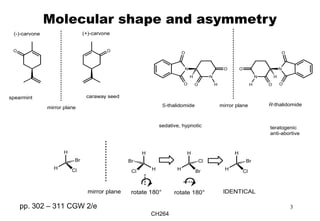
Molecular shape and asymmetry
O O
mirror plane
spearmint caraway seed
(-)-carvone (+)-carvone
N
NH
O
O
O
O H
S-thalidomide
N
N H
O
O
O
OH
mirror plane R-thalidomide
sedative, hypnotic teratogenic
anti-abortive
pp. 302 – 311 CGW 2/e
H
H Cl
Br
H
HCl
Br
mirror plane rotate 180°
H
H Br
Cl
IDENTICAL
H
H Cl
Br
rotate 180°
CH264
4
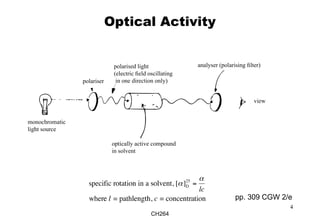
Optical Activity
pp. 309 CGW 2/e
polariser
analyser (polarising filter)polarised light
(electric field oscillating
in one direction only)
view
optically active compound
in solvent
monochromatic
light source
CH264
5
Assignment of stereochemistry
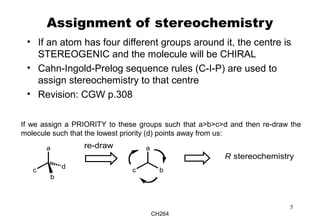
• If an atom has four different groups around it, the centre is
STEREOGENIC and the molecule will be CHIRAL
• Cahn-Ingold-Prelog sequence rules (C-I-P) are used to
assign stereochemistry to that centre
• Revision: CGW p.308
If we assign a PRIORITY to these groups such that a>b>c>d and then re-draw the
molecule such that the lowest priority (d) points away from us:
a
c
b
d
re-draw a
bc
R stereochemistry
CH264
6
C-I-P Assigning Priority
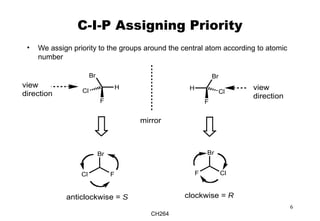
• We assign priority to the groups around the central atom according to atomic
number
Br
H
F
Cl
Br
H
F
Cl
view
direction
mirror
Br
FCl
anticlockwise = S
Br
ClF
clockwise = R
view
direction
CH264
7
Assigning Priority 2
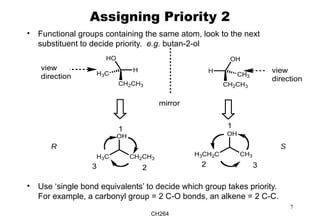
• Functional groups containing the same atom, look to the next
substituent to decide priority. e.g. butan-2-ol
• Use ‘single bond equivalents’ to decide which group takes priority.
For example, a carbonyl group = 2 C-O bonds, an alkene = 2 C-C.
HO
H
CH2CH3
H3C
OH
H
CH2CH3
CH3
view
direction
mirror
OH
CH2CH3H3C
OH
CH3H3CH2C
view
direction
R S
1
23
1
2 3
CH264
8
Diastereomers
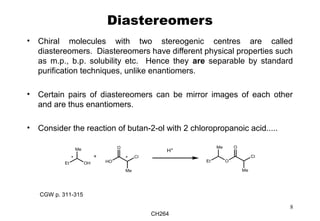
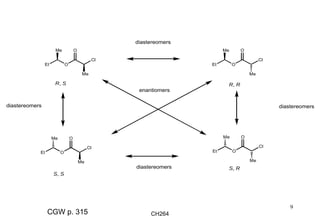
• Chiral molecules with two stereogenic centres are called
diastereomers. Diastereomers have different physical properties such
as m.p., b.p. solubility etc. Hence they are separable by standard
purification techniques, unlike enantiomers.
• Certain pairs of diastereomers can be mirror images of each other
and are thus enantiomers.
• Consider the reaction of butan-2-ol with 2 chloropropanoic acid.....
Me
OHEt
*
Me
Cl
HO
O
*+
Et
Me
O
O
Me
Cl
H+
CGW p. 311-315
CH264
9
Et
Me
O
O
Me
Cl
Et
Me
O
O
Me
Cl
R, S R, R
Et
Me
O
O
Me
Cl
S, S
Et
Me
O
O
Me
Cl
S, R
enantiomers
diastereomers
diastereomers
diastereomersdiastereomers
CGW p. 315
CH264
10
meso-Compounds
If a molecule has any symmetry element e.g. internal plane of symmetry, σ or
centre of inversion, i, it is rendered optically inactive and is designated meso-.
centre of inversion
CO2HHO2C
OHHO
meso-tartaric acid
CO2HHO2C
HO OH
CO2HHO2C
HO OH
(–)-tartaric acid(+)-tartaric acid
HO2C
CO2H
OH
OH
HO2C
CO2H
OH
OH
R
R S
S
S
R
HO2C
CO2H
OH
OH
m.p. 206°m.p. 168-170°m.p. 168-170°
[α]D = +12° (water, 20°C) [α]D = –12° (water, 20°C) [α]D = 0° (water, 20°C)
CH264
11
Examples
CH3
OH
H
Br
F
Cl
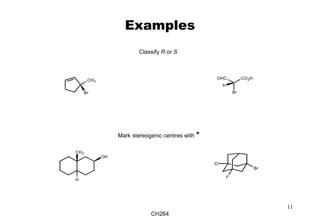
Mark stereogenic centres with *
Classify R or S
Br
CH3
OHC
Br
CO2H
H
CH264
12
Molecules without a stereogenic
carbon atom
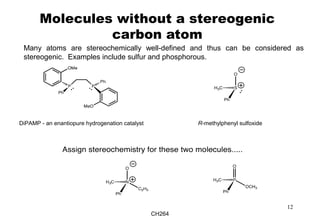
Many atoms are stereochemically well-defined and thus can be considered as
stereogenic. Examples include sulfur and phosphorous.
DiPAMP - an enantiopure hydrogenation catalyst R-methylphenyl sulfoxide
CH264
13
Chiral molecules without a
stereogenic centre
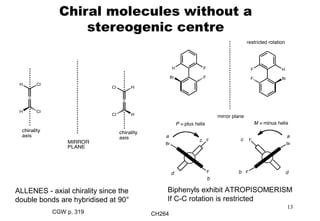
ALLENES - axial chirality since the
double bonds are hybridised at 90°
Biphenyls exhibit ATROPISOMERISM
If C-C rotation is restricted
CGW p. 319
CH264
14
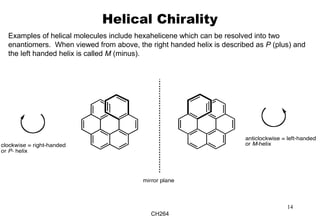
Helical Chirality
Examples of helical molecules include hexahelicene which can be resolved into two
enantiomers. When viewed from above, the right handed helix is described as P (plus) and
the left handed helix is called M (minus).
CH264
15
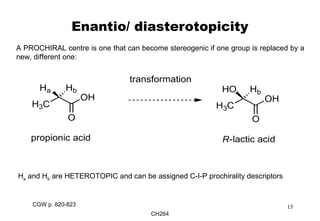
Enantio/ diasterotopicity
A PROCHIRAL centre is one that can become stereogenic if one group is replaced by a
new, different one:
Ha and Hb are HETEROTOPIC and can be assigned C-I-P prochirality descriptors
H3C
O
OH
Ha Hb
H3C
O
OH
HO Hb
transformation
R-lactic acidpropionic acid
CGW p. 820-823
CH264
16
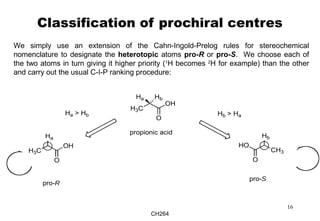
Classification of prochiral centres
We simply use an extension of the Cahn-Ingold-Prelog rules for stereochemical
nomenclature to designate the heterotopic atoms pro-R or pro-S. We choose each of
the two atoms in turn giving it higher priority (1
H becomes 2
H for example) than the other
and carry out the usual C-I-P ranking procedure:
H3C
O
OH
Ha Hb
propionic acid
Ha
H3C
O
OH
Ha > Hb
Hb
CH3
O
HO
pro-R
pro-S
Hb > Ha
CH264
17
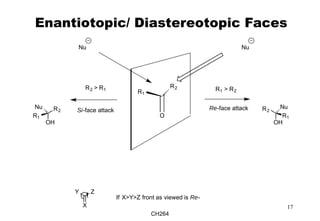
Enantiotopic/ Diastereotopic Faces
R1
O
R2
NuNu
OH
R2
R1
Nu
OH
R2
R1
Nu
R1 > R2
Re-face attack
R2 > R1
Si-face attack
X
Y Z
If X>Y>Z front as viewed is Re-
CH264
18
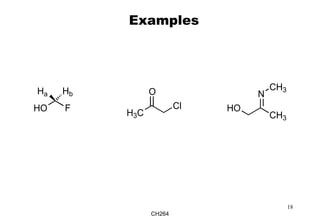
Examples
HO F
Ha Hb O
H3C
Cl
N
CH3
CH3
HO
CH264
19
You should be able to:
(i) Use R/S configuration according to C-I-P nomenclature.
(ii) Define and use the terms enantiomer and diastereomer.
(iii) Recognise non-carbon atom stereogenic centres.
(iv) Define axial and helical chirality and give examples.
(v) Identify and use prochiral centres and faces.
Outputs

Organic Chemistry Year 2 Mechanism and Stereochemistry Lecture 1

  • 1.
    CH264 1 CH264/1 Organic Chemistry II Mechanismand Stereochemistry Dr Andrew Marsh C515 a.marsh@warwick.ac.uk Dr David J Fox B510 d.j.fox@warwick.ac.uk
  • 2.
    CH264 2 Today’s Lecture 1. Cahn-Ingold-Prelogrules for stereochemical assignment 2. Enantiomers - molecules with one stereogenic centre 3. Diastereomers - molecules with two or more stereogenic centres 4. Chiral molecules without a stereogenic centre CGW = Organic Chemistry J Clayden, N Greeves, S Warren 2nd Edition OUP 2012
  • 3.
    CH264 3 Molecular shape andasymmetry O O mirror plane spearmint caraway seed (-)-carvone (+)-carvone N NH O O O O H S-thalidomide N N H O O O OH mirror plane R-thalidomide sedative, hypnotic teratogenic anti-abortive pp. 302 – 311 CGW 2/e H H Cl Br H HCl Br mirror plane rotate 180° H H Br Cl IDENTICAL H H Cl Br rotate 180°
  • 4.
    CH264 4 Optical Activity pp. 309CGW 2/e polariser analyser (polarising filter)polarised light (electric field oscillating in one direction only) view optically active compound in solvent monochromatic light source
  • 5.
    CH264 5 Assignment of stereochemistry •If an atom has four different groups around it, the centre is STEREOGENIC and the molecule will be CHIRAL • Cahn-Ingold-Prelog sequence rules (C-I-P) are used to assign stereochemistry to that centre • Revision: CGW p.308 If we assign a PRIORITY to these groups such that a>b>c>d and then re-draw the molecule such that the lowest priority (d) points away from us: a c b d re-draw a bc R stereochemistry
  • 6.
    CH264 6 C-I-P Assigning Priority •We assign priority to the groups around the central atom according to atomic number Br H F Cl Br H F Cl view direction mirror Br FCl anticlockwise = S Br ClF clockwise = R view direction
  • 7.
    CH264 7 Assigning Priority 2 •Functional groups containing the same atom, look to the next substituent to decide priority. e.g. butan-2-ol • Use ‘single bond equivalents’ to decide which group takes priority. For example, a carbonyl group = 2 C-O bonds, an alkene = 2 C-C. HO H CH2CH3 H3C OH H CH2CH3 CH3 view direction mirror OH CH2CH3H3C OH CH3H3CH2C view direction R S 1 23 1 2 3
  • 8.
    CH264 8 Diastereomers • Chiral moleculeswith two stereogenic centres are called diastereomers. Diastereomers have different physical properties such as m.p., b.p. solubility etc. Hence they are separable by standard purification techniques, unlike enantiomers. • Certain pairs of diastereomers can be mirror images of each other and are thus enantiomers. • Consider the reaction of butan-2-ol with 2 chloropropanoic acid..... Me OHEt * Me Cl HO O *+ Et Me O O Me Cl H+ CGW p. 311-315
  • 9.
    CH264 9 Et Me O O Me Cl Et Me O O Me Cl R, S R,R Et Me O O Me Cl S, S Et Me O O Me Cl S, R enantiomers diastereomers diastereomers diastereomersdiastereomers CGW p. 315
  • 10.
    CH264 10 meso-Compounds If a moleculehas any symmetry element e.g. internal plane of symmetry, σ or centre of inversion, i, it is rendered optically inactive and is designated meso-. centre of inversion CO2HHO2C OHHO meso-tartaric acid CO2HHO2C HO OH CO2HHO2C HO OH (–)-tartaric acid(+)-tartaric acid HO2C CO2H OH OH HO2C CO2H OH OH R R S S S R HO2C CO2H OH OH m.p. 206°m.p. 168-170°m.p. 168-170° [α]D = +12° (water, 20°C) [α]D = –12° (water, 20°C) [α]D = 0° (water, 20°C)
  • 11.
    CH264 11 Examples CH3 OH H Br F Cl Mark stereogenic centreswith * Classify R or S Br CH3 OHC Br CO2H H
  • 12.
    CH264 12 Molecules without astereogenic carbon atom Many atoms are stereochemically well-defined and thus can be considered as stereogenic. Examples include sulfur and phosphorous. DiPAMP - an enantiopure hydrogenation catalyst R-methylphenyl sulfoxide
  • 13.
    CH264 13 Chiral molecules withouta stereogenic centre ALLENES - axial chirality since the double bonds are hybridised at 90° Biphenyls exhibit ATROPISOMERISM If C-C rotation is restricted CGW p. 319
  • 14.
    CH264 14 Helical Chirality Examples ofhelical molecules include hexahelicene which can be resolved into two enantiomers. When viewed from above, the right handed helix is described as P (plus) and the left handed helix is called M (minus).
  • 15.
    CH264 15 Enantio/ diasterotopicity A PROCHIRALcentre is one that can become stereogenic if one group is replaced by a new, different one: Ha and Hb are HETEROTOPIC and can be assigned C-I-P prochirality descriptors H3C O OH Ha Hb H3C O OH HO Hb transformation R-lactic acidpropionic acid CGW p. 820-823
  • 16.
    CH264 16 Classification of prochiralcentres We simply use an extension of the Cahn-Ingold-Prelog rules for stereochemical nomenclature to designate the heterotopic atoms pro-R or pro-S. We choose each of the two atoms in turn giving it higher priority (1 H becomes 2 H for example) than the other and carry out the usual C-I-P ranking procedure: H3C O OH Ha Hb propionic acid Ha H3C O OH Ha > Hb Hb CH3 O HO pro-R pro-S Hb > Ha
  • 17.
    CH264 17 Enantiotopic/ Diastereotopic Faces R1 O R2 NuNu OH R2 R1 Nu OH R2 R1 Nu R1> R2 Re-face attack R2 > R1 Si-face attack X Y Z If X>Y>Z front as viewed is Re-
  • 18.
    CH264 18 Examples HO F Ha HbO H3C Cl N CH3 CH3 HO
  • 19.
    CH264 19 You should beable to: (i) Use R/S configuration according to C-I-P nomenclature. (ii) Define and use the terms enantiomer and diastereomer. (iii) Recognise non-carbon atom stereogenic centres. (iv) Define axial and helical chirality and give examples. (v) Identify and use prochiral centres and faces. Outputs