Stereochemistry
prepared by : Suha Hudhud
stereochemistry
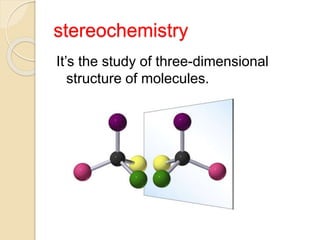
It’s the study of three-dimensional
structure of molecules.
Why we need
stereochemistry?
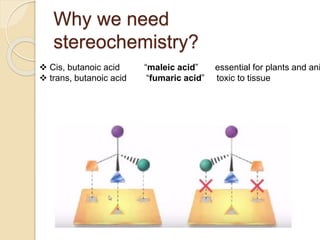
 Cis, butanoic acid “maleic acid” essential for plants and ani
 trans, butanoic acid “fumaric acid” toxic to tissue
contents
1- isomers types
2- stereoisomers
3- chirality center
4- Cahn-Ingold-Prelog R/S system
5- optical activity
6- Fischer projections
isomers
Compounds that have the same molecular
formula but different chemical structures .
 isomers contain the same number of atoms
of each element, but have different
arrangements of their atoms
Isomers are classified to different types
depending on what differences there are
between the structures
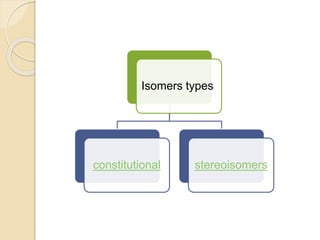
Isomers types
constitutional stereoisomers
Isomers types
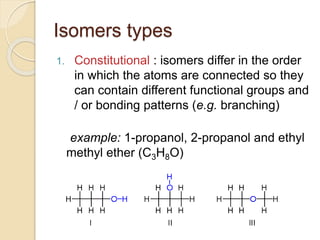
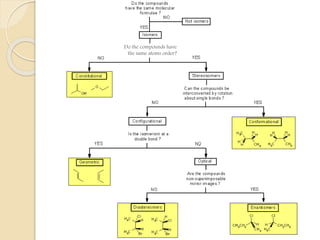
1. Constitutional : isomers differ in the order
in which the atoms are connected so they
can contain different functional groups and
/ or bonding patterns (e.g. branching)
example: 1-propanol, 2-propanol and ethyl
methyl ether (C3H8O)
2. Stereoisomers: have the same functional
groups and the same atoms order, they
differ only in the arrangement of atoms
and bonds in space.
Do the compounds have
the same atoms order?
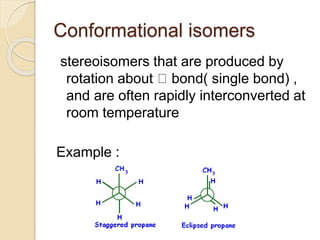
Conformational isomers
stereoisomers that are produced by
rotation about bond( single bond) ,
and are often rapidly interconverted at
room temperature
Example :
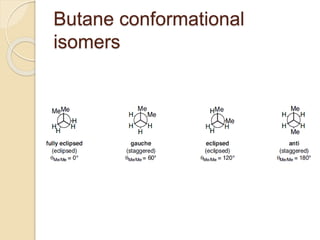
Butane conformational
isomers
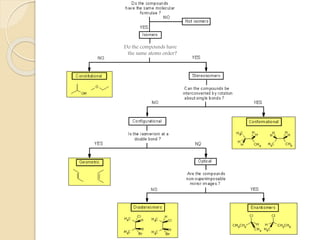
Do the compounds have
the same atoms order?
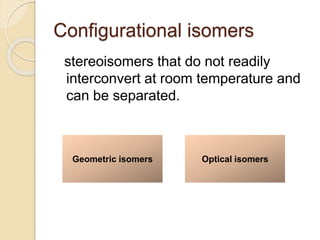
Configurational isomers
stereoisomers that do not readily
interconvert at room temperature and
can be separated.
Geometric isomers Optical isomers
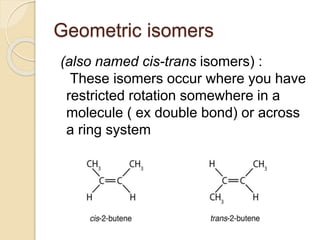
Geometric isomers
(also named cis-trans isomers) :
These isomers occur where you have
restricted rotation somewhere in a
molecule ( ex double bond) or across
a ring system
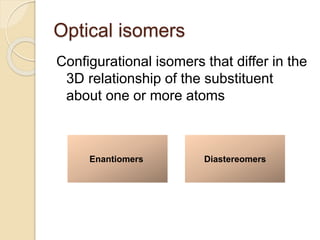
Optical isomers
Configurational isomers that differ in the
3D relationship of the substituent
about one or more atoms
DiastereomersEnantiomers
If you don't know :
 mirror images are the reflections of an
object.
 If two objects are superimposable, it means
you can not tell them apart, they are identical.
 If two objects are non-superimposable, then
you can always distinguish them.
 Bring these together, and it means we are
comparing an object with it's mirror image to
see if the object can be distinguished from it's
mirror image or not.
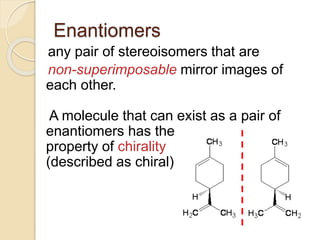
Enantiomers
any pair of stereoisomers that are
non-superimposable mirror images of
each other.
A molecule that can exist as a pair of
enantiomers has the
property of chirality
(described as chiral)
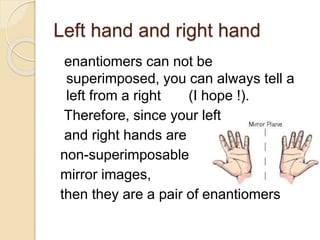
Left hand and right hand
enantiomers can not be
superimposed, you can always tell a
left from a right (I hope !).
Therefore, since your left
and right hands are
non-superimposable
mirror images,
then they are a pair of enantiomers
Diastereomers
can be superposed ( no difference
between original object and it’s mirror
image) (not an enantiomers).
They have quite different physical and
chemical properties from one another.
This is important as it allows them to
be separated
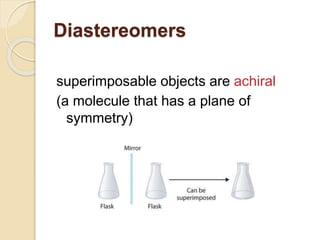
superimposable objects are achiral
(a molecule that has a plane of
symmetry)
Diastereomers
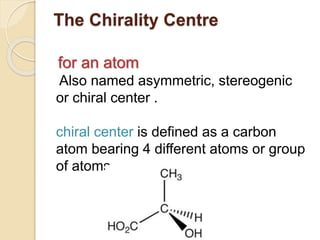
The Chirality Centre
for an atom
Also named asymmetric, stereogenic
or chiral center .
chiral center is defined as a carbon
atom bearing 4 different atoms or group
of atoms
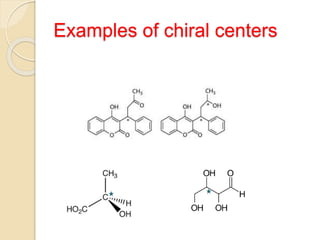
Examples of chiral centers
The Cahn-Ingold-Prelog
system
it is a system that is used for the
naming of enantiomers and
diastereomers .
It is also known as
R & S naming system.
How R & S naming system
works?
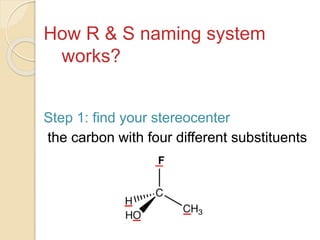
Step 1: find your stereocenter
the carbon with four different substituents
F
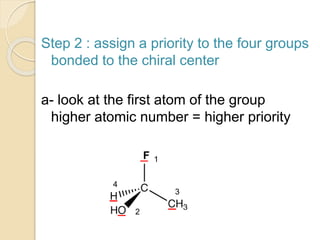
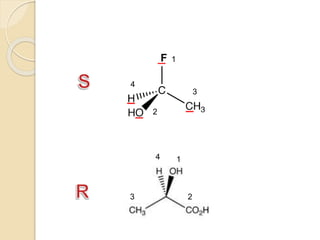
Step 2 : assign a priority to the four groups
bonded to the chiral center
a- look at the first atom of the group
higher atomic number = higher priority
F 1
2
3
4
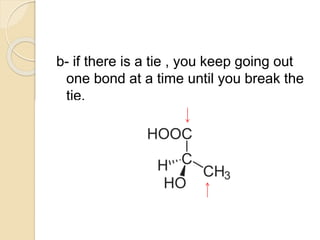
b- if there is a tie , you keep going out
one bond at a time until you break the
tie.
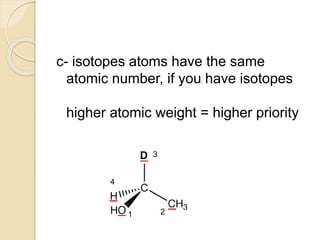
c- isotopes atoms have the same
atomic number, if you have isotopes
higher atomic weight = higher priority
D
1 2
3
4
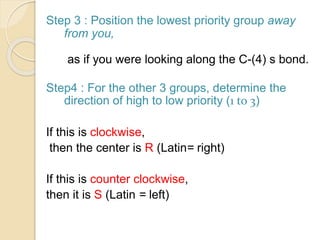
Step 3 : Position the lowest priority group away
from you,
as if you were looking along the C-(4) s bond.
Step4 : For the other 3 groups, determine the
direction of high to low priority (1 to 3)
If this is clockwise,
then the center is R (Latin= right)
If this is counter clockwise,
then it is S (Latin = left)
F 1
2
3
4
1
23
4
The Chirality Centre
For Molecules With More Than One Chiral
Center
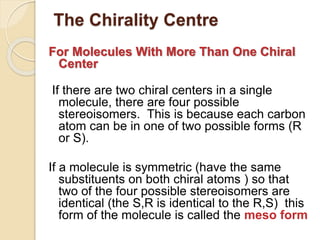
If there are two chiral centers in a single
molecule, there are four possible
stereoisomers. This is because each carbon
atom can be in one of two possible forms (R
or S).
If a molecule is symmetric (have the same
substituents on both chiral atoms ) so that
two of the four possible stereoisomers are
identical (the S,R is identical to the R,S) this
form of the molecule is called the meso form
How to determine Whether
Molecules Are Enantiomers,
Diastereomers or Meso
Compounds ?
1- determine whether the chiral center
is R or S ( using the previous
explained method )
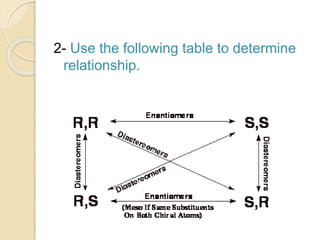
2- Use the following table to determine
relationship.
3- If the molecule have symmetry (same
substituents on both chiral centers ) ,
check for meso compound
only the R,S or S,R molecules can be
meso (the S,S and R,R forms of even
symmetric molecules are not meso
compounds, they are enantiomers).
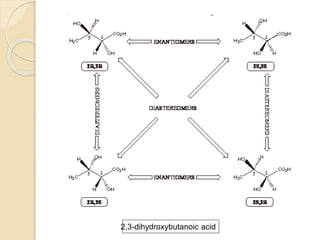
2,3-dihydroxybutanoic acid
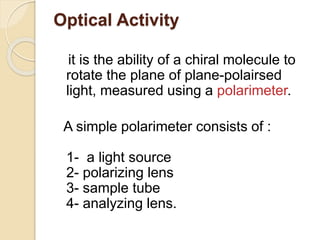
Optical Activity
it is the ability of a chiral molecule to
rotate the plane of plane-polairsed
light, measured using a polarimeter.
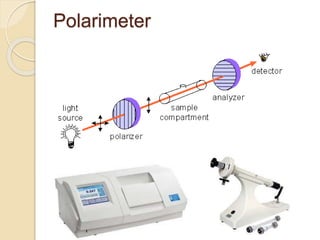
A simple polarimeter consists of :
1- a light source
2- polarizing lens
3- sample tube
4- analyzing lens.
Polarimeter
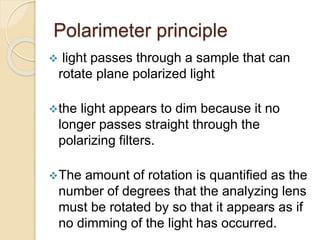
Polarimeter principle
 light passes through a sample that can
rotate plane polarized light
the light appears to dim because it no
longer passes straight through the
polarizing filters.
The amount of rotation is quantified as the
number of degrees that the analyzing lens
must be rotated by so that it appears as if
no dimming of the light has occurred.
 The rotation is affected by two factors :
1- path length (l, the time the light travels
through a sample)
2- concentration (c, how much of the
sample is present that will rotate the
light)
When these effects are eliminated a
standard for comparison of all molecules
is obtained, the specific rotation [ ]
 the quantified rotation determined using
polarimeter is known as observed rotation
[ ] = 100 / c*l
concentration is expressed as: g sample /100ml solution
 Enantiomers will rotate the plane of
polarisation in exactly equal amounts (same
magnitude) but in opposite directions.
Dextrorotary : d or (+), clockwise rotation
(to the right)
Levorotary : l or (-), anti-clockwise rotation
(to the left)
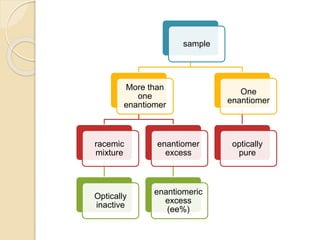
sample
More than
one
enantiomer
racemic
mixture
Optically
inactive
enantiomer
excess
enantiomeric
excess
(ee%)
One
enantiomer
optically
pure
enantiomeric excess (ee%)
The optical purity or the enantiomeric excess (ee%) of a
sample can be determined as follows:
% enantiomeric excess = % enantiomer1 - % enantiomer2
= 100 [ ]mixture / [ ]pure sample
ee% = 100 ([major enantiomer] - [minor enantiomer]) /
([major enantiomer] + [minor enantiomer])
where
[major enantiomer] = concentration of the major
enantiomer
[minor enantiomer] = concentration of the minor
Example of optical activity
Consider that (S)-bromobutane has a specific
rotation of +23.1o and (R)-bromobutane has a
specific rotation of -23.1o
1- Determine the optical purity of a racemic
mixture.
Answer: The specific rotation, [ ], of the
racemate is expected to be 0, since the effect
of one enantiomer cancel the other .
Optical purity, % = 100 [ ]mixture / [ ]pure sample
= 100 (0) / +23.1o
= 0%
2- Which isomer is dominant and what is the
optical purity of a mixture, of (R)- and (S)-
bromobutane, whose specific rotation was found
to be -9.2o?
 Answer: The negative sign tells indicates that
the R enantiomer is the dominant one.
Optical purity, % = 100 [ ]mixture / [ ]pure sample
= 100 (-9.2) / -23.1o
= 40%
this indicates a 40% excess of R over S!
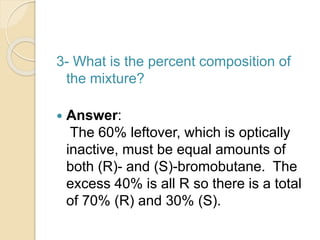
3- What is the percent composition of
the mixture?
 Answer:
The 60% leftover, which is optically
inactive, must be equal amounts of
both (R)- and (S)-bromobutane. The
excess 40% is all R so there is a total
of 70% (R) and 30% (S).
Newman projection
 A representation of a molecule in which the
atoms and bonds are viewed along the axis
about which rotation occurs.
 the molecule is viewed along an axis
containing two atoms bonded to each other
and the bond between them, about which the
molecule can rotate. Carbon-carbon bond
the "substituents" of each atom , can then be
viewed both in front of and behind the
carbon-carbon bond
Fischer Projection
representation of a 3D molecule as a
flat structure where a tetrahedral
carbon is represented as two crossed
lines.
the atoms that are pointed toward the
viewer would be specified with a
wedged
and the ones pointed away from the
viewer are specified with dashed
(4)
The Fischer Projection consists of :
1- horizontal lines represent the
wedged
2- vertical line represents the dashed .
The point of intersection between the
horizontal and vertical lines represents
the central carbon.
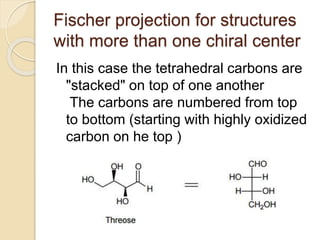
Fischer projection for structures
with more than one chiral center
In this case the tetrahedral carbons are
"stacked" on top of one another
The carbons are numbered from top
to bottom (starting with highly oxidized
carbon on he top )
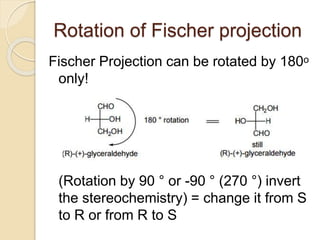
Rotation of Fischer projection
Fischer Projection can be rotated by 180ᵒ
only!
(Rotation by 90 ° or -90 ° (270 °) invert
the stereochemistry) = change it from S
to R or from R to S
references
1- L. G. Wade Jr, Organic chemistry , 169-210
2- Ann Van Eeckhaut, Yvette Michotte,Chiral Separations by Capillary
Electrophoresis, pp 11
3- John Wiley & Sons, Organic Chemistry I For Dummies, pp 89
4- Shore, N. (2007). Study Guide and Solutions Manual for Organic
Chemistry (5th Ed.). New York: W.H. Freeman. (182-186)
5- INDAH PURNAMA SARYa,*, SISWANDONOb, TUTUK BUDIATIb
,International Journal of Pharmacy and Pharmaceutical Sciences ISSN-
0975-1491 ,Vol 7, Issue 3, 2015

Stereochemistry

  • 1.
  • 2.
    stereochemistry It’s the studyof three-dimensional structure of molecules.
  • 3.
    Why we need stereochemistry? Cis, butanoic acid “maleic acid” essential for plants and ani  trans, butanoic acid “fumaric acid” toxic to tissue
  • 4.
    contents 1- isomers types 2-stereoisomers 3- chirality center 4- Cahn-Ingold-Prelog R/S system 5- optical activity 6- Fischer projections
  • 5.
    isomers Compounds that havethe same molecular formula but different chemical structures .  isomers contain the same number of atoms of each element, but have different arrangements of their atoms Isomers are classified to different types depending on what differences there are between the structures
  • 6.
  • 7.
    Isomers types 1. Constitutional: isomers differ in the order in which the atoms are connected so they can contain different functional groups and / or bonding patterns (e.g. branching) example: 1-propanol, 2-propanol and ethyl methyl ether (C3H8O)
  • 8.
    2. Stereoisomers: havethe same functional groups and the same atoms order, they differ only in the arrangement of atoms and bonds in space.
  • 9.
    Do the compoundshave the same atoms order?
  • 10.
    Conformational isomers stereoisomers thatare produced by rotation about bond( single bond) , and are often rapidly interconverted at room temperature Example :
  • 11.
  • 12.
    Do the compoundshave the same atoms order?
  • 13.
    Configurational isomers stereoisomers thatdo not readily interconvert at room temperature and can be separated. Geometric isomers Optical isomers
  • 14.
    Geometric isomers (also namedcis-trans isomers) : These isomers occur where you have restricted rotation somewhere in a molecule ( ex double bond) or across a ring system
  • 15.
    Optical isomers Configurational isomersthat differ in the 3D relationship of the substituent about one or more atoms DiastereomersEnantiomers
  • 16.
    If you don'tknow :  mirror images are the reflections of an object.  If two objects are superimposable, it means you can not tell them apart, they are identical.  If two objects are non-superimposable, then you can always distinguish them.  Bring these together, and it means we are comparing an object with it's mirror image to see if the object can be distinguished from it's mirror image or not.
  • 17.
    Enantiomers any pair ofstereoisomers that are non-superimposable mirror images of each other. A molecule that can exist as a pair of enantiomers has the property of chirality (described as chiral)
  • 18.
    Left hand andright hand enantiomers can not be superimposed, you can always tell a left from a right (I hope !). Therefore, since your left and right hands are non-superimposable mirror images, then they are a pair of enantiomers
  • 19.
    Diastereomers can be superposed( no difference between original object and it’s mirror image) (not an enantiomers). They have quite different physical and chemical properties from one another. This is important as it allows them to be separated
  • 20.
    superimposable objects areachiral (a molecule that has a plane of symmetry) Diastereomers
  • 21.
    The Chirality Centre foran atom Also named asymmetric, stereogenic or chiral center . chiral center is defined as a carbon atom bearing 4 different atoms or group of atoms
  • 22.
  • 23.
    The Cahn-Ingold-Prelog system it isa system that is used for the naming of enantiomers and diastereomers . It is also known as R & S naming system.
  • 24.
    How R &S naming system works? Step 1: find your stereocenter the carbon with four different substituents F
  • 25.
    Step 2 :assign a priority to the four groups bonded to the chiral center a- look at the first atom of the group higher atomic number = higher priority F 1 2 3 4
  • 26.
    b- if thereis a tie , you keep going out one bond at a time until you break the tie.
  • 27.
    c- isotopes atomshave the same atomic number, if you have isotopes higher atomic weight = higher priority D 1 2 3 4
  • 28.
    Step 3 :Position the lowest priority group away from you, as if you were looking along the C-(4) s bond. Step4 : For the other 3 groups, determine the direction of high to low priority (1 to 3) If this is clockwise, then the center is R (Latin= right) If this is counter clockwise, then it is S (Latin = left)
  • 29.
  • 30.
    The Chirality Centre ForMolecules With More Than One Chiral Center If there are two chiral centers in a single molecule, there are four possible stereoisomers. This is because each carbon atom can be in one of two possible forms (R or S). If a molecule is symmetric (have the same substituents on both chiral atoms ) so that two of the four possible stereoisomers are identical (the S,R is identical to the R,S) this form of the molecule is called the meso form
  • 31.
    How to determineWhether Molecules Are Enantiomers, Diastereomers or Meso Compounds ? 1- determine whether the chiral center is R or S ( using the previous explained method )
  • 32.
    2- Use thefollowing table to determine relationship.
  • 33.
    3- If themolecule have symmetry (same substituents on both chiral centers ) , check for meso compound only the R,S or S,R molecules can be meso (the S,S and R,R forms of even symmetric molecules are not meso compounds, they are enantiomers).
  • 34.
  • 35.
    Optical Activity it isthe ability of a chiral molecule to rotate the plane of plane-polairsed light, measured using a polarimeter. A simple polarimeter consists of : 1- a light source 2- polarizing lens 3- sample tube 4- analyzing lens.
  • 36.
  • 37.
    Polarimeter principle  lightpasses through a sample that can rotate plane polarized light the light appears to dim because it no longer passes straight through the polarizing filters. The amount of rotation is quantified as the number of degrees that the analyzing lens must be rotated by so that it appears as if no dimming of the light has occurred.
  • 38.
     The rotationis affected by two factors : 1- path length (l, the time the light travels through a sample) 2- concentration (c, how much of the sample is present that will rotate the light) When these effects are eliminated a standard for comparison of all molecules is obtained, the specific rotation [ ]
  • 39.
     the quantifiedrotation determined using polarimeter is known as observed rotation [ ] = 100 / c*l concentration is expressed as: g sample /100ml solution  Enantiomers will rotate the plane of polarisation in exactly equal amounts (same magnitude) but in opposite directions. Dextrorotary : d or (+), clockwise rotation (to the right) Levorotary : l or (-), anti-clockwise rotation (to the left)
  • 40.
  • 41.
    enantiomeric excess (ee%) Theoptical purity or the enantiomeric excess (ee%) of a sample can be determined as follows: % enantiomeric excess = % enantiomer1 - % enantiomer2 = 100 [ ]mixture / [ ]pure sample ee% = 100 ([major enantiomer] - [minor enantiomer]) / ([major enantiomer] + [minor enantiomer]) where [major enantiomer] = concentration of the major enantiomer [minor enantiomer] = concentration of the minor
  • 42.
    Example of opticalactivity Consider that (S)-bromobutane has a specific rotation of +23.1o and (R)-bromobutane has a specific rotation of -23.1o 1- Determine the optical purity of a racemic mixture. Answer: The specific rotation, [ ], of the racemate is expected to be 0, since the effect of one enantiomer cancel the other . Optical purity, % = 100 [ ]mixture / [ ]pure sample = 100 (0) / +23.1o = 0%
  • 43.
    2- Which isomeris dominant and what is the optical purity of a mixture, of (R)- and (S)- bromobutane, whose specific rotation was found to be -9.2o?  Answer: The negative sign tells indicates that the R enantiomer is the dominant one. Optical purity, % = 100 [ ]mixture / [ ]pure sample = 100 (-9.2) / -23.1o = 40% this indicates a 40% excess of R over S!
  • 44.
    3- What isthe percent composition of the mixture?  Answer: The 60% leftover, which is optically inactive, must be equal amounts of both (R)- and (S)-bromobutane. The excess 40% is all R so there is a total of 70% (R) and 30% (S).
  • 45.
    Newman projection  Arepresentation of a molecule in which the atoms and bonds are viewed along the axis about which rotation occurs.  the molecule is viewed along an axis containing two atoms bonded to each other and the bond between them, about which the molecule can rotate. Carbon-carbon bond the "substituents" of each atom , can then be viewed both in front of and behind the carbon-carbon bond
  • 46.
    Fischer Projection representation ofa 3D molecule as a flat structure where a tetrahedral carbon is represented as two crossed lines. the atoms that are pointed toward the viewer would be specified with a wedged and the ones pointed away from the viewer are specified with dashed (4)
  • 47.
    The Fischer Projectionconsists of : 1- horizontal lines represent the wedged 2- vertical line represents the dashed . The point of intersection between the horizontal and vertical lines represents the central carbon.
  • 48.
    Fischer projection forstructures with more than one chiral center In this case the tetrahedral carbons are "stacked" on top of one another The carbons are numbered from top to bottom (starting with highly oxidized carbon on he top )
  • 49.
    Rotation of Fischerprojection Fischer Projection can be rotated by 180ᵒ only! (Rotation by 90 ° or -90 ° (270 °) invert the stereochemistry) = change it from S to R or from R to S
  • 50.
    references 1- L. G.Wade Jr, Organic chemistry , 169-210 2- Ann Van Eeckhaut, Yvette Michotte,Chiral Separations by Capillary Electrophoresis, pp 11 3- John Wiley & Sons, Organic Chemistry I For Dummies, pp 89 4- Shore, N. (2007). Study Guide and Solutions Manual for Organic Chemistry (5th Ed.). New York: W.H. Freeman. (182-186) 5- INDAH PURNAMA SARYa,*, SISWANDONOb, TUTUK BUDIATIb ,International Journal of Pharmacy and Pharmaceutical Sciences ISSN- 0975-1491 ,Vol 7, Issue 3, 2015