The Filipino Values
The Filipinos are product of the blending
race and culture of the eastern and
western inhabitants. In this sense and by
blood, they can be said as people
of eastern race with western culture or
may be called as the brown Americans.
They possess multilayered influences of Indian,
Malay, Chinese, Spanish, Japanese and
Americans.
Jocano (2002 and 2001) pointed out that these
colonizers had developed some dimensions in
Filipino culture in terms of religious, social,
economic and political systems.
Indian
Superstitious Beliefs
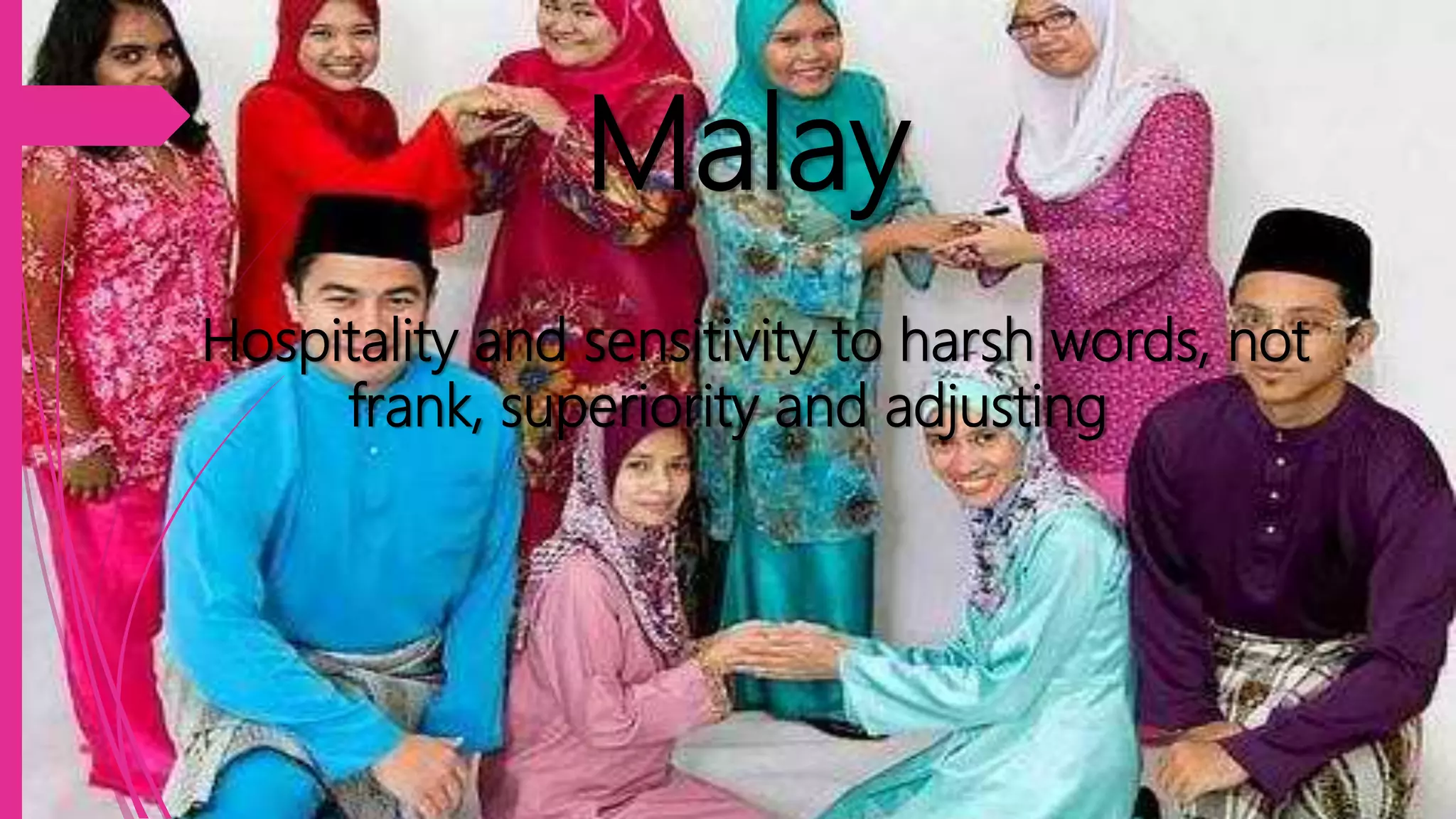
Malay
Hospitality and sensitivity to harsh words, not
frank, superiority and adjusting
Chinese
on being fond of eating noodles piety, frugality,
submission to parents, patience and
perseverance.
Spanish
Catholicism, language, names and family rituals
Americans
English language, open communication,
democracy, and mass education
Japanese
Sincerity and Industry
F. Landa Jocano identified two models of the
Filipino Values System, the first the exogenous
model or the foreign model, while the second is
is the indigenous model or the traditional
model.
Exogenous Model
Indigenous Model
Filipino Values in a Fourfold Sense
1. Although mankind shares universal human values, it
is obvious that certain values take on for us a
distinctively Filipino Flavor. The greek ideal of
moderation or meden agan, the Roman in medio stat
virtus, the Confucian Budhhist “doctrine in the middle”
find their Filipino equivalent in “hindi labis hindi
kulang, katamtaman lamang”
2. When we speak of Filipino values, we do not mean
that these Filipino values are absent in the value
system of other peoples and culture.
3. Universal human values in a Filipino context
(historical, cultural, socio-economic, political, moral,
and religious) take on a distinctive set of meanings and
motivations.
4. The Filipino concept of justice has evolve from
inequality to equality, and to human dignity; from the
tribe, to the family, and to the nation. Filipino
consciousness of these different values varies at
different periods of our history.
It is only in the last two decades that the Filipino
people have become more conscious of
overpopulation and family planning, environmental
population (Kawasaki sentering plant) and wildlife
conservation (Caluit Island), and the violation of
human rights (Martial Law), active non-violence and
People Power (1986 non-violent Revolution)
The Values System
Values allow a person to choose, prize,
cherish, publicly affirm, act and celebrate on
something.
These are either positive values where a
person is likable, pleasing, and socially
integrative or negative values that make one
anti-social, unproductive and destructive to self
and others.
Values are developed from the home through
the parents as the primary teachers of Filipino
families then by its members.
As the individual grows, the environment has
influence either to retain or reject the values taught
or established values at home.
Filipino values and traits vary depending on how
they are raised in their respective homes.
Filipino values are ambivalent – can either be
good or bad and thus color the uniqueness of
every individual.
Values can also be considered as a guide towards
the betterment of life because without proper
values, a person will never achieve what one aspires
for.
Positive Filipino Values
1. Bayanihan system or spirit of kinship and camaraderie
A Filipino community spirit and cooperation wherein a
group of individuals extends a helping hand without
expecting any remuneration.
2. Damayan System
Sympathy for people who lost their love ones. In
case of death of a certain member in the community,
the whole community sympathizes with the bereaved
family.
3. Familism or close family relations
Giving highest importance to family above other
things.
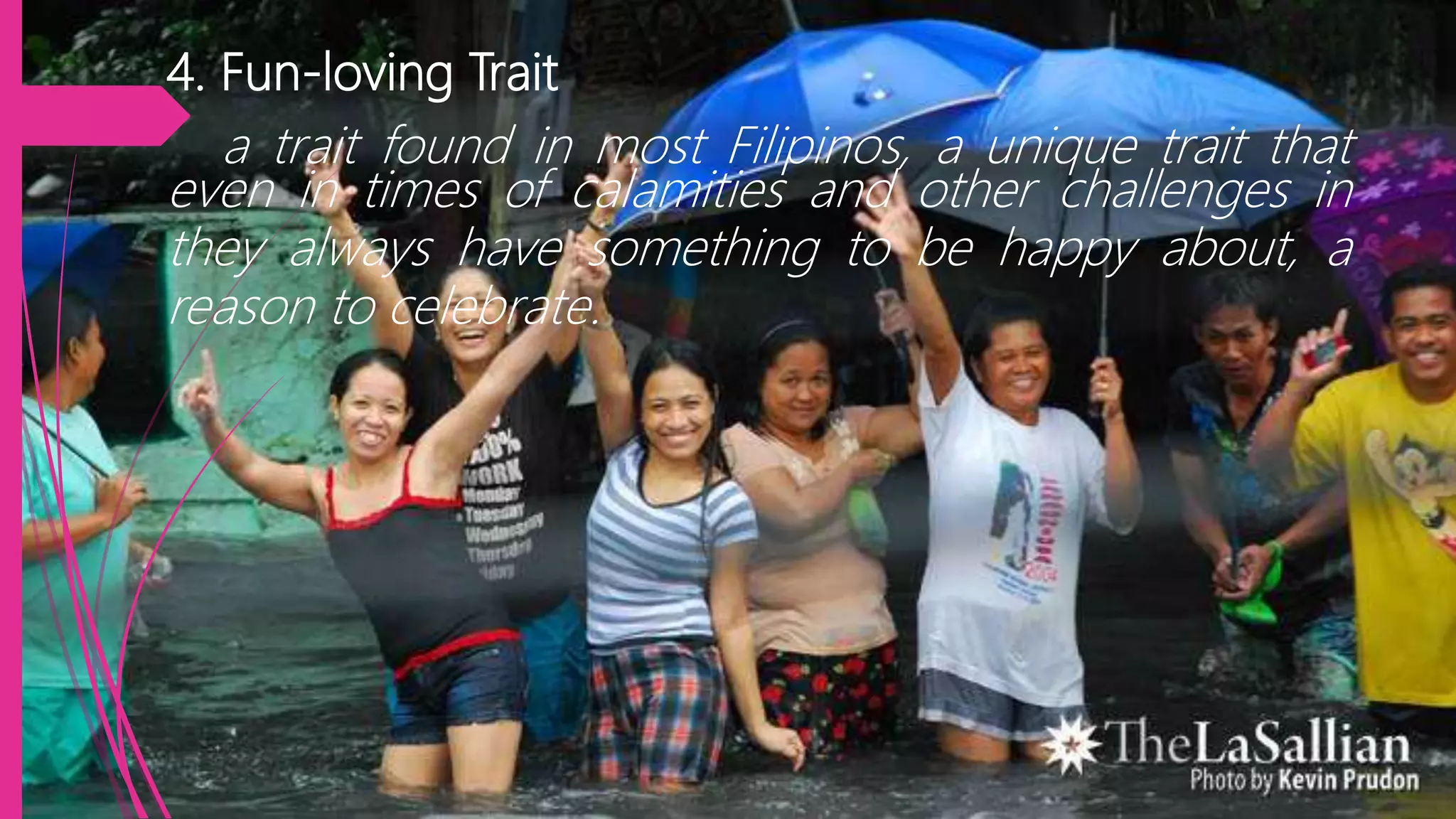
4. Fun-loving Trait
a trait found in most Filipinos, a unique trait that
even in times of calamities and other challenges in
they always have something to be happy about, a
reason to celebrate.
5. Hospitality
a trait of being receptive and generous to guests
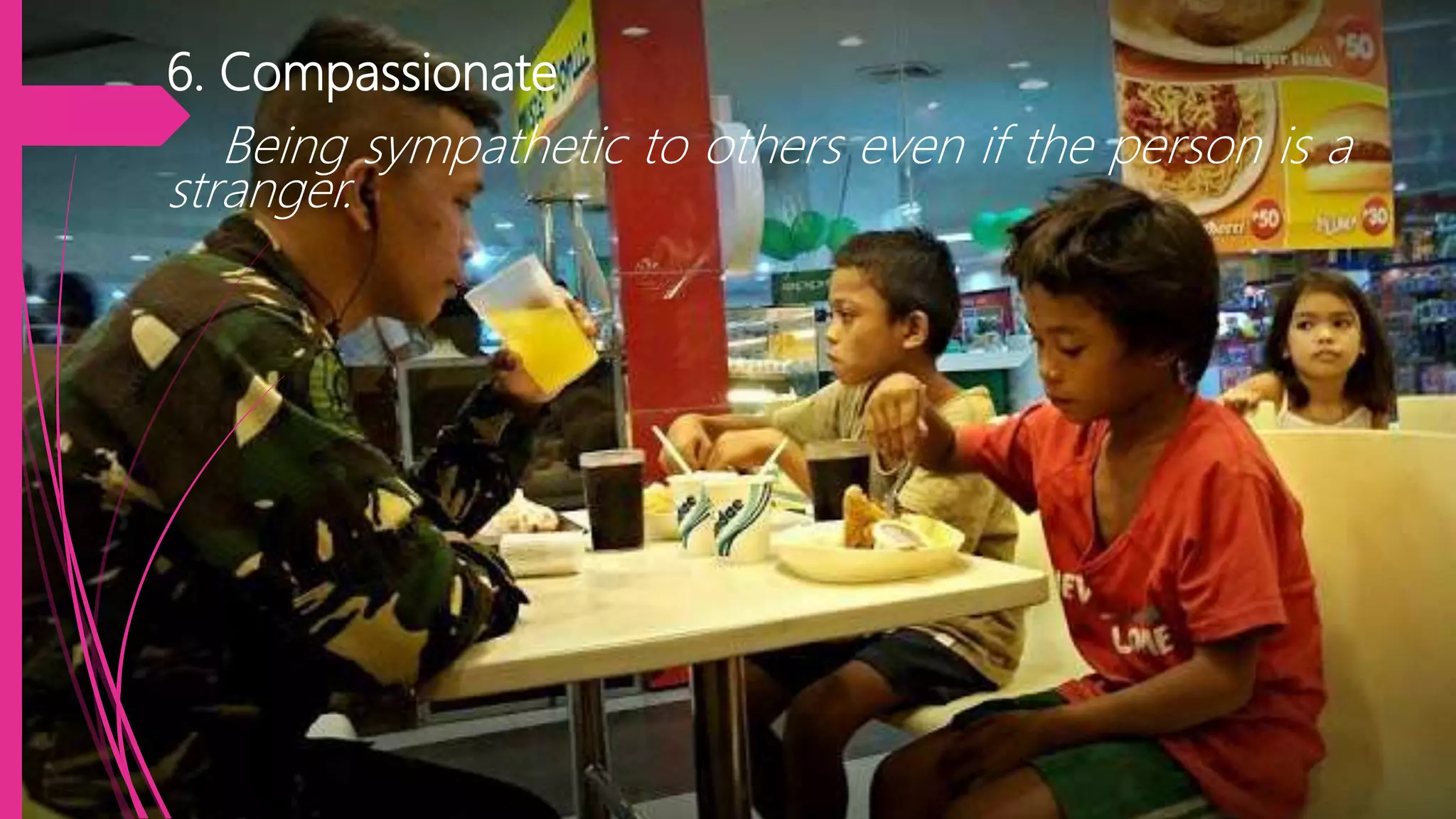
6. Compassionate
Being sympathetic to others even if the person is a
stranger.
7. Regionalism
Giving more priority or
preference in giving favor to his
province mate before others.
8. Friendly
Being a sincere, loyal, kind and sociable person.
9. Flexible or Magaling Makibagay
The ability to ride on or adjust to thenoms of other
group to attain smooth and harmonious relationship.
10. Religious
Possess strong conformance of their religious belief
in action and in words.
11. Respect for elders
Being courteous both in words and in actions to
older people.
12. Remedyo Attitude
Being creative and resourceful .
13. Matiyaga
Tenacity and strong determination in every
undertaking.
14. Utang na loob
a feeling of obligation to repay someone who
extend assistance to another which may take place in
undetermined time and in whatever way.
Negative Filipino Values
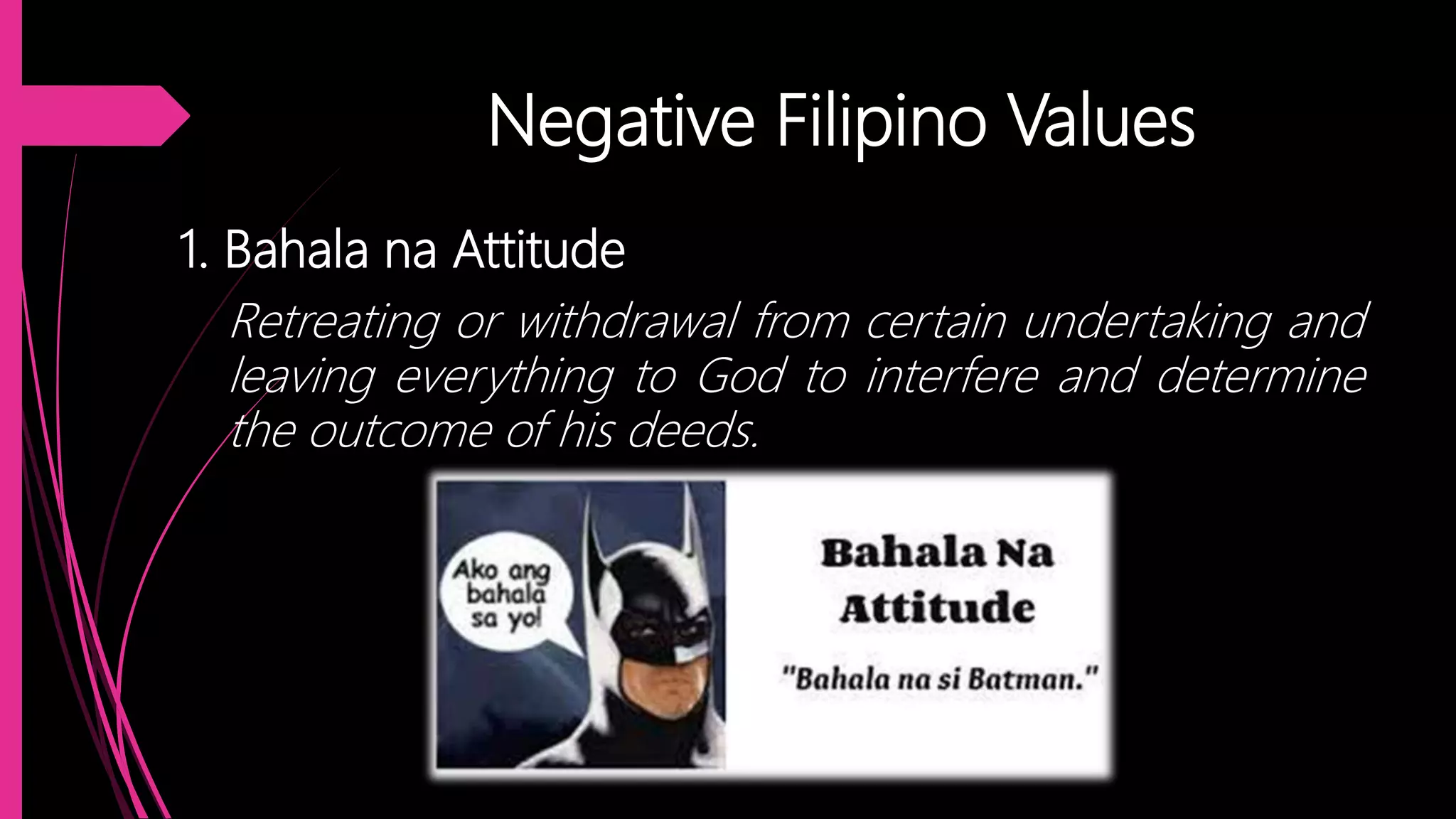
1. Bahala na Attitude
Retreating or withdrawal from certain undertaking and
leaving everything to God to interfere and determine
the outcome of his deeds.
2. Colonial Complex or Blue-seal mentality
Showing high admiration and preference to foreign
produced goods over local ones.
3. Crab Mentality
An attempt to “pull down” someone who has
achieved success beyond the others done by jealousy
and insecurity.
4. Euphemism
Substituting a word or phrase that is thought to be
offensive or harsh with a mild and acceptable one in
order to not offend or hurt another person.
5. Filipino Time
In reality, it means “always late”, an attitude of
impreciseness towards time.
6. Gaya-gaya Attitude
Imitating or copying other cultures specifically in
mode of dressing.
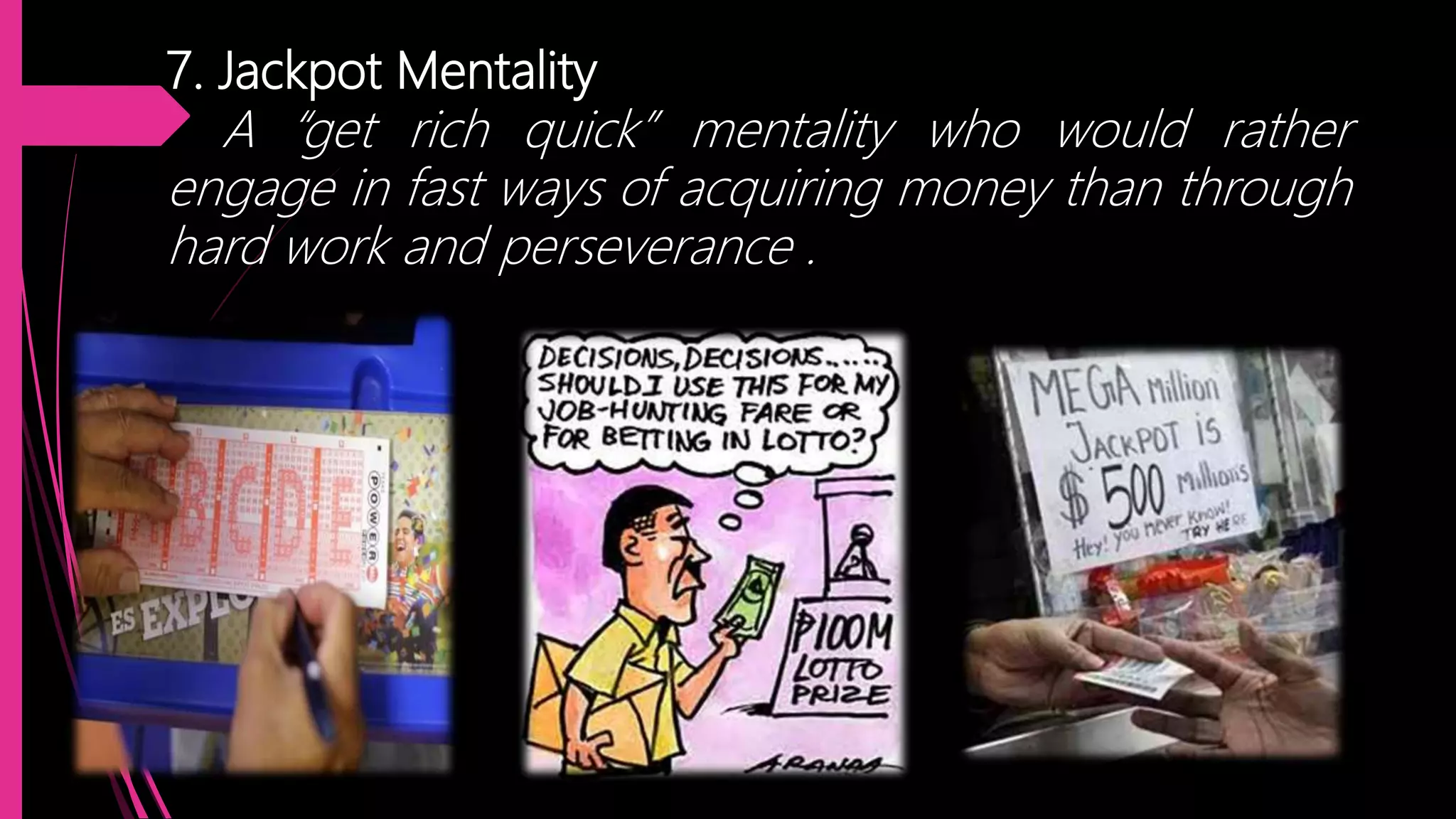
7. Jackpot Mentality
A “get rich quick” mentality who would rather
engage in fast ways of acquiring money than through
hard work and perseverance .
8. Mañana Habit
Delaying or setting aside a certain task assigned on
the next day although it can be done today.
9. Ningas Cogon
Being enthusiastic only during the start of new
undertaking but ends dismally in accomplishing
nothing.
10. Oversensitive
Filipinos have tendency to be irritated easily or hurt
upon hearing some criticisms or comment.
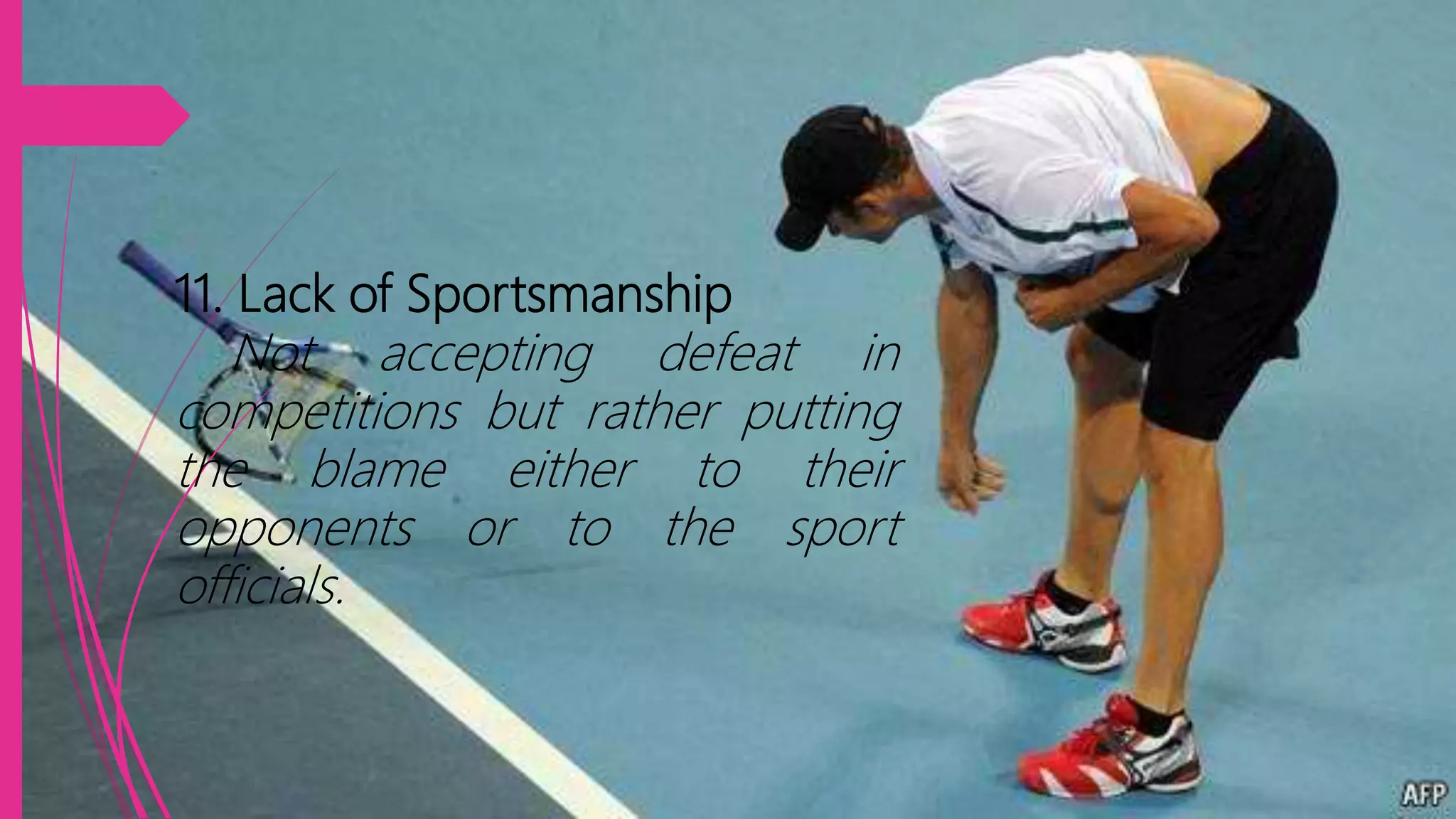
11. Lack of Sportsmanship
Not accepting defeat in
competitions but rather putting
the blame either to their
opponents or to the sport
officials.
12. Tsamba lang attitude
Simplicity by declaring that his/her
accomplishments are results of luck and not from
perseverance and ability.
13. Pakikisama
Submitting oneself to the will of the group for the
sake of camaraderie and unity. Failure to comply with
the group demand, the person will be called “walang
pakikisama or selfish.”
Get ¼ sheet of
paper 
1.Who influenced the Filipinos
for being Hospitable and
sensitive to harsh words, not
frank, superiority and adjusting
2. The model of Filipino values
that is inherited from Western
cultures, particularly from the
Spaniards and the Americans.
3. This allows a person to
choose, prize, cherish, publicly
affirm, act and celebrate on
something.
4.Filipino values are ambivalent.
What does ambivalent mean?
a. Good
b. Bad
c. Can either be good or bad
d. Can neither be good or bad
5. A Filipino community spirit and
cooperation wherein a group of
individuals extends a helping hand
without expecting any
remuneration.
a) Damayan System
b) Bayanihan System
c) Compassionate
d) Utang na Loob
6. A Filipino attitude that he/she
simply declares that his/her
accomplishments are results of
luck and not from perseverance
and ability.
a) Tsamba Lang Attitude
b) Jackpot Mentality
c) Gaya Gaya Attitude
d) Blue Seal Mentality
7-8. What are the two models of
the Filipino values identified by F.
Landa Jocano?
9-10. Based on the report, does the
Filipino values only exist here in the
Philippines or does it also exist in
foreign countries and different
cultures? Why?
The filipino values

The filipino values

  • 1.
  • 2.
    The Filipinos areproduct of the blending race and culture of the eastern and western inhabitants. In this sense and by blood, they can be said as people of eastern race with western culture or may be called as the brown Americans.
  • 3.
    They possess multilayeredinfluences of Indian, Malay, Chinese, Spanish, Japanese and Americans. Jocano (2002 and 2001) pointed out that these colonizers had developed some dimensions in Filipino culture in terms of religious, social, economic and political systems.
  • 4.
  • 5.
    Malay Hospitality and sensitivityto harsh words, not frank, superiority and adjusting
  • 6.
    Chinese on being fondof eating noodles piety, frugality, submission to parents, patience and perseverance.
  • 7.
  • 8.
    Americans English language, opencommunication, democracy, and mass education
  • 9.
  • 10.
    F. Landa Jocanoidentified two models of the Filipino Values System, the first the exogenous model or the foreign model, while the second is is the indigenous model or the traditional model.
  • 11.
  • 12.
  • 13.
    Filipino Values ina Fourfold Sense 1. Although mankind shares universal human values, it is obvious that certain values take on for us a distinctively Filipino Flavor. The greek ideal of moderation or meden agan, the Roman in medio stat virtus, the Confucian Budhhist “doctrine in the middle” find their Filipino equivalent in “hindi labis hindi kulang, katamtaman lamang”
  • 14.
    2. When wespeak of Filipino values, we do not mean that these Filipino values are absent in the value system of other peoples and culture.
  • 15.
    3. Universal humanvalues in a Filipino context (historical, cultural, socio-economic, political, moral, and religious) take on a distinctive set of meanings and motivations.
  • 16.
    4. The Filipinoconcept of justice has evolve from inequality to equality, and to human dignity; from the tribe, to the family, and to the nation. Filipino consciousness of these different values varies at different periods of our history.
  • 17.
    It is onlyin the last two decades that the Filipino people have become more conscious of overpopulation and family planning, environmental population (Kawasaki sentering plant) and wildlife conservation (Caluit Island), and the violation of human rights (Martial Law), active non-violence and People Power (1986 non-violent Revolution)
  • 18.
    The Values System Valuesallow a person to choose, prize, cherish, publicly affirm, act and celebrate on something. These are either positive values where a person is likable, pleasing, and socially integrative or negative values that make one anti-social, unproductive and destructive to self and others.
  • 19.
    Values are developedfrom the home through the parents as the primary teachers of Filipino families then by its members. As the individual grows, the environment has influence either to retain or reject the values taught or established values at home. Filipino values and traits vary depending on how they are raised in their respective homes.
  • 20.
    Filipino values areambivalent – can either be good or bad and thus color the uniqueness of every individual. Values can also be considered as a guide towards the betterment of life because without proper values, a person will never achieve what one aspires for.
  • 21.
    Positive Filipino Values 1.Bayanihan system or spirit of kinship and camaraderie A Filipino community spirit and cooperation wherein a group of individuals extends a helping hand without expecting any remuneration.
  • 22.
    2. Damayan System Sympathyfor people who lost their love ones. In case of death of a certain member in the community, the whole community sympathizes with the bereaved family.
  • 23.
    3. Familism orclose family relations Giving highest importance to family above other things.
  • 24.
    4. Fun-loving Trait atrait found in most Filipinos, a unique trait that even in times of calamities and other challenges in they always have something to be happy about, a reason to celebrate.
  • 25.
    5. Hospitality a traitof being receptive and generous to guests
  • 26.
    6. Compassionate Being sympatheticto others even if the person is a stranger.
  • 27.
    7. Regionalism Giving morepriority or preference in giving favor to his province mate before others.
  • 28.
    8. Friendly Being asincere, loyal, kind and sociable person.
  • 29.
    9. Flexible orMagaling Makibagay The ability to ride on or adjust to thenoms of other group to attain smooth and harmonious relationship.
  • 30.
    10. Religious Possess strongconformance of their religious belief in action and in words.
  • 31.
    11. Respect forelders Being courteous both in words and in actions to older people.
  • 32.
    12. Remedyo Attitude Beingcreative and resourceful .
  • 33.
    13. Matiyaga Tenacity andstrong determination in every undertaking.
  • 34.
    14. Utang naloob a feeling of obligation to repay someone who extend assistance to another which may take place in undetermined time and in whatever way.
  • 35.
    Negative Filipino Values 1.Bahala na Attitude Retreating or withdrawal from certain undertaking and leaving everything to God to interfere and determine the outcome of his deeds.
  • 36.
    2. Colonial Complexor Blue-seal mentality Showing high admiration and preference to foreign produced goods over local ones.
  • 37.
    3. Crab Mentality Anattempt to “pull down” someone who has achieved success beyond the others done by jealousy and insecurity.
  • 38.
    4. Euphemism Substituting aword or phrase that is thought to be offensive or harsh with a mild and acceptable one in order to not offend or hurt another person.
  • 39.
    5. Filipino Time Inreality, it means “always late”, an attitude of impreciseness towards time.
  • 40.
    6. Gaya-gaya Attitude Imitatingor copying other cultures specifically in mode of dressing.
  • 41.
    7. Jackpot Mentality A“get rich quick” mentality who would rather engage in fast ways of acquiring money than through hard work and perseverance .
  • 42.
    8. Mañana Habit Delayingor setting aside a certain task assigned on the next day although it can be done today.
  • 43.
    9. Ningas Cogon Beingenthusiastic only during the start of new undertaking but ends dismally in accomplishing nothing.
  • 44.
    10. Oversensitive Filipinos havetendency to be irritated easily or hurt upon hearing some criticisms or comment.
  • 45.
    11. Lack ofSportsmanship Not accepting defeat in competitions but rather putting the blame either to their opponents or to the sport officials.
  • 46.
    12. Tsamba langattitude Simplicity by declaring that his/her accomplishments are results of luck and not from perseverance and ability.
  • 47.
    13. Pakikisama Submitting oneselfto the will of the group for the sake of camaraderie and unity. Failure to comply with the group demand, the person will be called “walang pakikisama or selfish.”
  • 49.
    Get ¼ sheetof paper 
  • 50.
    1.Who influenced theFilipinos for being Hospitable and sensitive to harsh words, not frank, superiority and adjusting
  • 51.
    2. The modelof Filipino values that is inherited from Western cultures, particularly from the Spaniards and the Americans.
  • 52.
    3. This allowsa person to choose, prize, cherish, publicly affirm, act and celebrate on something.
  • 53.
    4.Filipino values areambivalent. What does ambivalent mean? a. Good b. Bad c. Can either be good or bad d. Can neither be good or bad
  • 54.
    5. A Filipinocommunity spirit and cooperation wherein a group of individuals extends a helping hand without expecting any remuneration. a) Damayan System b) Bayanihan System c) Compassionate d) Utang na Loob
  • 55.
    6. A Filipinoattitude that he/she simply declares that his/her accomplishments are results of luck and not from perseverance and ability. a) Tsamba Lang Attitude b) Jackpot Mentality c) Gaya Gaya Attitude d) Blue Seal Mentality
  • 56.
    7-8. What arethe two models of the Filipino values identified by F. Landa Jocano?
  • 57.
    9-10. Based onthe report, does the Filipino values only exist here in the Philippines or does it also exist in foreign countries and different cultures? Why?