Enantiomers
Enantiomers
Glyceraldehydes are not supper
impossible on its mirror image has chiral
center and therefore exist as two
different enantiomers with opposite
optical rotation.
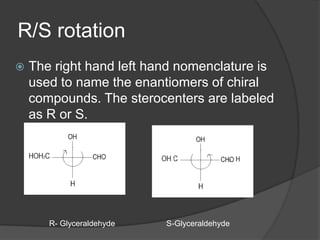
R/S rotation


The right hand left hand nomenclature is
used to name the enantiomers of chiral
compounds. The sterocenters are labeled
as R or S.

R- Glyceraldehyde

S-Glyceraldehyde
Chirality


In compounds in which an atom that is
connected to 4 different substituent groups.
This atom is called a-symmetric atom or a
stereo center. Those compounds are called
chiral compounds.

Chiral Center
Optical Activity
The interaction with light is called optical
activity and enantiomers are often called
optical isomers.
 Optical rotation is measured with the
polarimeter.

Block diagram
Anti-clock
wise
rotation
(-)(l)

When plane
polarized light

Fall sample
of
enantiomers

Rotate the
light

Clockwise
dextrorotatry
(+)(d)
Racemic Mixture


It is a mixture of equal amount of (+)
and (-) enantiomers of chiral
compounds.



It shows no net rotation of plane
polarized light.
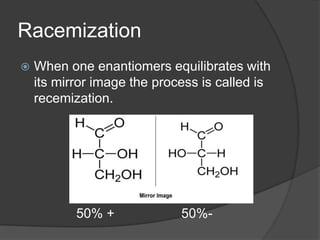
Racemization


When one enantiomers equilibrates with
its mirror image the process is called is
recemization.

50% +

50%-
Representation:
•“andiron” or “sawhorse ”

Newman projections:
Fisher Projection
It is a formula which represent tetrahedral
carbon atom and their substituent's in two
dimensions. The molecule is drawn in the
form of cross.
 The tetrahedral carbon is the plane of the
paper at the center of cross.
 Atoms connected to the tetrahedral carbon
by horizontal bonds are behind the plane of
the paper.
 Atoms connected to the tetrahedral carbon
by vertical bonds in front of the plane of the
paper.

Conti……


Fisher projection tell us the absolute
configuration then we get R and S
enantiomers.
Resolution
Pure enantiomers can be synthesizing
racemic mixture and then separating the
enantiomers Formed by a process
called resolution.
 Glyceraldehydes are separated by
chemical method in compound COOH
must be present in compound does not
contain COOH acid. first it changed into
carboxylic acid then react with
L-brucine.


Enantiomers

  • 2.
  • 3.
    Enantiomers Glyceraldehydes are notsupper impossible on its mirror image has chiral center and therefore exist as two different enantiomers with opposite optical rotation.
  • 4.
    R/S rotation  The righthand left hand nomenclature is used to name the enantiomers of chiral compounds. The sterocenters are labeled as R or S. R- Glyceraldehyde S-Glyceraldehyde
  • 5.
    Chirality  In compounds inwhich an atom that is connected to 4 different substituent groups. This atom is called a-symmetric atom or a stereo center. Those compounds are called chiral compounds. Chiral Center
  • 6.
    Optical Activity The interactionwith light is called optical activity and enantiomers are often called optical isomers.  Optical rotation is measured with the polarimeter. 
  • 7.
    Block diagram Anti-clock wise rotation (-)(l) When plane polarizedlight Fall sample of enantiomers Rotate the light Clockwise dextrorotatry (+)(d)
  • 8.
    Racemic Mixture  It isa mixture of equal amount of (+) and (-) enantiomers of chiral compounds.  It shows no net rotation of plane polarized light.
  • 9.
    Racemization  When one enantiomersequilibrates with its mirror image the process is called is recemization. 50% + 50%-
  • 11.
  • 12.
    Fisher Projection It isa formula which represent tetrahedral carbon atom and their substituent's in two dimensions. The molecule is drawn in the form of cross.  The tetrahedral carbon is the plane of the paper at the center of cross.  Atoms connected to the tetrahedral carbon by horizontal bonds are behind the plane of the paper.  Atoms connected to the tetrahedral carbon by vertical bonds in front of the plane of the paper. 
  • 13.
    Conti……  Fisher projection tellus the absolute configuration then we get R and S enantiomers.
  • 14.
    Resolution Pure enantiomers canbe synthesizing racemic mixture and then separating the enantiomers Formed by a process called resolution.  Glyceraldehydes are separated by chemical method in compound COOH must be present in compound does not contain COOH acid. first it changed into carboxylic acid then react with L-brucine. 