RESOLUTION OF RACEMIC MIXTURE
BY
IQRAR AHMAD ABRAR AHMAD
Department Of Pharmaceutical Chemistry
M.Pharm First Year(Sem 1)
RCPIPER,shirpur
1
ENANTIOMERS:
 Isomers which are nonsuperimposable mirror images of each
other are called enantiomers.
 These are distinguished by
 1)+/-
 2)D/L
(l/-)-enantiomer
(anticlockwise rotation)
(dl/±)-racemate
(no overall effect)
(d/+)-enantiomer
(clockwise rotation)
2
 RACEMIC MIXTURE: A equimolar(50/50) mixture of the two
enantiomers is called a racemic mixture or a racemate.
 Enantiomers have identical chemical and physical properties,
except:Their effect on plane polarised light.
 RESOLUTION: the process of seperation of pure enantiomer from
their racemic modification is called resolution.
3
NEED FOR RESOLUTION OF RACEMIC
MIXTURE:
CETRIZINE
levocetirizine has been found to be less sedating than
cetirizine
4
LEVODOPA
levodopa (L-dopa) is used in treatment of Parkinson’s disease, its
D-form causes serious side effects,such as granulocytopenia
5
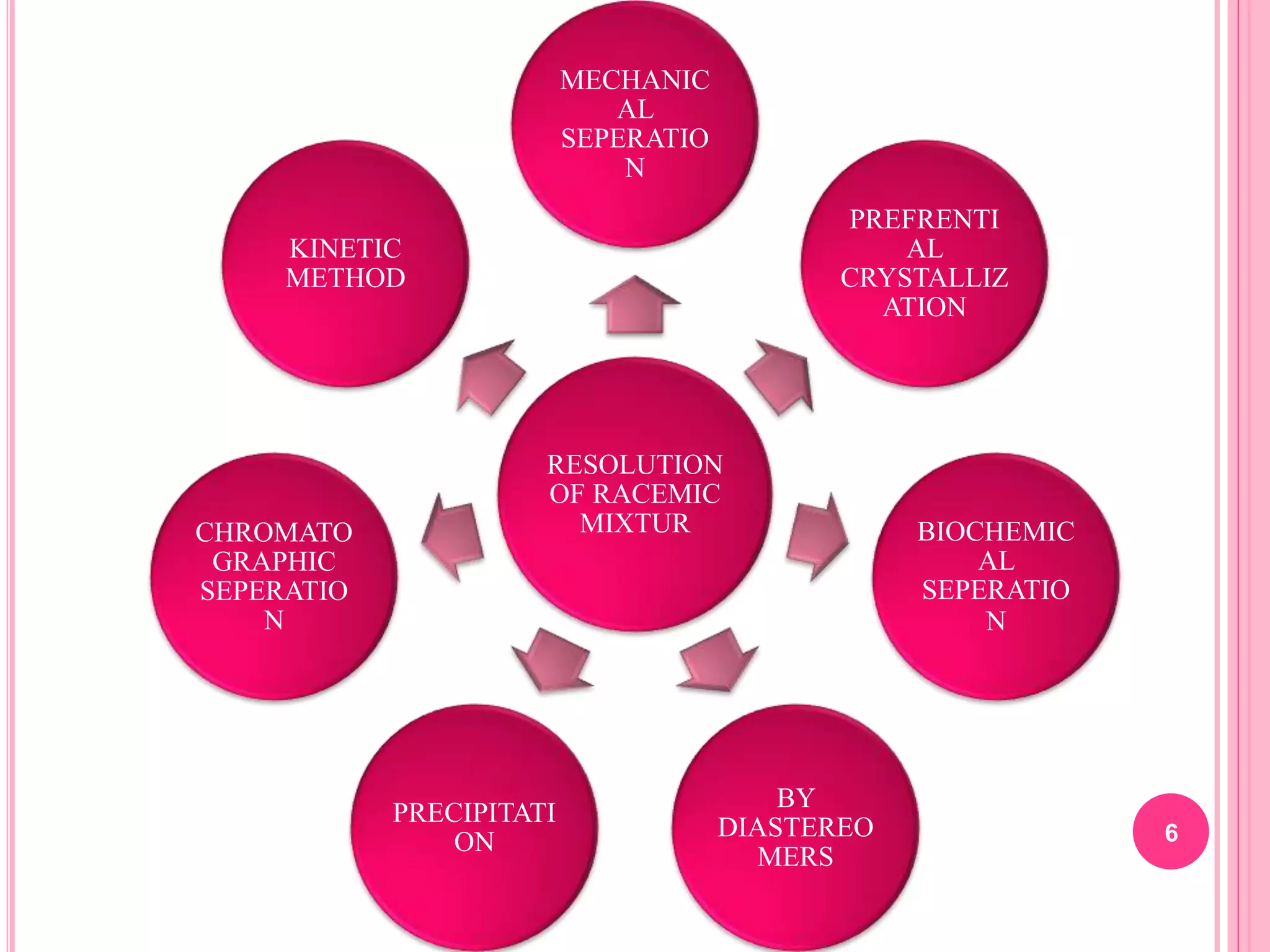
RESOLUTION
OF RACEMIC
MIXTUR
MECHANIC
AL
SEPERATIO
N
PREFRENTI
AL
CRYSTALLIZ
ATION
BIOCHEMIC
AL
SEPERATIO
N
BY
DIASTEREO
MERS
PRECIPITATI
ON
CHROMATO
GRAPHIC
SEPERATIO
N
KINETIC
METHOD
6
1.MECHANICAL SEPARATION OR
SPONTANEOUS RESOLUTION:
 This invoved mechanical separation of the crystal of one enantiomers
from the other in racemic mixture based on difference in their shapes
 Crystal of the two forms have different shapes separated by
magnifying lens and forceps
 This method first used by pasteur for he resolutiuon of sodium
ammonium tartarate which crystallise out in the form of racemic
mixture below 27 degree
 This methods is time consuming and every compound can not be
crystallized at room temperature
7
2.PREFERENTIAL CRYSTALIZATION BY
INOCULATION:
 This method involve seeding of a saturated solution of the racemic
mixture with a pure crystal of one the two enantiomers.
 The soluition now become suppersaturated with respect to the added
enantiomers
 It begins to crystallise out
 Eg. Harda obtained free from amino acid by adding corresponding
d/l isomers of amino acid
8
3.BIOCHEMICAL SEPARATION:
 It was introduced by PASTEUR in 1858.
 This method is based on fact that when certain micro organisms like
bacteria,fungi,yeast,moulds,etc are grown in dilute solution of racemic
mixture,they eat up one enantiomer rapidly than other.
 Example: the mould penicillium glaucum preferentially destroys the
(+) isomer of racemic ammonium tartarate leaving (-) ammonium
tartarate in solution.
9
4.CHROMATOGRAPHIC SEPERATION:
 The racemic mixture can be separated by chromatography on an
optically active support.
 The diastereomeric adsorbates which are formed have different
stabilities.
 Thus one enantiomer will be held more tightly than the other and
would be eluted first.
10
5.KINETIC METHOD :
 This method is based on the fact that one of the enantiomer of racemic
mixture reacts faster than other with optically active compound.
 menthol reacts faster with (+) mandelic acid than with (-) mandelic
acid.
 Thus with difference in kinetics of reaction,racemic mixture can be
seperated.
11
6.PRECIPITATION:
 This method is based on formation of precipitate by reaction between
any reagent and racemic mixture.
 Example: (+) & (-) narcotine when dissolved in HCL ,precipitates
(+) narcotine.
12
7.BY DIASTEREOMERS:
 When racemic mixture is allowed to interact with optically active
material, it give a diastereomeric derivatives.
 Diastereomer have different physical properties and hence can
easily separated into two component by fractional crystallisation
13
REFRENCES:
 1. O.P Agrawal, “Organic Chemistry Reaction And Reagent”
Goel Publication Fourty Eight Edition 2012 Page No.137-143
 2.Ernest L Eliel, “Stereochemistry Of Carbon Compound”
Tata Mc Graw-hill Page No.47-75
 3.Jerry March, “Advance Organic Chemistry” Fourth Edition
Page No.120-124
 4 Morrison Boyd, “Organic chemistry”, edition-6,page-133
14
15

Resolution of racemic mixture

  • 1.
    RESOLUTION OF RACEMICMIXTURE BY IQRAR AHMAD ABRAR AHMAD Department Of Pharmaceutical Chemistry M.Pharm First Year(Sem 1) RCPIPER,shirpur 1
  • 2.
    ENANTIOMERS:  Isomers whichare nonsuperimposable mirror images of each other are called enantiomers.  These are distinguished by  1)+/-  2)D/L (l/-)-enantiomer (anticlockwise rotation) (dl/±)-racemate (no overall effect) (d/+)-enantiomer (clockwise rotation) 2
  • 3.
     RACEMIC MIXTURE:A equimolar(50/50) mixture of the two enantiomers is called a racemic mixture or a racemate.  Enantiomers have identical chemical and physical properties, except:Their effect on plane polarised light.  RESOLUTION: the process of seperation of pure enantiomer from their racemic modification is called resolution. 3
  • 4.
    NEED FOR RESOLUTIONOF RACEMIC MIXTURE: CETRIZINE levocetirizine has been found to be less sedating than cetirizine 4
  • 5.
    LEVODOPA levodopa (L-dopa) isused in treatment of Parkinson’s disease, its D-form causes serious side effects,such as granulocytopenia 5
  • 6.
  • 7.
    1.MECHANICAL SEPARATION OR SPONTANEOUSRESOLUTION:  This invoved mechanical separation of the crystal of one enantiomers from the other in racemic mixture based on difference in their shapes  Crystal of the two forms have different shapes separated by magnifying lens and forceps  This method first used by pasteur for he resolutiuon of sodium ammonium tartarate which crystallise out in the form of racemic mixture below 27 degree  This methods is time consuming and every compound can not be crystallized at room temperature 7
  • 8.
    2.PREFERENTIAL CRYSTALIZATION BY INOCULATION: This method involve seeding of a saturated solution of the racemic mixture with a pure crystal of one the two enantiomers.  The soluition now become suppersaturated with respect to the added enantiomers  It begins to crystallise out  Eg. Harda obtained free from amino acid by adding corresponding d/l isomers of amino acid 8
  • 9.
    3.BIOCHEMICAL SEPARATION:  Itwas introduced by PASTEUR in 1858.  This method is based on fact that when certain micro organisms like bacteria,fungi,yeast,moulds,etc are grown in dilute solution of racemic mixture,they eat up one enantiomer rapidly than other.  Example: the mould penicillium glaucum preferentially destroys the (+) isomer of racemic ammonium tartarate leaving (-) ammonium tartarate in solution. 9
  • 10.
    4.CHROMATOGRAPHIC SEPERATION:  Theracemic mixture can be separated by chromatography on an optically active support.  The diastereomeric adsorbates which are formed have different stabilities.  Thus one enantiomer will be held more tightly than the other and would be eluted first. 10
  • 11.
    5.KINETIC METHOD : This method is based on the fact that one of the enantiomer of racemic mixture reacts faster than other with optically active compound.  menthol reacts faster with (+) mandelic acid than with (-) mandelic acid.  Thus with difference in kinetics of reaction,racemic mixture can be seperated. 11
  • 12.
    6.PRECIPITATION:  This methodis based on formation of precipitate by reaction between any reagent and racemic mixture.  Example: (+) & (-) narcotine when dissolved in HCL ,precipitates (+) narcotine. 12
  • 13.
    7.BY DIASTEREOMERS:  Whenracemic mixture is allowed to interact with optically active material, it give a diastereomeric derivatives.  Diastereomer have different physical properties and hence can easily separated into two component by fractional crystallisation 13
  • 14.
    REFRENCES:  1. O.PAgrawal, “Organic Chemistry Reaction And Reagent” Goel Publication Fourty Eight Edition 2012 Page No.137-143  2.Ernest L Eliel, “Stereochemistry Of Carbon Compound” Tata Mc Graw-hill Page No.47-75  3.Jerry March, “Advance Organic Chemistry” Fourth Edition Page No.120-124  4 Morrison Boyd, “Organic chemistry”, edition-6,page-133 14
  • 15.