AROMATICITY
Dr. Ravi S. Balaskar
Department of Chemistry
Pratap College, Amalner
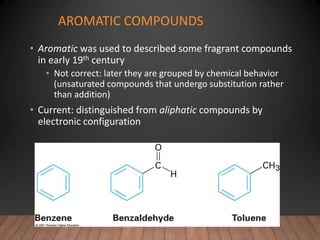
AROMATIC COMPOUNDS
• Aromatic was used to described some fragrant compounds
in early 19th century
• Not correct: later they are grouped by chemical behavior
(unsaturated compounds that undergo substitution rather
than addition)
• Current: distinguished from aliphatic compounds by
electronic configuration
REASON
• Reactivity of substituted aromatic compounds is tied to
their structure
• Aromatic compounds provide a sensitive probe for studying
relationship between structure and reactivity
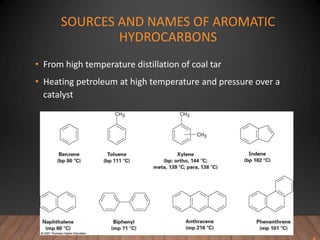
SOURCES AND NAMES OF AROMATIC
HYDROCARBONS
• From high temperature distillation of coal tar
• Heating petroleum at high temperature and pressure over a
catalyst
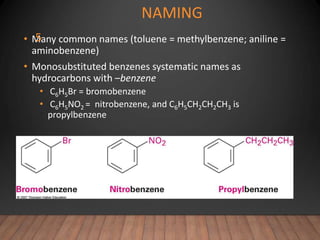
NAMING
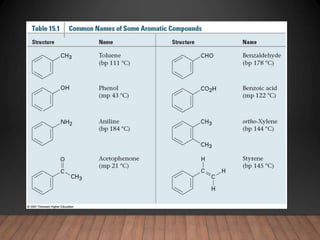
• Many common names (toluene = methylbenzene; aniline =
aminobenzene)
• Monosubstituted benzenes systematic names as
hydrocarbons with –benzene
• C6H5Br = bromobenzene
• C6H5NO2 = nitrobenzene, and C6H5CH2CH2CH3 is
propylbenzene
5
6
BENZENE
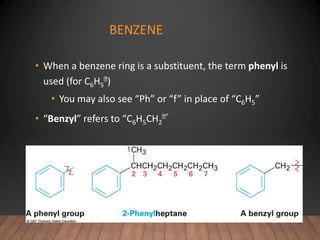
• When a benzene ring is a substituent, the term phenyl is
used (for C6H5 )
• You may also see “Ph” or “f” in place of “C6H5”
• “Benzyl” refers to “C6H5CH2
”
DISUBSTITUTED BENZENES
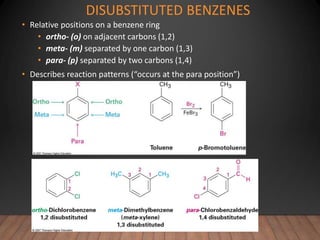
• Relative positions on a benzene ring
• ortho- (o) on adjacent carbons (1,2)
• meta- (m) separated by one carbon (1,3)
• para- (p) separated by two carbons (1,4)
• Describes reaction patterns (“occurs at the para position”)
NAMING BENZENES WITH MORE THAN TWO
SUBSTITUENTS
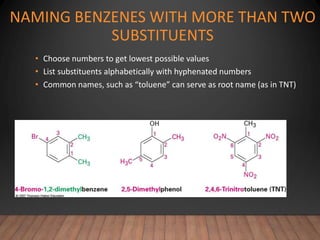
• Choose numbers to get lowest possible values
• List substituents alphabetically with hyphenated numbers
• Common names, such as “toluene” can serve as root name (as in TNT)
STRUCTURE AND STABILITY OF BENZENE:
MOLECULAR ORBITAL THEORY
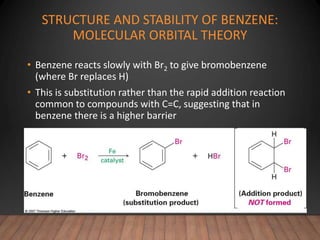
• Benzene reacts slowly with Br2 to give bromobenzene
(where Br replaces H)
• This is substitution rather than the rapid addition reaction
common to compounds with C=C, suggesting that in
benzene there is a higher barrier
HEATS OF HYDROGENATION AS INDICATORS OF STABILITY
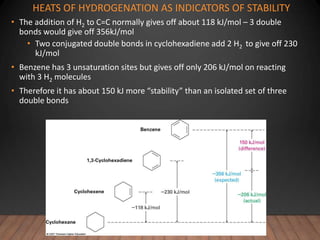
• The addition of H2 to C=C normally gives off about 118 kJ/mol – 3 double
bonds would give off 356kJ/mol
• Two conjugated double bonds in cyclohexadiene add 2 H2 to give off 230
kJ/mol
• Benzene has 3 unsaturation sites but gives off only 206 kJ/mol on reacting
with 3 H2 molecules
• Therefore it has about 150 kJ more “stability” than an isolated set of three
double bonds
BENZENE’S UNUSUAL STRUCTURE
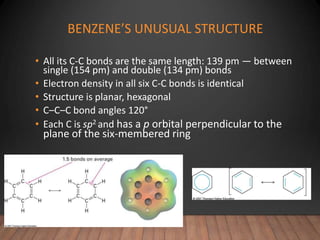
• All its C-C bonds are the same length: 139 pm — between
single (154 pm) and double (134 pm) bonds
• Electron density in all six C-C bonds is identical
• Structure is planar, hexagonal
• C–C–C bond angles 120°
• Each C is sp2 and has a p orbital perpendicular to the
plane of the six-membered ring
MOLECULAR ORBITAL DESCRIPTION OF
BENZENE
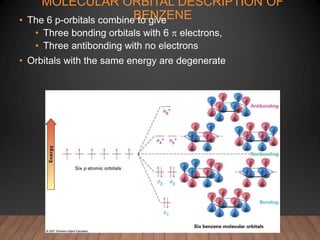
• The 6 p-orbitals combine to give
• Three bonding orbitals with 6  electrons,
• Three antibonding with no electrons
• Orbitals with the same energy are degenerate
AROMATICITY AND THE HÜCKEL 4N+2 RULE
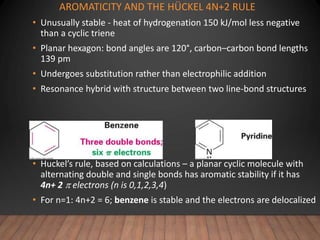
• Unusually stable - heat of hydrogenation 150 kJ/mol less negative
than a cyclic triene
• Planar hexagon: bond angles are 120°, carbon–carbon bond lengths
139 pm
• Undergoes substitution rather than electrophilic addition
• Resonance hybrid with structure between two line-bond structures
• Huckel’s rule, based on calculations – a planar cyclic molecule with
alternating double and single bonds has aromatic stability if it has
4n+ 2  electrons (n is 0,1,2,3,4)
• For n=1: 4n+2 = 6; benzene is stable and the electrons are delocalized
COMPOUNDS WITH 4N  ELECTRONS ARE NOT
AROMATIC (MAY BE ANTIAROMATIC)
• Planar, cyclic molecules with 4 n  electrons are much less stable than
expected (antiaromatic)
• They will distort out of plane and behave like ordinary alkenes
• 4- and 8-electron compounds are not delocalized (single and double
bonds)
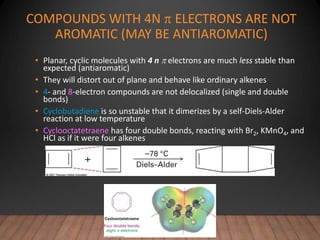
• Cyclobutadiene is so unstable that it dimerizes by a self-Diels-Alder
reaction at low temperature
• Cyclooctatetraene has four double bonds, reacting with Br2, KMnO4, and
HCl as if it were four alkenes
AROMATIC IONS
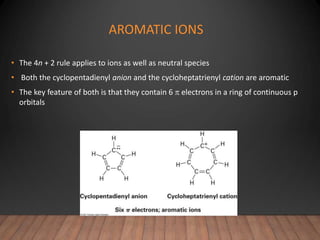
• The 4n + 2 rule applies to ions as well as neutral species
• Both the cyclopentadienyl anion and the cycloheptatrienyl cation are aromatic
• The key feature of both is that they contain 6  electrons in a ring of continuous p
orbitals
AROMATICITY OF THE CYCLOPENTADIENYL ANION
• 1,3-Cyclopentadiene contains
conjugated double bonds
joined by a CH2 that blocks
delocalization
• Removal of H+ at the CH2
produces a cyclic 6-electron
system, which is stable
• Removal of H- or H• generates
nonaromatic 4 and 5 electron
systems
• Relatively acidic (pKa = 16)
because the anion is stable
CYCLOHEPTATRIENE
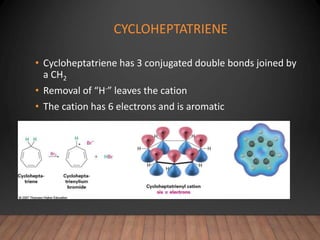
• Cycloheptatriene has 3 conjugated double bonds joined by
a CH2
• Removal of “H-” leaves the cation
• The cation has 6 electrons and is aromatic
AROMATIC HETEROCYCLES: PYRIDINE
AND PYRROLE
• Heterocyclic compounds contain elements other than carbon
in a ring, such as N,S,O,P
• Aromatic compounds can have elements other than carbon in
the ring
• There are many heterocyclic aromatic compounds and many
are very common
• Cyclic compounds that contain only carbon are called
carbocycles (not homocycles)
• Nomenclature is specialized
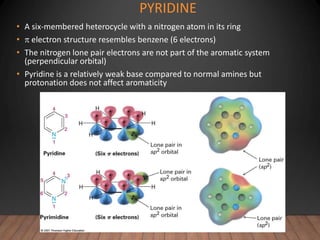
PYRIDINE
• A six-membered heterocycle with a nitrogen atom in its ring
•  electron structure resembles benzene (6 electrons)
• The nitrogen lone pair electrons are not part of the aromatic system
(perpendicular orbital)
• Pyridine is a relatively weak base compared to normal amines but
protonation does not affect aromaticity
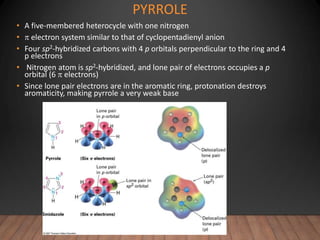
PYRROLE
• A five-membered heterocycle with one nitrogen
•  electron system similar to that of cyclopentadienyl anion
• Four sp2-hybridized carbons with 4 p orbitals perpendicular to the ring and 4
p electrons
• Nitrogen atom is sp2-hybridized, and lone pair of electrons occupies a p
orbital (6  electrons)
• Since lone pair electrons are in the aromatic ring, protonation destroys
aromaticity, making pyrrole a very weak base
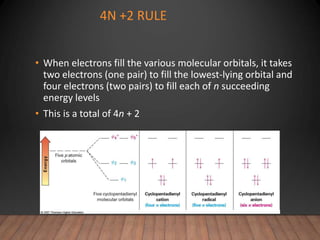
4N +2 RULE
• When electrons fill the various molecular orbitals, it takes
two electrons (one pair) to fill the lowest-lying orbital and
four electrons (two pairs) to fill each of n succeeding
energy levels
• This is a total of 4n + 2
POLYCYCLIC AROMATIC COMPOUNDS
• Aromatic compounds can have rings that share a set of
carbon atoms (fused rings)
• Compounds from fused benzene or aromatic heterocycle
rings are themselves aromatic
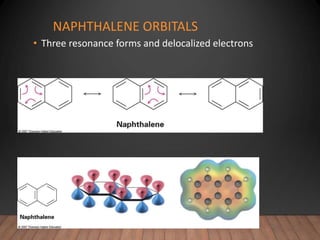
NAPHTHALENE ORBITALS
• Three resonance forms and delocalized electrons

Aromaticity

  • 1.
    AROMATICITY Dr. Ravi S.Balaskar Department of Chemistry Pratap College, Amalner
  • 2.
    AROMATIC COMPOUNDS • Aromaticwas used to described some fragrant compounds in early 19th century • Not correct: later they are grouped by chemical behavior (unsaturated compounds that undergo substitution rather than addition) • Current: distinguished from aliphatic compounds by electronic configuration
  • 3.
    REASON • Reactivity ofsubstituted aromatic compounds is tied to their structure • Aromatic compounds provide a sensitive probe for studying relationship between structure and reactivity
  • 4.
    SOURCES AND NAMESOF AROMATIC HYDROCARBONS • From high temperature distillation of coal tar • Heating petroleum at high temperature and pressure over a catalyst
  • 5.
    NAMING • Many commonnames (toluene = methylbenzene; aniline = aminobenzene) • Monosubstituted benzenes systematic names as hydrocarbons with –benzene • C6H5Br = bromobenzene • C6H5NO2 = nitrobenzene, and C6H5CH2CH2CH3 is propylbenzene 5
  • 6.
  • 7.
    BENZENE • When abenzene ring is a substituent, the term phenyl is used (for C6H5 ) • You may also see “Ph” or “f” in place of “C6H5” • “Benzyl” refers to “C6H5CH2 ”
  • 8.
    DISUBSTITUTED BENZENES • Relativepositions on a benzene ring • ortho- (o) on adjacent carbons (1,2) • meta- (m) separated by one carbon (1,3) • para- (p) separated by two carbons (1,4) • Describes reaction patterns (“occurs at the para position”)
  • 9.
    NAMING BENZENES WITHMORE THAN TWO SUBSTITUENTS • Choose numbers to get lowest possible values • List substituents alphabetically with hyphenated numbers • Common names, such as “toluene” can serve as root name (as in TNT)
  • 10.
    STRUCTURE AND STABILITYOF BENZENE: MOLECULAR ORBITAL THEORY • Benzene reacts slowly with Br2 to give bromobenzene (where Br replaces H) • This is substitution rather than the rapid addition reaction common to compounds with C=C, suggesting that in benzene there is a higher barrier
  • 11.
    HEATS OF HYDROGENATIONAS INDICATORS OF STABILITY • The addition of H2 to C=C normally gives off about 118 kJ/mol – 3 double bonds would give off 356kJ/mol • Two conjugated double bonds in cyclohexadiene add 2 H2 to give off 230 kJ/mol • Benzene has 3 unsaturation sites but gives off only 206 kJ/mol on reacting with 3 H2 molecules • Therefore it has about 150 kJ more “stability” than an isolated set of three double bonds
  • 12.
    BENZENE’S UNUSUAL STRUCTURE •All its C-C bonds are the same length: 139 pm — between single (154 pm) and double (134 pm) bonds • Electron density in all six C-C bonds is identical • Structure is planar, hexagonal • C–C–C bond angles 120° • Each C is sp2 and has a p orbital perpendicular to the plane of the six-membered ring
  • 13.
    MOLECULAR ORBITAL DESCRIPTIONOF BENZENE • The 6 p-orbitals combine to give • Three bonding orbitals with 6  electrons, • Three antibonding with no electrons • Orbitals with the same energy are degenerate
  • 14.
    AROMATICITY AND THEHÜCKEL 4N+2 RULE • Unusually stable - heat of hydrogenation 150 kJ/mol less negative than a cyclic triene • Planar hexagon: bond angles are 120°, carbon–carbon bond lengths 139 pm • Undergoes substitution rather than electrophilic addition • Resonance hybrid with structure between two line-bond structures • Huckel’s rule, based on calculations – a planar cyclic molecule with alternating double and single bonds has aromatic stability if it has 4n+ 2  electrons (n is 0,1,2,3,4) • For n=1: 4n+2 = 6; benzene is stable and the electrons are delocalized
  • 15.
    COMPOUNDS WITH 4N ELECTRONS ARE NOT AROMATIC (MAY BE ANTIAROMATIC) • Planar, cyclic molecules with 4 n  electrons are much less stable than expected (antiaromatic) • They will distort out of plane and behave like ordinary alkenes • 4- and 8-electron compounds are not delocalized (single and double bonds) • Cyclobutadiene is so unstable that it dimerizes by a self-Diels-Alder reaction at low temperature • Cyclooctatetraene has four double bonds, reacting with Br2, KMnO4, and HCl as if it were four alkenes
  • 16.
    AROMATIC IONS • The4n + 2 rule applies to ions as well as neutral species • Both the cyclopentadienyl anion and the cycloheptatrienyl cation are aromatic • The key feature of both is that they contain 6  electrons in a ring of continuous p orbitals
  • 17.
    AROMATICITY OF THECYCLOPENTADIENYL ANION • 1,3-Cyclopentadiene contains conjugated double bonds joined by a CH2 that blocks delocalization • Removal of H+ at the CH2 produces a cyclic 6-electron system, which is stable • Removal of H- or H• generates nonaromatic 4 and 5 electron systems • Relatively acidic (pKa = 16) because the anion is stable
  • 18.
    CYCLOHEPTATRIENE • Cycloheptatriene has3 conjugated double bonds joined by a CH2 • Removal of “H-” leaves the cation • The cation has 6 electrons and is aromatic
  • 19.
    AROMATIC HETEROCYCLES: PYRIDINE ANDPYRROLE • Heterocyclic compounds contain elements other than carbon in a ring, such as N,S,O,P • Aromatic compounds can have elements other than carbon in the ring • There are many heterocyclic aromatic compounds and many are very common • Cyclic compounds that contain only carbon are called carbocycles (not homocycles) • Nomenclature is specialized
  • 20.
    PYRIDINE • A six-memberedheterocycle with a nitrogen atom in its ring •  electron structure resembles benzene (6 electrons) • The nitrogen lone pair electrons are not part of the aromatic system (perpendicular orbital) • Pyridine is a relatively weak base compared to normal amines but protonation does not affect aromaticity
  • 21.
    PYRROLE • A five-memberedheterocycle with one nitrogen •  electron system similar to that of cyclopentadienyl anion • Four sp2-hybridized carbons with 4 p orbitals perpendicular to the ring and 4 p electrons • Nitrogen atom is sp2-hybridized, and lone pair of electrons occupies a p orbital (6  electrons) • Since lone pair electrons are in the aromatic ring, protonation destroys aromaticity, making pyrrole a very weak base
  • 22.
    4N +2 RULE •When electrons fill the various molecular orbitals, it takes two electrons (one pair) to fill the lowest-lying orbital and four electrons (two pairs) to fill each of n succeeding energy levels • This is a total of 4n + 2
  • 23.
    POLYCYCLIC AROMATIC COMPOUNDS •Aromatic compounds can have rings that share a set of carbon atoms (fused rings) • Compounds from fused benzene or aromatic heterocycle rings are themselves aromatic
  • 24.
    NAPHTHALENE ORBITALS • Threeresonance forms and delocalized electrons