Stereochemistry
Presented by
Rudraprasad Sahoo
M. Pharm 2nd semester
Department of Pharmaceutical Chemistry
Institute of Pharmacy & Technology, Salipur.
CONTENTS
2
1
3
5
4
Classification
Basic concepts in stereo
chemistry
Meso compounds
Fisher’s D & L notation
Reference
Flow chart of classification according to the molecular orientation
Stereochemistry
Isomers are different compounds with the same molecular formula.
• The two major classes of isomers are constitutional isomers and
stereoisomers.
Constitutional/structural isomers have different IUPAC names, the same or
different functional groups, different physical properties and different chemical
properties.
Stereoisomers differ only in the way the atoms are oriented in space. They have
identical IUPAC names (except for a prefix like cis or trans). They always have
the same functional group(s).
• A particular three-dimensional arrangement is called a configuration.
• Stereoisomers differ in configuration.
Geometrical Isomers
The π-bond in an alkene does not permit rotation, thus all of the atoms attached directly to the
alkene lie in a plane.
Groups attached to the alkene could be positioned on the same side of the alkene (or) on
opposite sides of the alkene. Such compounds are different in chemical and physical properties
as well as in their geometry, and are called geometrical
isomers.
Ex: In 2-butene the methyl groups can be located on the same side or on the opposite side of the
double bond, giving rise to two geometrical isomers.
The isomer with the groups on the same side is called the Cis isomer, while the isomer with
the groups located on opposite sides is called the Trans isomer.
Trans isomers of compounds are usually more stable than Cis isomers.
Geometrical Isomers ( cis – trans & E – Z )
Geometric (Cis and Trans) Isomers result from restriction rotation.
Compounds with double bonds:
Cis isomer – have same substituents on the same side of the double bond (Z - zusammen
(together) with more complex molecules having high priority groups on the same side).
Trans isomer – have the same substituents on the opposite side of the double bond (E - entgegen
(opposite) with more complex molecules having high priority groups on opposite sides).
Compounds with bonds in a ring:
Cis isomer – have the same substituents on the same side of the ring.
Trans isomer - have the same substituents on the opposite side of the ring.
Priority groups at
same side – ‘E’
Priority groups
at opposite side –
‘Z’
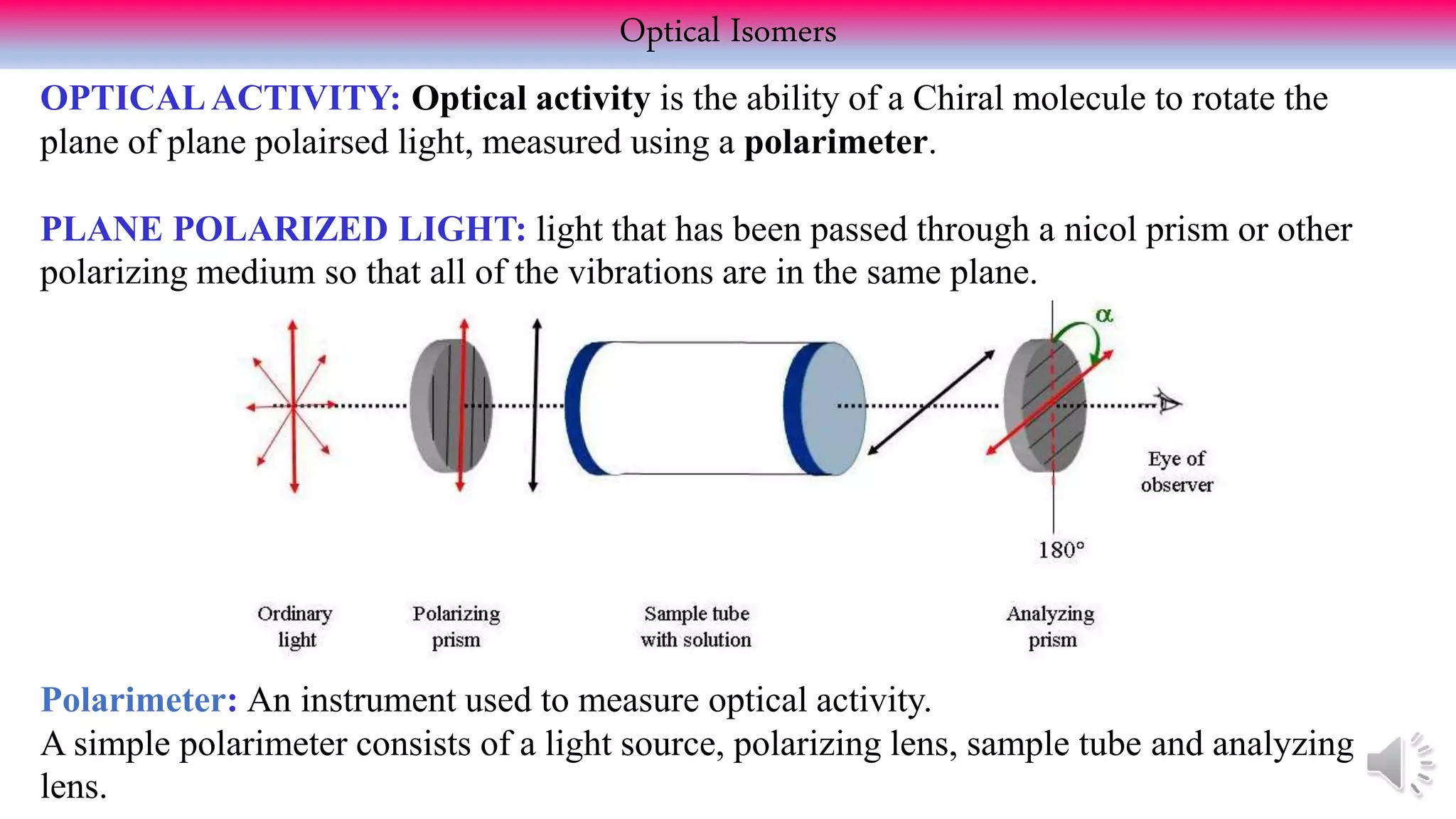
OPTICALACTIVITY: Optical activity is the ability of a Chiral molecule to rotate the
plane of plane polairsed light, measured using a polarimeter.
PLANE POLARIZED LIGHT: light that has been passed through a nicol prism or other
polarizing medium so that all of the vibrations are in the same plane.
Optical Isomers
Polarimeter: An instrument used to measure optical activity.
A simple polarimeter consists of a light source, polarizing lens, sample tube and analyzing
lens.
Dextrorotatory (+):
An optically active compound that rotates plane polarized light in a clockwise direction.
(+) or (d)
Levorotatory (-):
An optically active compound that rotates plane polarized light in a counter clockwise direction.
(-) or (l)
The angle of rotation of plane polarized light by an optically active substance is proportional to
the number of atoms in the path of the light.
SPECIFIC ROTATION:
The angle of rotation of plane polarized light by a 1.00 gram per cm-3 sample in a 1 dm tube.
[α ]D (D = sodium lamp, λ = 589 mμ).
[ α ]D = α
l × d
where α = observed rotation
l = length (dm)
d = concentration (g/cc)
(+)-alanine [ α ]D = +8.5
(-)-lactic acid [α ]D = -3.8
Specific Rotation depends on the nature of substance, wavelength of light used, concentration
of the solution, thickness of the layer, nature of the solvent and temperature at which
experiment is conducted.
Asymmetric Centre
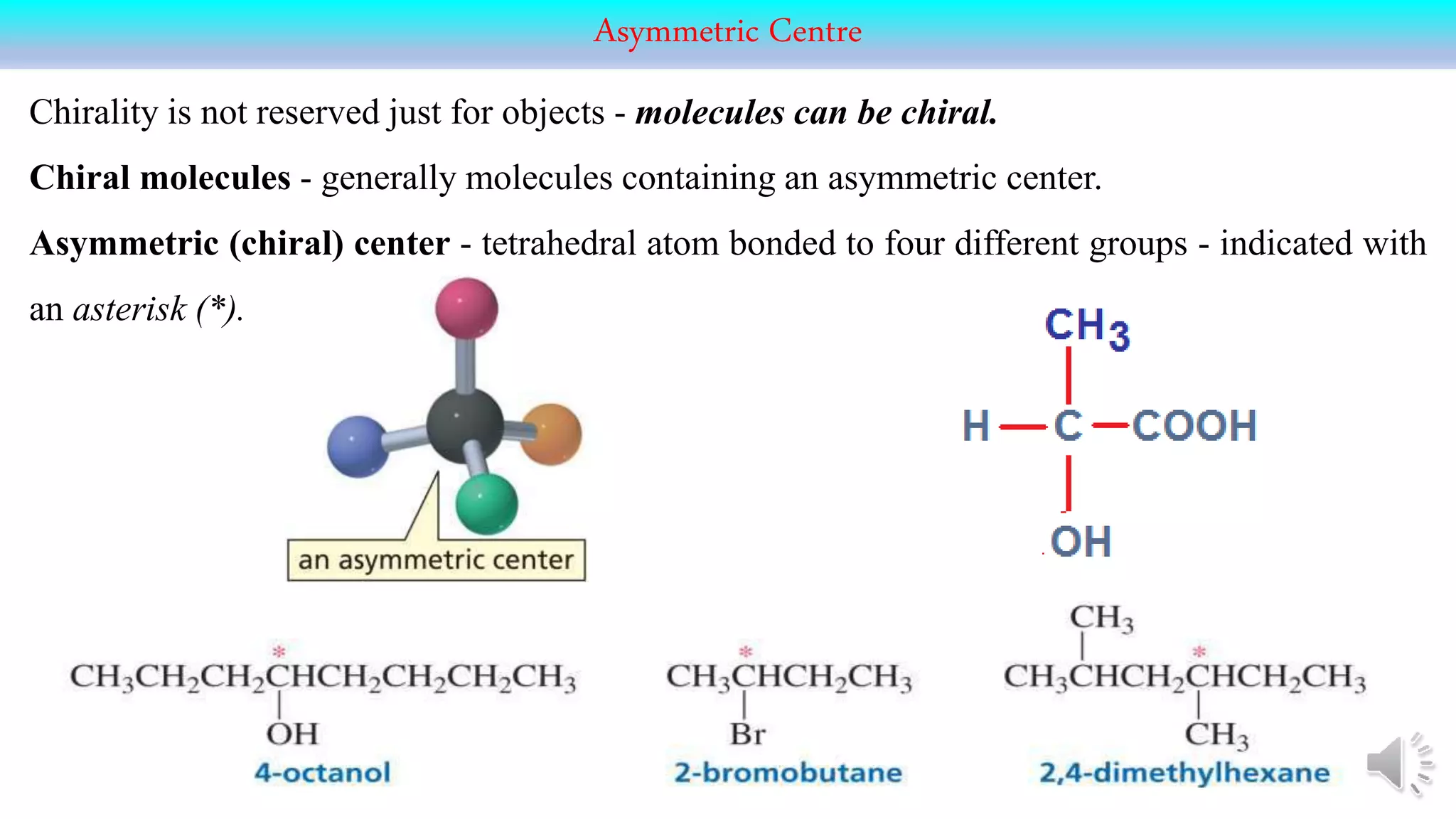
Chirality is not reserved just for objects - molecules can be chiral.
Chiral molecules - generally molecules containing an asymmetric center.
Asymmetric (chiral) center - tetrahedral atom bonded to four different groups - indicated with
an asterisk (*).
Chirality
Chiral objects are objects with left-handed and right-handed forms.
Achiral objects - objects that have superimposable mirror images.
Non superimposable mirror images - a mirror image that is not the same as the image
itself - chiral objects have non superimposable mirror images.
•A point in a molecule where four different groups (or atoms) are attached to carbon is
called a Chiral center.
•If two groups are the same, then there is only one way.
•A Chiral molecule usually has at least one Chiral center.
Enantiomers
 Enantiomers are non-superimposable mirror image isomers.
 Enantiomers are related to each other much like a right hand is related to a left hand.
 Enantiomers are said to be Chiral.
 sometimes the terms right-handed and left-handed are used describe compounds with an
asymmetric carbon.
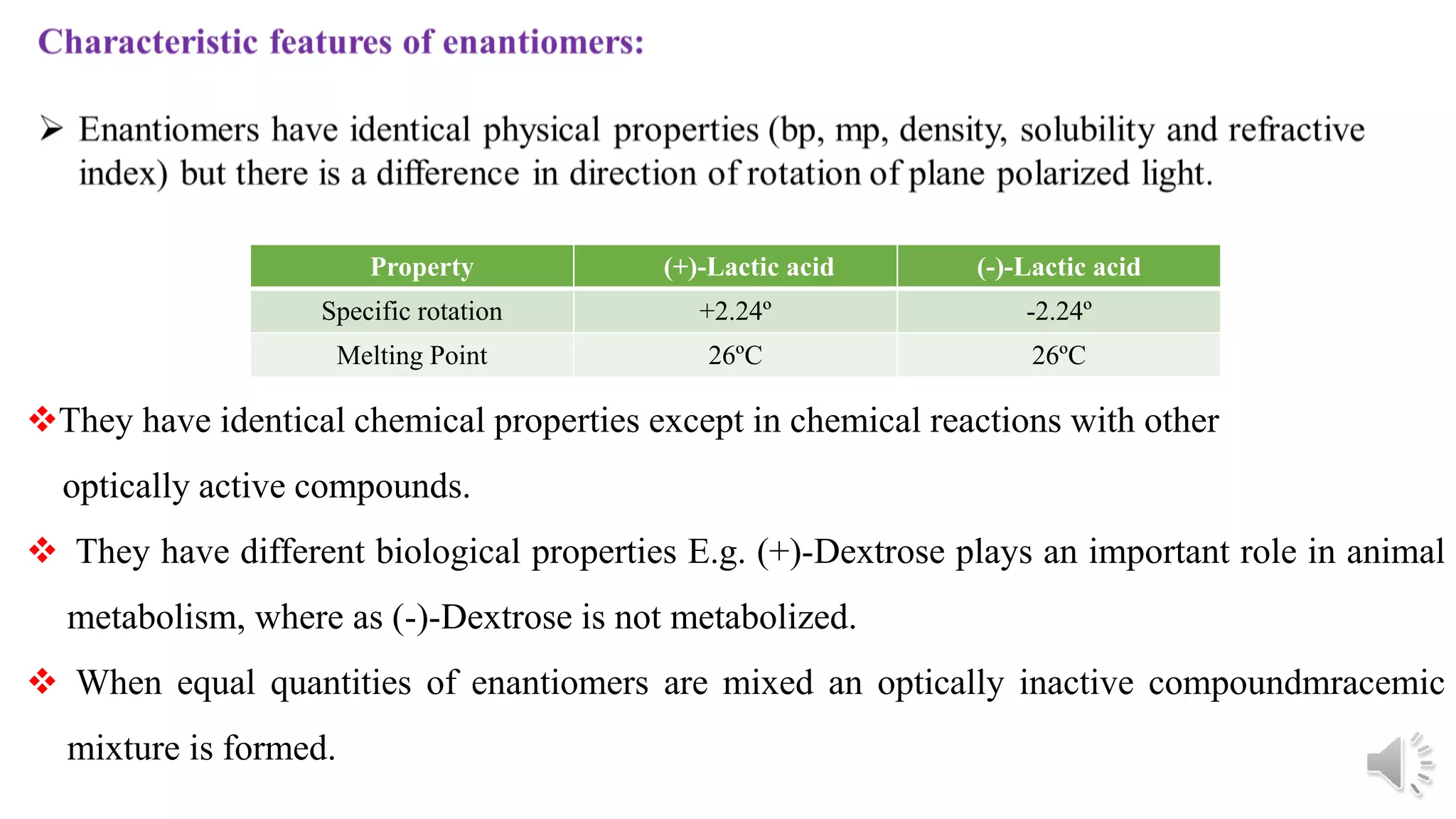
Property (+)-Lactic acid (-)-Lactic acid
Specific rotation +2.24º -2.24º
Melting Point 26ºC 26ºC
They have identical chemical properties except in chemical reactions with other
optically active compounds.
 They have different biological properties E.g. (+)-Dextrose plays an important role in animal
metabolism, where as (-)-Dextrose is not metabolized.
 When equal quantities of enantiomers are mixed an optically inactive compoundmracemic
mixture is formed.
Diastereomers
Stereomers of a substance that are not mirror images of each other are termed as Diastereomers.
 They have different physical properties like m.p, b.p, solubility, density and refractive
index, etc.
 Diastereomers have different specific rotation but they may have same or opposite sign of
rotation.
Meso compounds
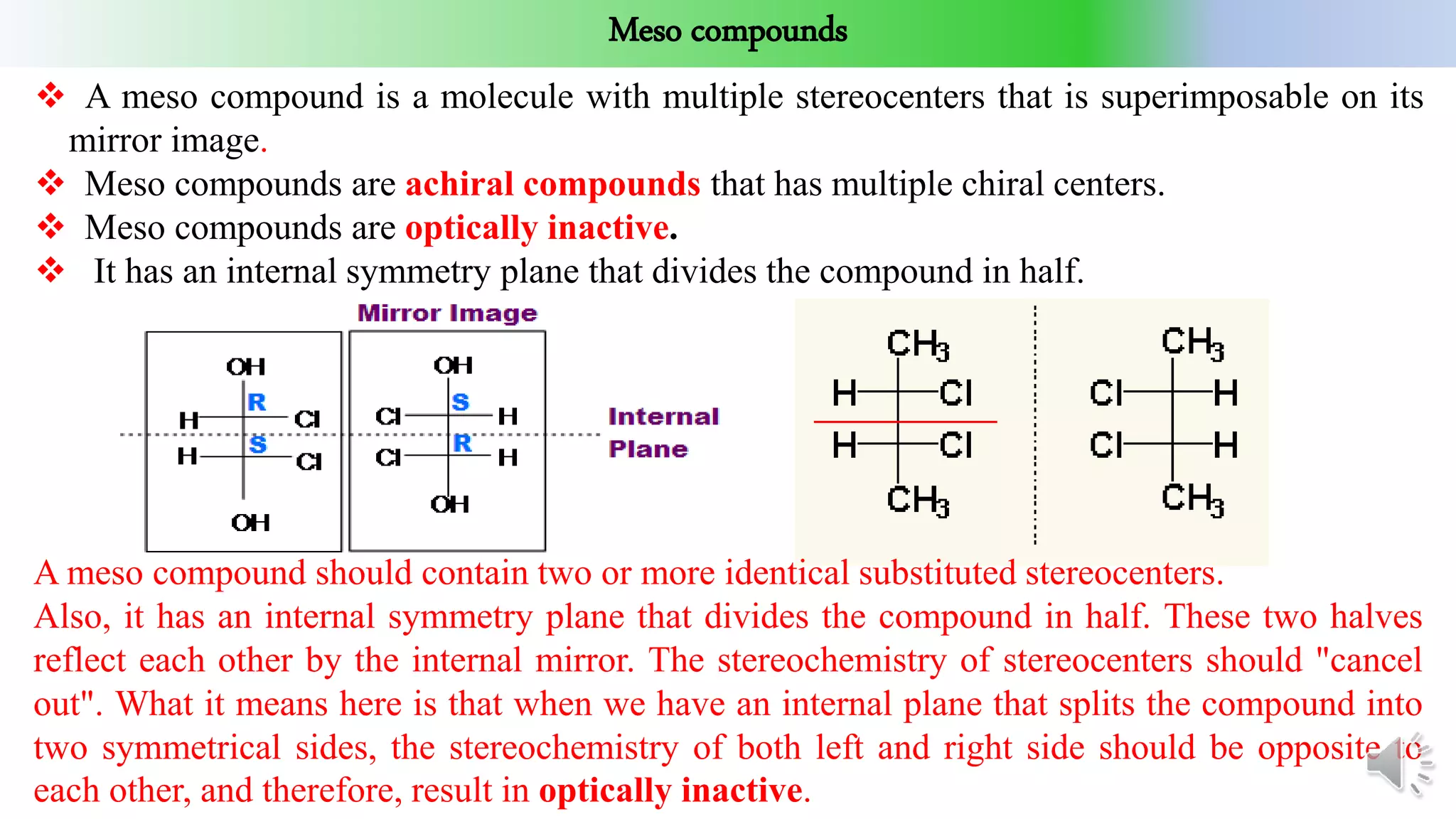
 A meso compound is a molecule with multiple stereocenters that is superimposable on its
mirror image.
 Meso compounds are achiral compounds that has multiple chiral centers.
 Meso compounds are optically inactive.
 It has an internal symmetry plane that divides the compound in half.
A meso compound should contain two or more identical substituted stereocenters.
Also, it has an internal symmetry plane that divides the compound in half. These two halves
reflect each other by the internal mirror. The stereochemistry of stereocenters should "cancel
out". What it means here is that when we have an internal plane that splits the compound into
two symmetrical sides, the stereochemistry of both left and right side should be opposite to
each other, and therefore, result in optically inactive.
Racemic Mixture
 A mixture having equal amounts of enantiomers is called racemic mixture or racemic
modification.
 A racemic mixture (or) racemate is one that has equal amounts of left- and right handed
enantiomers of a chiral molecule. The first known racemic mixture was racemic acid, which
Louis Pasteur found to be a mixture of the two enantiomeric isomers of tartaric acid.
 A racemic mixture is denoted by the prefix (±)- or dl- (for sugars the prefix Dl may be used),
indicating an equal (1:1) mixture of dextro and levo isomers. Also the prefix symbols RS and
SR (all in italic letters) are used.
Fischer Projections and the D/L Notation:
 The first system for doing this was developed by Fischer and Rosanoff around 1900.
 Fischer first developed a method for drawing carbohydrates in two-dimensions, and a
convention with respect to orientation, so as to indicate their three dimensional structures,
so-called Fischer projections.
 Fischer and Rosanoff then devised a notation for designating the configurations of
stereogenic centres, depicted in Fischer projections, as either D or L.
Ex. The notation was extended to a-amino acids : L enantiomers are those in which the NH2
group is on the LHS of the Fischer projection in which the carboxyl group appears at the top.
Conversely, the D enantiomers are those in which the NH2 group is on the RHS. Thus (+)-
alanine and (-)-serine are L-amino acids.
 Isomrism and Stereo chemistry

Isomrism and Stereo chemistry

  • 1.
    Stereochemistry Presented by Rudraprasad Sahoo M.Pharm 2nd semester Department of Pharmaceutical Chemistry Institute of Pharmacy & Technology, Salipur.
  • 2.
    CONTENTS 2 1 3 5 4 Classification Basic concepts instereo chemistry Meso compounds Fisher’s D & L notation Reference
  • 3.
    Flow chart ofclassification according to the molecular orientation
  • 4.
    Stereochemistry Isomers are differentcompounds with the same molecular formula. • The two major classes of isomers are constitutional isomers and stereoisomers. Constitutional/structural isomers have different IUPAC names, the same or different functional groups, different physical properties and different chemical properties. Stereoisomers differ only in the way the atoms are oriented in space. They have identical IUPAC names (except for a prefix like cis or trans). They always have the same functional group(s). • A particular three-dimensional arrangement is called a configuration. • Stereoisomers differ in configuration.
  • 5.
    Geometrical Isomers The π-bondin an alkene does not permit rotation, thus all of the atoms attached directly to the alkene lie in a plane. Groups attached to the alkene could be positioned on the same side of the alkene (or) on opposite sides of the alkene. Such compounds are different in chemical and physical properties as well as in their geometry, and are called geometrical isomers. Ex: In 2-butene the methyl groups can be located on the same side or on the opposite side of the double bond, giving rise to two geometrical isomers. The isomer with the groups on the same side is called the Cis isomer, while the isomer with the groups located on opposite sides is called the Trans isomer. Trans isomers of compounds are usually more stable than Cis isomers.
  • 6.
    Geometrical Isomers (cis – trans & E – Z ) Geometric (Cis and Trans) Isomers result from restriction rotation. Compounds with double bonds: Cis isomer – have same substituents on the same side of the double bond (Z - zusammen (together) with more complex molecules having high priority groups on the same side). Trans isomer – have the same substituents on the opposite side of the double bond (E - entgegen (opposite) with more complex molecules having high priority groups on opposite sides). Compounds with bonds in a ring: Cis isomer – have the same substituents on the same side of the ring. Trans isomer - have the same substituents on the opposite side of the ring. Priority groups at same side – ‘E’ Priority groups at opposite side – ‘Z’
  • 7.
    OPTICALACTIVITY: Optical activityis the ability of a Chiral molecule to rotate the plane of plane polairsed light, measured using a polarimeter. PLANE POLARIZED LIGHT: light that has been passed through a nicol prism or other polarizing medium so that all of the vibrations are in the same plane. Optical Isomers Polarimeter: An instrument used to measure optical activity. A simple polarimeter consists of a light source, polarizing lens, sample tube and analyzing lens.
  • 8.
    Dextrorotatory (+): An opticallyactive compound that rotates plane polarized light in a clockwise direction. (+) or (d) Levorotatory (-): An optically active compound that rotates plane polarized light in a counter clockwise direction. (-) or (l) The angle of rotation of plane polarized light by an optically active substance is proportional to the number of atoms in the path of the light.
  • 9.
    SPECIFIC ROTATION: The angleof rotation of plane polarized light by a 1.00 gram per cm-3 sample in a 1 dm tube. [α ]D (D = sodium lamp, λ = 589 mμ). [ α ]D = α l × d where α = observed rotation l = length (dm) d = concentration (g/cc) (+)-alanine [ α ]D = +8.5 (-)-lactic acid [α ]D = -3.8 Specific Rotation depends on the nature of substance, wavelength of light used, concentration of the solution, thickness of the layer, nature of the solvent and temperature at which experiment is conducted.
  • 10.
    Asymmetric Centre Chirality isnot reserved just for objects - molecules can be chiral. Chiral molecules - generally molecules containing an asymmetric center. Asymmetric (chiral) center - tetrahedral atom bonded to four different groups - indicated with an asterisk (*).
  • 11.
    Chirality Chiral objects areobjects with left-handed and right-handed forms. Achiral objects - objects that have superimposable mirror images. Non superimposable mirror images - a mirror image that is not the same as the image itself - chiral objects have non superimposable mirror images. •A point in a molecule where four different groups (or atoms) are attached to carbon is called a Chiral center. •If two groups are the same, then there is only one way. •A Chiral molecule usually has at least one Chiral center.
  • 12.
    Enantiomers  Enantiomers arenon-superimposable mirror image isomers.  Enantiomers are related to each other much like a right hand is related to a left hand.  Enantiomers are said to be Chiral.  sometimes the terms right-handed and left-handed are used describe compounds with an asymmetric carbon.
  • 13.
    Property (+)-Lactic acid(-)-Lactic acid Specific rotation +2.24º -2.24º Melting Point 26ºC 26ºC They have identical chemical properties except in chemical reactions with other optically active compounds.  They have different biological properties E.g. (+)-Dextrose plays an important role in animal metabolism, where as (-)-Dextrose is not metabolized.  When equal quantities of enantiomers are mixed an optically inactive compoundmracemic mixture is formed.
  • 14.
    Diastereomers Stereomers of asubstance that are not mirror images of each other are termed as Diastereomers.  They have different physical properties like m.p, b.p, solubility, density and refractive index, etc.  Diastereomers have different specific rotation but they may have same or opposite sign of rotation.
  • 15.
    Meso compounds  Ameso compound is a molecule with multiple stereocenters that is superimposable on its mirror image.  Meso compounds are achiral compounds that has multiple chiral centers.  Meso compounds are optically inactive.  It has an internal symmetry plane that divides the compound in half. A meso compound should contain two or more identical substituted stereocenters. Also, it has an internal symmetry plane that divides the compound in half. These two halves reflect each other by the internal mirror. The stereochemistry of stereocenters should "cancel out". What it means here is that when we have an internal plane that splits the compound into two symmetrical sides, the stereochemistry of both left and right side should be opposite to each other, and therefore, result in optically inactive.
  • 16.
    Racemic Mixture  Amixture having equal amounts of enantiomers is called racemic mixture or racemic modification.  A racemic mixture (or) racemate is one that has equal amounts of left- and right handed enantiomers of a chiral molecule. The first known racemic mixture was racemic acid, which Louis Pasteur found to be a mixture of the two enantiomeric isomers of tartaric acid.  A racemic mixture is denoted by the prefix (±)- or dl- (for sugars the prefix Dl may be used), indicating an equal (1:1) mixture of dextro and levo isomers. Also the prefix symbols RS and SR (all in italic letters) are used.
  • 17.
    Fischer Projections andthe D/L Notation:  The first system for doing this was developed by Fischer and Rosanoff around 1900.  Fischer first developed a method for drawing carbohydrates in two-dimensions, and a convention with respect to orientation, so as to indicate their three dimensional structures, so-called Fischer projections.  Fischer and Rosanoff then devised a notation for designating the configurations of stereogenic centres, depicted in Fischer projections, as either D or L. Ex. The notation was extended to a-amino acids : L enantiomers are those in which the NH2 group is on the LHS of the Fischer projection in which the carboxyl group appears at the top. Conversely, the D enantiomers are those in which the NH2 group is on the RHS. Thus (+)- alanine and (-)-serine are L-amino acids.