CHEMISTRY
ISOMERISM
STRUCTURAL ISOMERS AND
STEREOISOMERS CONFIGURATION
STRUCTURAL ISOMERS
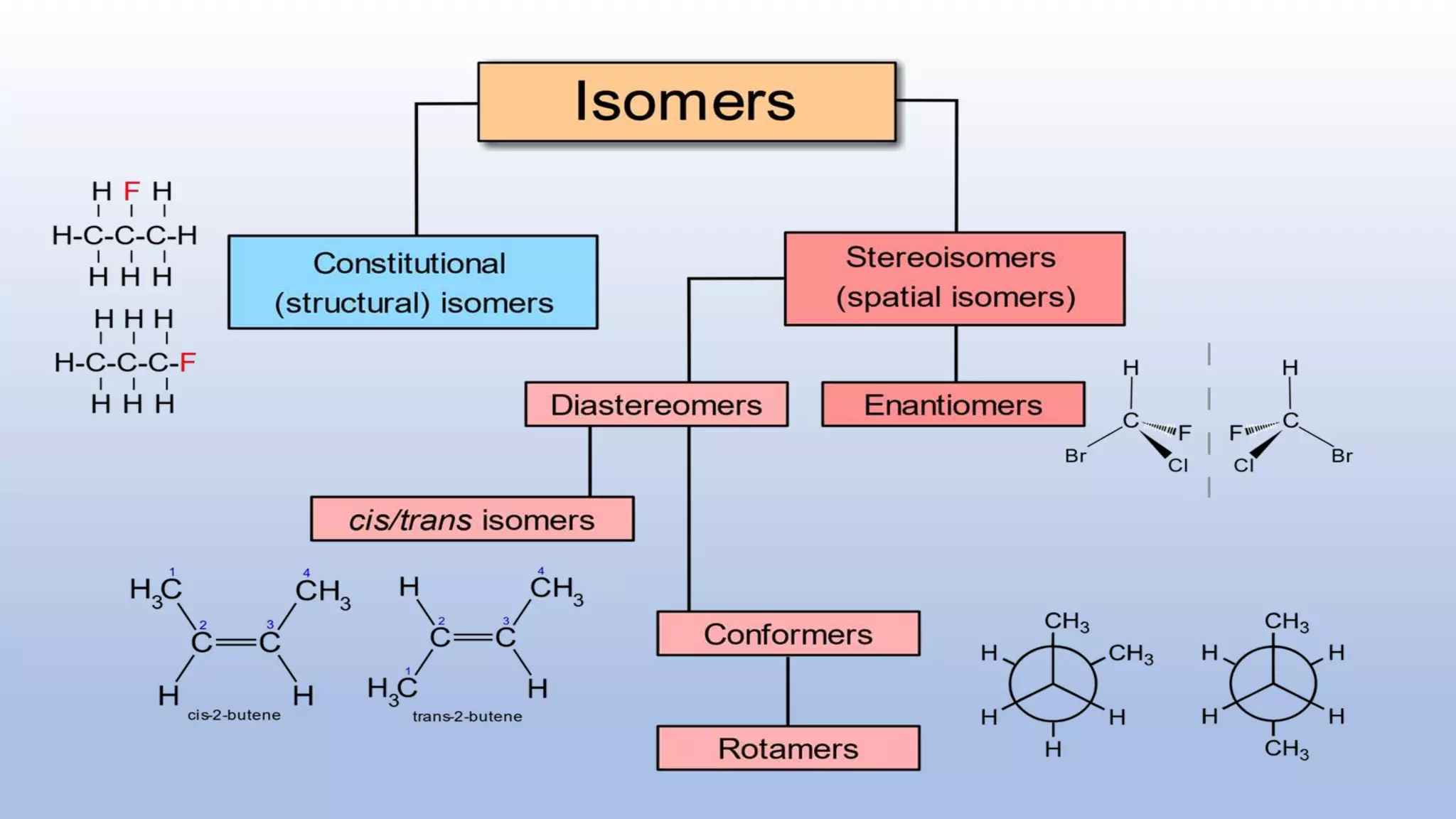
A structural isomer, or constitutional isomer, is a type of isomer
in which molecules with the same molecular formula have
different bonding patterns and atomic organization, as opposed
to stereoisomers in which molecular bonds are always in the same
order and only spatial arrangement differs. There are multiple
synonyms for structural isomers.
THREE CATAGORIES OF STRUCTUARL
ISOMERS
• SKELETAL ISOMERS (CHAIN ISOMERS)
• POSITIONAL ISOMERS (REGIOISOMERS)
• FUNCTIONAL ISOMERS
SKELETAL ISOMERS (CHAIN ISOMERS)
In chain isomerism, or skeletal isomerism, components of the (usually
carbon) skeleton are distinctly re-ordered to create different
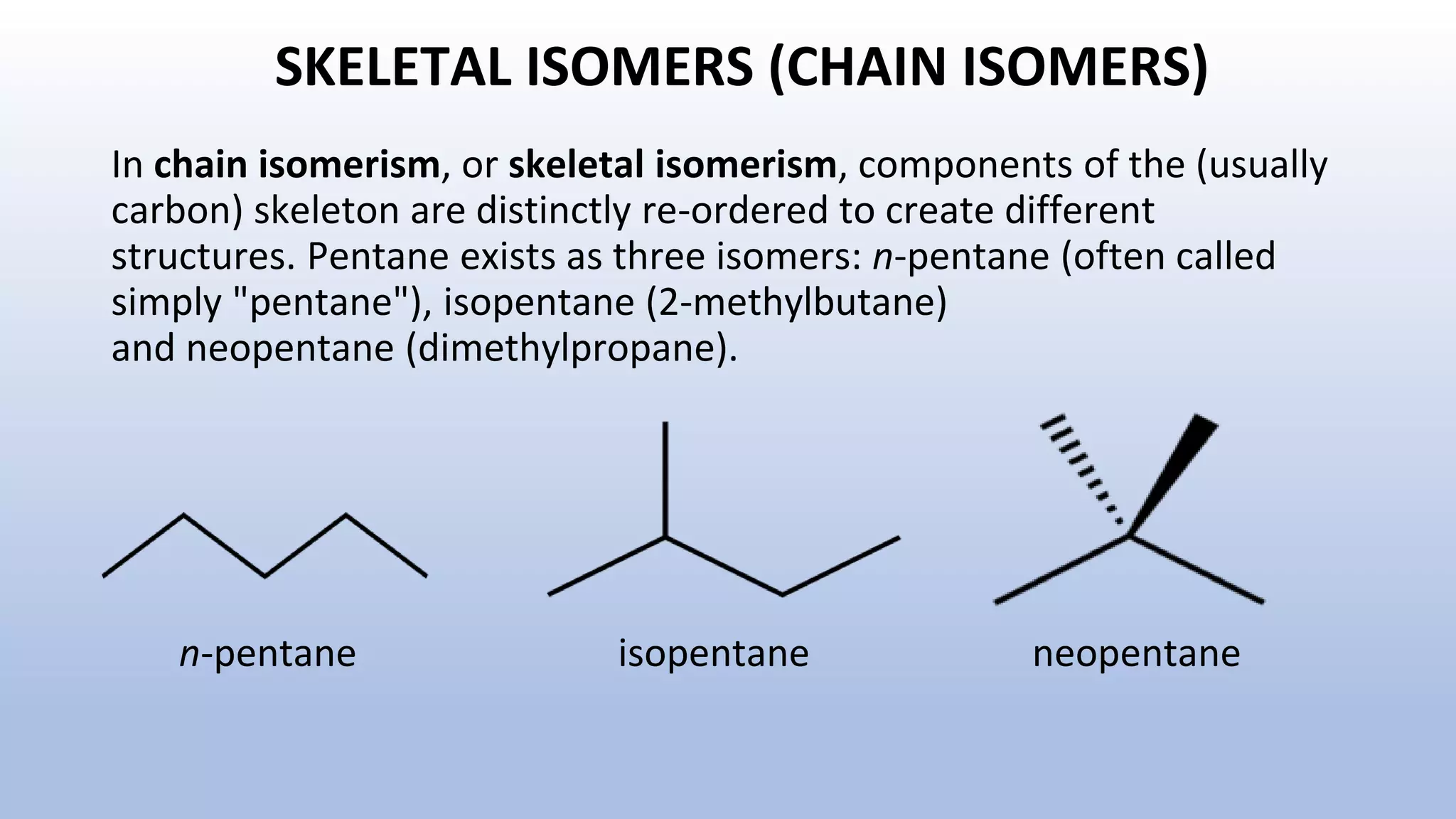
structures. Pentane exists as three isomers: n-pentane (often called
simply "pentane"), isopentane (2-methylbutane)
and neopentane (dimethylpropane).
n-pentane isopentane neopentane
POSITIONAL ISOMERS (REGIOISOMERS)
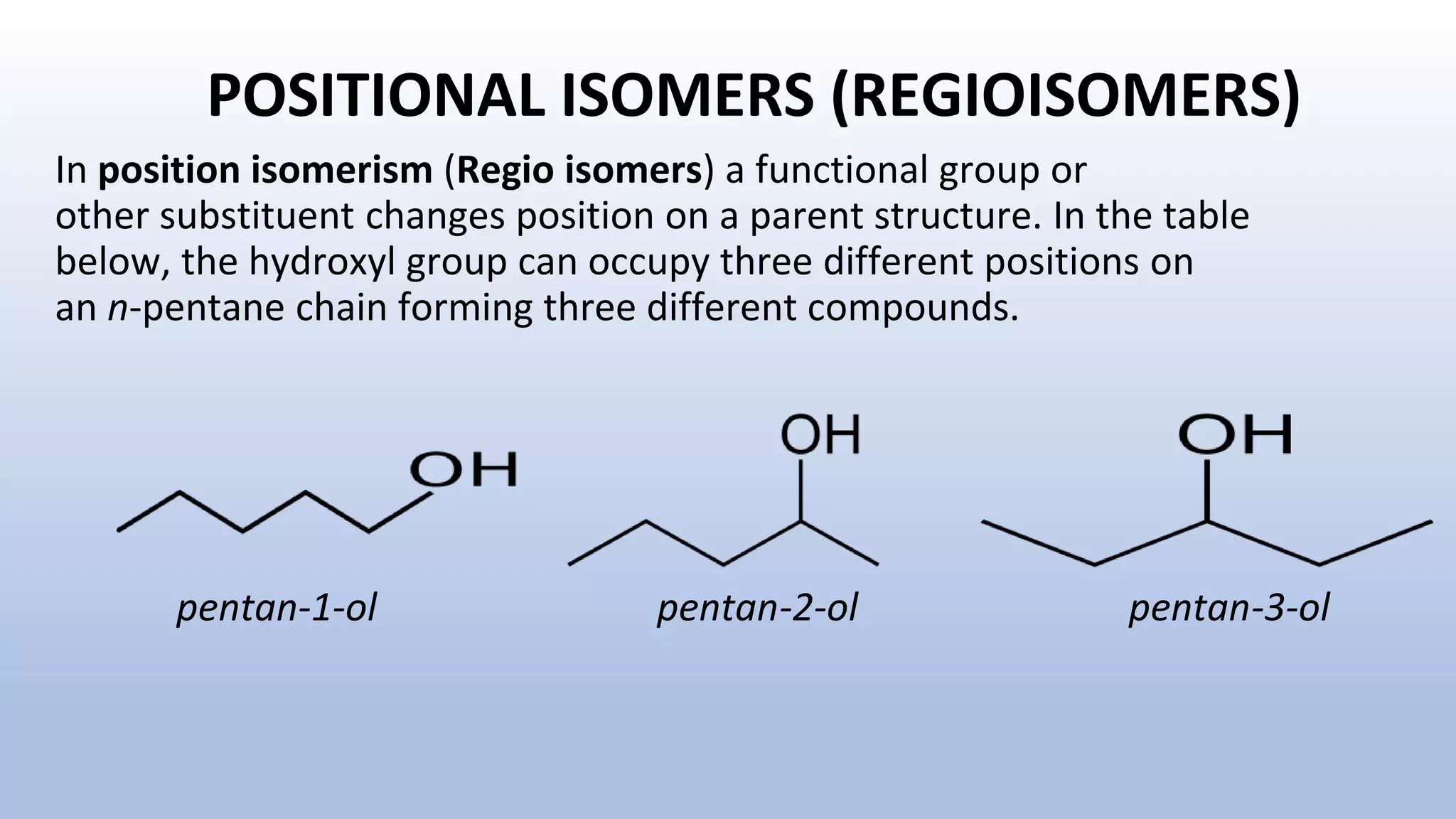
pentan-1-ol pentan-2-ol pentan-3-ol
In position isomerism (Regio isomers) a functional group or
other substituent changes position on a parent structure. In the table
below, the hydroxyl group can occupy three different positions on
an n-pentane chain forming three different compounds.
FUNCTIONAL ISOMERS
Functional isomers are structural isomers that have the same molecular
formula (that is, the same number of atoms of the same elements), but the
atoms are connected in different ways so that the groupings are dissimilar.
These groups of atoms are called functional groups, functionalities.
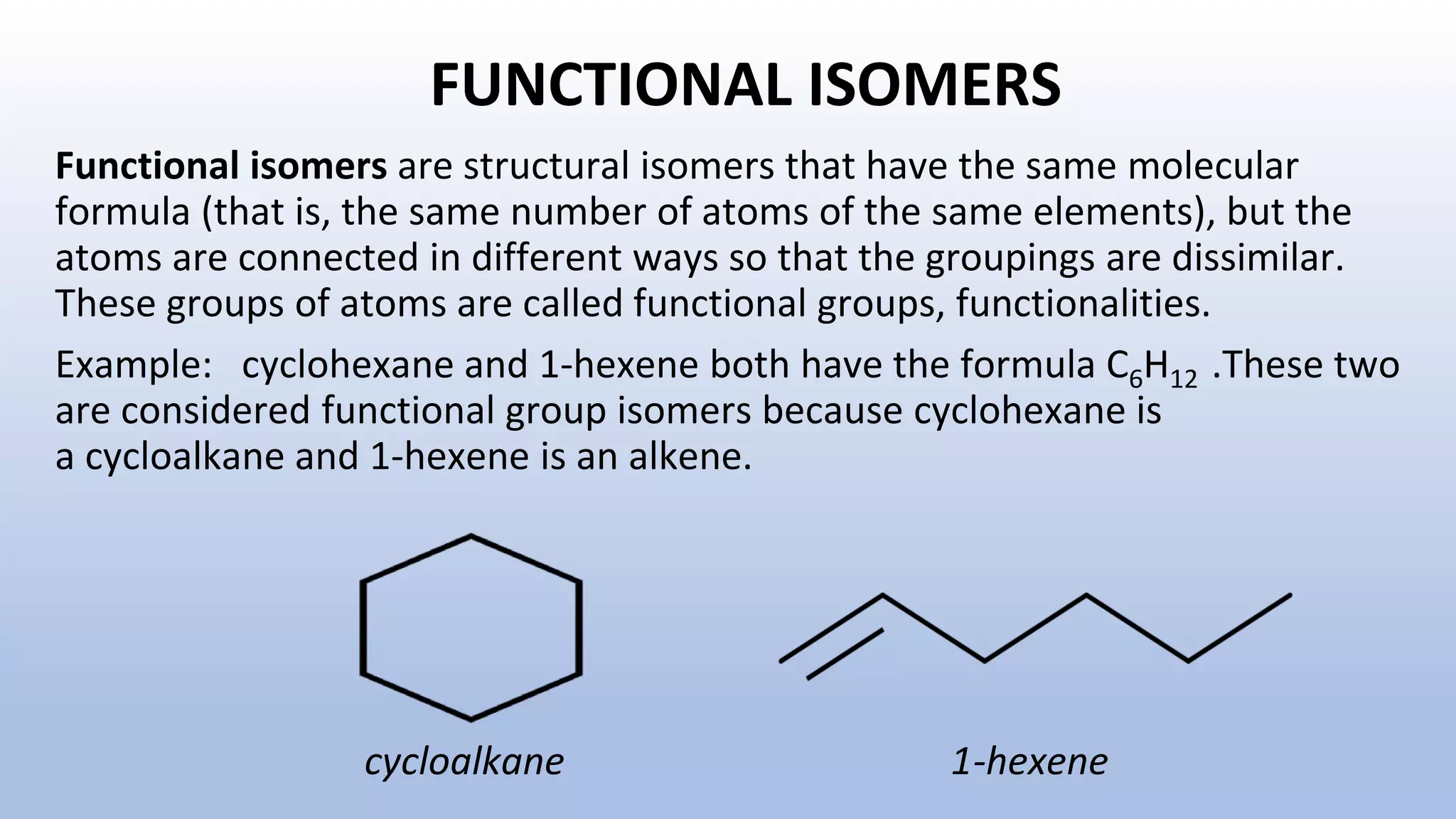
Example: cyclohexane and 1-hexene both have the formula C6H12 .These two
are considered functional group isomers because cyclohexane is
a cycloalkane and 1-hexene is an alkene.
cycloalkane 1-hexene
STEREOISOMERS
In stereochemistry, stereoisomerism, or spatial isomerism, is a form
of isomers in which molecules have the same molecular formula and
sequence of bonded atoms (constitution), but differ in the three-
dimensional orientations of their atoms in space. This contrasts
with structural isomers, which share the same molecular formula, but
the bond connections or their order differs. By definition, molecules
that are stereoisomers of each other represent the same structural
isomer.
They are two types:
• Optical isomerism(Enantiomers)
• Geometrical isomerism
Enantiomers
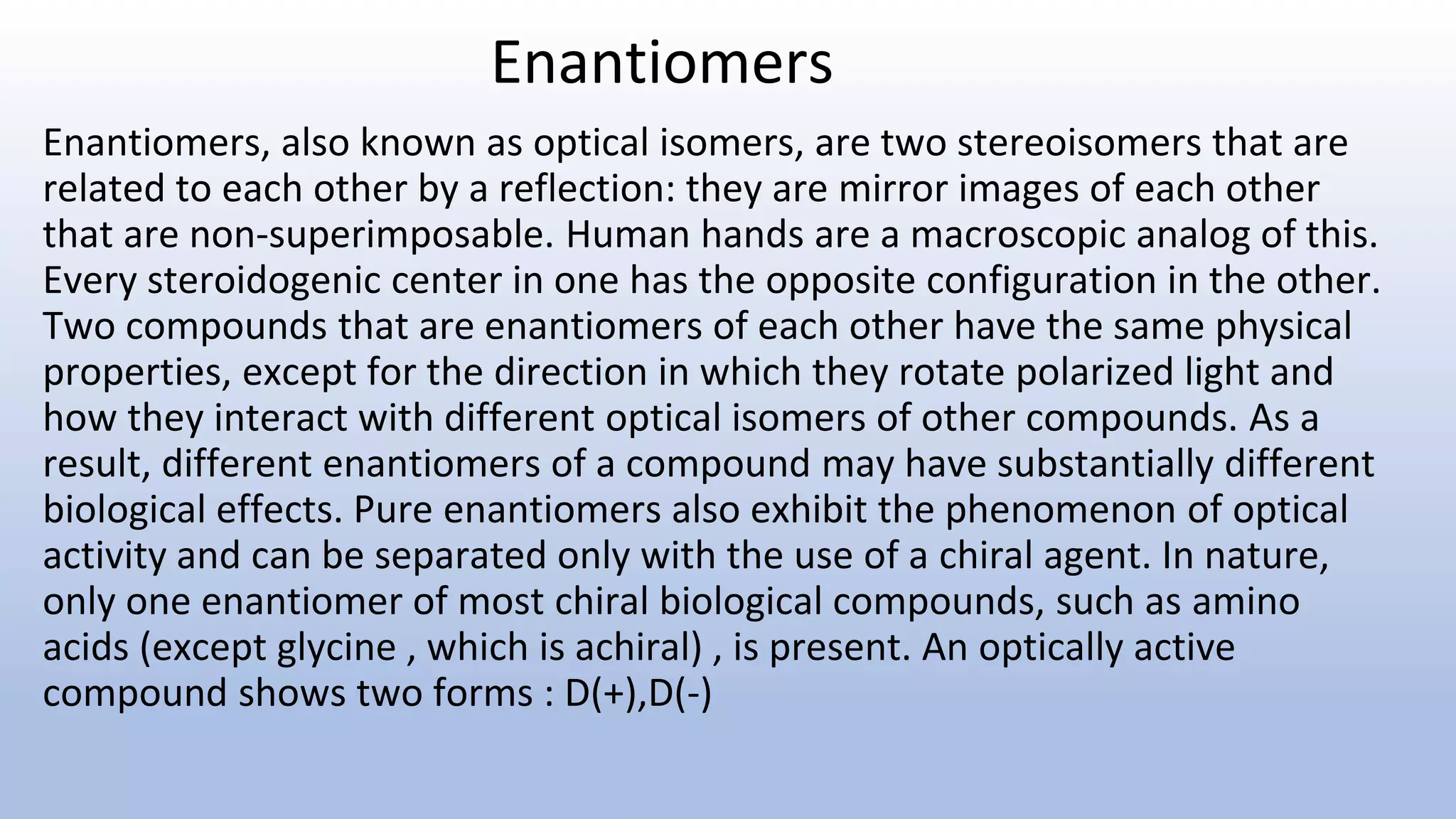
Enantiomers, also known as optical isomers, are two stereoisomers that are
related to each other by a reflection: they are mirror images of each other
that are non-superimposable. Human hands are a macroscopic analog of this.
Every steroidogenic center in one has the opposite configuration in the other.
Two compounds that are enantiomers of each other have the same physical
properties, except for the direction in which they rotate polarized light and
how they interact with different optical isomers of other compounds. As a
result, different enantiomers of a compound may have substantially different
biological effects. Pure enantiomers also exhibit the phenomenon of optical
activity and can be separated only with the use of a chiral agent. In nature,
only one enantiomer of most chiral biological compounds, such as amino
acids (except glycine , which is achiral) , is present. An optically active
compound shows two forms : D(+),D(-)
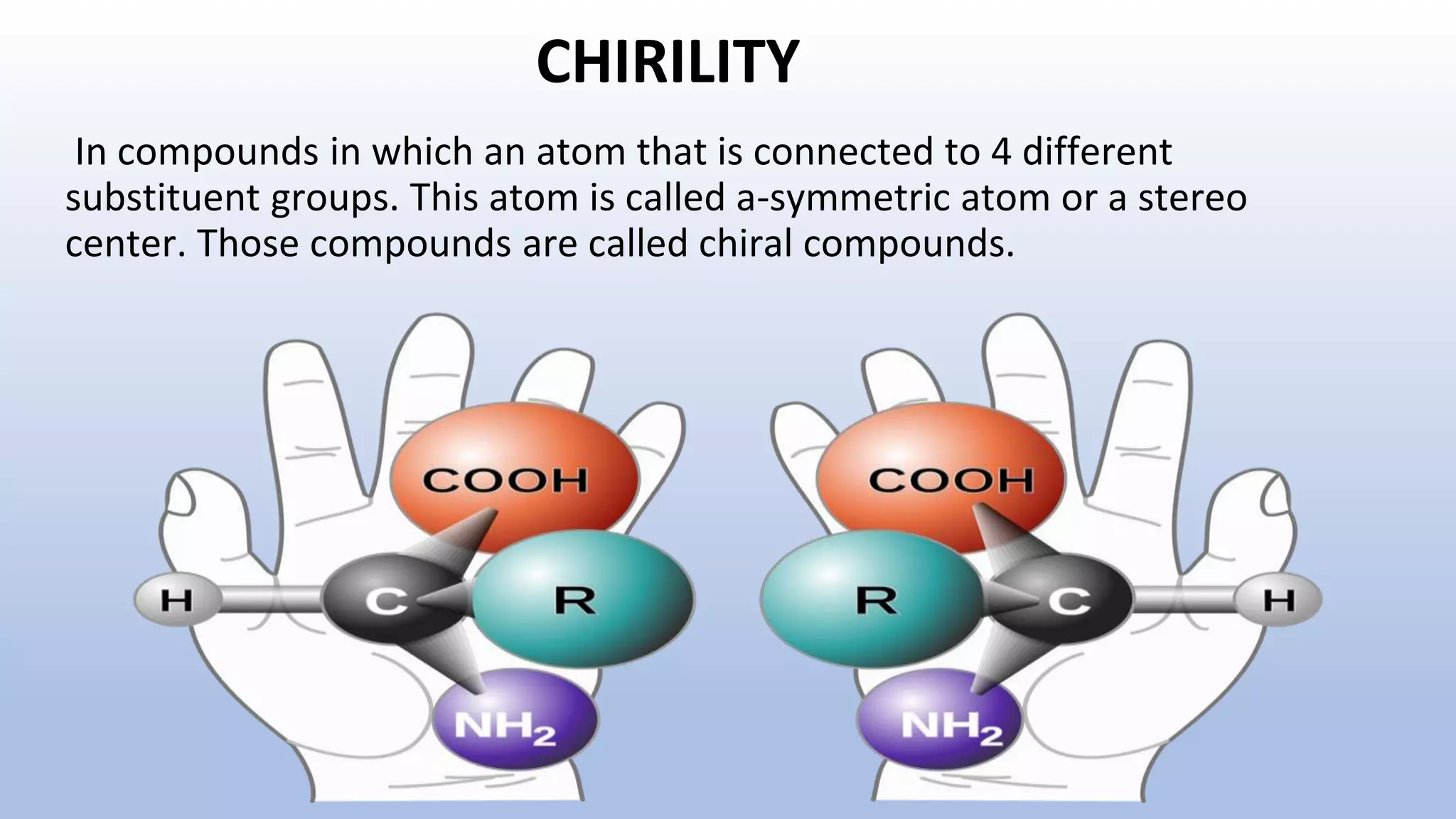
CHIRILITY
In compounds in which an atom that is connected to 4 different
substituent groups. This atom is called a-symmetric atom or a stereo
center. Those compounds are called chiral compounds.
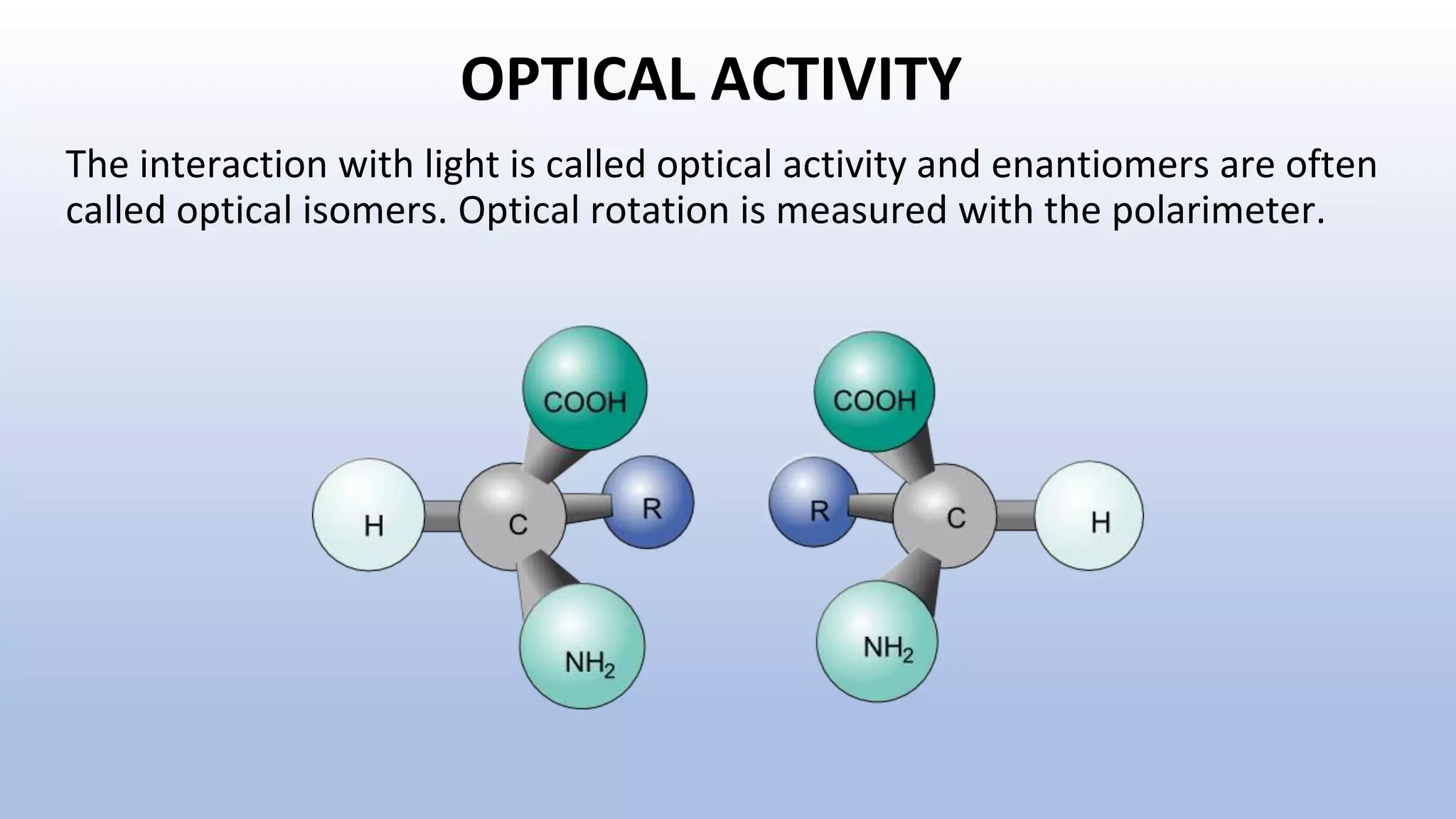
OPTICAL ACTIVITY
The interaction with light is called optical activity and enantiomers are often
called optical isomers. Optical rotation is measured with the polarimeter.
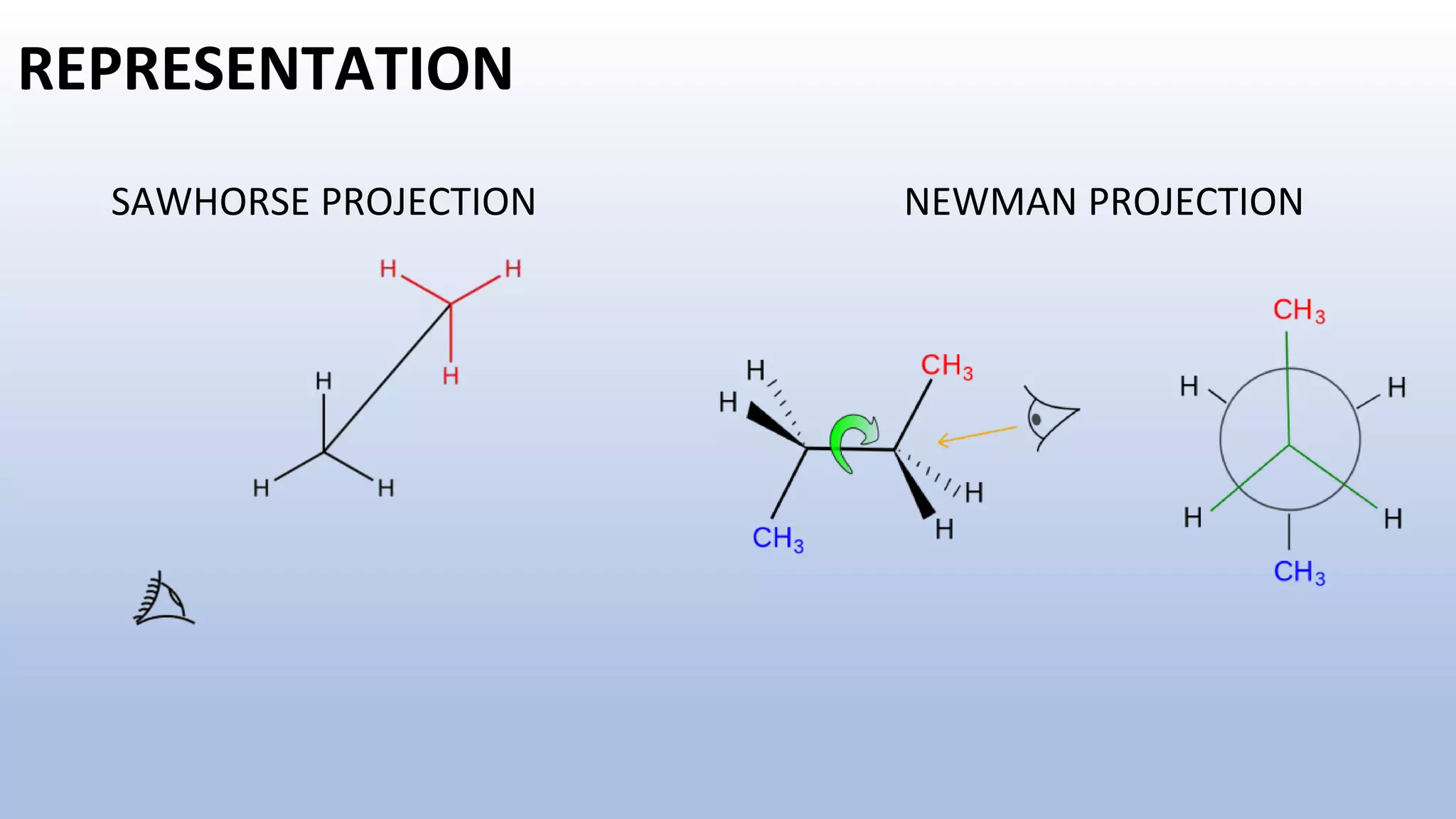
REPRESENTATION
SAWHORSE PROJECTION NEWMAN PROJECTION
FISHER PROJECTION
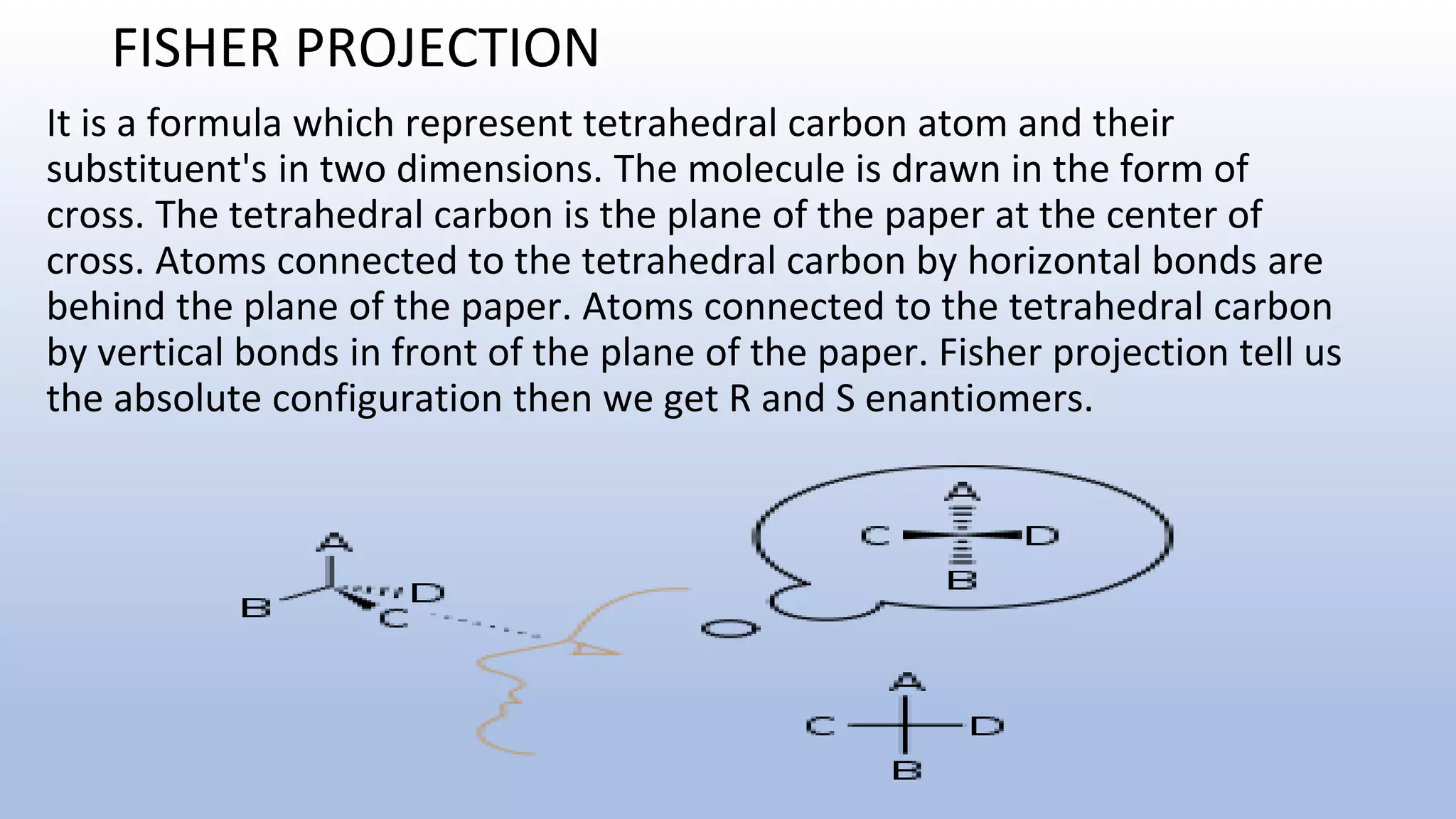
It is a formula which represent tetrahedral carbon atom and their
substituent's in two dimensions. The molecule is drawn in the form of
cross. The tetrahedral carbon is the plane of the paper at the center of
cross. Atoms connected to the tetrahedral carbon by horizontal bonds are
behind the plane of the paper. Atoms connected to the tetrahedral carbon
by vertical bonds in front of the plane of the paper. Fisher projection tell us
the absolute configuration then we get R and S enantiomers.
DIASTEREOMERS
Diastereomers (sometimes called diastereoisomers) are a type of
a stereoimers. Diasteoreomers are defined as non-mirror image non-identical
stereoisomers. Hence, they occur when two or more stereoisomers of a
compound have different configurations at one or more (but not all) of the
equivalent (related) stereocentre and are not mirror images of each other.
When two diastereoisomers differ from each other at only one stereocenter
they are epimers. Each stereocenter gives rise to two different configurations
and thus typically increases the number of stereoisomers by a factor of two.
Diastereomerism can also occur at a double bond, where the cis vs trans
relative positions of substituents give two non-superimposable isomers.
NOMENCLATURE
• Cis -Trans nomenclature
• E-Z nomenclature
• Syn -Anti system of nomenclature.
Cis-Trans nomenclature
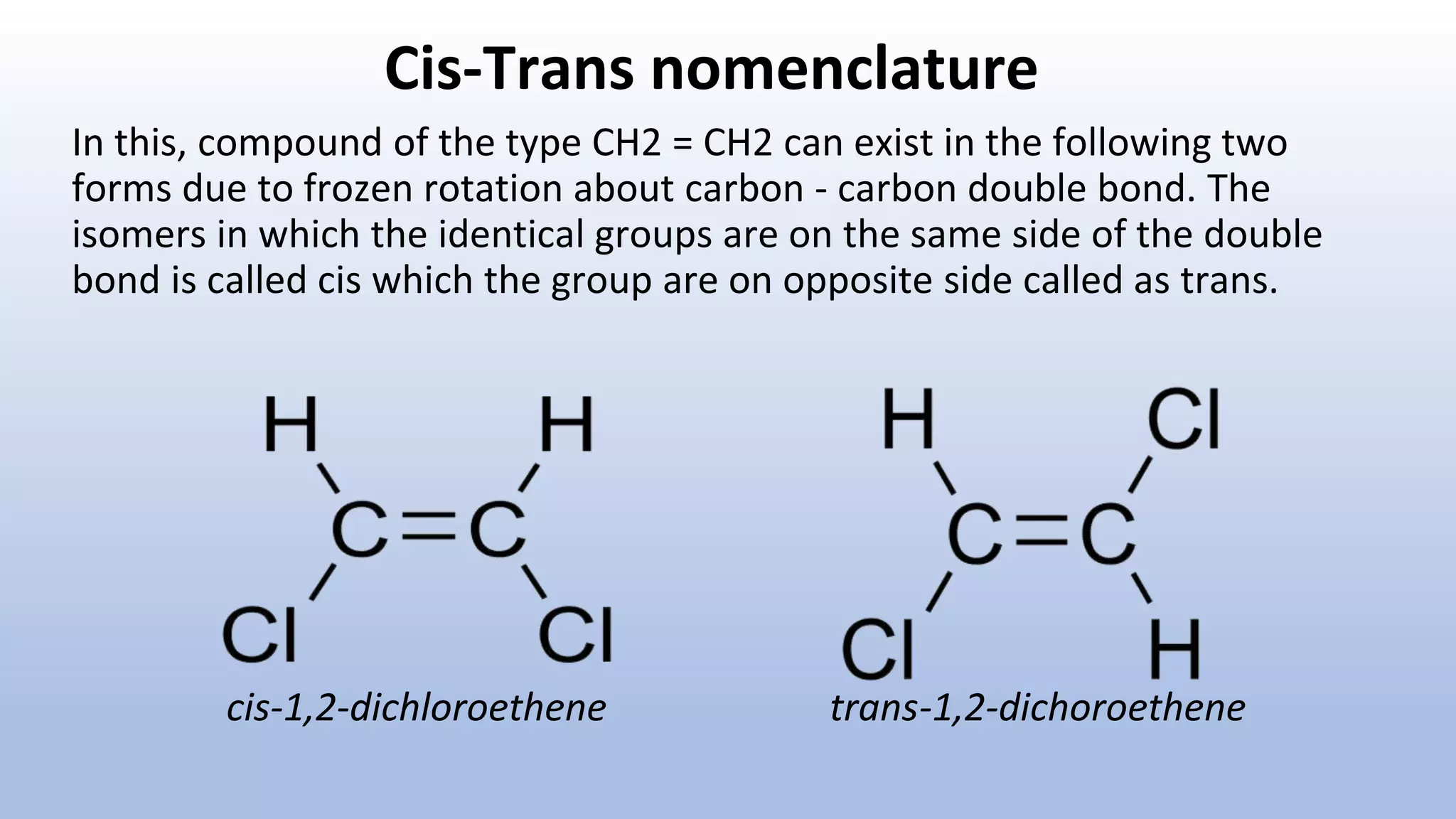
In this, compound of the type CH2 = CH2 can exist in the following two
forms due to frozen rotation about carbon - carbon double bond. The
isomers in which the identical groups are on the same side of the double
bond is called cis which the group are on opposite side called as trans.
cis-1,2-dichloroethene trans-1,2-dichoroethene
E-Z nomenclature
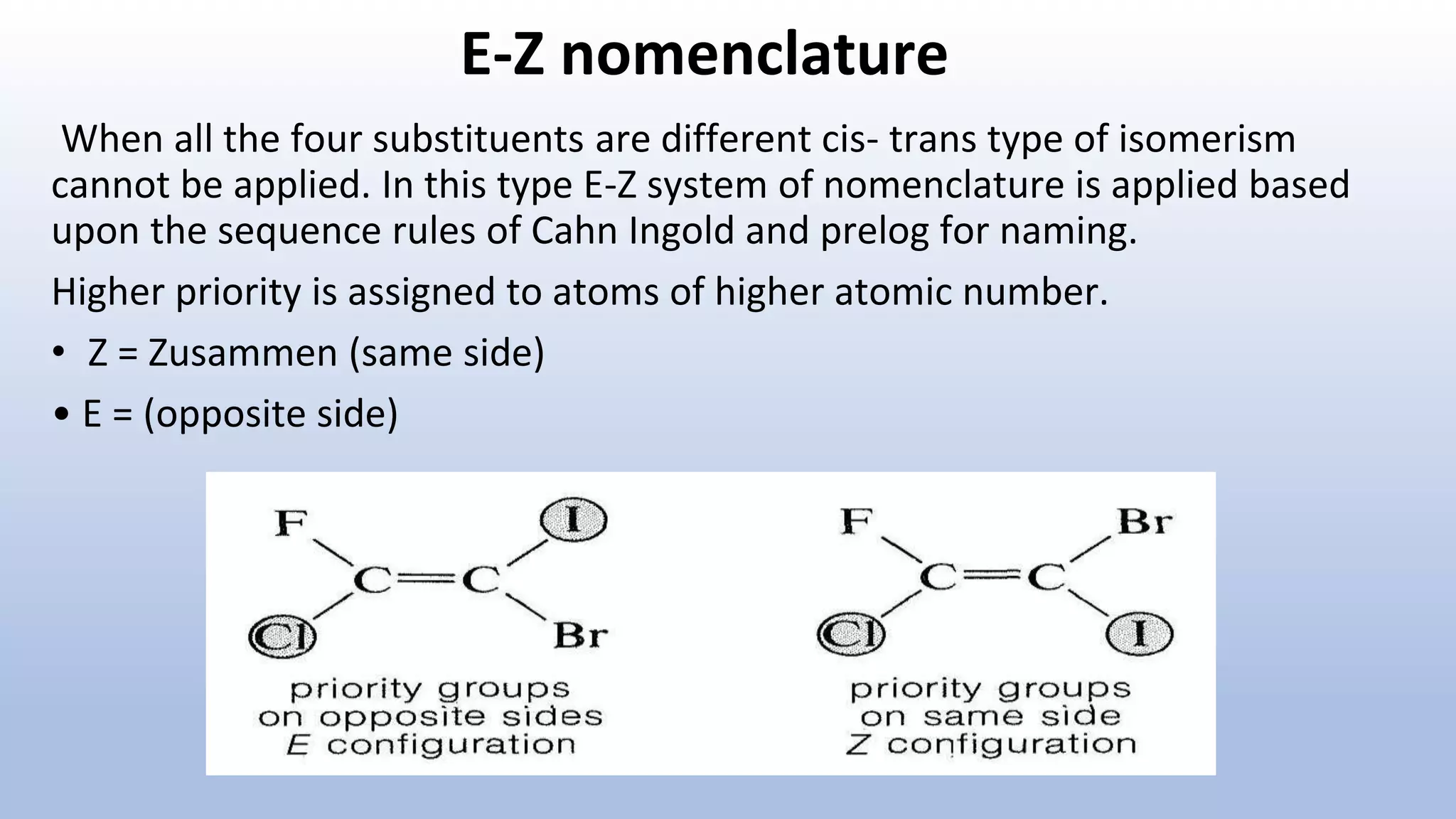
When all the four substituents are different cis- trans type of isomerism
cannot be applied. In this type E-Z system of nomenclature is applied based
upon the sequence rules of Cahn Ingold and prelog for naming.
Higher priority is assigned to atoms of higher atomic number.
• Z = Zusammen (same side)
• E = (opposite side)
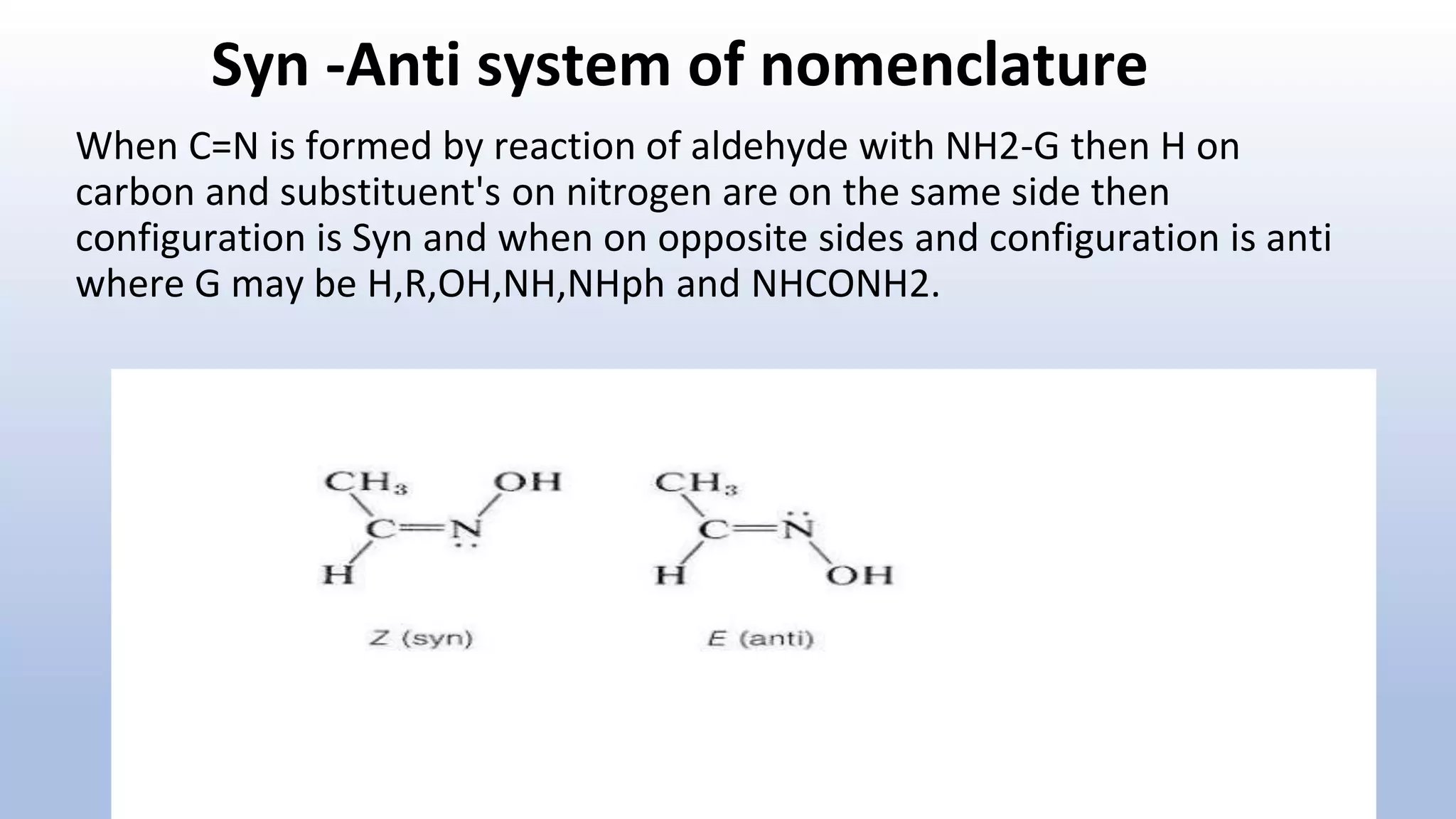
Syn -Anti system of nomenclature
When C=N is formed by reaction of aldehyde with NH2-G then H on
carbon and substituent's on nitrogen are on the same side then
configuration is Syn and when on opposite sides and configuration is anti
where G may be H,R,OH,NH,NHph and NHCONH2.
Resources
• Wikipedia
thank you

Structural isomers and stereoisomers configuration | types of isomers | isomers | isomerism

  • 1.
  • 3.
    STRUCTURAL ISOMERS A structuralisomer, or constitutional isomer, is a type of isomer in which molecules with the same molecular formula have different bonding patterns and atomic organization, as opposed to stereoisomers in which molecular bonds are always in the same order and only spatial arrangement differs. There are multiple synonyms for structural isomers.
  • 4.
    THREE CATAGORIES OFSTRUCTUARL ISOMERS • SKELETAL ISOMERS (CHAIN ISOMERS) • POSITIONAL ISOMERS (REGIOISOMERS) • FUNCTIONAL ISOMERS
  • 5.
    SKELETAL ISOMERS (CHAINISOMERS) In chain isomerism, or skeletal isomerism, components of the (usually carbon) skeleton are distinctly re-ordered to create different structures. Pentane exists as three isomers: n-pentane (often called simply "pentane"), isopentane (2-methylbutane) and neopentane (dimethylpropane). n-pentane isopentane neopentane
  • 6.
    POSITIONAL ISOMERS (REGIOISOMERS) pentan-1-olpentan-2-ol pentan-3-ol In position isomerism (Regio isomers) a functional group or other substituent changes position on a parent structure. In the table below, the hydroxyl group can occupy three different positions on an n-pentane chain forming three different compounds.
  • 7.
    FUNCTIONAL ISOMERS Functional isomersare structural isomers that have the same molecular formula (that is, the same number of atoms of the same elements), but the atoms are connected in different ways so that the groupings are dissimilar. These groups of atoms are called functional groups, functionalities. Example: cyclohexane and 1-hexene both have the formula C6H12 .These two are considered functional group isomers because cyclohexane is a cycloalkane and 1-hexene is an alkene. cycloalkane 1-hexene
  • 8.
    STEREOISOMERS In stereochemistry, stereoisomerism,or spatial isomerism, is a form of isomers in which molecules have the same molecular formula and sequence of bonded atoms (constitution), but differ in the three- dimensional orientations of their atoms in space. This contrasts with structural isomers, which share the same molecular formula, but the bond connections or their order differs. By definition, molecules that are stereoisomers of each other represent the same structural isomer. They are two types: • Optical isomerism(Enantiomers) • Geometrical isomerism
  • 9.
    Enantiomers Enantiomers, also knownas optical isomers, are two stereoisomers that are related to each other by a reflection: they are mirror images of each other that are non-superimposable. Human hands are a macroscopic analog of this. Every steroidogenic center in one has the opposite configuration in the other. Two compounds that are enantiomers of each other have the same physical properties, except for the direction in which they rotate polarized light and how they interact with different optical isomers of other compounds. As a result, different enantiomers of a compound may have substantially different biological effects. Pure enantiomers also exhibit the phenomenon of optical activity and can be separated only with the use of a chiral agent. In nature, only one enantiomer of most chiral biological compounds, such as amino acids (except glycine , which is achiral) , is present. An optically active compound shows two forms : D(+),D(-)
  • 10.
    CHIRILITY In compounds inwhich an atom that is connected to 4 different substituent groups. This atom is called a-symmetric atom or a stereo center. Those compounds are called chiral compounds.
  • 11.
    OPTICAL ACTIVITY The interactionwith light is called optical activity and enantiomers are often called optical isomers. Optical rotation is measured with the polarimeter.
  • 12.
  • 13.
    FISHER PROJECTION It isa formula which represent tetrahedral carbon atom and their substituent's in two dimensions. The molecule is drawn in the form of cross. The tetrahedral carbon is the plane of the paper at the center of cross. Atoms connected to the tetrahedral carbon by horizontal bonds are behind the plane of the paper. Atoms connected to the tetrahedral carbon by vertical bonds in front of the plane of the paper. Fisher projection tell us the absolute configuration then we get R and S enantiomers.
  • 14.
    DIASTEREOMERS Diastereomers (sometimes calleddiastereoisomers) are a type of a stereoimers. Diasteoreomers are defined as non-mirror image non-identical stereoisomers. Hence, they occur when two or more stereoisomers of a compound have different configurations at one or more (but not all) of the equivalent (related) stereocentre and are not mirror images of each other. When two diastereoisomers differ from each other at only one stereocenter they are epimers. Each stereocenter gives rise to two different configurations and thus typically increases the number of stereoisomers by a factor of two. Diastereomerism can also occur at a double bond, where the cis vs trans relative positions of substituents give two non-superimposable isomers. NOMENCLATURE • Cis -Trans nomenclature • E-Z nomenclature • Syn -Anti system of nomenclature.
  • 15.
    Cis-Trans nomenclature In this,compound of the type CH2 = CH2 can exist in the following two forms due to frozen rotation about carbon - carbon double bond. The isomers in which the identical groups are on the same side of the double bond is called cis which the group are on opposite side called as trans. cis-1,2-dichloroethene trans-1,2-dichoroethene
  • 16.
    E-Z nomenclature When allthe four substituents are different cis- trans type of isomerism cannot be applied. In this type E-Z system of nomenclature is applied based upon the sequence rules of Cahn Ingold and prelog for naming. Higher priority is assigned to atoms of higher atomic number. • Z = Zusammen (same side) • E = (opposite side)
  • 17.
    Syn -Anti systemof nomenclature When C=N is formed by reaction of aldehyde with NH2-G then H on carbon and substituent's on nitrogen are on the same side then configuration is Syn and when on opposite sides and configuration is anti where G may be H,R,OH,NH,NHph and NHCONH2.
  • 18.