Summary of Derivatives
In this section we summarize the various types of
derivatives we have encountered and the algebra
associated with each type.
Summary of Derivatives
In this section we summarize the various types of
derivatives we have encountered and the algebra
associated with each type.
Simple Derivatives
Summary of Derivatives
In this section we summarize the various types of
derivatives we have encountered and the algebra
associated with each type.
Simple Derivatives
By simple derivative we mean there is only one input
and one output in the context.
Summary of Derivatives
In this section we summarize the various types of
derivatives we have encountered and the algebra
associated with each type.
Simple Derivatives
By simple derivative we mean there is only one input
and one output in the context. Hence if we only have
y = y(x) or x = x(t), etc.. in such cases the variable that
the derivative is taken with respect to is clear.
Summary of Derivatives
In this section we summarize the various types of
derivatives we have encountered and the algebra
associated with each type.
Simple Derivatives
By simple derivative we mean there is only one input
and one output in the context. Hence if we only have
y = y(x) or x = x(t), etc.. in such cases the variable that
the derivative is taken with respect to is clear.
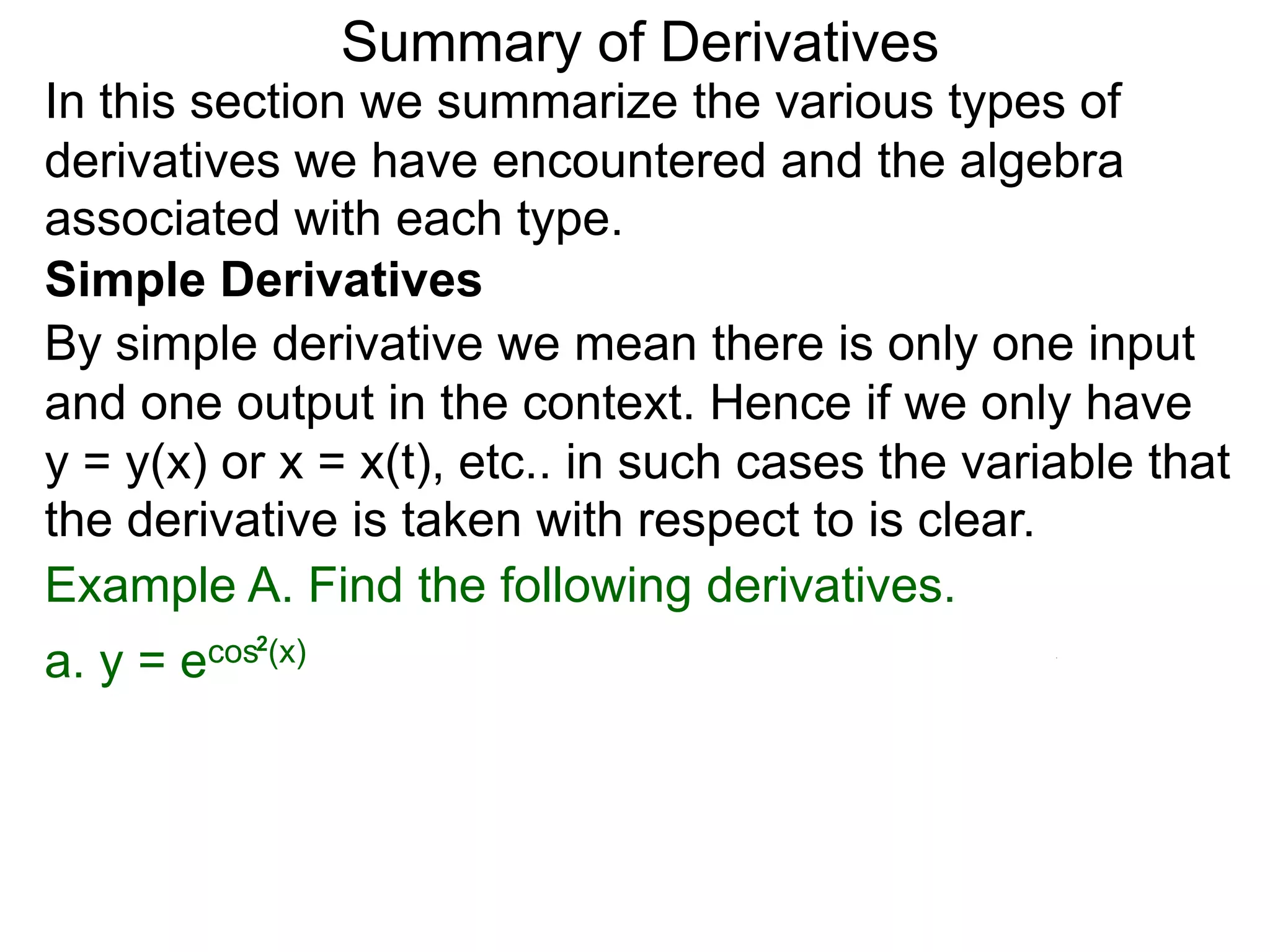
Example A. Find the following derivatives.
a. y =   e cos2(x)
Summary of Derivatives
In this section we summarize the various types of
derivatives we have encountered and the algebra
associated with each type.
Simple Derivatives
By simple derivative we mean there is only one input
and one output in the context. Hence if we only have
y = y(x) or x = x(t), etc.. in such cases the variable that
the derivative is taken with respect to is clear.
Example A. Find the following derivatives.
a. y =e cos2(x)

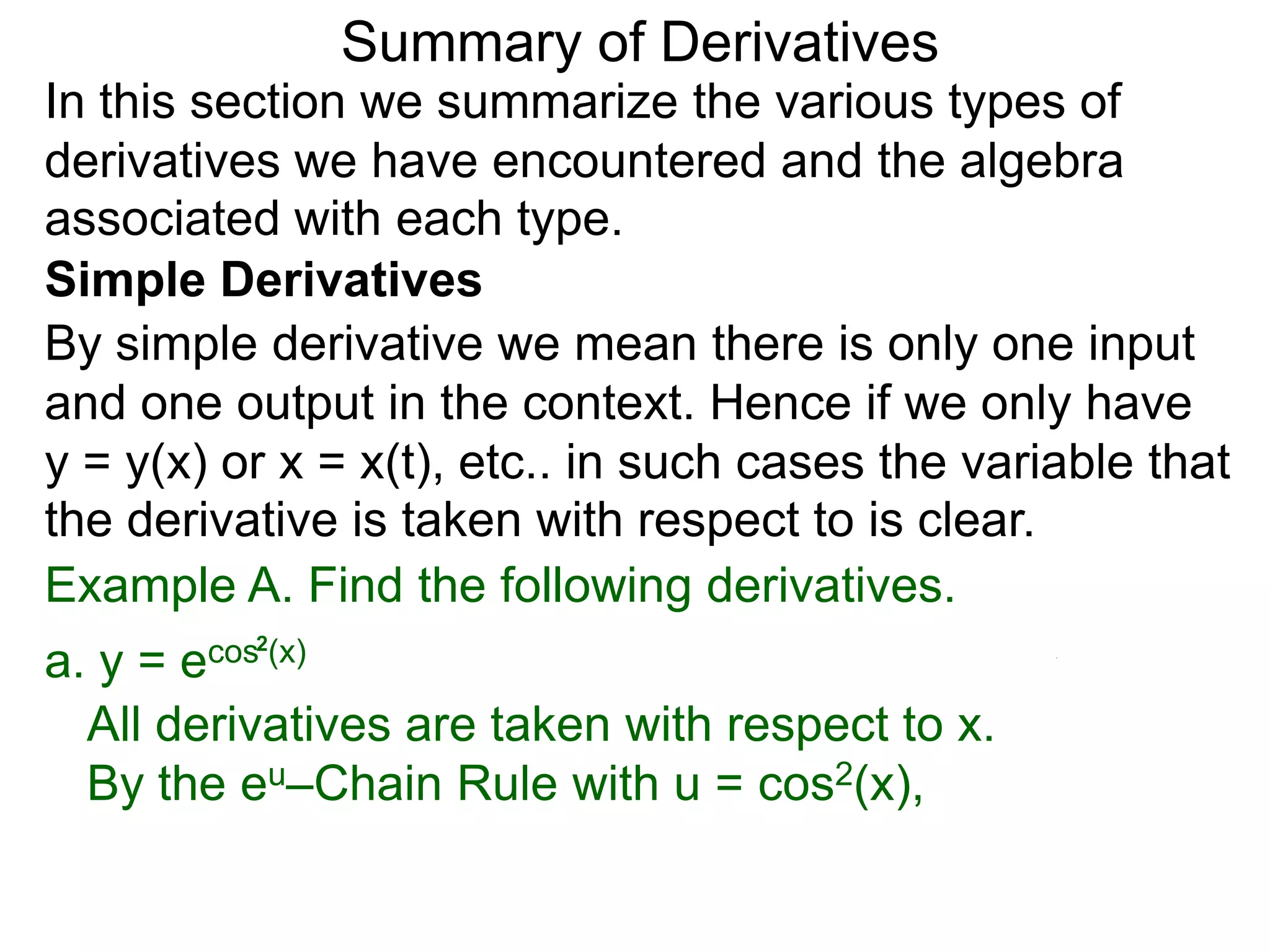
  All derivatives are taken with respect to x.
  By the eu–Chain Rule with u = cos2(x),
Summary of Derivatives
In this section we summarize the various types of
derivatives we have encountered and the algebra
associated with each type.
Simple Derivatives
By simple derivative we mean there is only one input
and one output in the context. Hence if we only have
y = y(x) or x = x(t), etc.. in such cases the variable that
the derivative is taken with respect to is clear.
Example A. Find the following derivatives.
a. y =e cos2(x)

  All derivatives are taken with respect to x.
  By the eu–Chain Rule with u = cos2(x),
  y' = e cos2(x) [cos2(x)]'
Summary of Derivatives
In this section we summarize the various types of
derivatives we have encountered and the algebra
associated with each type.
Simple Derivatives
By simple derivative we mean there is only one input
and one output in the context. Hence if we only have
y = y(x) or x = x(t), etc.. in such cases the variable that
the derivative is taken with respect to is clear.
Example A. Find the following derivatives.
a. y =e cos2(x)

  All derivatives are taken with respect to x.
  By the eu–Chain Rule with u = cos2(x),
  y' = e cos2(x) [cos2(x)]'    by the Power Chain Rule
                                       2
  =e  cos2 (x)2cos(x)[cos(x)]'
Summary of Derivatives
In this section we summarize the various types of
derivatives we have encountered and the algebra
associated with each type.
Simple Derivatives
By simple derivative we mean there is only one input
and one output in the context. Hence if we only have
y = y(x) or x = x(t), etc.. in such cases the variable that
the derivative is taken with respect to is clear.
Example A. Find the following derivatives.
a. y =e cos2(x)

  All derivatives are taken with respect to x.
  By the eu–Chain Rule with u = cos2(x),
  y' = e cos2(x) [cos2(x)]'   by the Power Chain Rule
  =e  cos2 (x)2cos(x)[cos(x)]' = –2ecos2 (x)cos(x)sin(x)
Summary of Derivatives
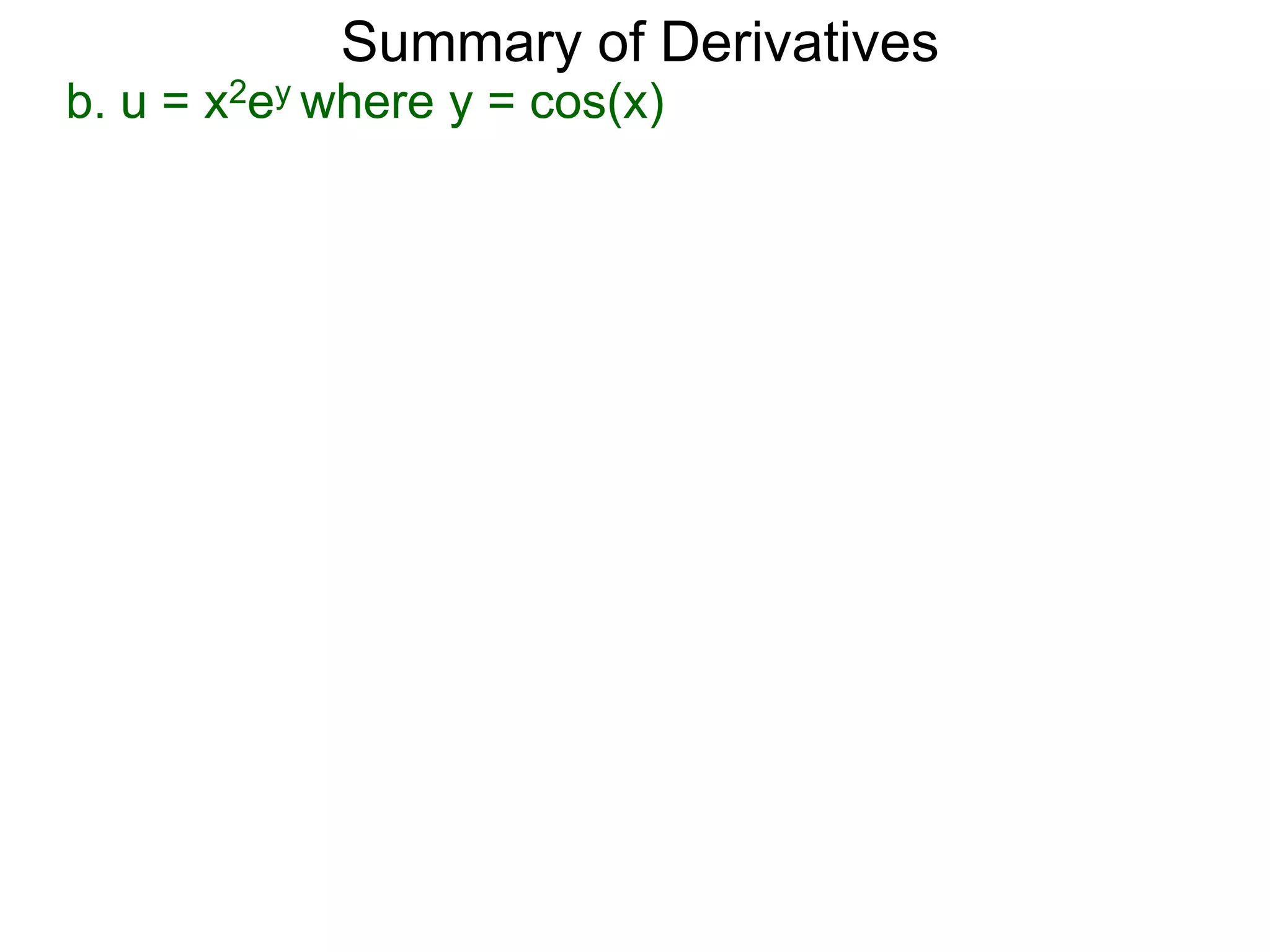
b. u = x2ey where y = cos(x)
Summary of Derivatives
b. u = x2ey where y = cos(x)
Assuming the derivative is taken with respect to x,
there are two ways to track the derivation.
Summary of Derivatives
b. u = x2ey where y = cos(x)
Assuming the derivative is taken with respect to x,
there are two ways to track the derivation.
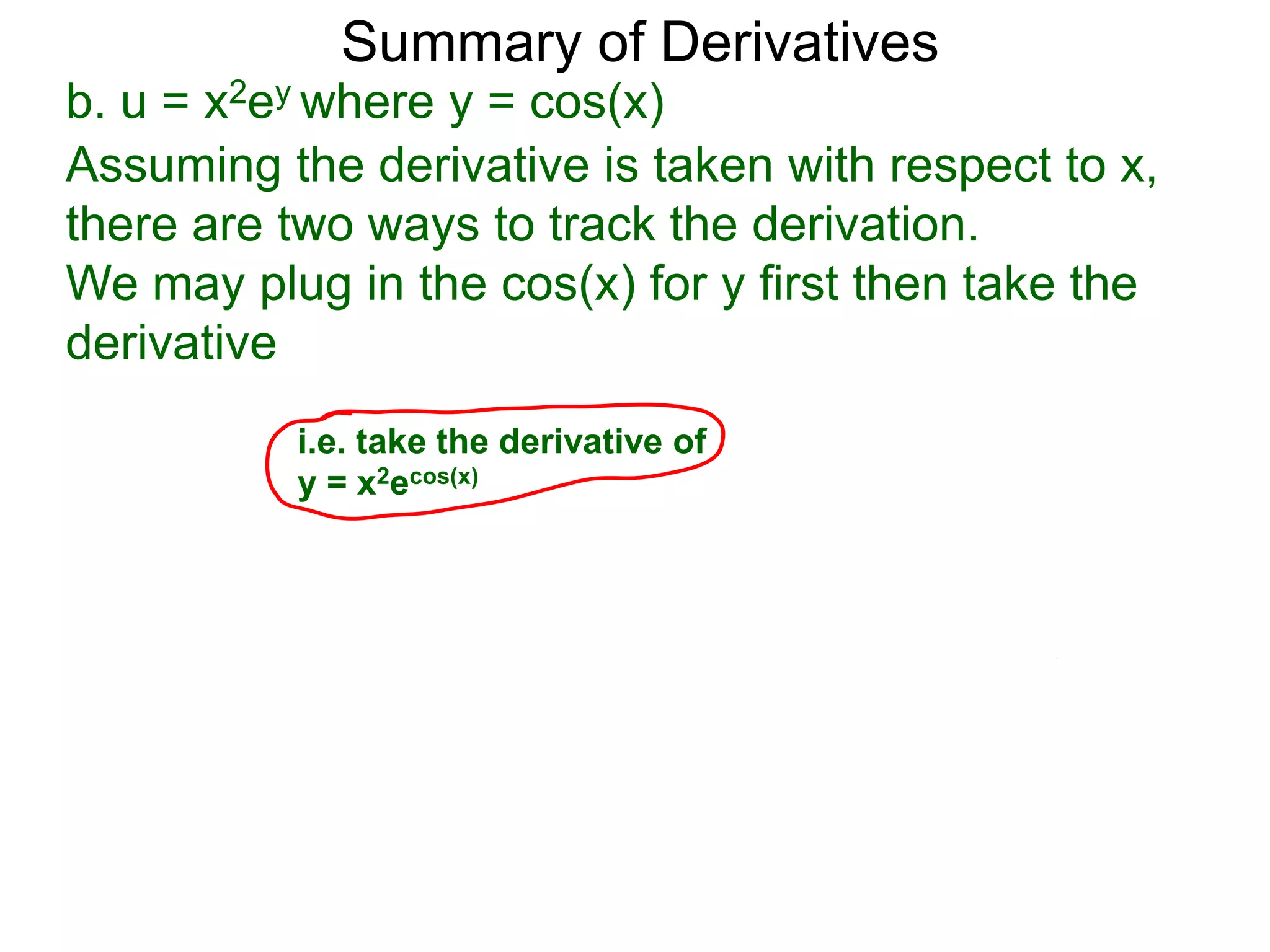
We may plug in the cos(x) for y first then take the
derivative
Summary of Derivatives
b. u = x2ey where y = cos(x)
Assuming the derivative is taken with respect to x,
there are two ways to track the derivation.
We may plug in the cos(x) for y first then take the
derivative
          i.e. take the derivative of
          y = x2ecos(x)
Summary of Derivatives
b. u = x2ey where y = cos(x)
Assuming the derivative is taken with respect to x,
there are two ways to track the derivation.
We may plug in the cos(x) for y first then take the
derivative or as we would proceed with the
Product Rule and track the derivation with y.
Summary of Derivatives
b. u = x2ey where y = cos(x)
Assuming the derivative is taken with respect to x,
there are two ways to track the derivation.
We may plug in the cos(x) for y first then take the
derivative or as we would proceed with the
Product Rule and track the derivation with y.
u' = [x2]'ey + x2[ey]'
Summary of Derivatives
b. u = x2ey where y = cos(x)
Assuming the derivative is taken with respect to x,
there are two ways to track the derivation.
We may plug in the cos(x) for y first then take the
derivative or as we would proceed with the
Product Rule and track the derivation with y.
u' = [x2]'ey + x2[ey]'
   = 2xey + x2ey[y]'
Summary of Derivatives
b. u = x2ey where y = cos(x)
Assuming the derivative is taken with respect to x,
there are two ways to track the derivation.
We may plug in the cos(x) for y first then take the
derivative or as we would proceed with the
Product Rule and track the derivation with y.
u' = [x2]'ey + x2[ey]'
   = 2xey + x2ey[y]'
Substitute y = cos(x) and y' = –sin(x), we have
u' = 2xecos(x) – x2sin(x)ecos(x)
Summary of Derivatives
b. u = x2ey where y = cos(x)
Assuming the derivative is taken with respect to x,
there are two ways to track the derivation.
We may plug in the cos(x) for y first then take the
derivative or as we would proceed with the
Product Rule and track the derivation with y.
u' = [x2]'ey + x2[ey]'
   = 2xey + x2ey[y]'
Substitute y = cos(x) and y' = –sin(x), we have
u' = 2xecos(x) – x2sin(x)ecos(x)
   = xecos(x)(2 – xsin(x))
Summary of Derivatives
b. u = x2ey where y = cos(x)
Assuming the derivative is taken with respect to x,
there are two ways to track the derivation.
We may plug in the cos(x) for y first then take the
derivative or as we would proceed with the
Product Rule and track the derivation with y.
u' = [x2]'ey + x2[ey]'
   = 2xey + x2ey[y]'
Substitute y = cos(x) and y' = –sin(x), we have
u' = 2xecos(x) – x2sin(x)ecos(x)
   = xecos(x)(2 – xsin(x))
The above derivation leads to implicit differentiation.
Summary of Derivatives
Implicit Derivatives
Summary of Derivatives
Implicit Derivatives
In implicit differentiation, a two (or more)–variable
equation is given, we assume one of them as the
independent variable, say v,
Summary of Derivatives
Implicit Derivatives
In implicit differentiation, a two (or more)–variable
equation is given, we assume one of them as the
independent variable, say v, and we are to find the
derivative of the other variable with respect to v,
Summary of Derivatives
Implicit Derivatives
In implicit differentiation, a two (or more)–variable
equation is given, we assume one of them as the
independent variable, say v, and we are to find the
derivative of the other variable with respect to v,
hence the Chain Rules are needed for derivatives of
the variable in the equations.
Summary of Derivatives
Implicit Derivatives
In implicit differentiation, a two (or more)–variable
equation is given, we assume one of them as the
independent variable, say v, and we are to find the
derivative of the other variable with respect to v,
hence the Chain Rules are needed for derivatives of
the variable in the equations.
Example B. Given that 2u2 – v3 = 2 – uv,
a. Find the derivative of u with respect to v.
Summary of Derivatives
Implicit Derivatives
In implicit differentiation, a two (or more)–variable
equation is given, we assume one of them as the
independent variable, say v, and we are to find the
derivative of the other variable with respect to v,
hence the Chain Rules are needed for derivatives of
the variable in the equations.
Example B. Given that 2u2 – v3 = 2 – uv,
a. Find the derivative of u with respect to v.
Taking the derivative with respect to v both sides,
[2u2 – v3 = 2 – uv]'
Summary of Derivatives
Implicit Derivatives
In implicit differentiation, a two (or more)–variable
equation is given, we assume one of them as the
independent variable, say v, and we are to find the
derivative of the other variable with respect to v,
hence the Chain Rules are needed for derivatives of
the variable in the equations.
Example B. Given that 2u2 – v3 = 2 – uv,
a. Find the derivative of u with respect to v.
Taking the derivative with respect to v both sides,
[2u2 – v3 = 2 – uv]'
4uu' – 3v2 =
Summary of Derivatives
Implicit Derivatives
In implicit differentiation, a two (or more)–variable
equation is given, we assume one of them as the
independent variable, say v, and we are to find the
derivative of the other variable with respect to v,
hence the Chain Rules are needed for derivatives of
the variable in the equations.
Example B. Given that 2u2 – v3 = 2 – uv,
a. Find the derivative of u with respect to v.
Taking the derivative with respect to v both sides,
[2u2 – v3 = 2 – uv]'
4uu' – 3v2 = –u'v – uv'
Summary of Derivatives
Implicit Derivatives
In implicit differentiation, a two (or more)–variable
equation is given, we assume one of them as the
independent variable, say v, and we are to find the
derivative of the other variable with respect to v,
hence the Chain Rules are needed for derivatives of
the variable in the equations.
Example B. Given that 2u2 – v3 = 2 – uv,
a. Find the derivative of u with respect to v.
Taking the derivative with respect to v both sides,
[2u2 – v3 = 2 – uv]'         1
4uu' – 3v2 = –u'v – uv'
Summary of Derivatives
Implicit Derivatives
In implicit differentiation, a two (or more)–variable
equation is given, we assume one of them as the
independent variable, say v, and we are to find the
derivative of the other variable with respect to v,
hence the Chain Rules are needed for derivatives of
the variable in the equations.
Example B. Given that 2u2 – v3 = 2 – uv,
a. Find the derivative of u with respect to v.
Taking the derivative with respect to v both sides,
[2u2 – v3 = 2 – uv]'         1
4uu' – 3v2 = –u'v – uv'
u'(4u + v) = 3v2 – u
Summary of Derivatives
Implicit Derivatives
In implicit differentiation, a two (or more)–variable
equation is given, we assume one of them as the
independent variable, say v, and we are to find the
derivative of the other variable with respect to v,
hence the Chain Rules are needed for derivatives of
the variable in the equations.
Example B. Given that 2u2 – v3 = 2 – uv,
a. Find the derivative of u with respect to v.
Taking the derivative with respect to v both sides,
[2u2 – v3 = 2 – uv]'         1
4uu' – 3v2 = –u'v – uv'
u'(4u + v) = 3v2 – u
        3v2 – u
so u' = 4u + v
Summary of Derivatives
b. Find the derivative of v with respect to u.
Summary of Derivatives
b. Find the derivative of v with respect to u.
Taking the derivative with respect to u both sides,
[2u2 – v3 = 2 – uv]'
Summary of Derivatives
b. Find the derivative of v with respect to u.
Taking the derivative with respect to u both sides,
[2u2 – v3 = 2 – uv]'
4u – 3v2v' = –v – uv'
Summary of Derivatives
b. Find the derivative of v with respect to u.
Taking the derivative with respect to u both sides,
[2u2 – v3 = 2 – uv]'
4u – 3v2v' = –v – uv'
uv' – 3v2v' = –v – 4u
Summary of Derivatives
b. Find the derivative of v with respect to u.
Taking the derivative with respect to u both sides,
[2u2 – v3 = 2 – uv]'
4u – 3v2v' = –v – uv'
uv' – 3v2v' = –v – 4u
v'(u – 3v2) = – v – 4u so
Summary of Derivatives
b. Find the derivative of v with respect to u.
Taking the derivative with respect to u both sides,
[2u2 – v3 = 2 – uv]'
4u – 3v2v' = –v – uv'
uv' – 3v2v' = –v – 4u
v'(u – 3v2) = – v – 4u so
         – 4u – v      4u + v
so v' = u – 3v2 = 3v2 – u
Summary of Derivatives
b. Find the derivative of v with respect to u.
Taking the derivative with respect to u both sides,
[2u2 – v3 = 2 – uv]'
4u – 3v2v' = –v – uv'
uv' – 3v2v' = –v – 4u
v'(u – 3v2) = – v – 4u so
         – 4u – v      4u + v
so v' = u – 3v2 = 3v2 – u
In the differential–notation, the reciprocal relation of
these derivatives becomes clear.
Summary of Derivatives
b. Find the derivative of v with respect to u.
Taking the derivative with respect to u both sides,
[2u2 – v3 = 2 – uv]'
4u – 3v2v' = –v – uv'
uv' – 3v2v' = –v – 4u
v'(u – 3v2) = – v – 4u so
         – 4u – v      4u + v
so v' = u – 3v2 = 3v2 – u
In the differential–notation, the reciprocal relation of
these derivatives becomes clear.
 du 3v2 – u           dv = 4u + v
 dv = 4u + v          du      3v2 – u
Summary of Derivatives
b. Find the derivative of v with respect to u.
Taking the derivative with respect to u both sides,
[2u2 – v3 = 2 – uv]'
4u – 3v2v' = –v – uv'
uv' – 3v2v' = –v – 4u
v'(u – 3v2) = – v – 4u so
         – 4u – v      4u + v
so v' = u – 3v2 = 3v2 – u
In the differential–notation, the reciprocal relation of
these derivatives becomes clear.
 du 3v2 – u           dv = 4u + v
 dv = 4u + v          du      3v2 – u
This follows the fact that the slopes at two diagonally
reflected points on the graphs of a pair of inverse
functions are the reciprocal of each other.
Related Rates
Related Rates Derivatives
Related Rates
Related Rates Derivatives
In related rates problems all variables are assumed to
be functions of a single variable t, usually for time,
Related Rates
Related Rates Derivatives
In related rates problems all variables are assumed to
be functions of a single variable t, usually for time,
and all the derivatives (#)' are taken with respect to t.
Related Rates
Related Rates Derivatives
In related rates problems all variables are assumed to
be functions of a single variable t, usually for time,
and all the derivatives (#)' are taken with respect to t.
Hence the derivatives of all of the variables in the
context require the Chain Rules.
Related Rates
Related Rates Derivatives
In related rates problems all variables are assumed to
be functions of a single variable t, usually for time,
and all the derivatives (#)' are taken with respect to t.
Hence the derivatives of all of the variables in the
context require the Chain Rules. In a related rate
problem, the defining relation usually is formula such
as the Distance Formula, or any formula from any
scientific discipline that relates multiple variables where
each variable is a function in t.
Related Rates
Related Rates Derivatives
In related rates problems all variables are assumed to
be functions of a single variable t, usually for time,
and all the derivatives (#)' are taken with respect to t.
Hence the derivatives of all of the variables in the
context require the Chain Rules. In a related rate
problem, the defining relation usually is formula such
as the Distance Formula, or any formula from any
scientific discipline that relates multiple variables where
each variable is a function in t.
Often in these problems, the explicit formulas in terms t
are bypassed. Instead the relations and values of the
variables and their rates with respect to t are provided
for numeric inputs.
Summary of Derivatives
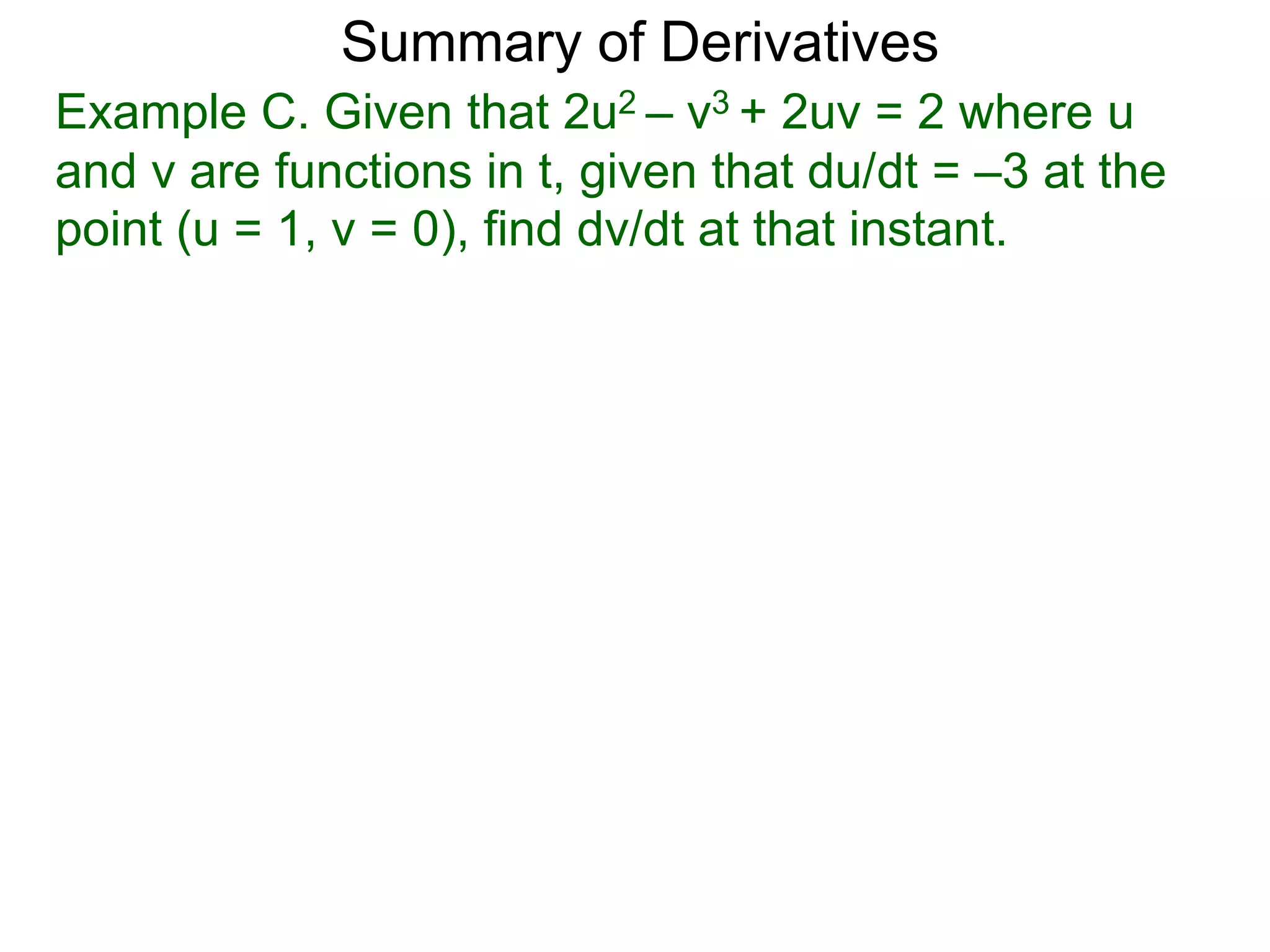
Example C. Given that 2u2 – v3 + 2uv = 2 where u
and v are functions in t, given that du/dt = –3 at the
point (u = 1, v = 0), find dv/dt at that instant.
Summary of Derivatives
Example C. Given that 2u2 – v3 + 2uv = 2 where u
and v are functions in t, given that du/dt = –3 at the
point (u = 1, v = 0), find dv/dt at that instant.
Taking the derivative with respect to t using the
prime–notation,
[2u2 – v3 + 2uv = 2]'
Summary of Derivatives
Example C. Given that 2u2 – v3 + 2uv = 2 where u
and v are functions in t, given that du/dt = –3 at the
point (u = 1, v = 0), find dv/dt at that instant.
Taking the derivative with respect to t using the
prime–notation,
[2u2 – v3 + 2uv = 2]'
4uu' – 3v2v' + 2u'v + 2uv' = 0
Summary of Derivatives
Example C. Given that 2u2 – v3 + 2uv = 2 where u
and v are functions in t, given that du/dt = –3 at the
point (u = 1, v = 0), find dv/dt at that instant.
Taking the derivative with respect to t using the
prime–notation,
[2u2 – v3 + 2uv = 2]'
4uu' – 3v2v' + 2u'v + 2uv' = 0
Substitute u' = –3 at u = 1, v = 0, we get
–12 + 2v' = 0
Summary of Derivatives
Example C. Given that 2u2 – v3 + 2uv = 2 where u
and v are functions in t, given that du/dt = –3 at the
point (u = 1, v = 0), find dv/dt at that instant.
Taking the derivative with respect to t using the
prime–notation,
[2u2 – v3 + 2uv = 2]'
4uu' – 3v2v' + 2u'v + 2uv' = 0
Substitute u' = –3 at u = 1, v = 0, we get
–12 + 2v' = 0 or v' = dv/dt = 6
Summary of Derivatives
Example C. Given that 2u2 – v3 + 2uv = 2 where u
and v are functions in t, given that du/dt = –3 at the
point (u = 1, v = 0), find dv/dt at that instant.
Taking the derivative with respect to t using the
prime–notation,
[2u2 – v3 + 2uv = 2]'
4uu' – 3v2v' + 2u'v + 2uv' = 0
Substitute u' = –3 at u = 1, v = 0, we get
–12 + 2v' = 0 or v' = dv/dt = 6
The Geometry of Derivatives
Summary of Derivatives
Example C. Given that 2u2 – v3 + 2uv = 2 where u
and v are functions in t, given that du/dt = –3 at the
point (u = 1, v = 0), find dv/dt at that instant.
Taking the derivative with respect to t using the
prime–notation,
[2u2 – v3 + 2uv = 2]'
4uu' – 3v2v' + 2u'v + 2uv' = 0
Substitute u' = –3 at u = 1, v = 0, we get
–12 + 2v' = 0 or v' = dv/dt = 6
The Geometry of Derivatives
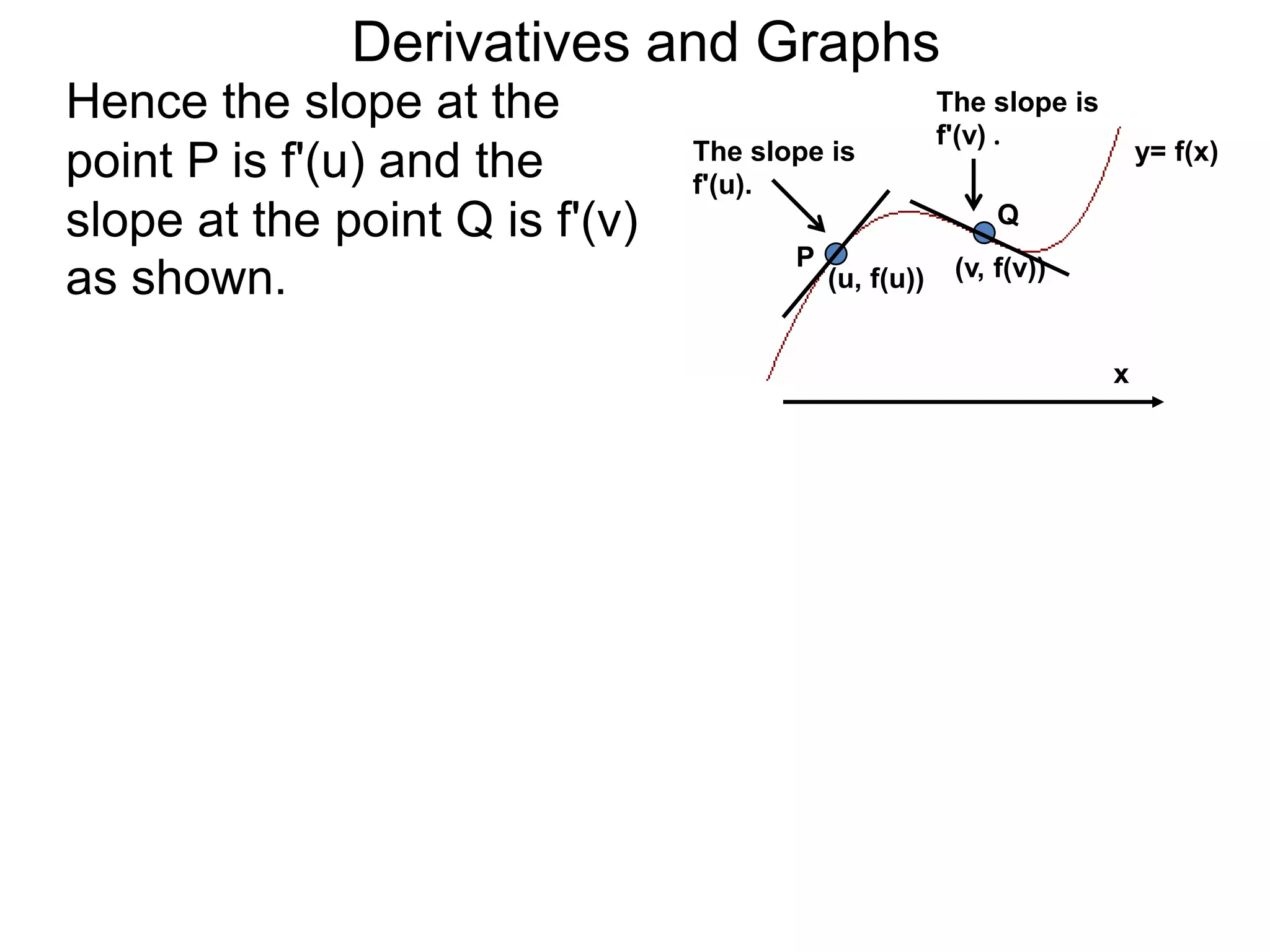
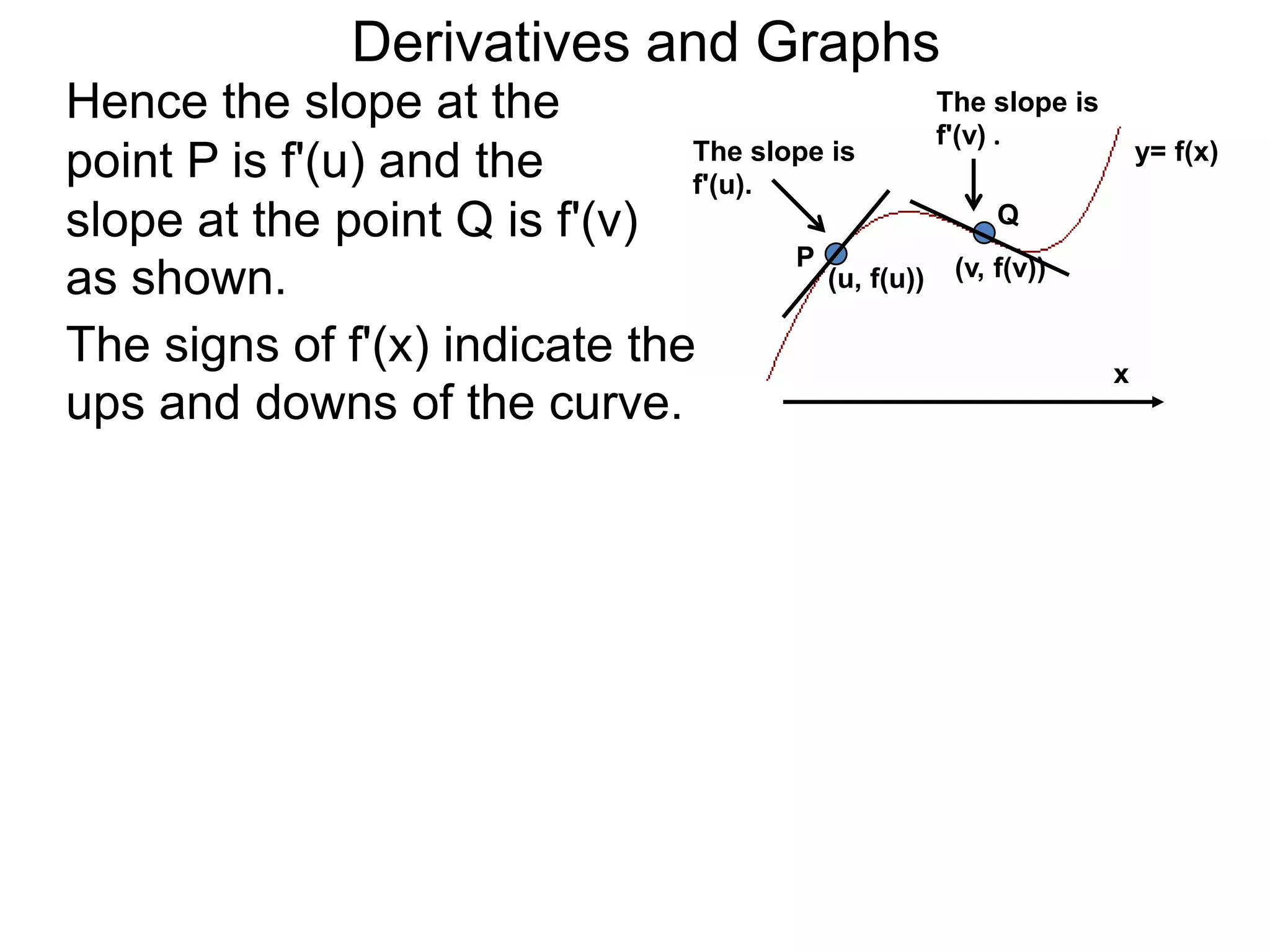
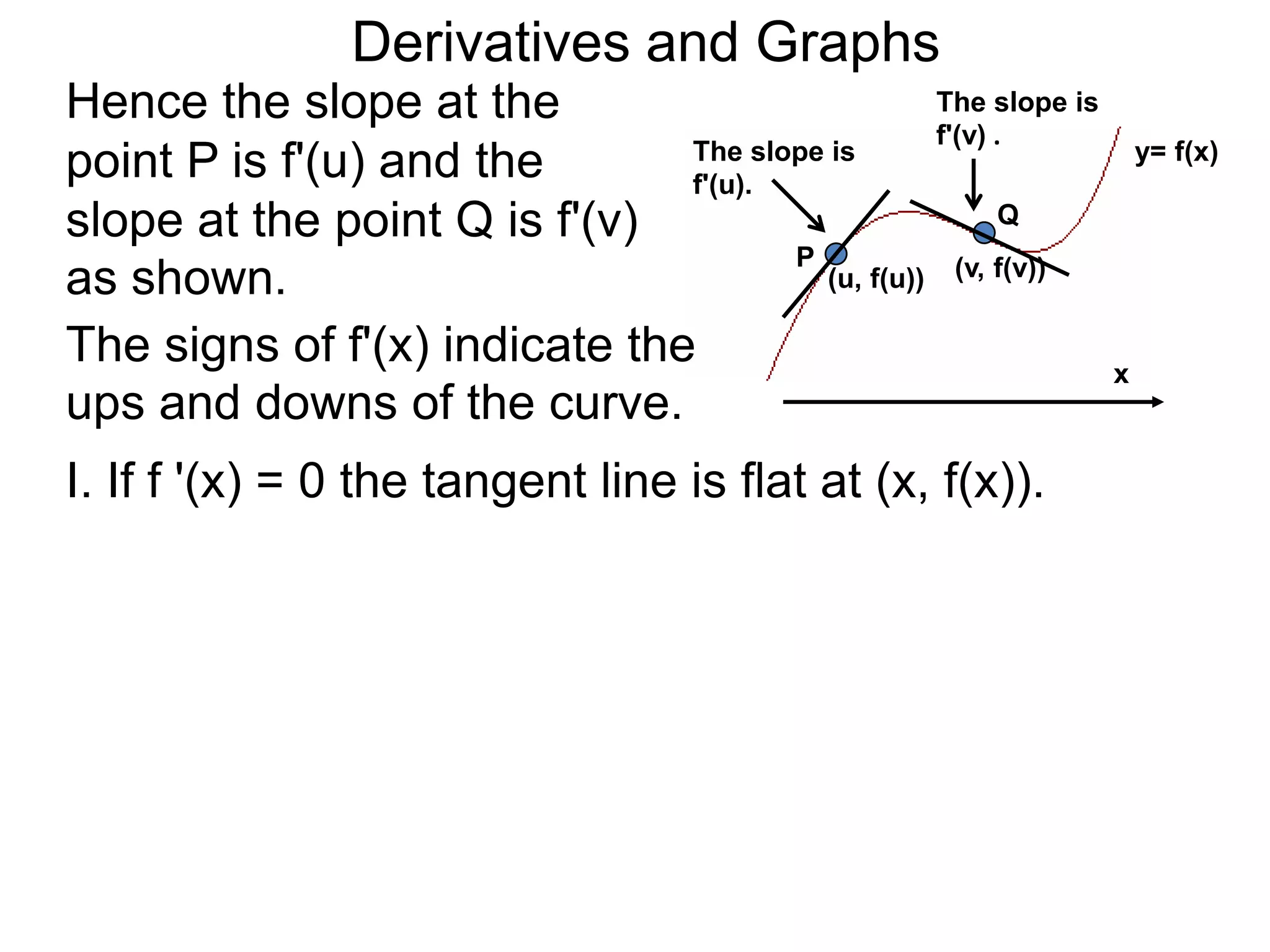
At a generic point x, the derivative f'(x) of the
function f(x) gives the “slope” at the point (x, f(x))
on the graph of y = f(x).
Summary of Derivatives
Example C. Given that 2u2 – v3 + 2uv = 2 where u
and v are functions in t, given that du/dt = –3 at the
point (u = 1, v = 0), find dv/dt at that instant.
Taking the derivative with respect to t using the
prime–notation,
[2u2 – v3 + 2uv = 2]'
4uu' – 3v2v' + 2u'v + 2uv' = 0
Substitute u' = –3 at u = 1, v = 0, we get
–12 + 2v' = 0 or v' = dv/dt = 6
The Geometry of Derivatives
At a generic point x, the derivative f'(x) of the
function f(x) gives the “slope” at the point (x, f(x))
on the graph of y = f(x). The existence of this slope
means the graph is smooth at that point.
Summary of Derivatives
Example C. Given that 2u2 – v3 + 2uv = 2 where u
and v are functions in t, given that du/dt = –3 at the
point (u = 1, v = 0), find dv/dt at that instant.
Taking the derivative with respect to t using the
prime–notation,
[2u2 – v3 + 2uv = 2]'
4uu' – 3v2v' + 2u'v + 2uv' = 0
Substitute u' = –3 at u = 1, v = 0, we get
–12 + 2v' = 0 or v' = dv/dt = 6
The Geometry of Derivatives
At a generic point x, the derivative f'(x) of the
function f(x) gives the “slope” at the point (x, f(x))
on the graph of y = f(x). The existence of this slope
means the graph is smooth at that point.
Derivatives and Graphs
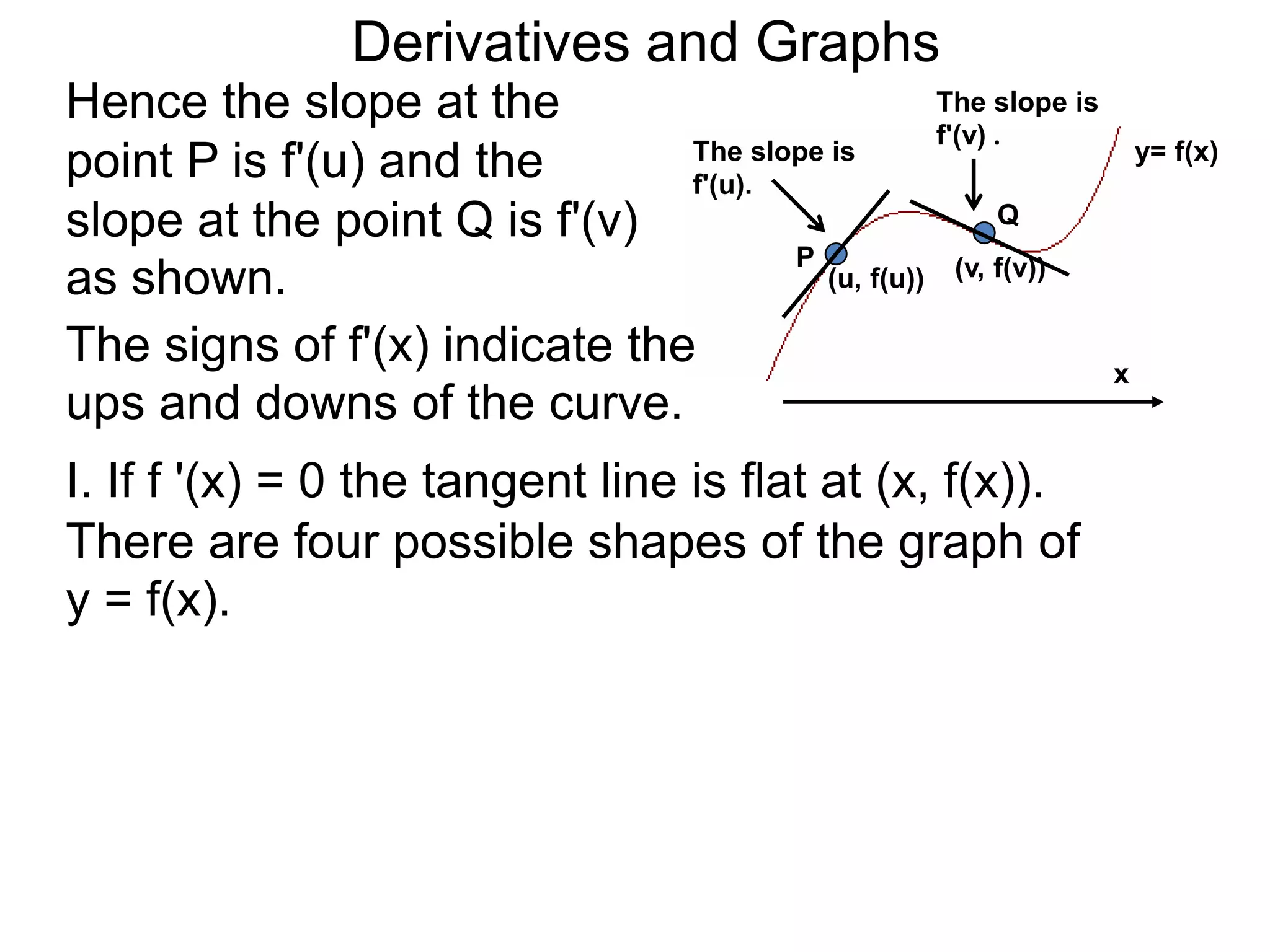
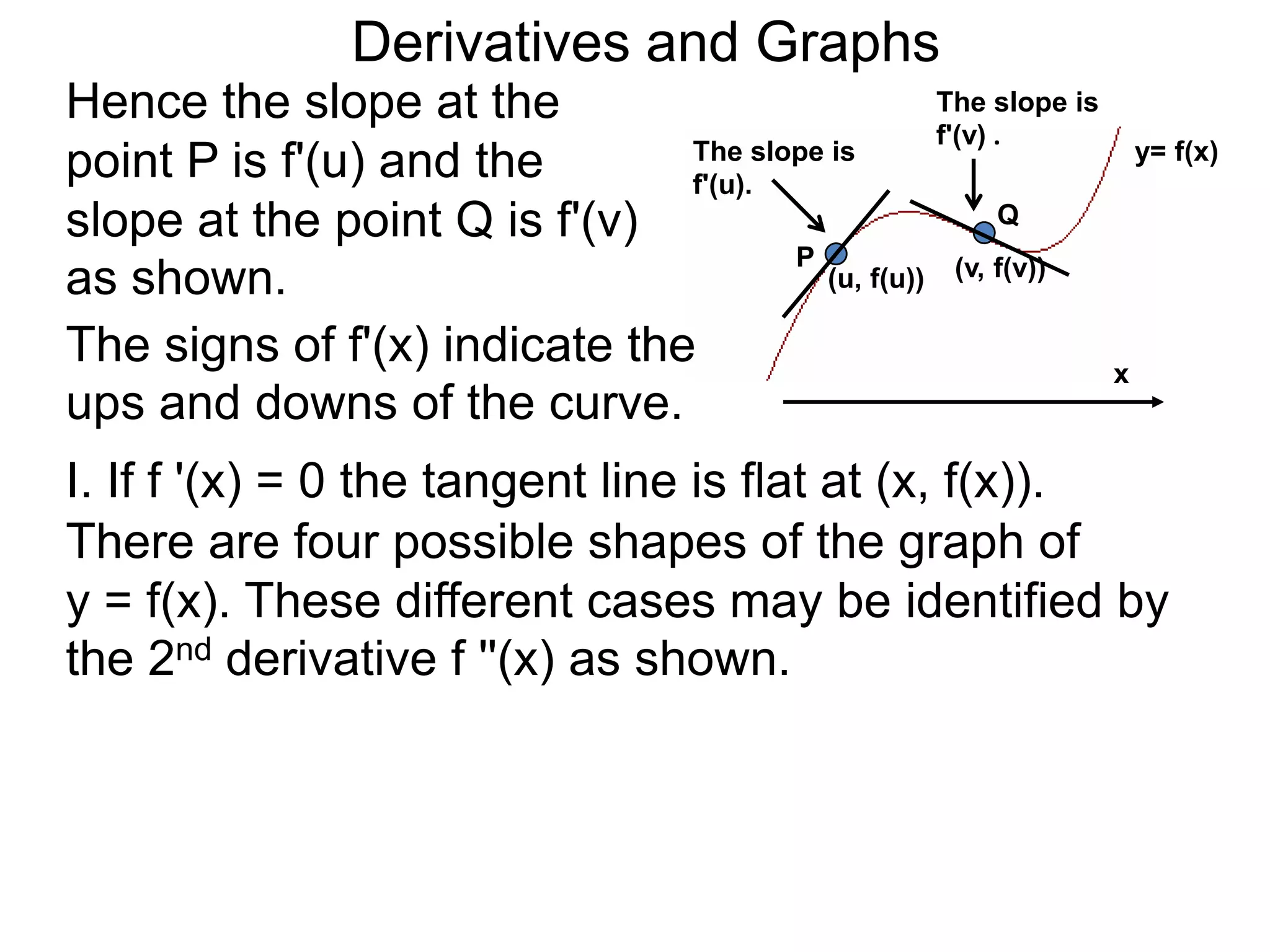
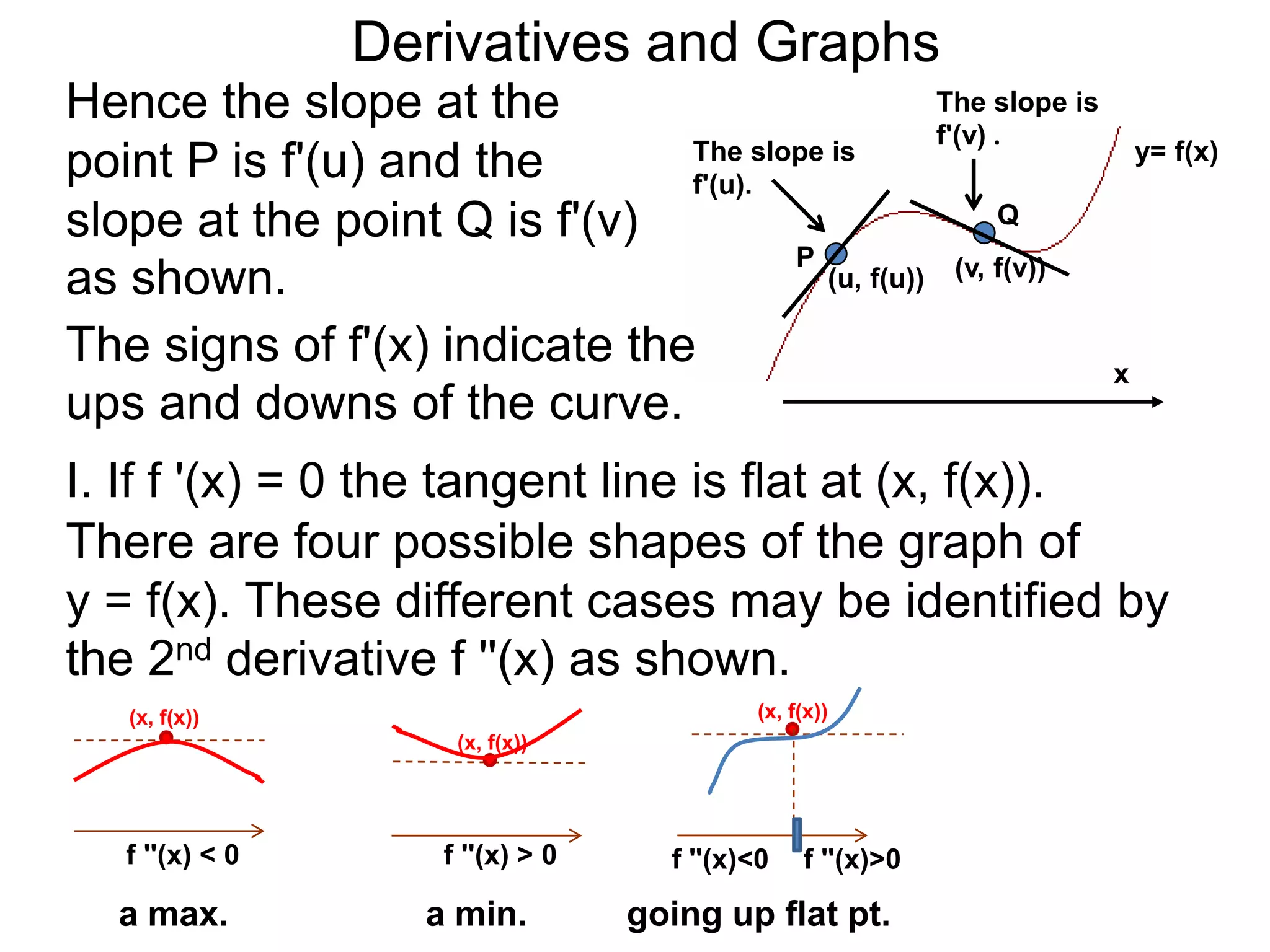
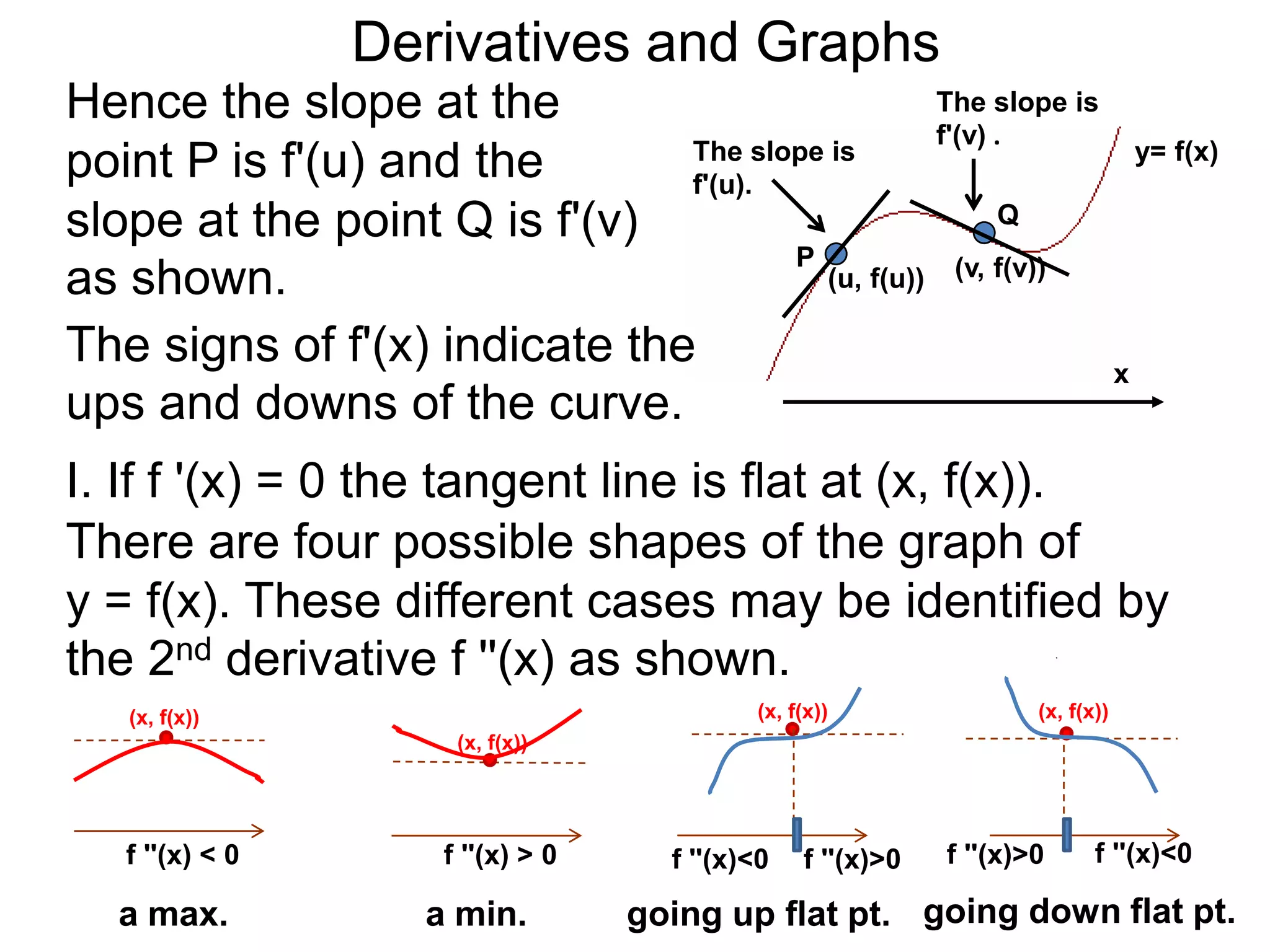
Hence the slope at the                                 The slope is
                                                       f'(v) .
                                The slope is                              y= f(x)
point P is f'(u) and the        f'(u).
slope at the point Q is f'(v)                               Q
                                       P                (v, f(v))
as shown.                                  (u, f(u))


                                                                      x
Derivatives and Graphs
Hence the slope at the                           The slope is
                                                 f'(v) .
                               The slope is                     y= f(x)
point P is f'(u) and the       f'(u).
slope at the point Q is f'(v)                           Q
                                      P
as shown.                               (u, f(u)) (v, f(v))

The signs of f'(x) indicate the                               x
ups and downs of the curve.
Derivatives and Graphs
Hence the slope at the                           The slope is
                                                 f'(v) .
                               The slope is                     y= f(x)
point P is f'(u) and the       f'(u).
slope at the point Q is f'(v)                           Q
                                      P
as shown.                               (u, f(u)) (v, f(v))

The signs of f'(x) indicate the                               x
ups and downs of the curve.
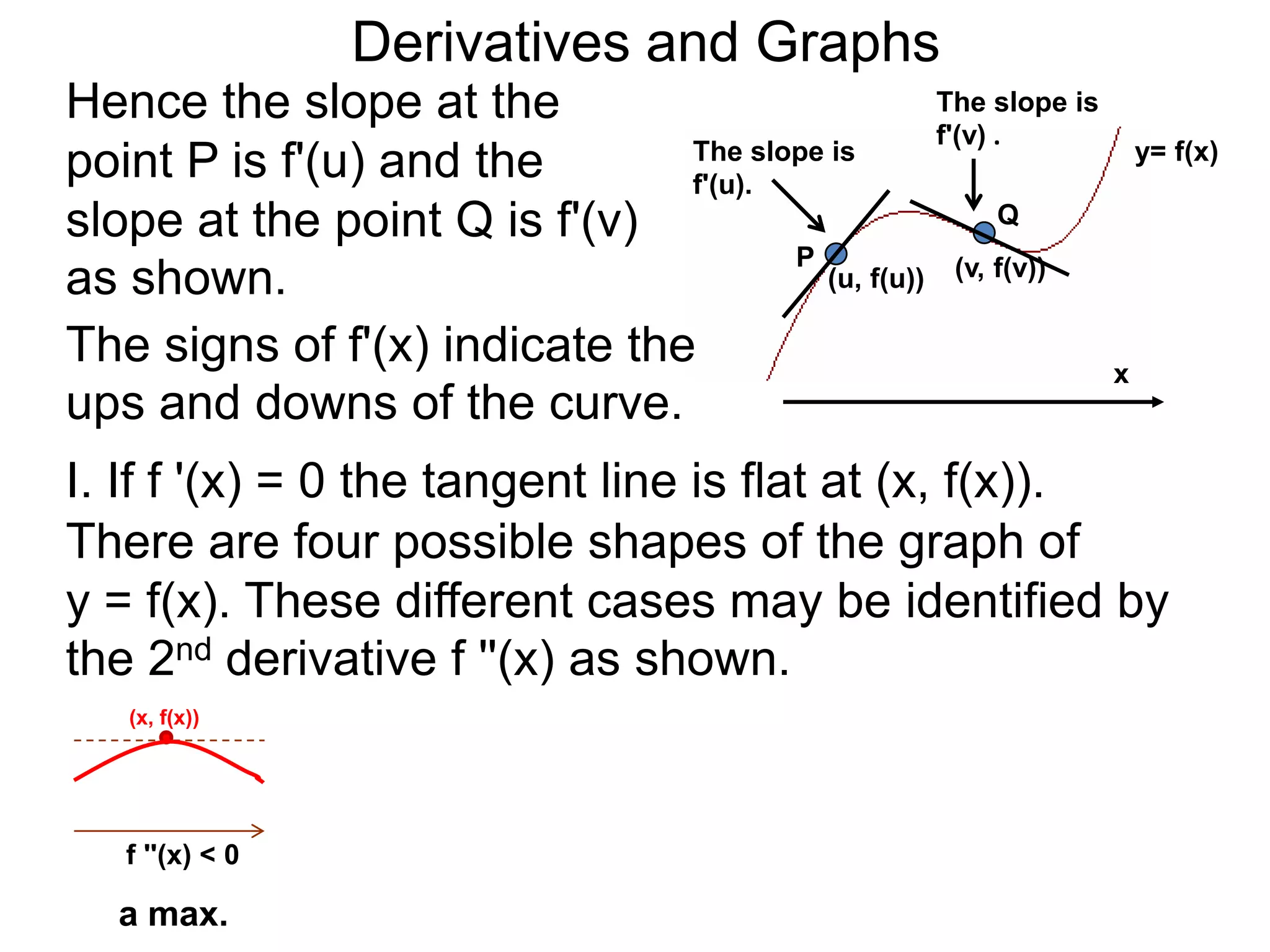
I. If f '(x) = 0 the tangent line is flat at (x, f(x)).
Derivatives and Graphs
Hence the slope at the                           The slope is
                                                 f'(v) .
                               The slope is                     y= f(x)
point P is f'(u) and the       f'(u).
slope at the point Q is f'(v)                           Q
                                      P
as shown.                               (u, f(u)) (v, f(v))

The signs of f'(x) indicate the                               x
ups and downs of the curve.
I. If f '(x) = 0 the tangent line is flat at (x, f(x)).
There are four possible shapes of the graph of
y = f(x).
Derivatives and Graphs
Hence the slope at the                           The slope is
                                                 f'(v) .
                               The slope is                     y= f(x)
point P is f'(u) and the       f'(u).
slope at the point Q is f'(v)                           Q
                                      P
as shown.                               (u, f(u)) (v, f(v))

The signs of f'(x) indicate the                               x
ups and downs of the curve.
I. If f '(x) = 0 the tangent line is flat at (x, f(x)).
There are four possible shapes of the graph of
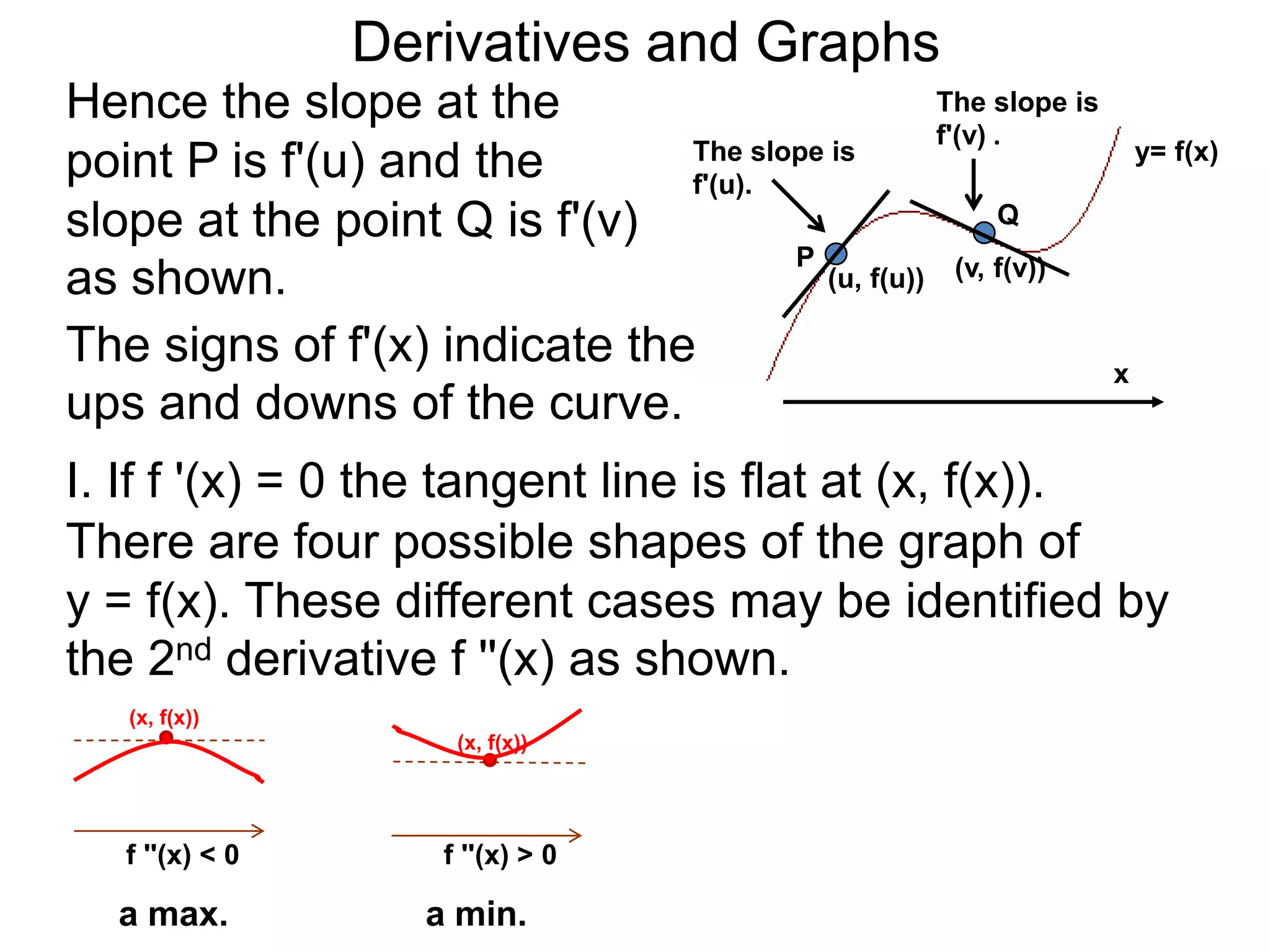
y = f(x). These different cases may be identified by
the 2nd derivative f ''(x) as shown.
Derivatives and Graphs
Hence the slope at the                           The slope is
                                                 f'(v) .
                               The slope is                     y= f(x)
point P is f'(u) and the       f'(u).
slope at the point Q is f'(v)                           Q
                                      P
as shown.                               (u, f(u)) (v, f(v))

The signs of f'(x) indicate the                               x
ups and downs of the curve.
I. If f '(x) = 0 the tangent line is flat at (x, f(x)).
There are four possible shapes of the graph of
y = f(x). These different cases may be identified by
the 2nd derivative f ''(x) as shown.
   (x, f(x))


   f ''(x) < 0

   a max.
Derivatives and Graphs
Hence the slope at the                           The slope is
                                                 f'(v) .
                               The slope is                     y= f(x)
point P is f'(u) and the       f'(u).
slope at the point Q is f'(v)                           Q
                                      P
as shown.                               (u, f(u)) (v, f(v))

The signs of f'(x) indicate the                               x
ups and downs of the curve.
I. If f '(x) = 0 the tangent line is flat at (x, f(x)).
There are four possible shapes of the graph of
y = f(x). These different cases may be identified by
the 2nd derivative f ''(x) as shown.
   (x, f(x))
                        (x, f(x))


   f ''(x) < 0         f ''(x) > 0

   a max.             a min.
Derivatives and Graphs
Hence the slope at the                           The slope is
                                                 f'(v) .
                               The slope is                     y= f(x)
point P is f'(u) and the       f'(u).
slope at the point Q is f'(v)                           Q
                                      P
as shown.                               (u, f(u)) (v, f(v))

The signs of f'(x) indicate the                               x
ups and downs of the curve.
I. If f '(x) = 0 the tangent line is flat at (x, f(x)).
There are four possible shapes of the graph of
y = f(x). These different cases may be identified by
the 2nd derivative f ''(x) as shown.
   (x, f(x))                                  (x, f(x))
                        (x, f(x))


   f ''(x) < 0         f ''(x) > 0     f ''(x)<0   f ''(x)>0

   a max.             a min.         going up flat pt.
Derivatives and Graphs
Hence the slope at the                           The slope is
                                                 f'(v) .
                               The slope is                     y= f(x)
point P is f'(u) and the       f'(u).
slope at the point Q is f'(v)                           Q
                                      P
as shown.                               (u, f(u)) (v, f(v))

The signs of f'(x) indicate the                               x
ups and downs of the curve.
I. If f '(x) = 0 the tangent line is flat at (x, f(x)).
There are four possible shapes of the graph of
y = f(x). These different cases may be identified by
the 2nd derivative f ''(x) as shown.
   (x, f(x))                                  (x, f(x))                (x, f(x))
                        (x, f(x))


   f ''(x) < 0         f ''(x) > 0     f ''(x)<0   f ''(x)>0   f ''(x)>0      f ''(x)<0

   a max.             a min.         going up flat pt. going down flat pt.
Derivatives and Graphs
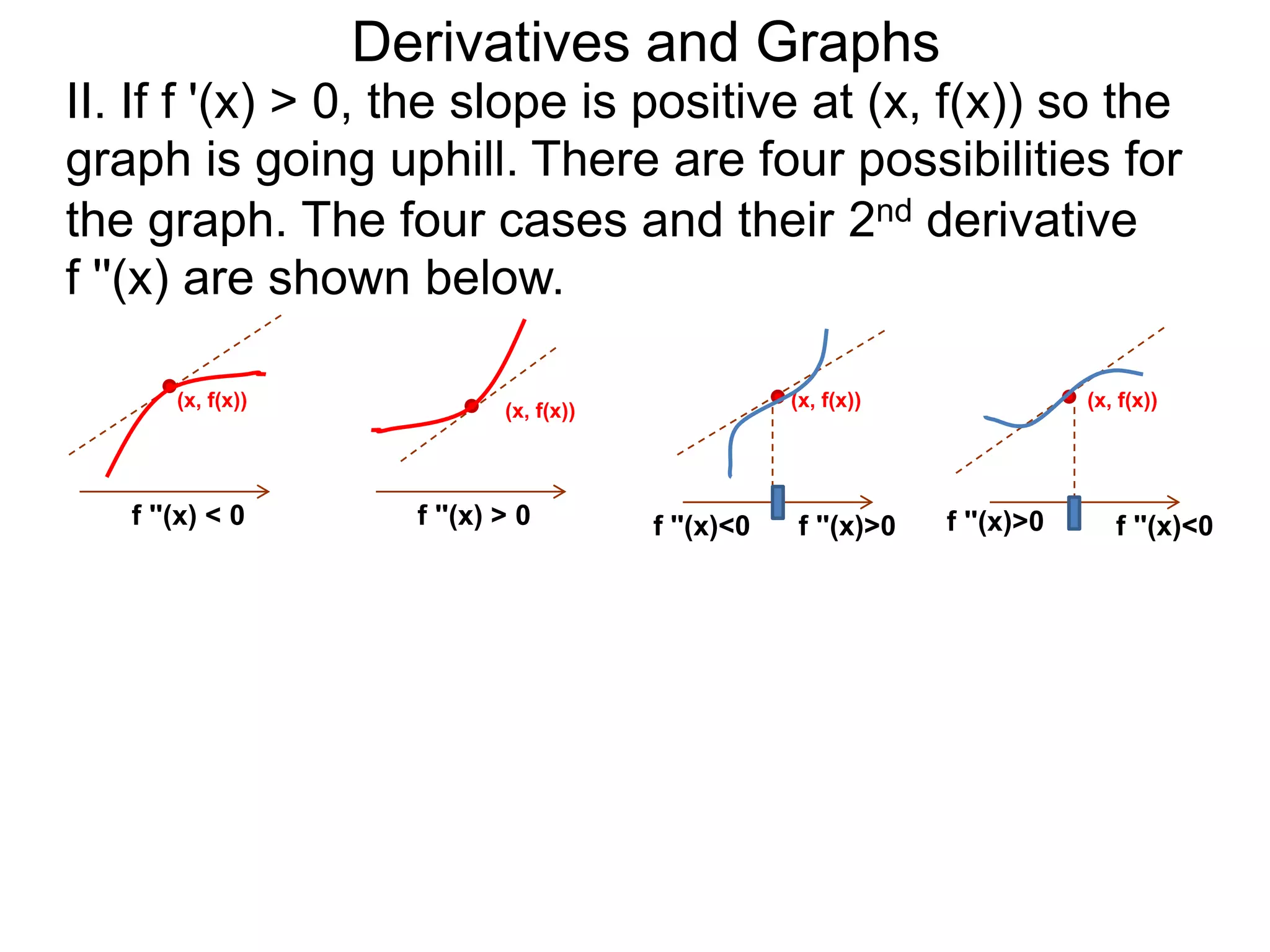
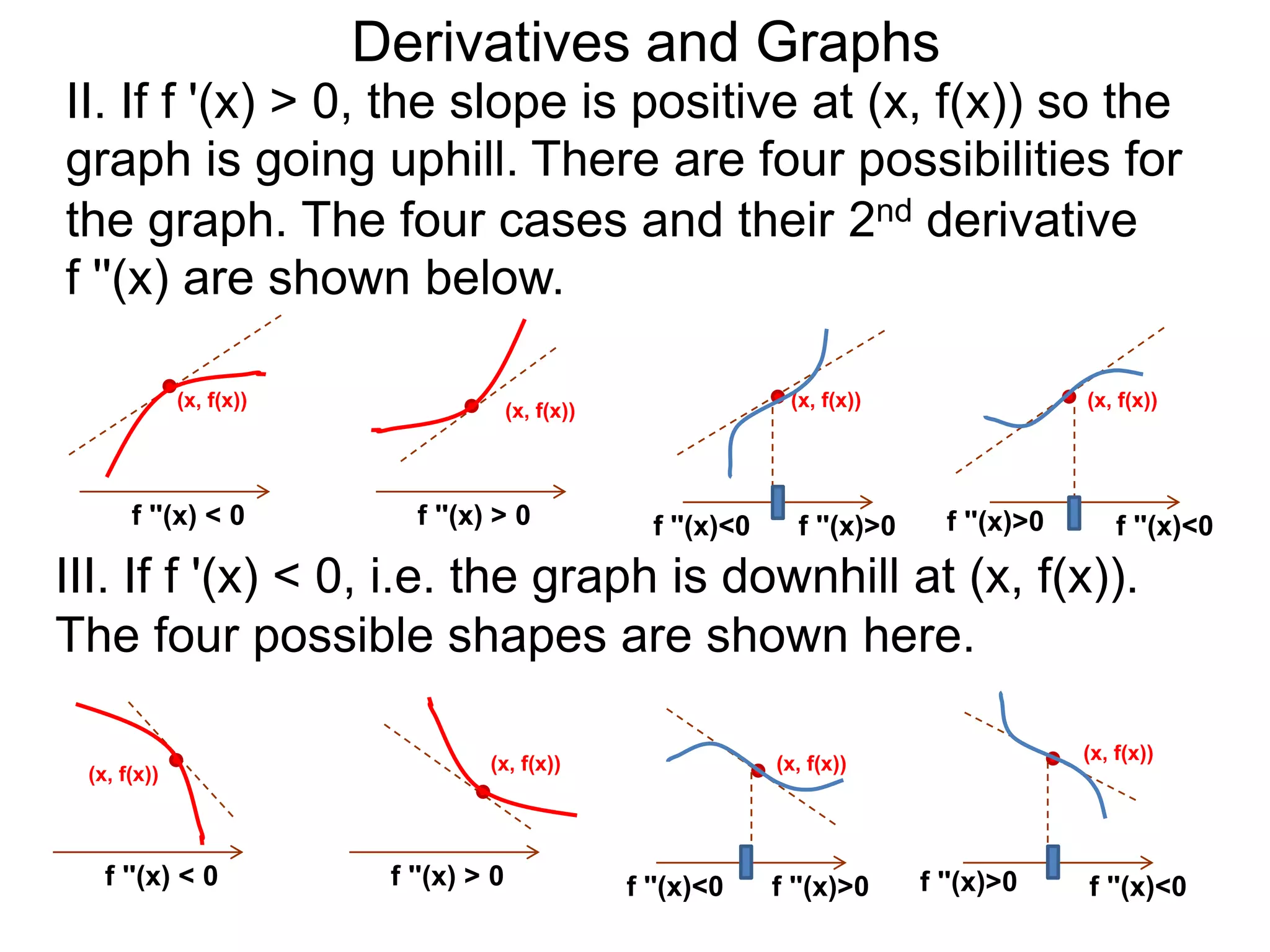
II. If f '(x) > 0, the slope is positive at (x, f(x)) so the
graph is going uphill. There are four possibilities for
the graph. The four cases and their 2nd derivative
f ''(x) are shown below.

       (x, f(x))                                     (x, f(x))               (x, f(x))
                             (x, f(x))


   f ''(x) < 0       f ''(x) > 0         f ''(x)<0   f ''(x)>0   f ''(x)>0      f ''(x)<0
Derivatives and Graphs
II. If f '(x) > 0, the slope is positive at (x, f(x)) so the
graph is going uphill. There are four possibilities for
the graph. The four cases and their 2nd derivative
f ''(x) are shown below.

             (x, f(x))                                             (x, f(x))                  (x, f(x))
                                        (x, f(x))


      f ''(x) < 0           f ''(x) > 0               f ''(x)<0     f ''(x)>0     f ''(x)>0       f ''(x)<0

III. If f '(x) < 0, i.e. the graph is downhill at (x, f(x)).
The four possible shapes are shown here.

                                                                                              (x, f(x))
 (x, f(x))                         (x, f(x))                      (x, f(x))


   f ''(x) < 0            f ''(x) > 0               f ''(x)<0     f ''(x)>0     f ''(x)>0     f ''(x)<0
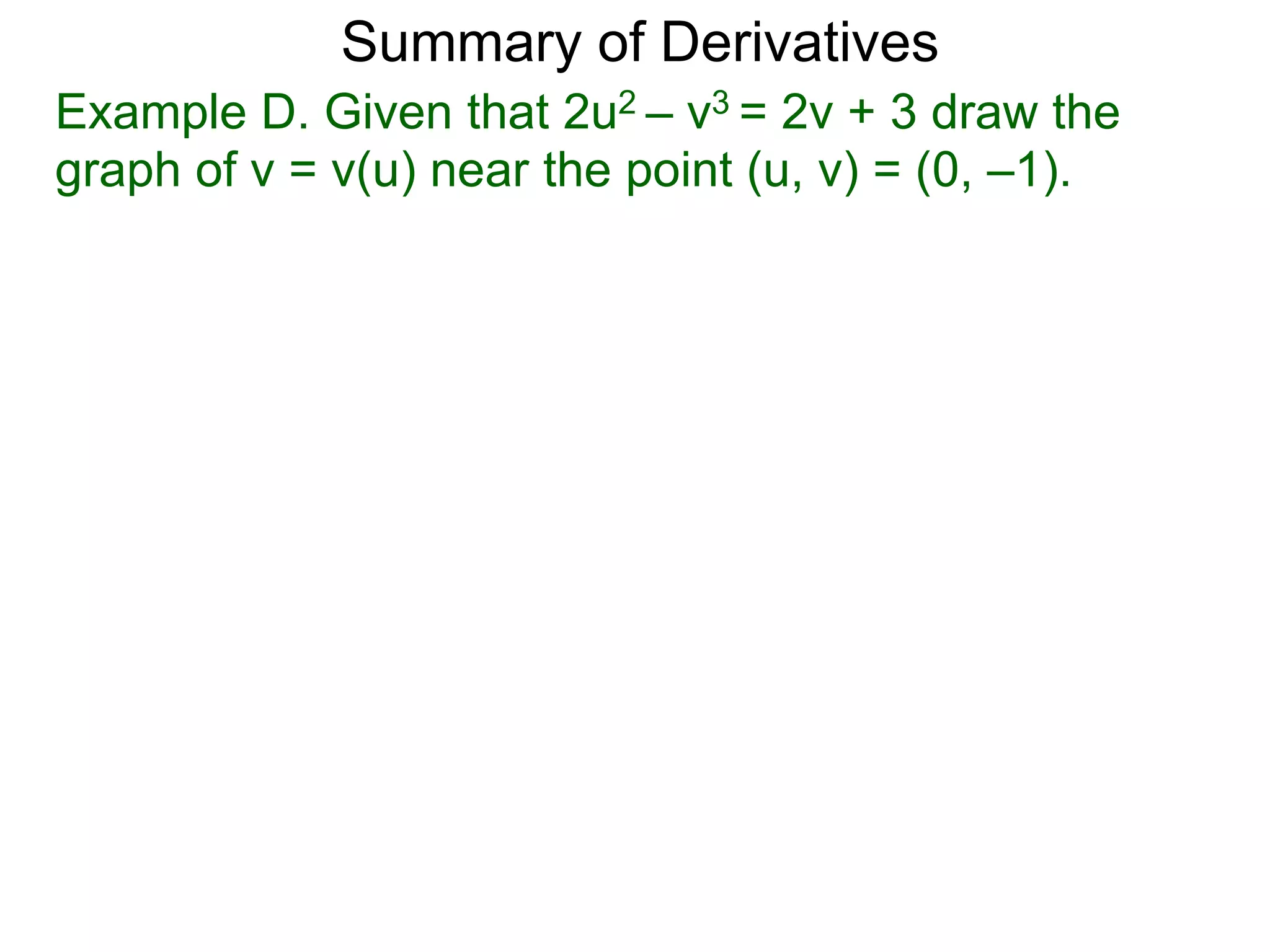
Summary of Derivatives
Example D. Given that 2u2 – v3 = 2v + 3 draw the
graph of v = v(u) near the point (u, v) = (0, –1).
Summary of Derivatives
Example D. Given that 2u2 – v3 = 2v + 3 draw the
graph of v = v(u) near the point (u, v) = (0, –1).
Take the derivative with respect to u to find dv/du,
[2u2 – v3 = 2v + 3] '
Summary of Derivatives
Example D. Given that 2u2 – v3 = 2v + 3 draw the
graph of v = v(u) near the point (u, v) = (0, –1).
Take the derivative with respect to u to find dv/du,
[2u2 – v3 = 2v + 3] '     4u – 3v2v' = 2v'
Summary of Derivatives
Example D. Given that 2u2 – v3 = 2v + 3 draw the
graph of v = v(u) near the point (u, v) = (0, –1).
Take the derivative with respect to u to find dv/du,
[2u2 – v3 = 2v + 3] '     4u – 3v2v' = 2v'
 So v' = 2 4u 2
           + 3v
Summary of Derivatives
Example D. Given that 2u2 – v3 = 2v + 3 draw the
graph of v = v(u) near the point (u, v) = (0, –1).
Take the derivative with respect to u to find dv/du,
[2u2 – v3 = 2v + 3] '     4u – 3v2v' = 2v'
 So v' = 2 4u 2
           + 3v
At u = 0, v = –1, we get v' = 0.
Summary of Derivatives
Example D. Given that 2u2 – v3 = 2v + 3 draw the
graph of v = v(u) near the point (u, v) = (0, –1).
Take the derivative with respect to u to find dv/du,
[2u2 – v3 = 2v + 3] '     4u – 3v2v' = 2v'
 So v' = 2 4u 2
           + 3v
At u = 0, v = –1, we get v' = 0.
Take the derivative of v' with respect to u again, we get
Summary of Derivatives
Example D. Given that 2u2 – v3 = 2v + 3 draw the
graph of v = v(u) near the point (u, v) = (0, –1).
Take the derivative with respect to u to find dv/du,
[2u2 – v3 = 2v + 3] '     4u – 3v2v' = 2v'
 So v' = 2 4u 2
           + 3v
At u = 0, v = –1, we get v' = 0.
Take the derivative of v' with respect to u again, we get
So v'' =
                (2 + 3v2)2
Summary of Derivatives
Example D. Given that 2u2 – v3 = 2v + 3 draw the
graph of v = v(u) near the point (u, v) = (0, –1).
Take the derivative with respect to u to find dv/du,
[2u2 – v3 = 2v + 3] '      4u – 3v2v' = 2v'
 So v' = 2 4u 2
           + 3v
At u = 0, v = –1, we get v' = 0.
Take the derivative of v' with respect to u again, we get
So v'' = (2 + 3v2)(4) – 4u(6vv')
                 (2 + 3v2)2
Summary of Derivatives
Example D. Given that 2u2 – v3 = 2v + 3 draw the
graph of v = v(u) near the point (u, v) = (0, –1).
Take the derivative with respect to u to find dv/du,
[2u2 – v3 = 2v + 3] '      4u – 3v2v' = 2v'
 So v' = 2 4u 2
           + 3v
At u = 0, v = –1, we get v' = 0.
Take the derivative of v' with respect to u again, we get
So v'' = (2 + 3v2)(4) – 4u(6vv')
                 (2 + 3v2)2
At u = 0, v = –1, and v' = 0 we get
v'' > 0.
Summary of Derivatives
Example D. Given that 2u2 – v3 = 2v + 3 draw the
graph of v = v(u) near the point (u, v) = (0, –1).
Take the derivative with respect to u to find dv/du,
[2u2 – v3 = 2v + 3] '      4u – 3v2v' = 2v'
 So v' = 2 4u 2
           + 3v
At u = 0, v = –1, we get v' = 0.
Take the derivative of v' with respect to u again, we get
So v'' = (2 + 3v2)(4) – 4u(6vv')
                 (2 + 3v2)2
At u = 0, v = –1, and v' = 0 we get
v'' > 0. From these, we conclude that
(0, –1) must be a minimum.
Summary of Derivatives
Example D. Given that 2u2 – v3 = 2v + 3 draw the
graph of v = v(u) near the point (u, v) = (0, –1).
Take the derivative with respect to u to find dv/du,
[2u2 – v3 = 2v + 3] '      4u – 3v2v' = 2v'
 So v' = 2 4u 2
           + 3v
At u = 0, v = –1, we get v' = 0.
Take the derivative of v' with respect to u again, we get
So v'' = (2 + 3v2)(4) – 4u(6vv')                 v

                 (2 + 3v2)2
At u = 0, v = –1, and v' = 0 we get                          u

v'' > 0. From these, we conclude that       (0,–1)
(0, –1) must be a minimum.                         v'(0) = 0
                                                   v''(0) > 0

4.4 review on derivatives

  • 1.
  • 2.
    Summary of Derivatives Inthis section we summarize the various types of derivatives we have encountered and the algebra associated with each type.
  • 3.
    Summary of Derivatives Inthis section we summarize the various types of derivatives we have encountered and the algebra associated with each type. Simple Derivatives
  • 4.
    Summary of Derivatives Inthis section we summarize the various types of derivatives we have encountered and the algebra associated with each type. Simple Derivatives By simple derivative we mean there is only one input and one output in the context.
  • 5.
    Summary of Derivatives Inthis section we summarize the various types of derivatives we have encountered and the algebra associated with each type. Simple Derivatives By simple derivative we mean there is only one input and one output in the context. Hence if we only have y = y(x) or x = x(t), etc.. in such cases the variable that the derivative is taken with respect to is clear.
  • 6.
    Summary of Derivatives Inthis section we summarize the various types of derivatives we have encountered and the algebra associated with each type. Simple Derivatives By simple derivative we mean there is only one input and one output in the context. Hence if we only have y = y(x) or x = x(t), etc.. in such cases the variable that the derivative is taken with respect to is clear. Example A. Find the following derivatives. a. y = e cos2(x)
  • 7.
    Summary of Derivatives Inthis section we summarize the various types of derivatives we have encountered and the algebra associated with each type. Simple Derivatives By simple derivative we mean there is only one input and one output in the context. Hence if we only have y = y(x) or x = x(t), etc.. in such cases the variable that the derivative is taken with respect to is clear. Example A. Find the following derivatives. a. y =e cos2(x) All derivatives are taken with respect to x. By the eu–Chain Rule with u = cos2(x),
  • 8.
    Summary of Derivatives Inthis section we summarize the various types of derivatives we have encountered and the algebra associated with each type. Simple Derivatives By simple derivative we mean there is only one input and one output in the context. Hence if we only have y = y(x) or x = x(t), etc.. in such cases the variable that the derivative is taken with respect to is clear. Example A. Find the following derivatives. a. y =e cos2(x) All derivatives are taken with respect to x. By the eu–Chain Rule with u = cos2(x), y' = e cos2(x) [cos2(x)]'
  • 9.
    Summary of Derivatives Inthis section we summarize the various types of derivatives we have encountered and the algebra associated with each type. Simple Derivatives By simple derivative we mean there is only one input and one output in the context. Hence if we only have y = y(x) or x = x(t), etc.. in such cases the variable that the derivative is taken with respect to is clear. Example A. Find the following derivatives. a. y =e cos2(x) All derivatives are taken with respect to x. By the eu–Chain Rule with u = cos2(x), y' = e cos2(x) [cos2(x)]' by the Power Chain Rule 2 =e cos2 (x)2cos(x)[cos(x)]'
  • 10.
    Summary of Derivatives Inthis section we summarize the various types of derivatives we have encountered and the algebra associated with each type. Simple Derivatives By simple derivative we mean there is only one input and one output in the context. Hence if we only have y = y(x) or x = x(t), etc.. in such cases the variable that the derivative is taken with respect to is clear. Example A. Find the following derivatives. a. y =e cos2(x) All derivatives are taken with respect to x. By the eu–Chain Rule with u = cos2(x), y' = e cos2(x) [cos2(x)]' by the Power Chain Rule =e cos2 (x)2cos(x)[cos(x)]' = –2ecos2 (x)cos(x)sin(x)
  • 11.
    Summary of Derivatives b.u = x2ey where y = cos(x)
  • 12.
    Summary of Derivatives b.u = x2ey where y = cos(x) Assuming the derivative is taken with respect to x, there are two ways to track the derivation.
  • 13.
    Summary of Derivatives b.u = x2ey where y = cos(x) Assuming the derivative is taken with respect to x, there are two ways to track the derivation. We may plug in the cos(x) for y first then take the derivative
  • 14.
    Summary of Derivatives b.u = x2ey where y = cos(x) Assuming the derivative is taken with respect to x, there are two ways to track the derivation. We may plug in the cos(x) for y first then take the derivative i.e. take the derivative of y = x2ecos(x)
  • 15.
    Summary of Derivatives b.u = x2ey where y = cos(x) Assuming the derivative is taken with respect to x, there are two ways to track the derivation. We may plug in the cos(x) for y first then take the derivative or as we would proceed with the Product Rule and track the derivation with y.
  • 16.
    Summary of Derivatives b.u = x2ey where y = cos(x) Assuming the derivative is taken with respect to x, there are two ways to track the derivation. We may plug in the cos(x) for y first then take the derivative or as we would proceed with the Product Rule and track the derivation with y. u' = [x2]'ey + x2[ey]'
  • 17.
    Summary of Derivatives b.u = x2ey where y = cos(x) Assuming the derivative is taken with respect to x, there are two ways to track the derivation. We may plug in the cos(x) for y first then take the derivative or as we would proceed with the Product Rule and track the derivation with y. u' = [x2]'ey + x2[ey]' = 2xey + x2ey[y]'
  • 18.
    Summary of Derivatives b.u = x2ey where y = cos(x) Assuming the derivative is taken with respect to x, there are two ways to track the derivation. We may plug in the cos(x) for y first then take the derivative or as we would proceed with the Product Rule and track the derivation with y. u' = [x2]'ey + x2[ey]' = 2xey + x2ey[y]' Substitute y = cos(x) and y' = –sin(x), we have u' = 2xecos(x) – x2sin(x)ecos(x)
  • 19.
    Summary of Derivatives b.u = x2ey where y = cos(x) Assuming the derivative is taken with respect to x, there are two ways to track the derivation. We may plug in the cos(x) for y first then take the derivative or as we would proceed with the Product Rule and track the derivation with y. u' = [x2]'ey + x2[ey]' = 2xey + x2ey[y]' Substitute y = cos(x) and y' = –sin(x), we have u' = 2xecos(x) – x2sin(x)ecos(x) = xecos(x)(2 – xsin(x))
  • 20.
    Summary of Derivatives b.u = x2ey where y = cos(x) Assuming the derivative is taken with respect to x, there are two ways to track the derivation. We may plug in the cos(x) for y first then take the derivative or as we would proceed with the Product Rule and track the derivation with y. u' = [x2]'ey + x2[ey]' = 2xey + x2ey[y]' Substitute y = cos(x) and y' = –sin(x), we have u' = 2xecos(x) – x2sin(x)ecos(x) = xecos(x)(2 – xsin(x)) The above derivation leads to implicit differentiation.
  • 21.
  • 22.
    Summary of Derivatives ImplicitDerivatives In implicit differentiation, a two (or more)–variable equation is given, we assume one of them as the independent variable, say v,
  • 23.
    Summary of Derivatives ImplicitDerivatives In implicit differentiation, a two (or more)–variable equation is given, we assume one of them as the independent variable, say v, and we are to find the derivative of the other variable with respect to v,
  • 24.
    Summary of Derivatives ImplicitDerivatives In implicit differentiation, a two (or more)–variable equation is given, we assume one of them as the independent variable, say v, and we are to find the derivative of the other variable with respect to v, hence the Chain Rules are needed for derivatives of the variable in the equations.
  • 25.
    Summary of Derivatives ImplicitDerivatives In implicit differentiation, a two (or more)–variable equation is given, we assume one of them as the independent variable, say v, and we are to find the derivative of the other variable with respect to v, hence the Chain Rules are needed for derivatives of the variable in the equations. Example B. Given that 2u2 – v3 = 2 – uv, a. Find the derivative of u with respect to v.
  • 26.
    Summary of Derivatives ImplicitDerivatives In implicit differentiation, a two (or more)–variable equation is given, we assume one of them as the independent variable, say v, and we are to find the derivative of the other variable with respect to v, hence the Chain Rules are needed for derivatives of the variable in the equations. Example B. Given that 2u2 – v3 = 2 – uv, a. Find the derivative of u with respect to v. Taking the derivative with respect to v both sides, [2u2 – v3 = 2 – uv]'
  • 27.
    Summary of Derivatives ImplicitDerivatives In implicit differentiation, a two (or more)–variable equation is given, we assume one of them as the independent variable, say v, and we are to find the derivative of the other variable with respect to v, hence the Chain Rules are needed for derivatives of the variable in the equations. Example B. Given that 2u2 – v3 = 2 – uv, a. Find the derivative of u with respect to v. Taking the derivative with respect to v both sides, [2u2 – v3 = 2 – uv]' 4uu' – 3v2 =
  • 28.
    Summary of Derivatives ImplicitDerivatives In implicit differentiation, a two (or more)–variable equation is given, we assume one of them as the independent variable, say v, and we are to find the derivative of the other variable with respect to v, hence the Chain Rules are needed for derivatives of the variable in the equations. Example B. Given that 2u2 – v3 = 2 – uv, a. Find the derivative of u with respect to v. Taking the derivative with respect to v both sides, [2u2 – v3 = 2 – uv]' 4uu' – 3v2 = –u'v – uv'
  • 29.
    Summary of Derivatives ImplicitDerivatives In implicit differentiation, a two (or more)–variable equation is given, we assume one of them as the independent variable, say v, and we are to find the derivative of the other variable with respect to v, hence the Chain Rules are needed for derivatives of the variable in the equations. Example B. Given that 2u2 – v3 = 2 – uv, a. Find the derivative of u with respect to v. Taking the derivative with respect to v both sides, [2u2 – v3 = 2 – uv]' 1 4uu' – 3v2 = –u'v – uv'
  • 30.
    Summary of Derivatives ImplicitDerivatives In implicit differentiation, a two (or more)–variable equation is given, we assume one of them as the independent variable, say v, and we are to find the derivative of the other variable with respect to v, hence the Chain Rules are needed for derivatives of the variable in the equations. Example B. Given that 2u2 – v3 = 2 – uv, a. Find the derivative of u with respect to v. Taking the derivative with respect to v both sides, [2u2 – v3 = 2 – uv]' 1 4uu' – 3v2 = –u'v – uv' u'(4u + v) = 3v2 – u
  • 31.
    Summary of Derivatives ImplicitDerivatives In implicit differentiation, a two (or more)–variable equation is given, we assume one of them as the independent variable, say v, and we are to find the derivative of the other variable with respect to v, hence the Chain Rules are needed for derivatives of the variable in the equations. Example B. Given that 2u2 – v3 = 2 – uv, a. Find the derivative of u with respect to v. Taking the derivative with respect to v both sides, [2u2 – v3 = 2 – uv]' 1 4uu' – 3v2 = –u'v – uv' u'(4u + v) = 3v2 – u 3v2 – u so u' = 4u + v
  • 32.
    Summary of Derivatives b.Find the derivative of v with respect to u.
  • 33.
    Summary of Derivatives b.Find the derivative of v with respect to u. Taking the derivative with respect to u both sides, [2u2 – v3 = 2 – uv]'
  • 34.
    Summary of Derivatives b.Find the derivative of v with respect to u. Taking the derivative with respect to u both sides, [2u2 – v3 = 2 – uv]' 4u – 3v2v' = –v – uv'
  • 35.
    Summary of Derivatives b.Find the derivative of v with respect to u. Taking the derivative with respect to u both sides, [2u2 – v3 = 2 – uv]' 4u – 3v2v' = –v – uv' uv' – 3v2v' = –v – 4u
  • 36.
    Summary of Derivatives b.Find the derivative of v with respect to u. Taking the derivative with respect to u both sides, [2u2 – v3 = 2 – uv]' 4u – 3v2v' = –v – uv' uv' – 3v2v' = –v – 4u v'(u – 3v2) = – v – 4u so
  • 37.
    Summary of Derivatives b.Find the derivative of v with respect to u. Taking the derivative with respect to u both sides, [2u2 – v3 = 2 – uv]' 4u – 3v2v' = –v – uv' uv' – 3v2v' = –v – 4u v'(u – 3v2) = – v – 4u so – 4u – v 4u + v so v' = u – 3v2 = 3v2 – u
  • 38.
    Summary of Derivatives b.Find the derivative of v with respect to u. Taking the derivative with respect to u both sides, [2u2 – v3 = 2 – uv]' 4u – 3v2v' = –v – uv' uv' – 3v2v' = –v – 4u v'(u – 3v2) = – v – 4u so – 4u – v 4u + v so v' = u – 3v2 = 3v2 – u In the differential–notation, the reciprocal relation of these derivatives becomes clear.
  • 39.
    Summary of Derivatives b.Find the derivative of v with respect to u. Taking the derivative with respect to u both sides, [2u2 – v3 = 2 – uv]' 4u – 3v2v' = –v – uv' uv' – 3v2v' = –v – 4u v'(u – 3v2) = – v – 4u so – 4u – v 4u + v so v' = u – 3v2 = 3v2 – u In the differential–notation, the reciprocal relation of these derivatives becomes clear. du 3v2 – u dv = 4u + v dv = 4u + v du 3v2 – u
  • 40.
    Summary of Derivatives b.Find the derivative of v with respect to u. Taking the derivative with respect to u both sides, [2u2 – v3 = 2 – uv]' 4u – 3v2v' = –v – uv' uv' – 3v2v' = –v – 4u v'(u – 3v2) = – v – 4u so – 4u – v 4u + v so v' = u – 3v2 = 3v2 – u In the differential–notation, the reciprocal relation of these derivatives becomes clear. du 3v2 – u dv = 4u + v dv = 4u + v du 3v2 – u This follows the fact that the slopes at two diagonally reflected points on the graphs of a pair of inverse functions are the reciprocal of each other.
  • 41.
  • 42.
    Related Rates Related RatesDerivatives In related rates problems all variables are assumed to be functions of a single variable t, usually for time,
  • 43.
    Related Rates Related RatesDerivatives In related rates problems all variables are assumed to be functions of a single variable t, usually for time, and all the derivatives (#)' are taken with respect to t.
  • 44.
    Related Rates Related RatesDerivatives In related rates problems all variables are assumed to be functions of a single variable t, usually for time, and all the derivatives (#)' are taken with respect to t. Hence the derivatives of all of the variables in the context require the Chain Rules.
  • 45.
    Related Rates Related RatesDerivatives In related rates problems all variables are assumed to be functions of a single variable t, usually for time, and all the derivatives (#)' are taken with respect to t. Hence the derivatives of all of the variables in the context require the Chain Rules. In a related rate problem, the defining relation usually is formula such as the Distance Formula, or any formula from any scientific discipline that relates multiple variables where each variable is a function in t.
  • 46.
    Related Rates Related RatesDerivatives In related rates problems all variables are assumed to be functions of a single variable t, usually for time, and all the derivatives (#)' are taken with respect to t. Hence the derivatives of all of the variables in the context require the Chain Rules. In a related rate problem, the defining relation usually is formula such as the Distance Formula, or any formula from any scientific discipline that relates multiple variables where each variable is a function in t. Often in these problems, the explicit formulas in terms t are bypassed. Instead the relations and values of the variables and their rates with respect to t are provided for numeric inputs.
  • 47.
    Summary of Derivatives ExampleC. Given that 2u2 – v3 + 2uv = 2 where u and v are functions in t, given that du/dt = –3 at the point (u = 1, v = 0), find dv/dt at that instant.
  • 48.
    Summary of Derivatives ExampleC. Given that 2u2 – v3 + 2uv = 2 where u and v are functions in t, given that du/dt = –3 at the point (u = 1, v = 0), find dv/dt at that instant. Taking the derivative with respect to t using the prime–notation, [2u2 – v3 + 2uv = 2]'
  • 49.
    Summary of Derivatives ExampleC. Given that 2u2 – v3 + 2uv = 2 where u and v are functions in t, given that du/dt = –3 at the point (u = 1, v = 0), find dv/dt at that instant. Taking the derivative with respect to t using the prime–notation, [2u2 – v3 + 2uv = 2]' 4uu' – 3v2v' + 2u'v + 2uv' = 0
  • 50.
    Summary of Derivatives ExampleC. Given that 2u2 – v3 + 2uv = 2 where u and v are functions in t, given that du/dt = –3 at the point (u = 1, v = 0), find dv/dt at that instant. Taking the derivative with respect to t using the prime–notation, [2u2 – v3 + 2uv = 2]' 4uu' – 3v2v' + 2u'v + 2uv' = 0 Substitute u' = –3 at u = 1, v = 0, we get –12 + 2v' = 0
  • 51.
    Summary of Derivatives ExampleC. Given that 2u2 – v3 + 2uv = 2 where u and v are functions in t, given that du/dt = –3 at the point (u = 1, v = 0), find dv/dt at that instant. Taking the derivative with respect to t using the prime–notation, [2u2 – v3 + 2uv = 2]' 4uu' – 3v2v' + 2u'v + 2uv' = 0 Substitute u' = –3 at u = 1, v = 0, we get –12 + 2v' = 0 or v' = dv/dt = 6
  • 52.
    Summary of Derivatives ExampleC. Given that 2u2 – v3 + 2uv = 2 where u and v are functions in t, given that du/dt = –3 at the point (u = 1, v = 0), find dv/dt at that instant. Taking the derivative with respect to t using the prime–notation, [2u2 – v3 + 2uv = 2]' 4uu' – 3v2v' + 2u'v + 2uv' = 0 Substitute u' = –3 at u = 1, v = 0, we get –12 + 2v' = 0 or v' = dv/dt = 6 The Geometry of Derivatives
  • 53.
    Summary of Derivatives ExampleC. Given that 2u2 – v3 + 2uv = 2 where u and v are functions in t, given that du/dt = –3 at the point (u = 1, v = 0), find dv/dt at that instant. Taking the derivative with respect to t using the prime–notation, [2u2 – v3 + 2uv = 2]' 4uu' – 3v2v' + 2u'v + 2uv' = 0 Substitute u' = –3 at u = 1, v = 0, we get –12 + 2v' = 0 or v' = dv/dt = 6 The Geometry of Derivatives At a generic point x, the derivative f'(x) of the function f(x) gives the “slope” at the point (x, f(x)) on the graph of y = f(x).
  • 54.
    Summary of Derivatives ExampleC. Given that 2u2 – v3 + 2uv = 2 where u and v are functions in t, given that du/dt = –3 at the point (u = 1, v = 0), find dv/dt at that instant. Taking the derivative with respect to t using the prime–notation, [2u2 – v3 + 2uv = 2]' 4uu' – 3v2v' + 2u'v + 2uv' = 0 Substitute u' = –3 at u = 1, v = 0, we get –12 + 2v' = 0 or v' = dv/dt = 6 The Geometry of Derivatives At a generic point x, the derivative f'(x) of the function f(x) gives the “slope” at the point (x, f(x)) on the graph of y = f(x). The existence of this slope means the graph is smooth at that point.
  • 55.
    Summary of Derivatives ExampleC. Given that 2u2 – v3 + 2uv = 2 where u and v are functions in t, given that du/dt = –3 at the point (u = 1, v = 0), find dv/dt at that instant. Taking the derivative with respect to t using the prime–notation, [2u2 – v3 + 2uv = 2]' 4uu' – 3v2v' + 2u'v + 2uv' = 0 Substitute u' = –3 at u = 1, v = 0, we get –12 + 2v' = 0 or v' = dv/dt = 6 The Geometry of Derivatives At a generic point x, the derivative f'(x) of the function f(x) gives the “slope” at the point (x, f(x)) on the graph of y = f(x). The existence of this slope means the graph is smooth at that point.
  • 56.
    Derivatives and Graphs Hencethe slope at the The slope is f'(v) . The slope is y= f(x) point P is f'(u) and the f'(u). slope at the point Q is f'(v) Q P (v, f(v)) as shown. (u, f(u)) x
  • 57.
    Derivatives and Graphs Hencethe slope at the The slope is f'(v) . The slope is y= f(x) point P is f'(u) and the f'(u). slope at the point Q is f'(v) Q P as shown. (u, f(u)) (v, f(v)) The signs of f'(x) indicate the x ups and downs of the curve.
  • 58.
    Derivatives and Graphs Hencethe slope at the The slope is f'(v) . The slope is y= f(x) point P is f'(u) and the f'(u). slope at the point Q is f'(v) Q P as shown. (u, f(u)) (v, f(v)) The signs of f'(x) indicate the x ups and downs of the curve. I. If f '(x) = 0 the tangent line is flat at (x, f(x)).
  • 59.
    Derivatives and Graphs Hencethe slope at the The slope is f'(v) . The slope is y= f(x) point P is f'(u) and the f'(u). slope at the point Q is f'(v) Q P as shown. (u, f(u)) (v, f(v)) The signs of f'(x) indicate the x ups and downs of the curve. I. If f '(x) = 0 the tangent line is flat at (x, f(x)). There are four possible shapes of the graph of y = f(x).
  • 60.
    Derivatives and Graphs Hencethe slope at the The slope is f'(v) . The slope is y= f(x) point P is f'(u) and the f'(u). slope at the point Q is f'(v) Q P as shown. (u, f(u)) (v, f(v)) The signs of f'(x) indicate the x ups and downs of the curve. I. If f '(x) = 0 the tangent line is flat at (x, f(x)). There are four possible shapes of the graph of y = f(x). These different cases may be identified by the 2nd derivative f ''(x) as shown.
  • 61.
    Derivatives and Graphs Hencethe slope at the The slope is f'(v) . The slope is y= f(x) point P is f'(u) and the f'(u). slope at the point Q is f'(v) Q P as shown. (u, f(u)) (v, f(v)) The signs of f'(x) indicate the x ups and downs of the curve. I. If f '(x) = 0 the tangent line is flat at (x, f(x)). There are four possible shapes of the graph of y = f(x). These different cases may be identified by the 2nd derivative f ''(x) as shown. (x, f(x)) f ''(x) < 0 a max.
  • 62.
    Derivatives and Graphs Hencethe slope at the The slope is f'(v) . The slope is y= f(x) point P is f'(u) and the f'(u). slope at the point Q is f'(v) Q P as shown. (u, f(u)) (v, f(v)) The signs of f'(x) indicate the x ups and downs of the curve. I. If f '(x) = 0 the tangent line is flat at (x, f(x)). There are four possible shapes of the graph of y = f(x). These different cases may be identified by the 2nd derivative f ''(x) as shown. (x, f(x)) (x, f(x)) f ''(x) < 0 f ''(x) > 0 a max. a min.
  • 63.
    Derivatives and Graphs Hencethe slope at the The slope is f'(v) . The slope is y= f(x) point P is f'(u) and the f'(u). slope at the point Q is f'(v) Q P as shown. (u, f(u)) (v, f(v)) The signs of f'(x) indicate the x ups and downs of the curve. I. If f '(x) = 0 the tangent line is flat at (x, f(x)). There are four possible shapes of the graph of y = f(x). These different cases may be identified by the 2nd derivative f ''(x) as shown. (x, f(x)) (x, f(x)) (x, f(x)) f ''(x) < 0 f ''(x) > 0 f ''(x)<0 f ''(x)>0 a max. a min. going up flat pt.
  • 64.
    Derivatives and Graphs Hencethe slope at the The slope is f'(v) . The slope is y= f(x) point P is f'(u) and the f'(u). slope at the point Q is f'(v) Q P as shown. (u, f(u)) (v, f(v)) The signs of f'(x) indicate the x ups and downs of the curve. I. If f '(x) = 0 the tangent line is flat at (x, f(x)). There are four possible shapes of the graph of y = f(x). These different cases may be identified by the 2nd derivative f ''(x) as shown. (x, f(x)) (x, f(x)) (x, f(x)) (x, f(x)) f ''(x) < 0 f ''(x) > 0 f ''(x)<0 f ''(x)>0 f ''(x)>0 f ''(x)<0 a max. a min. going up flat pt. going down flat pt.
  • 65.
    Derivatives and Graphs II.If f '(x) > 0, the slope is positive at (x, f(x)) so the graph is going uphill. There are four possibilities for the graph. The four cases and their 2nd derivative f ''(x) are shown below. (x, f(x)) (x, f(x)) (x, f(x)) (x, f(x)) f ''(x) < 0 f ''(x) > 0 f ''(x)<0 f ''(x)>0 f ''(x)>0 f ''(x)<0
  • 66.
    Derivatives and Graphs II.If f '(x) > 0, the slope is positive at (x, f(x)) so the graph is going uphill. There are four possibilities for the graph. The four cases and their 2nd derivative f ''(x) are shown below. (x, f(x)) (x, f(x)) (x, f(x)) (x, f(x)) f ''(x) < 0 f ''(x) > 0 f ''(x)<0 f ''(x)>0 f ''(x)>0 f ''(x)<0 III. If f '(x) < 0, i.e. the graph is downhill at (x, f(x)). The four possible shapes are shown here. (x, f(x)) (x, f(x)) (x, f(x)) (x, f(x)) f ''(x) < 0 f ''(x) > 0 f ''(x)<0 f ''(x)>0 f ''(x)>0 f ''(x)<0
  • 67.
    Summary of Derivatives ExampleD. Given that 2u2 – v3 = 2v + 3 draw the graph of v = v(u) near the point (u, v) = (0, –1).
  • 68.
    Summary of Derivatives ExampleD. Given that 2u2 – v3 = 2v + 3 draw the graph of v = v(u) near the point (u, v) = (0, –1). Take the derivative with respect to u to find dv/du, [2u2 – v3 = 2v + 3] '
  • 69.
    Summary of Derivatives ExampleD. Given that 2u2 – v3 = 2v + 3 draw the graph of v = v(u) near the point (u, v) = (0, –1). Take the derivative with respect to u to find dv/du, [2u2 – v3 = 2v + 3] ' 4u – 3v2v' = 2v'
  • 70.
    Summary of Derivatives ExampleD. Given that 2u2 – v3 = 2v + 3 draw the graph of v = v(u) near the point (u, v) = (0, –1). Take the derivative with respect to u to find dv/du, [2u2 – v3 = 2v + 3] ' 4u – 3v2v' = 2v' So v' = 2 4u 2 + 3v
  • 71.
    Summary of Derivatives ExampleD. Given that 2u2 – v3 = 2v + 3 draw the graph of v = v(u) near the point (u, v) = (0, –1). Take the derivative with respect to u to find dv/du, [2u2 – v3 = 2v + 3] ' 4u – 3v2v' = 2v' So v' = 2 4u 2 + 3v At u = 0, v = –1, we get v' = 0.
  • 72.
    Summary of Derivatives ExampleD. Given that 2u2 – v3 = 2v + 3 draw the graph of v = v(u) near the point (u, v) = (0, –1). Take the derivative with respect to u to find dv/du, [2u2 – v3 = 2v + 3] ' 4u – 3v2v' = 2v' So v' = 2 4u 2 + 3v At u = 0, v = –1, we get v' = 0. Take the derivative of v' with respect to u again, we get
  • 73.
    Summary of Derivatives ExampleD. Given that 2u2 – v3 = 2v + 3 draw the graph of v = v(u) near the point (u, v) = (0, –1). Take the derivative with respect to u to find dv/du, [2u2 – v3 = 2v + 3] ' 4u – 3v2v' = 2v' So v' = 2 4u 2 + 3v At u = 0, v = –1, we get v' = 0. Take the derivative of v' with respect to u again, we get So v'' = (2 + 3v2)2
  • 74.
    Summary of Derivatives ExampleD. Given that 2u2 – v3 = 2v + 3 draw the graph of v = v(u) near the point (u, v) = (0, –1). Take the derivative with respect to u to find dv/du, [2u2 – v3 = 2v + 3] ' 4u – 3v2v' = 2v' So v' = 2 4u 2 + 3v At u = 0, v = –1, we get v' = 0. Take the derivative of v' with respect to u again, we get So v'' = (2 + 3v2)(4) – 4u(6vv') (2 + 3v2)2
  • 75.
    Summary of Derivatives ExampleD. Given that 2u2 – v3 = 2v + 3 draw the graph of v = v(u) near the point (u, v) = (0, –1). Take the derivative with respect to u to find dv/du, [2u2 – v3 = 2v + 3] ' 4u – 3v2v' = 2v' So v' = 2 4u 2 + 3v At u = 0, v = –1, we get v' = 0. Take the derivative of v' with respect to u again, we get So v'' = (2 + 3v2)(4) – 4u(6vv') (2 + 3v2)2 At u = 0, v = –1, and v' = 0 we get v'' > 0.
  • 76.
    Summary of Derivatives ExampleD. Given that 2u2 – v3 = 2v + 3 draw the graph of v = v(u) near the point (u, v) = (0, –1). Take the derivative with respect to u to find dv/du, [2u2 – v3 = 2v + 3] ' 4u – 3v2v' = 2v' So v' = 2 4u 2 + 3v At u = 0, v = –1, we get v' = 0. Take the derivative of v' with respect to u again, we get So v'' = (2 + 3v2)(4) – 4u(6vv') (2 + 3v2)2 At u = 0, v = –1, and v' = 0 we get v'' > 0. From these, we conclude that (0, –1) must be a minimum.
  • 77.
    Summary of Derivatives ExampleD. Given that 2u2 – v3 = 2v + 3 draw the graph of v = v(u) near the point (u, v) = (0, –1). Take the derivative with respect to u to find dv/du, [2u2 – v3 = 2v + 3] ' 4u – 3v2v' = 2v' So v' = 2 4u 2 + 3v At u = 0, v = –1, we get v' = 0. Take the derivative of v' with respect to u again, we get So v'' = (2 + 3v2)(4) – 4u(6vv') v (2 + 3v2)2 At u = 0, v = –1, and v' = 0 we get u v'' > 0. From these, we conclude that (0,–1) (0, –1) must be a minimum. v'(0) = 0 v''(0) > 0