Made by: 
Rudra Patel 
Harsh Desai 
Ravi Patel 
Rishabh Patel 
Harshil Raymagiya
We now have a pretty good list of “shortcuts” to find 
derivatives of simple functions. 
Of course, many of the functions that we will encounter 
are not so simple. What is needed is a way to combine 
derivative rules to evaluate more complicated functions. 
®
Consider a simple composite function: 
y = 6x -10 
y = 2( 3x -5) 
If u = 3x -5 
then y = 2u 
y = 6x -10 y = 2u u = 3x - 5 
= 2 dy 
dy 6 
dx 
du 
= du 3 
dx 
= 
6 = 2×3 
dy = dy × 
du 
dx du dx 
®
and another: 
y = 5u - 2 
where u = 3t 
then y = 5( 3t ) - 2 
u = 3t 
dy 15 
dt 
= dy 5 
du 
= du 3 
dt 
= 
15 = 5×3 
dy = dy × 
du 
dt du dt 
y = 5( 3t ) - 2 
y =15t - 2 
y = 5u - 2 
®
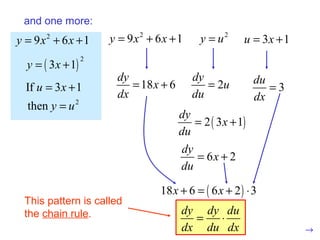
and one more: 
y = 9x2 + 6x +1 
( ) 2 y = 3x +1 
If u = 3x +1 
u = 3x +1 
dy 18x 6 
dx 
y = u2 
= + dy 2u 
du 
= du 3 
dx 
= 
dy = dy × 
du 
dx du dx 
then y = u2 
y = 9x2 + 6x +1 
dy 2( 3x 1) 
du 
= + 
dy = 6x + 
2 
du 
18x + 6 = ( 6x + 2) ×3 
This pattern is called 
the chain rule. 
®
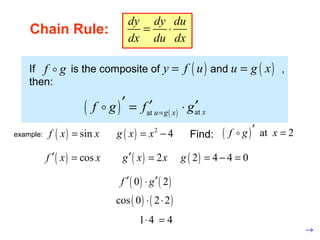
dy dy du 
dx du dx 
Chain Rule: = × 
f o g y = f ( u) u = g ( x) 
If is the composite of and , 
then: 
o ¢ = ¢ × ¢ 
( ) at u g( x) at x f g f g = 
example: f ( x) = sin x g ( x) = x2 - 4 Find: ( f o g )¢ at x = 2 
f ¢( x) = cos x g¢( x) = 2x g ( 2) = 4 - 4 = 0 
f ¢( 0) × g¢( 2) 
cos ( 0) ×( 2×2) 
1× 4 = 4 
®
We could also do it this way: 
f ( g ( x) ) = sin ( x2 - 4) 
y = sin ( x2 - 4) 
y = sin u u = x2 - 4 
dy = cosu 
du = 
2x 
du 
dx 
dy = dy × 
du 
dx du dx 
dy = cosu × 
2x 
dx 
dy = cos ( x2 - 4) × 
2x 
dx 
dy = cos ( 22 - 4) × 2 × 
2 
dx 
dy = cos( 0) × 
4 
dx 
dy = 
4 
dx 
®
Here is a faster way to find the derivative: 
y = sin ( x2 - 4) 
y ¢ = cos( x2 - 4) ´ d ( x2 - 
4) 
dx 
y¢ = cos ( x2 - 4) ´2x 
Differentiate the outside function... 
…then the inside function 
At x = 2, y¢ = 4 
®
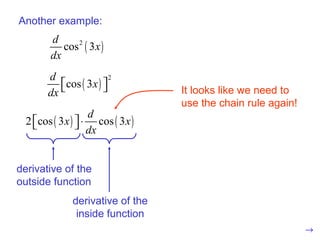
Another example: 
d cos2 ( 3x) 
dx 
d éë cos ( 3x 
) 2 dx 
ùû 
2 cos ( 3x) d cos ( 3x) 
dx 
éë ùû × 
derivative of the 
outside function 
derivative of the 
inside function 
It looks like we need to 
use the chain rule again! 
®
Another example: 
d cos2 ( 3x) 
dx 
d éë cos ( 3x 
) 2 dx 
ùû 
2 cos ( 3x) d cos ( 3x) 
dx 
éë ùû × 
2cos ( 3x) sin ( 3x) d ( 3x) 
dx 
×- × 
-2cos ( 3x) ×sin ( 3x) ×3 
-6cos ( 3x) sin ( 3x) 
The chain rule can be used 
more than once. 
(That’s what makes the 
“chain” in the “chain rule”!) 
®
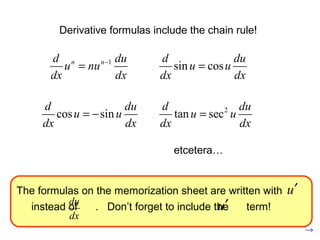
Derivative formulas include the chain rule! 
d un = nun - 1 du 
d sin u = 
cosu du 
dx dx 
dx dx 
d cosu sin u du 
dx dx 
= - d tan u = 
sec2 u du 
dx dx 
etcetera… 
The formulas on the memorization sheet are written with 
instead of . Don’t forget to include the term! 
u¢ 
du u¢ 
dx 
®
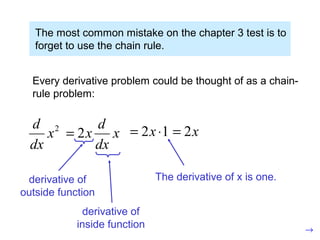
The most common mistake on the chapter 3 test is to 
forget to use the chain rule. 
Every derivative problem could be thought of as a chain-rule 
problem: 
d x2 
dx 
2x d x 
dx 
= = 2x ×1 = 2x 
derivative of 
outside function 
derivative of 
inside function 
The derivative of x is one. 
®
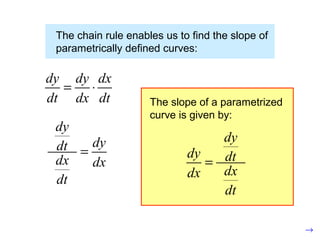
The chain rule enables us to find the slope of 
parametrically defined curves: 
dy = dy × 
dx 
dt dx dt 
dy 
dt dy 
dx = 
dx 
dt 
Divide both sides by 
dx 
The slope of a pardatmetrized 
curve is given by: 
dy 
dy dt 
dx dx 
dt 
= 
®
Example: x = 3cos t y = 2sin t 
These are the equations for 
an ellipse. 
dx 3sin t 
dt 
= - dy 2cos t 
dt 
dy t 
dx t 
= 2cos 
= 
- 
3sin 
2 cot 
3 
= - t
p

Chain Rule

  • 1.
    Made by: RudraPatel Harsh Desai Ravi Patel Rishabh Patel Harshil Raymagiya
  • 2.
    We now havea pretty good list of “shortcuts” to find derivatives of simple functions. Of course, many of the functions that we will encounter are not so simple. What is needed is a way to combine derivative rules to evaluate more complicated functions. ®
  • 3.
    Consider a simplecomposite function: y = 6x -10 y = 2( 3x -5) If u = 3x -5 then y = 2u y = 6x -10 y = 2u u = 3x - 5 = 2 dy dy 6 dx du = du 3 dx = 6 = 2×3 dy = dy × du dx du dx ®
  • 4.
    and another: y= 5u - 2 where u = 3t then y = 5( 3t ) - 2 u = 3t dy 15 dt = dy 5 du = du 3 dt = 15 = 5×3 dy = dy × du dt du dt y = 5( 3t ) - 2 y =15t - 2 y = 5u - 2 ®
  • 5.
    and one more: y = 9x2 + 6x +1 ( ) 2 y = 3x +1 If u = 3x +1 u = 3x +1 dy 18x 6 dx y = u2 = + dy 2u du = du 3 dx = dy = dy × du dx du dx then y = u2 y = 9x2 + 6x +1 dy 2( 3x 1) du = + dy = 6x + 2 du 18x + 6 = ( 6x + 2) ×3 This pattern is called the chain rule. ®
  • 6.
    dy dy du dx du dx Chain Rule: = × f o g y = f ( u) u = g ( x) If is the composite of and , then: o ¢ = ¢ × ¢ ( ) at u g( x) at x f g f g = example: f ( x) = sin x g ( x) = x2 - 4 Find: ( f o g )¢ at x = 2 f ¢( x) = cos x g¢( x) = 2x g ( 2) = 4 - 4 = 0 f ¢( 0) × g¢( 2) cos ( 0) ×( 2×2) 1× 4 = 4 ®
  • 7.
    We could alsodo it this way: f ( g ( x) ) = sin ( x2 - 4) y = sin ( x2 - 4) y = sin u u = x2 - 4 dy = cosu du = 2x du dx dy = dy × du dx du dx dy = cosu × 2x dx dy = cos ( x2 - 4) × 2x dx dy = cos ( 22 - 4) × 2 × 2 dx dy = cos( 0) × 4 dx dy = 4 dx ®
  • 8.
    Here is afaster way to find the derivative: y = sin ( x2 - 4) y ¢ = cos( x2 - 4) ´ d ( x2 - 4) dx y¢ = cos ( x2 - 4) ´2x Differentiate the outside function... …then the inside function At x = 2, y¢ = 4 ®
  • 9.
    Another example: dcos2 ( 3x) dx d éë cos ( 3x ) 2 dx ùû 2 cos ( 3x) d cos ( 3x) dx éë ùû × derivative of the outside function derivative of the inside function It looks like we need to use the chain rule again! ®
  • 10.
    Another example: dcos2 ( 3x) dx d éë cos ( 3x ) 2 dx ùû 2 cos ( 3x) d cos ( 3x) dx éë ùû × 2cos ( 3x) sin ( 3x) d ( 3x) dx ×- × -2cos ( 3x) ×sin ( 3x) ×3 -6cos ( 3x) sin ( 3x) The chain rule can be used more than once. (That’s what makes the “chain” in the “chain rule”!) ®
  • 11.
    Derivative formulas includethe chain rule! d un = nun - 1 du d sin u = cosu du dx dx dx dx d cosu sin u du dx dx = - d tan u = sec2 u du dx dx etcetera… The formulas on the memorization sheet are written with instead of . Don’t forget to include the term! u¢ du u¢ dx ®
  • 12.
    The most commonmistake on the chapter 3 test is to forget to use the chain rule. Every derivative problem could be thought of as a chain-rule problem: d x2 dx 2x d x dx = = 2x ×1 = 2x derivative of outside function derivative of inside function The derivative of x is one. ®
  • 13.
    The chain ruleenables us to find the slope of parametrically defined curves: dy = dy × dx dt dx dt dy dt dy dx = dx dt Divide both sides by dx The slope of a pardatmetrized curve is given by: dy dy dt dx dx dt = ®
  • 14.
    Example: x =3cos t y = 2sin t These are the equations for an ellipse. dx 3sin t dt = - dy 2cos t dt dy t dx t = 2cos = - 3sin 2 cot 3 = - t
  • 15.