Graphs of Factorable Polynomials
Function–Dance (origin unknown)
Graphs of Factorable Polynomials
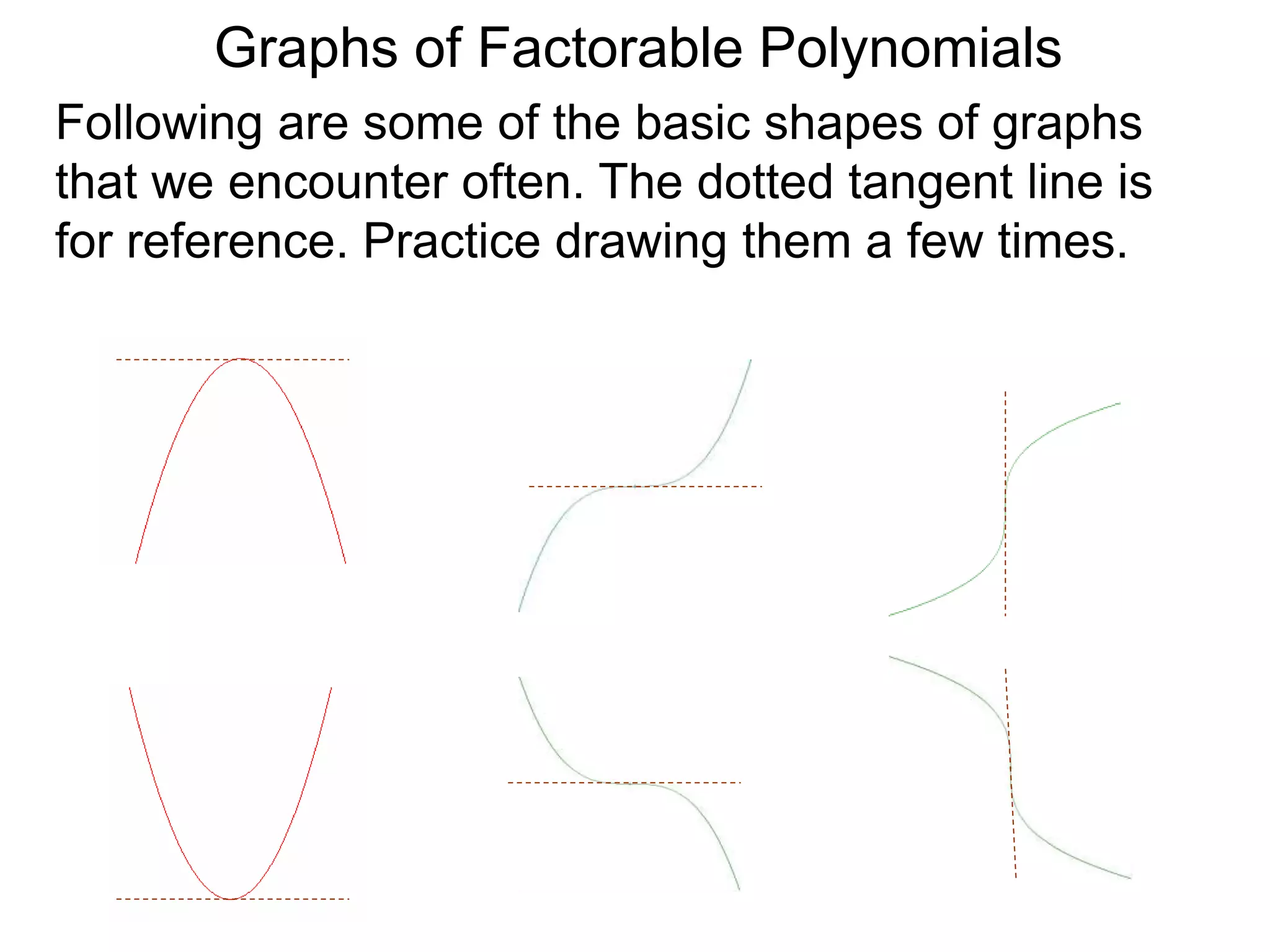
Following are some of the basic shapes of graphs
that we encounter often. The dotted tangent line is
for reference. Practice drawing them a few times.
Graphs of Factorable Polynomials
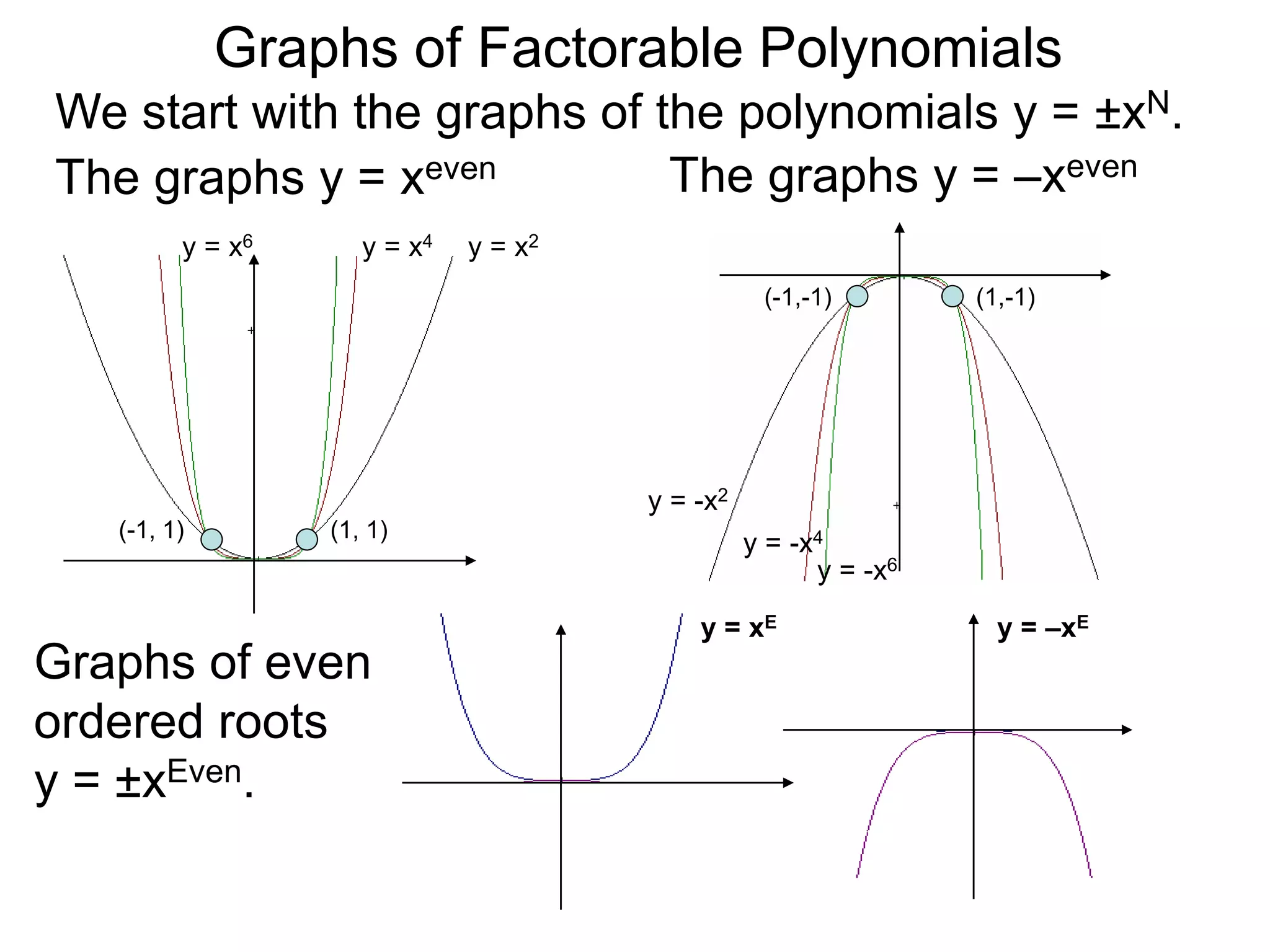
We start with the graphs of the polynomials y = ±xN.
Graphs of Factorable Polynomials
We start with the graphs of the polynomials y = ±xN.
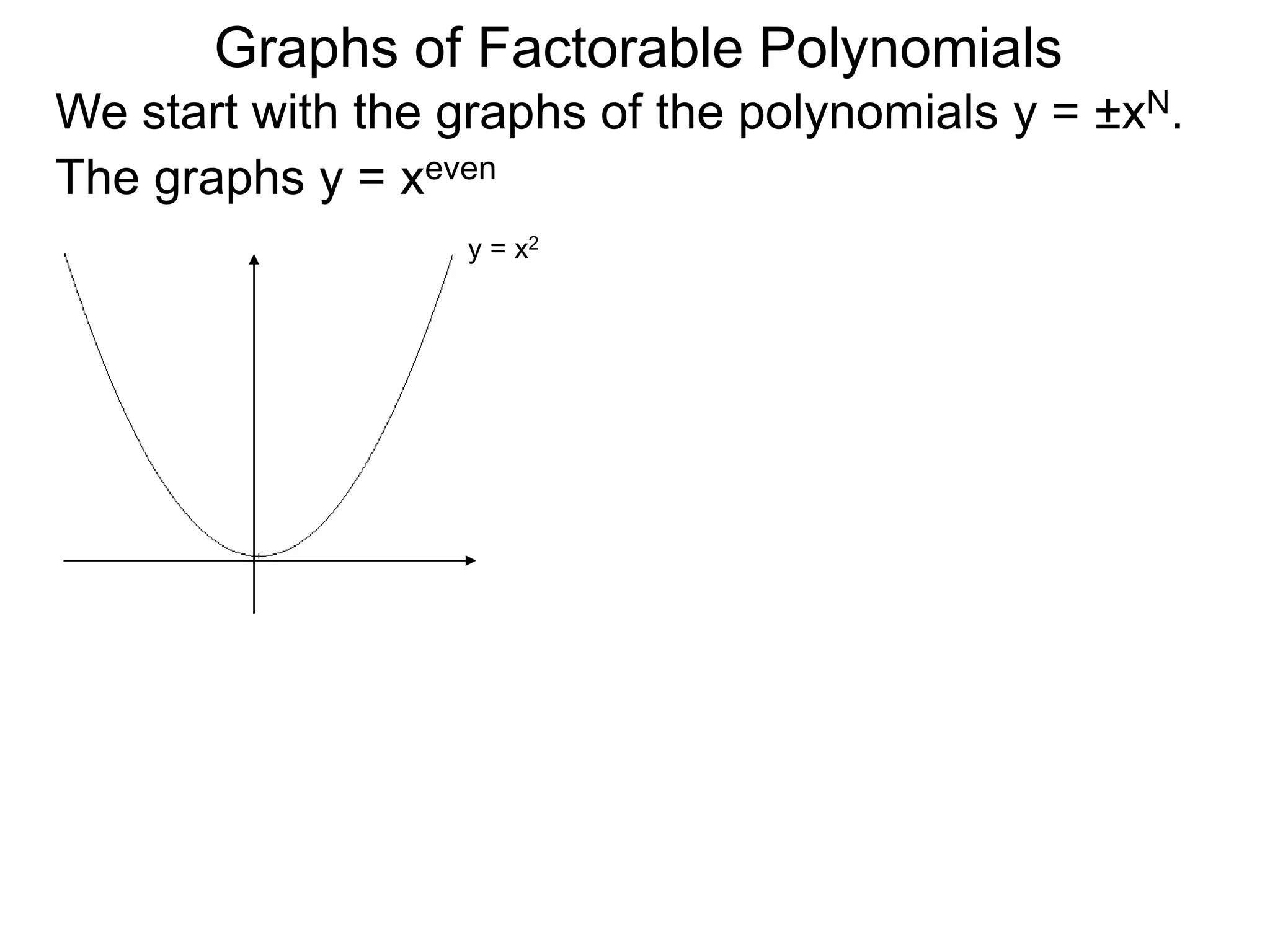
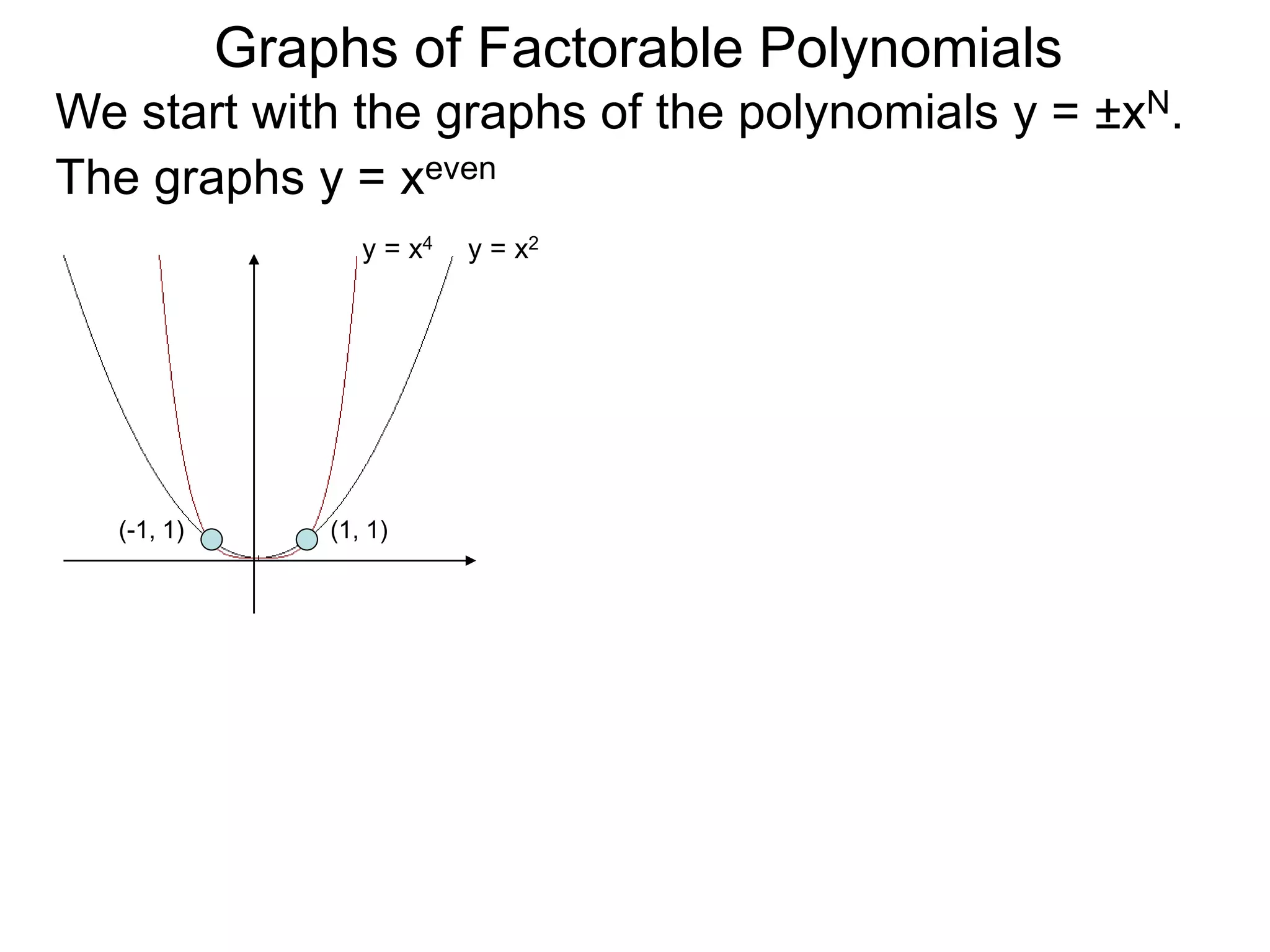
The graphs y = xeven
y = x2
Graphs of Factorable Polynomials
The graphs y = xeven
y = x2y = x4
(1, 1)(-1, 1)
We start with the graphs of the polynomials y = ±xN.
Graphs of Factorable Polynomials
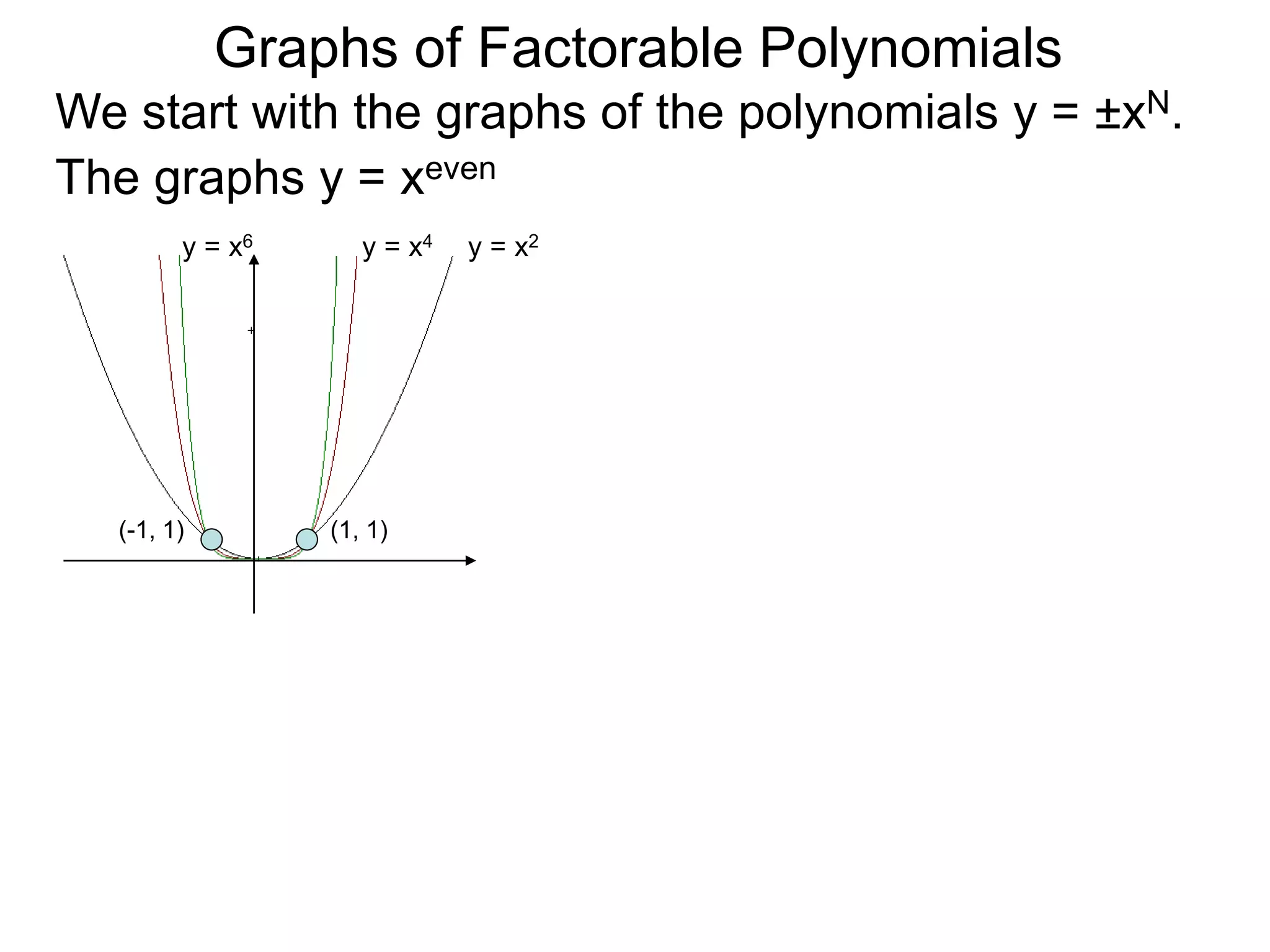
The graphs y = xeven
y = x2y = x4y = x6
(1, 1)(-1, 1)
We start with the graphs of the polynomials y = ±xN.
Graphs of Factorable Polynomials
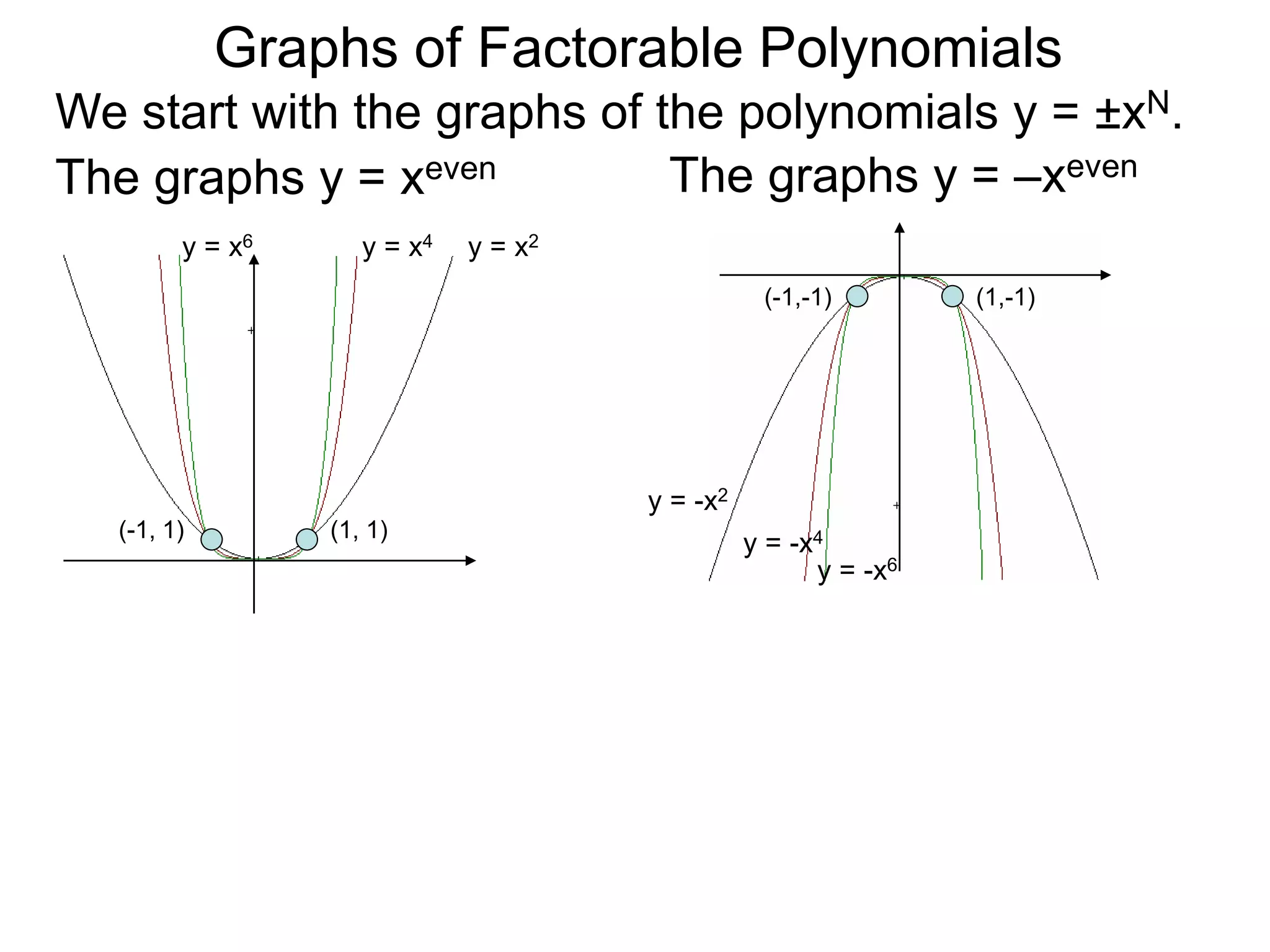
The graphs y = xeven
y = x2y = x4y = x6
y = -x2
y = -x4
y = -x6
(1, 1)(-1, 1)
(-1,-1) (1,-1)
We start with the graphs of the polynomials y = ±xN.
The graphs y = –xeven
Graphs of Factorable Polynomials
The graphs y = xeven
y = x2y = x4y = x6
y = -x2
y = -x4
y = -x6
(1, 1)(-1, 1)
(-1,-1) (1,-1)
We start with the graphs of the polynomials y = ±xN.
The graphs y = –xeven
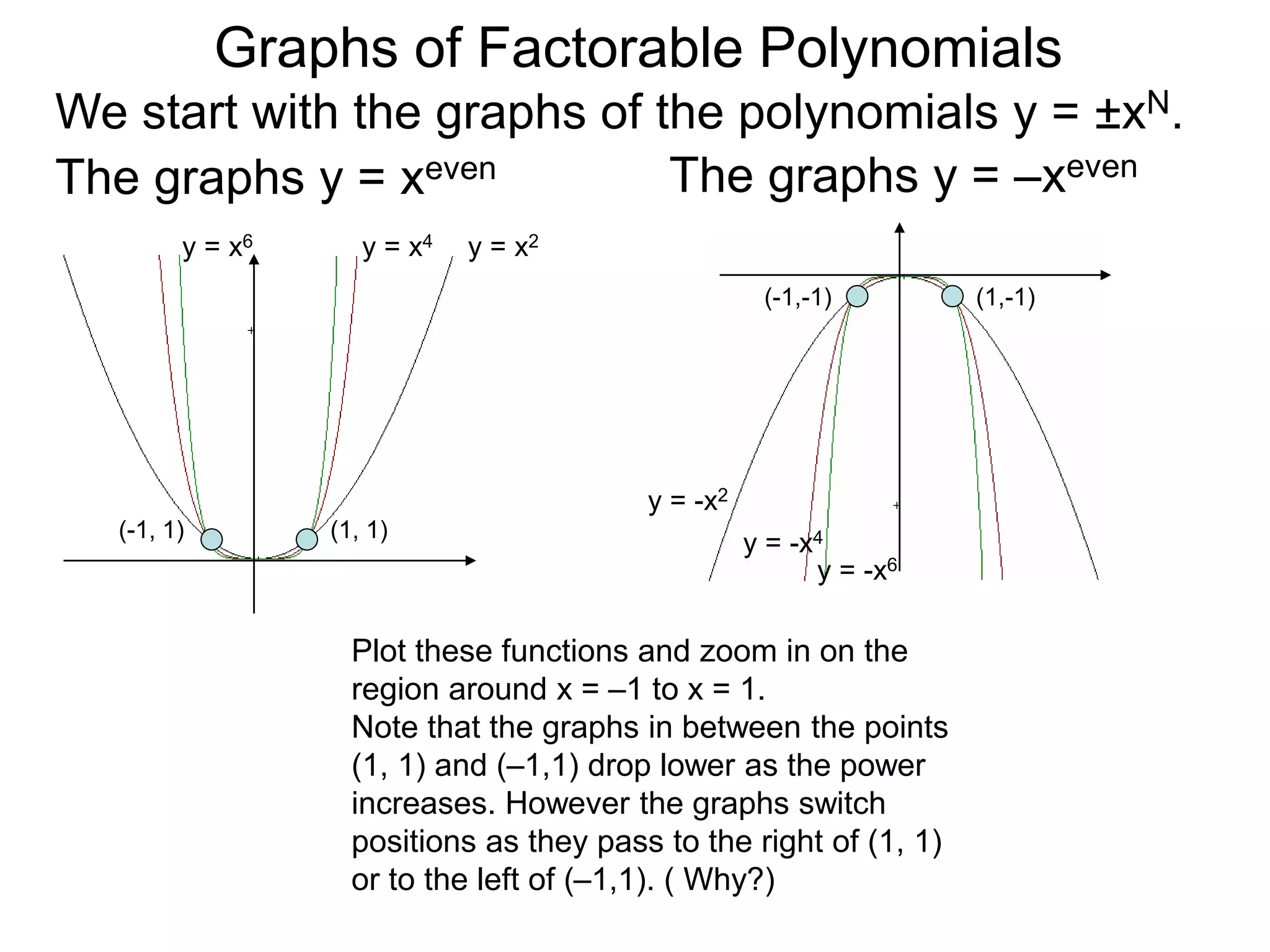
Plot these functions and zoom in on the
region around x = –1 to x = 1.
Note that the graphs in between the points
(1, 1) and (–1,1) drop lower as the power
increases. However the graphs switch
positions as they pass to the right of (1, 1)
or to the left of (–1,1). ( Why?)
Graphs of Factorable Polynomials
The graphs y = xeven
y = x2y = x4y = x6
y = xE y = –xE
(1, 1)(-1, 1)
We start with the graphs of the polynomials y = ±xN.
The graphs y = –xeven
Graphs of even
ordered roots
y = ±xEven.
y = -x2
y = -x4
y = -x6
(-1,-1) (1,-1)
Graphs of Factorable Polynomials
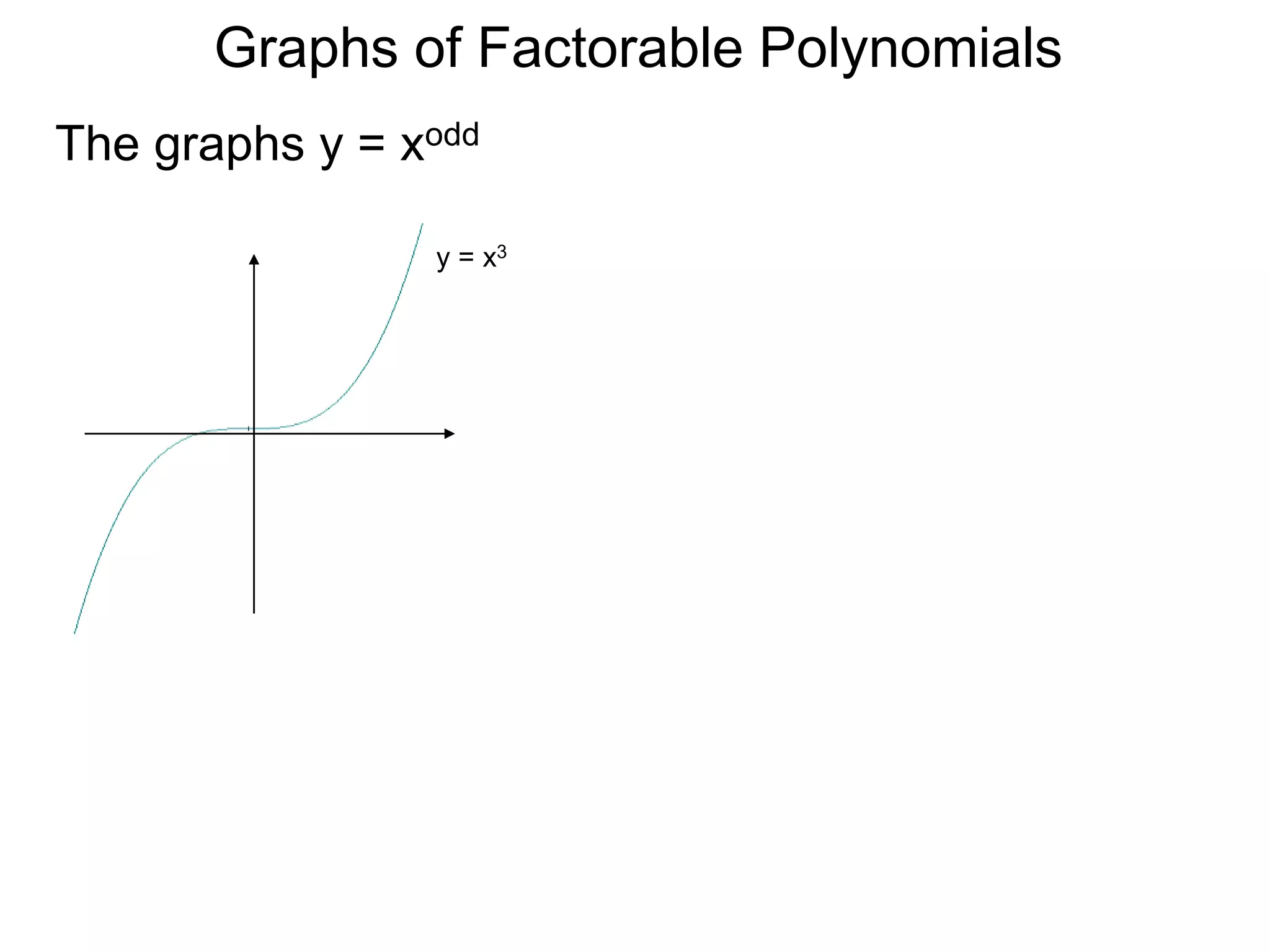
y = x3
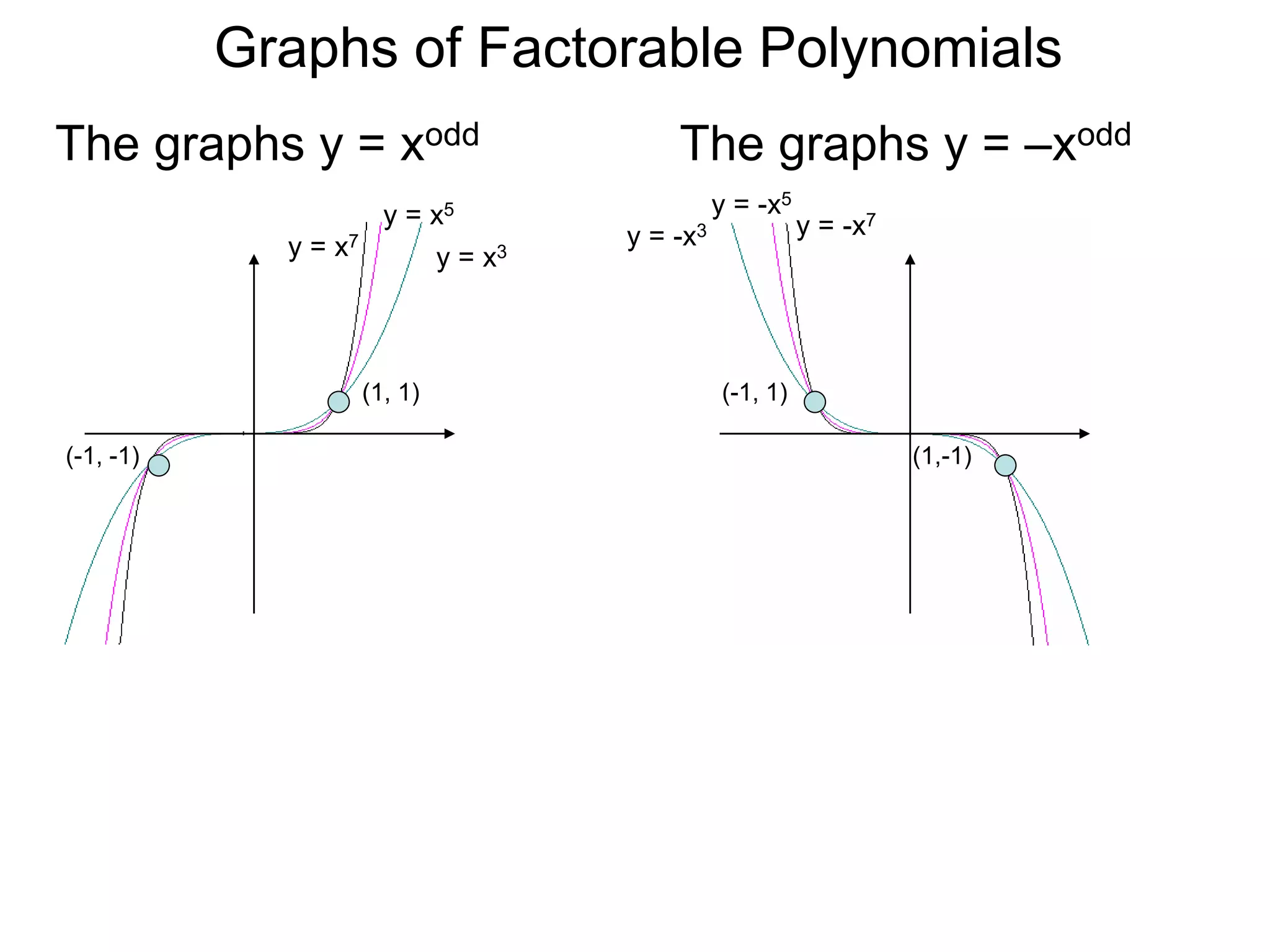
The graphs y = xodd
Graphs of Factorable Polynomials
y = x3
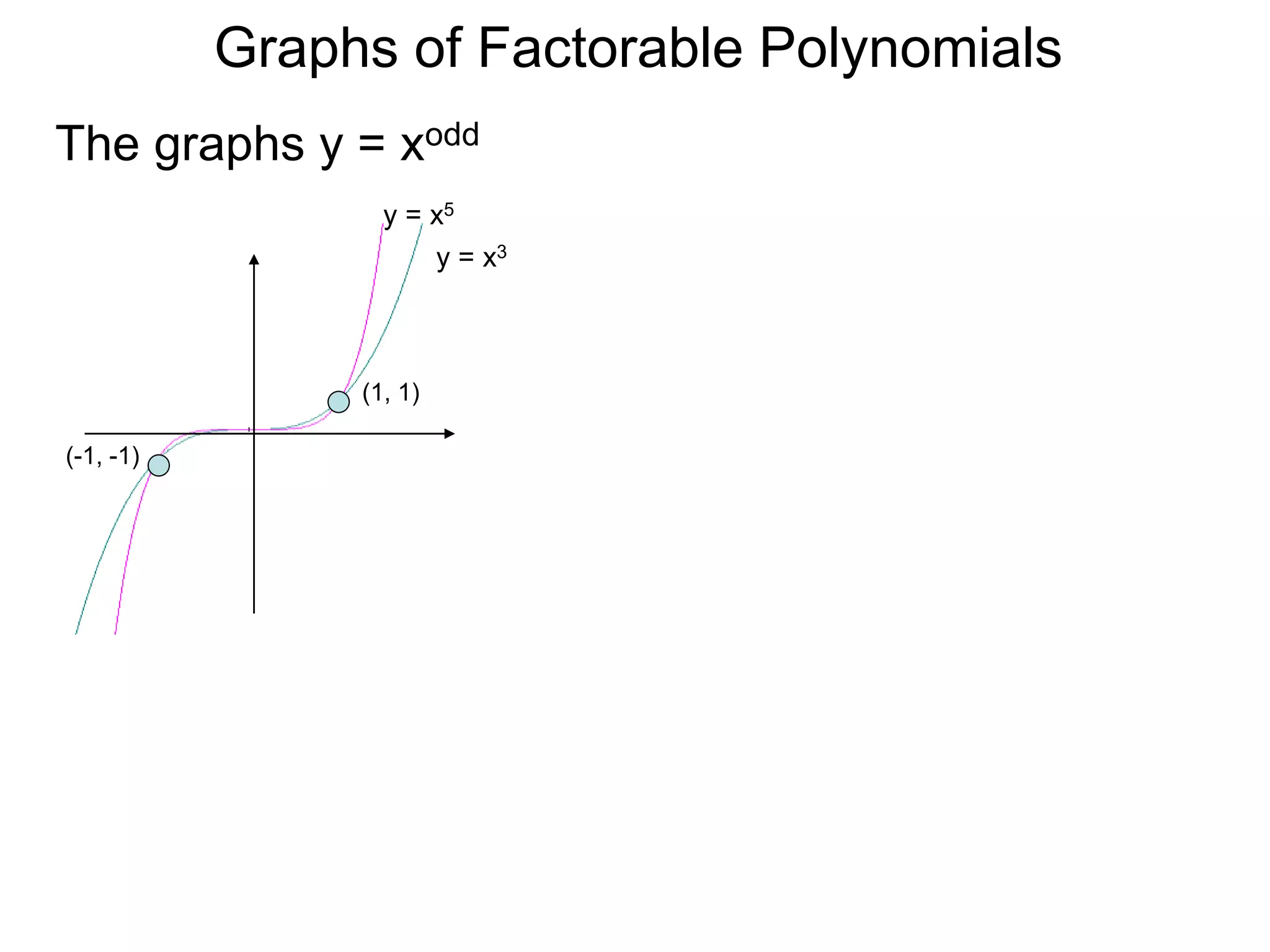
y = x5
(1, 1)
(-1, -1)
The graphs y = xodd
Graphs of Factorable Polynomials
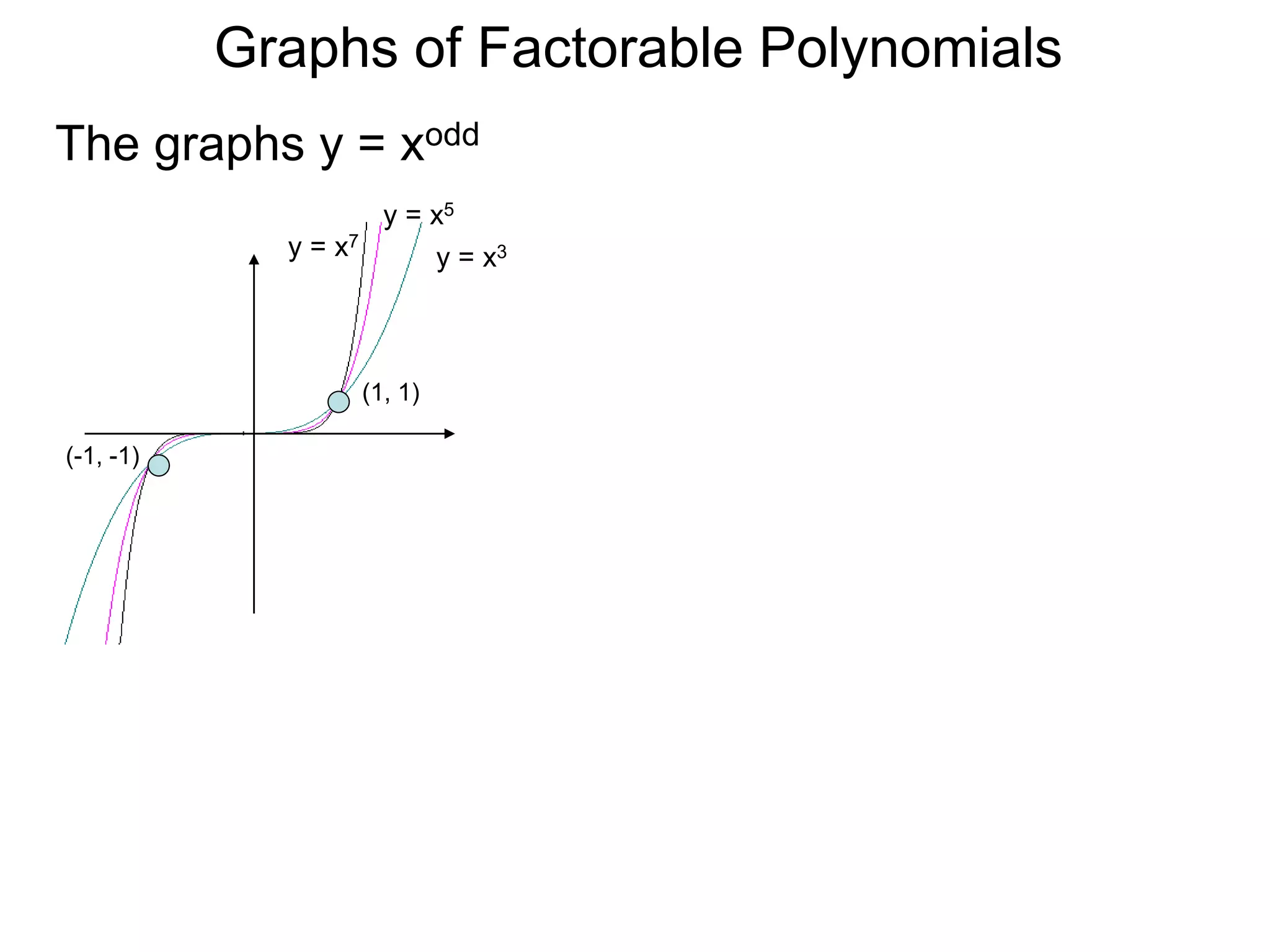
y = x3
y = x5
y = x7
(1, 1)
(-1, -1)
The graphs y = xodd
Graphs of Factorable Polynomials
The graphs y = xodd
y = x3
y = x5
y = x7 y = -x3
y = -x5
y = -x7
(1, 1)
(-1, -1)
(-1, 1)
(1,-1)
The graphs y = –xodd
Graphs of Factorable Polynomials
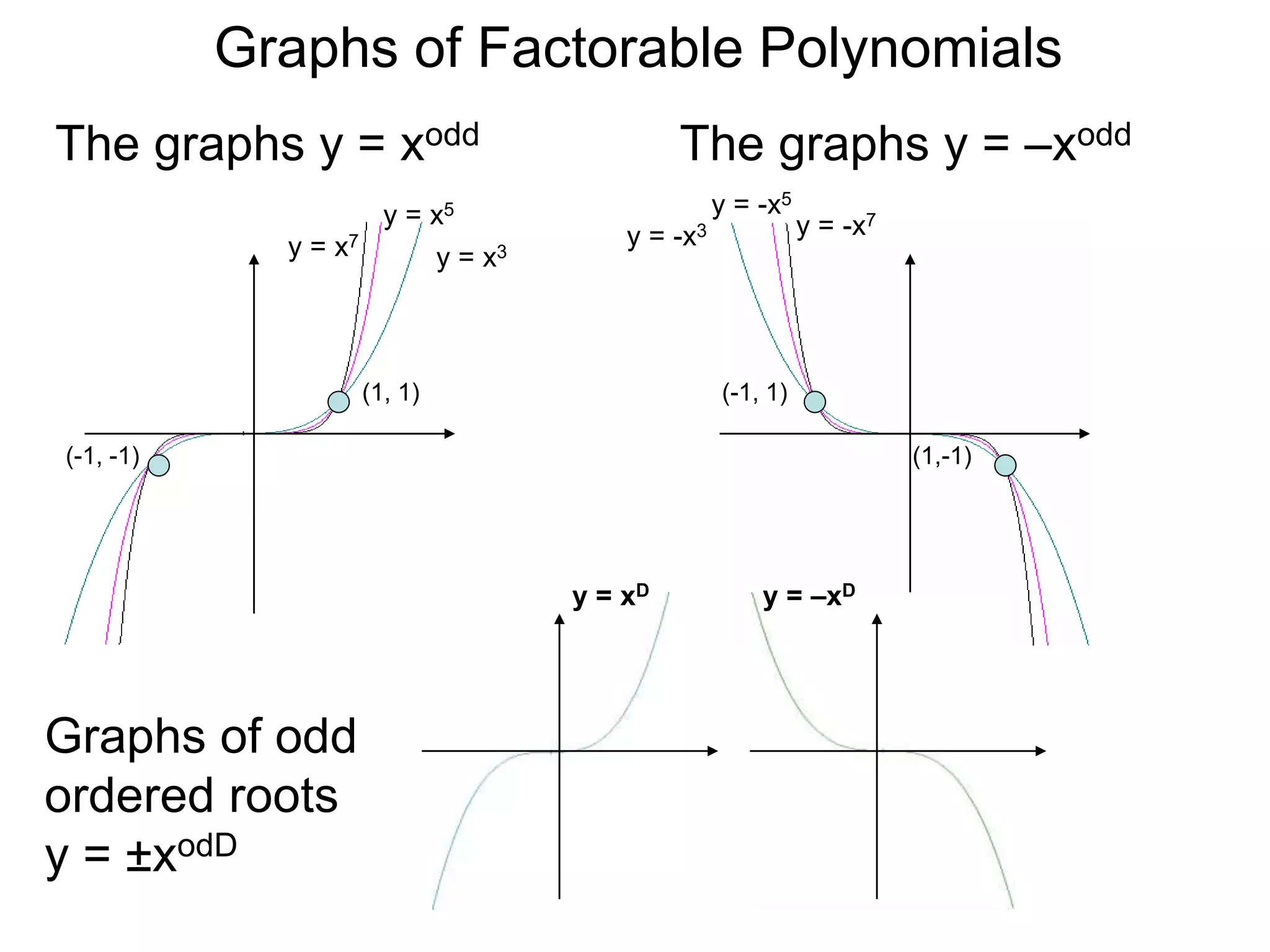
The graphs y = xodd
y = x3
y = x5
y = x7 y = -x3
y = -x5
y = -x7
y = xD y = –xD
(1, 1)
(-1, -1)
(-1, 1)
(1,-1)
The graphs y = –xodd
Graphs of odd
ordered roots
y = ±xodD
Graphs of Factorable Polynomials
Facts about the graphs of polynomials:
Graphs of Factorable Polynomials
Facts about the graphs of polynomials:
• The graphs of polynomials are unbroken curves.
Graphs of Factorable Polynomials
Facts about the graphs of polynomials:
• The graphs of polynomials are unbroken curves.
• Polynomial curves are smooth (no corners).
Graphs of Factorable Polynomials
Facts about the graphs of polynomials:
• The graphs of polynomials are unbroken curves.
• Polynomial curves are smooth (no corners).
• Let P(x) = anxn + lower degree terms.
Graphs of Factorable Polynomials
Facts about the graphs of polynomials:
• The graphs of polynomials are unbroken curves.
• Polynomial curves are smooth (no corners).
• Let P(x) = anxn + lower degree terms.
For large |x|, the leading term anxn dominates the
lower degree terms.
Graphs of Factorable Polynomials
Facts about the graphs of polynomials:
• The graphs of polynomials are unbroken curves.
• Polynomial curves are smooth (no corners).
• Let P(x) = anxn + lower degree terms.
For large |x|, the leading term anxn dominates the
lower degree terms. For x's such that | x | are large,
the "lower degree terms" are negligible compared to
anxn.
Graphs of Factorable Polynomials
Facts about the graphs of polynomials:
• The graphs of polynomials are unbroken curves.
• Polynomial curves are smooth (no corners).
• Let P(x) = anxn + lower degree terms.
For large |x|, the leading term anxn dominates the
lower degree terms. For x's such that | x | are large,
the "lower degree terms" are negligible compared to
anxn.
Hence, for x where |x| is "large", the graph of P(x)
resembles the graph y = anxn.
Graphs of Factorable Polynomials
Facts about the graphs of polynomials:
• The graphs of polynomials are unbroken curves.
• Polynomial curves are smooth (no corners).
• Let P(x) = anxn + lower degree terms.
For large |x|, the leading term anxn dominates the
lower degree terms. For x's such that | x | are large,
the "lower degree terms" are negligible compared to
anxn.
Hence, for x where |x| is "large", the graph of P(x)
resembles the graph y = anxn.This means there're four behaviors of
polynomial-graphs to the far left or far right
(as | x | becomes large).
Graphs of Factorable Polynomials
Facts about the graphs of polynomials:
• The graphs of polynomials are unbroken curves.
• Polynomial curves are smooth (no corners).
• Let P(x) = anxn + lower degree terms.
For large |x|, the leading term anxn dominates the
lower degree terms. For x's such that | x | are large,
the "lower degree terms" are negligible compared to
anxn.
Hence, for x where |x| is "large", the graph of P(x)
resembles the graph y = anxn.This means there're four behaviors of
polynomial-graphs to the far left or far right
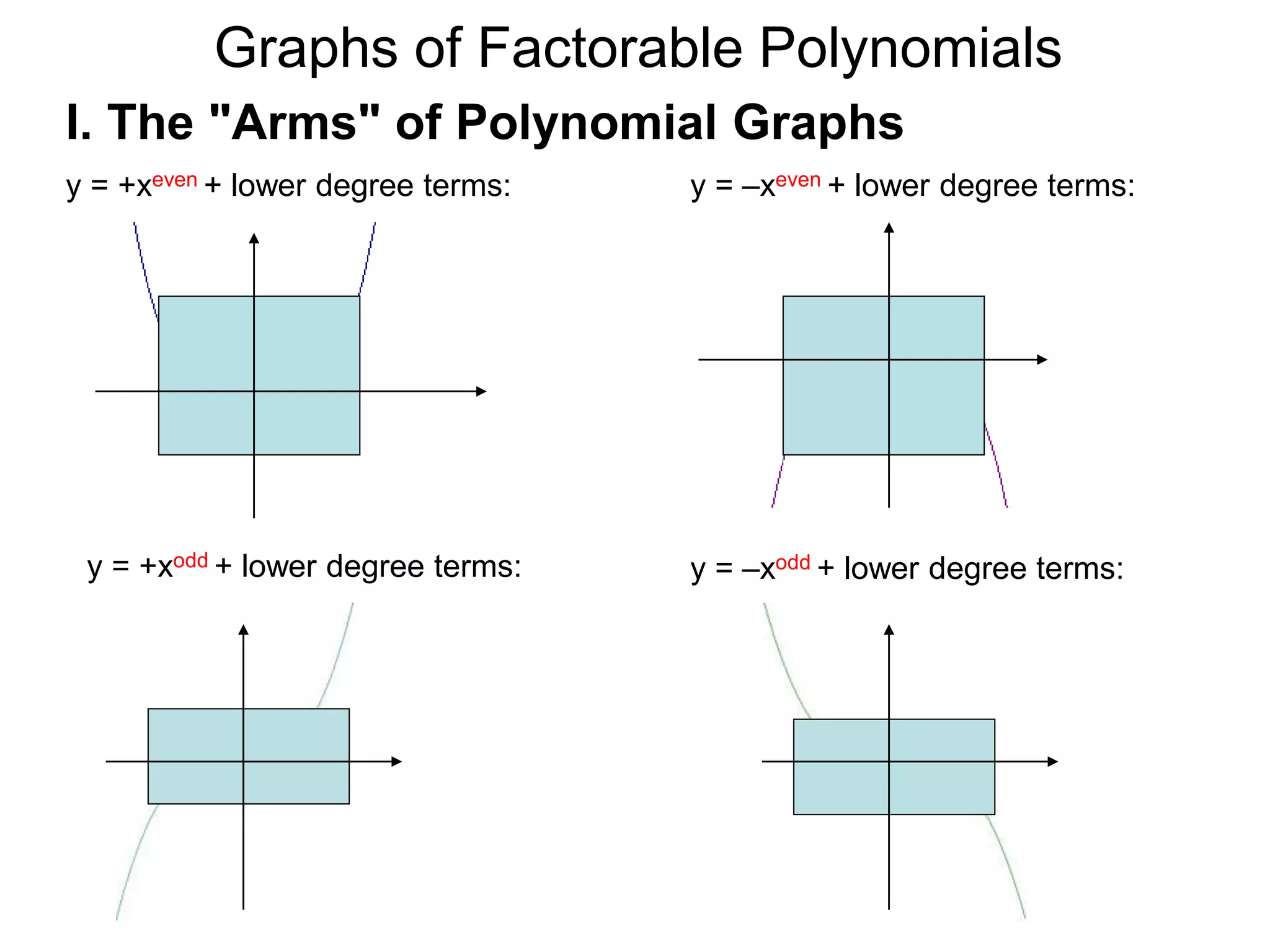
(as | x | becomes large). These behaviors are based
on the sign the leading term anxn, and whether n is
even or odd.
Graphs of Factorable Polynomials
I. The "Arms" of Polynomial Graphs
Graphs of Factorable Polynomials
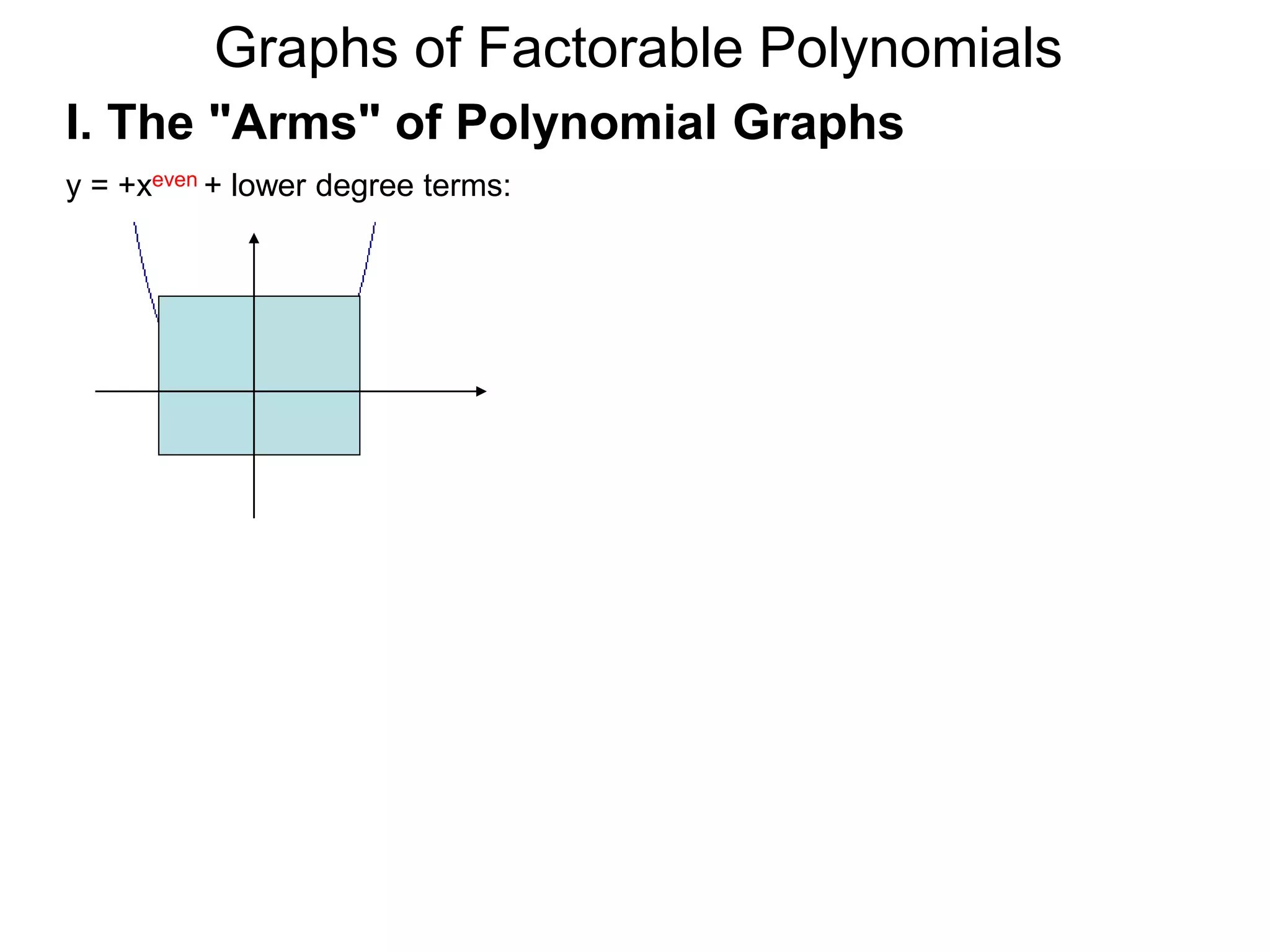
y = +xeven + lower degree terms:
I. The "Arms" of Polynomial Graphs
Graphs of Factorable Polynomials
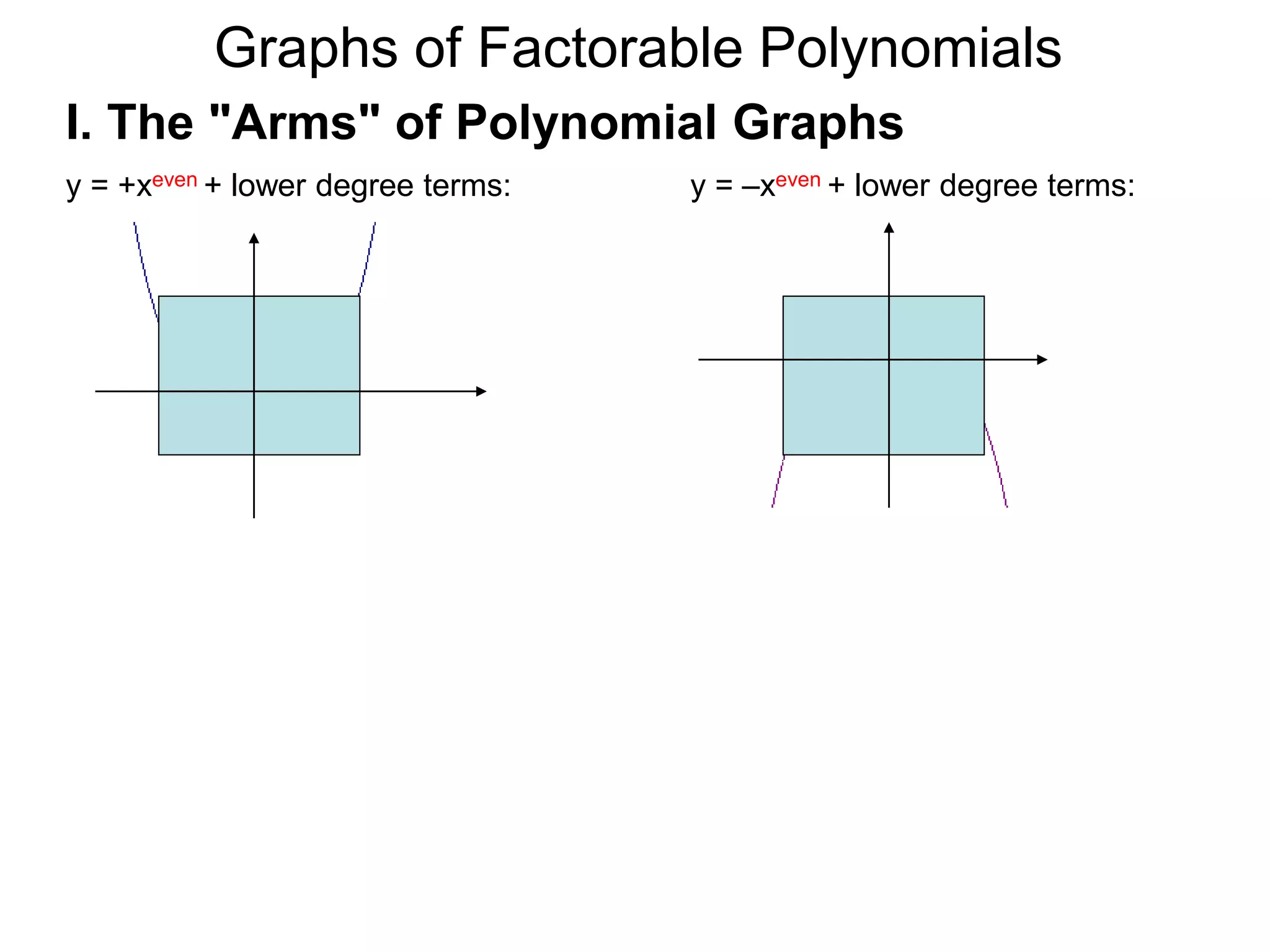
y = +xeven + lower degree terms: y = –xeven + lower degree terms:
I. The "Arms" of Polynomial Graphs
Graphs of Factorable Polynomials
y = +xeven + lower degree terms: y = –xeven + lower degree terms:
I. The "Arms" of Polynomial Graphs
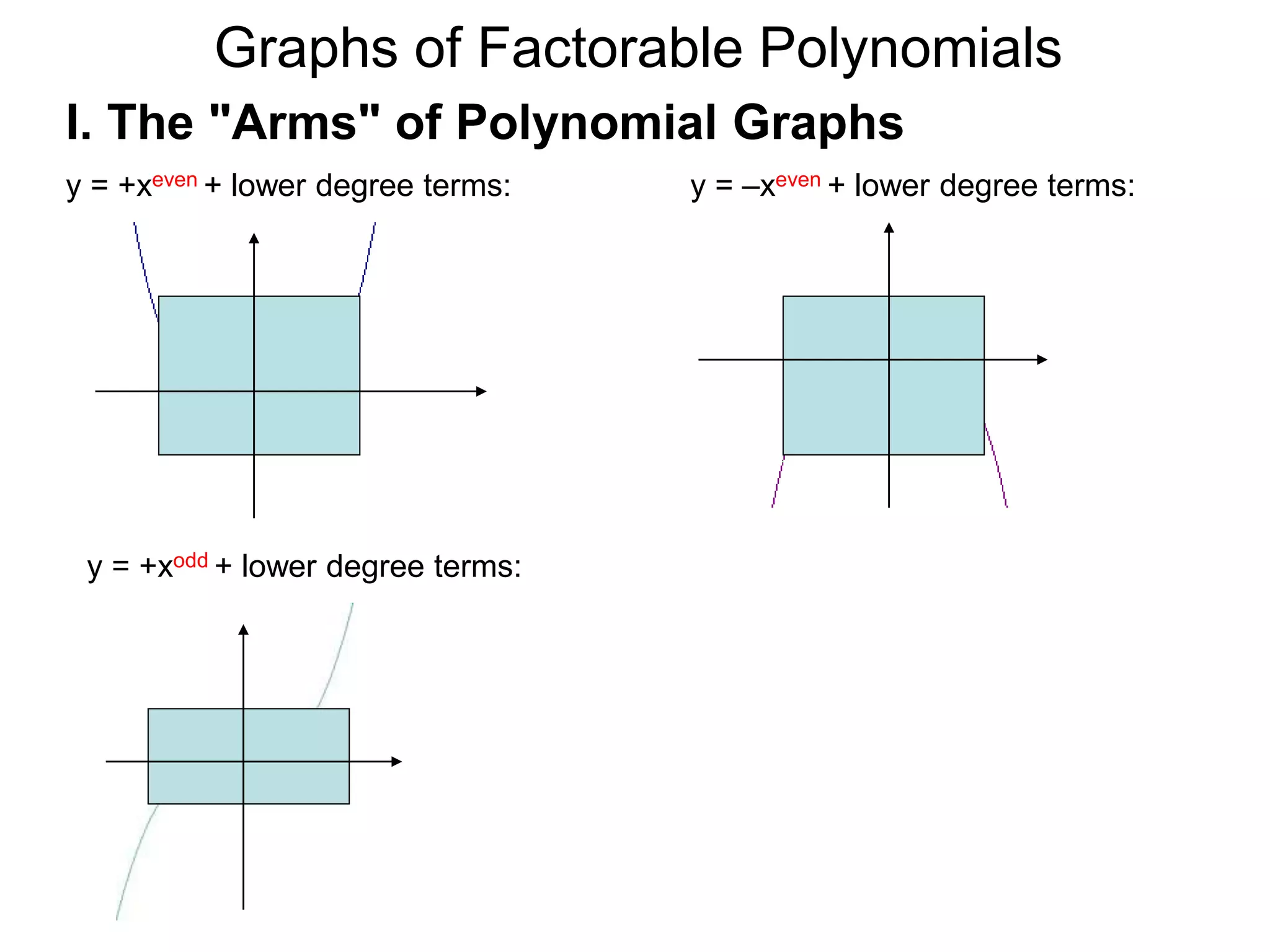
y = +xodd + lower degree terms:
Graphs of Factorable Polynomials
y = +xeven + lower degree terms: y = –xeven + lower degree terms:
I. The "Arms" of Polynomial Graphs
y = +xodd + lower degree terms: y = –xodd + lower degree terms:
Graphs of Factorable Polynomials
For factorable polynomials, we use the sign-charts to
sketch the central portion of the graphs.
Graphs of Factorable Polynomials
For factorable polynomials, we use the sign-charts to
sketch the central portion of the graphs.
Recall that given a polynomial P(x), it's sign-chart is
constructed in the following manner:
Graphs of Factorable Polynomials
For factorable polynomials, we use the sign-charts to
sketch the central portion of the graphs.
Recall that given a polynomial P(x), it's sign-chart is
constructed in the following manner:
Construction of the sign-chart of polynomial P(x):
Graphs of Factorable Polynomials
For factorable polynomials, we use the sign-charts to
sketch the central portion of the graphs.
Recall that given a polynomial P(x), it's sign-chart is
constructed in the following manner:
Construction of the sign-chart of polynomial P(x):
I. Find the roots of P(x) and their order respectively.
Graphs of Factorable Polynomials
For factorable polynomials, we use the sign-charts to
sketch the central portion of the graphs.
Recall that given a polynomial P(x), it's sign-chart is
constructed in the following manner:
Construction of the sign-chart of polynomial P(x):
I. Find the roots of P(x) and their order respectively.
II. Draw the real line, mark off the answers from I.
Graphs of Factorable Polynomials
For factorable polynomials, we use the sign-charts to
sketch the central portion of the graphs.
Recall that given a polynomial P(x), it's sign-chart is
constructed in the following manner:
Construction of the sign-chart of polynomial P(x):
I. Find the roots of P(x) and their order respectively.
II. Draw the real line, mark off the answers from I.
III. Sample a point for its sign, use the the orders of
the roots to extend and fill in the signs.
Graphs of Factorable Polynomials
For factorable polynomials, we use the sign-charts to
sketch the central portion of the graphs.
Recall that given a polynomial P(x), it's sign-chart is
constructed in the following manner:
Construction of the sign-chart of polynomial P(x):
I. Find the roots of P(x) and their order respectively.
II. Draw the real line, mark off the answers from I.
III. Sample a point for its sign, use the the orders of
the roots to extend and fill in the signs.
(Reminder:
Across odd-ordered root, sign changes
Across even-ordered root, sign stays the same.)
Example A: Make the sign-chart of f(x) = x2 – 3x – 4
and graph y = f(x).
Graphs of Factorable Polynomials
Example A: Make the sign-chart of f(x) = x2 – 3x – 4
and graph y = f(x).
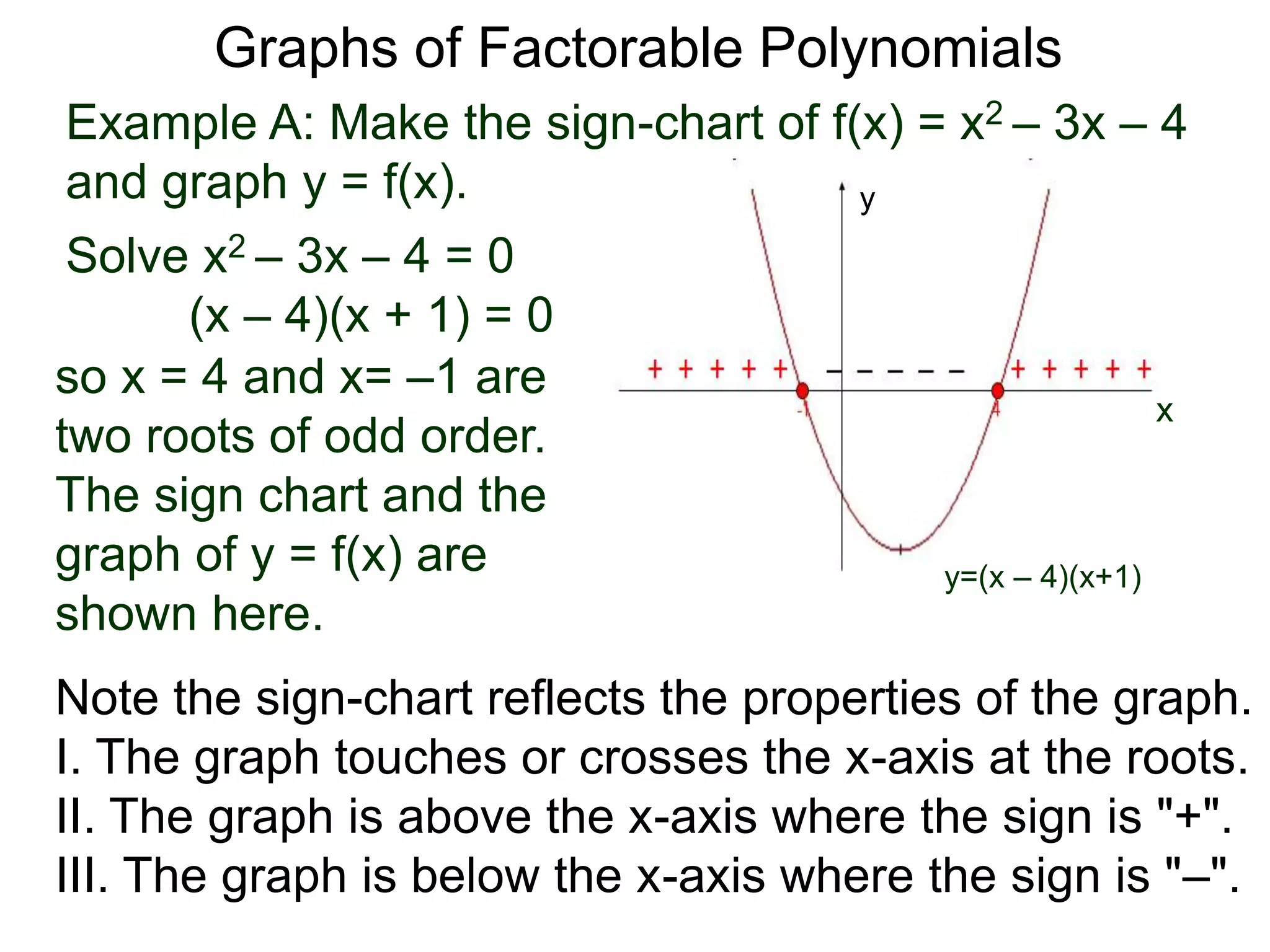
Solve x2 – 3x – 4 = 0
(x – 4)(x + 1) = 0
Graphs of Factorable Polynomials
so x = 4 and x= –1 are
two roots of odd order.
Example A: Make the sign-chart of f(x) = x2 – 3x – 4
and graph y = f(x).
Solve x2 – 3x – 4 = 0
(x – 4)(x + 1) = 0
Graphs of Factorable Polynomials
so x = 4 and x= –1 are
two roots of odd order.
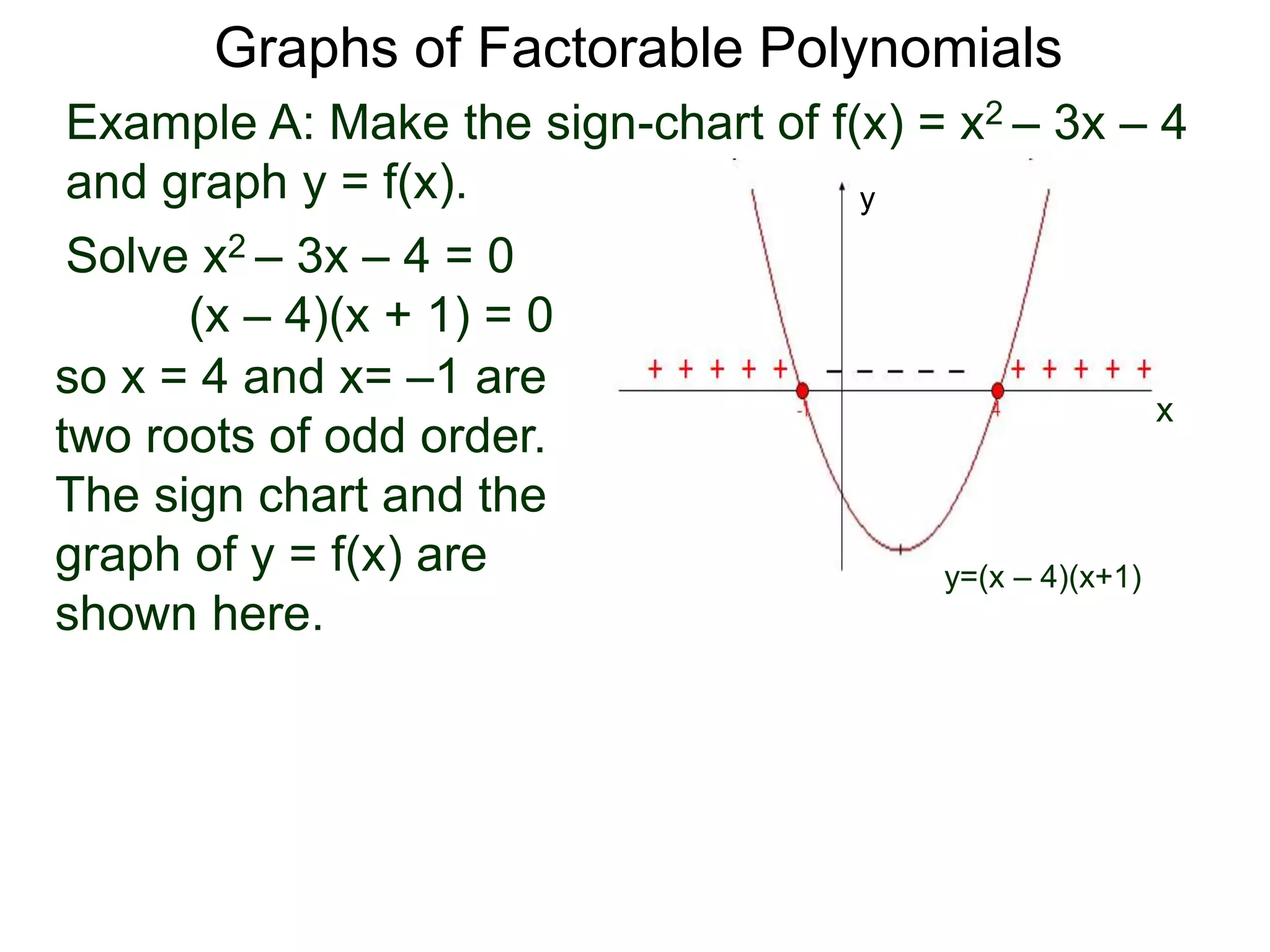
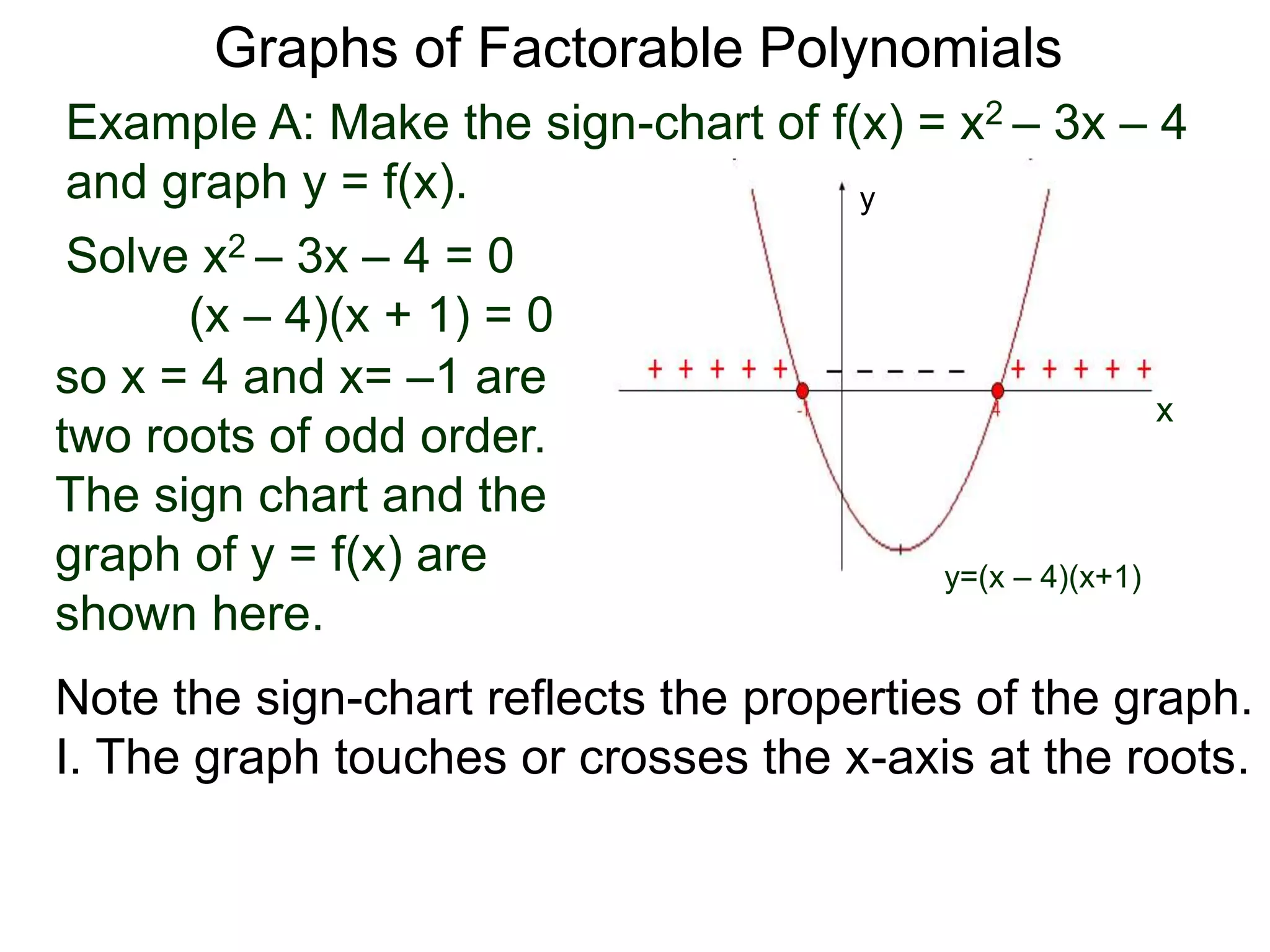
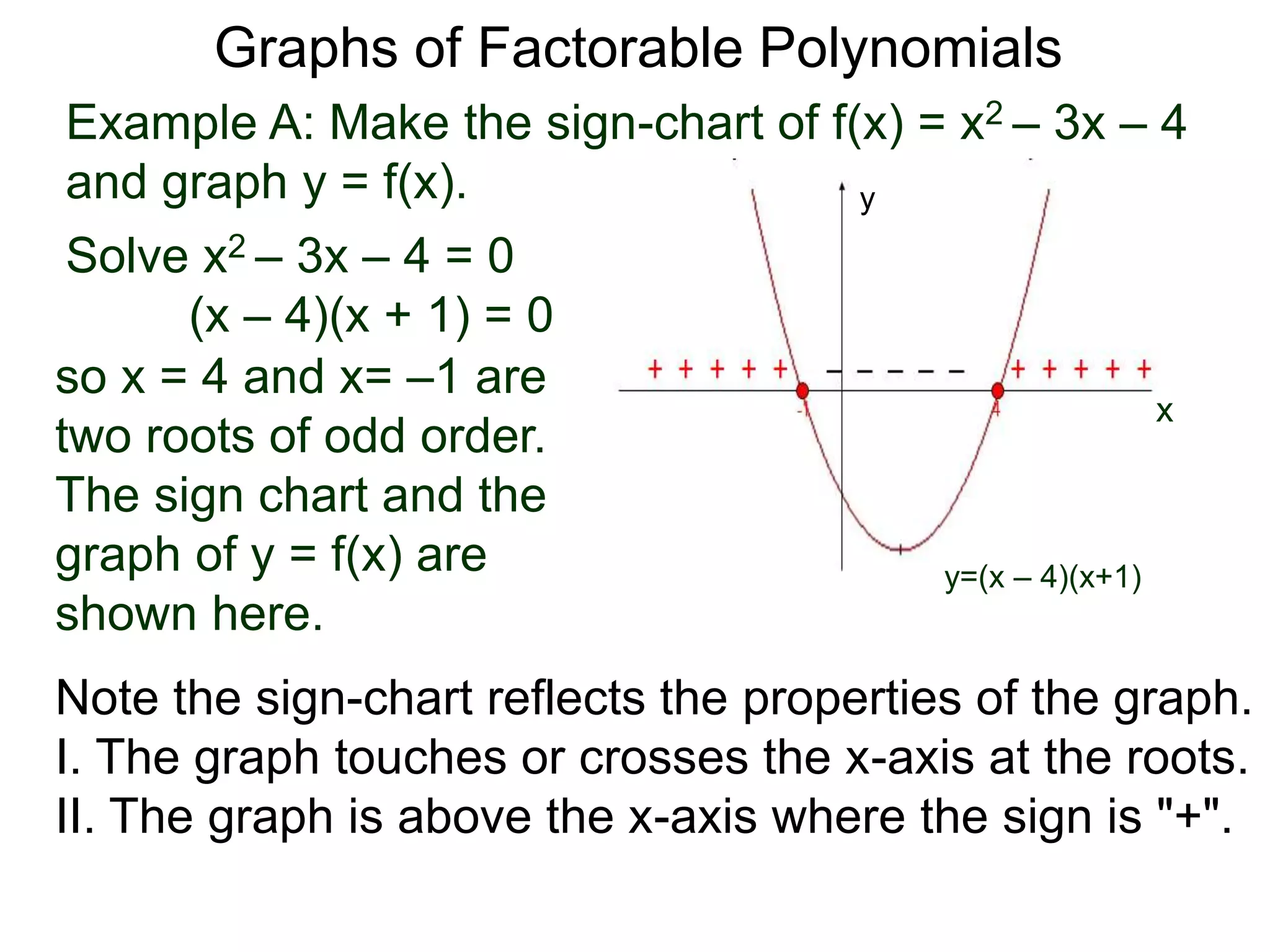
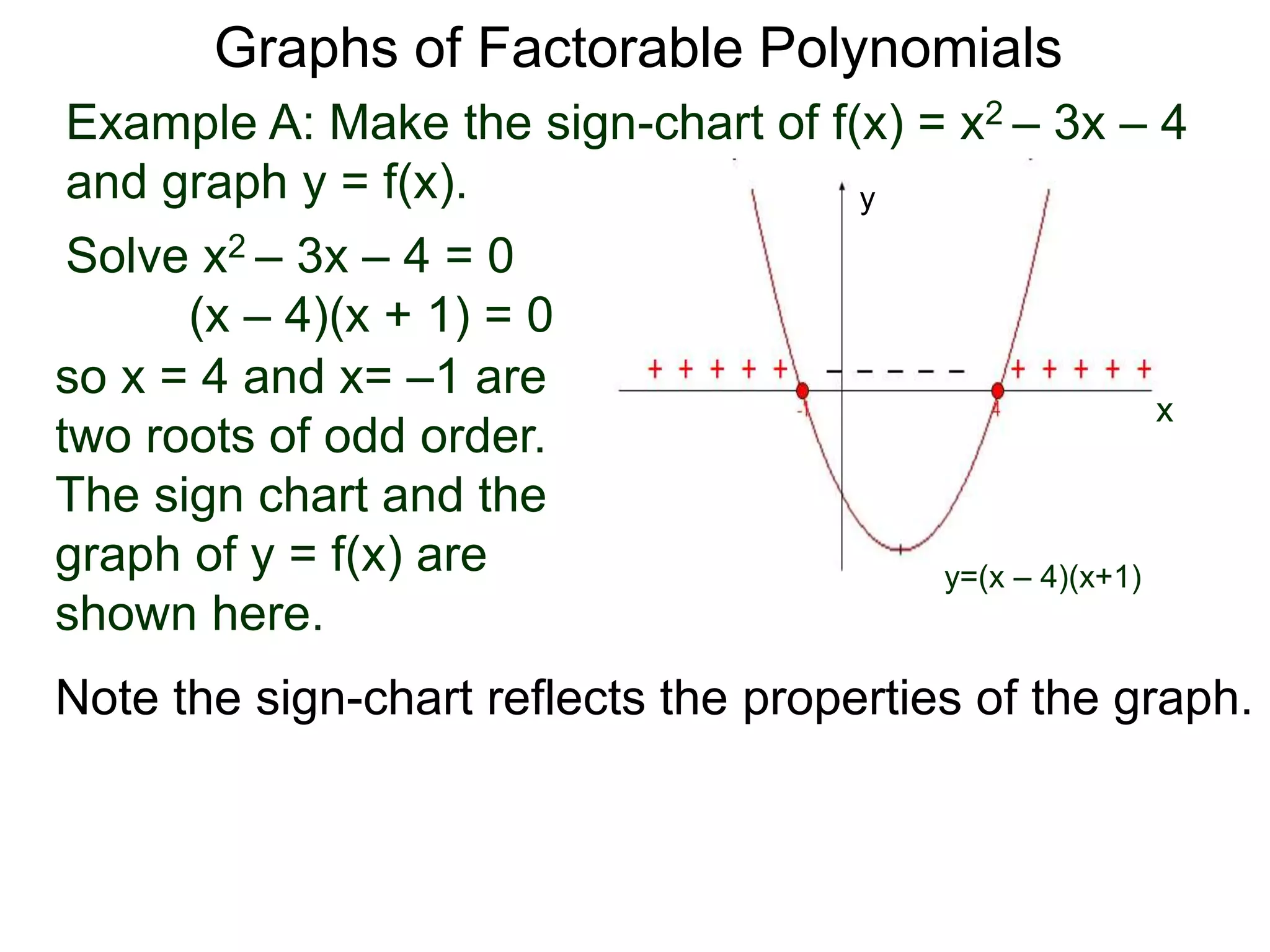
The sign chart and the
graph of y = f(x) are
shown here.
y=(x – 4)(x+1)
x
y
Example A: Make the sign-chart of f(x) = x2 – 3x – 4
and graph y = f(x).
Solve x2 – 3x – 4 = 0
(x – 4)(x + 1) = 0
Graphs of Factorable Polynomials
so x = 4 and x= –1 are
two roots of odd order.
The sign chart and the
graph of y = f(x) are
shown here.
y=(x – 4)(x+1)
x
y
Note the sign-chart reflects the properties of the graph.
Example A: Make the sign-chart of f(x) = x2 – 3x – 4
and graph y = f(x).
Solve x2 – 3x – 4 = 0
(x – 4)(x + 1) = 0
Graphs of Factorable Polynomials
so x = 4 and x= –1 are
two roots of odd order.
The sign chart and the
graph of y = f(x) are
shown here.
y=(x – 4)(x+1)
x
y
Note the sign-chart reflects the properties of the graph.
I. The graph touches or crosses the x-axis at the roots.
Example A: Make the sign-chart of f(x) = x2 – 3x – 4
and graph y = f(x).
Solve x2 – 3x – 4 = 0
(x – 4)(x + 1) = 0
Graphs of Factorable Polynomials
so x = 4 and x= –1 are
two roots of odd order.
The sign chart and the
graph of y = f(x) are
shown here.
y=(x – 4)(x+1)
x
y
Note the sign-chart reflects the properties of the graph.
I. The graph touches or crosses the x-axis at the roots.
II. The graph is above the x-axis where the sign is "+".
Example A: Make the sign-chart of f(x) = x2 – 3x – 4
and graph y = f(x).
Solve x2 – 3x – 4 = 0
(x – 4)(x + 1) = 0
Graphs of Factorable Polynomials
so x = 4 and x= –1 are
two roots of odd order.
The sign chart and the
graph of y = f(x) are
shown here.
y=(x – 4)(x+1)
x
y
Note the sign-chart reflects the properties of the graph.
I. The graph touches or crosses the x-axis at the roots.
II. The graph is above the x-axis where the sign is "+".
III. The graph is below the x-axis where the sign is "–".
Graphs of Factorable Polynomials
II. The “Mid-Portions” of Polynomial Graphs
Graphs of Factorable Polynomials
II. The “Mid-Portions” of Polynomial Graphs
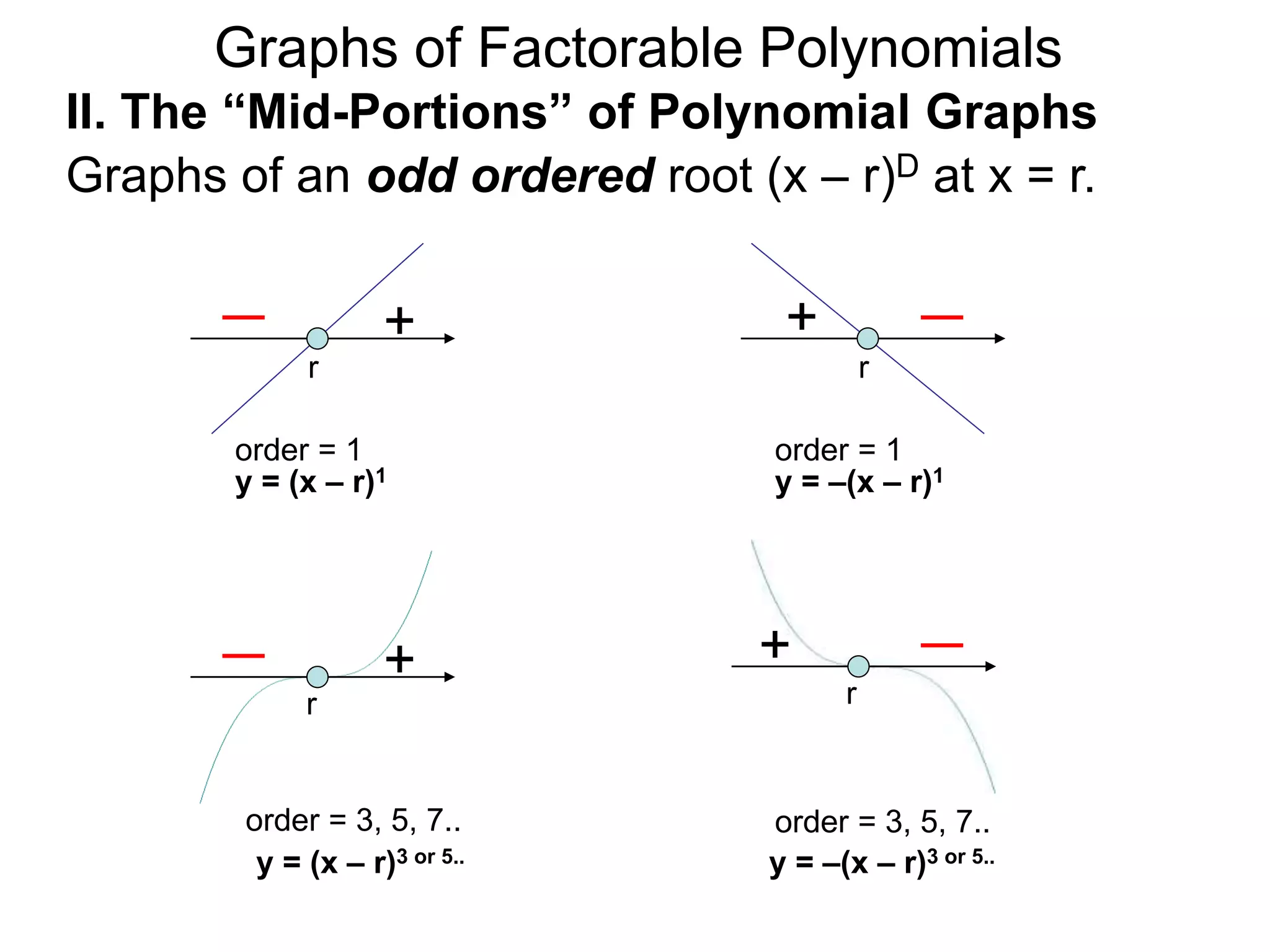
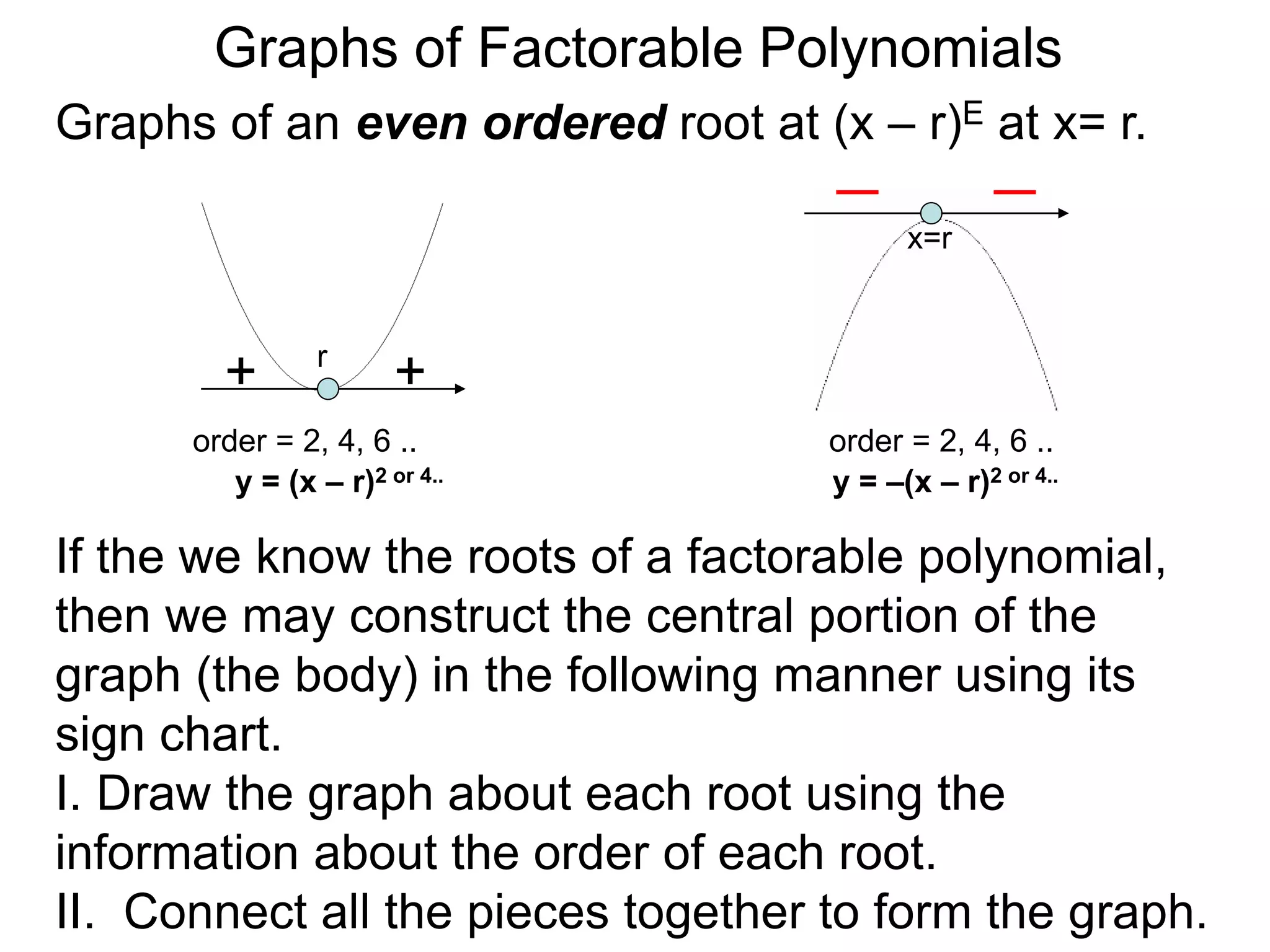
Graphs of an odd ordered root (x – r)D at x = r.
Graphs of Factorable Polynomials
+
+ +
order = 1 order = 1
order = 3, 5, 7..
r r
r
II. The “Mid-Portions” of Polynomial Graphs
Graphs of an odd ordered root (x – r)D at x = r.
+
order = 3, 5, 7..
r
y = (x – r)1 y = –(x – r)1
y = (x – r)3 or 5.. y = –(x – r)3 or 5..
Graphs of Factorable Polynomials
order = 2, 4, 6 ..
++
If the we know the roots of a factorable polynomial,
then we may construct the central portion of the
graph (the body) in the following manner using its
sign chart.
I. Draw the graph about each root using the
information about the order of each root.
II. Connect all the pieces together to form the graph.
x=r
r
Graphs of an even ordered root at (x – r)E at x= r.
order = 2, 4, 6 ..
y = (x – r)2 or 4.. y = –(x – r)2 or 4..
Graphs of Factorable Polynomials
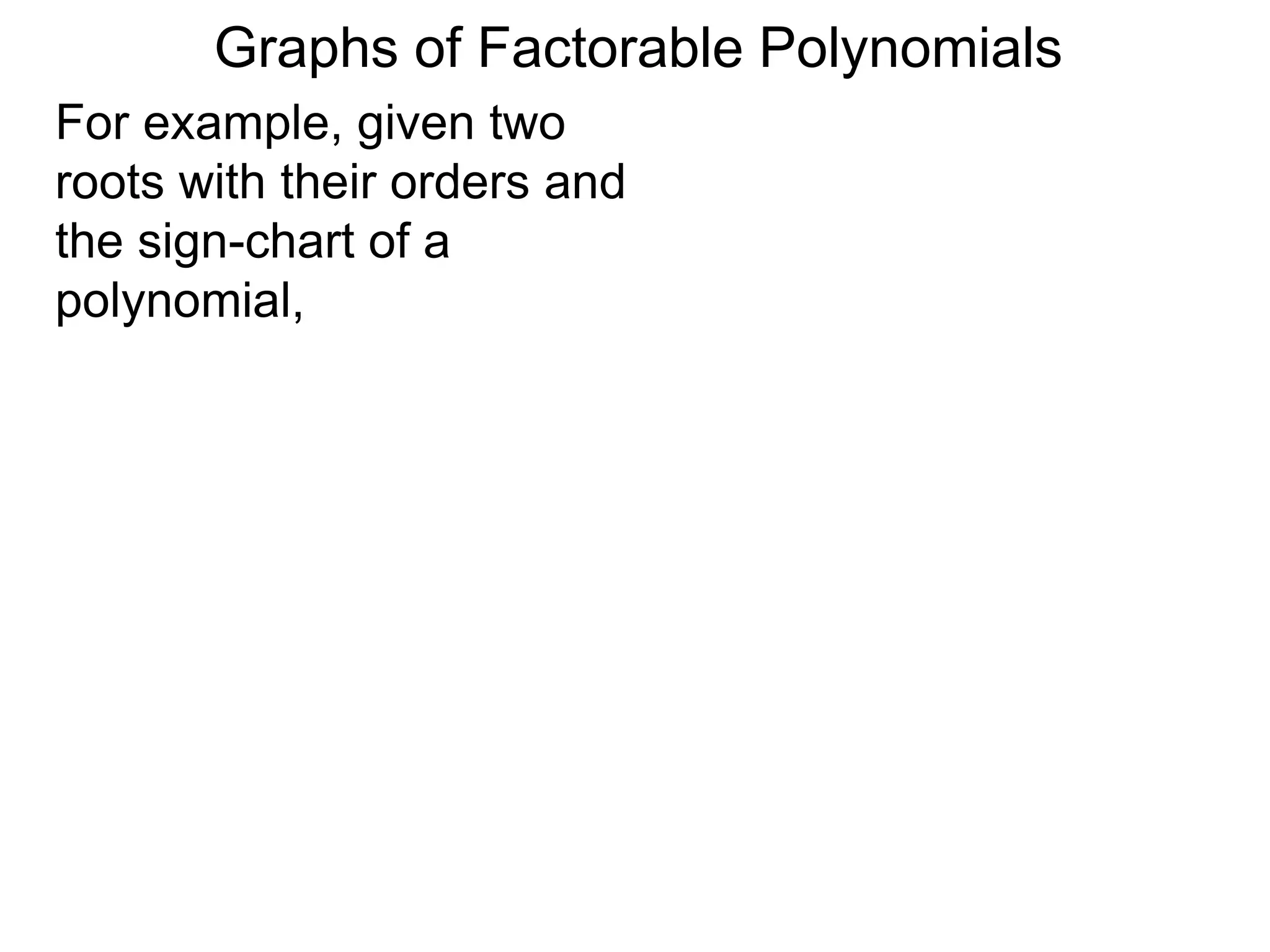
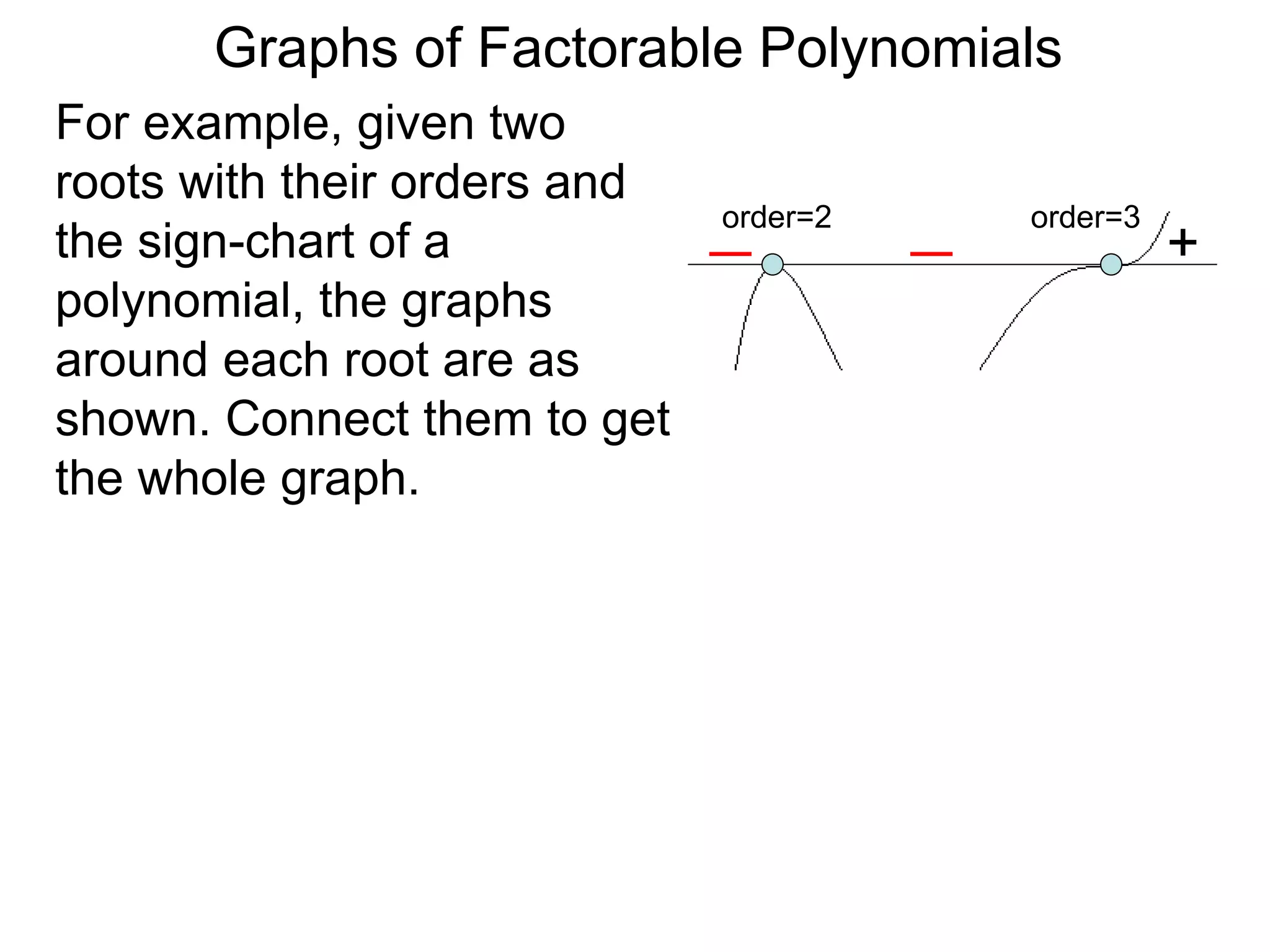
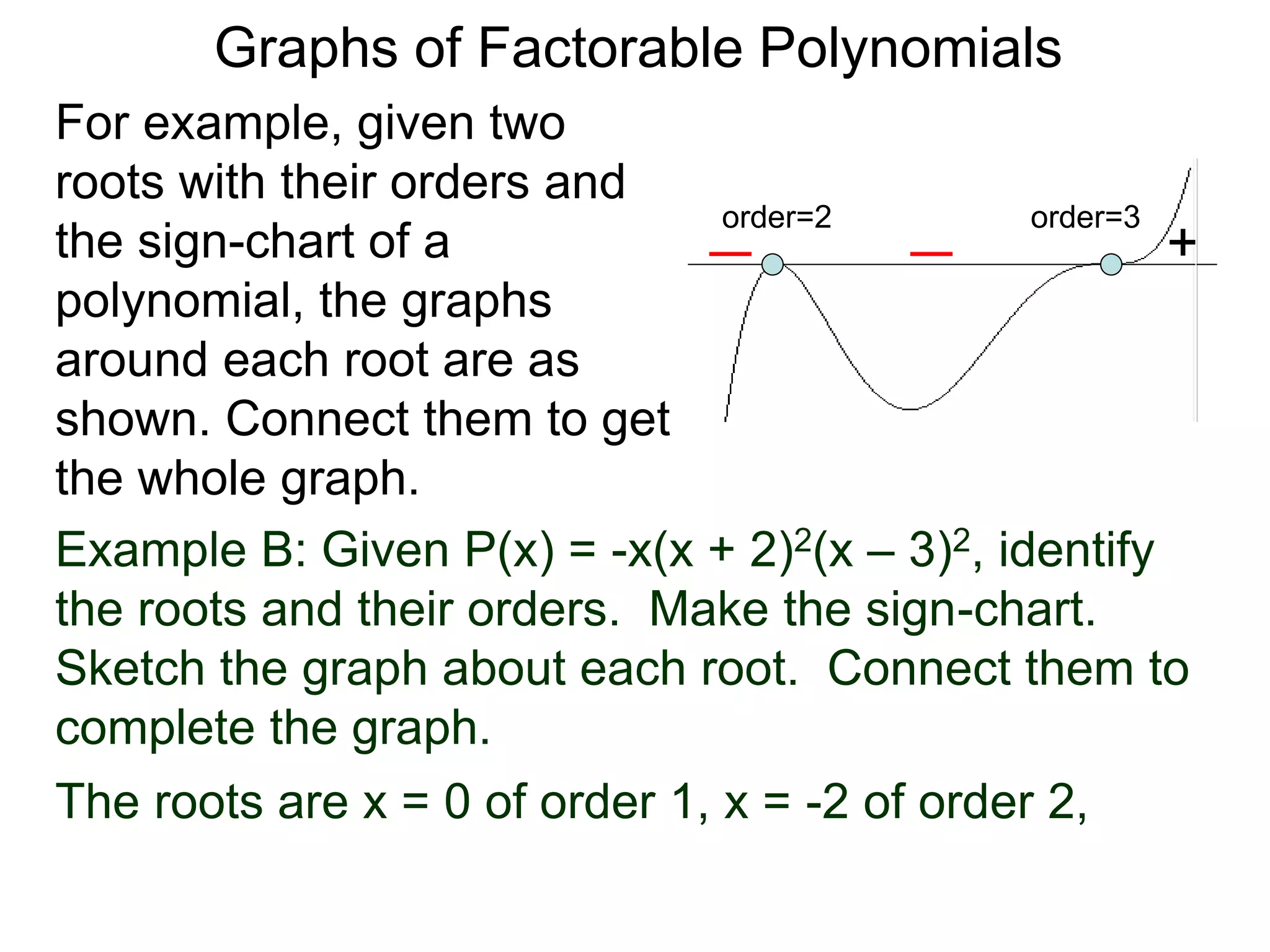
For example, given two
roots with their orders and
the sign-chart of a
polynomial,
Graphs of Factorable Polynomials
For example, given two
roots with their orders and
the sign-chart of a
polynomial,
+
order=2 order=3
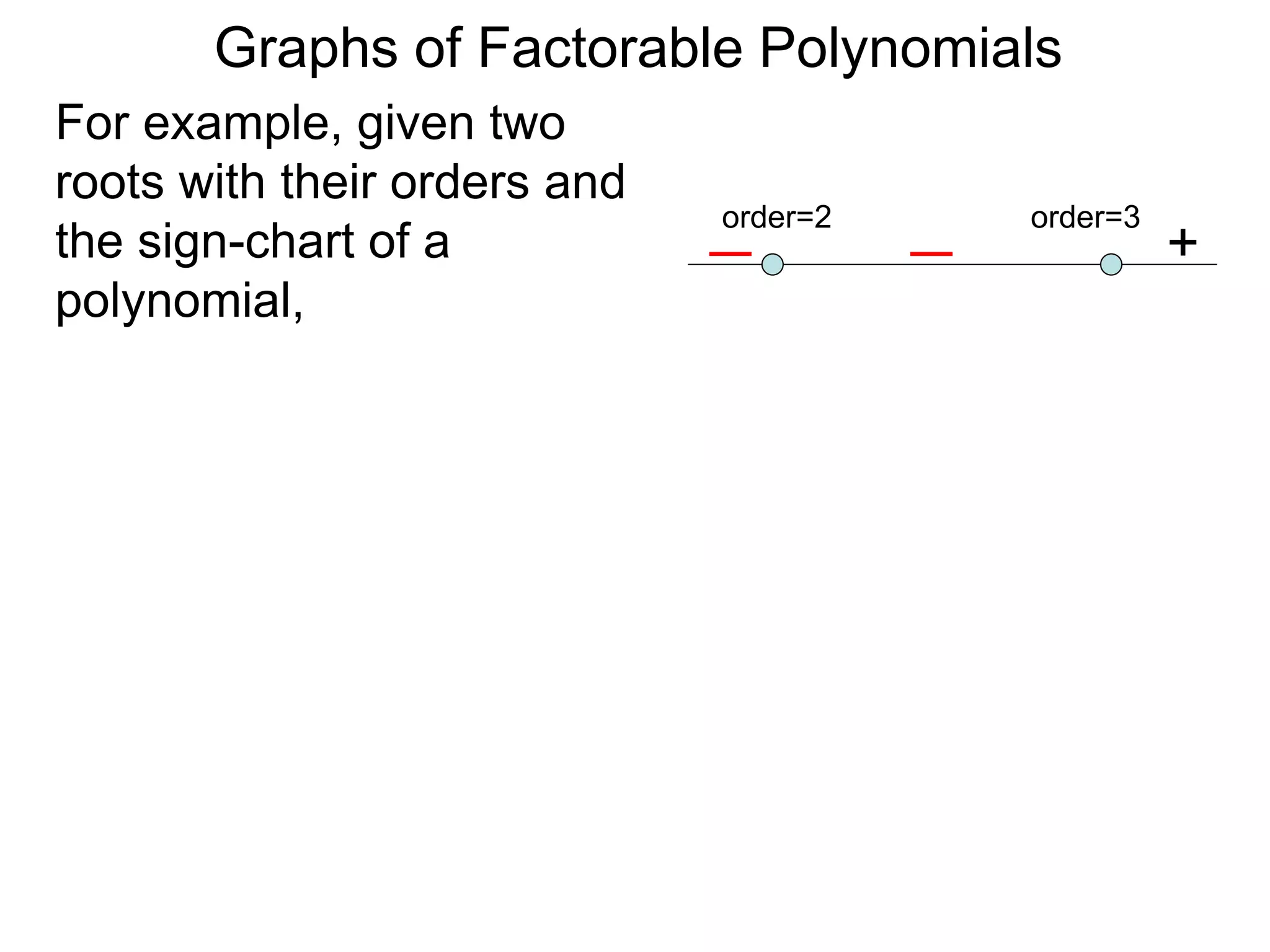
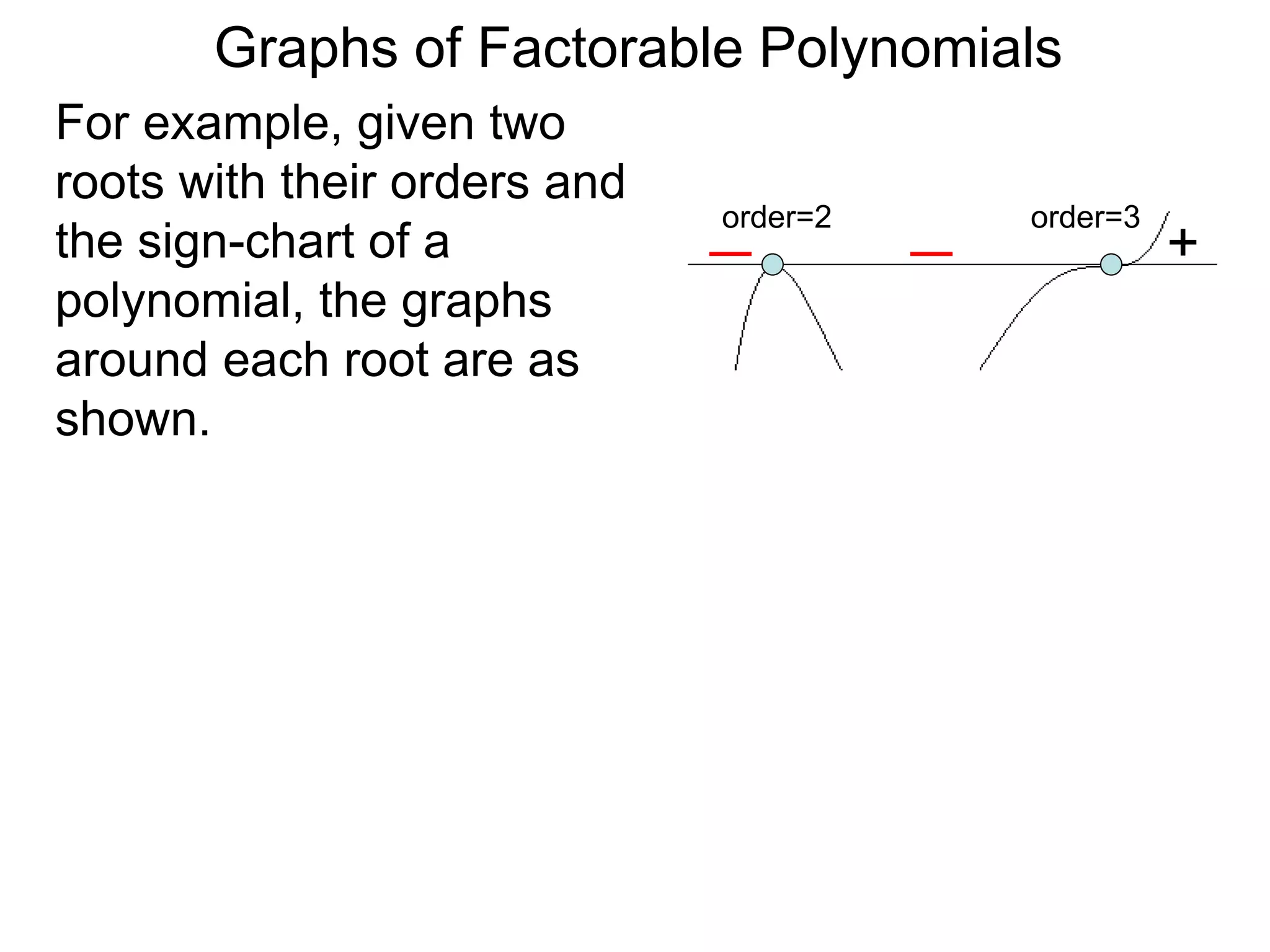
Graphs of Factorable Polynomials
For example, given two
roots with their orders and
the sign-chart of a
polynomial, the graphs
around each root are as
shown.
+
order=2 order=3
Graphs of Factorable Polynomials
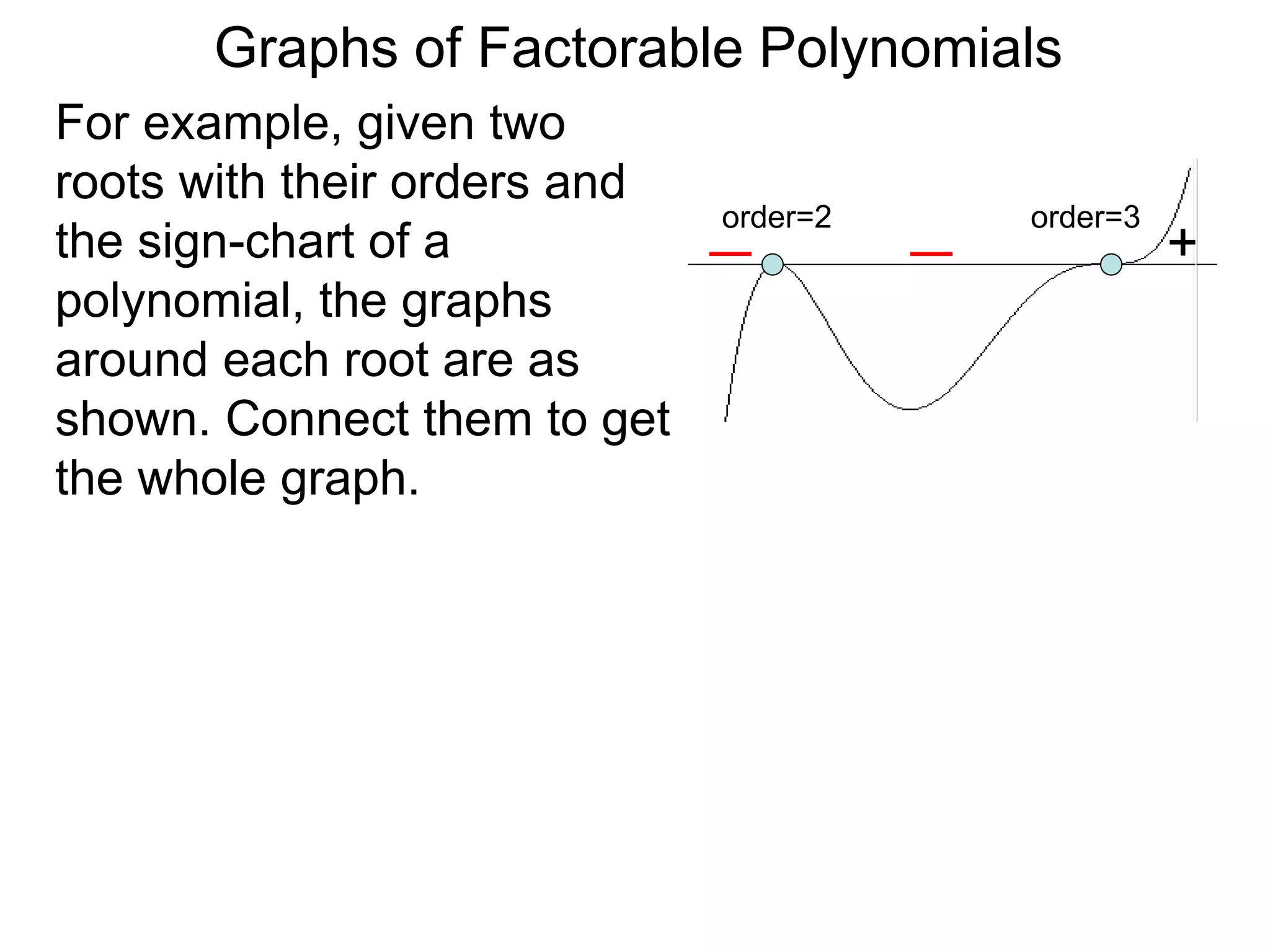
For example, given two
roots with their orders and
the sign-chart of a
polynomial, the graphs
around each root are as
shown. Connect them to get
the whole graph.
+
order=2 order=3
Graphs of Factorable Polynomials
For example, given two
roots with their orders and
the sign-chart of a
polynomial, the graphs
around each root are as
shown. Connect them to get
the whole graph.
+
order=2 order=3
Graphs of Factorable Polynomials
For example, given two
roots with their orders and
the sign-chart of a
polynomial, the graphs
around each root are as
shown. Connect them to get
the whole graph.
Example B: Given P(x) = -x(x + 2)2(x – 3)2, identify
the roots and their orders. Make the sign-chart.
Sketch the graph about each root. Connect them to
complete the graph.
+
order=2 order=3
Graphs of Factorable Polynomials
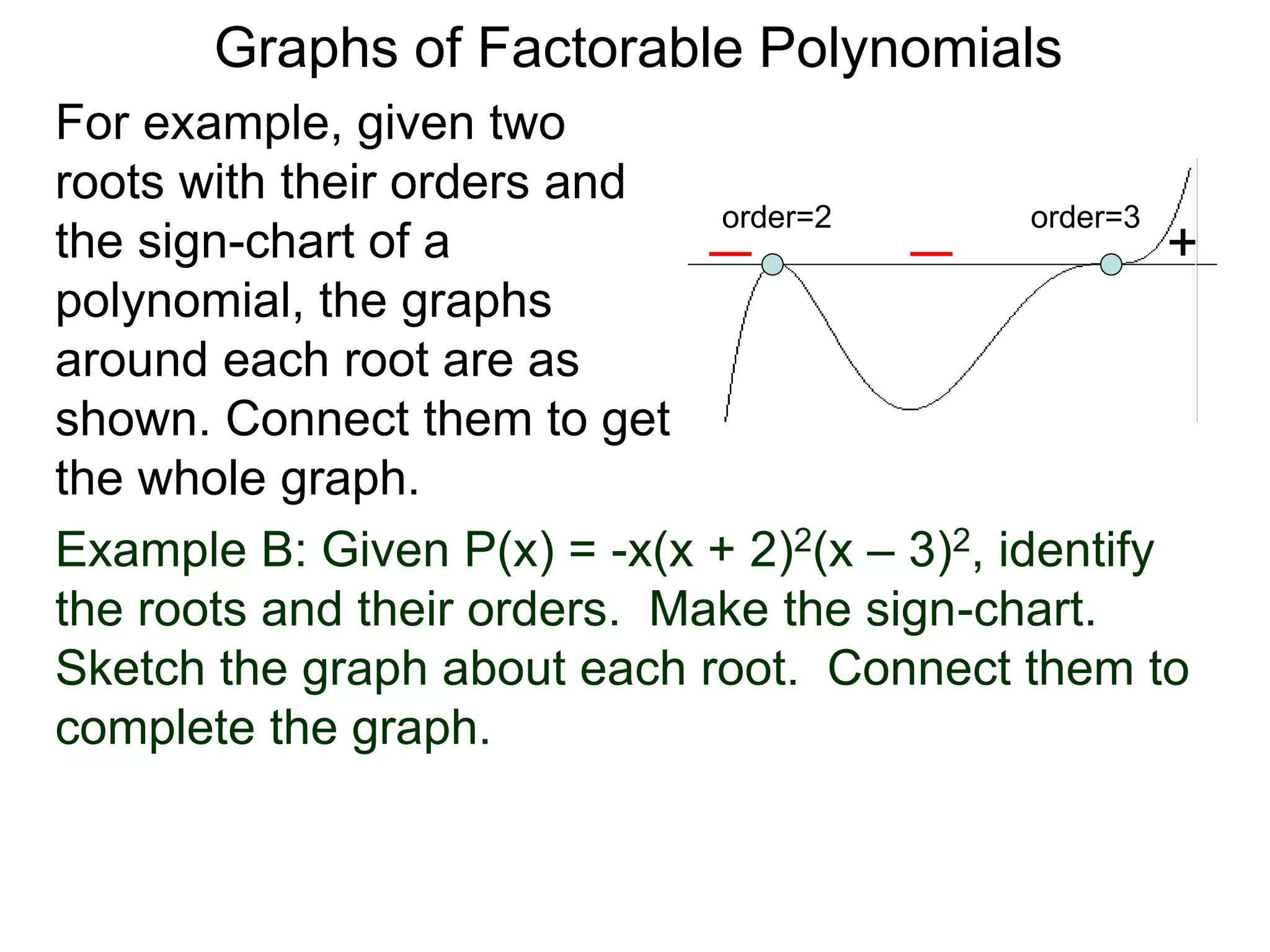
For example, given two
roots with their orders and
the sign-chart of a
polynomial, the graphs
around each root are as
shown. Connect them to get
the whole graph.
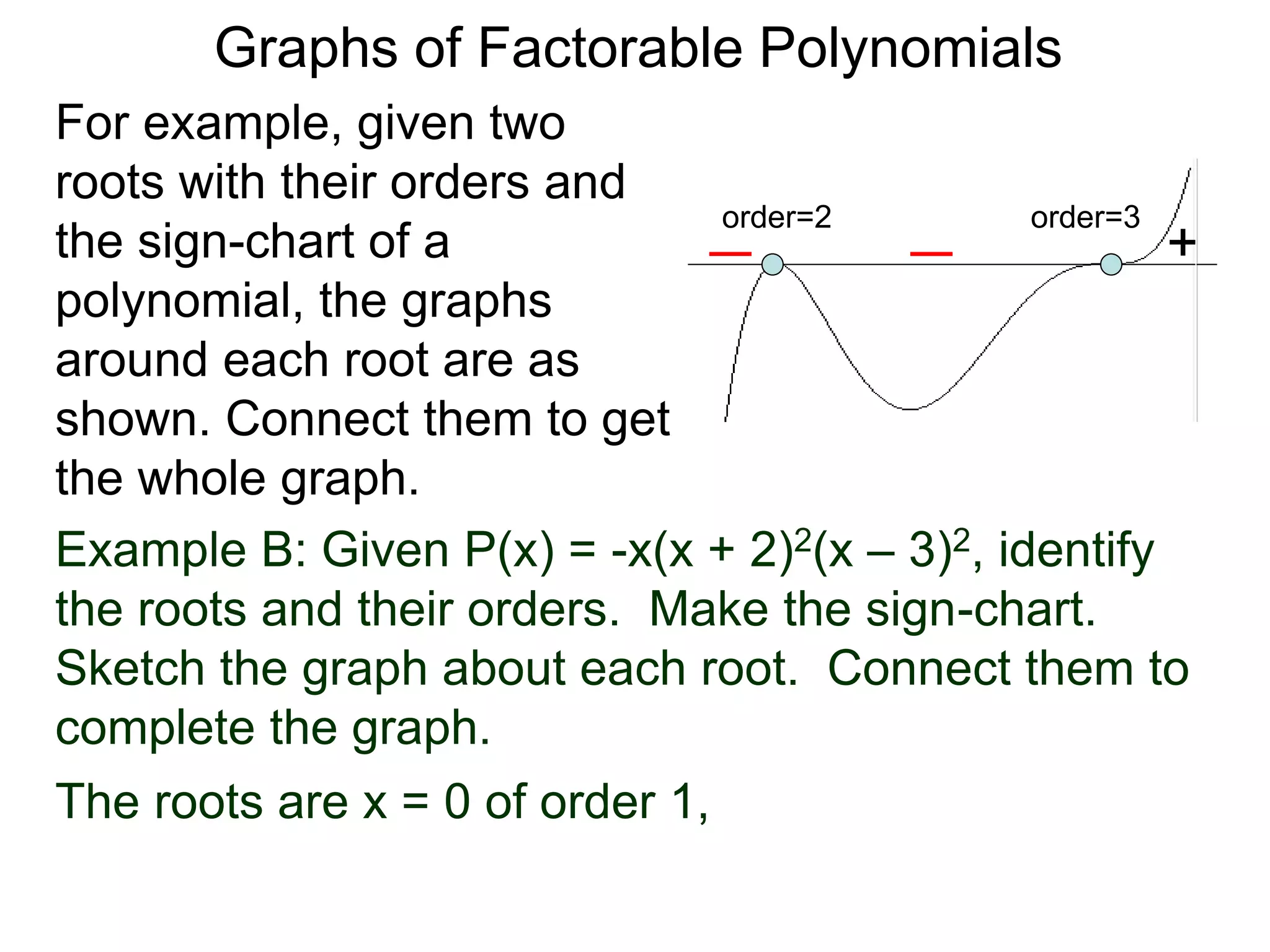
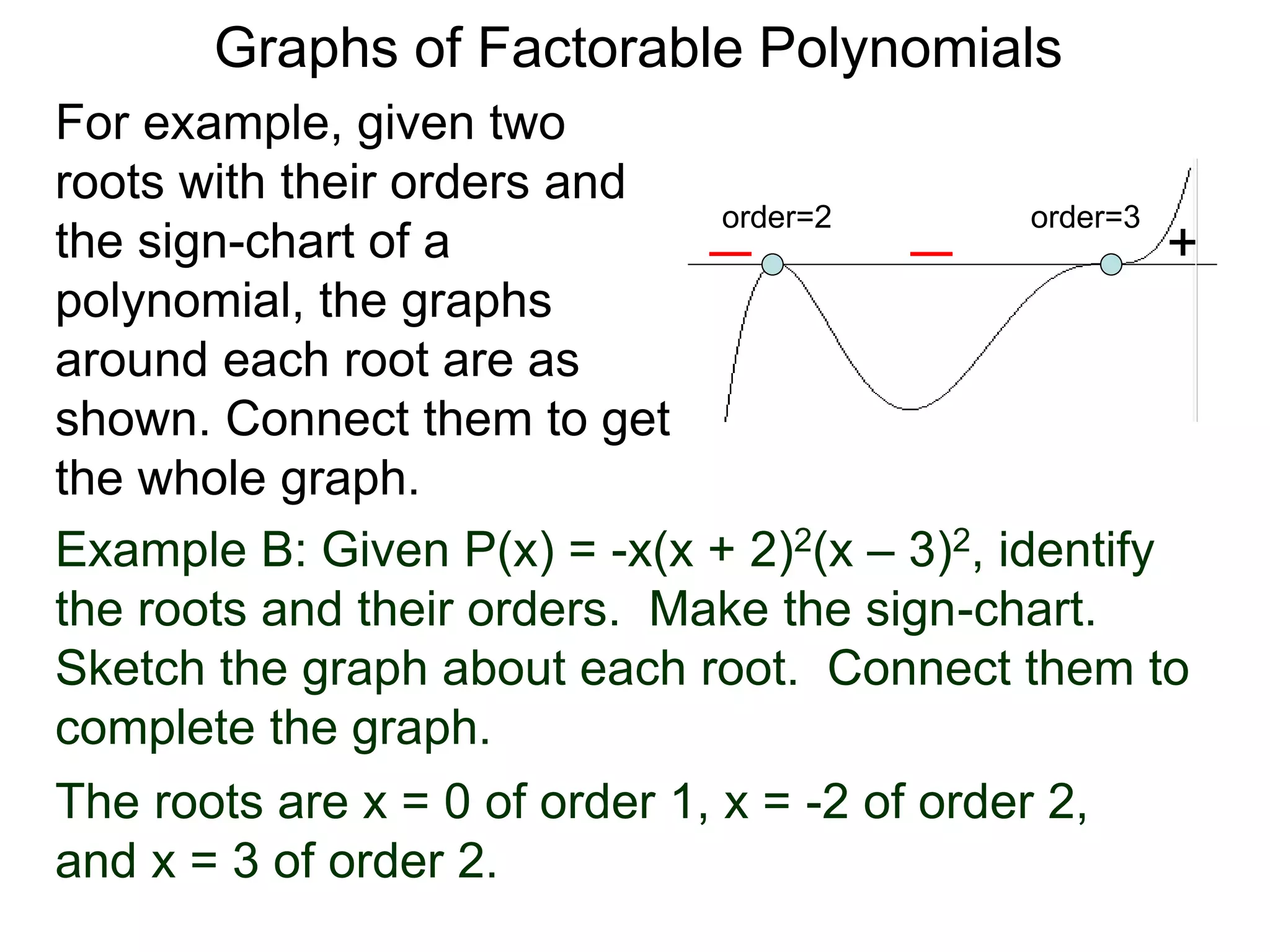
Example B: Given P(x) = -x(x + 2)2(x – 3)2, identify
the roots and their orders. Make the sign-chart.
Sketch the graph about each root. Connect them to
complete the graph.
The roots are x = 0 of order 1,
+
order=2 order=3
Graphs of Factorable Polynomials
For example, given two
roots with their orders and
the sign-chart of a
polynomial, the graphs
around each root are as
shown. Connect them to get
the whole graph.
Example B: Given P(x) = -x(x + 2)2(x – 3)2, identify
the roots and their orders. Make the sign-chart.
Sketch the graph about each root. Connect them to
complete the graph.
The roots are x = 0 of order 1, x = -2 of order 2,
+
order=2 order=3
Graphs of Factorable Polynomials
For example, given two
roots with their orders and
the sign-chart of a
polynomial, the graphs
around each root are as
shown. Connect them to get
the whole graph.
Example B: Given P(x) = -x(x + 2)2(x – 3)2, identify
the roots and their orders. Make the sign-chart.
Sketch the graph about each root. Connect them to
complete the graph.
The roots are x = 0 of order 1, x = -2 of order 2,
and x = 3 of order 2.
+
order=2 order=3
Graphs of Factorable Polynomials
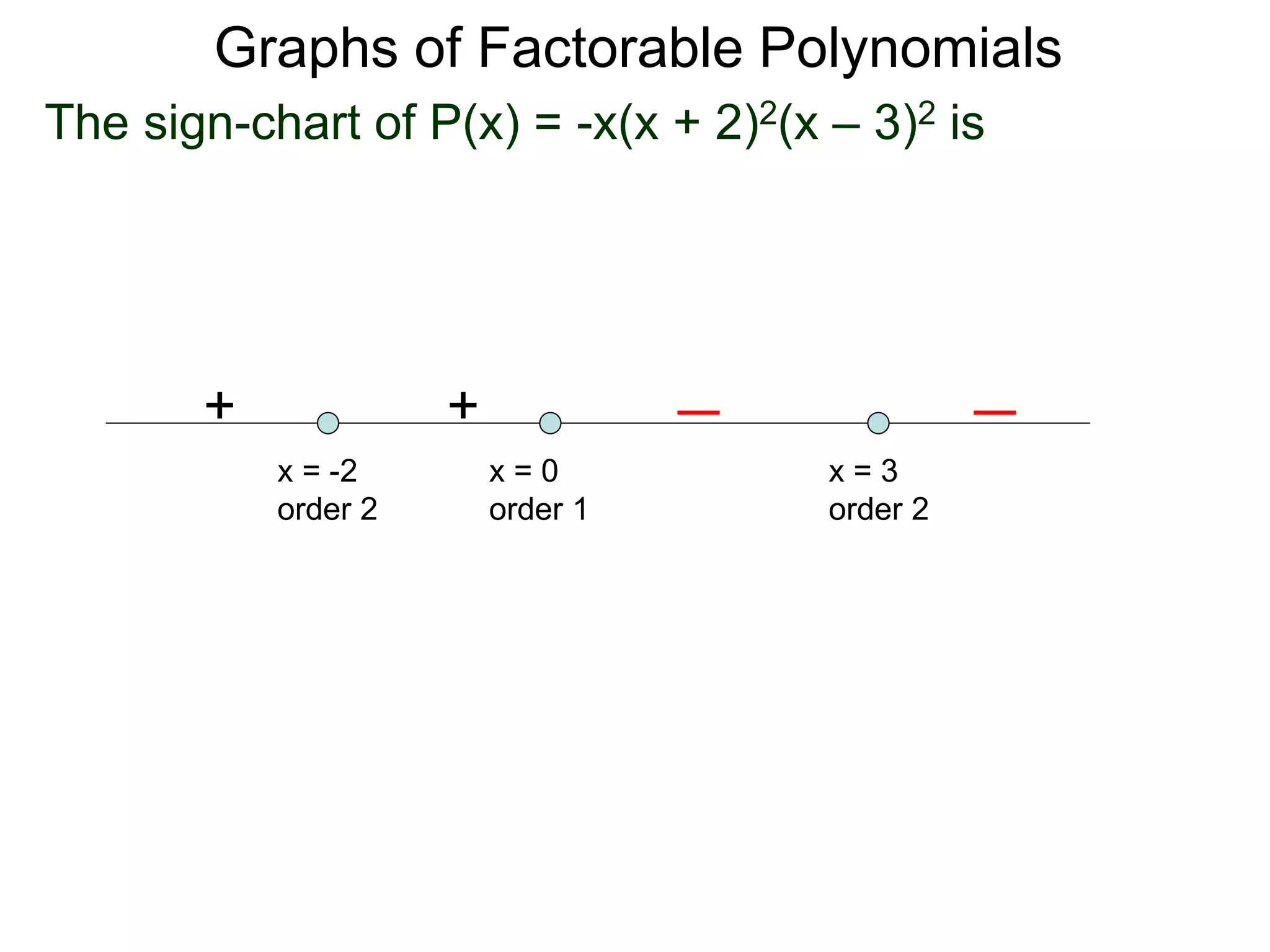
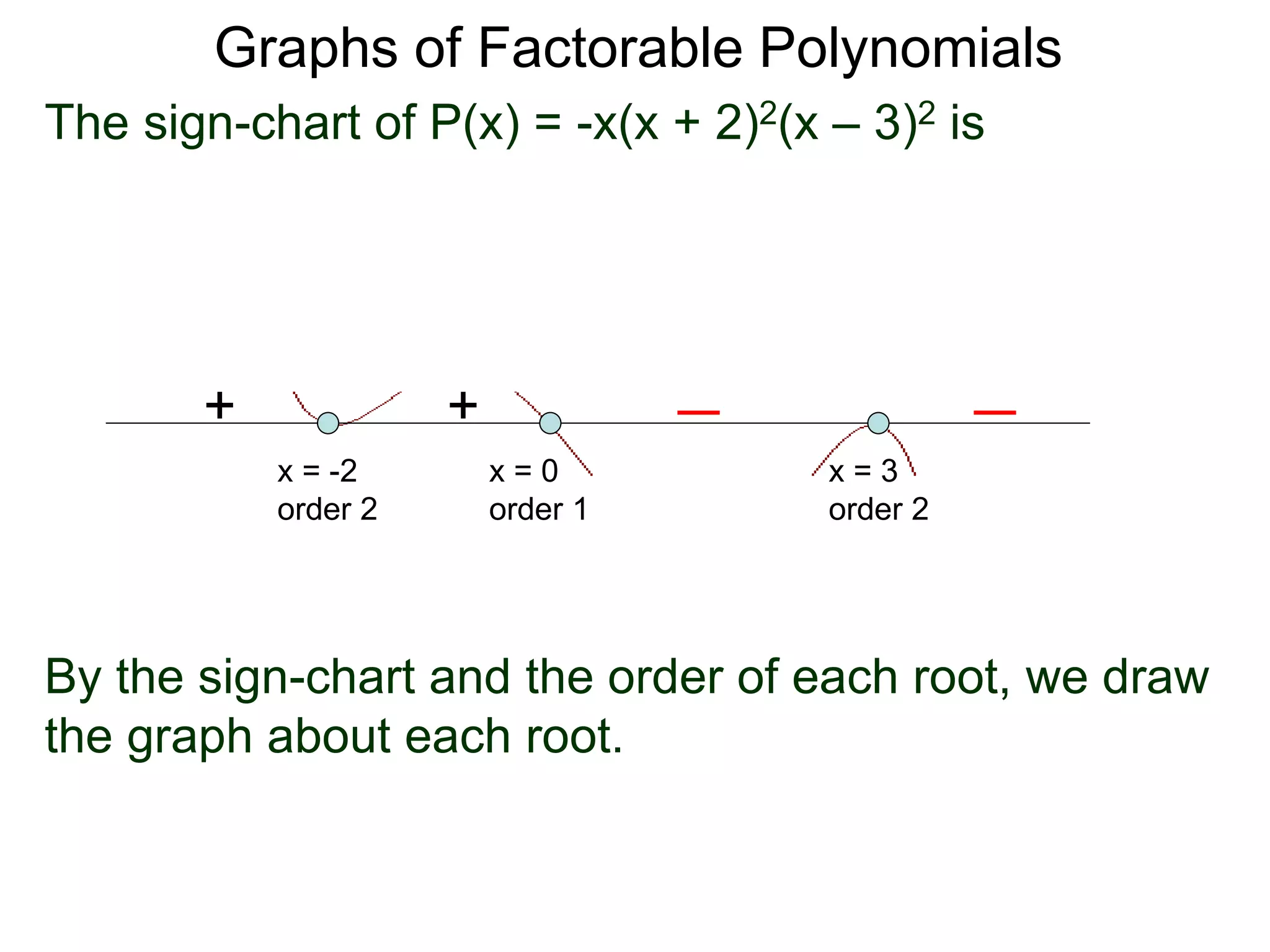
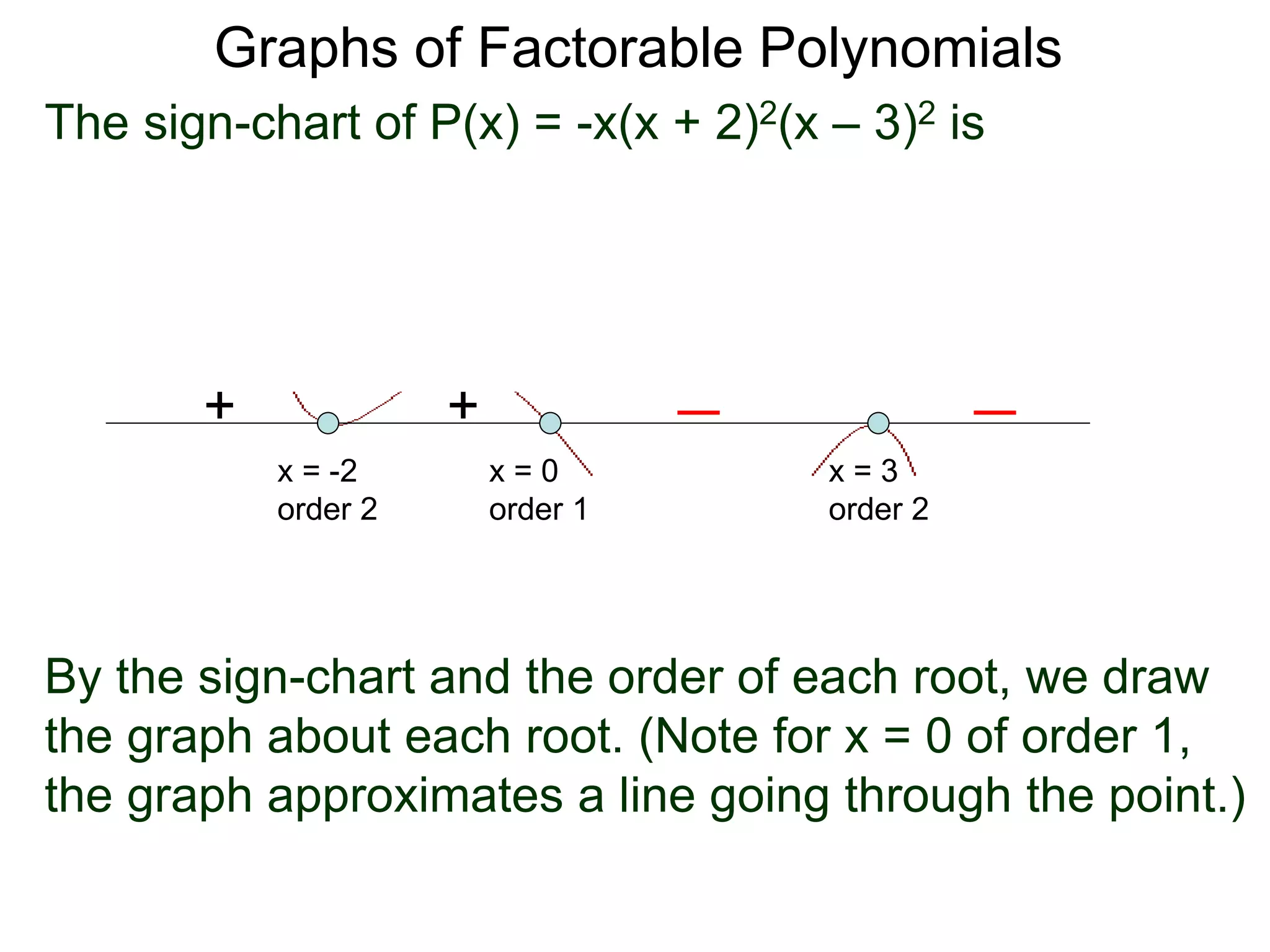
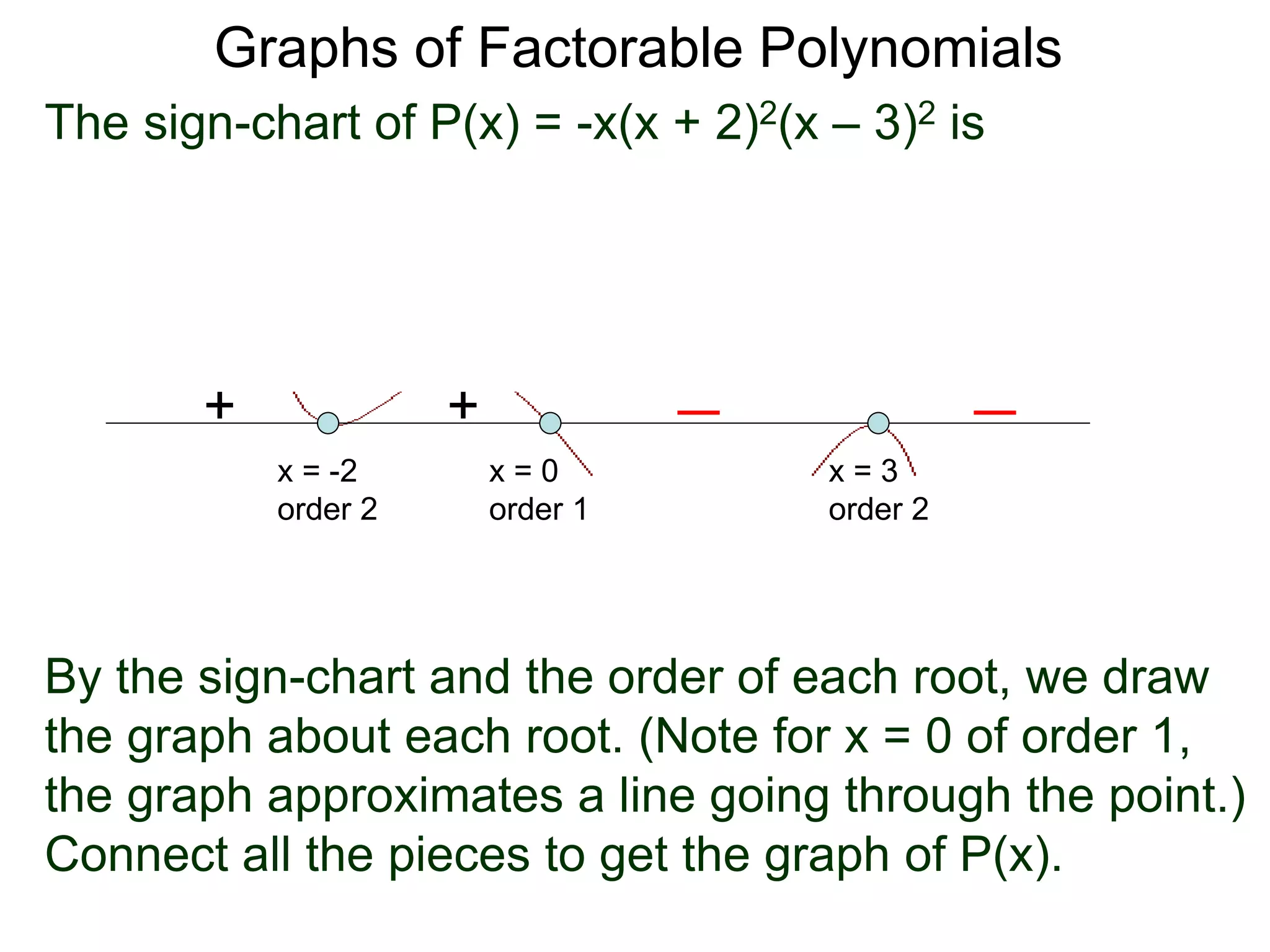
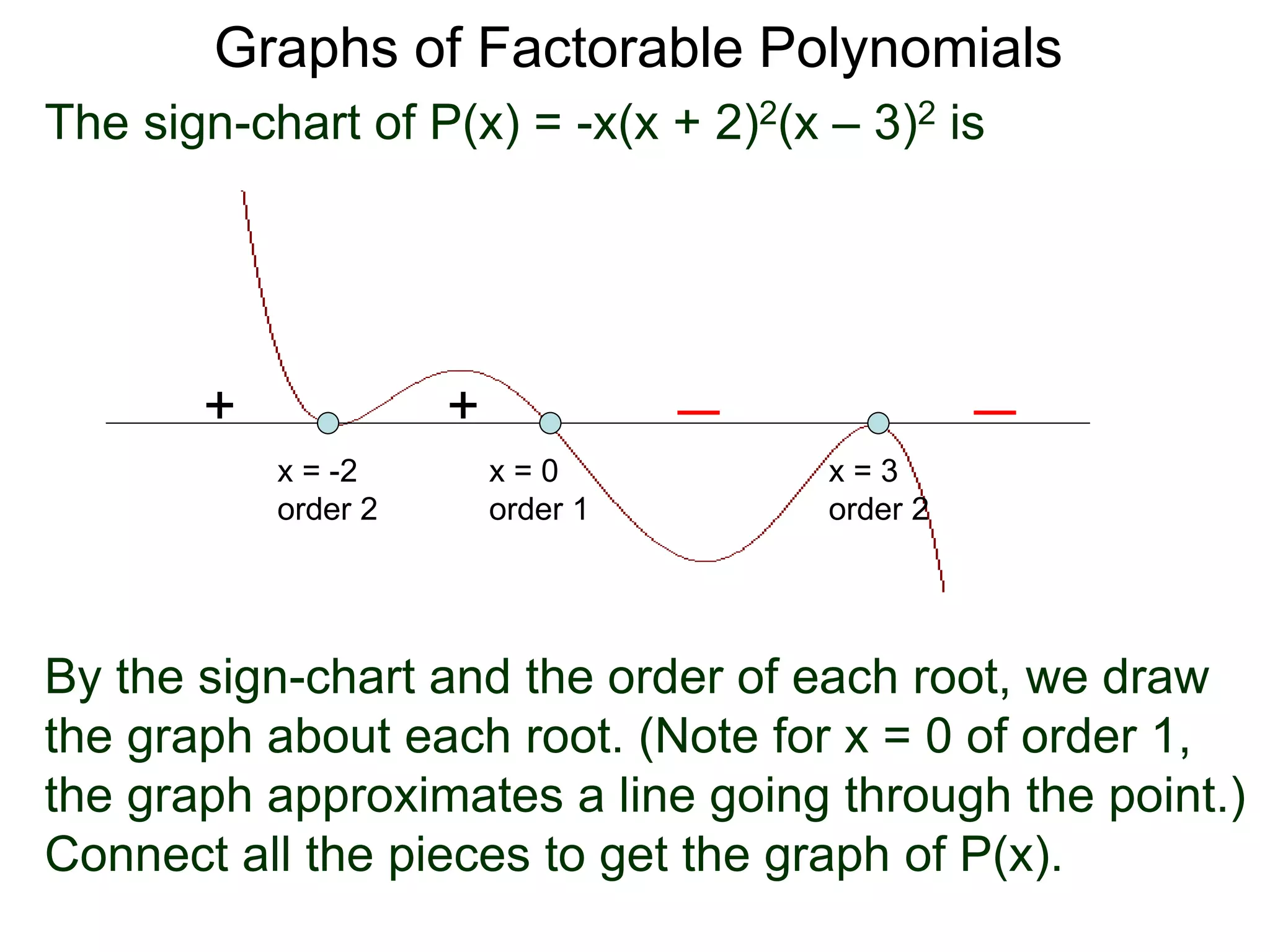
The sign-chart of P(x) = -x(x + 2)2(x – 3)2 is
++
x = 3
order 2
x = 0
order 1
x = -2
order 2
Graphs of Factorable Polynomials
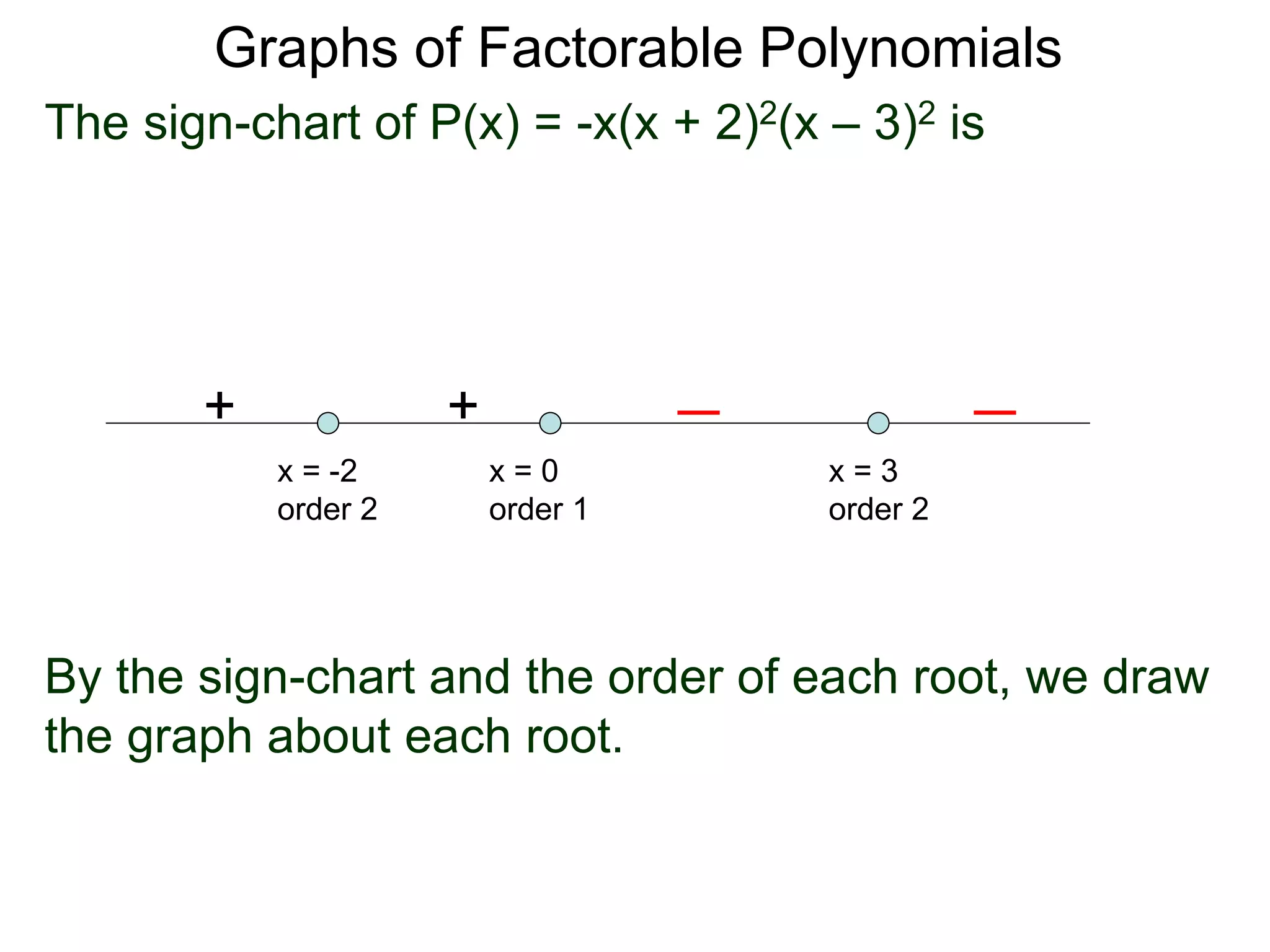
The sign-chart of P(x) = -x(x + 2)2(x – 3)2 is
++
x = 3
order 2
x = 0
order 1
x = -2
order 2
By the sign-chart and the order of each root, we draw
the graph about each root.
Graphs of Factorable Polynomials
The sign-chart of P(x) = -x(x + 2)2(x – 3)2 is
++
x = 3
order 2
x = 0
order 1
x = -2
order 2
By the sign-chart and the order of each root, we draw
the graph about each root.
Graphs of Factorable Polynomials
The sign-chart of P(x) = -x(x + 2)2(x – 3)2 is
++
x = 3
order 2
x = 0
order 1
x = -2
order 2
By the sign-chart and the order of each root, we draw
the graph about each root. (Note for x = 0 of order 1,
the graph approximates a line going through the point.)
Graphs of Factorable Polynomials
The sign-chart of P(x) = -x(x + 2)2(x – 3)2 is
++
x = 3
order 2
x = 0
order 1
x = -2
order 2
By the sign-chart and the order of each root, we draw
the graph about each root. (Note for x = 0 of order 1,
the graph approximates a line going through the point.)
Connect all the pieces to get the graph of P(x).
Graphs of Factorable Polynomials
The sign-chart of P(x) = -x(x + 2)2(x – 3)2 is
x = -2
order 2
++
x = 0
order 1
x = 3
order 2
By the sign-chart and the order of each root, we draw
the graph about each root. (Note for x = 0 of order 1,
the graph approximates a line going through the point.)
Connect all the pieces to get the graph of P(x).
Graphs of Factorable Polynomials
Note the graph resembles y = -x5, it's leading term,
when viewed at a distance.
Graphs of Factorable Polynomials
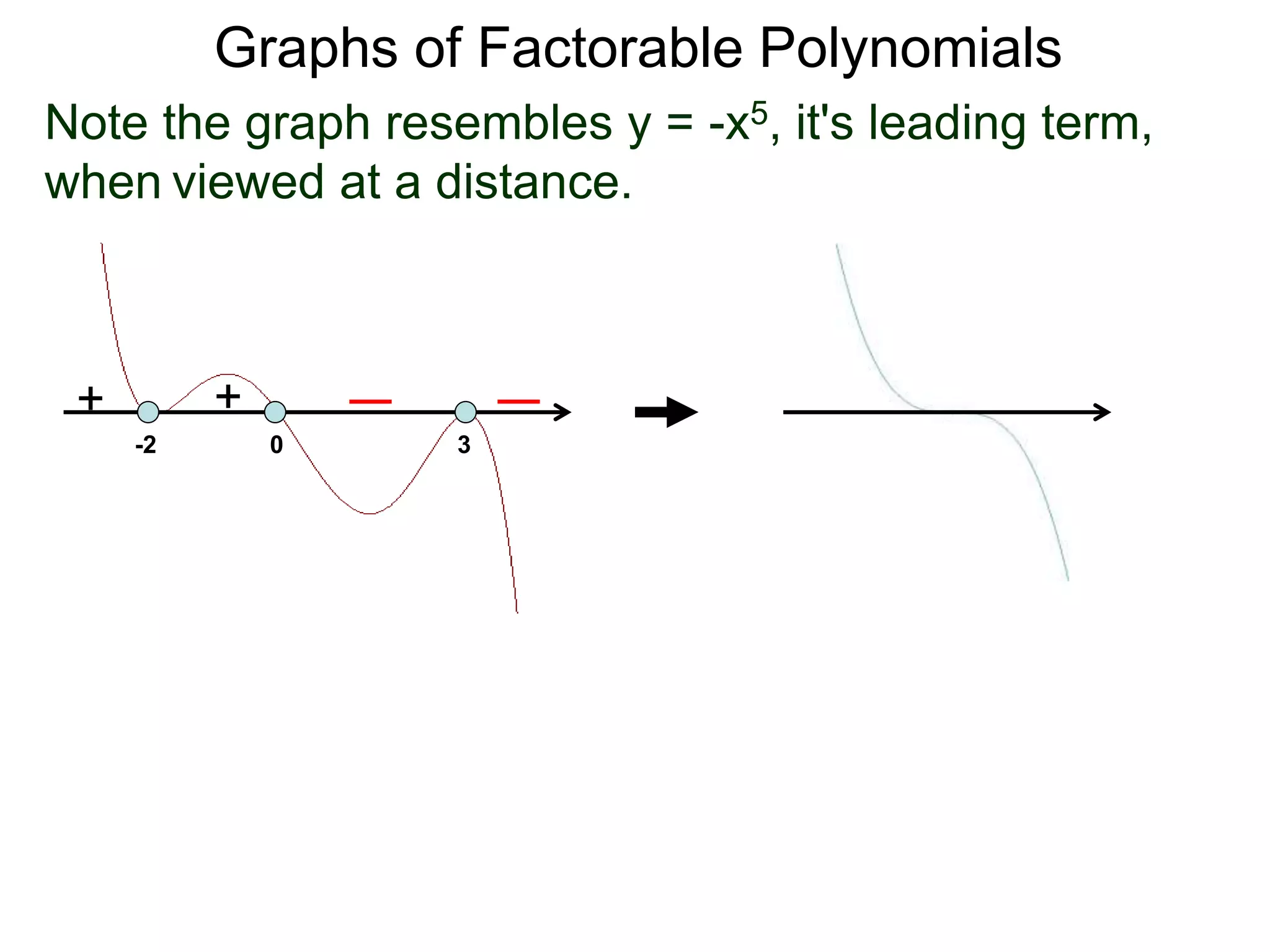
Note the graph resembles y = -x5, it's leading term,
when viewed at a distance.
-2
++
0 3
Graphs of Rational Functions
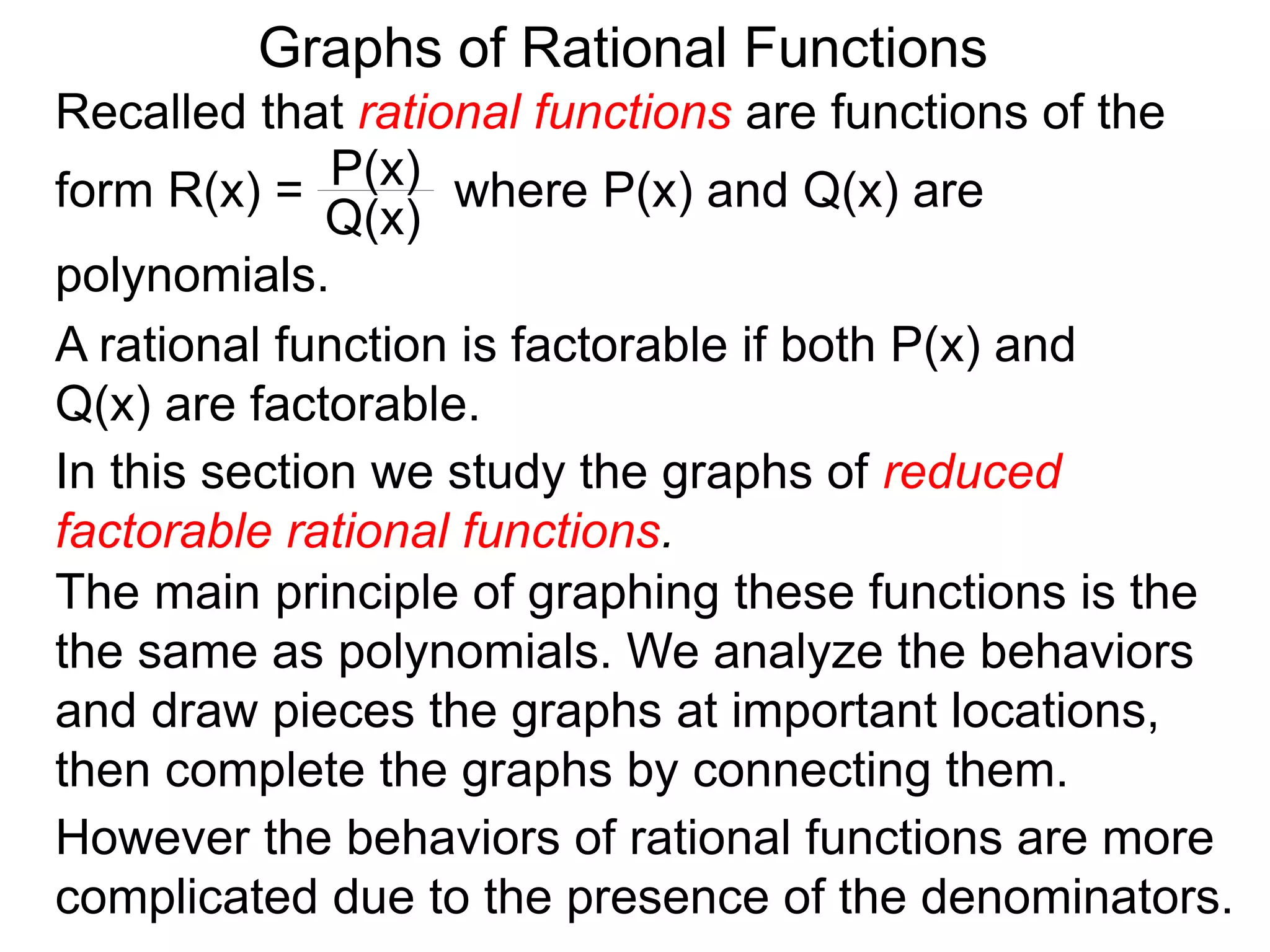
Recalled that rational functions are functions of the
form R(x) = where P(x) and Q(x) are
polynomials.
P(x)
Q(x)
Graphs of Rational Functions
Recalled that rational functions are functions of the
form R(x) = where P(x) and Q(x) are
polynomials.
P(x)
Q(x)
A rational function is factorable if both P(x) and
Q(x) are factorable.
Graphs of Rational Functions
Recalled that rational functions are functions of the
form R(x) = where P(x) and Q(x) are
polynomials.
P(x)
Q(x)
A rational function is factorable if both P(x) and
Q(x) are factorable.
In this section we study the graphs of reduced
factorable rational functions.
Graphs of Rational Functions
Recalled that rational functions are functions of the
form R(x) = where P(x) and Q(x) are
polynomials.
P(x)
Q(x)
A rational function is factorable if both P(x) and
Q(x) are factorable.
In this section we study the graphs of reduced
factorable rational functions.
The main principle of graphing these functions is the
the same as polynomials.
Graphs of Rational Functions
Recalled that rational functions are functions of the
form R(x) = where P(x) and Q(x) are
polynomials.
P(x)
Q(x)
A rational function is factorable if both P(x) and
Q(x) are factorable.
In this section we study the graphs of reduced
factorable rational functions.
The main principle of graphing these functions is the
the same as polynomials. We analyze the behaviors
and draw pieces the graphs at important locations,
then complete the graphs by connecting them.
Graphs of Rational Functions
Recalled that rational functions are functions of the
form R(x) = where P(x) and Q(x) are
polynomials.
P(x)
Q(x)
A rational function is factorable if both P(x) and
Q(x) are factorable.
In this section we study the graphs of reduced
factorable rational functions.
The main principle of graphing these functions is the
the same as polynomials. We analyze the behaviors
and draw pieces the graphs at important locations,
then complete the graphs by connecting them.
However the behaviors of rational functions are more
complicated due to the presence of the denominators.
x=0
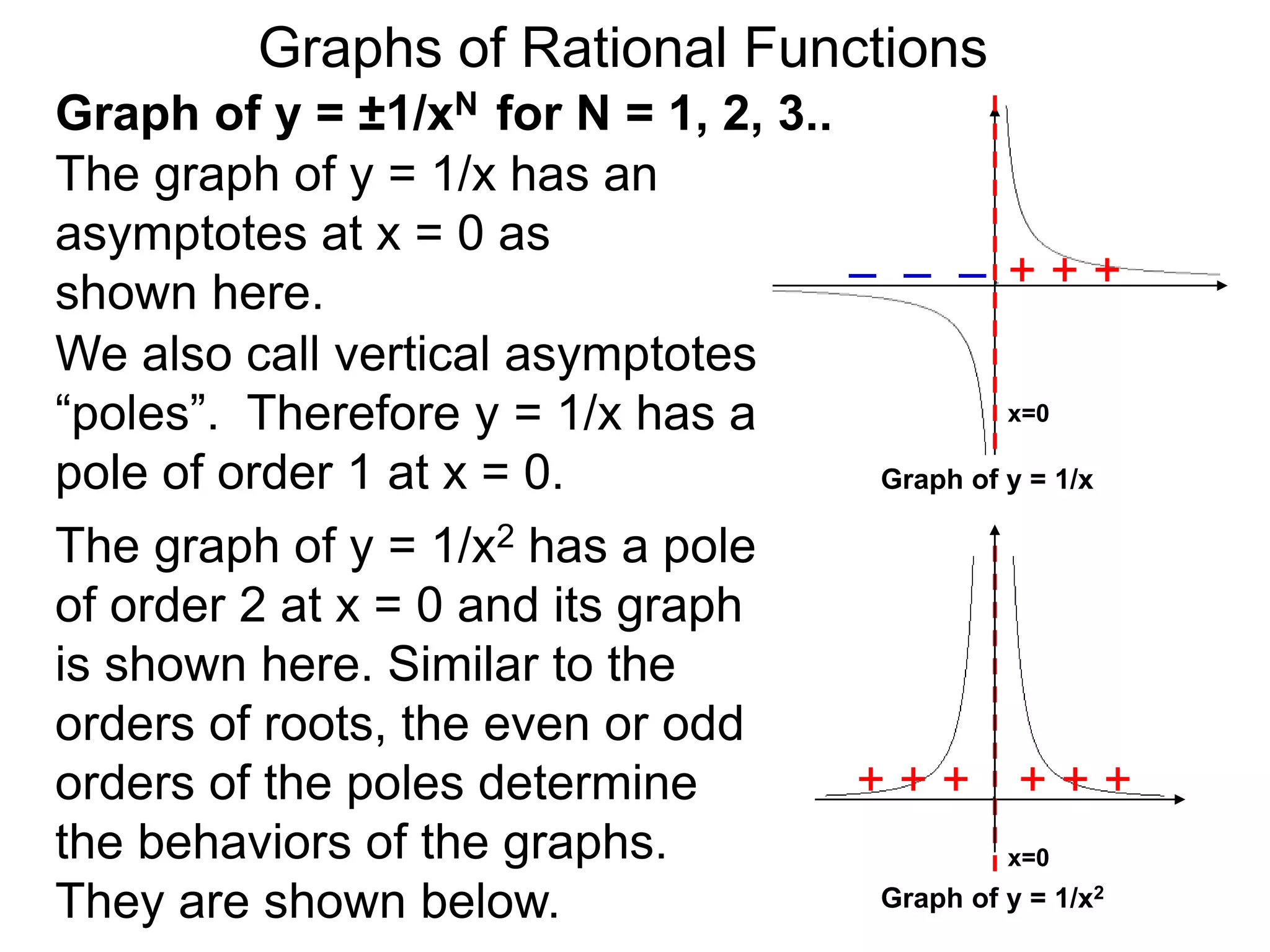
The graph of y = 1/x has an
asymptotes at x = 0 as
shown here.
We also call vertical asymptotes
“poles”. Therefore y = 1/x has a
pole of order 1 at x = 0.
Graphs of Rational Functions
+ + +– – –
Graph of y = 1/x2
Graph of y = 1/x
x=0
The graph of y = 1/x2 has a pole
of order 2 at x = 0 and its graph
is shown here. Similar to the
orders of roots, the even or odd
orders of the poles determine
the behaviors of the graphs.
They are shown below.
+ + + + + +
Graph of y = ±1/xN for N = 1, 2, 3..
Graphs of Rational Functions
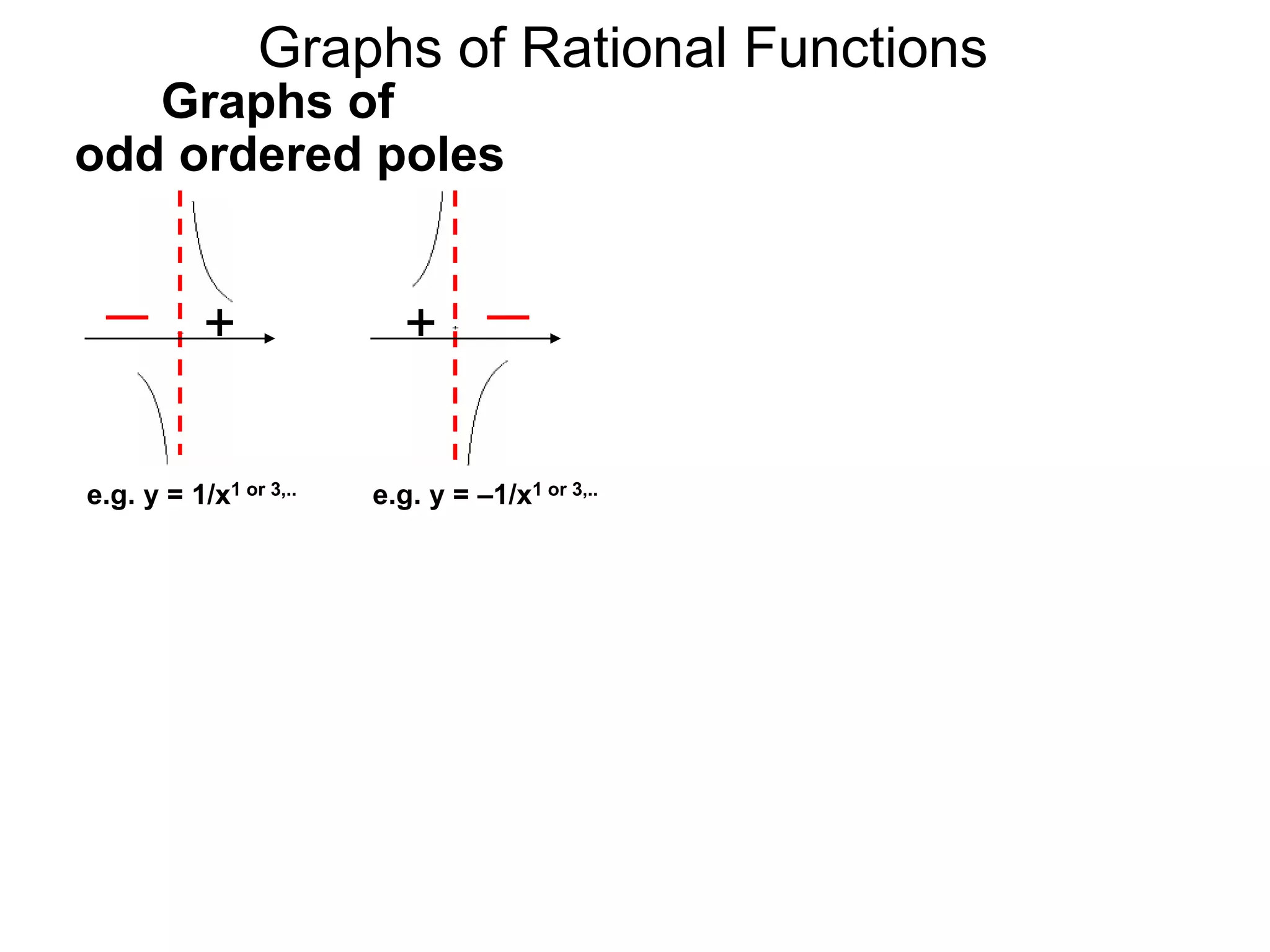
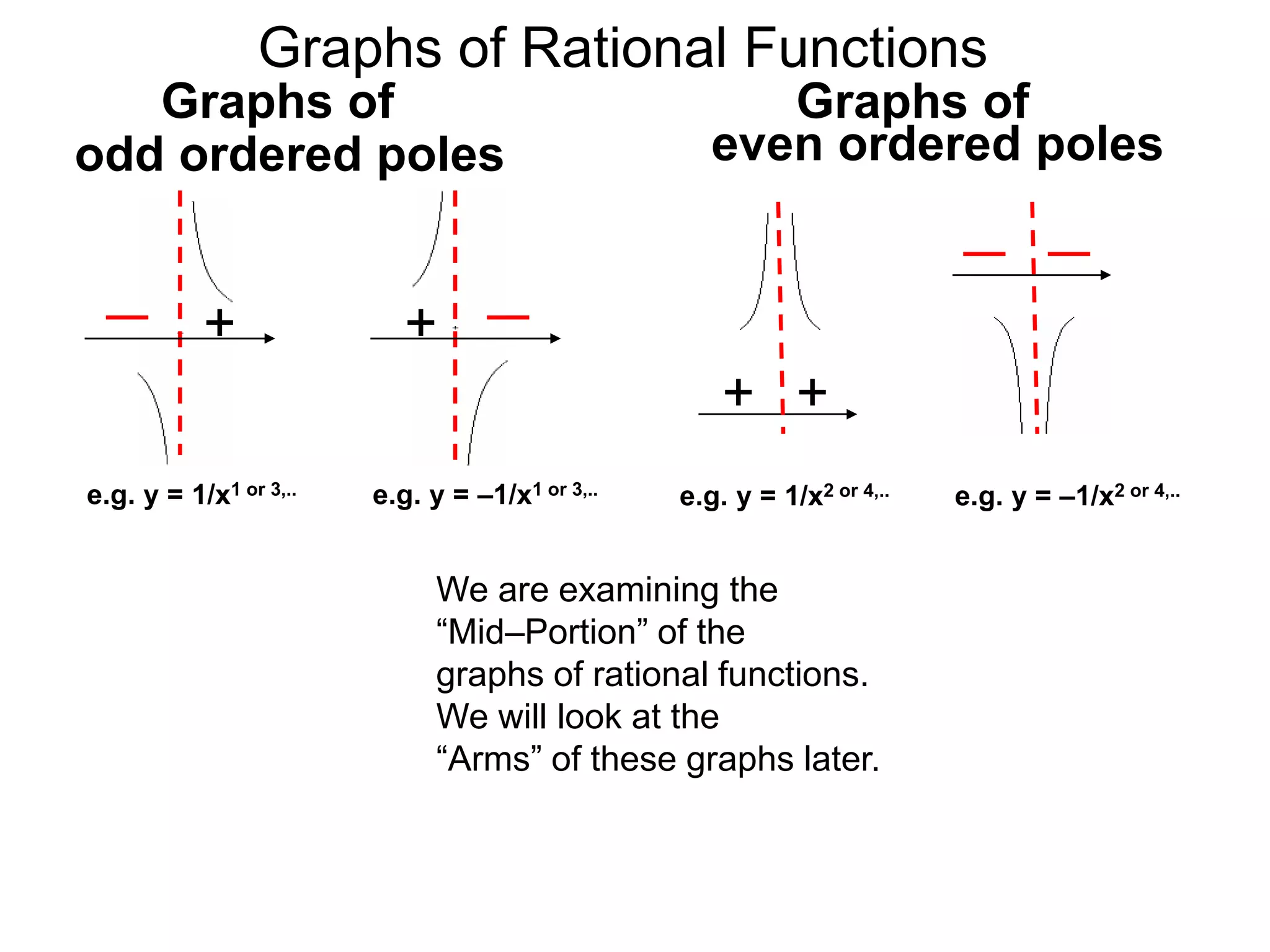
e.g. y = –1/x1 or 3,..
+
e.g. y = 1/x1 or 3,..
+
Graphs of
odd ordered poles
Graphs of Rational Functions
e.g. y = –1/x1 or 3,..
+
e.g. y = 1/x1 or 3,..
+
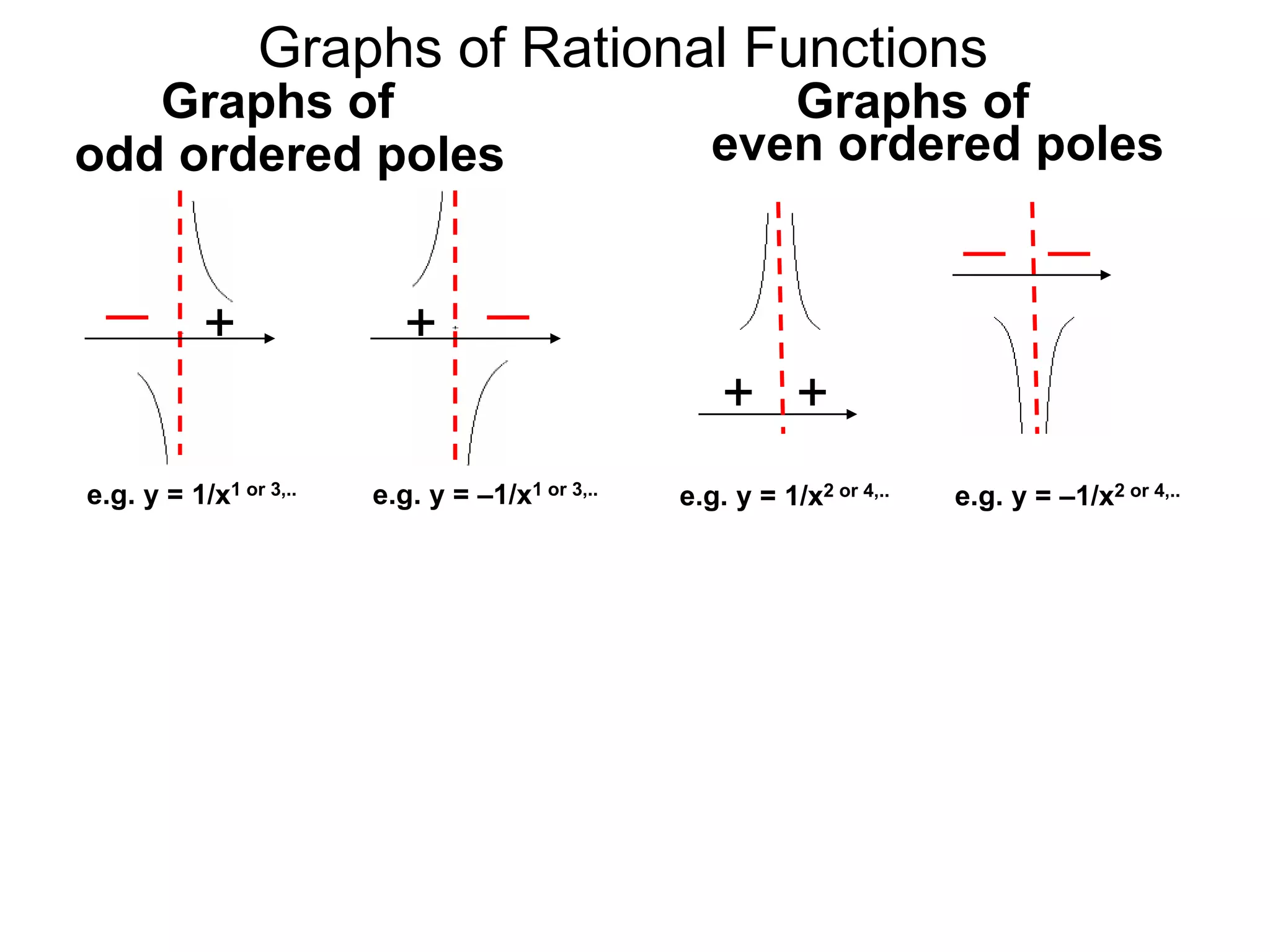
+ +
Graphs of
even ordered polesodd ordered poles
Graphs of
e.g. y = 1/x2 or 4,.. e.g. y = –1/x2 or 4,..
Graphs of Rational Functions
e.g. y = –1/x1 or 3,..
+
e.g. y = 1/x1 or 3,..
+
+ +
Graphs of
even ordered polesodd ordered poles
Graphs of
e.g. y = 1/x2 or 4,.. e.g. y = –1/x2 or 4,..
We are examining the
“Mid–Portion” of the
graphs of rational functions.
We will look at the
“Arms” of these graphs later.
Graphs of Rational Functions
e.g. y = –1/x1 or 3,..
+
e.g. y = 1/x1 or 3,..
+
+ +
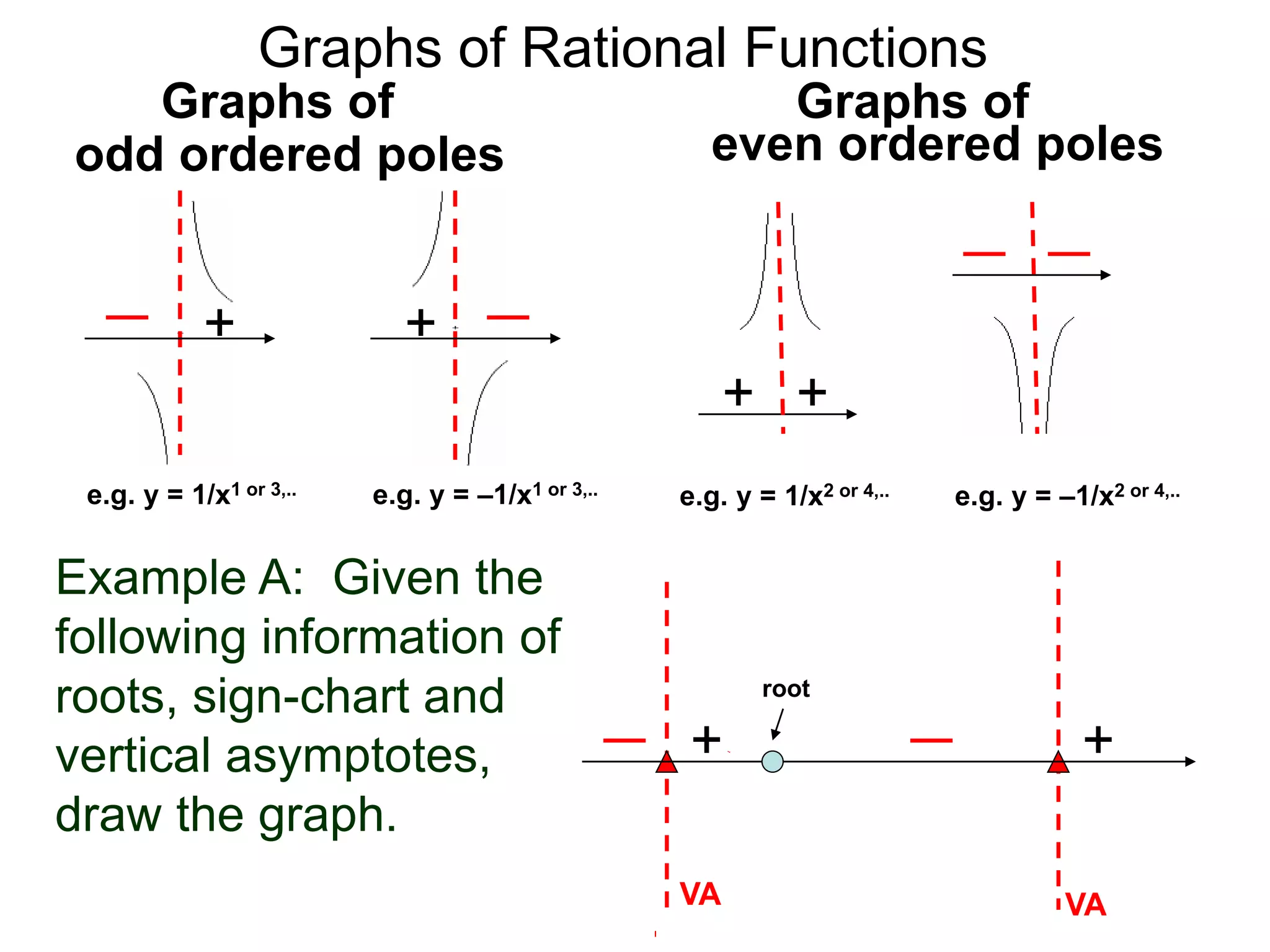
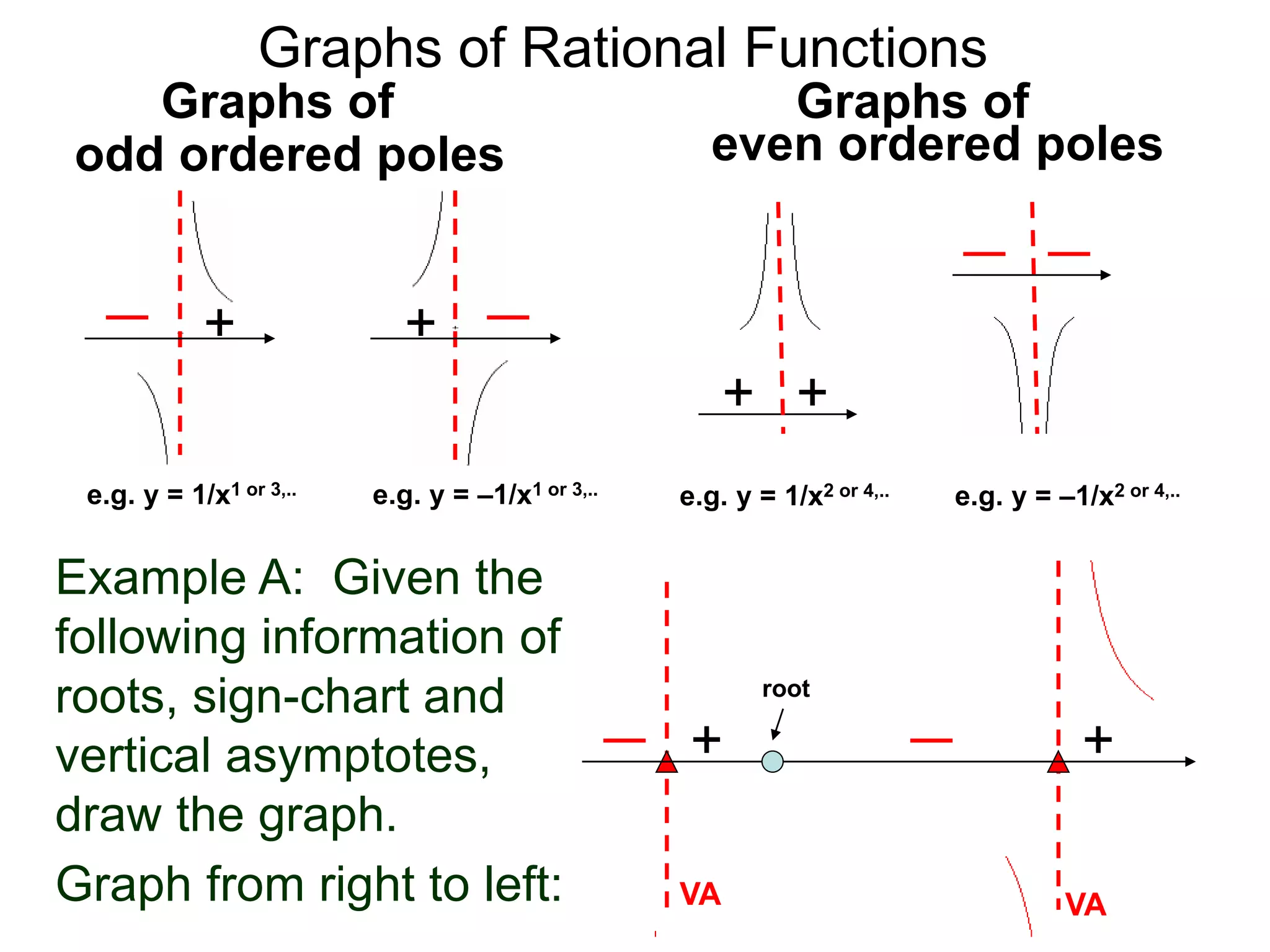
Example A: Given the
following information of
roots, sign-chart and
vertical asymptotes,
draw the graph.
++
root
VAVA
Graphs of
even ordered polesodd ordered poles
Graphs of
e.g. y = 1/x2 or 4,.. e.g. y = –1/x2 or 4,..
Graphs of Rational Functions
e.g. y = –1/x1 or 3,..
+
e.g. y = 1/x1 or 3,..
+
+ +
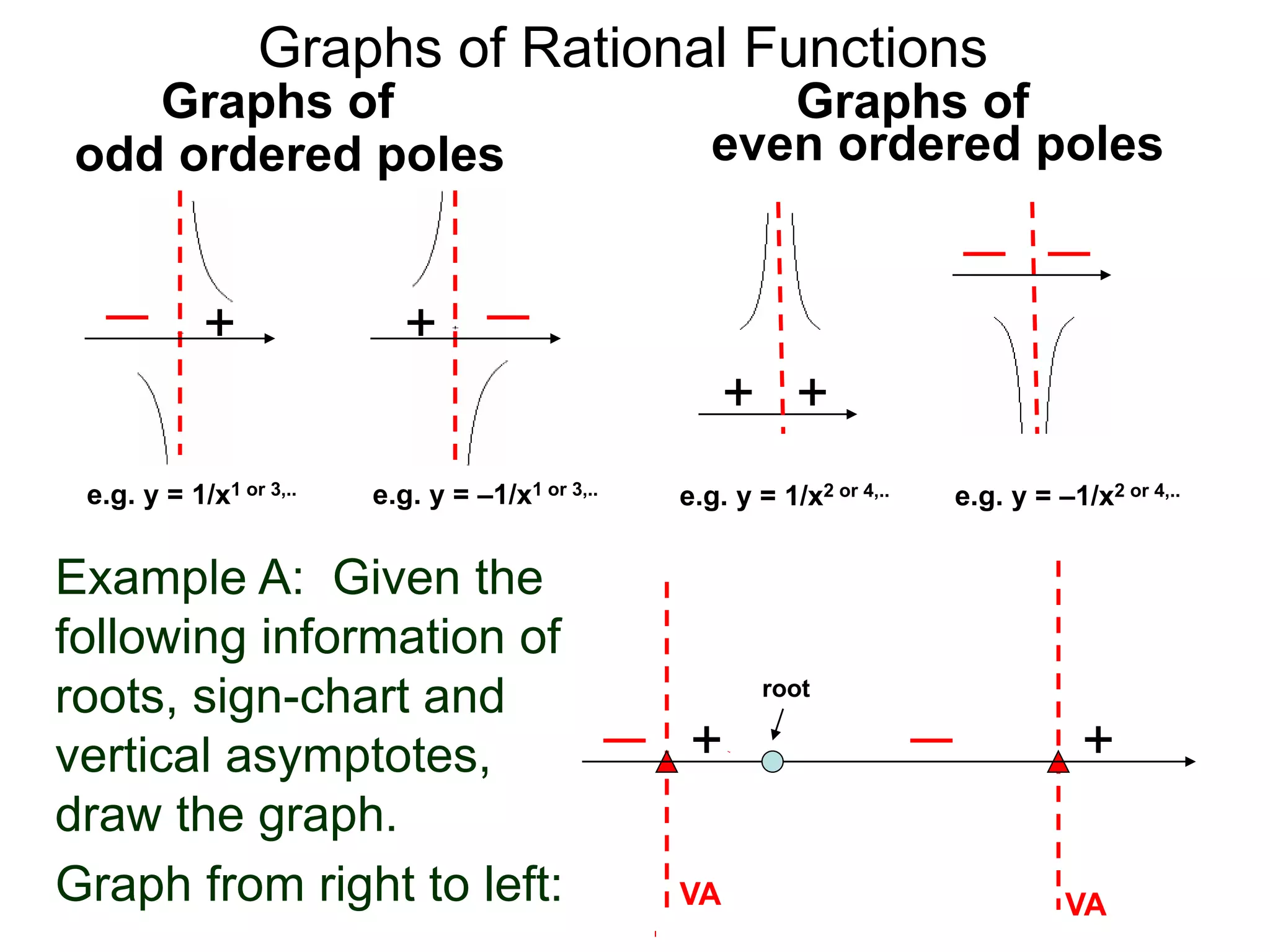
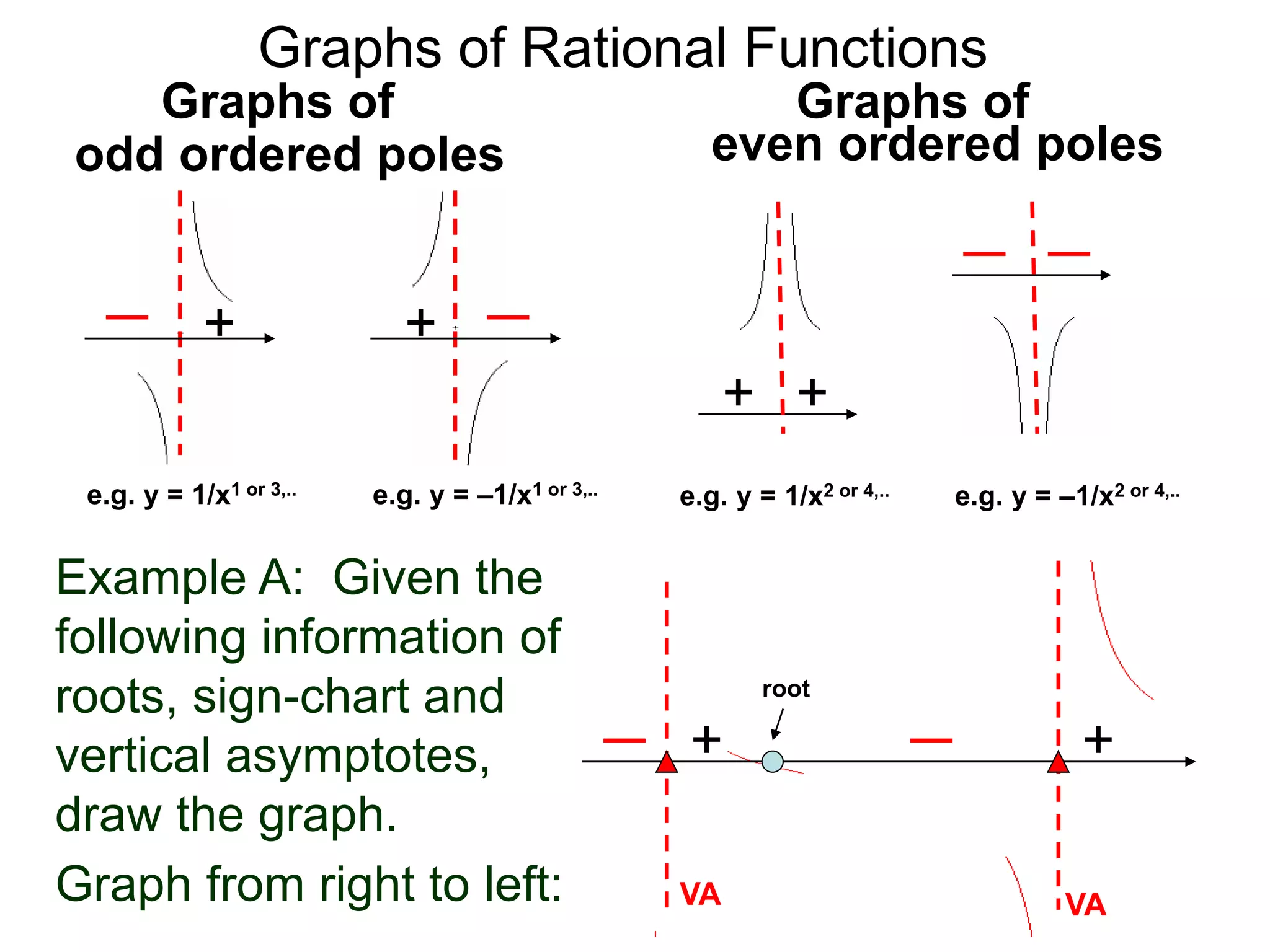
Example A: Given the
following information of
roots, sign-chart and
vertical asymptotes,
draw the graph.
++
root
VAVAGraph from right to left:
Graphs of
even ordered polesodd ordered poles
Graphs of
e.g. y = 1/x2 or 4,.. e.g. y = –1/x2 or 4,..
Graphs of Rational Functions
e.g. y = –1/x1 or 3,..
+
e.g. y = 1/x1 or 3,..
+
+ +
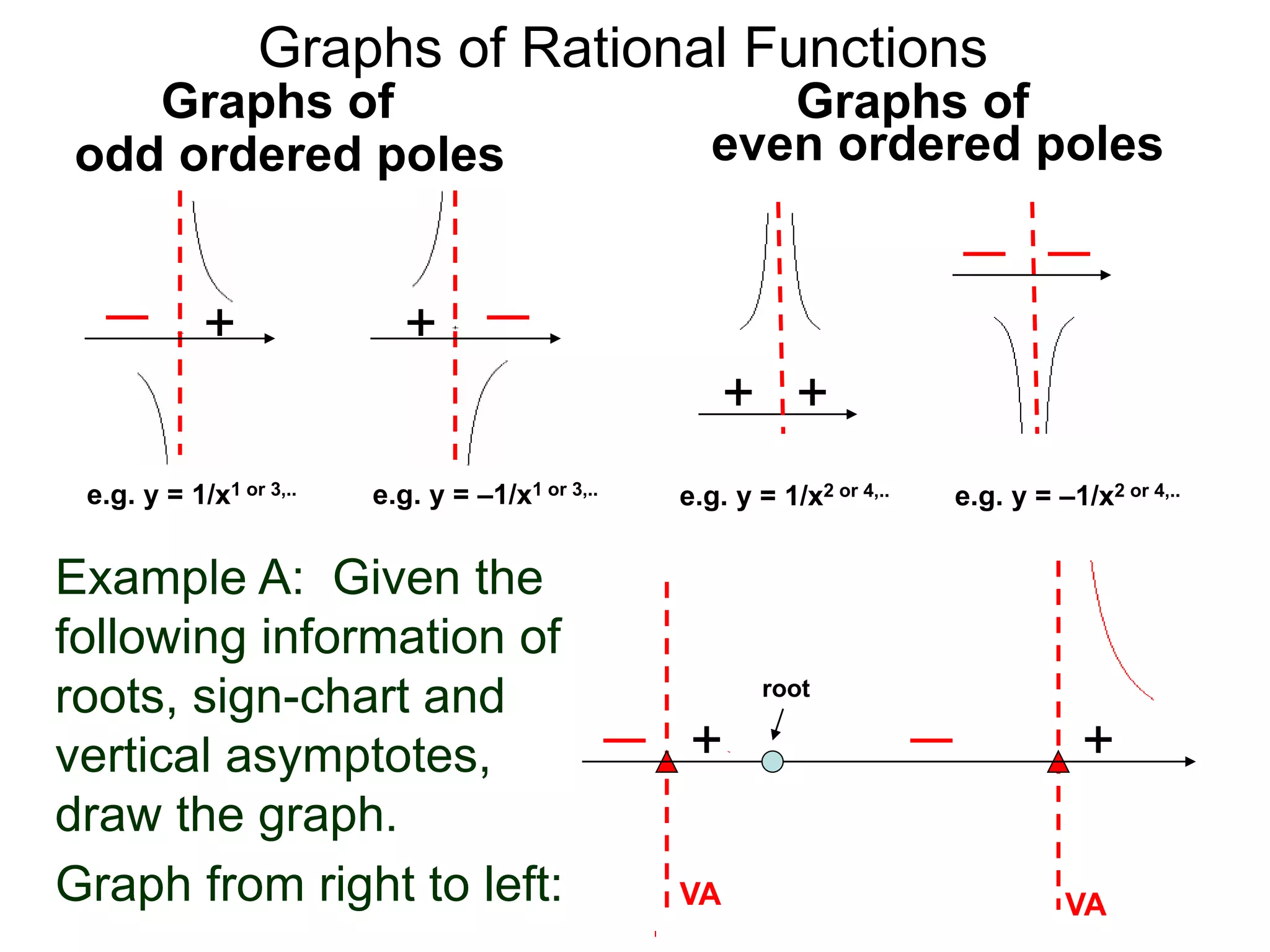
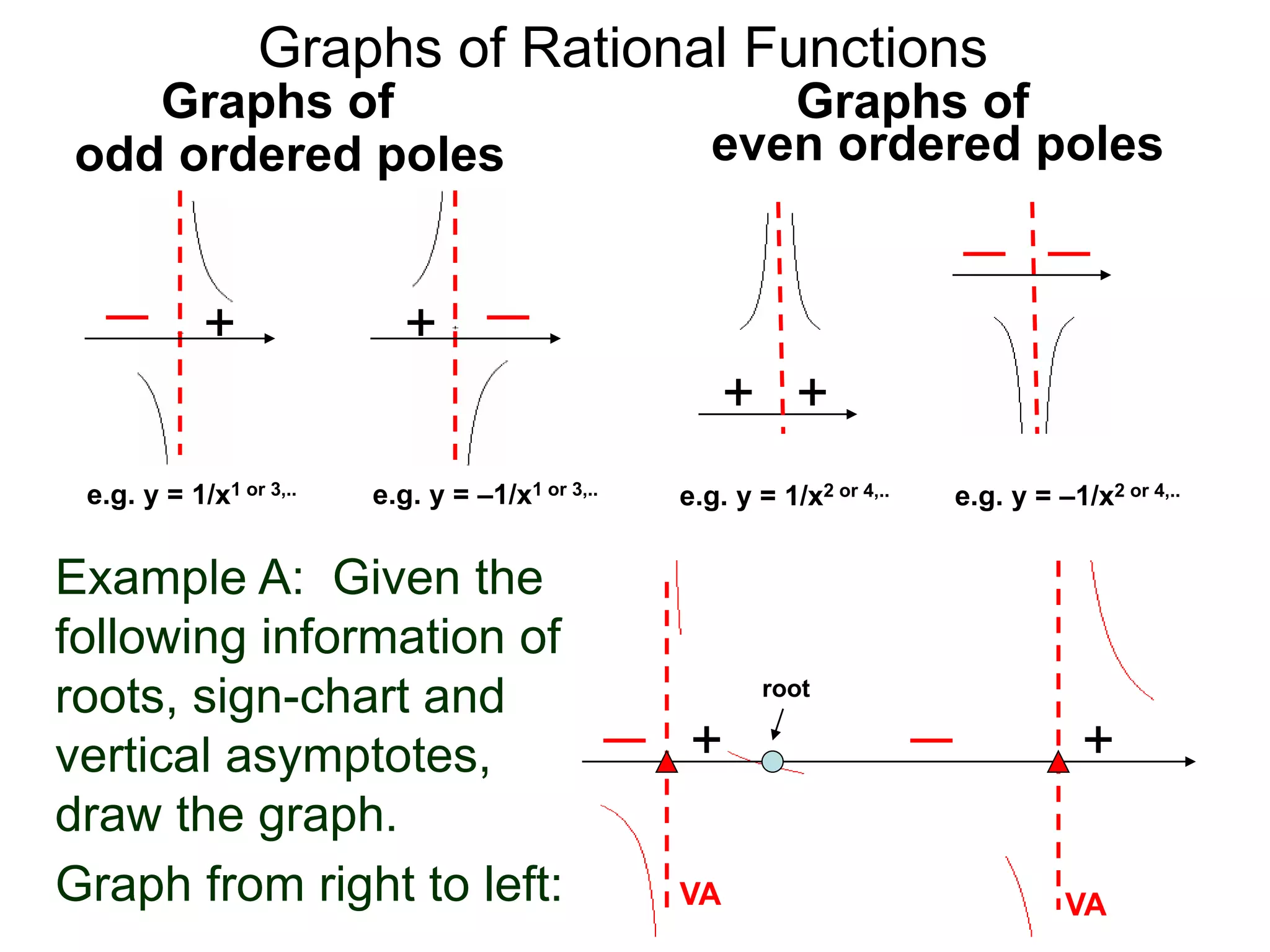
Example A: Given the
following information of
roots, sign-chart and
vertical asymptotes,
draw the graph.
++
root
VAVAGraph from right to left:
Graphs of
even ordered polesodd ordered poles
Graphs of
e.g. y = 1/x2 or 4,.. e.g. y = –1/x2 or 4,..
Graphs of Rational Functions
e.g. y = –1/x1 or 3,..
+
e.g. y = 1/x1 or 3,..
+
+ +
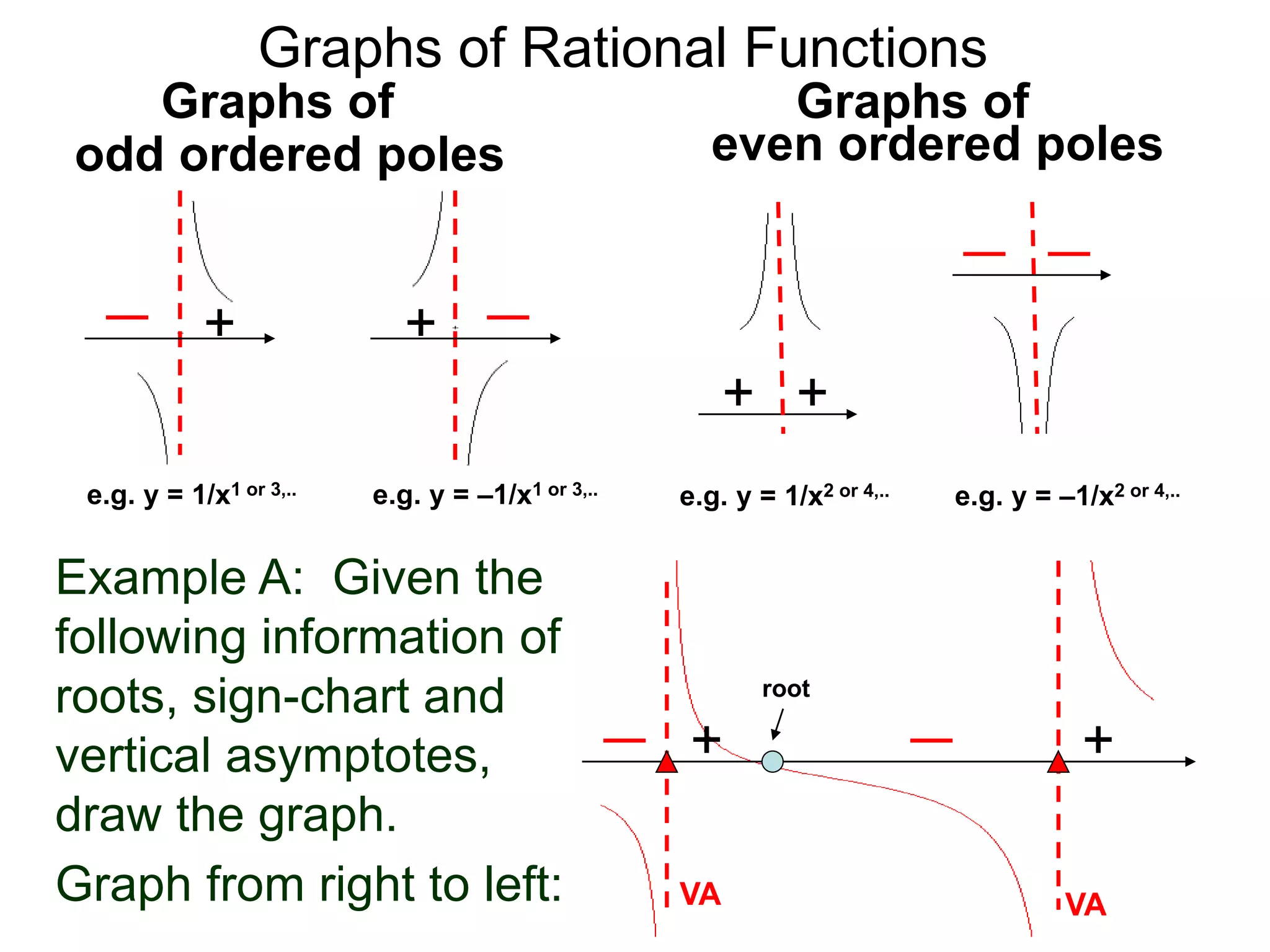
Example A: Given the
following information of
roots, sign-chart and
vertical asymptotes,
draw the graph.
++
root
VAVAGraph from right to left:
Graphs of
even ordered polesodd ordered poles
Graphs of
e.g. y = 1/x2 or 4,.. e.g. y = –1/x2 or 4,..
Graphs of Rational Functions
e.g. y = –1/x1 or 3,..
+
e.g. y = 1/x1 or 3,..
+
+ +
Example A: Given the
following information of
roots, sign-chart and
vertical asymptotes,
draw the graph.
++
root
VAVAGraph from right to left:
Graphs of
even ordered polesodd ordered poles
Graphs of
e.g. y = 1/x2 or 4,.. e.g. y = –1/x2 or 4,..
Graphs of Rational Functions
Example A: Given the
following information of
roots, sign-chart and
vertical asymptotes,
draw the graph.
++
root
VAVAGraph from right to left:
e.g. y = –1/x1 or 3,..
+
e.g. y = 1/x1 or 3,..
+
+ +
Graphs of
even ordered polesodd ordered poles
Graphs of
e.g. y = 1/x2 or 4,.. e.g. y = –1/x2 or 4,..
Graphs of Rational Functions
Example A: Given the
following information of
roots, sign-chart and
vertical asymptotes,
draw the graph.
++
root
VAVAGraph from right to left:
e.g. y = –1/x1 or 3,..
+
e.g. y = 1/x1 or 3,..
+
+ +
Graphs of
even ordered polesodd ordered poles
Graphs of
e.g. y = 1/x2 or 4,.. e.g. y = –1/x2 or 4,..
Graphs of Rational Functions
Horizontal Asymptotes
Graphs of Rational Functions
Horizontal Asymptotes
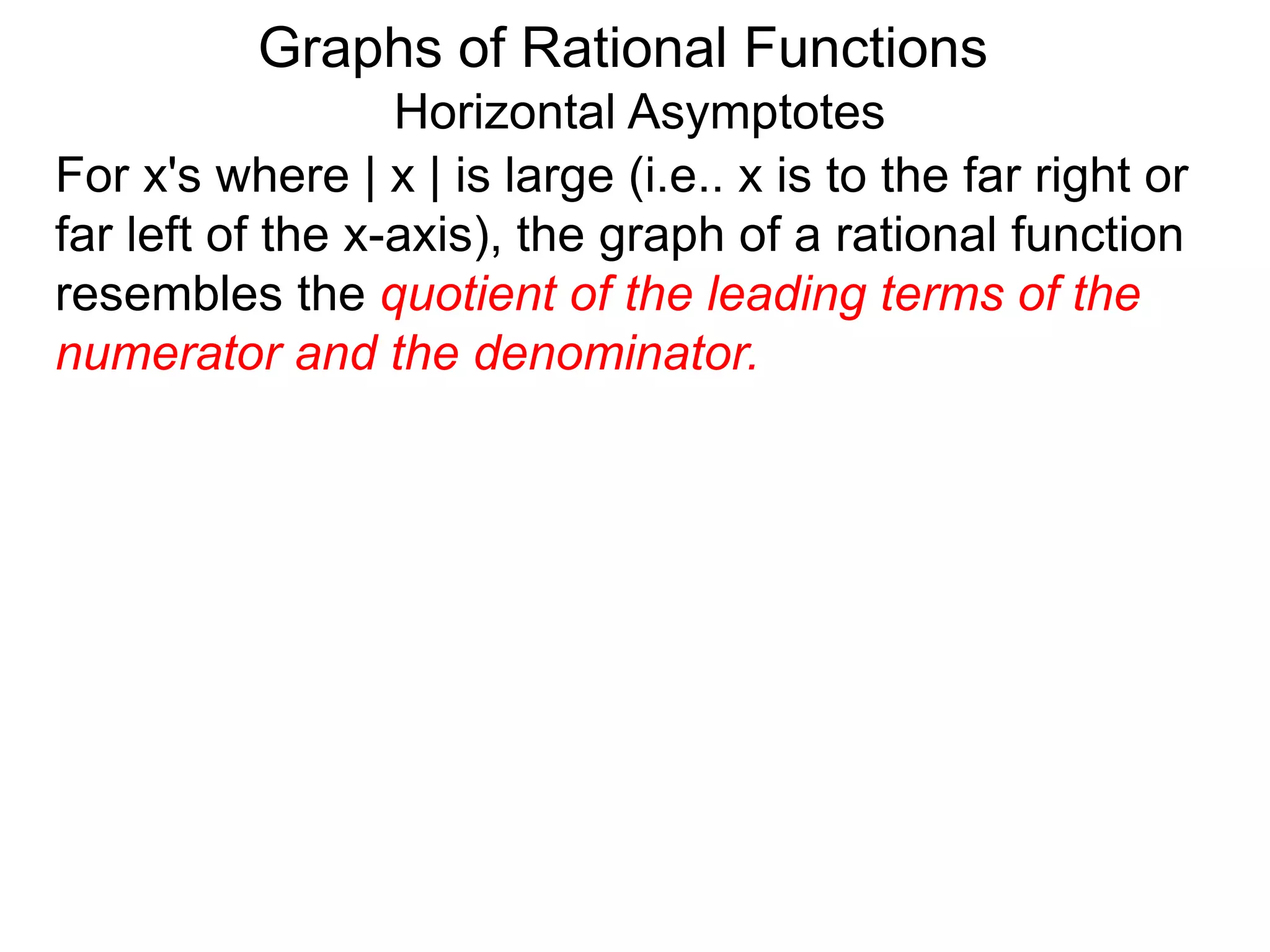
For x's where | x | is large (i.e.. x is to the far right or
far left of the x-axis),
Graphs of Rational Functions
Horizontal Asymptotes
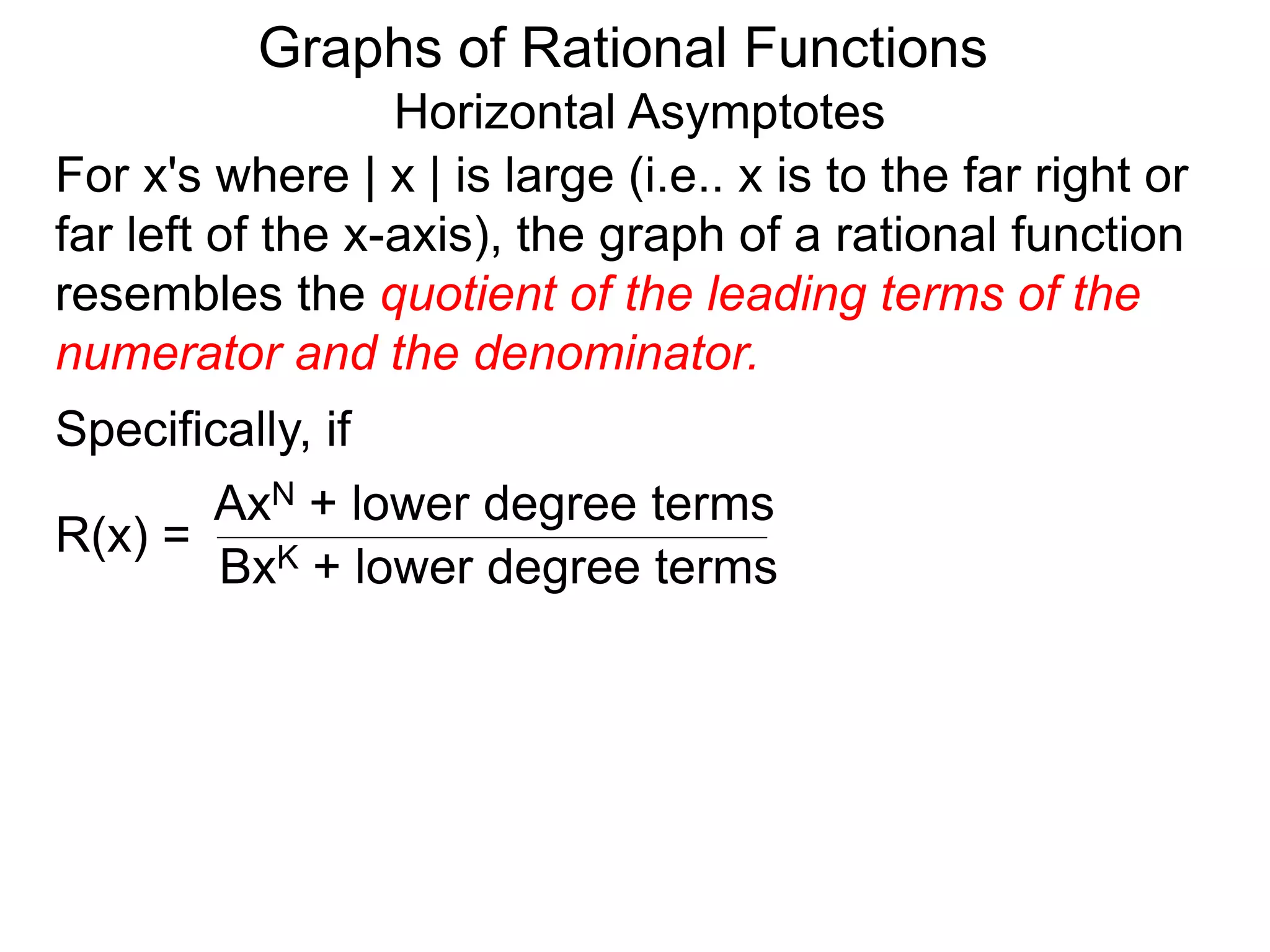
For x's where | x | is large (i.e.. x is to the far right or
far left of the x-axis), the graph of a rational function
resembles the quotient of the leading terms of the
numerator and the denominator.
Graphs of Rational Functions
Horizontal Asymptotes
For x's where | x | is large (i.e.. x is to the far right or
far left of the x-axis), the graph of a rational function
resembles the quotient of the leading terms of the
numerator and the denominator.
R(x) =
AxN + lower degree terms
BxK + lower degree terms
Specifically, if
Graphs of Rational Functions
Horizontal Asymptotes
For x's where | x | is large (i.e.. x is to the far right or
far left of the x-axis), the graph of a rational function
resembles the quotient of the leading terms of the
numerator and the denominator.
R(x) =
AxN + lower degree terms
BxK + lower degree terms
Specifically, if
then for x's where | x | is large, the graph of R(x)
resembles (quotient of the leading terms).AxN
BxK
Graphs of Rational Functions
Horizontal Asymptotes
For x's where | x | is large (i.e.. x is to the far right or
far left of the x-axis), the graph of a rational function
resembles the quotient of the leading terms of the
numerator and the denominator.
R(x) =
AxN + lower degree terms
BxK + lower degree terms
Specifically, if
then for x's where | x | is large, the graph of R(x)
resembles (quotient of the leading terms).AxN
BxK
The graph may or may not level off horizontally.
Graphs of Rational Functions
Horizontal Asymptotes
For x's where | x | is large (i.e.. x is to the far right or
far left of the x-axis), the graph of a rational function
resembles the quotient of the leading terms of the
numerator and the denominator.
R(x) =
AxN + lower degree terms
BxK + lower degree terms
Specifically, if
then for x's where | x | is large, the graph of R(x)
resembles (quotient of the leading terms).AxN
BxK
The graph may or may not level off horizontally.
If it does, then we have a horizontal asymptote (HA).
Graphs of Rational Functions
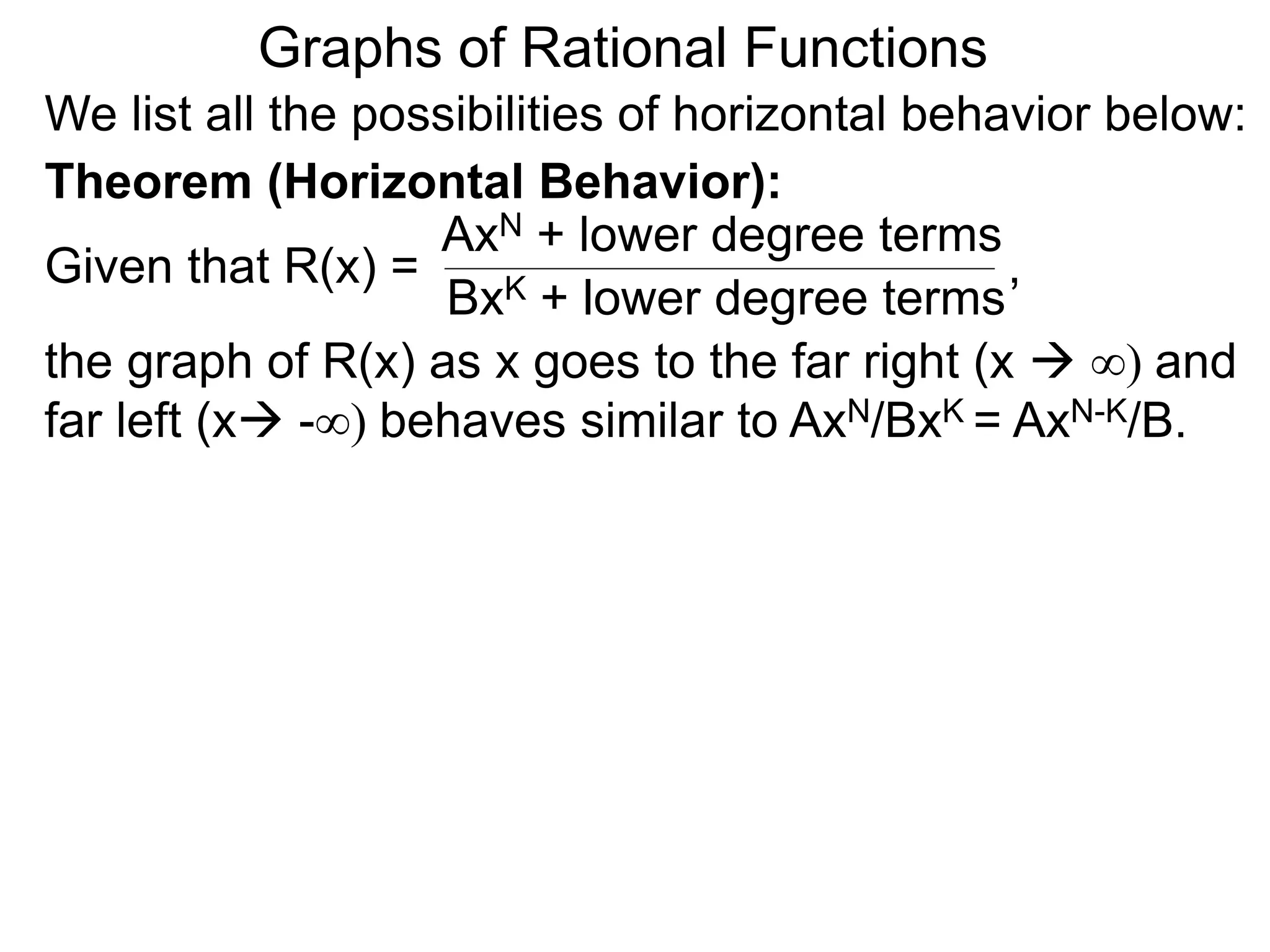
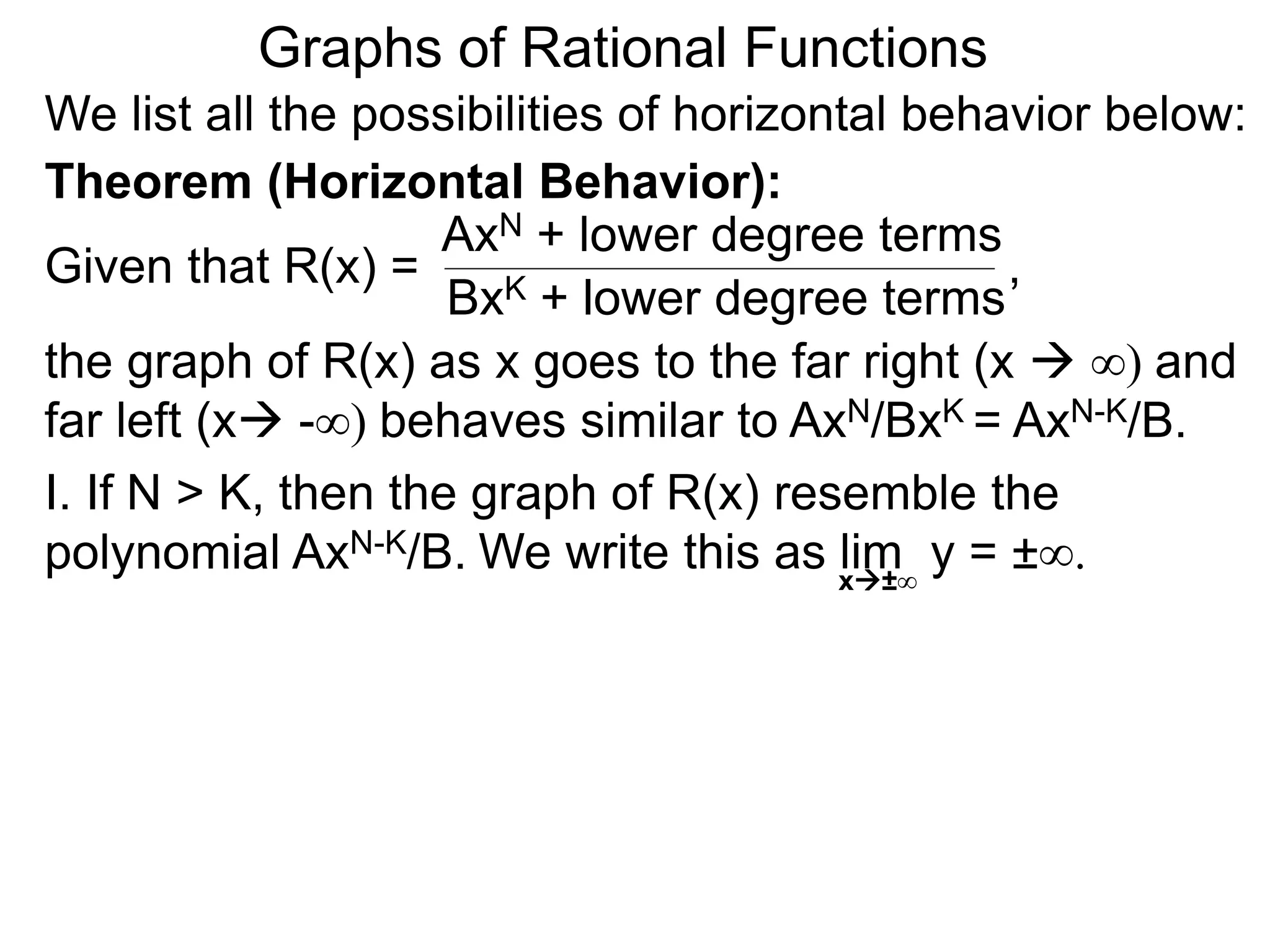
We list all the possibilities of horizontal behavior below:
Graphs of Rational Functions
We list all the possibilities of horizontal behavior below:
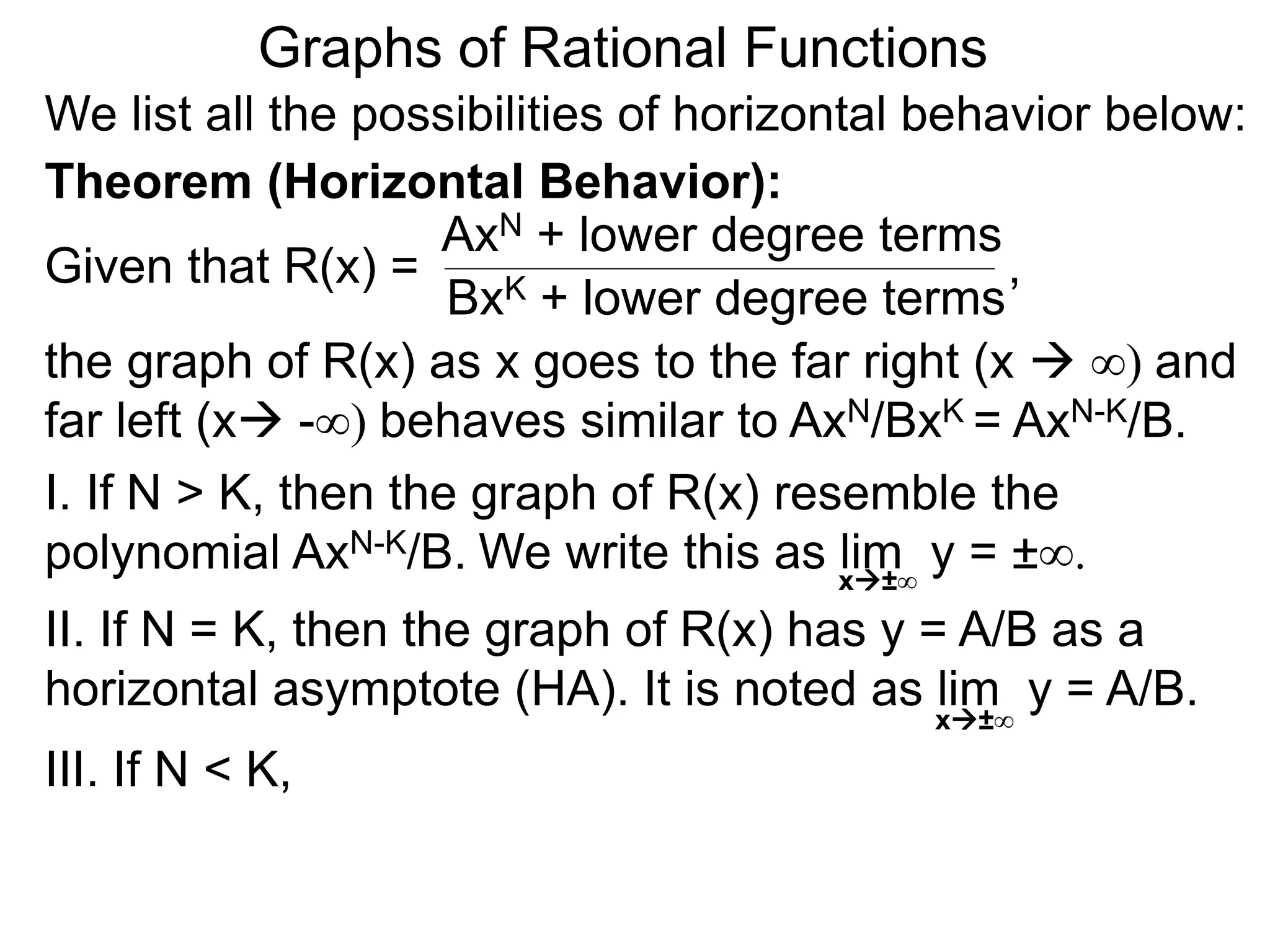
Theorem (Horizontal Behavior):
Graphs of Rational Functions
We list all the possibilities of horizontal behavior below:
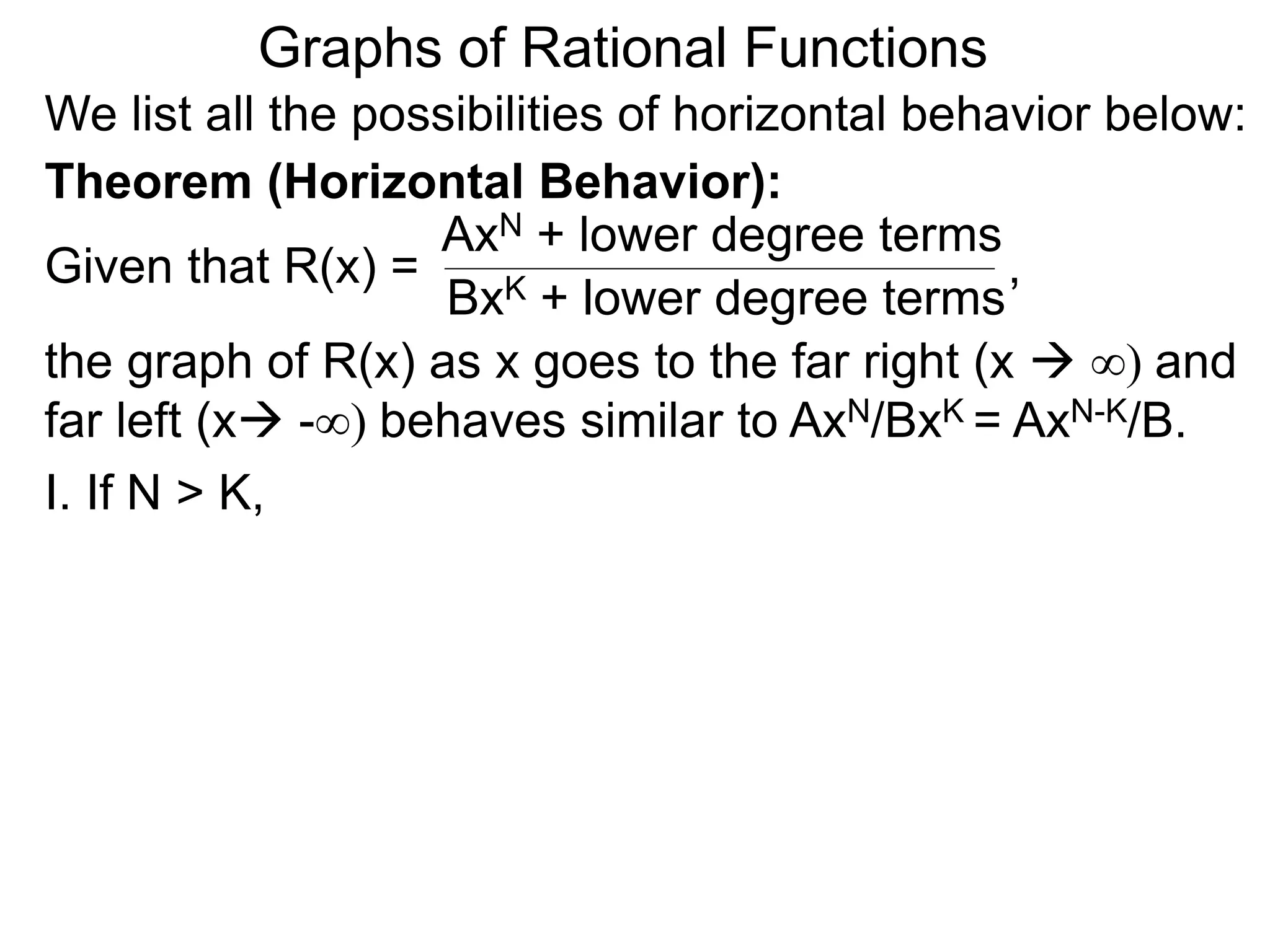
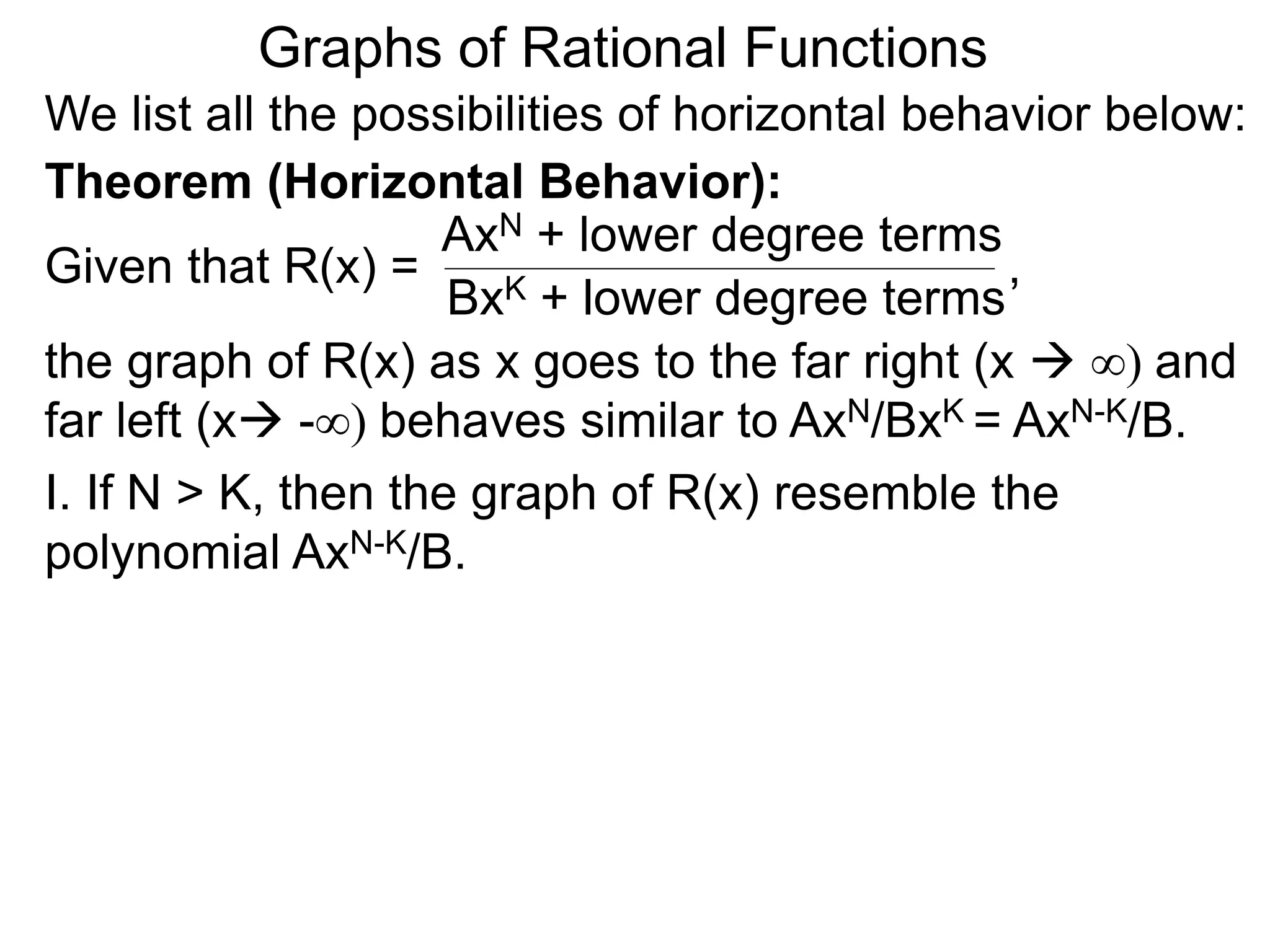
Given that R(x) =
AxN + lower degree terms
BxK + lower degree terms
Theorem (Horizontal Behavior):
the graph of R(x) as x goes to the far right (x  ∞) and
far left (x -∞) behaves similar to AxN/BxK = AxN-K/B.
,
Graphs of Rational Functions
We list all the possibilities of horizontal behavior below:
Given that R(x) =
AxN + lower degree terms
BxK + lower degree terms
Theorem (Horizontal Behavior):
the graph of R(x) as x goes to the far right (x  ∞) and
far left (x -∞) behaves similar to AxN/BxK = AxN-K/B.
I. If N > K,
,
Graphs of Rational Functions
We list all the possibilities of horizontal behavior below:
Given that R(x) =
AxN + lower degree terms
BxK + lower degree terms
Theorem (Horizontal Behavior):
the graph of R(x) as x goes to the far right (x  ∞) and
far left (x -∞) behaves similar to AxN/BxK = AxN-K/B.
I. If N > K, then the graph of R(x) resemble the
polynomial AxN-K/B.
,
Graphs of Rational Functions
We list all the possibilities of horizontal behavior below:
Given that R(x) =
AxN + lower degree terms
BxK + lower degree terms
Theorem (Horizontal Behavior):
the graph of R(x) as x goes to the far right (x  ∞) and
far left (x -∞) behaves similar to AxN/BxK = AxN-K/B.
I. If N > K, then the graph of R(x) resemble the
polynomial AxN-K/B.
,
We write this as lim y = ±∞.x±∞
Graphs of Rational Functions
We list all the possibilities of horizontal behavior below:
Given that R(x) =
AxN + lower degree terms
BxK + lower degree terms
Theorem (Horizontal Behavior):
the graph of R(x) as x goes to the far right (x  ∞) and
far left (x -∞) behaves similar to AxN/BxK = AxN-K/B.
I. If N > K, then the graph of R(x) resemble the
polynomial AxN-K/B.
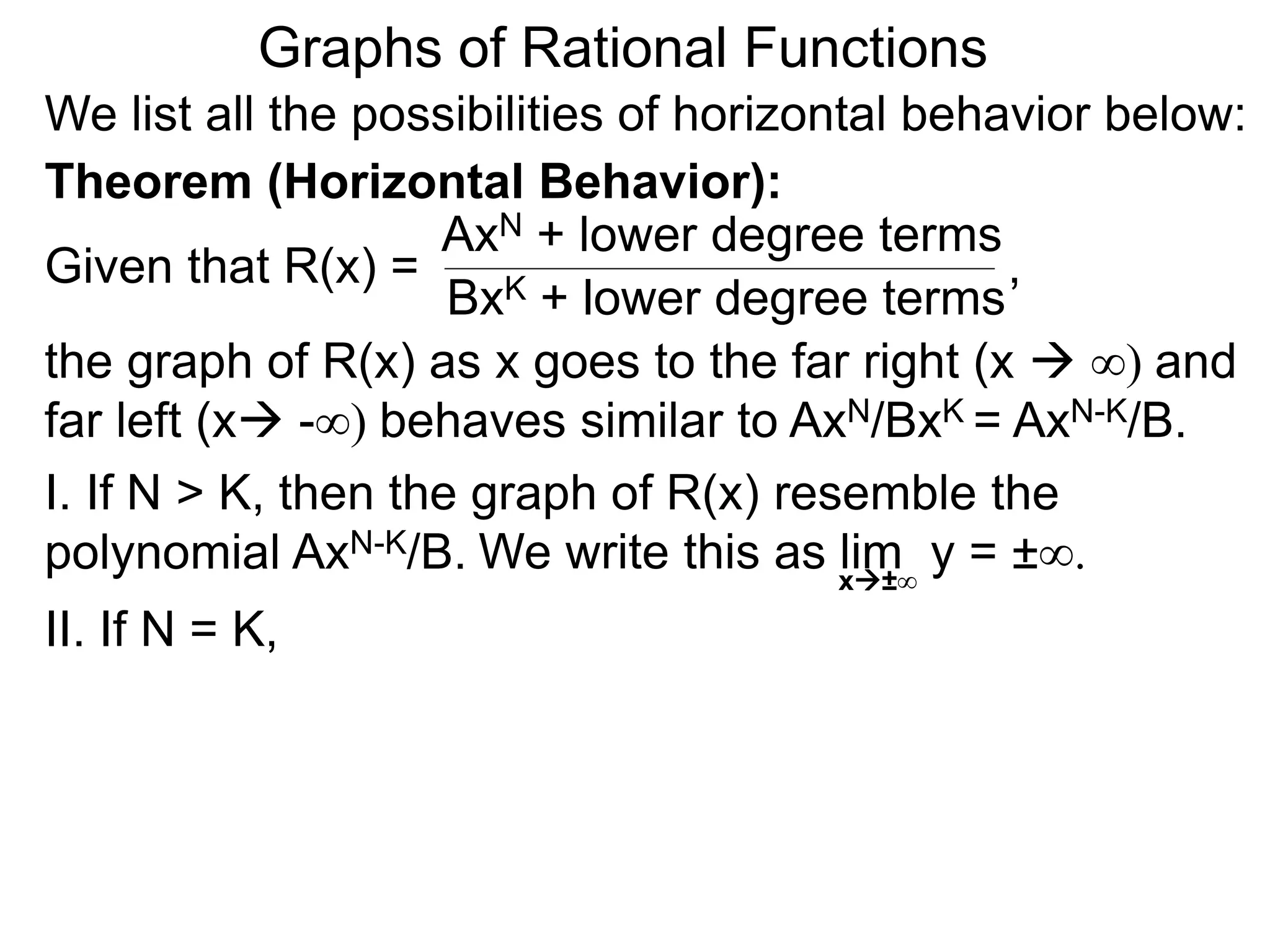
II. If N = K,
,
We write this as lim y = ±∞.x±∞
Graphs of Rational Functions
We list all the possibilities of horizontal behavior below:
Given that R(x) =
AxN + lower degree terms
BxK + lower degree terms
Theorem (Horizontal Behavior):
the graph of R(x) as x goes to the far right (x  ∞) and
far left (x -∞) behaves similar to AxN/BxK = AxN-K/B.
I. If N > K, then the graph of R(x) resemble the
polynomial AxN-K/B.
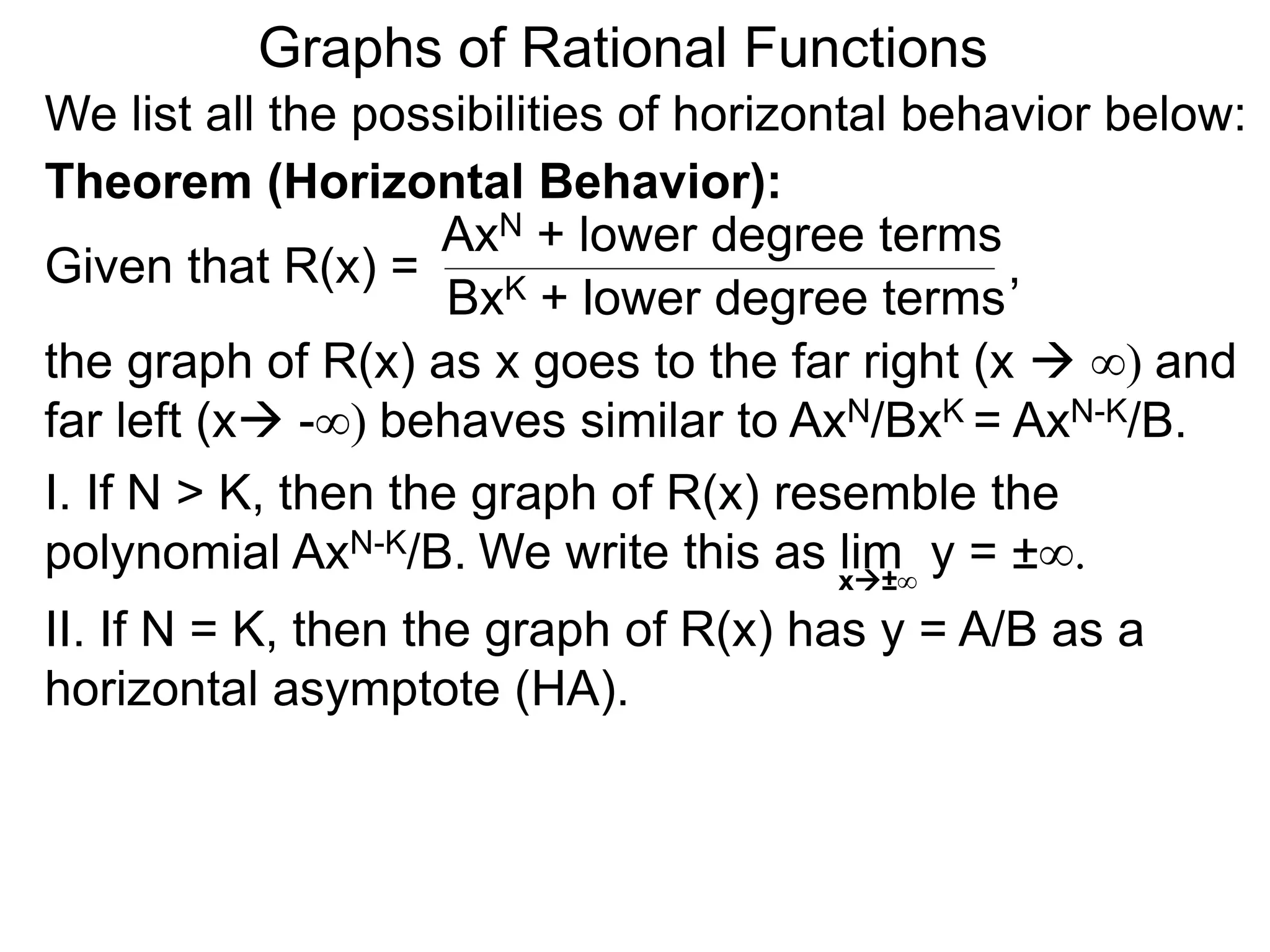
II. If N = K, then the graph of R(x) has y = A/B as a
horizontal asymptote (HA).
,
We write this as lim y = ±∞.x±∞
Graphs of Rational Functions
We list all the possibilities of horizontal behavior below:
Given that R(x) =
AxN + lower degree terms
BxK + lower degree terms
Theorem (Horizontal Behavior):
the graph of R(x) as x goes to the far right (x  ∞) and
far left (x -∞) behaves similar to AxN/BxK = AxN-K/B.
I. If N > K, then the graph of R(x) resemble the
polynomial AxN-K/B.
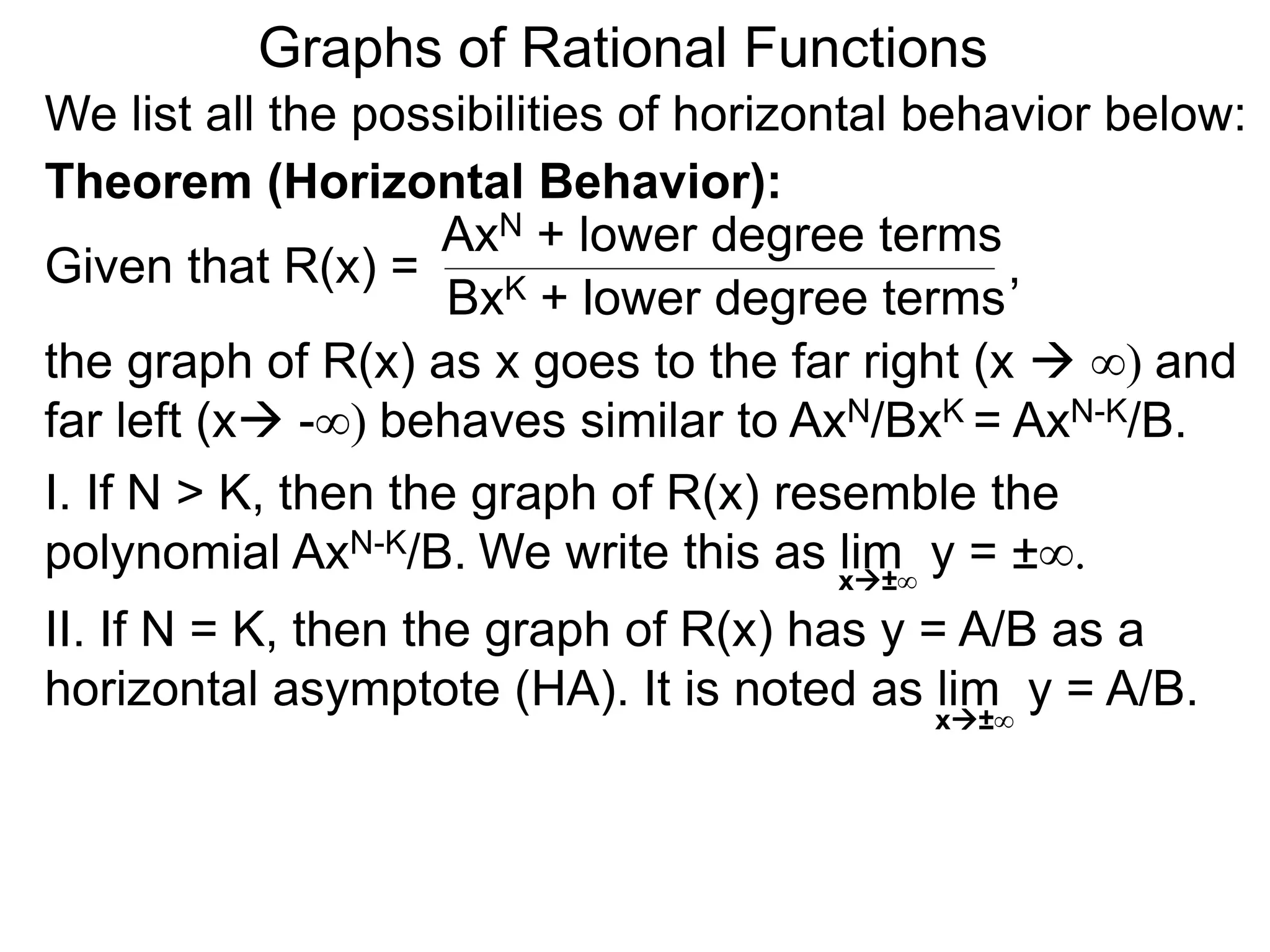
II. If N = K, then the graph of R(x) has y = A/B as a
horizontal asymptote (HA). It is noted as lim y = A/B.x±∞
,
We write this as lim y = ±∞.x±∞
Graphs of Rational Functions
We list all the possibilities of horizontal behavior below:
Given that R(x) =
AxN + lower degree terms
BxK + lower degree terms
Theorem (Horizontal Behavior):
the graph of R(x) as x goes to the far right (x  ∞) and
far left (x -∞) behaves similar to AxN/BxK = AxN-K/B.
I. If N > K, then the graph of R(x) resemble the
polynomial AxN-K/B.
II. If N = K, then the graph of R(x) has y = A/B as a
horizontal asymptote (HA). It is noted as lim y = A/B.
III. If N < K,
x±∞
,
We write this as lim y = ±∞.x±∞
Graphs of Rational Functions
We list all the possibilities of horizontal behavior below:
Given that R(x) =
AxN + lower degree terms
BxK + lower degree terms
Theorem (Horizontal Behavior):
the graph of R(x) as x goes to the far right (x  ∞) and
far left (x -∞) behaves similar to AxN/BxK = AxN-K/B.
I. If N > K, then the graph of R(x) resemble the
polynomial AxN-K/B.
II. If N = K, then the graph of R(x) has y = A/B as a
horizontal asymptote (HA). It is noted as lim y = A/B.
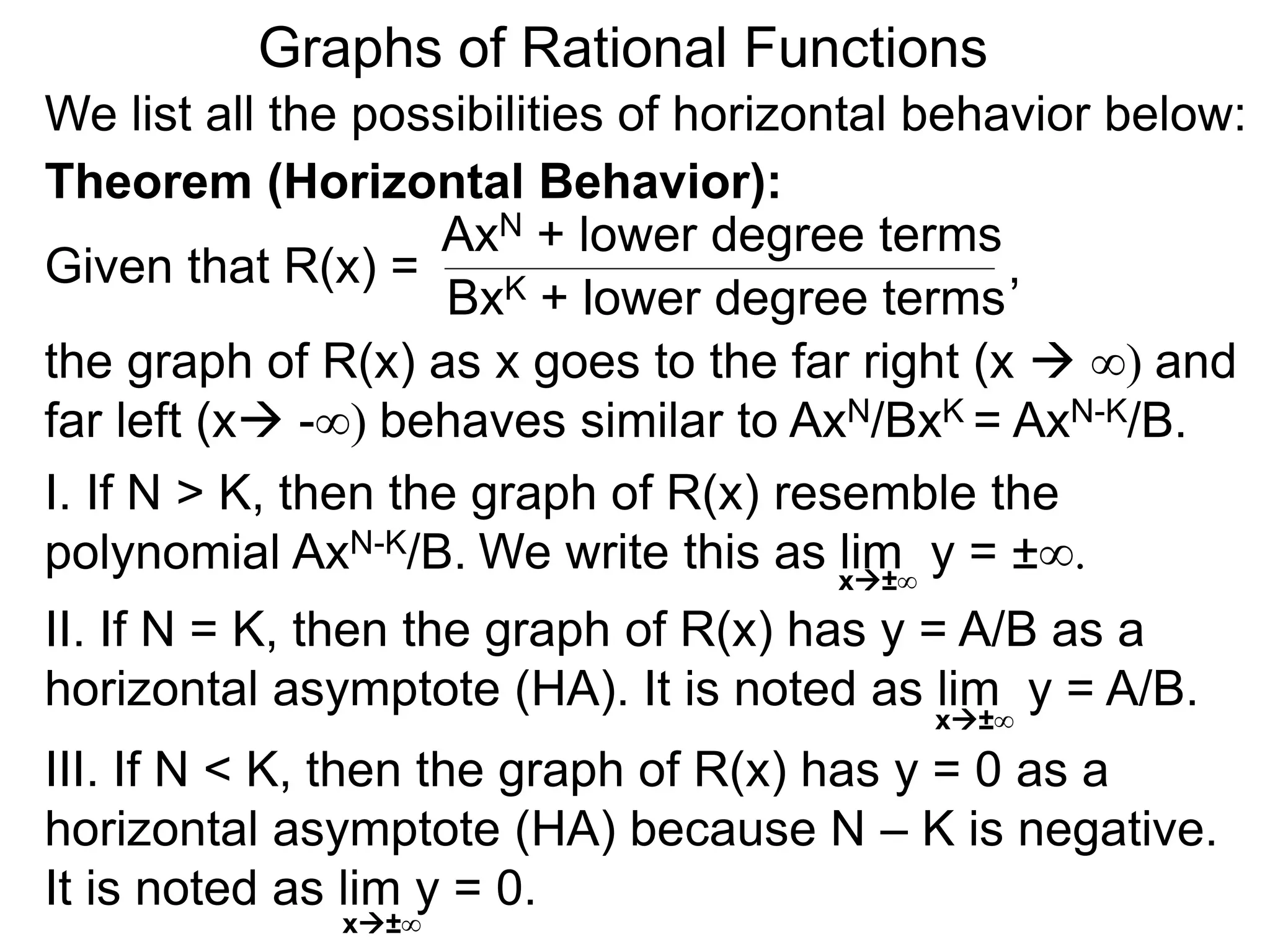
III. If N < K, then the graph of R(x) has y = 0 as a
horizontal asymptote (HA) because N – K is negative.
x±∞
,
We write this as lim y = ±∞.x±∞
Graphs of Rational Functions
We list all the possibilities of horizontal behavior below:
Given that R(x) =
AxN + lower degree terms
BxK + lower degree terms
Theorem (Horizontal Behavior):
the graph of R(x) as x goes to the far right (x  ∞) and
far left (x -∞) behaves similar to AxN/BxK = AxN-K/B.
I. If N > K, then the graph of R(x) resemble the
polynomial AxN-K/B.
II. If N = K, then the graph of R(x) has y = A/B as a
horizontal asymptote (HA). It is noted as lim y = A/B.
III. If N < K, then the graph of R(x) has y = 0 as a
horizontal asymptote (HA) because N – K is negative.
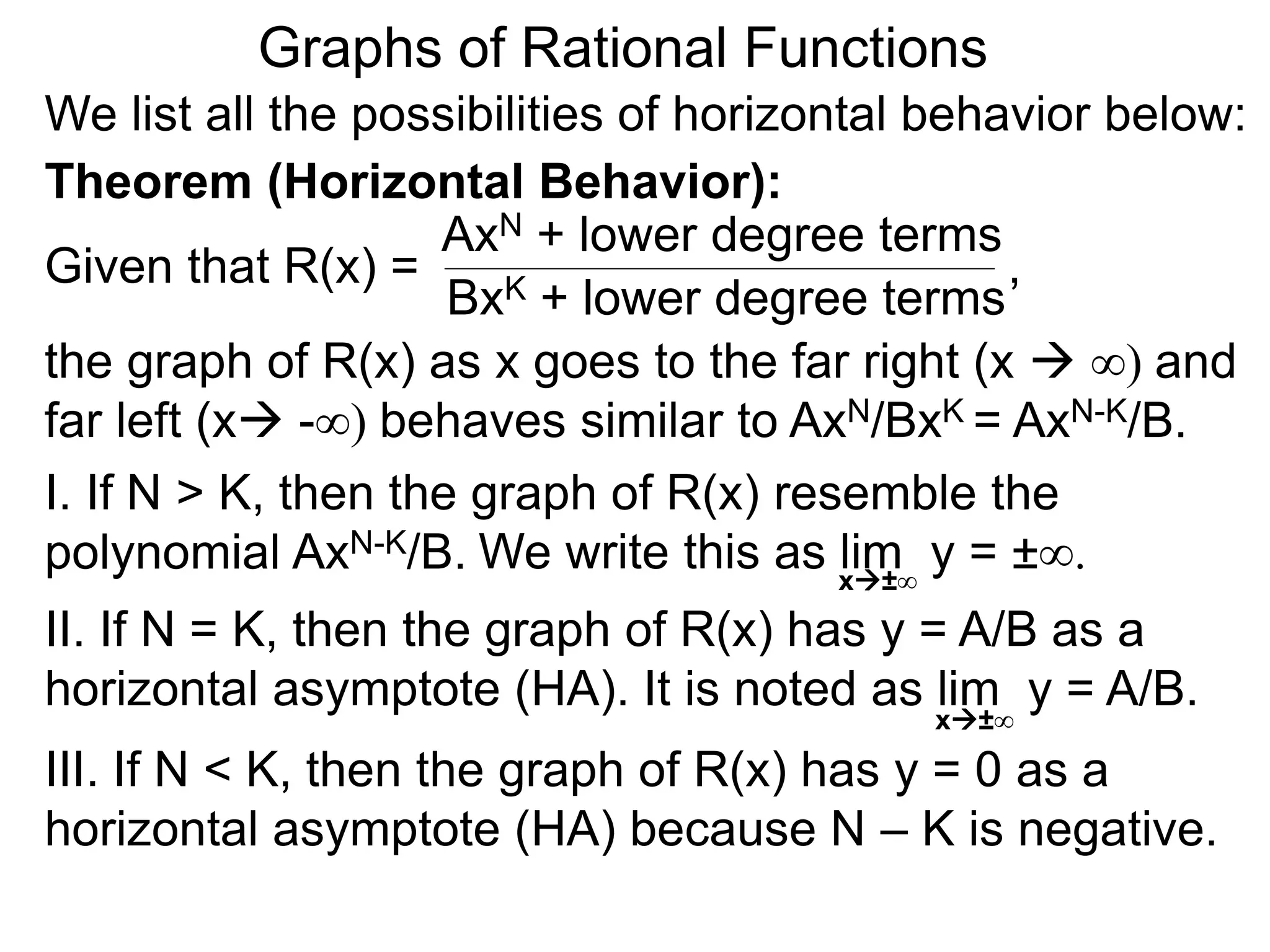
It is noted as lim y = 0.
x±∞
x±∞
,
We write this as lim y = ±∞.x±∞
Graphs of Rational Functions
Steps for graphing a rational function R(x) = P(x)
Q(x)
Graphs of Rational Functions
Steps for graphing a rational function R(x) =
I. (Roots) Find the roots of P(x) and their orders
by solving P(x) = 0.
P(x)
Q(x)
Graphs of Rational Functions
Steps for graphing a rational function R(x) =
I. (Roots) Find the roots of P(x) and their orders
by solving P(x) = 0.
P(x)
Q(x)
II. (Poles or VA) Find the vertical asymptotes (VA)
and their orders by solving Q(x) = 0.
Graphs of Rational Functions
Steps for graphing a rational function R(x) =
I. (Roots) Find the roots of P(x) and their orders
by solving P(x) = 0.
P(x)
Q(x)
II. (Poles or VA) Find the vertical asymptotes (VA)
and their orders by solving Q(x) = 0.
Steps I and II give the sign-chart,
Graphs of Rational Functions
Steps for graphing a rational function R(x) =
I. (Roots) Find the roots of P(x) and their orders
by solving P(x) = 0.
P(x)
Q(x)
II. (Poles or VA) Find the vertical asymptotes (VA)
and their orders by solving Q(x) = 0.
Steps I and II give the sign-chart, the shape of the
graph around the roots, and the shape of the graph
along the poles.
Graphs of Rational Functions
Steps for graphing a rational function R(x) =
I. (Roots) Find the roots of P(x) and their orders
by solving P(x) = 0.
P(x)
Q(x)
II. (Poles or VA) Find the vertical asymptotes (VA)
and their orders by solving Q(x) = 0.
Steps I and II give the sign-chart, the shape of the
graph around the roots, and the shape of the graph
along the poles.
Steps I and II give the "mid-section“ of the graph.
Graphs of Rational Functions
Steps for graphing a rational function R(x) =
I. (Roots) Find the roots of P(x) and their orders
by solving P(x) = 0.
P(x)
Q(x)
II. (Poles or VA) Find the vertical asymptotes (VA)
and their orders by solving Q(x) = 0.
Steps I and II give the sign-chart, the shape of the
graph around the roots, and the shape of the graph
along the poles.
Steps I and II give the "mid-section“ of the graph.
III. (HA) Use the last theorem to determine the
behavior of the graph to the right and left as x±∞.
Graphs of Rational Functions
Steps for graphing a rational function R(x) =
I. (Roots) Find the roots of P(x) and their orders
by solving P(x) = 0.
P(x)
Q(x)
II. (Poles or VA) Find the vertical asymptotes (VA)
and their orders by solving Q(x) = 0.
Steps I and II give the sign-chart, the shape of the
graph around the roots, and the shape of the graph
along the poles.
Steps I and II give the "mid-section“ of the graph.
III. (HA) Use the last theorem to determine the
behavior of the graph to the right and left as x±∞.
The horizontal asymptote exists only if the limit exists.
Graphs of Rational Functions
Steps for graphing a rational function R(x) =
I. (Roots) Find the roots of P(x) and their orders
by solving P(x) = 0.
P(x)
Q(x)
II. (Poles or VA) Find the vertical asymptotes (VA)
and their orders by solving Q(x) = 0.
Steps I and II give the sign-chart, the shape of the
graph around the roots, and the shape of the graph
along the poles.
Steps I and II give the "mid-section“ of the graph.
III. (HA) Use the last theorem to determine the
behavior of the graph to the right and left as x±∞.
The horizontal asymptote exists only if the limit exists.
Step III gives the “arms” of the graph.
Graphs of Rational Functions
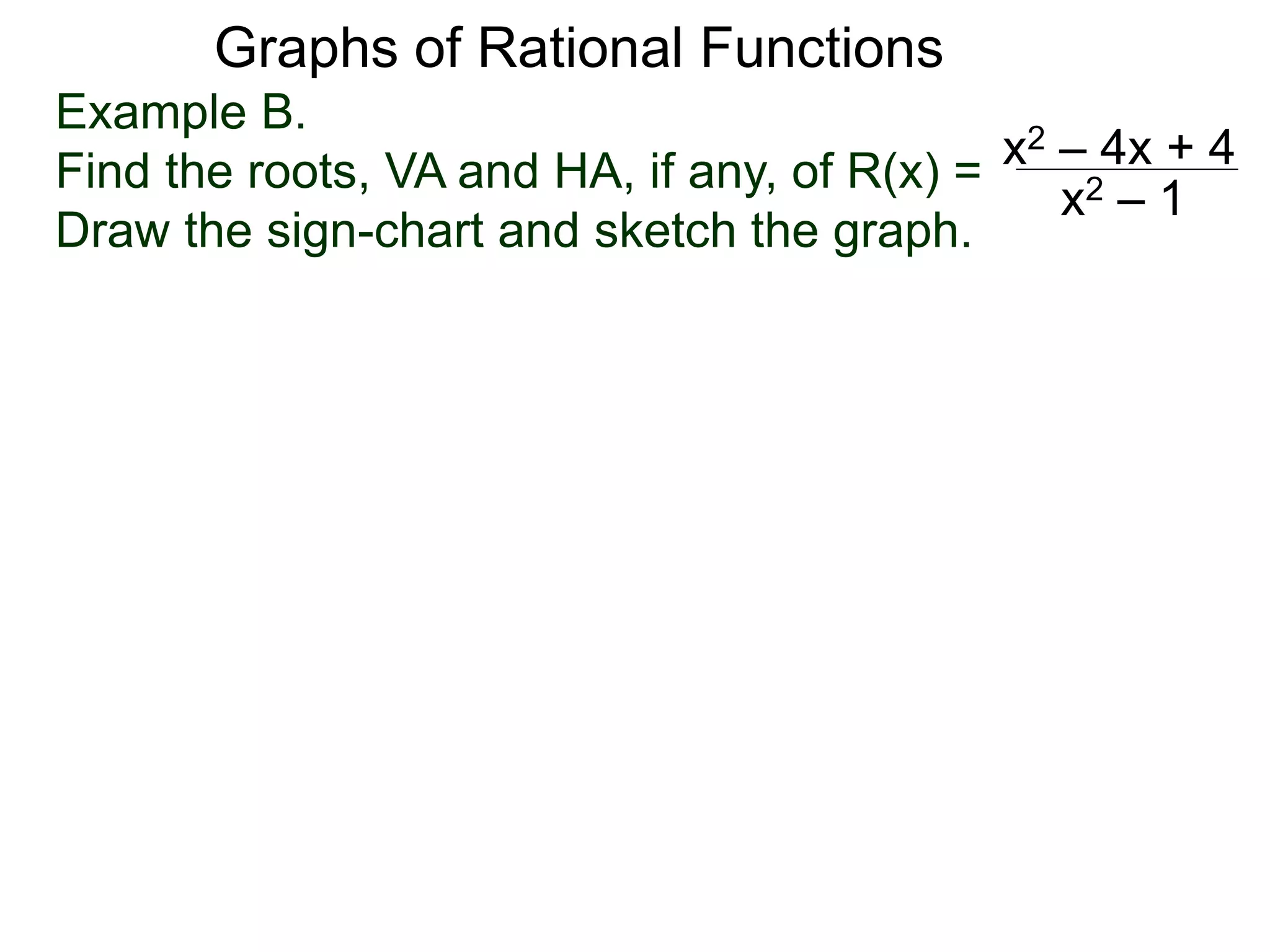
Example B.
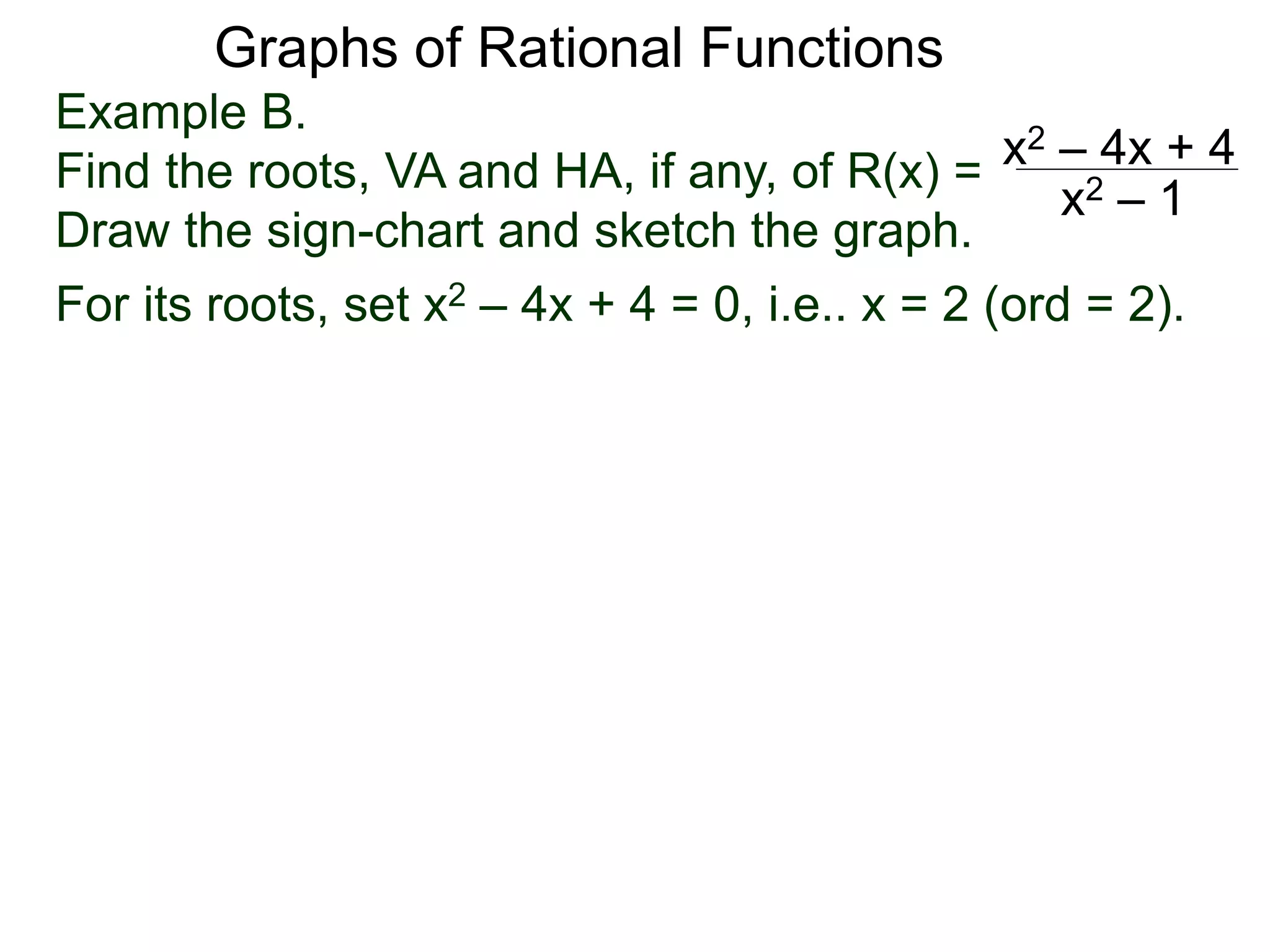
Find the roots, VA and HA, if any, of R(x) =
Draw the sign-chart and sketch the graph.
x2 – 4x + 4
x2 – 1
Graphs of Rational Functions
Example B.
Find the roots, VA and HA, if any, of R(x) =
Draw the sign-chart and sketch the graph.
x2 – 4x + 4
x2 – 1
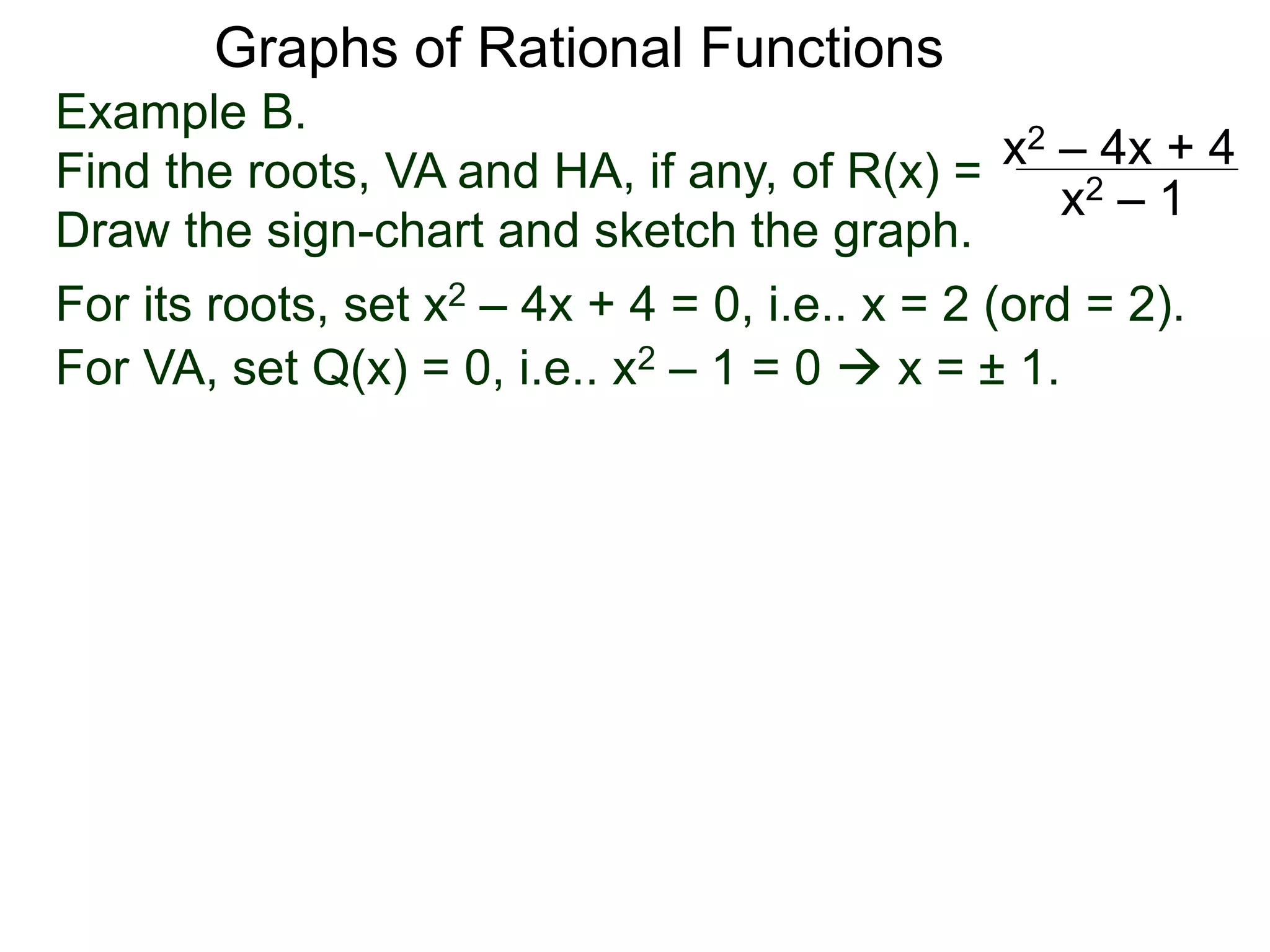
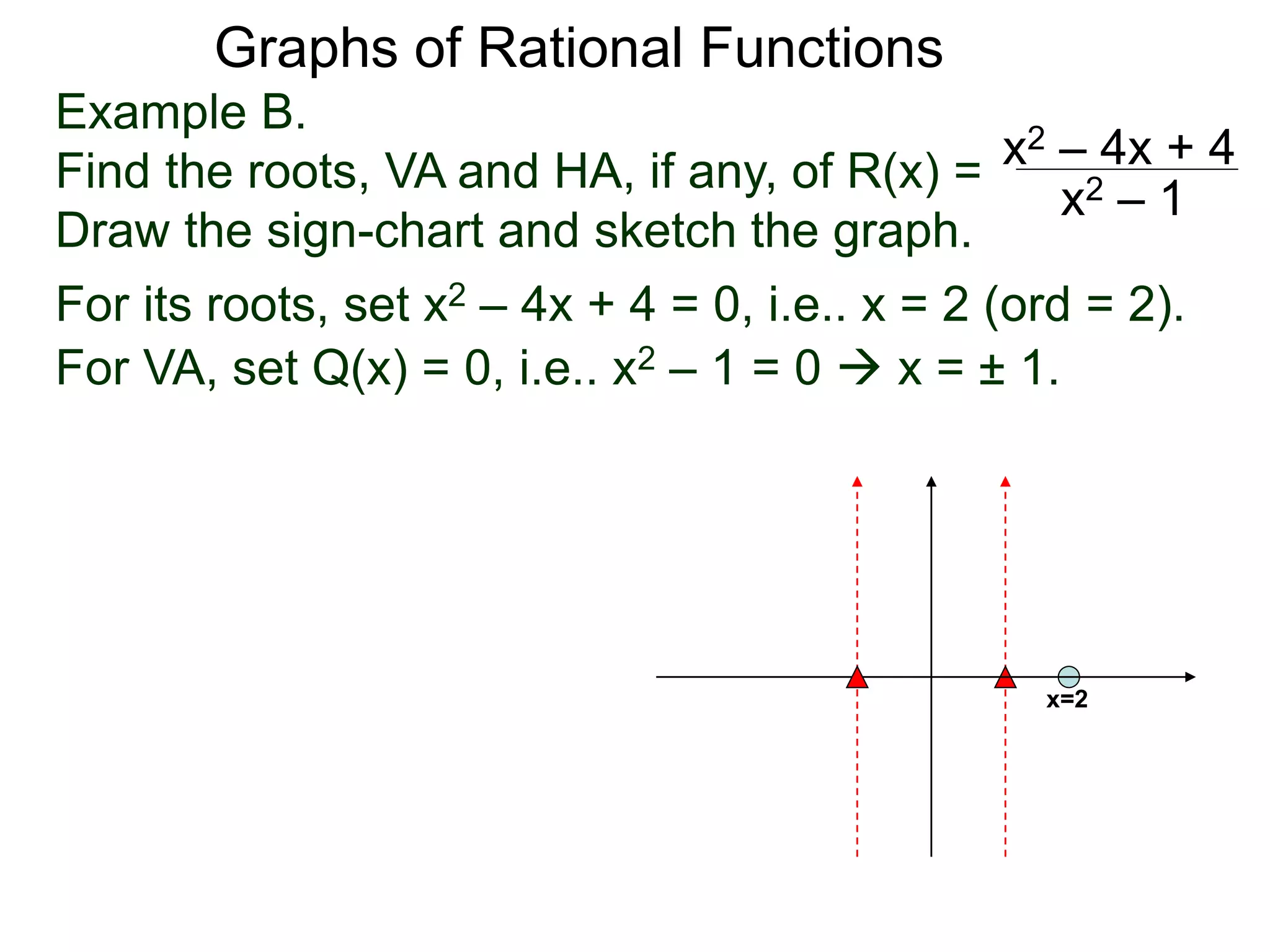
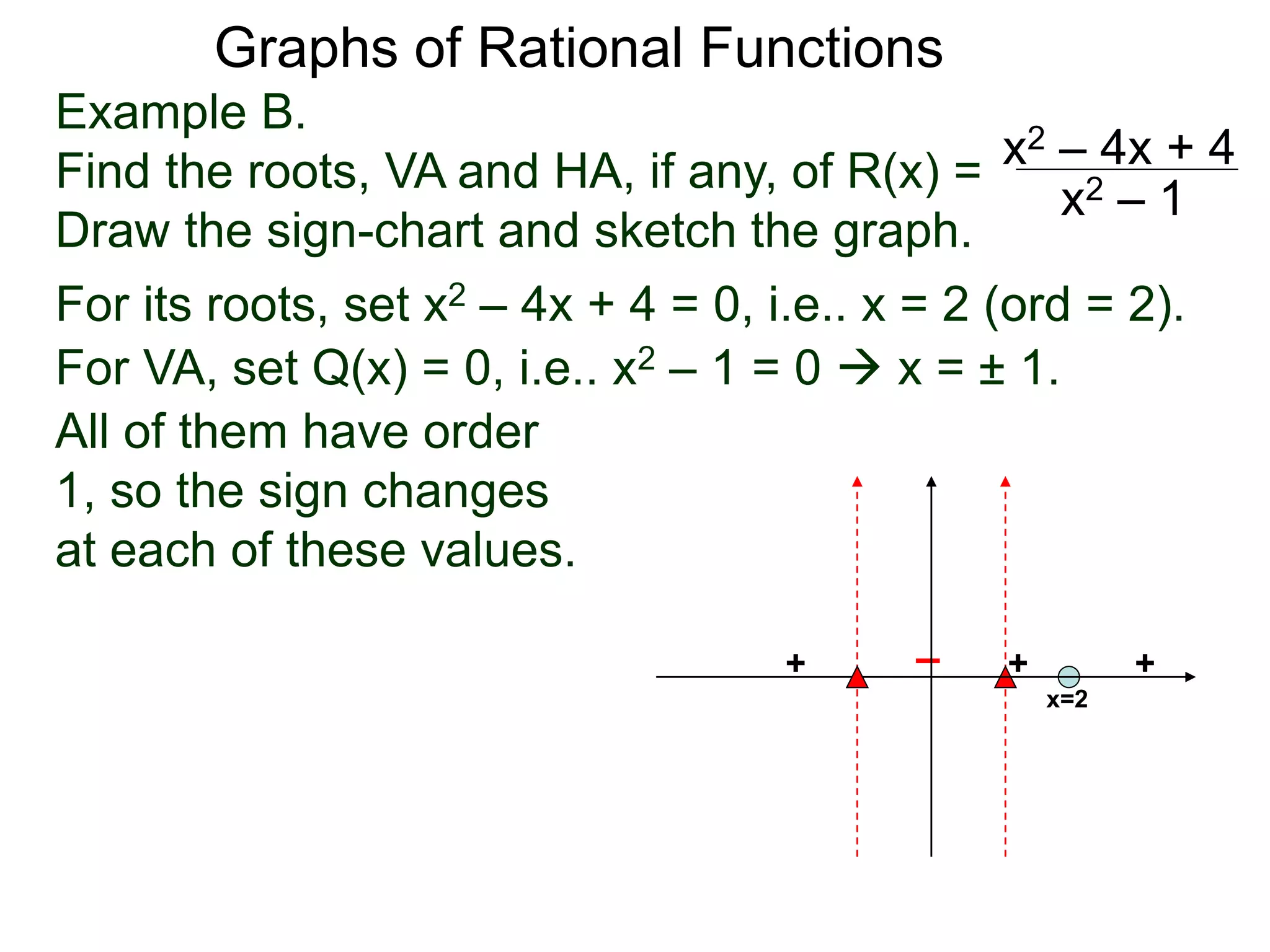
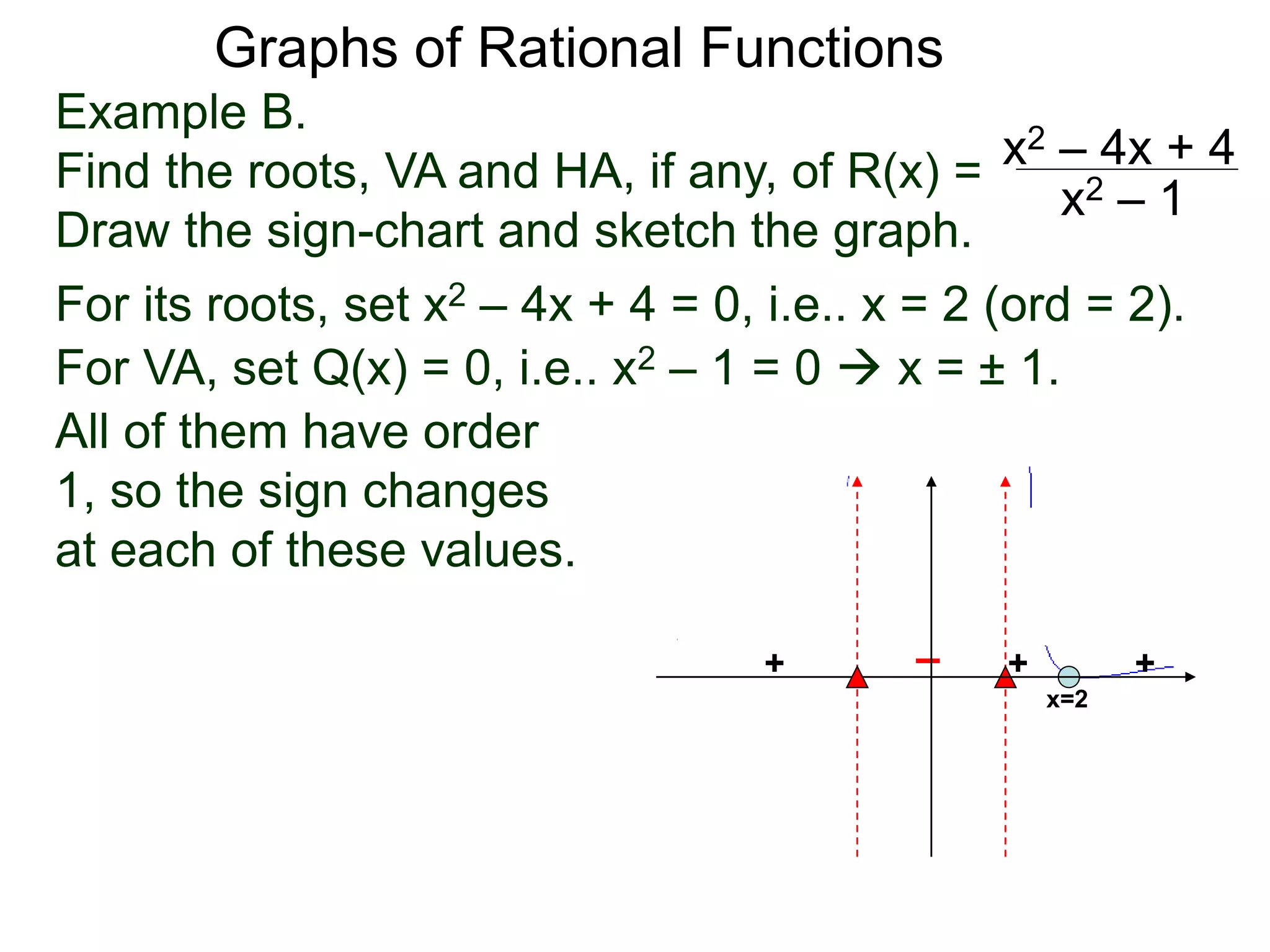
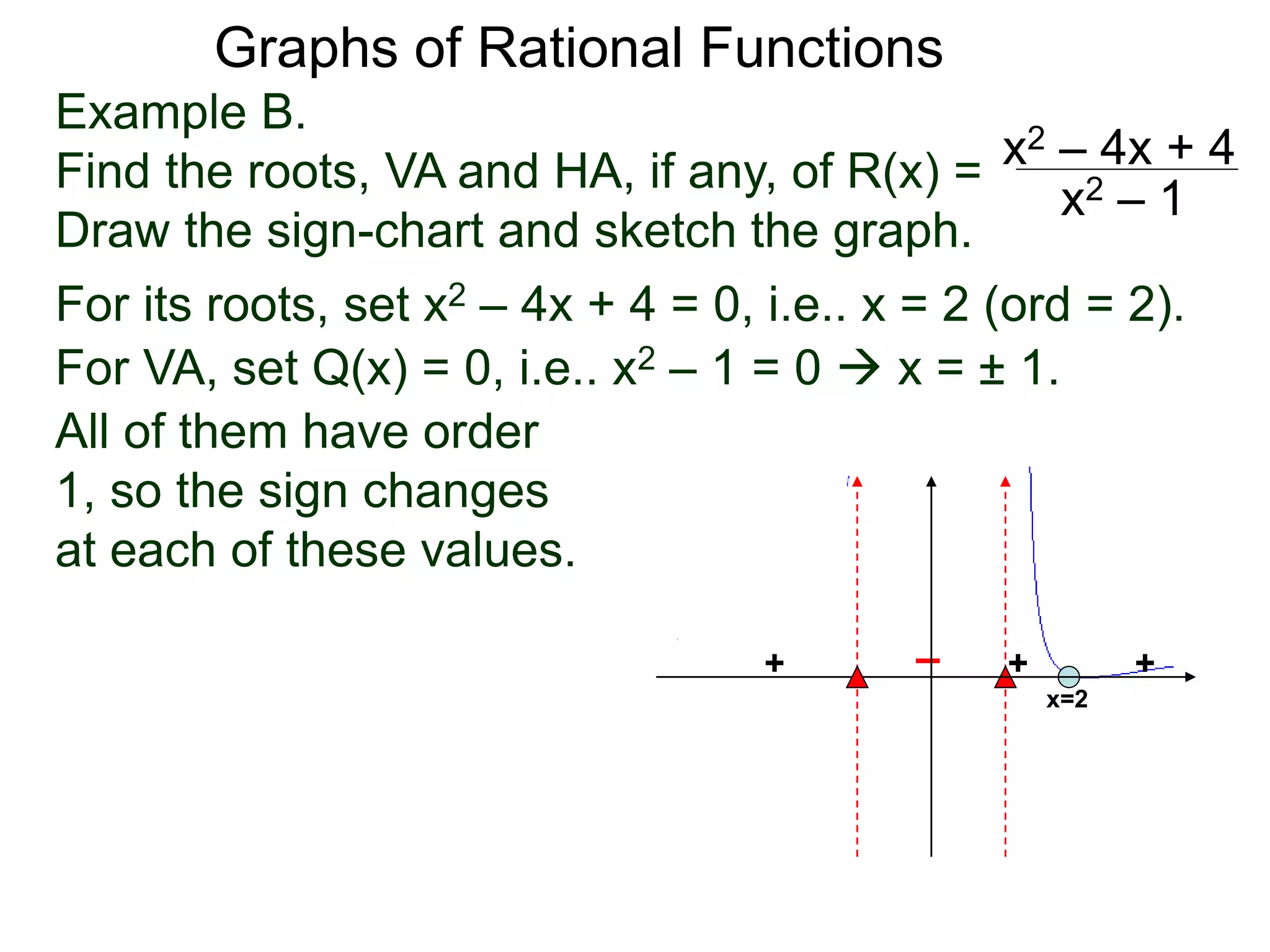
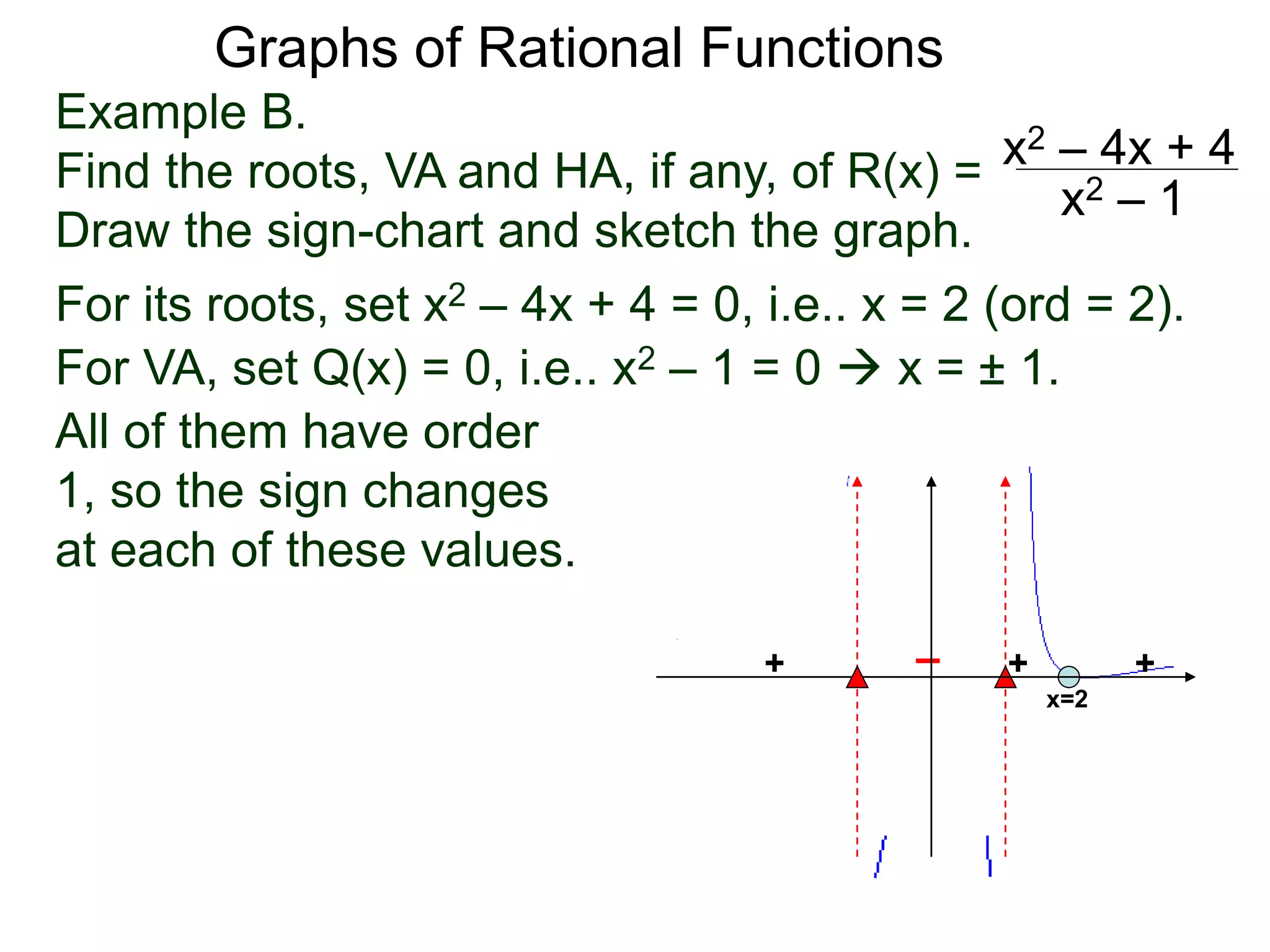
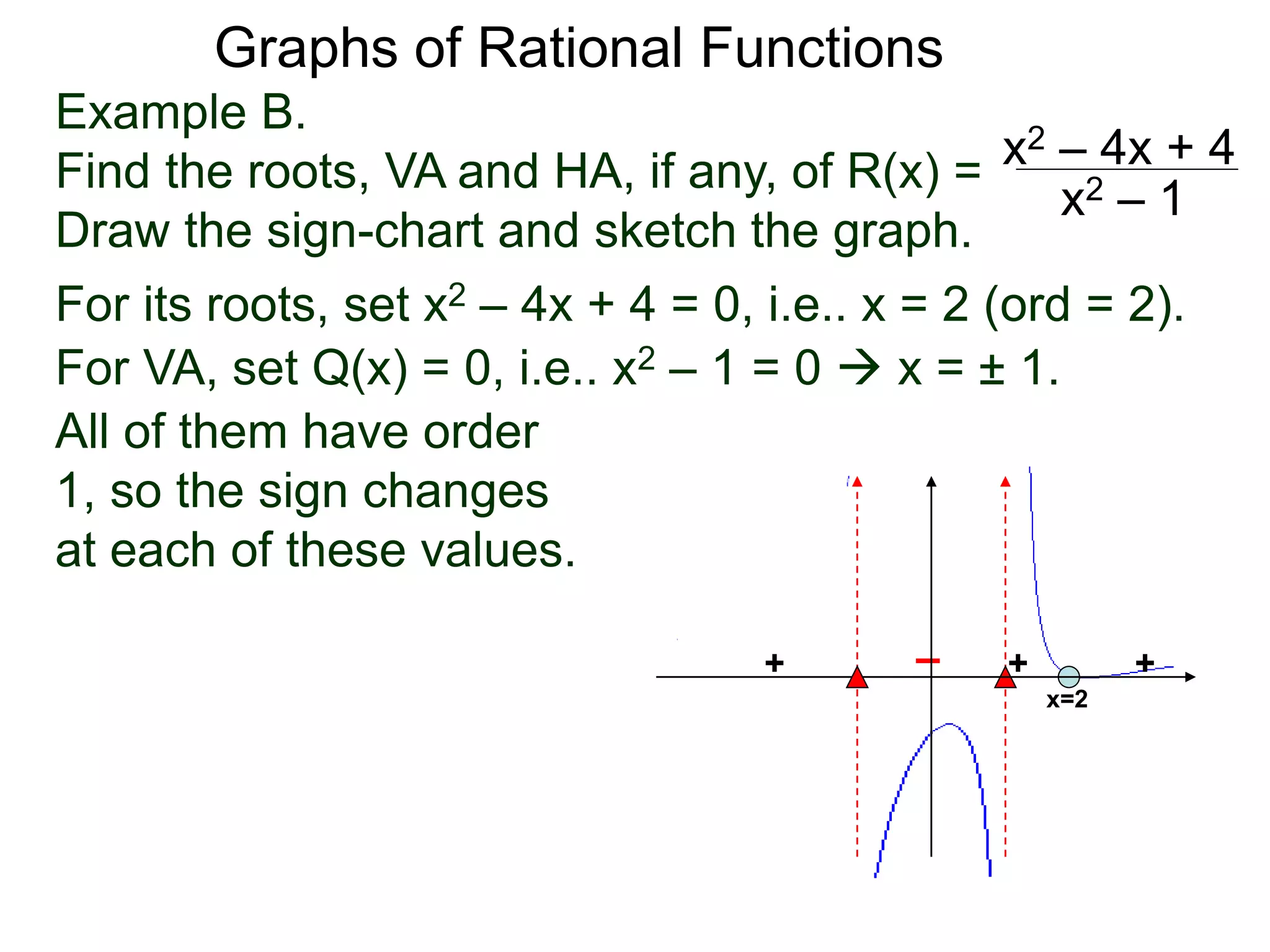
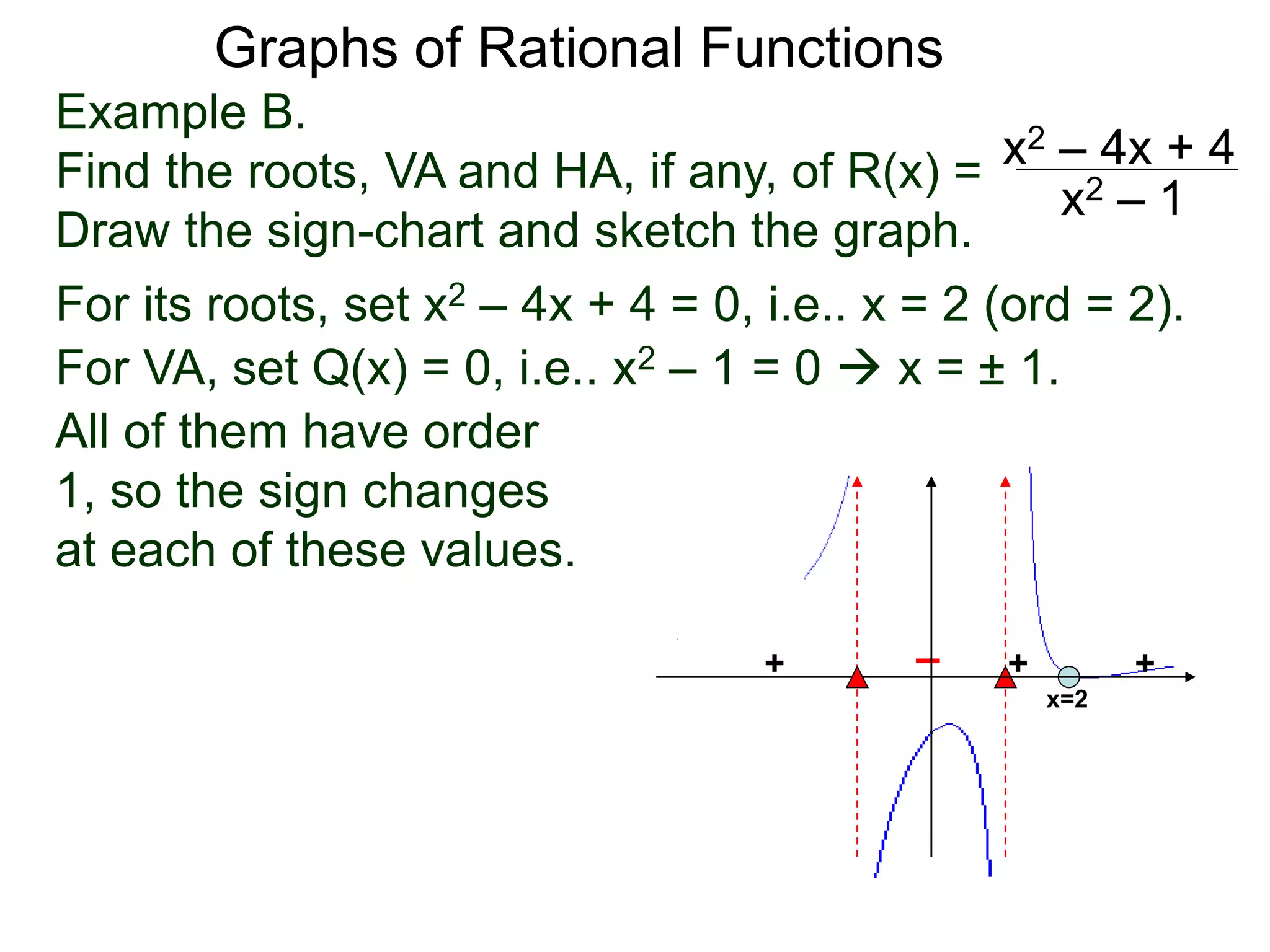
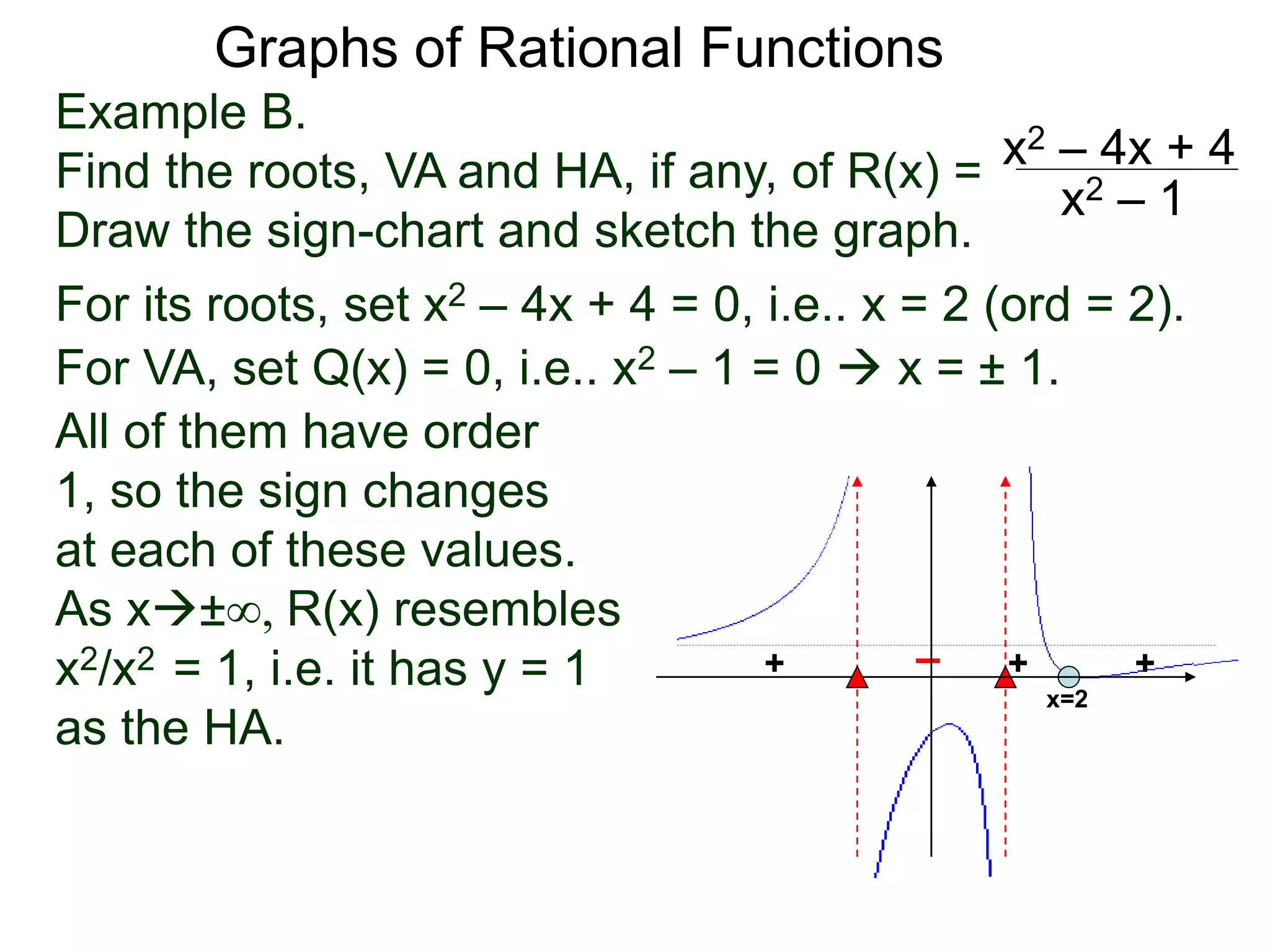
For its roots, set x2 – 4x + 4 = 0, i.e.. x = 2 (ord = 2).
Graphs of Rational Functions
Example B.
Find the roots, VA and HA, if any, of R(x) =
Draw the sign-chart and sketch the graph.
x2 – 4x + 4
x2 – 1
For its roots, set x2 – 4x + 4 = 0, i.e.. x = 2 (ord = 2).
For VA, set Q(x) = 0, i.e.. x2 – 1 = 0  x = ± 1.
Graphs of Rational Functions
Example B.
Find the roots, VA and HA, if any, of R(x) =
Draw the sign-chart and sketch the graph.
x2 – 4x + 4
x2 – 1
For its roots, set x2 – 4x + 4 = 0, i.e.. x = 2 (ord = 2).
For VA, set Q(x) = 0, i.e.. x2 – 1 = 0  x = ± 1.
x=2
Graphs of Rational Functions
Example B.
Find the roots, VA and HA, if any, of R(x) =
Draw the sign-chart and sketch the graph.
x2 – 4x + 4
x2 – 1
For its roots, set x2 – 4x + 4 = 0, i.e.. x = 2 (ord = 2).
For VA, set Q(x) = 0, i.e.. x2 – 1 = 0  x = ± 1.
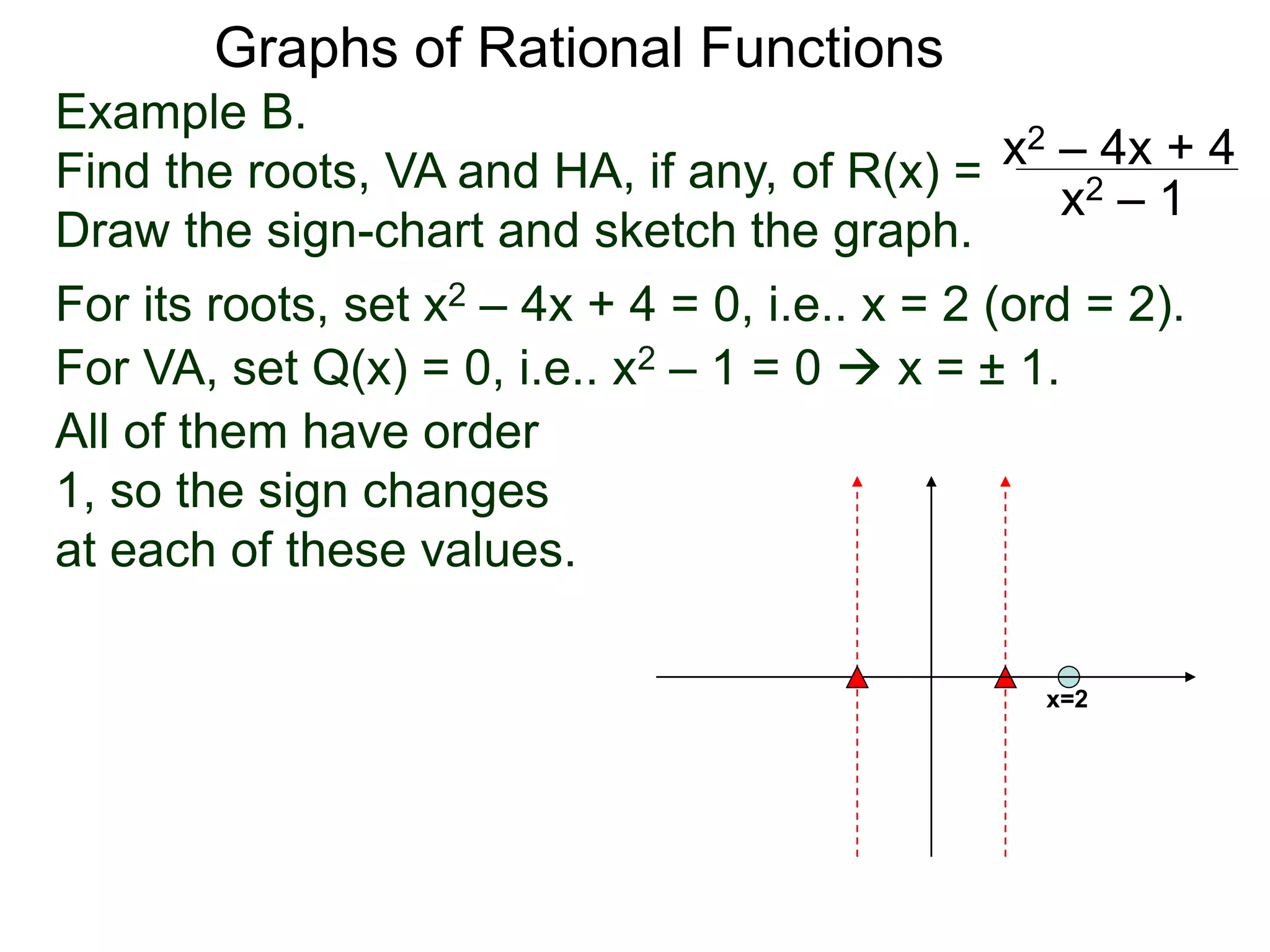
All of them have order
1, so the sign changes
at each of these values.
x=2
Graphs of Rational Functions
Example B.
Find the roots, VA and HA, if any, of R(x) =
Draw the sign-chart and sketch the graph.
x2 – 4x + 4
x2 – 1
For its roots, set x2 – 4x + 4 = 0, i.e.. x = 2 (ord = 2).
For VA, set Q(x) = 0, i.e.. x2 – 1 = 0  x = ± 1.
All of them have order
1, so the sign changes
at each of these values.
++ –
x=2
+
Graphs of Rational Functions
Example B.
Find the roots, VA and HA, if any, of R(x) =
Draw the sign-chart and sketch the graph.
x2 – 4x + 4
x2 – 1
For its roots, set x2 – 4x + 4 = 0, i.e.. x = 2 (ord = 2).
For VA, set Q(x) = 0, i.e.. x2 – 1 = 0  x = ± 1.
All of them have order
1, so the sign changes
at each of these values.
++ –
x=2
+ +
Graphs of Rational Functions
Example B.
Find the roots, VA and HA, if any, of R(x) =
Draw the sign-chart and sketch the graph.
x2 – 4x + 4
x2 – 1
For its roots, set x2 – 4x + 4 = 0, i.e.. x = 2 (ord = 2).
For VA, set Q(x) = 0, i.e.. x2 – 1 = 0  x = ± 1.
All of them have order
1, so the sign changes
at each of these values.
++ –
x=2
+ +
Graphs of Rational Functions
Example B.
Find the roots, VA and HA, if any, of R(x) =
Draw the sign-chart and sketch the graph.
x2 – 4x + 4
x2 – 1
For its roots, set x2 – 4x + 4 = 0, i.e.. x = 2 (ord = 2).
For VA, set Q(x) = 0, i.e.. x2 – 1 = 0  x = ± 1.
All of them have order
1, so the sign changes
at each of these values.
++ –
x=2
+ +
Graphs of Rational Functions
Example B.
Find the roots, VA and HA, if any, of R(x) =
Draw the sign-chart and sketch the graph.
x2 – 4x + 4
x2 – 1
For its roots, set x2 – 4x + 4 = 0, i.e.. x = 2 (ord = 2).
For VA, set Q(x) = 0, i.e.. x2 – 1 = 0  x = ± 1.
All of them have order
1, so the sign changes
at each of these values.
++ –
x=2
+ +
Graphs of Rational Functions
Example B.
Find the roots, VA and HA, if any, of R(x) =
Draw the sign-chart and sketch the graph.
x2 – 4x + 4
x2 – 1
For its roots, set x2 – 4x + 4 = 0, i.e.. x = 2 (ord = 2).
For VA, set Q(x) = 0, i.e.. x2 – 1 = 0  x = ± 1.
All of them have order
1, so the sign changes
at each of these values.
++ –
x=2
+ +
Graphs of Rational Functions
Example B.
Find the roots, VA and HA, if any, of R(x) =
Draw the sign-chart and sketch the graph.
x2 – 4x + 4
x2 – 1
For its roots, set x2 – 4x + 4 = 0, i.e.. x = 2 (ord = 2).
For VA, set Q(x) = 0, i.e.. x2 – 1 = 0  x = ± 1.
All of them have order
1, so the sign changes
at each of these values.
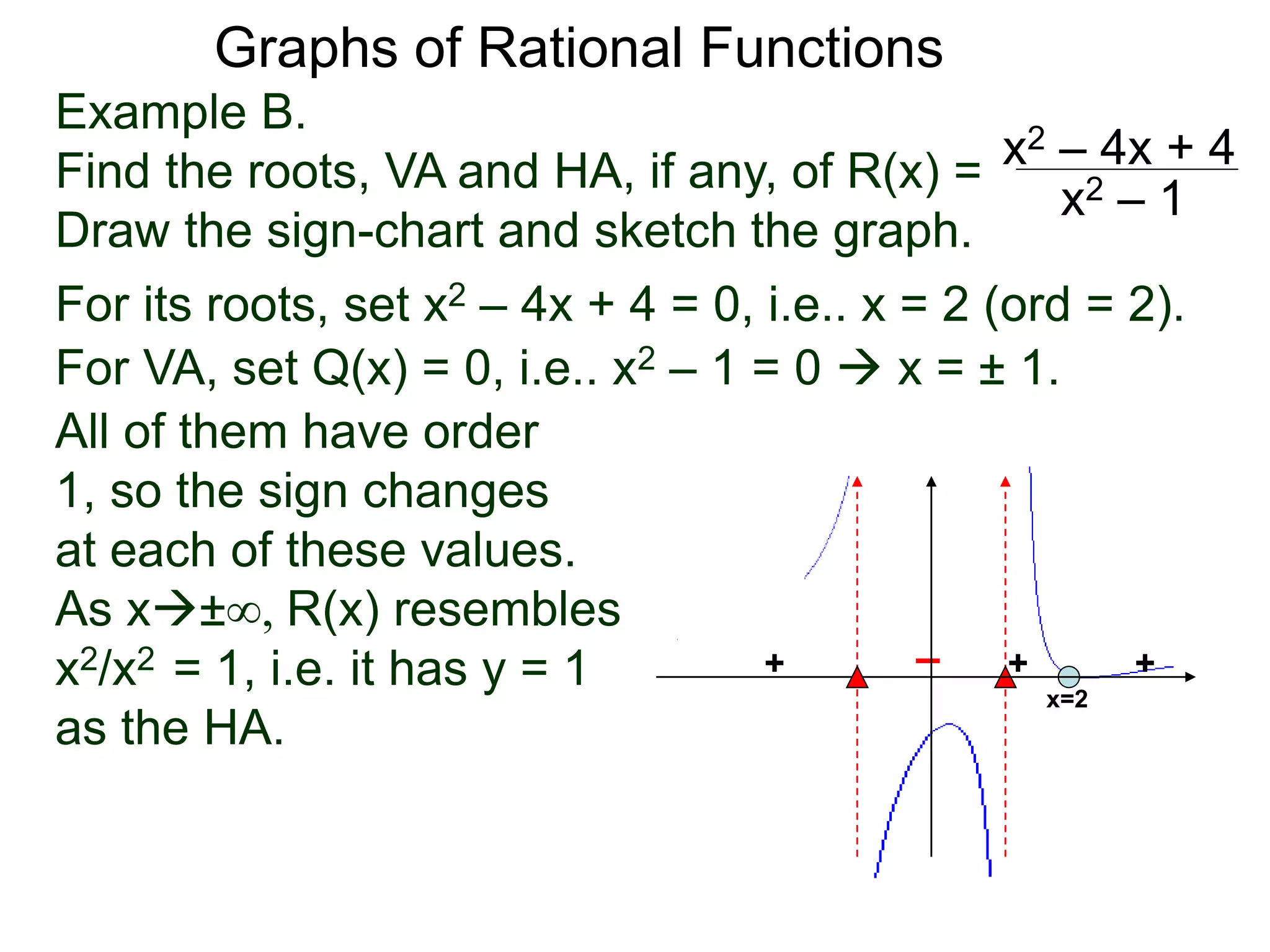
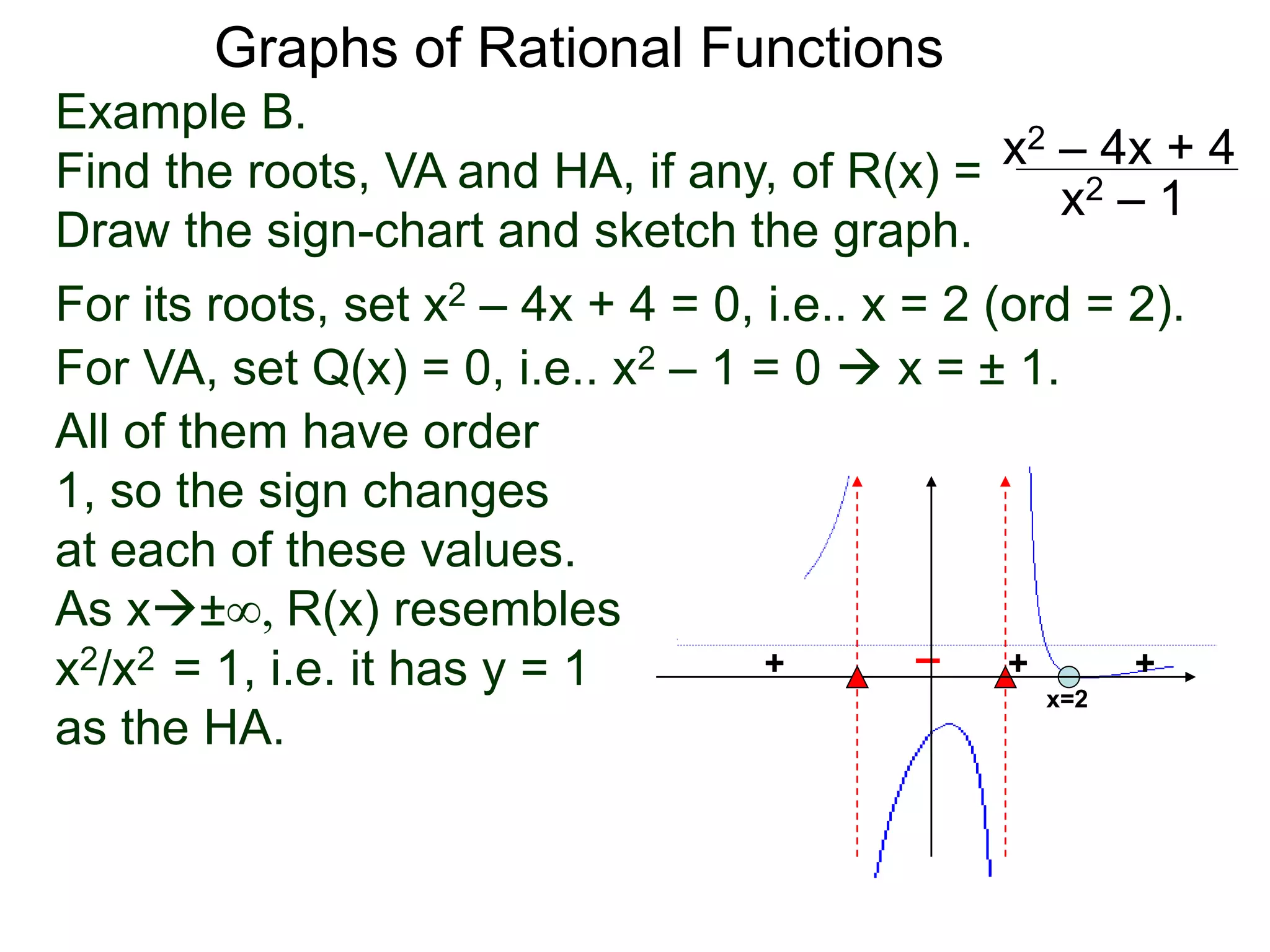
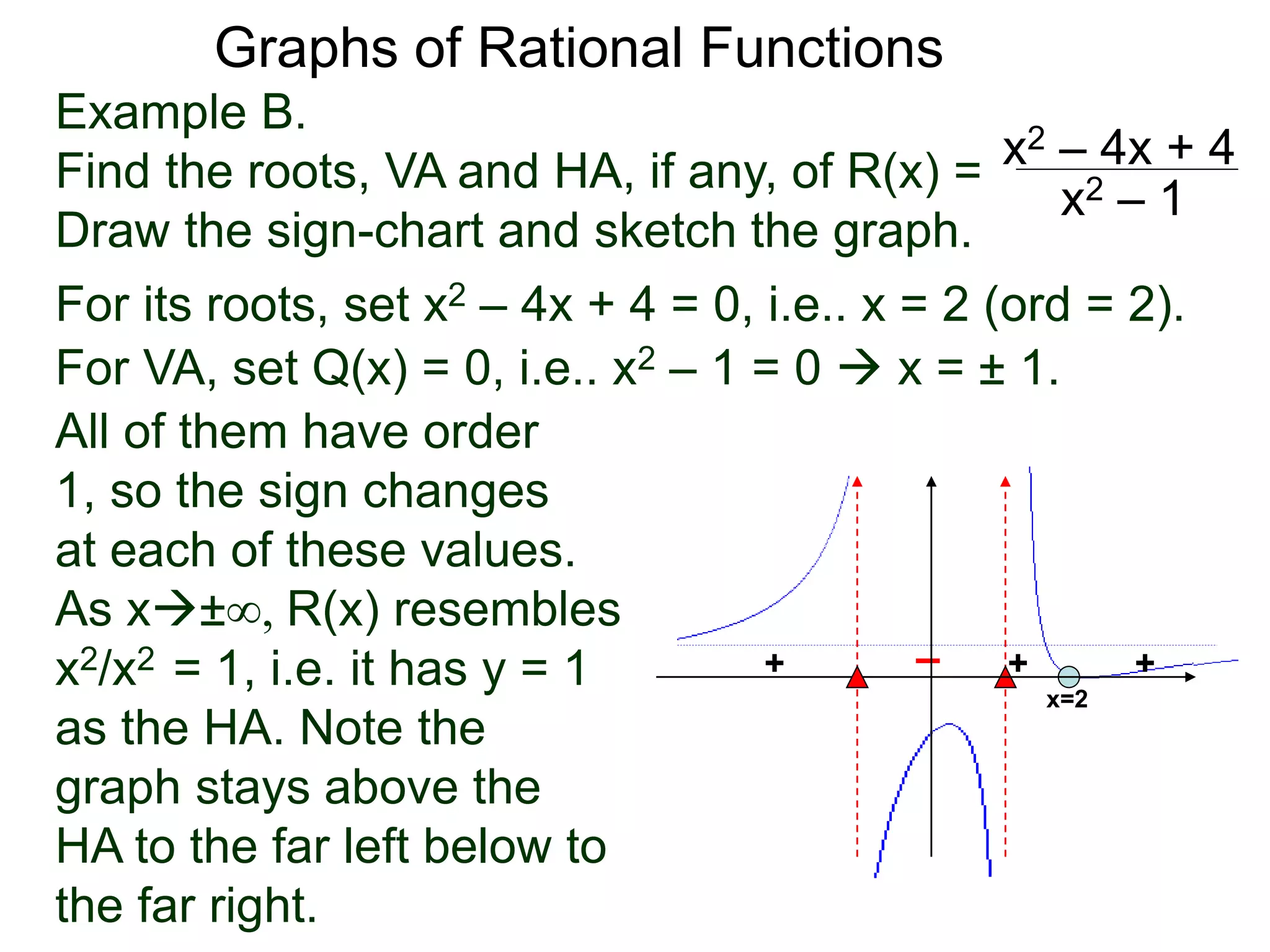
As x±∞, R(x) resembles
x2/x2 = 1, i.e. it has y = 1
as the HA.
++ –
x=2
+ +
Graphs of Rational Functions
Example B.
Find the roots, VA and HA, if any, of R(x) =
Draw the sign-chart and sketch the graph.
x2 – 4x + 4
x2 – 1
For its roots, set x2 – 4x + 4 = 0, i.e.. x = 2 (ord = 2).
For VA, set Q(x) = 0, i.e.. x2 – 1 = 0  x = ± 1.
All of them have order
1, so the sign changes
at each of these values.
As x±∞, R(x) resembles
x2/x2 = 1, i.e. it has y = 1
as the HA.
++ –
x=2
+ +
Graphs of Rational Functions
Example B.
Find the roots, VA and HA, if any, of R(x) =
Draw the sign-chart and sketch the graph.
x2 – 4x + 4
x2 – 1
For its roots, set x2 – 4x + 4 = 0, i.e.. x = 2 (ord = 2).
For VA, set Q(x) = 0, i.e.. x2 – 1 = 0  x = ± 1.
All of them have order
1, so the sign changes
at each of these values.
As x±∞, R(x) resembles
x2/x2 = 1, i.e. it has y = 1
as the HA.
++ –
x=2
++
Graphs of Rational Functions
Example B.
Find the roots, VA and HA, if any, of R(x) =
Draw the sign-chart and sketch the graph.
x2 – 4x + 4
x2 – 1
For its roots, set x2 – 4x + 4 = 0, i.e.. x = 2 (ord = 2).
For VA, set Q(x) = 0, i.e.. x2 – 1 = 0  x = ± 1.
All of them have order
1, so the sign changes
at each of these values.
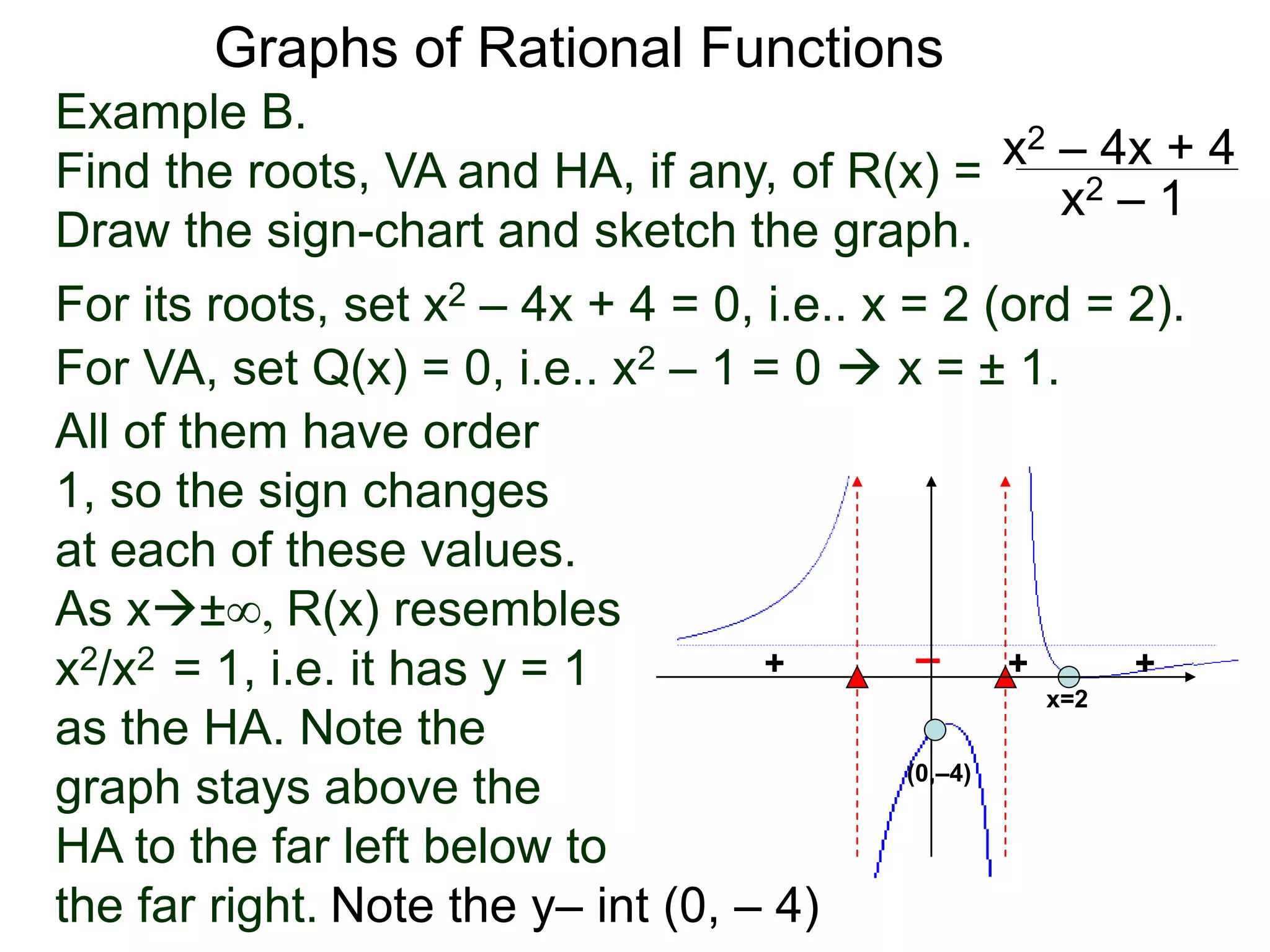
As x±∞, R(x) resembles
x2/x2 = 1, i.e. it has y = 1
as the HA. Note the
graph stays above the
HA to the far left below to
the far right.
++ –
x=2
++
Graphs of Rational Functions
Example B.
Find the roots, VA and HA, if any, of R(x) =
Draw the sign-chart and sketch the graph.
x2 – 4x + 4
x2 – 1
For its roots, set x2 – 4x + 4 = 0, i.e.. x = 2 (ord = 2).
For VA, set Q(x) = 0, i.e.. x2 – 1 = 0  x = ± 1.
All of them have order
1, so the sign changes
at each of these values.
++ –
x=2
++
Note the y– int (0, – 4)
(0,–4)
As x±∞, R(x) resembles
x2/x2 = 1, i.e. it has y = 1
as the HA. Note the
graph stays above the
HA to the far left below to
the far right.
Graphs of Rational Functions
Example C.
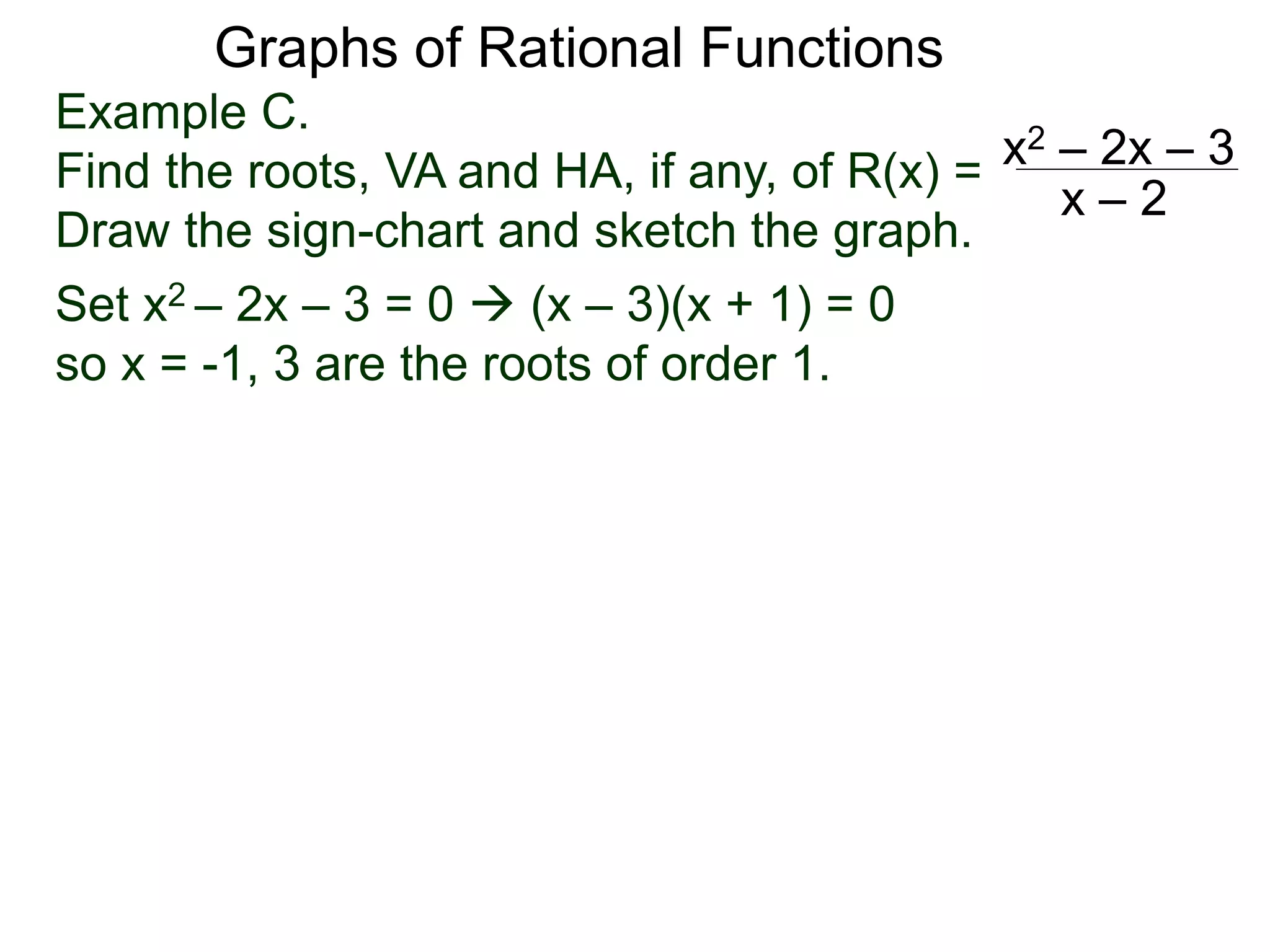
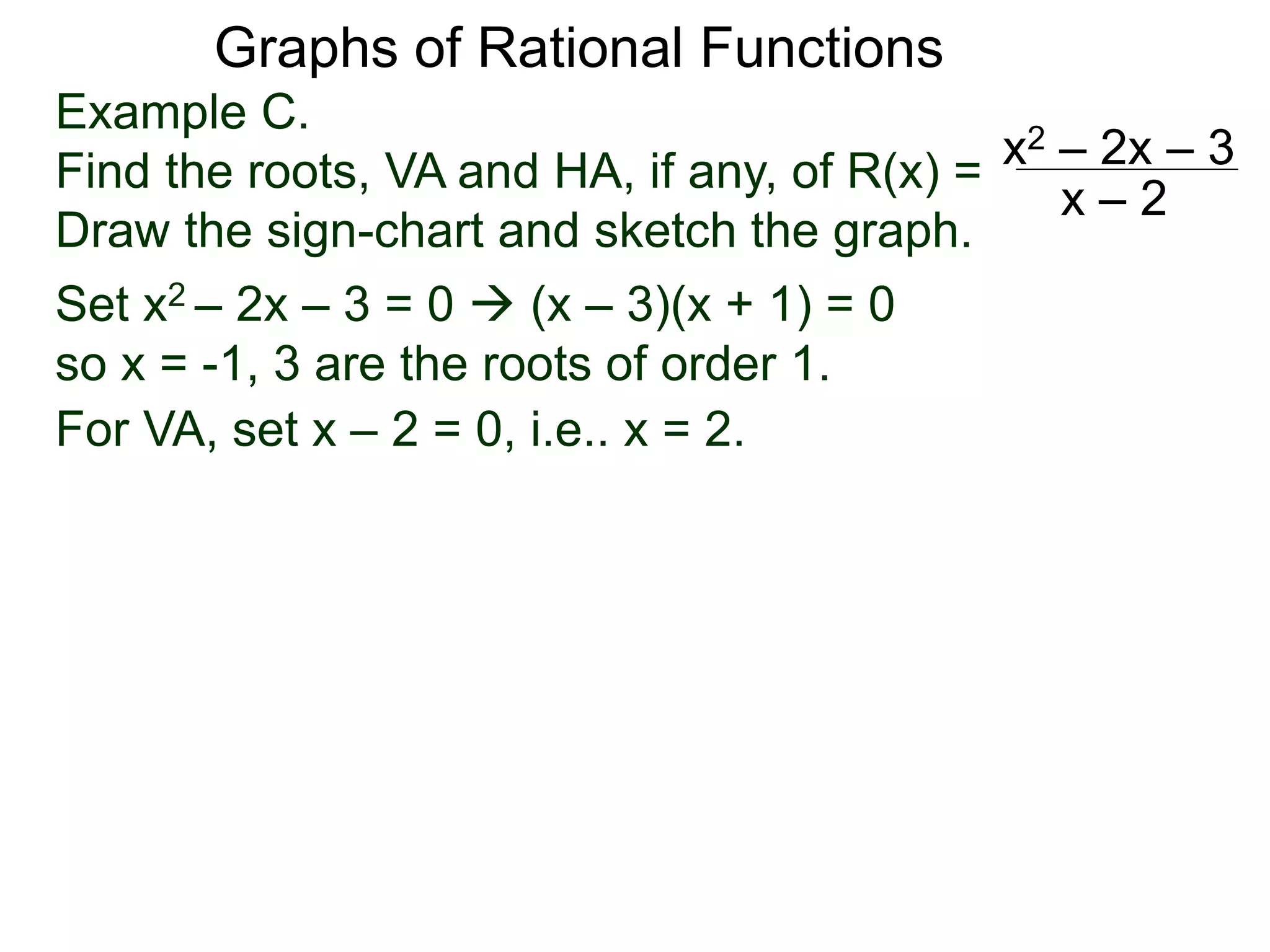
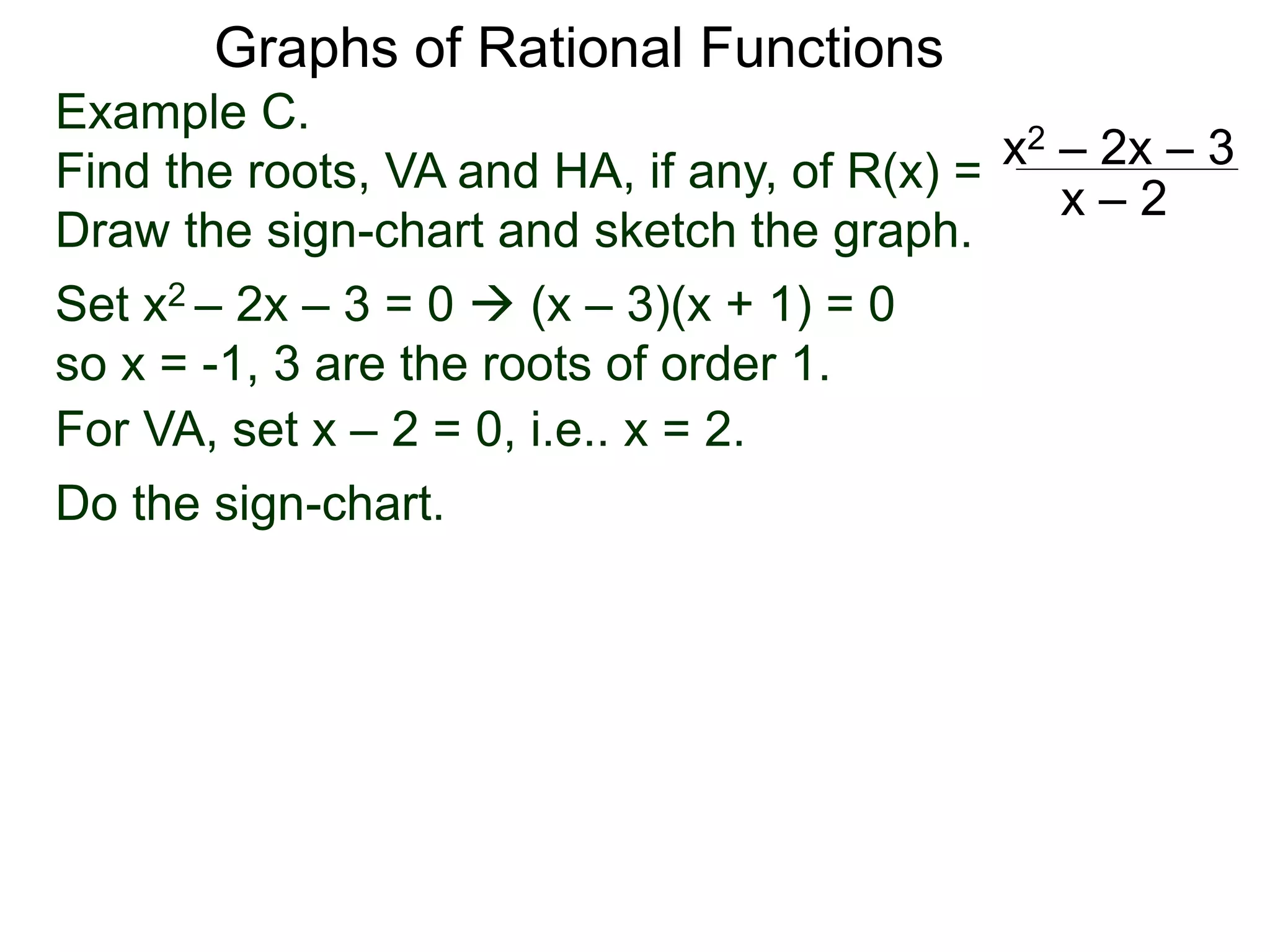
Find the roots, VA and HA, if any, of R(x) =
Draw the sign-chart and sketch the graph.
x2 – 2x – 3
x – 2
Graphs of Rational Functions
Example C.
Find the roots, VA and HA, if any, of R(x) =
Draw the sign-chart and sketch the graph.
x2 – 2x – 3
x – 2
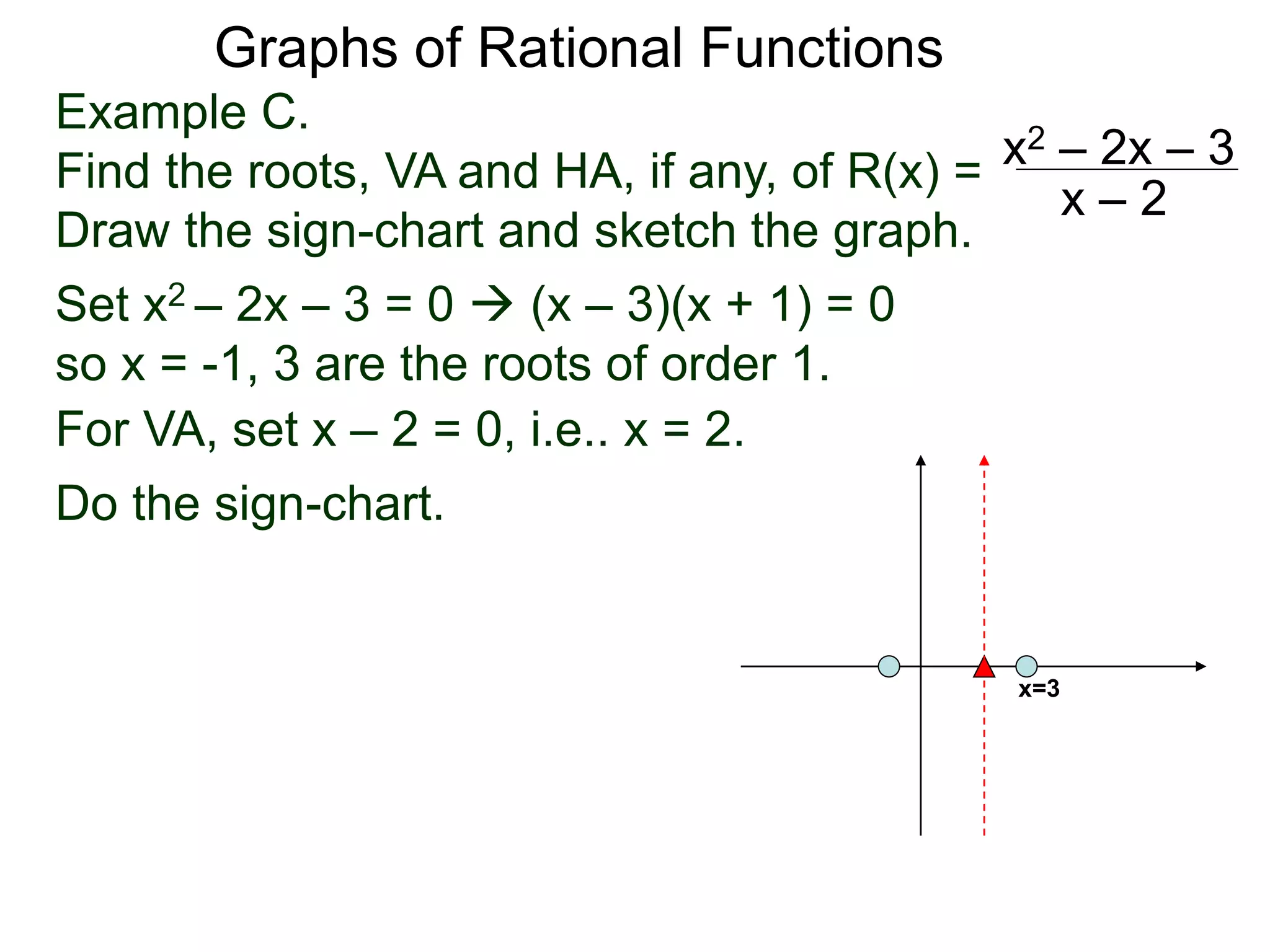
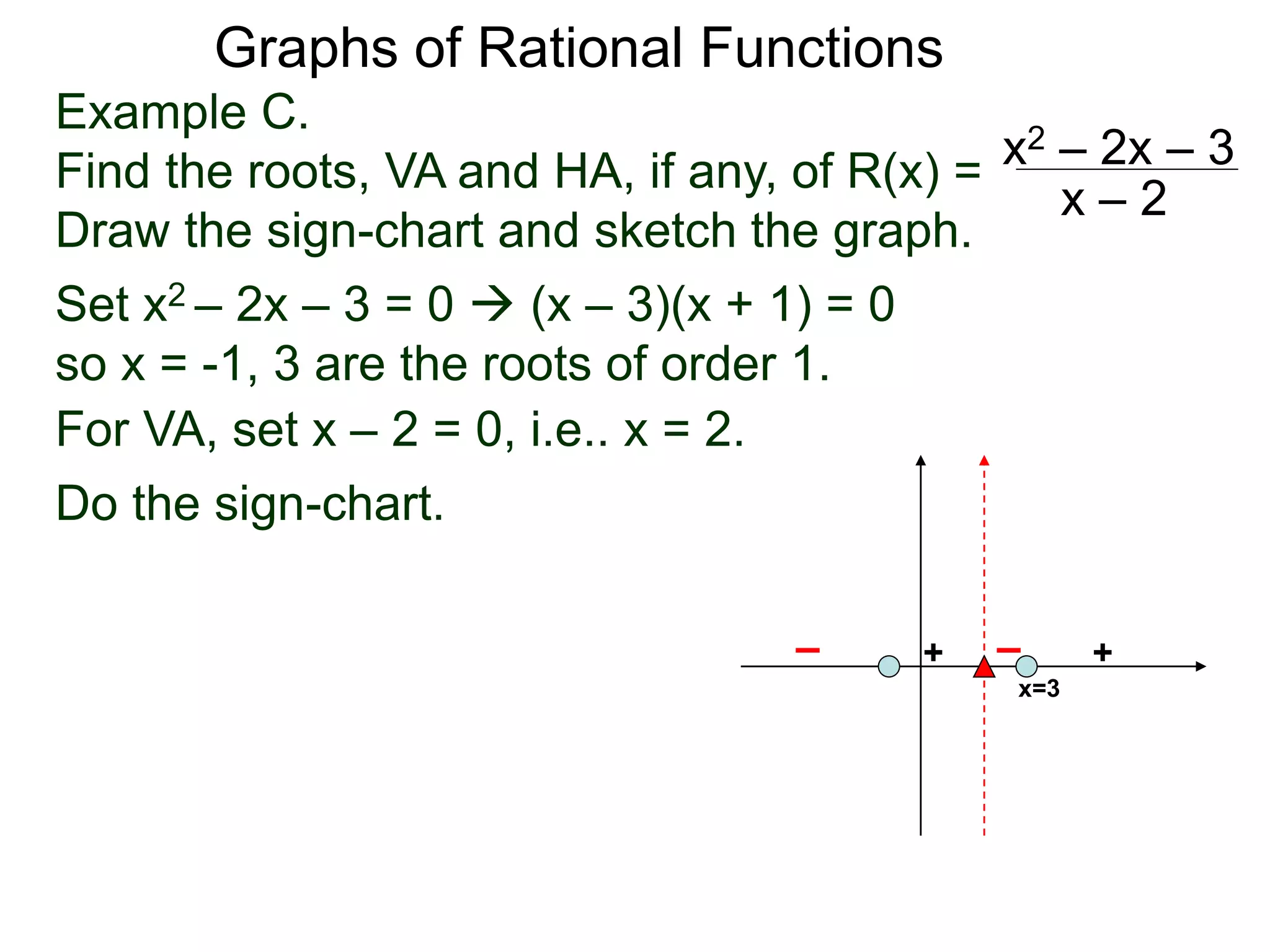
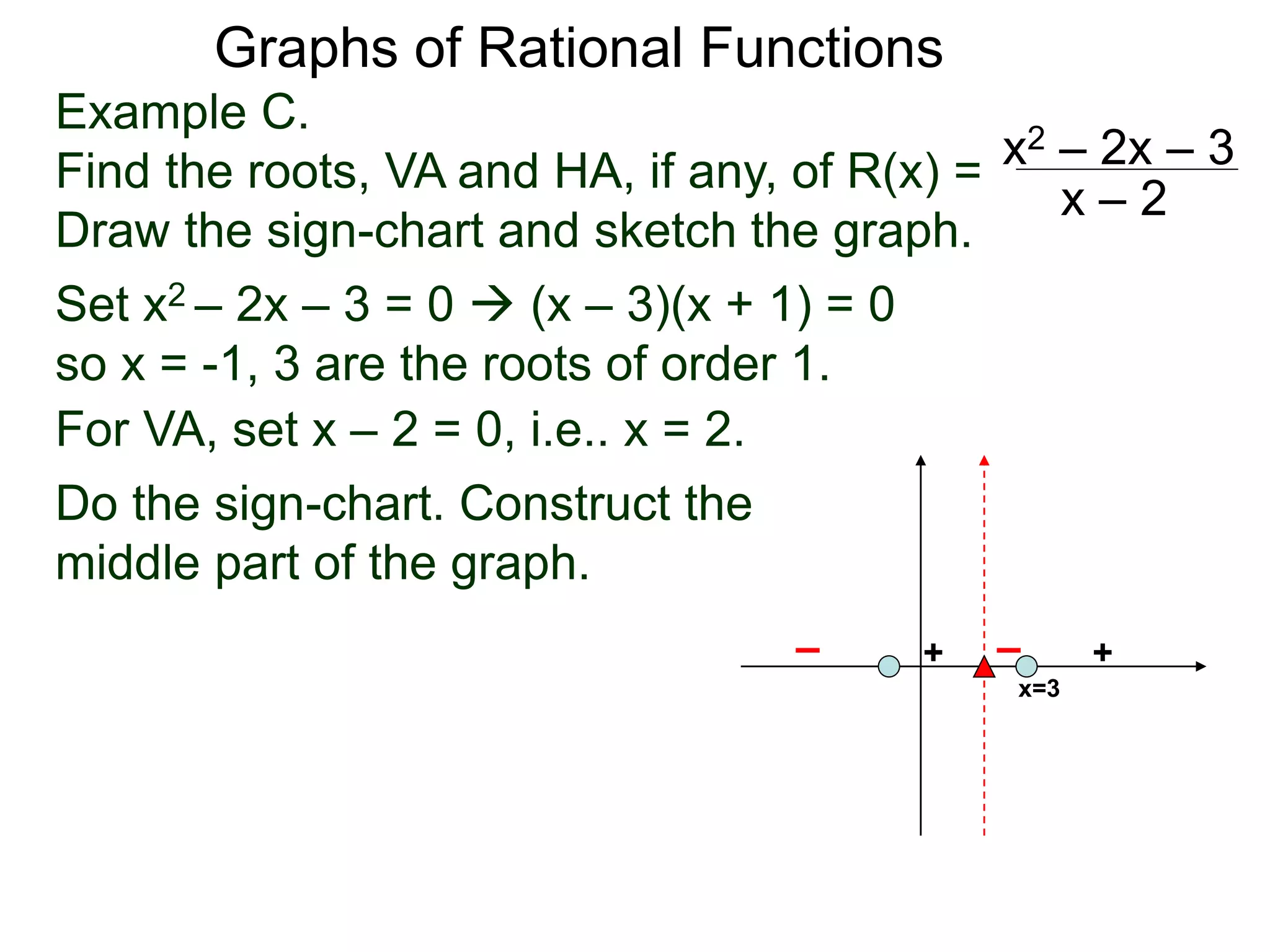
Set x2 – 2x – 3 = 0  (x – 3)(x + 1) = 0
so x = -1, 3 are the roots of order 1.
Graphs of Rational Functions
Example C.
Find the roots, VA and HA, if any, of R(x) =
Draw the sign-chart and sketch the graph.
x2 – 2x – 3
x – 2
Set x2 – 2x – 3 = 0  (x – 3)(x + 1) = 0
so x = -1, 3 are the roots of order 1.
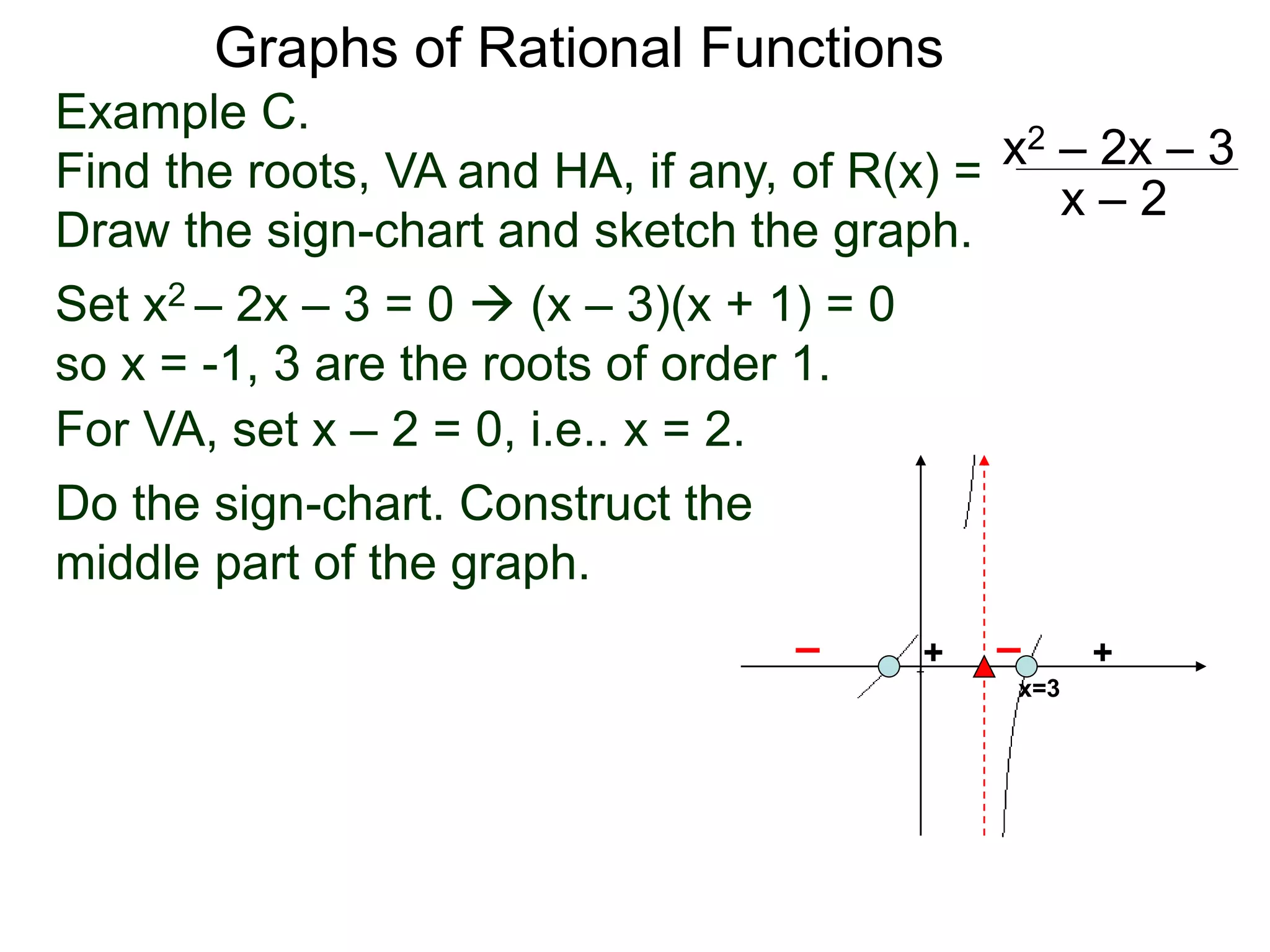
For VA, set x – 2 = 0, i.e.. x = 2.
Graphs of Rational Functions
Example C.
Find the roots, VA and HA, if any, of R(x) =
Draw the sign-chart and sketch the graph.
x2 – 2x – 3
x – 2
Set x2 – 2x – 3 = 0  (x – 3)(x + 1) = 0
so x = -1, 3 are the roots of order 1.
For VA, set x – 2 = 0, i.e.. x = 2.
Do the sign-chart.
Graphs of Rational Functions
Example C.
Find the roots, VA and HA, if any, of R(x) =
Draw the sign-chart and sketch the graph.
x2 – 2x – 3
x – 2
Set x2 – 2x – 3 = 0  (x – 3)(x + 1) = 0
so x = -1, 3 are the roots of order 1.
For VA, set x – 2 = 0, i.e.. x = 2.
x=3
Do the sign-chart.
Graphs of Rational Functions
Example C.
Find the roots, VA and HA, if any, of R(x) =
Draw the sign-chart and sketch the graph.
x2 – 2x – 3
x – 2
Set x2 – 2x – 3 = 0  (x – 3)(x + 1) = 0
so x = -1, 3 are the roots of order 1.
For VA, set x – 2 = 0, i.e.. x = 2.
x=3
Do the sign-chart.
+–+–
Graphs of Rational Functions
Example C.
Find the roots, VA and HA, if any, of R(x) =
Draw the sign-chart and sketch the graph.
x2 – 2x – 3
x – 2
Set x2 – 2x – 3 = 0  (x – 3)(x + 1) = 0
so x = -1, 3 are the roots of order 1.
For VA, set x – 2 = 0, i.e.. x = 2.
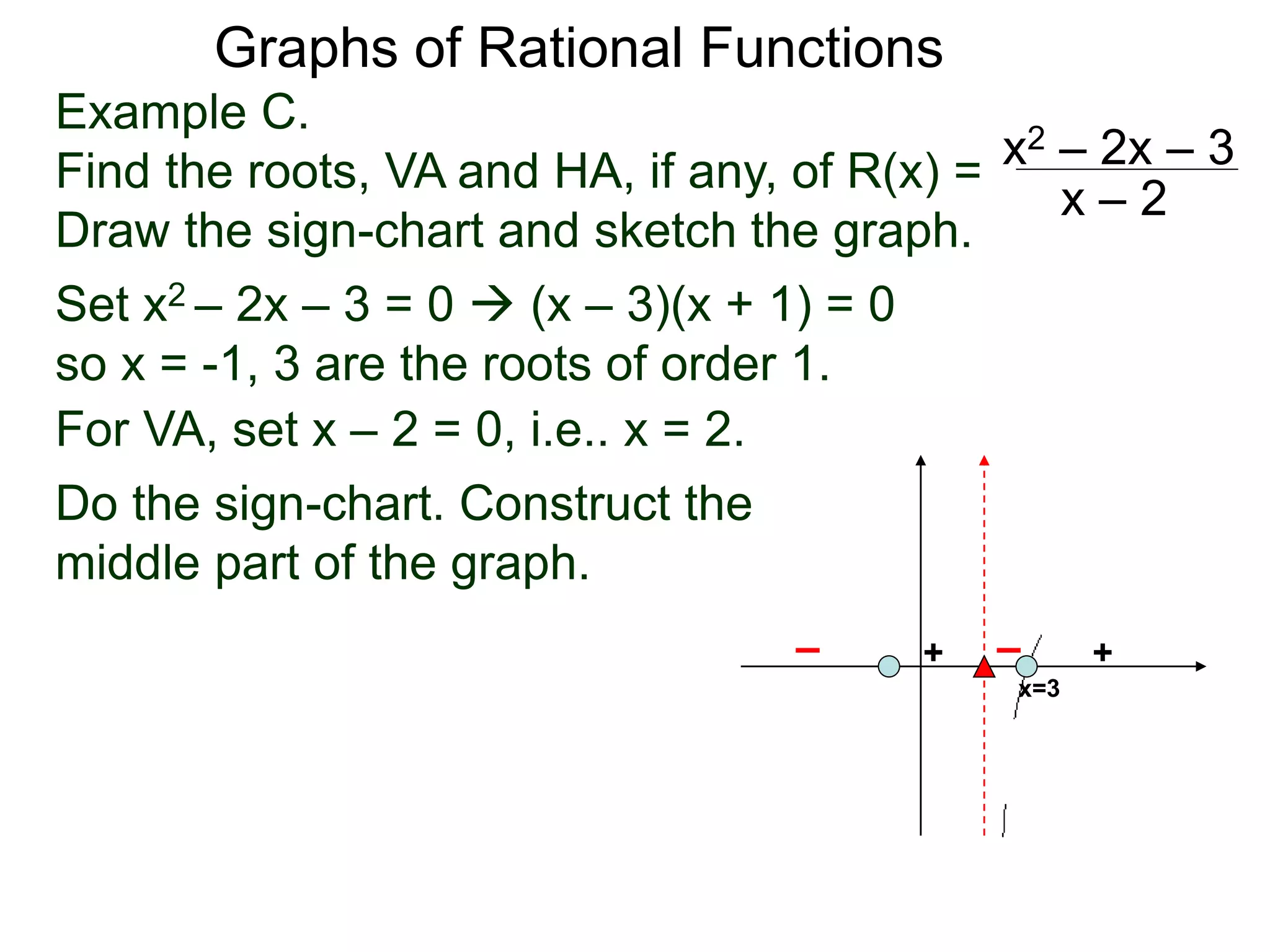
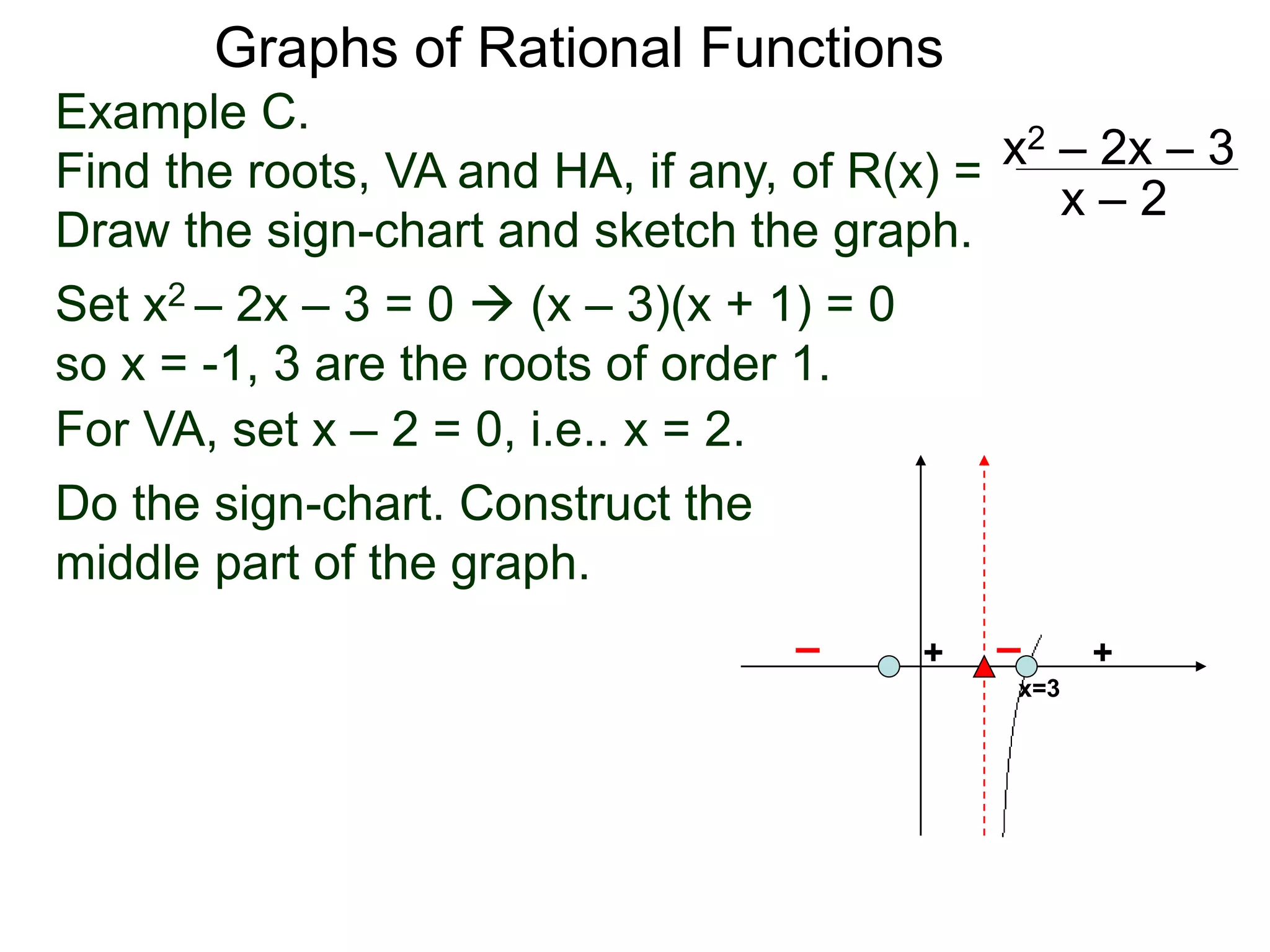
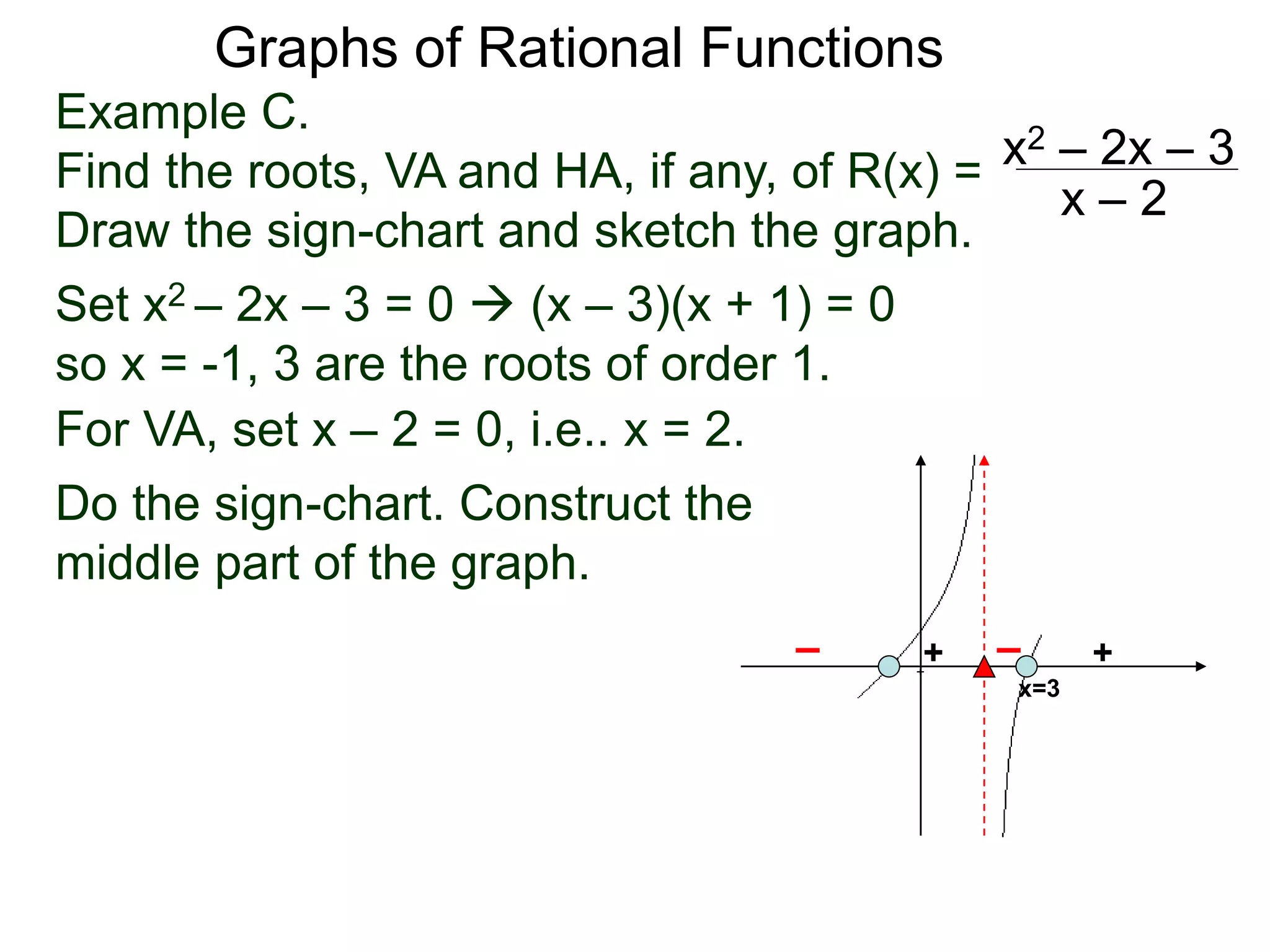
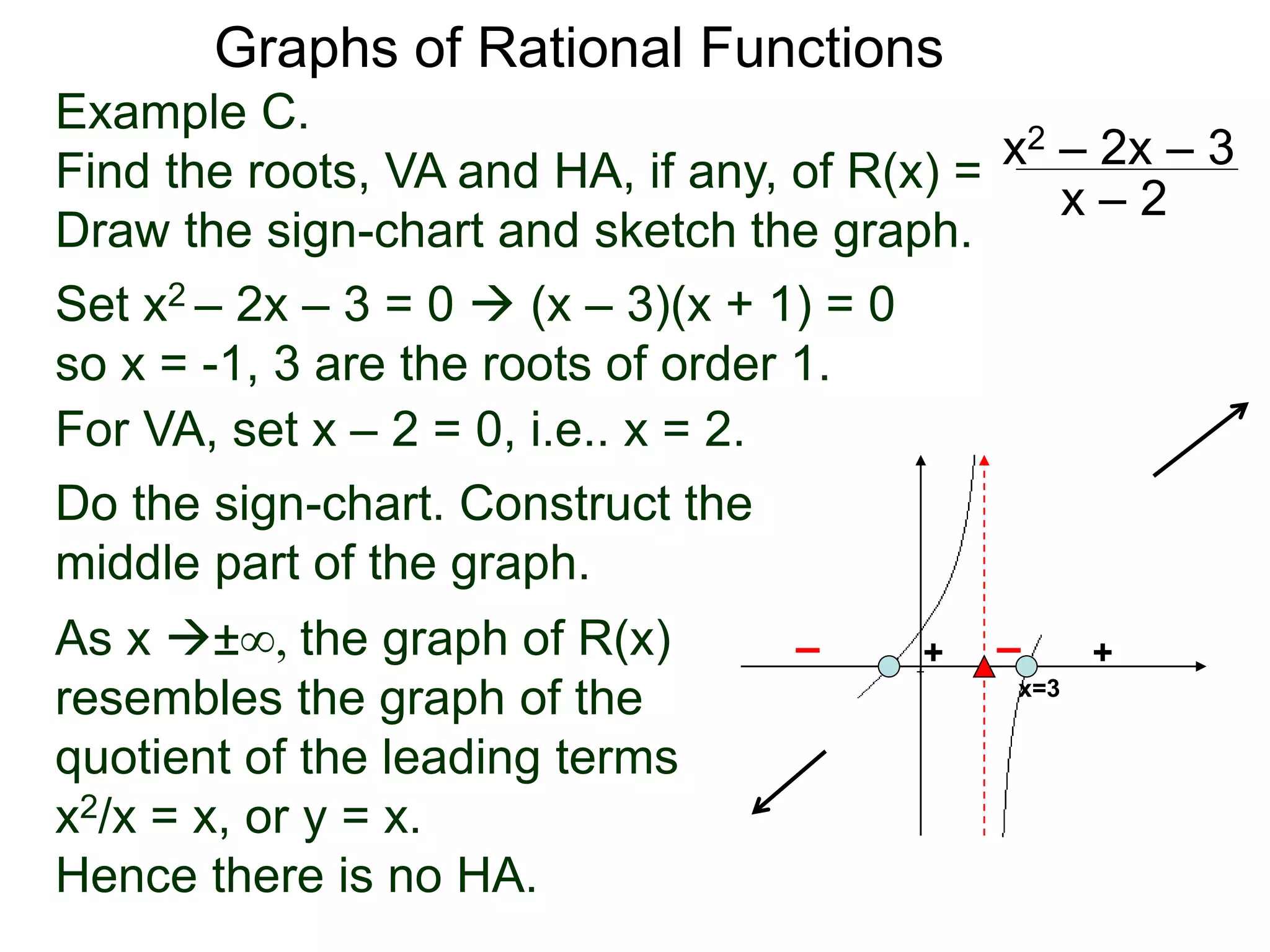
Do the sign-chart. Construct the
middle part of the graph.
x=3
+–+–
Graphs of Rational Functions
Example C.
Find the roots, VA and HA, if any, of R(x) =
Draw the sign-chart and sketch the graph.
x2 – 2x – 3
x – 2
Set x2 – 2x – 3 = 0  (x – 3)(x + 1) = 0
so x = -1, 3 are the roots of order 1.
For VA, set x – 2 = 0, i.e.. x = 2.
Do the sign-chart. Construct the
middle part of the graph.
x=3
+–+–
Graphs of Rational Functions
Example C.
Find the roots, VA and HA, if any, of R(x) =
Draw the sign-chart and sketch the graph.
x2 – 2x – 3
x – 2
Set x2 – 2x – 3 = 0  (x – 3)(x + 1) = 0
so x = -1, 3 are the roots of order 1.
For VA, set x – 2 = 0, i.e.. x = 2.
Do the sign-chart. Construct the
middle part of the graph.
x=3
+–+–
Graphs of Rational Functions
Example C.
Find the roots, VA and HA, if any, of R(x) =
Draw the sign-chart and sketch the graph.
x2 – 2x – 3
x – 2
Set x2 – 2x – 3 = 0  (x – 3)(x + 1) = 0
so x = -1, 3 are the roots of order 1.
For VA, set x – 2 = 0, i.e.. x = 2.
Do the sign-chart. Construct the
middle part of the graph.
x=3
+–+–
Graphs of Rational Functions
Example C.
Find the roots, VA and HA, if any, of R(x) =
Draw the sign-chart and sketch the graph.
x2 – 2x – 3
x – 2
Set x2 – 2x – 3 = 0  (x – 3)(x + 1) = 0
so x = -1, 3 are the roots of order 1.
For VA, set x – 2 = 0, i.e.. x = 2.
Do the sign-chart. Construct the
middle part of the graph.
x=3
+–+–
Graphs of Rational Functions
Example C.
Find the roots, VA and HA, if any, of R(x) =
Draw the sign-chart and sketch the graph.
x2 – 2x – 3
x – 2
Set x2 – 2x – 3 = 0  (x – 3)(x + 1) = 0
so x = -1, 3 are the roots of order 1.
For VA, set x – 2 = 0, i.e.. x = 2.
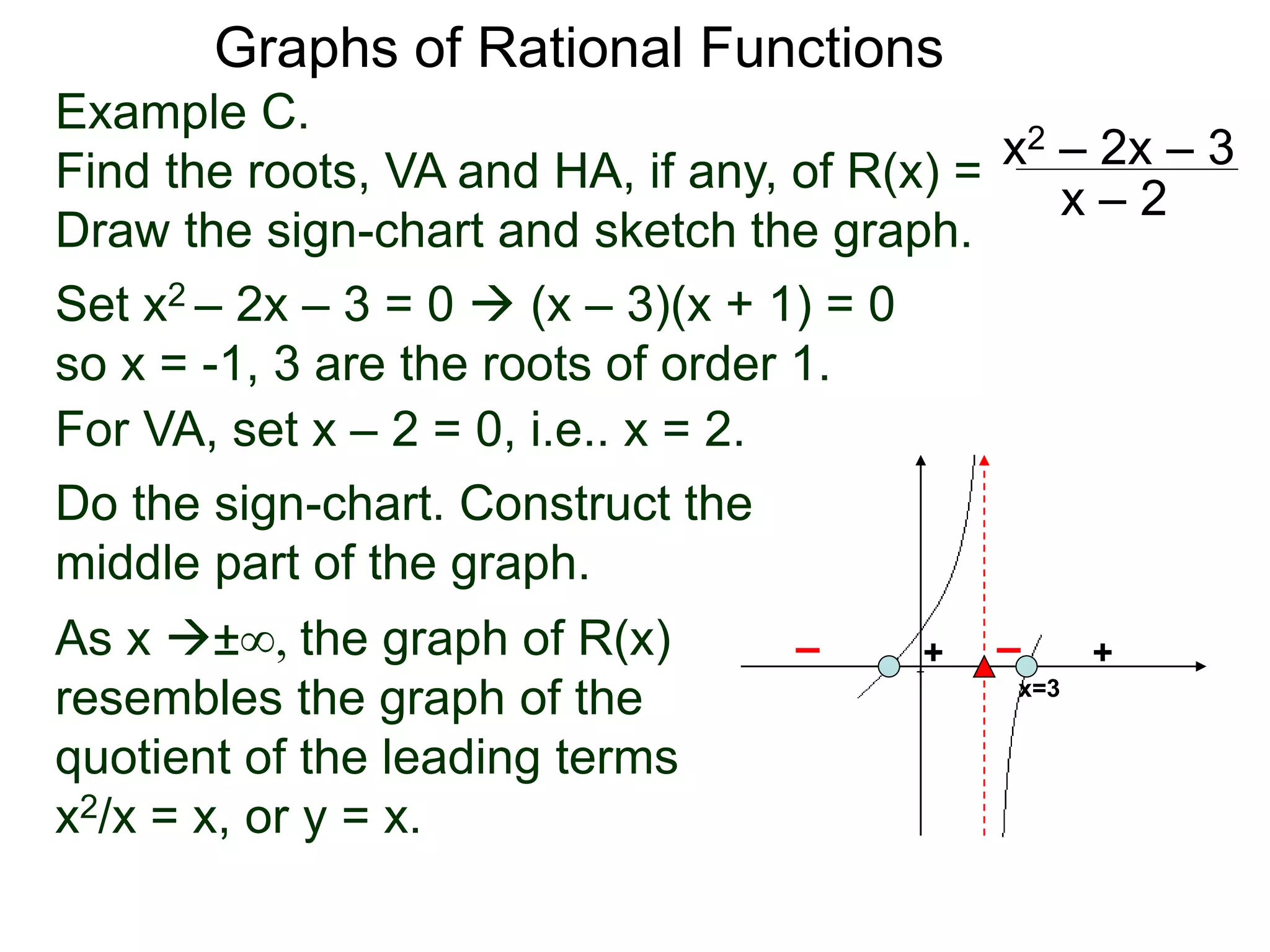
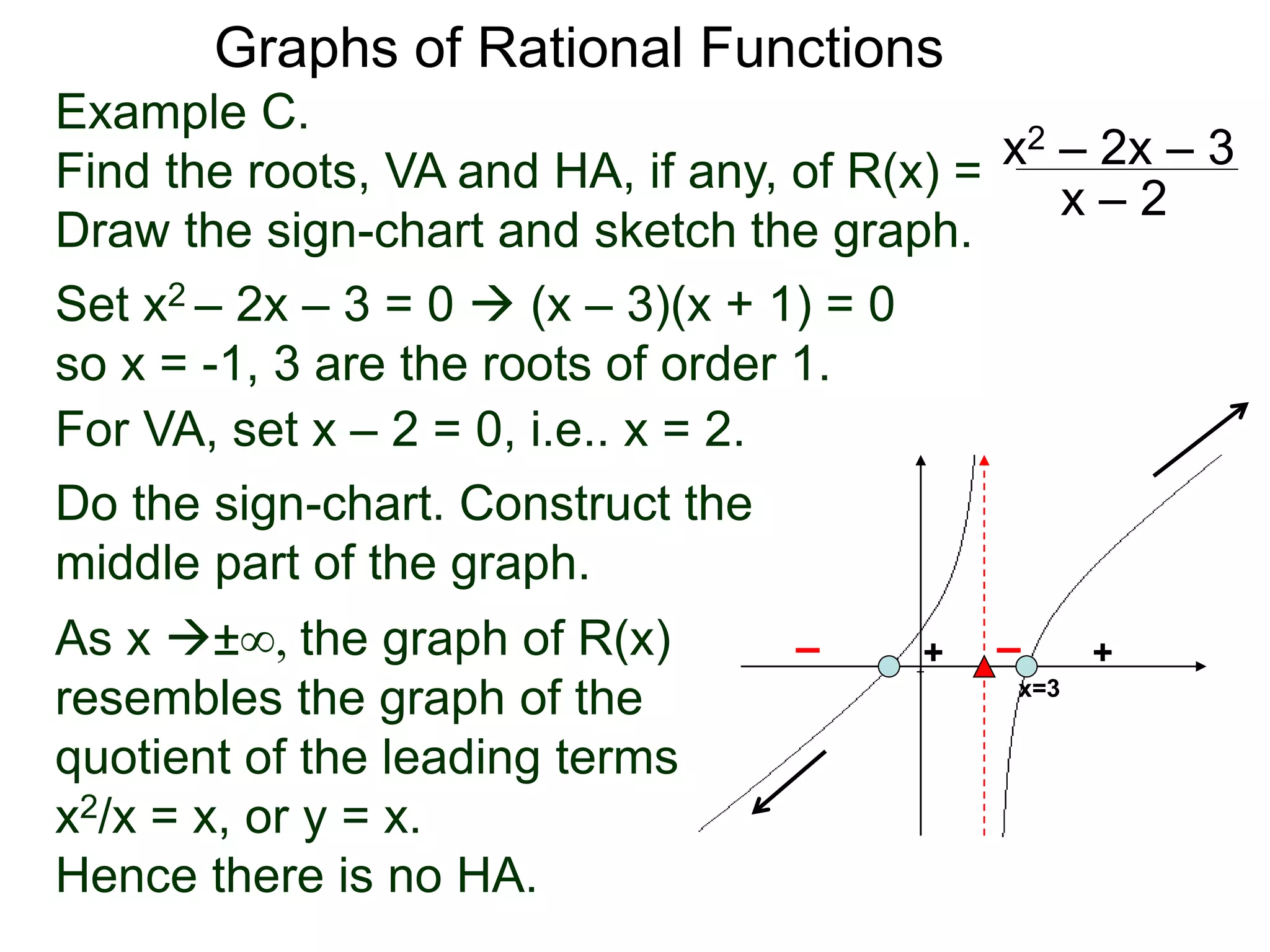
As x ±∞, the graph of R(x)
resembles the graph of the
quotient of the leading terms
x2/x = x, or y = x.
x=3
+–+–
Do the sign-chart. Construct the
middle part of the graph.
Graphs of Rational Functions
Example C.
Find the roots, VA and HA, if any, of R(x) =
Draw the sign-chart and sketch the graph.
x2 – 2x – 3
x – 2
Set x2 – 2x – 3 = 0  (x – 3)(x + 1) = 0
so x = -1, 3 are the roots of order 1.
For VA, set x – 2 = 0, i.e.. x = 2.
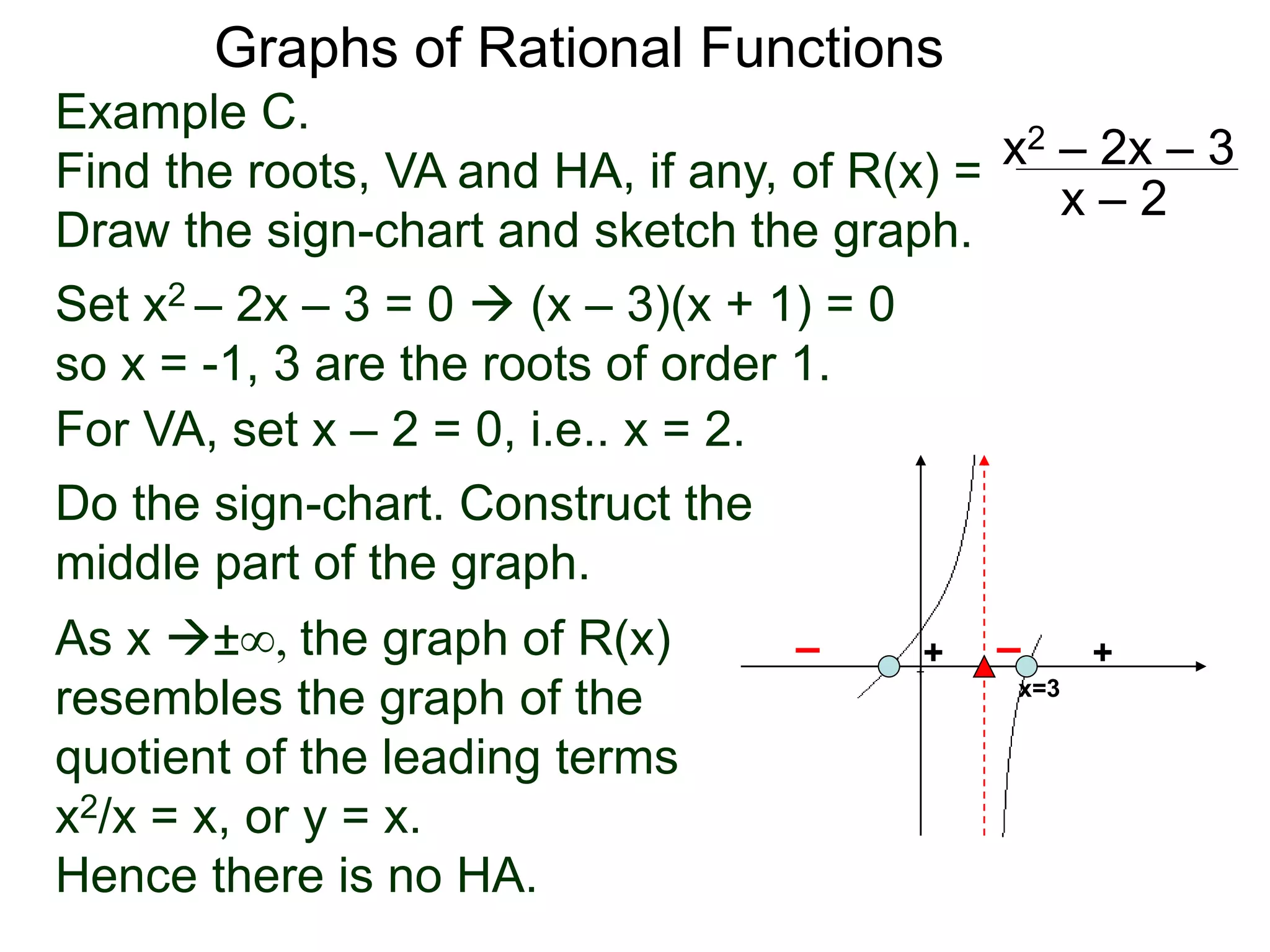
As x ±∞, the graph of R(x)
resembles the graph of the
quotient of the leading terms
x2/x = x, or y = x.
Hence there is no HA.
x=3
+–+–
Do the sign-chart. Construct the
middle part of the graph.
Graphs of Rational Functions
Example C.
Find the roots, VA and HA, if any, of R(x) =
Draw the sign-chart and sketch the graph.
x2 – 2x – 3
x – 2
Set x2 – 2x – 3 = 0  (x – 3)(x + 1) = 0
so x = -1, 3 are the roots of order 1.
For VA, set x – 2 = 0, i.e.. x = 2.
As x ±∞, the graph of R(x)
resembles the graph of the
quotient of the leading terms
x2/x = x, or y = x.
Hence there is no HA.
x=3
+–+–
Do the sign-chart. Construct the
middle part of the graph.
Graphs of Rational Functions
Example C.
Find the roots, VA and HA, if any, of R(x) =
Draw the sign-chart and sketch the graph.
x2 – 2x – 3
x – 2
Set x2 – 2x – 3 = 0  (x – 3)(x + 1) = 0
so x = -1, 3 are the roots of order 1.
For VA, set x – 2 = 0, i.e.. x = 2.
As x ±∞, the graph of R(x)
resembles the graph of the
quotient of the leading terms
x2/x = x, or y = x.
Hence there is no HA.
x=3
Do the sign-chart. Construct the
middle part of the graph.
+–+–
Graphs of Rational Functions
Example C.
Find the roots, VA and HA, if any, of R(x) =
Draw the sign-chart and sketch the graph.
x2 – 2x – 3
x – 2
Set x2 – 2x – 3 = 0  (x – 3)(x + 1) = 0
so x = -1, 3 are the roots of order 1.
For VA, set x – 2 = 0, i.e.. x = 2.
As x ±∞, the graph of R(x)
resembles the graph of the
quotient of the leading terms
x2/x = x, or y = x.
Hence there is no HA.
x=3
Do the sign-chart. Construct the
middle part of the graph.
+–+–
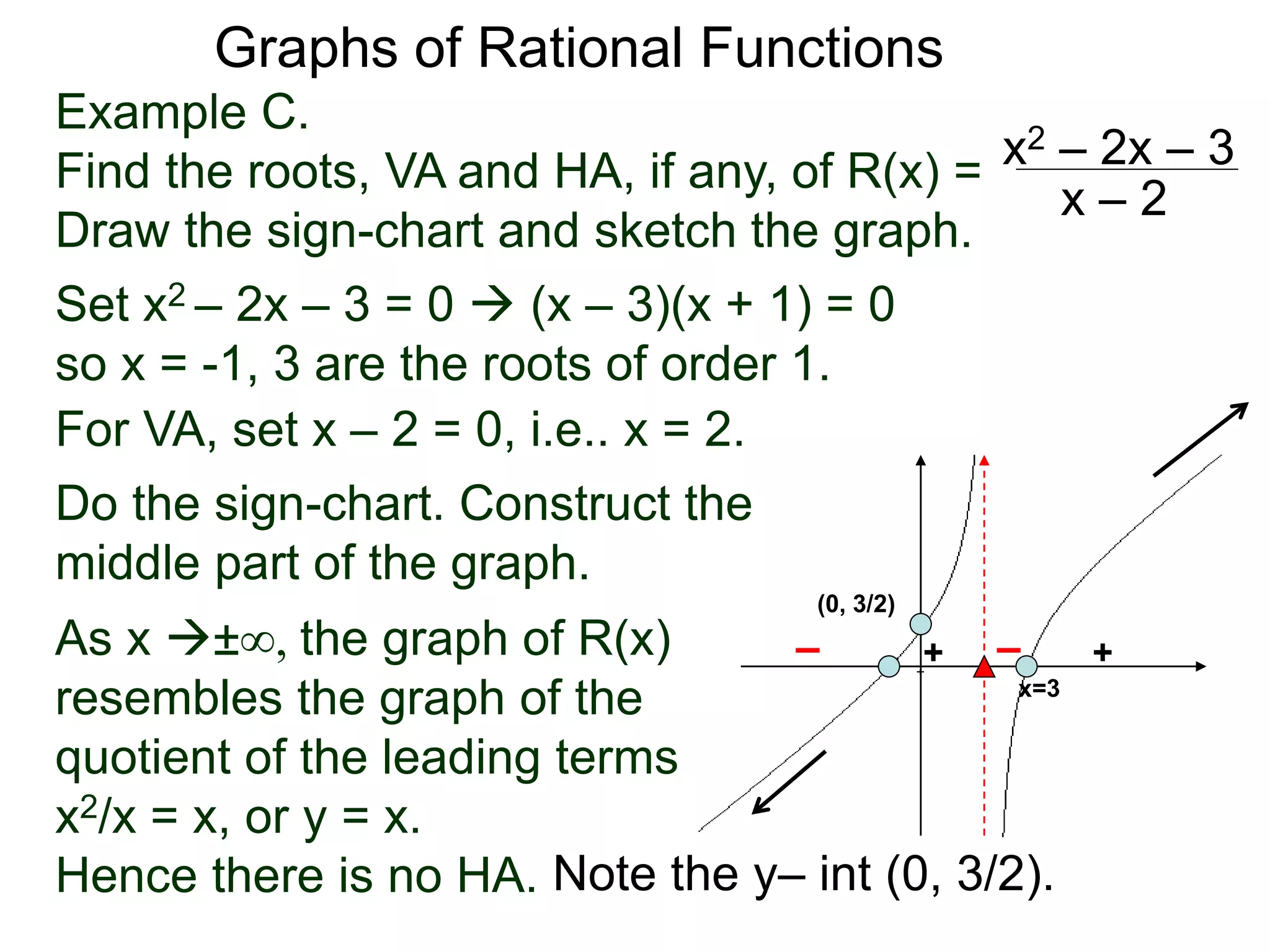
Note the y– int (0, 3/2).
(0, 3/2)

3.3 graphs of factorable polynomials and rational functions

  • 1.
    Graphs of FactorablePolynomials Function–Dance (origin unknown)
  • 2.
    Graphs of FactorablePolynomials Following are some of the basic shapes of graphs that we encounter often. The dotted tangent line is for reference. Practice drawing them a few times.
  • 3.
    Graphs of FactorablePolynomials We start with the graphs of the polynomials y = ±xN.
  • 4.
    Graphs of FactorablePolynomials We start with the graphs of the polynomials y = ±xN. The graphs y = xeven y = x2
  • 5.
    Graphs of FactorablePolynomials The graphs y = xeven y = x2y = x4 (1, 1)(-1, 1) We start with the graphs of the polynomials y = ±xN.
  • 6.
    Graphs of FactorablePolynomials The graphs y = xeven y = x2y = x4y = x6 (1, 1)(-1, 1) We start with the graphs of the polynomials y = ±xN.
  • 7.
    Graphs of FactorablePolynomials The graphs y = xeven y = x2y = x4y = x6 y = -x2 y = -x4 y = -x6 (1, 1)(-1, 1) (-1,-1) (1,-1) We start with the graphs of the polynomials y = ±xN. The graphs y = –xeven
  • 8.
    Graphs of FactorablePolynomials The graphs y = xeven y = x2y = x4y = x6 y = -x2 y = -x4 y = -x6 (1, 1)(-1, 1) (-1,-1) (1,-1) We start with the graphs of the polynomials y = ±xN. The graphs y = –xeven Plot these functions and zoom in on the region around x = –1 to x = 1. Note that the graphs in between the points (1, 1) and (–1,1) drop lower as the power increases. However the graphs switch positions as they pass to the right of (1, 1) or to the left of (–1,1). ( Why?)
  • 9.
    Graphs of FactorablePolynomials The graphs y = xeven y = x2y = x4y = x6 y = xE y = –xE (1, 1)(-1, 1) We start with the graphs of the polynomials y = ±xN. The graphs y = –xeven Graphs of even ordered roots y = ±xEven. y = -x2 y = -x4 y = -x6 (-1,-1) (1,-1)
  • 10.
    Graphs of FactorablePolynomials y = x3 The graphs y = xodd
  • 11.
    Graphs of FactorablePolynomials y = x3 y = x5 (1, 1) (-1, -1) The graphs y = xodd
  • 12.
    Graphs of FactorablePolynomials y = x3 y = x5 y = x7 (1, 1) (-1, -1) The graphs y = xodd
  • 13.
    Graphs of FactorablePolynomials The graphs y = xodd y = x3 y = x5 y = x7 y = -x3 y = -x5 y = -x7 (1, 1) (-1, -1) (-1, 1) (1,-1) The graphs y = –xodd
  • 14.
    Graphs of FactorablePolynomials The graphs y = xodd y = x3 y = x5 y = x7 y = -x3 y = -x5 y = -x7 y = xD y = –xD (1, 1) (-1, -1) (-1, 1) (1,-1) The graphs y = –xodd Graphs of odd ordered roots y = ±xodD
  • 15.
    Graphs of FactorablePolynomials Facts about the graphs of polynomials:
  • 16.
    Graphs of FactorablePolynomials Facts about the graphs of polynomials: • The graphs of polynomials are unbroken curves.
  • 17.
    Graphs of FactorablePolynomials Facts about the graphs of polynomials: • The graphs of polynomials are unbroken curves. • Polynomial curves are smooth (no corners).
  • 18.
    Graphs of FactorablePolynomials Facts about the graphs of polynomials: • The graphs of polynomials are unbroken curves. • Polynomial curves are smooth (no corners). • Let P(x) = anxn + lower degree terms.
  • 19.
    Graphs of FactorablePolynomials Facts about the graphs of polynomials: • The graphs of polynomials are unbroken curves. • Polynomial curves are smooth (no corners). • Let P(x) = anxn + lower degree terms. For large |x|, the leading term anxn dominates the lower degree terms.
  • 20.
    Graphs of FactorablePolynomials Facts about the graphs of polynomials: • The graphs of polynomials are unbroken curves. • Polynomial curves are smooth (no corners). • Let P(x) = anxn + lower degree terms. For large |x|, the leading term anxn dominates the lower degree terms. For x's such that | x | are large, the "lower degree terms" are negligible compared to anxn.
  • 21.
    Graphs of FactorablePolynomials Facts about the graphs of polynomials: • The graphs of polynomials are unbroken curves. • Polynomial curves are smooth (no corners). • Let P(x) = anxn + lower degree terms. For large |x|, the leading term anxn dominates the lower degree terms. For x's such that | x | are large, the "lower degree terms" are negligible compared to anxn. Hence, for x where |x| is "large", the graph of P(x) resembles the graph y = anxn.
  • 22.
    Graphs of FactorablePolynomials Facts about the graphs of polynomials: • The graphs of polynomials are unbroken curves. • Polynomial curves are smooth (no corners). • Let P(x) = anxn + lower degree terms. For large |x|, the leading term anxn dominates the lower degree terms. For x's such that | x | are large, the "lower degree terms" are negligible compared to anxn. Hence, for x where |x| is "large", the graph of P(x) resembles the graph y = anxn.This means there're four behaviors of polynomial-graphs to the far left or far right (as | x | becomes large).
  • 23.
    Graphs of FactorablePolynomials Facts about the graphs of polynomials: • The graphs of polynomials are unbroken curves. • Polynomial curves are smooth (no corners). • Let P(x) = anxn + lower degree terms. For large |x|, the leading term anxn dominates the lower degree terms. For x's such that | x | are large, the "lower degree terms" are negligible compared to anxn. Hence, for x where |x| is "large", the graph of P(x) resembles the graph y = anxn.This means there're four behaviors of polynomial-graphs to the far left or far right (as | x | becomes large). These behaviors are based on the sign the leading term anxn, and whether n is even or odd.
  • 24.
    Graphs of FactorablePolynomials I. The "Arms" of Polynomial Graphs
  • 25.
    Graphs of FactorablePolynomials y = +xeven + lower degree terms: I. The "Arms" of Polynomial Graphs
  • 26.
    Graphs of FactorablePolynomials y = +xeven + lower degree terms: y = –xeven + lower degree terms: I. The "Arms" of Polynomial Graphs
  • 27.
    Graphs of FactorablePolynomials y = +xeven + lower degree terms: y = –xeven + lower degree terms: I. The "Arms" of Polynomial Graphs y = +xodd + lower degree terms:
  • 28.
    Graphs of FactorablePolynomials y = +xeven + lower degree terms: y = –xeven + lower degree terms: I. The "Arms" of Polynomial Graphs y = +xodd + lower degree terms: y = –xodd + lower degree terms:
  • 29.
    Graphs of FactorablePolynomials For factorable polynomials, we use the sign-charts to sketch the central portion of the graphs.
  • 30.
    Graphs of FactorablePolynomials For factorable polynomials, we use the sign-charts to sketch the central portion of the graphs. Recall that given a polynomial P(x), it's sign-chart is constructed in the following manner:
  • 31.
    Graphs of FactorablePolynomials For factorable polynomials, we use the sign-charts to sketch the central portion of the graphs. Recall that given a polynomial P(x), it's sign-chart is constructed in the following manner: Construction of the sign-chart of polynomial P(x):
  • 32.
    Graphs of FactorablePolynomials For factorable polynomials, we use the sign-charts to sketch the central portion of the graphs. Recall that given a polynomial P(x), it's sign-chart is constructed in the following manner: Construction of the sign-chart of polynomial P(x): I. Find the roots of P(x) and their order respectively.
  • 33.
    Graphs of FactorablePolynomials For factorable polynomials, we use the sign-charts to sketch the central portion of the graphs. Recall that given a polynomial P(x), it's sign-chart is constructed in the following manner: Construction of the sign-chart of polynomial P(x): I. Find the roots of P(x) and their order respectively. II. Draw the real line, mark off the answers from I.
  • 34.
    Graphs of FactorablePolynomials For factorable polynomials, we use the sign-charts to sketch the central portion of the graphs. Recall that given a polynomial P(x), it's sign-chart is constructed in the following manner: Construction of the sign-chart of polynomial P(x): I. Find the roots of P(x) and their order respectively. II. Draw the real line, mark off the answers from I. III. Sample a point for its sign, use the the orders of the roots to extend and fill in the signs.
  • 35.
    Graphs of FactorablePolynomials For factorable polynomials, we use the sign-charts to sketch the central portion of the graphs. Recall that given a polynomial P(x), it's sign-chart is constructed in the following manner: Construction of the sign-chart of polynomial P(x): I. Find the roots of P(x) and their order respectively. II. Draw the real line, mark off the answers from I. III. Sample a point for its sign, use the the orders of the roots to extend and fill in the signs. (Reminder: Across odd-ordered root, sign changes Across even-ordered root, sign stays the same.)
  • 36.
    Example A: Makethe sign-chart of f(x) = x2 – 3x – 4 and graph y = f(x). Graphs of Factorable Polynomials
  • 37.
    Example A: Makethe sign-chart of f(x) = x2 – 3x – 4 and graph y = f(x). Solve x2 – 3x – 4 = 0 (x – 4)(x + 1) = 0 Graphs of Factorable Polynomials so x = 4 and x= –1 are two roots of odd order.
  • 38.
    Example A: Makethe sign-chart of f(x) = x2 – 3x – 4 and graph y = f(x). Solve x2 – 3x – 4 = 0 (x – 4)(x + 1) = 0 Graphs of Factorable Polynomials so x = 4 and x= –1 are two roots of odd order. The sign chart and the graph of y = f(x) are shown here. y=(x – 4)(x+1) x y
  • 39.
    Example A: Makethe sign-chart of f(x) = x2 – 3x – 4 and graph y = f(x). Solve x2 – 3x – 4 = 0 (x – 4)(x + 1) = 0 Graphs of Factorable Polynomials so x = 4 and x= –1 are two roots of odd order. The sign chart and the graph of y = f(x) are shown here. y=(x – 4)(x+1) x y Note the sign-chart reflects the properties of the graph.
  • 40.
    Example A: Makethe sign-chart of f(x) = x2 – 3x – 4 and graph y = f(x). Solve x2 – 3x – 4 = 0 (x – 4)(x + 1) = 0 Graphs of Factorable Polynomials so x = 4 and x= –1 are two roots of odd order. The sign chart and the graph of y = f(x) are shown here. y=(x – 4)(x+1) x y Note the sign-chart reflects the properties of the graph. I. The graph touches or crosses the x-axis at the roots.
  • 41.
    Example A: Makethe sign-chart of f(x) = x2 – 3x – 4 and graph y = f(x). Solve x2 – 3x – 4 = 0 (x – 4)(x + 1) = 0 Graphs of Factorable Polynomials so x = 4 and x= –1 are two roots of odd order. The sign chart and the graph of y = f(x) are shown here. y=(x – 4)(x+1) x y Note the sign-chart reflects the properties of the graph. I. The graph touches or crosses the x-axis at the roots. II. The graph is above the x-axis where the sign is "+".
  • 42.
    Example A: Makethe sign-chart of f(x) = x2 – 3x – 4 and graph y = f(x). Solve x2 – 3x – 4 = 0 (x – 4)(x + 1) = 0 Graphs of Factorable Polynomials so x = 4 and x= –1 are two roots of odd order. The sign chart and the graph of y = f(x) are shown here. y=(x – 4)(x+1) x y Note the sign-chart reflects the properties of the graph. I. The graph touches or crosses the x-axis at the roots. II. The graph is above the x-axis where the sign is "+". III. The graph is below the x-axis where the sign is "–".
  • 43.
    Graphs of FactorablePolynomials II. The “Mid-Portions” of Polynomial Graphs
  • 44.
    Graphs of FactorablePolynomials II. The “Mid-Portions” of Polynomial Graphs Graphs of an odd ordered root (x – r)D at x = r.
  • 45.
    Graphs of FactorablePolynomials + + + order = 1 order = 1 order = 3, 5, 7.. r r r II. The “Mid-Portions” of Polynomial Graphs Graphs of an odd ordered root (x – r)D at x = r. + order = 3, 5, 7.. r y = (x – r)1 y = –(x – r)1 y = (x – r)3 or 5.. y = –(x – r)3 or 5..
  • 46.
    Graphs of FactorablePolynomials order = 2, 4, 6 .. ++ If the we know the roots of a factorable polynomial, then we may construct the central portion of the graph (the body) in the following manner using its sign chart. I. Draw the graph about each root using the information about the order of each root. II. Connect all the pieces together to form the graph. x=r r Graphs of an even ordered root at (x – r)E at x= r. order = 2, 4, 6 .. y = (x – r)2 or 4.. y = –(x – r)2 or 4..
  • 47.
    Graphs of FactorablePolynomials For example, given two roots with their orders and the sign-chart of a polynomial,
  • 48.
    Graphs of FactorablePolynomials For example, given two roots with their orders and the sign-chart of a polynomial, + order=2 order=3
  • 49.
    Graphs of FactorablePolynomials For example, given two roots with their orders and the sign-chart of a polynomial, the graphs around each root are as shown. + order=2 order=3
  • 50.
    Graphs of FactorablePolynomials For example, given two roots with their orders and the sign-chart of a polynomial, the graphs around each root are as shown. Connect them to get the whole graph. + order=2 order=3
  • 51.
    Graphs of FactorablePolynomials For example, given two roots with their orders and the sign-chart of a polynomial, the graphs around each root are as shown. Connect them to get the whole graph. + order=2 order=3
  • 52.
    Graphs of FactorablePolynomials For example, given two roots with their orders and the sign-chart of a polynomial, the graphs around each root are as shown. Connect them to get the whole graph. Example B: Given P(x) = -x(x + 2)2(x – 3)2, identify the roots and their orders. Make the sign-chart. Sketch the graph about each root. Connect them to complete the graph. + order=2 order=3
  • 53.
    Graphs of FactorablePolynomials For example, given two roots with their orders and the sign-chart of a polynomial, the graphs around each root are as shown. Connect them to get the whole graph. Example B: Given P(x) = -x(x + 2)2(x – 3)2, identify the roots and their orders. Make the sign-chart. Sketch the graph about each root. Connect them to complete the graph. The roots are x = 0 of order 1, + order=2 order=3
  • 54.
    Graphs of FactorablePolynomials For example, given two roots with their orders and the sign-chart of a polynomial, the graphs around each root are as shown. Connect them to get the whole graph. Example B: Given P(x) = -x(x + 2)2(x – 3)2, identify the roots and their orders. Make the sign-chart. Sketch the graph about each root. Connect them to complete the graph. The roots are x = 0 of order 1, x = -2 of order 2, + order=2 order=3
  • 55.
    Graphs of FactorablePolynomials For example, given two roots with their orders and the sign-chart of a polynomial, the graphs around each root are as shown. Connect them to get the whole graph. Example B: Given P(x) = -x(x + 2)2(x – 3)2, identify the roots and their orders. Make the sign-chart. Sketch the graph about each root. Connect them to complete the graph. The roots are x = 0 of order 1, x = -2 of order 2, and x = 3 of order 2. + order=2 order=3
  • 56.
    Graphs of FactorablePolynomials The sign-chart of P(x) = -x(x + 2)2(x – 3)2 is ++ x = 3 order 2 x = 0 order 1 x = -2 order 2
  • 57.
    Graphs of FactorablePolynomials The sign-chart of P(x) = -x(x + 2)2(x – 3)2 is ++ x = 3 order 2 x = 0 order 1 x = -2 order 2 By the sign-chart and the order of each root, we draw the graph about each root.
  • 58.
    Graphs of FactorablePolynomials The sign-chart of P(x) = -x(x + 2)2(x – 3)2 is ++ x = 3 order 2 x = 0 order 1 x = -2 order 2 By the sign-chart and the order of each root, we draw the graph about each root.
  • 59.
    Graphs of FactorablePolynomials The sign-chart of P(x) = -x(x + 2)2(x – 3)2 is ++ x = 3 order 2 x = 0 order 1 x = -2 order 2 By the sign-chart and the order of each root, we draw the graph about each root. (Note for x = 0 of order 1, the graph approximates a line going through the point.)
  • 60.
    Graphs of FactorablePolynomials The sign-chart of P(x) = -x(x + 2)2(x – 3)2 is ++ x = 3 order 2 x = 0 order 1 x = -2 order 2 By the sign-chart and the order of each root, we draw the graph about each root. (Note for x = 0 of order 1, the graph approximates a line going through the point.) Connect all the pieces to get the graph of P(x).
  • 61.
    Graphs of FactorablePolynomials The sign-chart of P(x) = -x(x + 2)2(x – 3)2 is x = -2 order 2 ++ x = 0 order 1 x = 3 order 2 By the sign-chart and the order of each root, we draw the graph about each root. (Note for x = 0 of order 1, the graph approximates a line going through the point.) Connect all the pieces to get the graph of P(x).
  • 62.
    Graphs of FactorablePolynomials Note the graph resembles y = -x5, it's leading term, when viewed at a distance.
  • 63.
    Graphs of FactorablePolynomials Note the graph resembles y = -x5, it's leading term, when viewed at a distance. -2 ++ 0 3
  • 64.
  • 65.
    Graphs of RationalFunctions Recalled that rational functions are functions of the form R(x) = where P(x) and Q(x) are polynomials. P(x) Q(x)
  • 66.
    Graphs of RationalFunctions Recalled that rational functions are functions of the form R(x) = where P(x) and Q(x) are polynomials. P(x) Q(x) A rational function is factorable if both P(x) and Q(x) are factorable.
  • 67.
    Graphs of RationalFunctions Recalled that rational functions are functions of the form R(x) = where P(x) and Q(x) are polynomials. P(x) Q(x) A rational function is factorable if both P(x) and Q(x) are factorable. In this section we study the graphs of reduced factorable rational functions.
  • 68.
    Graphs of RationalFunctions Recalled that rational functions are functions of the form R(x) = where P(x) and Q(x) are polynomials. P(x) Q(x) A rational function is factorable if both P(x) and Q(x) are factorable. In this section we study the graphs of reduced factorable rational functions. The main principle of graphing these functions is the the same as polynomials.
  • 69.
    Graphs of RationalFunctions Recalled that rational functions are functions of the form R(x) = where P(x) and Q(x) are polynomials. P(x) Q(x) A rational function is factorable if both P(x) and Q(x) are factorable. In this section we study the graphs of reduced factorable rational functions. The main principle of graphing these functions is the the same as polynomials. We analyze the behaviors and draw pieces the graphs at important locations, then complete the graphs by connecting them.
  • 70.
    Graphs of RationalFunctions Recalled that rational functions are functions of the form R(x) = where P(x) and Q(x) are polynomials. P(x) Q(x) A rational function is factorable if both P(x) and Q(x) are factorable. In this section we study the graphs of reduced factorable rational functions. The main principle of graphing these functions is the the same as polynomials. We analyze the behaviors and draw pieces the graphs at important locations, then complete the graphs by connecting them. However the behaviors of rational functions are more complicated due to the presence of the denominators.
  • 71.
    x=0 The graph ofy = 1/x has an asymptotes at x = 0 as shown here. We also call vertical asymptotes “poles”. Therefore y = 1/x has a pole of order 1 at x = 0. Graphs of Rational Functions + + +– – – Graph of y = 1/x2 Graph of y = 1/x x=0 The graph of y = 1/x2 has a pole of order 2 at x = 0 and its graph is shown here. Similar to the orders of roots, the even or odd orders of the poles determine the behaviors of the graphs. They are shown below. + + + + + + Graph of y = ±1/xN for N = 1, 2, 3..
  • 72.
    Graphs of RationalFunctions e.g. y = –1/x1 or 3,.. + e.g. y = 1/x1 or 3,.. + Graphs of odd ordered poles
  • 73.
    Graphs of RationalFunctions e.g. y = –1/x1 or 3,.. + e.g. y = 1/x1 or 3,.. + + + Graphs of even ordered polesodd ordered poles Graphs of e.g. y = 1/x2 or 4,.. e.g. y = –1/x2 or 4,..
  • 74.
    Graphs of RationalFunctions e.g. y = –1/x1 or 3,.. + e.g. y = 1/x1 or 3,.. + + + Graphs of even ordered polesodd ordered poles Graphs of e.g. y = 1/x2 or 4,.. e.g. y = –1/x2 or 4,.. We are examining the “Mid–Portion” of the graphs of rational functions. We will look at the “Arms” of these graphs later.
  • 75.
    Graphs of RationalFunctions e.g. y = –1/x1 or 3,.. + e.g. y = 1/x1 or 3,.. + + + Example A: Given the following information of roots, sign-chart and vertical asymptotes, draw the graph. ++ root VAVA Graphs of even ordered polesodd ordered poles Graphs of e.g. y = 1/x2 or 4,.. e.g. y = –1/x2 or 4,..
  • 76.
    Graphs of RationalFunctions e.g. y = –1/x1 or 3,.. + e.g. y = 1/x1 or 3,.. + + + Example A: Given the following information of roots, sign-chart and vertical asymptotes, draw the graph. ++ root VAVAGraph from right to left: Graphs of even ordered polesodd ordered poles Graphs of e.g. y = 1/x2 or 4,.. e.g. y = –1/x2 or 4,..
  • 77.
    Graphs of RationalFunctions e.g. y = –1/x1 or 3,.. + e.g. y = 1/x1 or 3,.. + + + Example A: Given the following information of roots, sign-chart and vertical asymptotes, draw the graph. ++ root VAVAGraph from right to left: Graphs of even ordered polesodd ordered poles Graphs of e.g. y = 1/x2 or 4,.. e.g. y = –1/x2 or 4,..
  • 78.
    Graphs of RationalFunctions e.g. y = –1/x1 or 3,.. + e.g. y = 1/x1 or 3,.. + + + Example A: Given the following information of roots, sign-chart and vertical asymptotes, draw the graph. ++ root VAVAGraph from right to left: Graphs of even ordered polesodd ordered poles Graphs of e.g. y = 1/x2 or 4,.. e.g. y = –1/x2 or 4,..
  • 79.
    Graphs of RationalFunctions e.g. y = –1/x1 or 3,.. + e.g. y = 1/x1 or 3,.. + + + Example A: Given the following information of roots, sign-chart and vertical asymptotes, draw the graph. ++ root VAVAGraph from right to left: Graphs of even ordered polesodd ordered poles Graphs of e.g. y = 1/x2 or 4,.. e.g. y = –1/x2 or 4,..
  • 80.
    Graphs of RationalFunctions Example A: Given the following information of roots, sign-chart and vertical asymptotes, draw the graph. ++ root VAVAGraph from right to left: e.g. y = –1/x1 or 3,.. + e.g. y = 1/x1 or 3,.. + + + Graphs of even ordered polesodd ordered poles Graphs of e.g. y = 1/x2 or 4,.. e.g. y = –1/x2 or 4,..
  • 81.
    Graphs of RationalFunctions Example A: Given the following information of roots, sign-chart and vertical asymptotes, draw the graph. ++ root VAVAGraph from right to left: e.g. y = –1/x1 or 3,.. + e.g. y = 1/x1 or 3,.. + + + Graphs of even ordered polesodd ordered poles Graphs of e.g. y = 1/x2 or 4,.. e.g. y = –1/x2 or 4,..
  • 82.
    Graphs of RationalFunctions Horizontal Asymptotes
  • 83.
    Graphs of RationalFunctions Horizontal Asymptotes For x's where | x | is large (i.e.. x is to the far right or far left of the x-axis),
  • 84.
    Graphs of RationalFunctions Horizontal Asymptotes For x's where | x | is large (i.e.. x is to the far right or far left of the x-axis), the graph of a rational function resembles the quotient of the leading terms of the numerator and the denominator.
  • 85.
    Graphs of RationalFunctions Horizontal Asymptotes For x's where | x | is large (i.e.. x is to the far right or far left of the x-axis), the graph of a rational function resembles the quotient of the leading terms of the numerator and the denominator. R(x) = AxN + lower degree terms BxK + lower degree terms Specifically, if
  • 86.
    Graphs of RationalFunctions Horizontal Asymptotes For x's where | x | is large (i.e.. x is to the far right or far left of the x-axis), the graph of a rational function resembles the quotient of the leading terms of the numerator and the denominator. R(x) = AxN + lower degree terms BxK + lower degree terms Specifically, if then for x's where | x | is large, the graph of R(x) resembles (quotient of the leading terms).AxN BxK
  • 87.
    Graphs of RationalFunctions Horizontal Asymptotes For x's where | x | is large (i.e.. x is to the far right or far left of the x-axis), the graph of a rational function resembles the quotient of the leading terms of the numerator and the denominator. R(x) = AxN + lower degree terms BxK + lower degree terms Specifically, if then for x's where | x | is large, the graph of R(x) resembles (quotient of the leading terms).AxN BxK The graph may or may not level off horizontally.
  • 88.
    Graphs of RationalFunctions Horizontal Asymptotes For x's where | x | is large (i.e.. x is to the far right or far left of the x-axis), the graph of a rational function resembles the quotient of the leading terms of the numerator and the denominator. R(x) = AxN + lower degree terms BxK + lower degree terms Specifically, if then for x's where | x | is large, the graph of R(x) resembles (quotient of the leading terms).AxN BxK The graph may or may not level off horizontally. If it does, then we have a horizontal asymptote (HA).
  • 89.
    Graphs of RationalFunctions We list all the possibilities of horizontal behavior below:
  • 90.
    Graphs of RationalFunctions We list all the possibilities of horizontal behavior below: Theorem (Horizontal Behavior):
  • 91.
    Graphs of RationalFunctions We list all the possibilities of horizontal behavior below: Given that R(x) = AxN + lower degree terms BxK + lower degree terms Theorem (Horizontal Behavior): the graph of R(x) as x goes to the far right (x  ∞) and far left (x -∞) behaves similar to AxN/BxK = AxN-K/B. ,
  • 92.
    Graphs of RationalFunctions We list all the possibilities of horizontal behavior below: Given that R(x) = AxN + lower degree terms BxK + lower degree terms Theorem (Horizontal Behavior): the graph of R(x) as x goes to the far right (x  ∞) and far left (x -∞) behaves similar to AxN/BxK = AxN-K/B. I. If N > K, ,
  • 93.
    Graphs of RationalFunctions We list all the possibilities of horizontal behavior below: Given that R(x) = AxN + lower degree terms BxK + lower degree terms Theorem (Horizontal Behavior): the graph of R(x) as x goes to the far right (x  ∞) and far left (x -∞) behaves similar to AxN/BxK = AxN-K/B. I. If N > K, then the graph of R(x) resemble the polynomial AxN-K/B. ,
  • 94.
    Graphs of RationalFunctions We list all the possibilities of horizontal behavior below: Given that R(x) = AxN + lower degree terms BxK + lower degree terms Theorem (Horizontal Behavior): the graph of R(x) as x goes to the far right (x  ∞) and far left (x -∞) behaves similar to AxN/BxK = AxN-K/B. I. If N > K, then the graph of R(x) resemble the polynomial AxN-K/B. , We write this as lim y = ±∞.x±∞
  • 95.
    Graphs of RationalFunctions We list all the possibilities of horizontal behavior below: Given that R(x) = AxN + lower degree terms BxK + lower degree terms Theorem (Horizontal Behavior): the graph of R(x) as x goes to the far right (x  ∞) and far left (x -∞) behaves similar to AxN/BxK = AxN-K/B. I. If N > K, then the graph of R(x) resemble the polynomial AxN-K/B. II. If N = K, , We write this as lim y = ±∞.x±∞
  • 96.
    Graphs of RationalFunctions We list all the possibilities of horizontal behavior below: Given that R(x) = AxN + lower degree terms BxK + lower degree terms Theorem (Horizontal Behavior): the graph of R(x) as x goes to the far right (x  ∞) and far left (x -∞) behaves similar to AxN/BxK = AxN-K/B. I. If N > K, then the graph of R(x) resemble the polynomial AxN-K/B. II. If N = K, then the graph of R(x) has y = A/B as a horizontal asymptote (HA). , We write this as lim y = ±∞.x±∞
  • 97.
    Graphs of RationalFunctions We list all the possibilities of horizontal behavior below: Given that R(x) = AxN + lower degree terms BxK + lower degree terms Theorem (Horizontal Behavior): the graph of R(x) as x goes to the far right (x  ∞) and far left (x -∞) behaves similar to AxN/BxK = AxN-K/B. I. If N > K, then the graph of R(x) resemble the polynomial AxN-K/B. II. If N = K, then the graph of R(x) has y = A/B as a horizontal asymptote (HA). It is noted as lim y = A/B.x±∞ , We write this as lim y = ±∞.x±∞
  • 98.
    Graphs of RationalFunctions We list all the possibilities of horizontal behavior below: Given that R(x) = AxN + lower degree terms BxK + lower degree terms Theorem (Horizontal Behavior): the graph of R(x) as x goes to the far right (x  ∞) and far left (x -∞) behaves similar to AxN/BxK = AxN-K/B. I. If N > K, then the graph of R(x) resemble the polynomial AxN-K/B. II. If N = K, then the graph of R(x) has y = A/B as a horizontal asymptote (HA). It is noted as lim y = A/B. III. If N < K, x±∞ , We write this as lim y = ±∞.x±∞
  • 99.
    Graphs of RationalFunctions We list all the possibilities of horizontal behavior below: Given that R(x) = AxN + lower degree terms BxK + lower degree terms Theorem (Horizontal Behavior): the graph of R(x) as x goes to the far right (x  ∞) and far left (x -∞) behaves similar to AxN/BxK = AxN-K/B. I. If N > K, then the graph of R(x) resemble the polynomial AxN-K/B. II. If N = K, then the graph of R(x) has y = A/B as a horizontal asymptote (HA). It is noted as lim y = A/B. III. If N < K, then the graph of R(x) has y = 0 as a horizontal asymptote (HA) because N – K is negative. x±∞ , We write this as lim y = ±∞.x±∞
  • 100.
    Graphs of RationalFunctions We list all the possibilities of horizontal behavior below: Given that R(x) = AxN + lower degree terms BxK + lower degree terms Theorem (Horizontal Behavior): the graph of R(x) as x goes to the far right (x  ∞) and far left (x -∞) behaves similar to AxN/BxK = AxN-K/B. I. If N > K, then the graph of R(x) resemble the polynomial AxN-K/B. II. If N = K, then the graph of R(x) has y = A/B as a horizontal asymptote (HA). It is noted as lim y = A/B. III. If N < K, then the graph of R(x) has y = 0 as a horizontal asymptote (HA) because N – K is negative. It is noted as lim y = 0. x±∞ x±∞ , We write this as lim y = ±∞.x±∞
  • 101.
    Graphs of RationalFunctions Steps for graphing a rational function R(x) = P(x) Q(x)
  • 102.
    Graphs of RationalFunctions Steps for graphing a rational function R(x) = I. (Roots) Find the roots of P(x) and their orders by solving P(x) = 0. P(x) Q(x)
  • 103.
    Graphs of RationalFunctions Steps for graphing a rational function R(x) = I. (Roots) Find the roots of P(x) and their orders by solving P(x) = 0. P(x) Q(x) II. (Poles or VA) Find the vertical asymptotes (VA) and their orders by solving Q(x) = 0.
  • 104.
    Graphs of RationalFunctions Steps for graphing a rational function R(x) = I. (Roots) Find the roots of P(x) and their orders by solving P(x) = 0. P(x) Q(x) II. (Poles or VA) Find the vertical asymptotes (VA) and their orders by solving Q(x) = 0. Steps I and II give the sign-chart,
  • 105.
    Graphs of RationalFunctions Steps for graphing a rational function R(x) = I. (Roots) Find the roots of P(x) and their orders by solving P(x) = 0. P(x) Q(x) II. (Poles or VA) Find the vertical asymptotes (VA) and their orders by solving Q(x) = 0. Steps I and II give the sign-chart, the shape of the graph around the roots, and the shape of the graph along the poles.
  • 106.
    Graphs of RationalFunctions Steps for graphing a rational function R(x) = I. (Roots) Find the roots of P(x) and their orders by solving P(x) = 0. P(x) Q(x) II. (Poles or VA) Find the vertical asymptotes (VA) and their orders by solving Q(x) = 0. Steps I and II give the sign-chart, the shape of the graph around the roots, and the shape of the graph along the poles. Steps I and II give the "mid-section“ of the graph.
  • 107.
    Graphs of RationalFunctions Steps for graphing a rational function R(x) = I. (Roots) Find the roots of P(x) and their orders by solving P(x) = 0. P(x) Q(x) II. (Poles or VA) Find the vertical asymptotes (VA) and their orders by solving Q(x) = 0. Steps I and II give the sign-chart, the shape of the graph around the roots, and the shape of the graph along the poles. Steps I and II give the "mid-section“ of the graph. III. (HA) Use the last theorem to determine the behavior of the graph to the right and left as x±∞.
  • 108.
    Graphs of RationalFunctions Steps for graphing a rational function R(x) = I. (Roots) Find the roots of P(x) and their orders by solving P(x) = 0. P(x) Q(x) II. (Poles or VA) Find the vertical asymptotes (VA) and their orders by solving Q(x) = 0. Steps I and II give the sign-chart, the shape of the graph around the roots, and the shape of the graph along the poles. Steps I and II give the "mid-section“ of the graph. III. (HA) Use the last theorem to determine the behavior of the graph to the right and left as x±∞. The horizontal asymptote exists only if the limit exists.
  • 109.
    Graphs of RationalFunctions Steps for graphing a rational function R(x) = I. (Roots) Find the roots of P(x) and their orders by solving P(x) = 0. P(x) Q(x) II. (Poles or VA) Find the vertical asymptotes (VA) and their orders by solving Q(x) = 0. Steps I and II give the sign-chart, the shape of the graph around the roots, and the shape of the graph along the poles. Steps I and II give the "mid-section“ of the graph. III. (HA) Use the last theorem to determine the behavior of the graph to the right and left as x±∞. The horizontal asymptote exists only if the limit exists. Step III gives the “arms” of the graph.
  • 110.
    Graphs of RationalFunctions Example B. Find the roots, VA and HA, if any, of R(x) = Draw the sign-chart and sketch the graph. x2 – 4x + 4 x2 – 1
  • 111.
    Graphs of RationalFunctions Example B. Find the roots, VA and HA, if any, of R(x) = Draw the sign-chart and sketch the graph. x2 – 4x + 4 x2 – 1 For its roots, set x2 – 4x + 4 = 0, i.e.. x = 2 (ord = 2).
  • 112.
    Graphs of RationalFunctions Example B. Find the roots, VA and HA, if any, of R(x) = Draw the sign-chart and sketch the graph. x2 – 4x + 4 x2 – 1 For its roots, set x2 – 4x + 4 = 0, i.e.. x = 2 (ord = 2). For VA, set Q(x) = 0, i.e.. x2 – 1 = 0  x = ± 1.
  • 113.
    Graphs of RationalFunctions Example B. Find the roots, VA and HA, if any, of R(x) = Draw the sign-chart and sketch the graph. x2 – 4x + 4 x2 – 1 For its roots, set x2 – 4x + 4 = 0, i.e.. x = 2 (ord = 2). For VA, set Q(x) = 0, i.e.. x2 – 1 = 0  x = ± 1. x=2
  • 114.
    Graphs of RationalFunctions Example B. Find the roots, VA and HA, if any, of R(x) = Draw the sign-chart and sketch the graph. x2 – 4x + 4 x2 – 1 For its roots, set x2 – 4x + 4 = 0, i.e.. x = 2 (ord = 2). For VA, set Q(x) = 0, i.e.. x2 – 1 = 0  x = ± 1. All of them have order 1, so the sign changes at each of these values. x=2
  • 115.
    Graphs of RationalFunctions Example B. Find the roots, VA and HA, if any, of R(x) = Draw the sign-chart and sketch the graph. x2 – 4x + 4 x2 – 1 For its roots, set x2 – 4x + 4 = 0, i.e.. x = 2 (ord = 2). For VA, set Q(x) = 0, i.e.. x2 – 1 = 0  x = ± 1. All of them have order 1, so the sign changes at each of these values. ++ – x=2 +
  • 116.
    Graphs of RationalFunctions Example B. Find the roots, VA and HA, if any, of R(x) = Draw the sign-chart and sketch the graph. x2 – 4x + 4 x2 – 1 For its roots, set x2 – 4x + 4 = 0, i.e.. x = 2 (ord = 2). For VA, set Q(x) = 0, i.e.. x2 – 1 = 0  x = ± 1. All of them have order 1, so the sign changes at each of these values. ++ – x=2 + +
  • 117.
    Graphs of RationalFunctions Example B. Find the roots, VA and HA, if any, of R(x) = Draw the sign-chart and sketch the graph. x2 – 4x + 4 x2 – 1 For its roots, set x2 – 4x + 4 = 0, i.e.. x = 2 (ord = 2). For VA, set Q(x) = 0, i.e.. x2 – 1 = 0  x = ± 1. All of them have order 1, so the sign changes at each of these values. ++ – x=2 + +
  • 118.
    Graphs of RationalFunctions Example B. Find the roots, VA and HA, if any, of R(x) = Draw the sign-chart and sketch the graph. x2 – 4x + 4 x2 – 1 For its roots, set x2 – 4x + 4 = 0, i.e.. x = 2 (ord = 2). For VA, set Q(x) = 0, i.e.. x2 – 1 = 0  x = ± 1. All of them have order 1, so the sign changes at each of these values. ++ – x=2 + +
  • 119.
    Graphs of RationalFunctions Example B. Find the roots, VA and HA, if any, of R(x) = Draw the sign-chart and sketch the graph. x2 – 4x + 4 x2 – 1 For its roots, set x2 – 4x + 4 = 0, i.e.. x = 2 (ord = 2). For VA, set Q(x) = 0, i.e.. x2 – 1 = 0  x = ± 1. All of them have order 1, so the sign changes at each of these values. ++ – x=2 + +
  • 120.
    Graphs of RationalFunctions Example B. Find the roots, VA and HA, if any, of R(x) = Draw the sign-chart and sketch the graph. x2 – 4x + 4 x2 – 1 For its roots, set x2 – 4x + 4 = 0, i.e.. x = 2 (ord = 2). For VA, set Q(x) = 0, i.e.. x2 – 1 = 0  x = ± 1. All of them have order 1, so the sign changes at each of these values. ++ – x=2 + +
  • 121.
    Graphs of RationalFunctions Example B. Find the roots, VA and HA, if any, of R(x) = Draw the sign-chart and sketch the graph. x2 – 4x + 4 x2 – 1 For its roots, set x2 – 4x + 4 = 0, i.e.. x = 2 (ord = 2). For VA, set Q(x) = 0, i.e.. x2 – 1 = 0  x = ± 1. All of them have order 1, so the sign changes at each of these values. As x±∞, R(x) resembles x2/x2 = 1, i.e. it has y = 1 as the HA. ++ – x=2 + +
  • 122.
    Graphs of RationalFunctions Example B. Find the roots, VA and HA, if any, of R(x) = Draw the sign-chart and sketch the graph. x2 – 4x + 4 x2 – 1 For its roots, set x2 – 4x + 4 = 0, i.e.. x = 2 (ord = 2). For VA, set Q(x) = 0, i.e.. x2 – 1 = 0  x = ± 1. All of them have order 1, so the sign changes at each of these values. As x±∞, R(x) resembles x2/x2 = 1, i.e. it has y = 1 as the HA. ++ – x=2 + +
  • 123.
    Graphs of RationalFunctions Example B. Find the roots, VA and HA, if any, of R(x) = Draw the sign-chart and sketch the graph. x2 – 4x + 4 x2 – 1 For its roots, set x2 – 4x + 4 = 0, i.e.. x = 2 (ord = 2). For VA, set Q(x) = 0, i.e.. x2 – 1 = 0  x = ± 1. All of them have order 1, so the sign changes at each of these values. As x±∞, R(x) resembles x2/x2 = 1, i.e. it has y = 1 as the HA. ++ – x=2 ++
  • 124.
    Graphs of RationalFunctions Example B. Find the roots, VA and HA, if any, of R(x) = Draw the sign-chart and sketch the graph. x2 – 4x + 4 x2 – 1 For its roots, set x2 – 4x + 4 = 0, i.e.. x = 2 (ord = 2). For VA, set Q(x) = 0, i.e.. x2 – 1 = 0  x = ± 1. All of them have order 1, so the sign changes at each of these values. As x±∞, R(x) resembles x2/x2 = 1, i.e. it has y = 1 as the HA. Note the graph stays above the HA to the far left below to the far right. ++ – x=2 ++
  • 125.
    Graphs of RationalFunctions Example B. Find the roots, VA and HA, if any, of R(x) = Draw the sign-chart and sketch the graph. x2 – 4x + 4 x2 – 1 For its roots, set x2 – 4x + 4 = 0, i.e.. x = 2 (ord = 2). For VA, set Q(x) = 0, i.e.. x2 – 1 = 0  x = ± 1. All of them have order 1, so the sign changes at each of these values. ++ – x=2 ++ Note the y– int (0, – 4) (0,–4) As x±∞, R(x) resembles x2/x2 = 1, i.e. it has y = 1 as the HA. Note the graph stays above the HA to the far left below to the far right.
  • 126.
    Graphs of RationalFunctions Example C. Find the roots, VA and HA, if any, of R(x) = Draw the sign-chart and sketch the graph. x2 – 2x – 3 x – 2
  • 127.
    Graphs of RationalFunctions Example C. Find the roots, VA and HA, if any, of R(x) = Draw the sign-chart and sketch the graph. x2 – 2x – 3 x – 2 Set x2 – 2x – 3 = 0  (x – 3)(x + 1) = 0 so x = -1, 3 are the roots of order 1.
  • 128.
    Graphs of RationalFunctions Example C. Find the roots, VA and HA, if any, of R(x) = Draw the sign-chart and sketch the graph. x2 – 2x – 3 x – 2 Set x2 – 2x – 3 = 0  (x – 3)(x + 1) = 0 so x = -1, 3 are the roots of order 1. For VA, set x – 2 = 0, i.e.. x = 2.
  • 129.
    Graphs of RationalFunctions Example C. Find the roots, VA and HA, if any, of R(x) = Draw the sign-chart and sketch the graph. x2 – 2x – 3 x – 2 Set x2 – 2x – 3 = 0  (x – 3)(x + 1) = 0 so x = -1, 3 are the roots of order 1. For VA, set x – 2 = 0, i.e.. x = 2. Do the sign-chart.
  • 130.
    Graphs of RationalFunctions Example C. Find the roots, VA and HA, if any, of R(x) = Draw the sign-chart and sketch the graph. x2 – 2x – 3 x – 2 Set x2 – 2x – 3 = 0  (x – 3)(x + 1) = 0 so x = -1, 3 are the roots of order 1. For VA, set x – 2 = 0, i.e.. x = 2. x=3 Do the sign-chart.
  • 131.
    Graphs of RationalFunctions Example C. Find the roots, VA and HA, if any, of R(x) = Draw the sign-chart and sketch the graph. x2 – 2x – 3 x – 2 Set x2 – 2x – 3 = 0  (x – 3)(x + 1) = 0 so x = -1, 3 are the roots of order 1. For VA, set x – 2 = 0, i.e.. x = 2. x=3 Do the sign-chart. +–+–
  • 132.
    Graphs of RationalFunctions Example C. Find the roots, VA and HA, if any, of R(x) = Draw the sign-chart and sketch the graph. x2 – 2x – 3 x – 2 Set x2 – 2x – 3 = 0  (x – 3)(x + 1) = 0 so x = -1, 3 are the roots of order 1. For VA, set x – 2 = 0, i.e.. x = 2. Do the sign-chart. Construct the middle part of the graph. x=3 +–+–
  • 133.
    Graphs of RationalFunctions Example C. Find the roots, VA and HA, if any, of R(x) = Draw the sign-chart and sketch the graph. x2 – 2x – 3 x – 2 Set x2 – 2x – 3 = 0  (x – 3)(x + 1) = 0 so x = -1, 3 are the roots of order 1. For VA, set x – 2 = 0, i.e.. x = 2. Do the sign-chart. Construct the middle part of the graph. x=3 +–+–
  • 134.
    Graphs of RationalFunctions Example C. Find the roots, VA and HA, if any, of R(x) = Draw the sign-chart and sketch the graph. x2 – 2x – 3 x – 2 Set x2 – 2x – 3 = 0  (x – 3)(x + 1) = 0 so x = -1, 3 are the roots of order 1. For VA, set x – 2 = 0, i.e.. x = 2. Do the sign-chart. Construct the middle part of the graph. x=3 +–+–
  • 135.
    Graphs of RationalFunctions Example C. Find the roots, VA and HA, if any, of R(x) = Draw the sign-chart and sketch the graph. x2 – 2x – 3 x – 2 Set x2 – 2x – 3 = 0  (x – 3)(x + 1) = 0 so x = -1, 3 are the roots of order 1. For VA, set x – 2 = 0, i.e.. x = 2. Do the sign-chart. Construct the middle part of the graph. x=3 +–+–
  • 136.
    Graphs of RationalFunctions Example C. Find the roots, VA and HA, if any, of R(x) = Draw the sign-chart and sketch the graph. x2 – 2x – 3 x – 2 Set x2 – 2x – 3 = 0  (x – 3)(x + 1) = 0 so x = -1, 3 are the roots of order 1. For VA, set x – 2 = 0, i.e.. x = 2. Do the sign-chart. Construct the middle part of the graph. x=3 +–+–
  • 137.
    Graphs of RationalFunctions Example C. Find the roots, VA and HA, if any, of R(x) = Draw the sign-chart and sketch the graph. x2 – 2x – 3 x – 2 Set x2 – 2x – 3 = 0  (x – 3)(x + 1) = 0 so x = -1, 3 are the roots of order 1. For VA, set x – 2 = 0, i.e.. x = 2. As x ±∞, the graph of R(x) resembles the graph of the quotient of the leading terms x2/x = x, or y = x. x=3 +–+– Do the sign-chart. Construct the middle part of the graph.
  • 138.
    Graphs of RationalFunctions Example C. Find the roots, VA and HA, if any, of R(x) = Draw the sign-chart and sketch the graph. x2 – 2x – 3 x – 2 Set x2 – 2x – 3 = 0  (x – 3)(x + 1) = 0 so x = -1, 3 are the roots of order 1. For VA, set x – 2 = 0, i.e.. x = 2. As x ±∞, the graph of R(x) resembles the graph of the quotient of the leading terms x2/x = x, or y = x. Hence there is no HA. x=3 +–+– Do the sign-chart. Construct the middle part of the graph.
  • 139.
    Graphs of RationalFunctions Example C. Find the roots, VA and HA, if any, of R(x) = Draw the sign-chart and sketch the graph. x2 – 2x – 3 x – 2 Set x2 – 2x – 3 = 0  (x – 3)(x + 1) = 0 so x = -1, 3 are the roots of order 1. For VA, set x – 2 = 0, i.e.. x = 2. As x ±∞, the graph of R(x) resembles the graph of the quotient of the leading terms x2/x = x, or y = x. Hence there is no HA. x=3 +–+– Do the sign-chart. Construct the middle part of the graph.
  • 140.
    Graphs of RationalFunctions Example C. Find the roots, VA and HA, if any, of R(x) = Draw the sign-chart and sketch the graph. x2 – 2x – 3 x – 2 Set x2 – 2x – 3 = 0  (x – 3)(x + 1) = 0 so x = -1, 3 are the roots of order 1. For VA, set x – 2 = 0, i.e.. x = 2. As x ±∞, the graph of R(x) resembles the graph of the quotient of the leading terms x2/x = x, or y = x. Hence there is no HA. x=3 Do the sign-chart. Construct the middle part of the graph. +–+–
  • 141.
    Graphs of RationalFunctions Example C. Find the roots, VA and HA, if any, of R(x) = Draw the sign-chart and sketch the graph. x2 – 2x – 3 x – 2 Set x2 – 2x – 3 = 0  (x – 3)(x + 1) = 0 so x = -1, 3 are the roots of order 1. For VA, set x – 2 = 0, i.e.. x = 2. As x ±∞, the graph of R(x) resembles the graph of the quotient of the leading terms x2/x = x, or y = x. Hence there is no HA. x=3 Do the sign-chart. Construct the middle part of the graph. +–+– Note the y– int (0, 3/2). (0, 3/2)