4G COMMUNICATION
SYSTEMS IN DIGITAL
ENVIRONMENT
Dheeraj Singh Negi
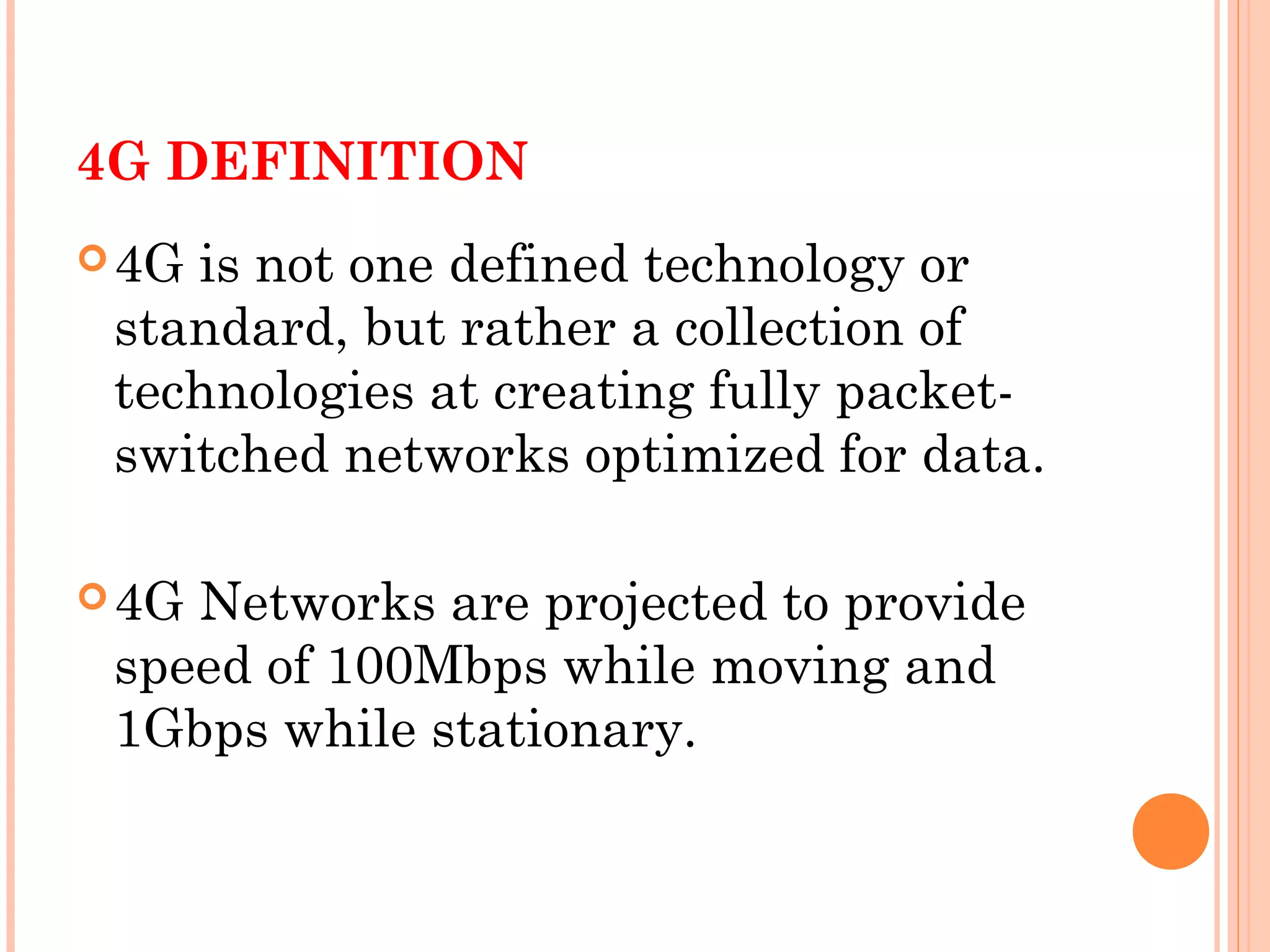
4G DEFINITION
4G is not one defined technology or
standard, but rather a collection of
technologies at creating fully packet-
switched networks optimized for data.
4G Networks are projected to provide
speed of 100Mbps while moving and
1Gbps while stationary.
INTRODUCTION
 4G, also known as
Beyond 3G, is a term
used to describe the
next step in wireless
communications
 Provides
comprehensive IP
solution where voice,
data and streamed
multimedia can be
given to users on an
"Anytime, Anywhere"
basis
 4G will be a fully IP
based integrated
system
EVOLUTION OF COMMUNICATIONS
NETWORKS
 First Generation: An analog system where
voice was considered to be the main traffic
 Second Generation: All standards in this form
are digital in form(GSM, IDEN)
 3G: The systems in this standard are
essentially a linear enhancement of 2G
systems
 2.75 G; 3G; 3.5G; 3G post
 4G: the infrastructure and the terminals of 4G
will have almost all the standards from 2G to
4G implemented
OBJECTIVES
 High network capacity: more
simultaneous users per cell
 A data rate of at least 100 Mbit/s between
any two points in the world
 Seamless connectivity and global roaming
across multiple networks
 High quality of service for next generation
multimedia support
USERS OF 4G
• The Japanese company NTT DoCoMo has
been testing a 4G communication system
prototype and is planning to release the
first commercial network in 2010
• Digiweb, an Irish wireless broadband
company recently started to use it
• Verizon Wireless and Vodafone are
getting together to establish 4g networks
soon.
• Sprint also announced that it is going to
launch it in 2008
COMMUNICATIONS
ARCHITECTURE
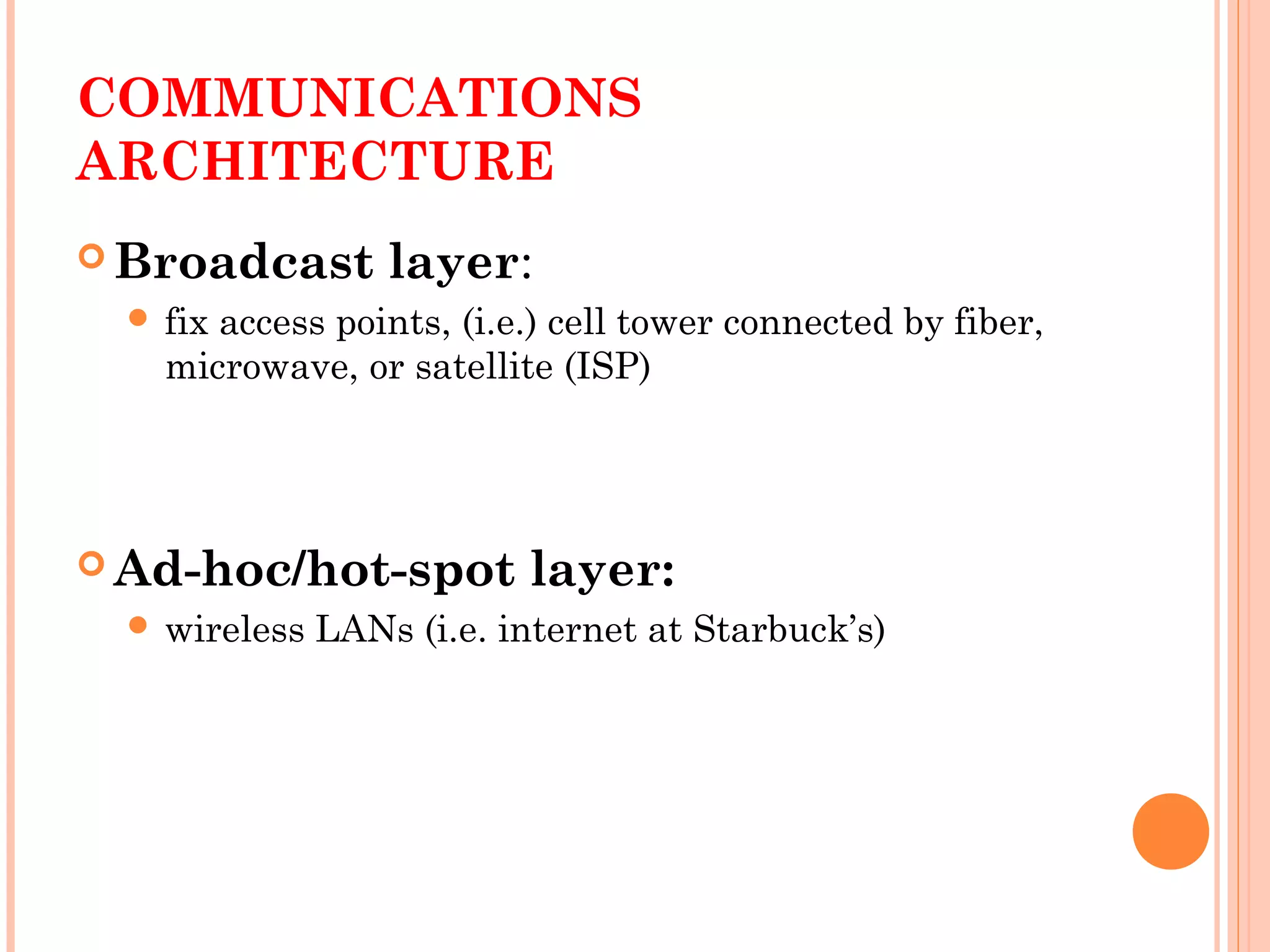
 Broadcast layer:
 fix access points, (i.e.) cell tower connected by fiber,
microwave, or satellite (ISP)
 Ad-hoc/hot-spot layer:
 wireless LANs (i.e. internet at Starbuck’s)
COMMUNICATIONS
ARCHITECTURE
 Personal Layer Gateway:
devices that connect to upper layers; cell
phone, fax, voice, data modem, MP3 players,
PDAs
 Info-Sensor layer:
environmental sensors
 Fiber-optic wire layer:
high speed subterranean labyrinth of fiber
optic cables and repeaters
AD HOC NETWORKS
 Spontaneous self
organization of networks of
devices
 Not necessarily connected
to internet
 4G will create hybrid
wireless networks using Ad
Hoc networks
 Form of mesh networking–
Very reliable
ENHANCE MOBILE GAMING
Experience enhance wireless
capabilities that deliver mobile gaming
interaction with less than five seconds
Play online multi player games while
traveling at high speeds or sitting
outside
BROADBAND ACCESS IN REMOTE
LOCATION
 4G will provide a wireless alternative for
broadband access
 I will provide first opportunity for broadband
access in remote locations without an
infrastructure to support cable or DSL access.
THANKING YOU

4 g technology in digital

  • 2.
    4G COMMUNICATION SYSTEMS INDIGITAL ENVIRONMENT Dheeraj Singh Negi
  • 3.
    4G DEFINITION 4G isnot one defined technology or standard, but rather a collection of technologies at creating fully packet- switched networks optimized for data. 4G Networks are projected to provide speed of 100Mbps while moving and 1Gbps while stationary.
  • 4.
    INTRODUCTION  4G, alsoknown as Beyond 3G, is a term used to describe the next step in wireless communications  Provides comprehensive IP solution where voice, data and streamed multimedia can be given to users on an "Anytime, Anywhere" basis  4G will be a fully IP based integrated system
  • 5.
    EVOLUTION OF COMMUNICATIONS NETWORKS First Generation: An analog system where voice was considered to be the main traffic  Second Generation: All standards in this form are digital in form(GSM, IDEN)  3G: The systems in this standard are essentially a linear enhancement of 2G systems  2.75 G; 3G; 3.5G; 3G post  4G: the infrastructure and the terminals of 4G will have almost all the standards from 2G to 4G implemented
  • 6.
    OBJECTIVES  High networkcapacity: more simultaneous users per cell  A data rate of at least 100 Mbit/s between any two points in the world  Seamless connectivity and global roaming across multiple networks  High quality of service for next generation multimedia support
  • 7.
    USERS OF 4G •The Japanese company NTT DoCoMo has been testing a 4G communication system prototype and is planning to release the first commercial network in 2010 • Digiweb, an Irish wireless broadband company recently started to use it • Verizon Wireless and Vodafone are getting together to establish 4g networks soon. • Sprint also announced that it is going to launch it in 2008
  • 8.
    COMMUNICATIONS ARCHITECTURE  Broadcast layer: fix access points, (i.e.) cell tower connected by fiber, microwave, or satellite (ISP)  Ad-hoc/hot-spot layer:  wireless LANs (i.e. internet at Starbuck’s)
  • 9.
    COMMUNICATIONS ARCHITECTURE  Personal LayerGateway: devices that connect to upper layers; cell phone, fax, voice, data modem, MP3 players, PDAs  Info-Sensor layer: environmental sensors  Fiber-optic wire layer: high speed subterranean labyrinth of fiber optic cables and repeaters
  • 10.
    AD HOC NETWORKS Spontaneous self organization of networks of devices  Not necessarily connected to internet  4G will create hybrid wireless networks using Ad Hoc networks  Form of mesh networking– Very reliable
  • 11.
    ENHANCE MOBILE GAMING Experienceenhance wireless capabilities that deliver mobile gaming interaction with less than five seconds Play online multi player games while traveling at high speeds or sitting outside
  • 12.
    BROADBAND ACCESS INREMOTE LOCATION  4G will provide a wireless alternative for broadband access  I will provide first opportunity for broadband access in remote locations without an infrastructure to support cable or DSL access.
  • 13.