www.oeclib.org
Submitted by:
Odisha Electronic Control library
Seminar
On
4G Wireless System
CONTENTS
• INTRODUCTION
• LIMITATIONS OF 3G AND DRIVERS FOR 4G
• 4G VISIONS MAPPING TO RESEARCH TOPICS
• RESEARCH CHALLENGES
• CONCLUSION
• REFERENCES
Introduction
• The major driver to change in the mobile area in the last ten
years has been the massive enabling implications of digital
technology, both in digital signal processing and in service
provision.
• The equivalent driver now, and in the next five years, will be
the all pervasiveness of software in both networks and
terminals.
Limitations of 3G and drivers for 4G
• From its basic conception to the time of roll-out took around
ten years for 2G; a similar period will apply to 3G, which will
commence service in 2001/2 and reach full deployment by
2005.
• Thus by 2010 it will be time to deploy 4G networks and,
working backwards with the ten year cycle, it is clear that the
year 2000 is appropriate to start with visions for 4G and a
research programme aimed at the key issues.
• The Mobile VCE’s second phase research programme has
been constructed to meet this aim.
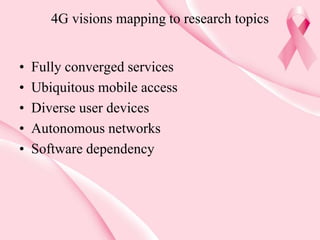
4G visions mapping to research topics
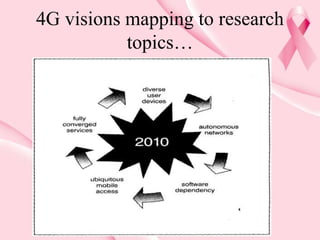
• Fully converged services
• Ubiquitous mobile access
• Diverse user devices
• Autonomous networks
• Software dependency
4G visions mapping to research
topics…
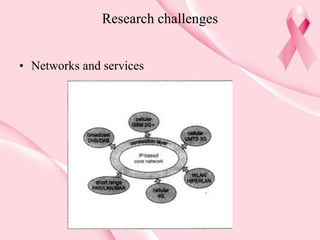
Research challenges
• Networks and services
Software systems
• Knowledge provision via intelligent browsing of the Internet
• E-business facilities for purchasing and payment
• Health monitoring and provision of warnings
• Infotainment: music, video and, maybe, virtual reality
Wireless access
• Adaptive reconfigurability—algorithms
• Spectral efficiency—air interface design and allocation of
bandwidth
• Environment coverage—all pervasive
• Software—for the radio and the network access
• Technology—embedded/wearable/low-power/high
communication time/displays.
Conclusion
• It is always dangerous to predict too far ahead in a fast-
moving field such as mobile communications.
• Almost by definition the eventual 2010 scene will not match
exactly that depicted in the 4G vision described herein.
• However, the key elements—fully converged services,
ubiquitous mobile access, diverse user devices, autonomous
networks and software dependency—will persist.
• The 4G Vision is a living document which intends to update
and amend as time and knowledge progress.
References
• www.google.com
• www.wikipedia.com
Thanks

4G Wireless Systems ppt

  • 1.
    www.oeclib.org Submitted by: Odisha ElectronicControl library Seminar On 4G Wireless System
  • 2.
    CONTENTS • INTRODUCTION • LIMITATIONSOF 3G AND DRIVERS FOR 4G • 4G VISIONS MAPPING TO RESEARCH TOPICS • RESEARCH CHALLENGES • CONCLUSION • REFERENCES
  • 3.
    Introduction • The majordriver to change in the mobile area in the last ten years has been the massive enabling implications of digital technology, both in digital signal processing and in service provision. • The equivalent driver now, and in the next five years, will be the all pervasiveness of software in both networks and terminals.
  • 4.
    Limitations of 3Gand drivers for 4G • From its basic conception to the time of roll-out took around ten years for 2G; a similar period will apply to 3G, which will commence service in 2001/2 and reach full deployment by 2005. • Thus by 2010 it will be time to deploy 4G networks and, working backwards with the ten year cycle, it is clear that the year 2000 is appropriate to start with visions for 4G and a research programme aimed at the key issues. • The Mobile VCE’s second phase research programme has been constructed to meet this aim.
  • 5.
    4G visions mappingto research topics • Fully converged services • Ubiquitous mobile access • Diverse user devices • Autonomous networks • Software dependency
  • 6.
    4G visions mappingto research topics…
  • 7.
  • 8.
    Software systems • Knowledgeprovision via intelligent browsing of the Internet • E-business facilities for purchasing and payment • Health monitoring and provision of warnings • Infotainment: music, video and, maybe, virtual reality
  • 9.
    Wireless access • Adaptivereconfigurability—algorithms • Spectral efficiency—air interface design and allocation of bandwidth • Environment coverage—all pervasive • Software—for the radio and the network access • Technology—embedded/wearable/low-power/high communication time/displays.
  • 10.
    Conclusion • It isalways dangerous to predict too far ahead in a fast- moving field such as mobile communications. • Almost by definition the eventual 2010 scene will not match exactly that depicted in the 4G vision described herein. • However, the key elements—fully converged services, ubiquitous mobile access, diverse user devices, autonomous networks and software dependency—will persist. • The 4G Vision is a living document which intends to update and amend as time and knowledge progress.
  • 11.
  • 12.

Editor's Notes