By: Shikha shakya
Project 2 (ITV205)
Submitted to: Mr. Hardik sir
 Introduction to 5G
 Evolution from 1G to 5G
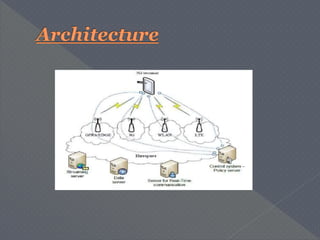
 Architecture
 Hardware & Software of 5G
 Features
 Major challenges
 Advantages
 Applications
 Conclusion
 What is wireless?
 What is 5G?
 What does It offer?
 What 5G will provide?
 The word wireless in dictionary is defined
having no wires .
 In networking terminology, wireless is the
term used to describe any computer network
where there is no physical wired connection
between sender and receiver, but rather the
network is connected by radio waves and or
microwaves to maintain communications.
 Wireless networking utilizes specific equipment
such as NICs and Routers in place of
wires(copper or optical fibre).
 5G wireless: Fifth generation wireless
technology
 Complete wireless communication with
almost no limitations
 Can be called REAL wireless world
 Has incredible transmission speed
 Concept is only theory not real
 Worldwide cellular phones
 Extraordinary data capabilities
 High connectivity
 More power & features in hand held phones
 Large phone memory, more dialing
speed,more clarity in audio & video.
 Multi domain performance
 Foundation for efficient industries and
society
 Massive machine type of communications
 Energy performance
 Global standard
 Mass market personalized TV
 Critical machine type of communications
 1G
 2G
 3G
 4G
 5G
 1G refers to the first
generation of wireless
telephone technology,
mobile telecommunication
which was first introduced
in 1980s & completed in
early 1990s
 Based on analog system
 Speed was upto 2.4 kbps.
 AMPS (Advance Mobile
phone system)was
launched by the US & it
was the 1G mobile system.
 It allows user to make
voice calls in 1 country.
 2G technology refers
to the second
generation which is
based on GSM.
 It was launched in
Finland in the year
1991.
 2G network use digital
signals.
 It’s data speed was
upto 64 kbps.
 It enables service such
as text messages,
pictures messages and
MMS (multi media
message).
 It provides better
quality and capacity.
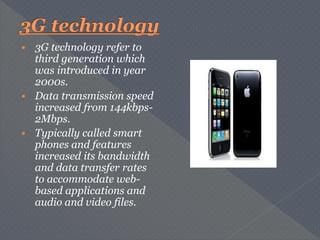
 3G technology refer to
third generation which
was introduced in year
2000s.
 Data transmission speed
increased from 144kbps-
2Mbps.
 Typically called smart
phones and features
increased its bandwidth
and data transfer rates
to accommodate web-
based applications and
audio and video files.
 Providing faster
communication
 Send/Receive Large
Email Messages
 High speed web /More
security
 Video conferencing/3D
Gaming
 TV streaming/ Mobile
TV/ phone calls
 Large capacities and
broadband Capabilities
 11 sec. – 1.5 min. time to
download a 3 min. Mp3
song
 High-speed data access
 High quality streaming video
 Combination of wi-fi and wi-
max
 Capable of providing
100Mbps-1Gbps speed
 One of the basic term used to
describe 4G is MAGIC.
MAGIC:
 Mobile Multimedia
 Anytime Anywhere
 Global Mobility Support
 Integrated Wireless Solution
 Customized Personal Services
Also known as Mobile Broadband
Everywhere.
 More Security
 High speed
 High Capacity
 Low Cost Per-bit etc.
 Except for the Scandinavian
Countries(Northern Europe that includes
Denmark and two of the nation of
Scandinavian ,Norway and Sweden ),a few
countries have started the 4G commercially
.
 In the US , Sprint Nextel and Other
Germany , Spain , China , Japan and
England are also using the 4G service and
mobiles .
 5G technology refer to
short name of fifth
Generation which was
started from late 2010s
 Complete wireless
communication with
almost no limitations
 It is highly supportable
to WWWW (wireless
world wide web).
 High speed , High capacity
 5G technology providing large broadcasting of
data in Gbps.
 Multi- Media Newspapers, watch T.V programs
with clarity as to that of an HD Quality.
 Faster data transmission that of the previous
generations.
 Large Phone Memory ,Dialing Speed, clarity in
Audio/ Video.
 Support interactive multimedia , voice , streaming
video , Internet and other
 5G is More Effective and More Attractive .
 Lower cost than previous generations
5G Hardware:
 Uses UWB ( Ultra Wides
Band) networks with
higher BW at low
energy levels
 BW is of 4000 Mbps ,
which is 400 times
faster than today’s
wireless networks
 Uses smart antenna
 Uses CDMA (code
division multiple Access)
5G software:
 5G will be single unified
standard of different
wireless network,
including LAN
technologies, LAN
/WAN, WWWW (world
wide wireless web,
unified IP & seamless
combination of
broadband
 Software defined radio,
encryption, flexibility,
Anti-virus.
 High resolution for crazy cell phone users
 Bi-directional large BW
 Less traffic
 25 Mbps connectivity speed
 Enhanced & available connectivity just about the
world
 Uploading & downloading speed of 5G touching
the peak (up to 1 Gbps)
 Better & fast solution
 High quality service based on policy to avoid error
 Support virtual private networks
 More attractive & effective
 Provides subscriber supervision tools for fast
action
 Data BW of 1 Gbps or higher
 Globally accessible
 Dynamic information access
 Available at low cost
 Wearable device with AI (Artificial
Intelligence) capabilities
 Pervasive (Global) networks
 Media independent handover
 Radio resources management
 VoIP (voice over IP) enabled devices
 With sixth sense technology
 3G- operator centric,
4G- service centric whereas
5G- User centric
 We have proposed 5G wireless concept designed
as an open platform on different layers
 The new coming 5G technology will be available
in the market at affordable rates, high peak
future & much reliability than preceding
technologies
Thank you...!!!


PRESENTATION

  • 1.
    By: Shikha shakya Project2 (ITV205) Submitted to: Mr. Hardik sir
  • 2.
     Introduction to5G  Evolution from 1G to 5G  Architecture  Hardware & Software of 5G  Features  Major challenges  Advantages  Applications  Conclusion
  • 3.
     What iswireless?  What is 5G?  What does It offer?  What 5G will provide?
  • 4.
     The wordwireless in dictionary is defined having no wires .  In networking terminology, wireless is the term used to describe any computer network where there is no physical wired connection between sender and receiver, but rather the network is connected by radio waves and or microwaves to maintain communications.  Wireless networking utilizes specific equipment such as NICs and Routers in place of wires(copper or optical fibre).
  • 5.
     5G wireless:Fifth generation wireless technology  Complete wireless communication with almost no limitations  Can be called REAL wireless world  Has incredible transmission speed  Concept is only theory not real
  • 6.
     Worldwide cellularphones  Extraordinary data capabilities  High connectivity  More power & features in hand held phones  Large phone memory, more dialing speed,more clarity in audio & video.
  • 7.
     Multi domainperformance  Foundation for efficient industries and society  Massive machine type of communications  Energy performance  Global standard  Mass market personalized TV  Critical machine type of communications
  • 8.
     1G  2G 3G  4G  5G
  • 9.
     1G refersto the first generation of wireless telephone technology, mobile telecommunication which was first introduced in 1980s & completed in early 1990s  Based on analog system  Speed was upto 2.4 kbps.  AMPS (Advance Mobile phone system)was launched by the US & it was the 1G mobile system.  It allows user to make voice calls in 1 country.
  • 10.
     2G technologyrefers to the second generation which is based on GSM.  It was launched in Finland in the year 1991.  2G network use digital signals.  It’s data speed was upto 64 kbps.
  • 11.
     It enablesservice such as text messages, pictures messages and MMS (multi media message).  It provides better quality and capacity.
  • 12.
     3G technologyrefer to third generation which was introduced in year 2000s.  Data transmission speed increased from 144kbps- 2Mbps.  Typically called smart phones and features increased its bandwidth and data transfer rates to accommodate web- based applications and audio and video files.
  • 13.
     Providing faster communication Send/Receive Large Email Messages  High speed web /More security  Video conferencing/3D Gaming  TV streaming/ Mobile TV/ phone calls  Large capacities and broadband Capabilities  11 sec. – 1.5 min. time to download a 3 min. Mp3 song
  • 14.
     High-speed dataaccess  High quality streaming video  Combination of wi-fi and wi- max  Capable of providing 100Mbps-1Gbps speed  One of the basic term used to describe 4G is MAGIC. MAGIC:  Mobile Multimedia  Anytime Anywhere  Global Mobility Support  Integrated Wireless Solution  Customized Personal Services Also known as Mobile Broadband Everywhere.
  • 15.
     More Security High speed  High Capacity  Low Cost Per-bit etc.
  • 16.
     Except forthe Scandinavian Countries(Northern Europe that includes Denmark and two of the nation of Scandinavian ,Norway and Sweden ),a few countries have started the 4G commercially .  In the US , Sprint Nextel and Other Germany , Spain , China , Japan and England are also using the 4G service and mobiles .
  • 17.
     5G technologyrefer to short name of fifth Generation which was started from late 2010s  Complete wireless communication with almost no limitations  It is highly supportable to WWWW (wireless world wide web).
  • 18.
     High speed, High capacity  5G technology providing large broadcasting of data in Gbps.  Multi- Media Newspapers, watch T.V programs with clarity as to that of an HD Quality.  Faster data transmission that of the previous generations.  Large Phone Memory ,Dialing Speed, clarity in Audio/ Video.  Support interactive multimedia , voice , streaming video , Internet and other  5G is More Effective and More Attractive .  Lower cost than previous generations
  • 20.
    5G Hardware:  UsesUWB ( Ultra Wides Band) networks with higher BW at low energy levels  BW is of 4000 Mbps , which is 400 times faster than today’s wireless networks  Uses smart antenna  Uses CDMA (code division multiple Access) 5G software:  5G will be single unified standard of different wireless network, including LAN technologies, LAN /WAN, WWWW (world wide wireless web, unified IP & seamless combination of broadband  Software defined radio, encryption, flexibility, Anti-virus.
  • 21.
     High resolutionfor crazy cell phone users  Bi-directional large BW  Less traffic  25 Mbps connectivity speed  Enhanced & available connectivity just about the world  Uploading & downloading speed of 5G touching the peak (up to 1 Gbps)  Better & fast solution  High quality service based on policy to avoid error  Support virtual private networks  More attractive & effective  Provides subscriber supervision tools for fast action
  • 23.
     Data BWof 1 Gbps or higher  Globally accessible  Dynamic information access  Available at low cost
  • 24.
     Wearable devicewith AI (Artificial Intelligence) capabilities  Pervasive (Global) networks  Media independent handover  Radio resources management  VoIP (voice over IP) enabled devices  With sixth sense technology
  • 25.
     3G- operatorcentric, 4G- service centric whereas 5G- User centric  We have proposed 5G wireless concept designed as an open platform on different layers  The new coming 5G technology will be available in the market at affordable rates, high peak future & much reliability than preceding technologies
  • 26.