

5G Mobile
technology
5G Technology Preface
With successful use of 4G technology,
telecommunication companies are looking forward to 5G
Technology as a new step in the communication network.
Companies are on the way to reach the goal of 5th Generation
technology. If we talk about the current positions, standard
bodies like 3Gbps are aware of this development. The major
achievement of this technology is to have fast downloading with
small use data. It can hope that 5G Mobile Wireless
Technologies will be completely achieved in 2020.
Vision of 5G tech
• A super efficient Mobile Network.
• A super fast Mobile Network.
• A Converged fiber Wireless Network.
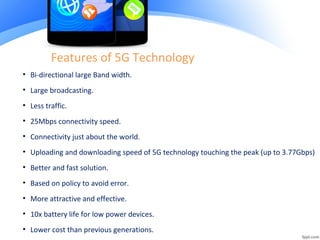
Features of 5G Technology
• Bi-directional large Band width.
• Large broadcasting.
• Less traffic.
• 25Mbps connectivity speed.
• Connectivity just about the world.
• Uploading and downloading speed of 5G technology touching the peak (up to 3.77Gbps)
• Better and fast solution.
• Based on policy to avoid error.
• More attractive and effective.
• 10x battery life for low power devices.
• Lower cost than previous generations.
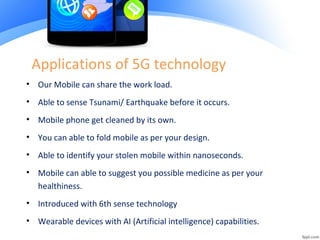
Applications of 5G technology
• Our Mobile can share the work load.
• Able to sense Tsunami/ Earthquake before it occurs.
• Mobile phone get cleaned by its own.
• You can able to fold mobile as per your design.
• Able to identify your stolen mobile within nanoseconds.
• Mobile can able to suggest you possible medicine as per your
healthiness.
• Introduced with 6th sense technology
• Wearable devices with AI (Artificial intelligence) capabilities.
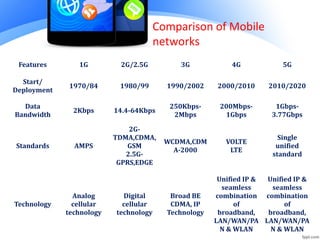
Features 1G 2G/2.5G 3G 4G 5G
Start/
Deployment
1970/84 1980/99 1990/2002 2000/2010 2010/2020
Data
Bandwidth
2Kbps 14.4-64Kbps
250Kbps-
2Mbps
200Mbps-
1Gbps
1Gbps-
3.77Gbps
Standards AMPS
2G-
TDMA,CDMA,
GSM
2.5G-
GPRS,EDGE
WCDMA,CDM
A-2000
VOLTE
LTE
Single
unified
standard
Technology
Analog
cellular
technology
Digital
cellular
technology
Broad BE
CDMA, IP
Technology
Unified IP &
seamless
combination
of
broadband,
LAN/WAN/PA
N & WLAN
Unified IP &
seamless
combination
of
broadband,
LAN/WAN/PA
N & WLAN
Comparison of Mobile
networks
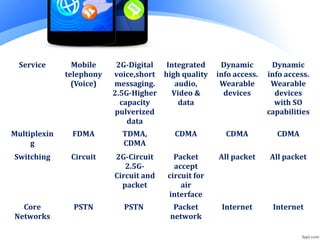
Service Mobile
telephony
(Voice)
2G-Digital
voice,short
messaging.
2.5G-Higher
capacity
pulverized
data
Integrated
high quality
audio,
Video &
data
Dynamic
info access.
Wearable
devices
Dynamic
info access.
Wearable
devices
with SO
capabilities
Multiplexin
g
FDMA TDMA,
CDMA
CDMA CDMA CDMA
Switching Circuit 2G-Circuit
2.5G-
Circuit and
packet
Packet
accept
circuit for
air
interface
All packet All packet
Core
Networks
PSTN PSTN Packet
network
Internet Internet
Conclusion
The development of the Mobile and wireless networks is
going towards higher data rates and all IP principle. Currently, there
are many available radio access technologies, which provide
possibility for IP based communication on the network layer, as
well as there is migration of all services in IP environment, including
the traditional Internet services, such as web and electronic mail as
most used among the others. It is accepted that the initial Internet
philosophy of keeping the network as possible, and giving more
functionalities to the end nodes,will become reality in the future
generation of mobile, here referred to as 5G.
Thanking to
DCN lecturer E & C
Ananthram Sir
5 g technology ppt

5 g technology ppt

  • 3.
  • 4.
    5G Technology Preface Withsuccessful use of 4G technology, telecommunication companies are looking forward to 5G Technology as a new step in the communication network. Companies are on the way to reach the goal of 5th Generation technology. If we talk about the current positions, standard bodies like 3Gbps are aware of this development. The major achievement of this technology is to have fast downloading with small use data. It can hope that 5G Mobile Wireless Technologies will be completely achieved in 2020.
  • 5.
    Vision of 5Gtech • A super efficient Mobile Network. • A super fast Mobile Network. • A Converged fiber Wireless Network.
  • 6.
    Features of 5GTechnology • Bi-directional large Band width. • Large broadcasting. • Less traffic. • 25Mbps connectivity speed. • Connectivity just about the world. • Uploading and downloading speed of 5G technology touching the peak (up to 3.77Gbps) • Better and fast solution. • Based on policy to avoid error. • More attractive and effective. • 10x battery life for low power devices. • Lower cost than previous generations.
  • 7.
    Applications of 5Gtechnology • Our Mobile can share the work load. • Able to sense Tsunami/ Earthquake before it occurs. • Mobile phone get cleaned by its own. • You can able to fold mobile as per your design. • Able to identify your stolen mobile within nanoseconds. • Mobile can able to suggest you possible medicine as per your healthiness. • Introduced with 6th sense technology • Wearable devices with AI (Artificial intelligence) capabilities.
  • 8.
    Features 1G 2G/2.5G3G 4G 5G Start/ Deployment 1970/84 1980/99 1990/2002 2000/2010 2010/2020 Data Bandwidth 2Kbps 14.4-64Kbps 250Kbps- 2Mbps 200Mbps- 1Gbps 1Gbps- 3.77Gbps Standards AMPS 2G- TDMA,CDMA, GSM 2.5G- GPRS,EDGE WCDMA,CDM A-2000 VOLTE LTE Single unified standard Technology Analog cellular technology Digital cellular technology Broad BE CDMA, IP Technology Unified IP & seamless combination of broadband, LAN/WAN/PA N & WLAN Unified IP & seamless combination of broadband, LAN/WAN/PA N & WLAN Comparison of Mobile networks
  • 9.
    Service Mobile telephony (Voice) 2G-Digital voice,short messaging. 2.5G-Higher capacity pulverized data Integrated high quality audio, Video& data Dynamic info access. Wearable devices Dynamic info access. Wearable devices with SO capabilities Multiplexin g FDMA TDMA, CDMA CDMA CDMA CDMA Switching Circuit 2G-Circuit 2.5G- Circuit and packet Packet accept circuit for air interface All packet All packet Core Networks PSTN PSTN Packet network Internet Internet
  • 10.
    Conclusion The development ofthe Mobile and wireless networks is going towards higher data rates and all IP principle. Currently, there are many available radio access technologies, which provide possibility for IP based communication on the network layer, as well as there is migration of all services in IP environment, including the traditional Internet services, such as web and electronic mail as most used among the others. It is accepted that the initial Internet philosophy of keeping the network as possible, and giving more functionalities to the end nodes,will become reality in the future generation of mobile, here referred to as 5G.
  • 11.
    Thanking to DCN lecturerE & C Ananthram Sir