5G WIRELESS
TECHNOLOGY
INTRODUCTION
 5G is the fifth generation cellular network technology.
5G technology was started from late 2010s.
 Complete wireless communication with almost no limitations.
 It is highly supportable to WWWW (Wireless World Wide Web).
 5g wireless technology will change the way we use wireless gadgets
with high bandwidth.
 Overall, 5G is expected to generate a variety of new applications, uses
and business cases as the technology is rolled out.
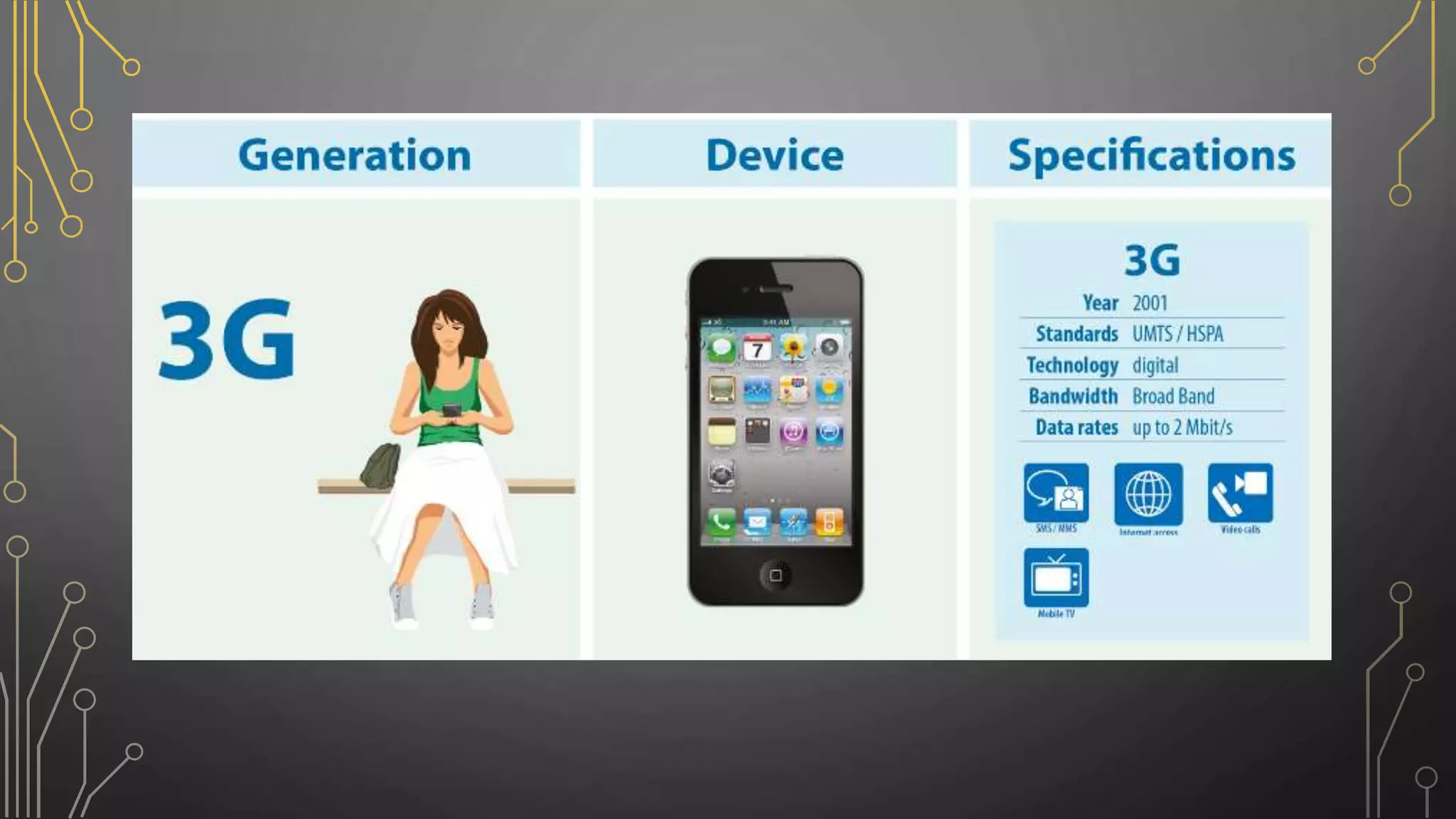
EVOLUTION OF MOBILE COMMUNICATION
1G TO 4G
COMPARISON BETWEEN ALL NETWORKS
Wireless networks are composed of cell sites divided into sectors that send
data through radio waves. Fourth-generation (4G) Long-Term Evolution
(LTE) wireless technology provides the foundation for 5G. Unlike 4G, which
requires large, high-power cell towers to radiate signals over longer
distances, 5G wireless signals will be transmitted via large numbers of small
cell stations located in places like light poles or building roofs. The use of
multiple small cells is necessary because the millimeter wave spectrum --
the band of spectrum between 30 GHz and 300 GHz that 5G relies on to
generate high speeds -- can only travel over short distances and is subject to
interference from weather and physical obstacles, like buildings.
HOW 5G WORKS
MERITS AND DEMERITS OF 5G
Merits :
 Less battery consumption.
 Higher speed network and high bandwidth.
 More efficient.
Demerits :
 Developing Infrastructure is very costly.
High bandwidth means less coverage.
Privacy and security issue is yet to be solved.
CONCLUSION
 All totally the best way to help all users is to use 5G as the next wireless
system and in totally it is safety and secure for public, this the need that
demands the solution.
 Today’s wired society is going wireless and if it has problem, 5G is answer.
 5G technology is going to give tough competition to Computers and
Laptops.
 It will be available in the market 2020 at affordable cost with more
reliability than previous mobiles.

5g wireless technology

  • 1.
  • 2.
    INTRODUCTION  5G isthe fifth generation cellular network technology. 5G technology was started from late 2010s.  Complete wireless communication with almost no limitations.  It is highly supportable to WWWW (Wireless World Wide Web).  5g wireless technology will change the way we use wireless gadgets with high bandwidth.  Overall, 5G is expected to generate a variety of new applications, uses and business cases as the technology is rolled out.
  • 3.
    EVOLUTION OF MOBILECOMMUNICATION 1G TO 4G
  • 8.
  • 10.
    Wireless networks arecomposed of cell sites divided into sectors that send data through radio waves. Fourth-generation (4G) Long-Term Evolution (LTE) wireless technology provides the foundation for 5G. Unlike 4G, which requires large, high-power cell towers to radiate signals over longer distances, 5G wireless signals will be transmitted via large numbers of small cell stations located in places like light poles or building roofs. The use of multiple small cells is necessary because the millimeter wave spectrum -- the band of spectrum between 30 GHz and 300 GHz that 5G relies on to generate high speeds -- can only travel over short distances and is subject to interference from weather and physical obstacles, like buildings. HOW 5G WORKS
  • 11.
    MERITS AND DEMERITSOF 5G Merits :  Less battery consumption.  Higher speed network and high bandwidth.  More efficient. Demerits :  Developing Infrastructure is very costly. High bandwidth means less coverage. Privacy and security issue is yet to be solved.
  • 12.
    CONCLUSION  All totallythe best way to help all users is to use 5G as the next wireless system and in totally it is safety and secure for public, this the need that demands the solution.  Today’s wired society is going wireless and if it has problem, 5G is answer.  5G technology is going to give tough competition to Computers and Laptops.  It will be available in the market 2020 at affordable cost with more reliability than previous mobiles.