Li-Fi
Technology
Introduction
• What is Li-Fi ?
• *Li-Fi stands for light fidelity.
• *It is bidirectional high speed and fully networked wireless
communication technology similar to WiFi.
• *Li-Fi is a technology that uses the Light Emitting Diodes
(LED) to transmit data wirelessly.
• *Li-Fi is based on Visible Light Communication (VLC).
• *This varies in intensity faster than human eye can follow.
• *Li-Fi is fast and cheap optical version of Wi-Fi.
History
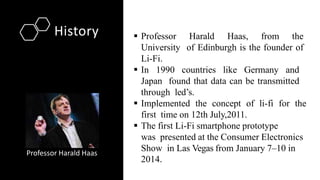
Professor Harald Haas
 Professor Harald Haas, from the
University of Edinburgh is the founder of
Li-Fi.
 In 1990 countries like Germany and
Japan found that data can be transmitted
through led’s.
 Implemented the concept of li-fi for the
first time on 12th July,2011.
 The first Li-Fi smartphone prototype
was presented at the Consumer Electronics
Show in Las Vegas from January 7–10 in
2014.
Present
Scenario
• Radio spectrum is congested but
the demand for wireless data
double each year.
• Bandwidth limitation.
• Data Security.
Working
Process
• Operational procedure is very simple, if
the led is on,transmit a digital 1 .
• if its off then transmit a 0. The LEDs can
be switched on and off very quickly, which
gives nice opportunities for transmitting
data. Hence all that required is some LEDs
and a controller that code data into those
LEDs. Wehave to just vary the rate at which
the LED’s .
• hus every light source will works as a hub
for data transmission .
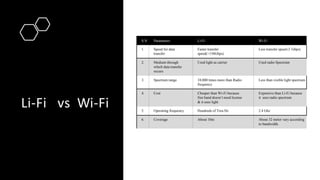
Li-Fi vs Wi-Fi
S.N Parameters Li-Fi Wi-Fi
1. Speed for data
transfer
Faster transfer
speed(>150Gbps)
Less transfer speed (1 Gbps)
2. Medium through
which data transfer
occurs
Used light as carrier Used radio Spectrum
3. Spectrum range 10,000 times more than Radio
frequency
Less than visible light spectrum
4. Cost Cheaper than Wi-Fi because
free band doesn’t need license
& it uses light
Expensive than Li-Fi because
it uses radio spectrum
5. Operating frequency Hundreds of Tera Hz 2.4 Ghz
6. Coverage About 10m About 32 meter vary according
to bandwidth.
Applications
• Li Fi technology is still in
its minority .However some areas where
it seems perfectly applicable are :
• Traffic lights
• virtually Safe Environment
• On ocean Beds
• Street Lamps(As Free Access Point)
Applications
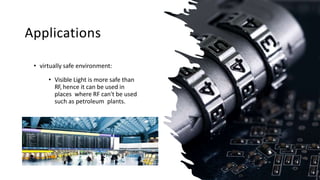
• virtually safe environment:
• Visible Light is more safe than
RF, hence it can be used in
places where RF can't be used
such as petroleum plants.
Applications
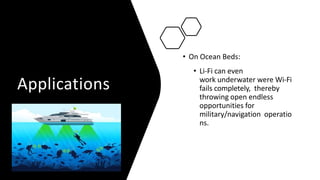
• On Ocean Beds:
• Li-Fi can even
work underwater were Wi-Fi
fails completely, thereby
throwing open endless
opportunities for
military/navigation operatio
ns.
Applications
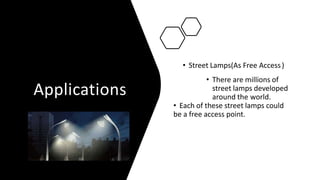
• Street Lamps(As Free Access)
• There are millions of
street lamps developed
around the world.
• Each of these street lamps could
be a free access point.
Challenges
for Li-Fi
 Light can’t pass through objects.
 Interferences from external light sources
like sun light, normal bulbs, and opaque
materials in the path of transmission
will cause interruption in the
communication
 A major challenge facing Li-Fi is
how the receiving device will
transmit back to transmitter.
Conclusion
• The possibilities are numerous and
can be explored further. If this
technology can be put into practical
use , every bulb can be used
something like a Wi-Fi hotspots to
transmit wireless data.
12
thank you

Lifi technology presentation

  • 1.
  • 2.
    Introduction • What isLi-Fi ? • *Li-Fi stands for light fidelity. • *It is bidirectional high speed and fully networked wireless communication technology similar to WiFi. • *Li-Fi is a technology that uses the Light Emitting Diodes (LED) to transmit data wirelessly. • *Li-Fi is based on Visible Light Communication (VLC). • *This varies in intensity faster than human eye can follow. • *Li-Fi is fast and cheap optical version of Wi-Fi.
  • 3.
    History Professor Harald Haas Professor Harald Haas, from the University of Edinburgh is the founder of Li-Fi.  In 1990 countries like Germany and Japan found that data can be transmitted through led’s.  Implemented the concept of li-fi for the first time on 12th July,2011.  The first Li-Fi smartphone prototype was presented at the Consumer Electronics Show in Las Vegas from January 7–10 in 2014.
  • 4.
    Present Scenario • Radio spectrumis congested but the demand for wireless data double each year. • Bandwidth limitation. • Data Security.
  • 5.
    Working Process • Operational procedureis very simple, if the led is on,transmit a digital 1 . • if its off then transmit a 0. The LEDs can be switched on and off very quickly, which gives nice opportunities for transmitting data. Hence all that required is some LEDs and a controller that code data into those LEDs. Wehave to just vary the rate at which the LED’s . • hus every light source will works as a hub for data transmission .
  • 6.
    Li-Fi vs Wi-Fi S.NParameters Li-Fi Wi-Fi 1. Speed for data transfer Faster transfer speed(>150Gbps) Less transfer speed (1 Gbps) 2. Medium through which data transfer occurs Used light as carrier Used radio Spectrum 3. Spectrum range 10,000 times more than Radio frequency Less than visible light spectrum 4. Cost Cheaper than Wi-Fi because free band doesn’t need license & it uses light Expensive than Li-Fi because it uses radio spectrum 5. Operating frequency Hundreds of Tera Hz 2.4 Ghz 6. Coverage About 10m About 32 meter vary according to bandwidth.
  • 7.
    Applications • Li Fitechnology is still in its minority .However some areas where it seems perfectly applicable are : • Traffic lights • virtually Safe Environment • On ocean Beds • Street Lamps(As Free Access Point)
  • 8.
    Applications • virtually safeenvironment: • Visible Light is more safe than RF, hence it can be used in places where RF can't be used such as petroleum plants.
  • 9.
    Applications • On OceanBeds: • Li-Fi can even work underwater were Wi-Fi fails completely, thereby throwing open endless opportunities for military/navigation operatio ns.
  • 10.
    Applications • Street Lamps(AsFree Access) • There are millions of street lamps developed around the world. • Each of these street lamps could be a free access point.
  • 11.
    Challenges for Li-Fi  Lightcan’t pass through objects.  Interferences from external light sources like sun light, normal bulbs, and opaque materials in the path of transmission will cause interruption in the communication  A major challenge facing Li-Fi is how the receiving device will transmit back to transmitter.
  • 12.
    Conclusion • The possibilitiesare numerous and can be explored further. If this technology can be put into practical use , every bulb can be used something like a Wi-Fi hotspots to transmit wireless data. 12
  • 13.