

By 
Web OPAC: A case study of 
International Management 
Institute Bhubaneswar Library 
Dheeraj Singh Negi 
dheerajnegi3@gmail.com
PPT Outline 
Introduction IMIB library 
Introduction WEB-OPAC 
Advantage of WEB-OPAC 
Analysis Books Searching by library users 
Finding Web OPAC use by IMIB library Users 
Why search Web OPAC 
Conclusion
Introduction IMIB Library 
• IMI Bhubaneswar library is located in a spacious and centrally 
air conditioned building over two floors spread over 6000 sq. 
feet. 
• The Information Centre aims to support the diverse 
information needs of all our students, faculty, researchers and 
staff through the provision of the ultra modern information 
resources and services. 
• The library provides access to relevant digital resources, 
covering not only all aspects of business and management, but 
also related areas such as sociology, computer science, 
economics, accounting, finance, behavioural sciences and 
information technology etc. 
• The large numbers of periodical titles subscribed by the library 
are a vital source for academic research and most journals are 
available electronically. 
• The Library and Information Service at IMI Bhubaneswar, offers 
access to a wide range of both printed and electronic sources 
with greater emphasis on electronic delivery of information to 
users.
Online Public Access Catalogue 
• An Online Public Access Catalogue (often 
abbreviated as OPAC or simply Library Catalogue) is 
an online database of materials held by a library or 
group of libraries. It is a computerized library 
catalogue available to the public. Most OPACs are 
accessible over the Internet to users all over the 
world. Users search a library catalogue principally 
to locate books and other material physically 
located at a library 
• Why use a catalogue instead of just browsing the 
shelves of the library to find a book? 
• Books that contain information on a particular topic 
may be shelved in several different areas of 
• the library, in special collections, or even in 
different libraries altogether.
• Books are shelved in the library by call number order (a 
unique number for each book), so you would have to be 
very familiar with the either the Dewey Decimal or 
Library of Congress Classification System to find the 
small area devoted to your topic. 
• The patrons in the library can search the bibliographic 
database and find specific information online. The 
• search facility also apprises the user about the 
availability of each item for circulation, including current 
• status of individual copies of a title and reserve status. It 
also shows titles on order displaying current 
• status in acquisition. The scope of these services include:
GENERAL FEATURES 
An OPAC is designed to give the user bibliographic details 
of holdings in the collection of a particular library. Many 
OPACs also let the user search the OPACs of a number of 
other libraries simultaneously, using the Z39.50 
protocol. Z39.50 is an international standard for 
communication between computer systems, primarily 
library- and information-related systems. Not all LMS 
suppliers may provide the full features of a portal, but 
they generally offer the features found in traditional 
OPACs, federated searching tools and user services such 
as renewals and interlibrary loan (ILL) requests. In 
addition, the portal may include other facilities for users 
who also want to carry out transactions, such as 
changing their address details, paying fines or cancelling 
reservations through the library's web.
Slide Title 
• Online Catalogues: The following catalogues are available online: 
• Title Catalogue 
• Author Catalogue 
• Subject Catalogue 
• Classified Catalogue 
• Publisher 
• Place of Publication 
• Boolean Searches: The boolean searches can be made on words from 
any of the bibliographic fields. The 
• use of the logical connectors 'OR', 'AND' and 'AND NOT' is allowed. 
The search is facilitated by using: 
• • Truncation 
• • Use of parentheses 
• • Proximity connectors (same as provided by 'DIALOG')
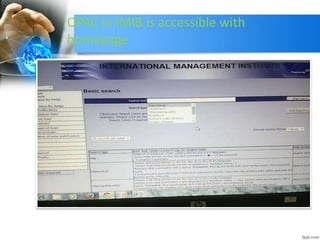
OPAC in IMIB is accessible with 
homepage
ADVANTAGES OF WEB OPAC 
1. Users can immediately notice the missing reprints by author search. 
2. Updating can be done quickly as Users take keen interest to submit the reprints. 
3. It is accessible all the time, worldwide. 
4. Increases awareness of 'Scientific Research Contributions' made by the Institute. 
5. It is possible for users to send reprint requests immediately by e-mail. 
6. Compilation of various lists of reprints becomes very easy.
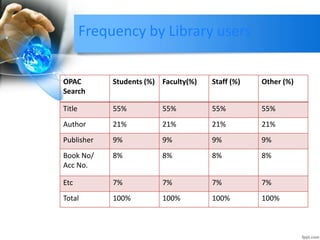
Frequency by Library users 
OPAC 
Search 
Students (%) Faculty(%) Staff (%) Other (%) 
Title 55% 55% 55% 55% 
Author 21% 21% 21% 21% 
Publisher 9% 9% 9% 9% 
Book No/ 
8% 8% 8% 8% 
Acc No. 
Etc 7% 7% 7% 7% 
Total 100% 100% 100% 100%
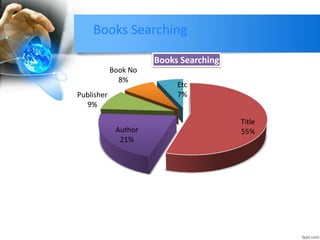
Books Searching 
Title 
Books Searching 
Author 55% 
21% 
Publisher 
9% 
Book No 
8% 
Etc 
7%
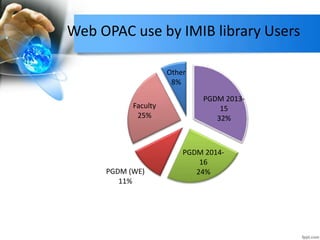
Web OPAC use by IMIB library Users 
PGDM 2013- 
15 
32% 
PGDM 2014- 
16 
PGDM (WE) 24% 
11% 
Faculty 
25% 
Other 
8%
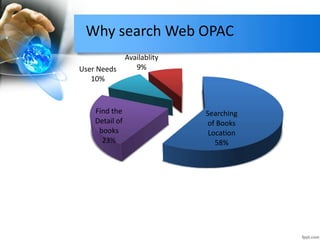
Why search Web OPAC 
Searching 
of Books 
Location 
58% 
User Needs 
10% 
Find the 
Detail of 
books 
23% 
Availablity 
9%
Conclusion 
IMIB library and Resource centre is a dynamic 
Management information centre in India . There 
are many library sources using by students and 
faculty member. Above study a Finding that 100 % 
students, faculty , other using web Opac his/her 
work. Mostly Users use the web Opac for books 
location searching .
Thanks

Web OPAC

  • 1.
    By Web OPAC:A case study of International Management Institute Bhubaneswar Library Dheeraj Singh Negi dheerajnegi3@gmail.com
  • 2.
    PPT Outline IntroductionIMIB library Introduction WEB-OPAC Advantage of WEB-OPAC Analysis Books Searching by library users Finding Web OPAC use by IMIB library Users Why search Web OPAC Conclusion
  • 3.
    Introduction IMIB Library • IMI Bhubaneswar library is located in a spacious and centrally air conditioned building over two floors spread over 6000 sq. feet. • The Information Centre aims to support the diverse information needs of all our students, faculty, researchers and staff through the provision of the ultra modern information resources and services. • The library provides access to relevant digital resources, covering not only all aspects of business and management, but also related areas such as sociology, computer science, economics, accounting, finance, behavioural sciences and information technology etc. • The large numbers of periodical titles subscribed by the library are a vital source for academic research and most journals are available electronically. • The Library and Information Service at IMI Bhubaneswar, offers access to a wide range of both printed and electronic sources with greater emphasis on electronic delivery of information to users.
  • 4.
    Online Public AccessCatalogue • An Online Public Access Catalogue (often abbreviated as OPAC or simply Library Catalogue) is an online database of materials held by a library or group of libraries. It is a computerized library catalogue available to the public. Most OPACs are accessible over the Internet to users all over the world. Users search a library catalogue principally to locate books and other material physically located at a library • Why use a catalogue instead of just browsing the shelves of the library to find a book? • Books that contain information on a particular topic may be shelved in several different areas of • the library, in special collections, or even in different libraries altogether.
  • 5.
    • Books areshelved in the library by call number order (a unique number for each book), so you would have to be very familiar with the either the Dewey Decimal or Library of Congress Classification System to find the small area devoted to your topic. • The patrons in the library can search the bibliographic database and find specific information online. The • search facility also apprises the user about the availability of each item for circulation, including current • status of individual copies of a title and reserve status. It also shows titles on order displaying current • status in acquisition. The scope of these services include:
  • 6.
    GENERAL FEATURES AnOPAC is designed to give the user bibliographic details of holdings in the collection of a particular library. Many OPACs also let the user search the OPACs of a number of other libraries simultaneously, using the Z39.50 protocol. Z39.50 is an international standard for communication between computer systems, primarily library- and information-related systems. Not all LMS suppliers may provide the full features of a portal, but they generally offer the features found in traditional OPACs, federated searching tools and user services such as renewals and interlibrary loan (ILL) requests. In addition, the portal may include other facilities for users who also want to carry out transactions, such as changing their address details, paying fines or cancelling reservations through the library's web.
  • 7.
    Slide Title •Online Catalogues: The following catalogues are available online: • Title Catalogue • Author Catalogue • Subject Catalogue • Classified Catalogue • Publisher • Place of Publication • Boolean Searches: The boolean searches can be made on words from any of the bibliographic fields. The • use of the logical connectors 'OR', 'AND' and 'AND NOT' is allowed. The search is facilitated by using: • • Truncation • • Use of parentheses • • Proximity connectors (same as provided by 'DIALOG')
  • 8.
    OPAC in IMIBis accessible with homepage
  • 9.
    ADVANTAGES OF WEBOPAC 1. Users can immediately notice the missing reprints by author search. 2. Updating can be done quickly as Users take keen interest to submit the reprints. 3. It is accessible all the time, worldwide. 4. Increases awareness of 'Scientific Research Contributions' made by the Institute. 5. It is possible for users to send reprint requests immediately by e-mail. 6. Compilation of various lists of reprints becomes very easy.
  • 10.
    Frequency by Libraryusers OPAC Search Students (%) Faculty(%) Staff (%) Other (%) Title 55% 55% 55% 55% Author 21% 21% 21% 21% Publisher 9% 9% 9% 9% Book No/ 8% 8% 8% 8% Acc No. Etc 7% 7% 7% 7% Total 100% 100% 100% 100%
  • 11.
    Books Searching Title Books Searching Author 55% 21% Publisher 9% Book No 8% Etc 7%
  • 12.
    Web OPAC useby IMIB library Users PGDM 2013- 15 32% PGDM 2014- 16 PGDM (WE) 24% 11% Faculty 25% Other 8%
  • 13.
    Why search WebOPAC Searching of Books Location 58% User Needs 10% Find the Detail of books 23% Availablity 9%
  • 14.
    Conclusion IMIB libraryand Resource centre is a dynamic Management information centre in India . There are many library sources using by students and faculty member. Above study a Finding that 100 % students, faculty , other using web Opac his/her work. Mostly Users use the web Opac for books location searching .
  • 15.