Seminar on….


               By:
               Niki Upadhyay
               100120107097
 Introduction to 5G
 Evolution from 1G to 5G
 Key concepts
 Architecture
 Hardware & Software of 5G
 Features
 Advantages
 Applications
 Conclusion
 What is 5G?
 What does it offer?
 5G Wireless: 5th generation wireless technology
 Complete wireless communication with almost no
  limitations
 Can be called REAL wireless world
 Has incredible transmission speed
 Concept is only theory not real
 Worldwide cellular phones
 Extraordinary data capabilities
 High connectivity
 More power & features in hand held phones
 Large phone memory, more dialing speed, more
 clarity in audio & video
 1G
 2G
 3G
 4G
 5G
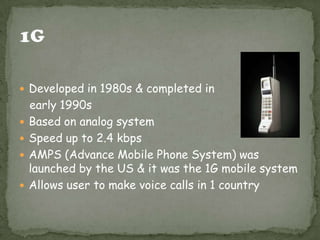
 Developed in 1980s & completed in
    early 1990s
   Based on analog system
   Speed up to 2.4 kbps
   AMPS (Advance Mobile Phone System) was
    launched by the US & it was the 1G mobile system
   Allows user to make voice calls in 1 country
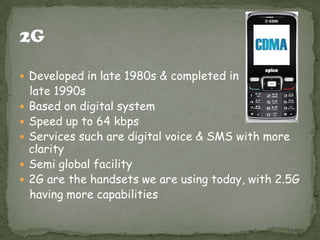
 Developed in late 1980s & completed in
    late 1990s
   Based on digital system
   Speed up to 64 kbps
   Services such are digital voice & SMS with more
    clarity
   Semi global facility
   2G are the handsets we are using today, with 2.5G
    having more capabilities
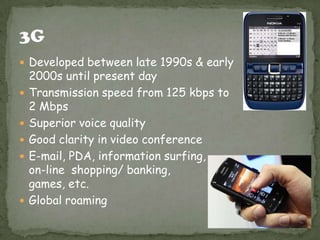
 Developed between late 1990s & early
    2000s until present day
   Transmission speed from 125 kbps to
    2 Mbps
   Superior voice quality
   Good clarity in video conference
   E-mail, PDA, information surfing,
    on-line shopping/ banking,
    games, etc.
   Global roaming
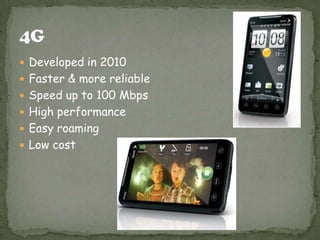
 Developed in 2010
 Faster & more reliable
 Speed up to 100 Mbps
 High performance
 Easy roaming
 Low cost
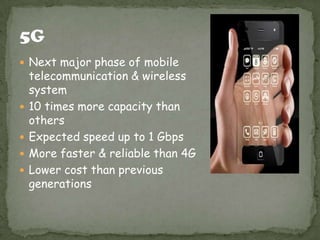
 Next major phase of mobile
    telecommunication & wireless
    system
   10 times more capacity than
    others
   Expected speed up to 1 Gbps
   More faster & reliable than 4G
   Lower cost than previous
    generations
 Real wireless world with no more limitations with
    access & zone issues
   Wearable devices
   IPv6, where a visiting care of mobile IP address is
    assigned according to location & connected
    network
   One unified global standard
   Smart radio
   The user can simultaneously be connected with
    several wireless access technology
   Multiple concurrent data transfer path
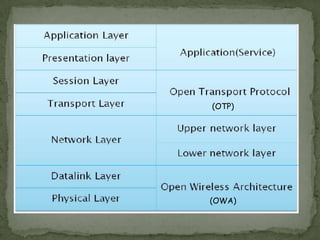
(OTP)


(OWA)
 OSI layer 1 & OSI layer 2 define the wireless
  technology
 For these two layers the 5G mobile network is
  likely to be based on Open Wireless Architecture
  (OWA)
 Physical layer + Data link layer = OWA
 All mobile networks will use mobile IP
 Each mobile terminal will be FA (Foreign Agent)
 A mobile can be attached to several mobiles or
  wireless networks at the same time
 The fixed IPv6 will be implemented in the mobile
  phones
 Separation of network layer into two sub-layers:
  (i) Lower network layer (for each interface)
  (ii) Upper network layer (for the mobile terminal)
 Wireless network differs from wired network
    regarding the transport layer
   In all TCP versions the assumption is that lost
    segments are due to network congestion
   In wireless, the loss is due to higher bit error
    ratio in the radio interface
   5G mobile terminals have transport layer that is
    possible to be downloaded & installed – Open
    Transport Protocol (OTP)
   Transport layer + Session layer = OTP
 Provides intelligent QoS (Quality of Service)
    management over variety of networks
   Provides possibility for service quality testing &
    storage of measurement information in
    information database in the mobile terminal
   Select the best wireless connection for given
    services
   QoS parameters, such
    as, delay, losses, BW, reliability, will be stored in
    DB of 5G mobile
   Presentation layer + Application layer =
    Application
 5G Hardware:                 5G Software:
• Uses UWB (Ultra Wide        • 5G will be single unified
  Band) networks with           standard of different
  higher BW at low energy       wireless
  levels                        networks, including LAN
• BW is of 4000                 technologies, LAN/WAN,
  Mbps, which is 400 times       WWWW- World Wide
  faster than today’s           Wireless Web, unified IP
  wireless networks             & seamless combination
                                of broadband
• Uses smart antenna
                              • Software defined
• Uses CDMA (Code
  Division Multiple Access)     radio, encryption, flexibil
                                ity, Anti-Virus
 High resolution for crazy cell phone users
 Bi-directional large BW
 Less traffic
 25 Mbps connectivity speed
 Enhanced & available connectivity just about the
  world
 Uploading & Downloading speed of 5G touching the
  peak (up to 1 Gbps)
 Better & fast solution
 High quality service based on policy to avoid error
 Support virtual private networks
 More attractive & effective
 Provides subscriber supervision tools for fast
 action
 Data BW of 1 Gbps or higher
 Globally accessible
 Dynamic information access
 Available at low cost
 Wearable devices with AI (Artificial Intelligence)
    capabilities
   Pervasive (Global) networks
   Media independent handover
   Radio resource management
   VoIP (Voice over IP) enabled devices
   With 6th sense technology
 3G- Operator Centric,
  4G- Service Centric whereas
  5G- User Centric
 We have proposed 5G wireless concept designed
  as an open platform on different layers
 The new coming 5G technology will be available in
  the market at affordable rates, high peak future
  & much reliability than preceding technologies


5G Wireless Technology

  • 1.
    Seminar on…. By: Niki Upadhyay 100120107097
  • 2.
     Introduction to5G  Evolution from 1G to 5G  Key concepts  Architecture  Hardware & Software of 5G  Features  Advantages  Applications  Conclusion
  • 3.
     What is5G?  What does it offer?
  • 4.
     5G Wireless:5th generation wireless technology  Complete wireless communication with almost no limitations  Can be called REAL wireless world  Has incredible transmission speed  Concept is only theory not real
  • 5.
     Worldwide cellularphones  Extraordinary data capabilities  High connectivity  More power & features in hand held phones  Large phone memory, more dialing speed, more clarity in audio & video
  • 6.
     1G  2G 3G  4G  5G
  • 7.
     Developed in1980s & completed in early 1990s  Based on analog system  Speed up to 2.4 kbps  AMPS (Advance Mobile Phone System) was launched by the US & it was the 1G mobile system  Allows user to make voice calls in 1 country
  • 8.
     Developed inlate 1980s & completed in late 1990s  Based on digital system  Speed up to 64 kbps  Services such are digital voice & SMS with more clarity  Semi global facility  2G are the handsets we are using today, with 2.5G having more capabilities
  • 9.
     Developed betweenlate 1990s & early 2000s until present day  Transmission speed from 125 kbps to 2 Mbps  Superior voice quality  Good clarity in video conference  E-mail, PDA, information surfing, on-line shopping/ banking, games, etc.  Global roaming
  • 10.
     Developed in2010  Faster & more reliable  Speed up to 100 Mbps  High performance  Easy roaming  Low cost
  • 11.
     Next majorphase of mobile telecommunication & wireless system  10 times more capacity than others  Expected speed up to 1 Gbps  More faster & reliable than 4G  Lower cost than previous generations
  • 12.
     Real wirelessworld with no more limitations with access & zone issues  Wearable devices  IPv6, where a visiting care of mobile IP address is assigned according to location & connected network  One unified global standard  Smart radio  The user can simultaneously be connected with several wireless access technology  Multiple concurrent data transfer path
  • 14.
  • 15.
     OSI layer1 & OSI layer 2 define the wireless technology  For these two layers the 5G mobile network is likely to be based on Open Wireless Architecture (OWA)  Physical layer + Data link layer = OWA
  • 16.
     All mobilenetworks will use mobile IP  Each mobile terminal will be FA (Foreign Agent)  A mobile can be attached to several mobiles or wireless networks at the same time  The fixed IPv6 will be implemented in the mobile phones  Separation of network layer into two sub-layers: (i) Lower network layer (for each interface) (ii) Upper network layer (for the mobile terminal)
  • 17.
     Wireless networkdiffers from wired network regarding the transport layer  In all TCP versions the assumption is that lost segments are due to network congestion  In wireless, the loss is due to higher bit error ratio in the radio interface  5G mobile terminals have transport layer that is possible to be downloaded & installed – Open Transport Protocol (OTP)  Transport layer + Session layer = OTP
  • 18.
     Provides intelligentQoS (Quality of Service) management over variety of networks  Provides possibility for service quality testing & storage of measurement information in information database in the mobile terminal  Select the best wireless connection for given services  QoS parameters, such as, delay, losses, BW, reliability, will be stored in DB of 5G mobile  Presentation layer + Application layer = Application
  • 19.
     5G Hardware:  5G Software: • Uses UWB (Ultra Wide • 5G will be single unified Band) networks with standard of different higher BW at low energy wireless levels networks, including LAN • BW is of 4000 technologies, LAN/WAN, Mbps, which is 400 times WWWW- World Wide faster than today’s Wireless Web, unified IP wireless networks & seamless combination of broadband • Uses smart antenna • Software defined • Uses CDMA (Code Division Multiple Access) radio, encryption, flexibil ity, Anti-Virus
  • 20.
     High resolutionfor crazy cell phone users  Bi-directional large BW  Less traffic  25 Mbps connectivity speed  Enhanced & available connectivity just about the world  Uploading & Downloading speed of 5G touching the peak (up to 1 Gbps)  Better & fast solution
  • 21.
     High qualityservice based on policy to avoid error  Support virtual private networks  More attractive & effective  Provides subscriber supervision tools for fast action
  • 22.
     Data BWof 1 Gbps or higher  Globally accessible  Dynamic information access  Available at low cost
  • 23.
     Wearable deviceswith AI (Artificial Intelligence) capabilities  Pervasive (Global) networks  Media independent handover  Radio resource management  VoIP (Voice over IP) enabled devices  With 6th sense technology
  • 24.
     3G- OperatorCentric, 4G- Service Centric whereas 5G- User Centric  We have proposed 5G wireless concept designed as an open platform on different layers  The new coming 5G technology will be available in the market at affordable rates, high peak future & much reliability than preceding technologies
  • 25.