5G WHAT AND WHY?
5G Technology stands for 5th Generation Mobile Technology. 5G technology has
changed to use cell phones within very high bandwidth. 5G is a packet switched wireless system
with wide area coverage and high throughput. 5G technologies use CDMA and BDMA and
millimeter wireless that enables seed is greater than 100Mbps at full mobility and higher
than1Gbps at low mobility. The 5G technologies include all types of advanced features which
make 5G technology most powerful and in huge demand in the near future. It is not amazing,
such a huge collection of technology being integrated into a small device. The 5G technology
provides the mobile phone users more features and efficiency. A user of mobile phone can easily
hook their 5G technology gadget with laptops or tablets to acquire broadband internet
connectivity. Up till now following features of the 5G technology have come to surface- High
resolution is offered by 5G for extreme mobile users, it also offers bidirectional huge bandwidth ,
higher data rates and the finest Quality of Service (QoS).
COMPARISON AMONG 3G, 4G AND 5G TECHNOLOGIES
FEATURES 3G 4G 5G
Data Bandwidth 2Mbps 2Mbps to 1Gbps 1Gbps & Higher
Frequency Band 1.8 - 2.5 GHz 2 - 8 GHz 3-300GHz
Standards WCDMA CDMA-
200 TD-SCDMA
All access convergence
including:
OFMDA,MC-CDMA
Network-LMPS
CDMA & BDMA
Technology Broad bandwidth
CDMA,IP
technology
Unified IP And
seamless combination
of broadband
LAN/WAN/ PAN and
WLAN
Unified IP and seamless
combination of
broadband,
LAN/WAN/PAN/WLAN
and technologies for 5G
new deployment
Service Integrated high
quality audio, video
and data
Dynamic information
access, wear-able
devices, HD streaming;
global roaming
Dynamic information
access, wear-able
devices, HD streaming;
any demand of users;
upcoming all
technologies; global
roaming smoothly;
Multiple Access CDMA CDMA CDMA & BDMA
Start from 2001 2010 2015
NEED FOR 5G
 It could make better revenue for current global operators as well as interoperability will
become more feasible.
 Improved and innovative data coding and modulation techniques, which includes filter
bank multi carrier way in schemes.
 For wireless access and back haul use of millimeter wave frequencies is very useful.
 With the support of different conduction points with related coverage and surrounding the
option of a supple usage of resources for uplink and down link transmission in each cell
is achieved by superior intrusion and mobility management.
 To make 5G practical for all sorts of radio access technologies there should be a common
platform unique for all the technologies.
 Lower battery consumption.
 Lower outage probability.
 Better coverage and high data rates available at cell edge.
 Multiple concurrent data transfer paths.
 Possible to1Gbps and higher data rate in mobility.
 More secure; better cognitive radio/SDR Security.
 Higher system level spectral efficiency.
 World Wide Wireless Web (WWWW), wireless-based web applications that include full
multimedia capability beyond 4G speeds.
 More applications combined with Artificial Intelligent (AI) as human life will be
surrounded by artificial sensors which could be communicating with mobile phones.
 Not harmful to human health.
 Cheaper traffic fees due to low infrastructure deployment costs.
 Smart beam antenna systems.
ADVANTAGES OF 5G NETWORK OF THE MASTERCORE
TECHNOLOGY
The Master Core technology has been designed for boundless wireless service; so that
computer, entertainment devices and mobile phone may all share the same wireless network and
can be connected with internet anytime, anywhere. It‘s designed for 5G communication system
to fulfill the limitless target up to the next two centuries, the common features as following:
 Files can be downloaded (even movies) within seconds.
 Pages will upload almost instantly.
 Can play easily online games.
 5G devices are comparatively less expensive than 3G and 4G devices.
 Using 5G the battery runs out very fast.
 Finest Quality of Service (QoS).
 All Networks can be gathered on a platform.
 Easily support previous generations.
 New deployments of 5G can be connected directly with The Mastercore by 5G -IU (5G
Interfacing Unit) without All IP concept.
 No limitation as user demands.
 Ability to support the new services.
 World combination services are available.
 The Master Core’s hardware and software are upgradeable.
 Able to fill user‘s demand up to next century.
 Subscribers can store data in central storage.
 Remote PCs can be controlled by handsets.
 Subscriber can use application software without installation in own devices that provided
by the MasterCore.
 Security is distributed several layers.
 The MasterCore can manage all securities of PSTNs, MSC, and BTS etc.
 The high quality services of 5G technology based on Policy to avoid error.
ARCHITECHTURE OF 5G
Terminals and network components are dynamically upgraded (and adapted) to new
situation. Network operators use the upgradeability to introduce value-added services more
easily. Upgradeability is based on cognitive radio. Cognitive radio technologies include the
ability of devices to determine their location and location‘s information (i.e. temperature,
weather etc.), sense spectrum used by neighboring devices, change frequency, adjust output
power and even alter transmission parameters and characteristics. A cognitive radio is a
transceiver (beam) that is able to understand and respond to its operating environment. Thus
cognitive radio concerns mobile devices and networks which are computationally intelligent
about radio resources and related communications to explore user communication needs and
provide wireless services, be appropriate to those needs. Hence, the radio is aware and cognitive
about changes in its environment and responds to these changes by adapting operating
characteristics in some way to improve its performance.
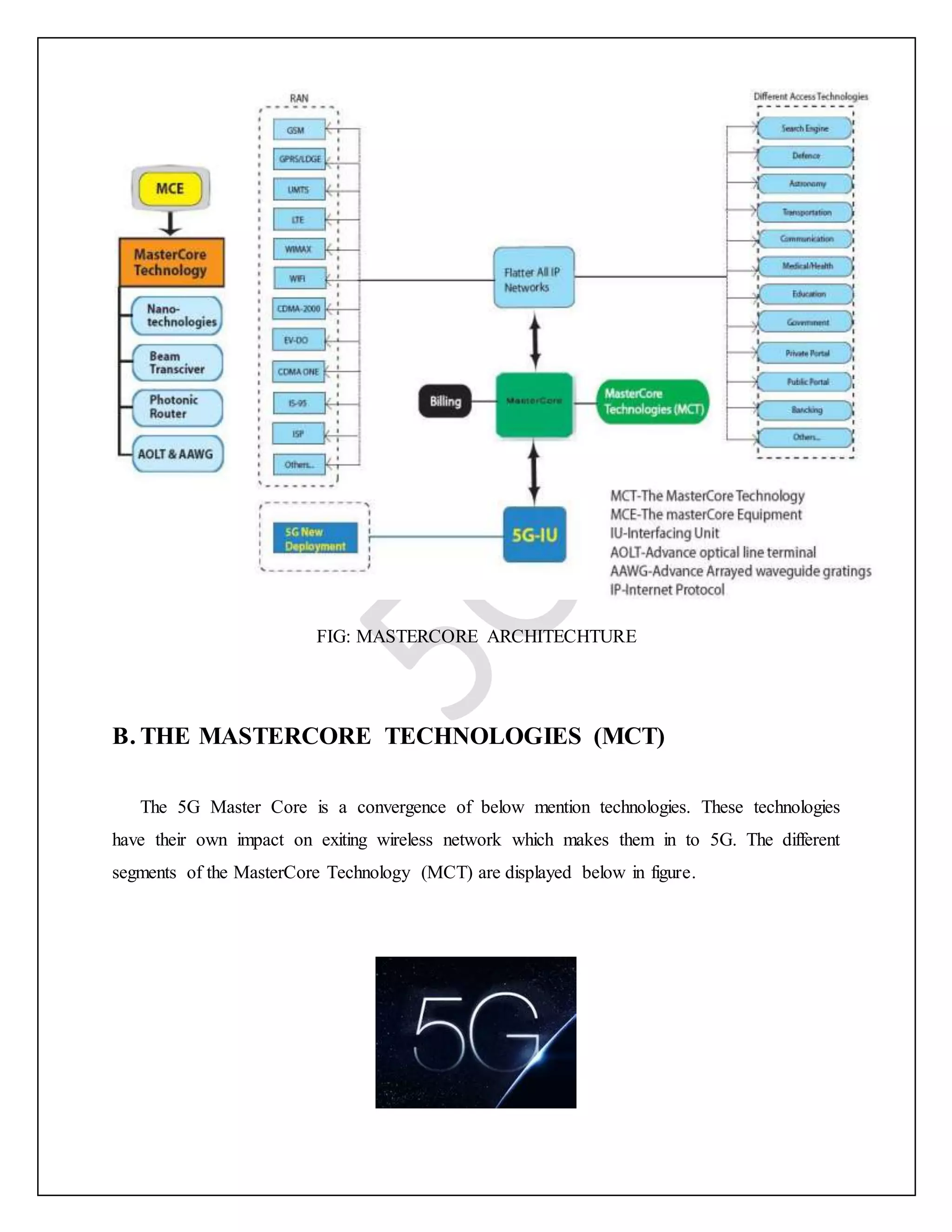
A. MASTERCORE
The 5G potential will require the design of a single wireless user terminal able to self-
explanatory operate in different heterogeneous access networks. A fully upgradable terminal
changes its communication functions depending on network and/or user demands. In addition,
the main challenge for an upgradable MasterCore is to deal with increasing number of different
radio access technologies based on solid interoperability criteria and mechanisms. A core could
be a convergence of the aforementioned nanotechnology, Parallel Multimode (PMM)
technology, cloud computing and cognitive radio, upgradable and based on All IP Platform and
5G-IU is called the MasterCore. The 5G MasterCore is an upgradable and multi-technologies
core. The MasterCore upgradability could be a self-adaptation and made adaptation to a
dynamically-changing environment or mission oriented adaptation to meet a given set of mission
requirements with the aim of improving service delivery and spectrum utilization. The
MasterCore changes its communication functions depending on network status and/or user
demands. Upgradability could be in both software and hardware.
FIG: MASTERCORE ARCHITECHTURE
B. THE MASTERCORE TECHNOLOGIES (MCT)
The 5G Master Core is a convergence of below mention technologies. These technologies
have their own impact on exiting wireless network which makes them in to 5G. The different
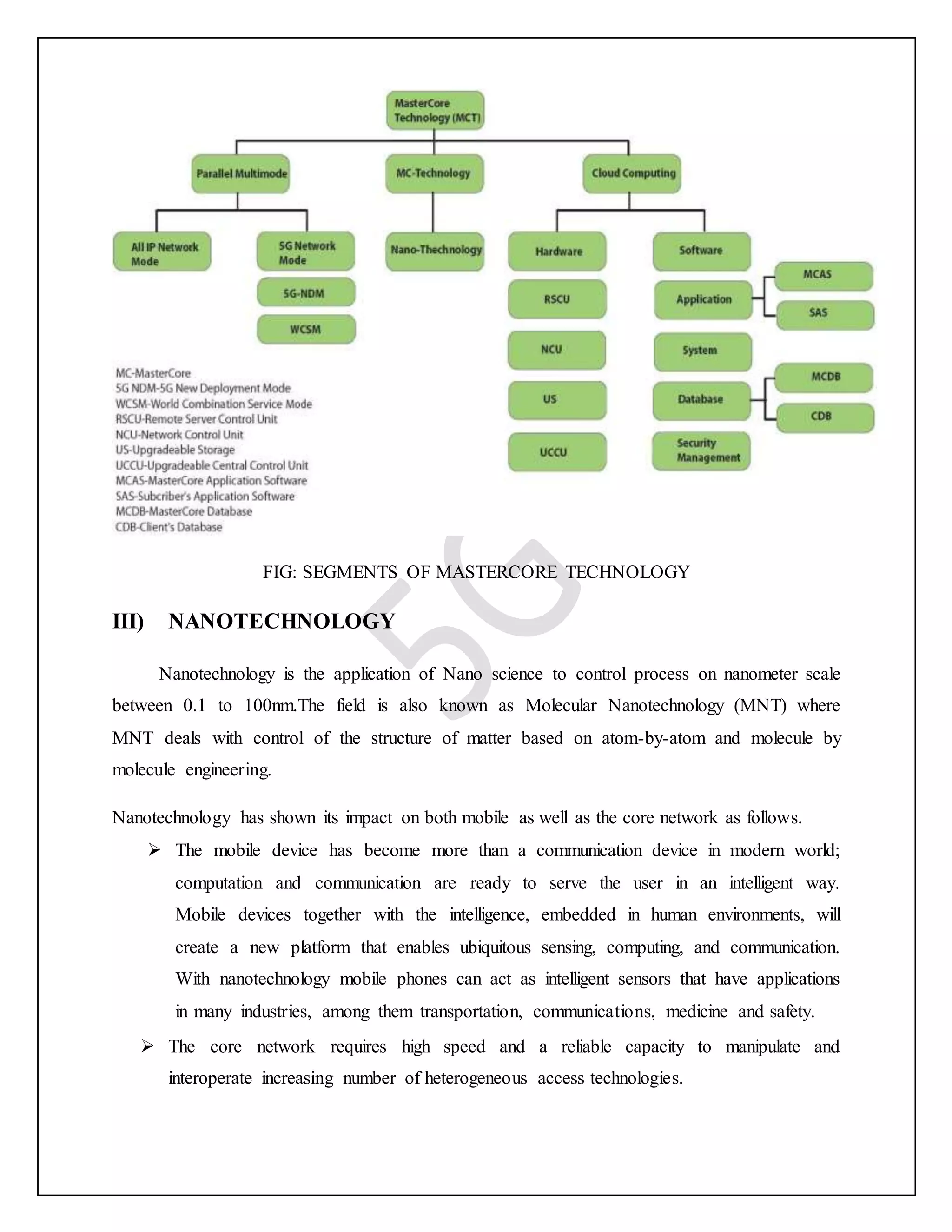
segments of the MasterCore Technology (MCT) are displayed below in figure.
I) PARALLEL MULTIMODE (PMM)
In 5G Wireless Communication Systems, The MasterCore can be operated into parallel
multimode such as All IP Network Mode, 5G Network Mode, where in All IP Network Mode
controls all network technologies of RAN and DAT (Different Access Networks) up to 5G new
deployments. 5G Network Mode manages all new deployments based on 5G as a result 5G
network systems will be more efficiency, powerful and less complicated. Any service mode can
be opened under 5G-NDM (New Deployment Mode) as WCSM (World Combination Service
Mode).WCSM provides some services among subscribers that can be used in special purposes.
For Parallel Multimode, any new service can be added easily so that system of the network no
needs to change. In fact all modes run at a time continuously (i.e. parallel).
II) ALL IP NETWORK
The All-IP Network (AIPN) is an evolution of the 3GPP system to fulfill the increasing
demands of the cellular communications market. It is a common platform valid for all sorts of
radio access technologies. AIPN focused primarily on the enhancements of packet switched
technology but now it provides a continued evolution and optimization in terms of both
performance and cost. The key benefits of AIPN architecture includes a variety of different
access systems‘provision, lower costs, universal seamless access, and increased user-satisfaction
and reduced system latency. But with the advantages of IP come some dangers: as data flow
more freely and the internet is open not only to developers but also to all manner of criminals
and viruses, developers and operators face new security challenges which should be solved
properly.
FIG: SEGMENTS OF MASTERCORE TECHNOLOGY
III) NANOTECHNOLOGY
Nanotechnology is the application of Nano science to control process on nanometer scale
between 0.1 to 100nm.The field is also known as Molecular Nanotechnology (MNT) where
MNT deals with control of the structure of matter based on atom-by-atom and molecule by
molecule engineering.
Nanotechnology has shown its impact on both mobile as well as the core network as follows.
 The mobile device has become more than a communication device in modern world;
computation and communication are ready to serve the user in an intelligent way.
Mobile devices together with the intelligence, embedded in human environments, will
create a new platform that enables ubiquitous sensing, computing, and communication.
With nanotechnology mobile phones can act as intelligent sensors that have applications
in many industries, among them transportation, communications, medicine and safety.
 The core network requires high speed and a reliable capacity to manipulate and
interoperate increasing number of heterogeneous access technologies.
IV) CLOUD COMPUTING
Cloud computing is a model for enabling ubiquitous, convenient, on-demand network
access to a shared pool of configurable computing resources (e.g., networks, servers, storage,
applications, and services) that can be rapidly provisioned and released with minimal
management effort or service provider interaction…” a definition from [11]. Hence, cloud
computing is a technology that uses the internet and central remote server to maintain data and
applications. In 5G networks this central remote server could be a content provider. Cloud
computing allows consumers and business to use applications without installation and access
their personal files at any computer with internet access. The same concept is going to be used in
multi-core technology where the user tries to access his private account form a global content
provider through cloud computing.
5G-IU
5G-IU (5G Interfacing Unit) acts to make the most powerful of 5G wireless
communication system. Because, all sorts of radio access technologies are combined in a
common platform is complex form of aggregation. It will be more complex in future when added
new radio access technologies. This is why, 5G-IU is used between new deployments and core
network so that 5G wireless communication system is easily manageable. It has some advantages
are:
 Lower costs to establish networks.
 Lessen equipments.
 Improve network efficiency.
 Reduce complexity.
 Easily maintain high security.
 Impossible to occur any trouble.
THE MASTERCORE EQUIPMENTS (MCE)
Equipments given as follow:
 Self Cleaning – the phone cleans by itself.
 Self powered – the phone derives its energy/power from the sun, water, or air.
 Sense the environment – the phone will tell you the weather, the amount of air pollution
present, etc.
 Flexible – bend but not break.
 More Reliable.
 Transparent – see through phones.
CONCLUSION
In this paper we have discussed the existing and future wireless mobile
communication generations and cellular systems focusing on four main key factors:
switching schemes, bandwidth, data rates, and radio access, also 5G main development
challenges and explained the necessity for 5G. The 5G mobile technology will be
implemented at the end of the current decade.
The new coming 5G technology is available in the market to fulfill user demands in
affordable rates, bright and high peak future also much reliability as well as exceptional
applications.
BY
AJITHKUMAR RAVI,
CSE DEPARTMENT
SRIRAM POLYTECHNIC COLLEGE,
PERUMALPATTU, CHENNAI.

5G perfect align

  • 1.
    5G WHAT ANDWHY? 5G Technology stands for 5th Generation Mobile Technology. 5G technology has changed to use cell phones within very high bandwidth. 5G is a packet switched wireless system with wide area coverage and high throughput. 5G technologies use CDMA and BDMA and millimeter wireless that enables seed is greater than 100Mbps at full mobility and higher than1Gbps at low mobility. The 5G technologies include all types of advanced features which make 5G technology most powerful and in huge demand in the near future. It is not amazing, such a huge collection of technology being integrated into a small device. The 5G technology provides the mobile phone users more features and efficiency. A user of mobile phone can easily hook their 5G technology gadget with laptops or tablets to acquire broadband internet connectivity. Up till now following features of the 5G technology have come to surface- High resolution is offered by 5G for extreme mobile users, it also offers bidirectional huge bandwidth , higher data rates and the finest Quality of Service (QoS).
  • 2.
    COMPARISON AMONG 3G,4G AND 5G TECHNOLOGIES FEATURES 3G 4G 5G Data Bandwidth 2Mbps 2Mbps to 1Gbps 1Gbps & Higher Frequency Band 1.8 - 2.5 GHz 2 - 8 GHz 3-300GHz Standards WCDMA CDMA- 200 TD-SCDMA All access convergence including: OFMDA,MC-CDMA Network-LMPS CDMA & BDMA Technology Broad bandwidth CDMA,IP technology Unified IP And seamless combination of broadband LAN/WAN/ PAN and WLAN Unified IP and seamless combination of broadband, LAN/WAN/PAN/WLAN and technologies for 5G new deployment Service Integrated high quality audio, video and data Dynamic information access, wear-able devices, HD streaming; global roaming Dynamic information access, wear-able devices, HD streaming; any demand of users; upcoming all technologies; global roaming smoothly; Multiple Access CDMA CDMA CDMA & BDMA Start from 2001 2010 2015
  • 3.
    NEED FOR 5G It could make better revenue for current global operators as well as interoperability will become more feasible.  Improved and innovative data coding and modulation techniques, which includes filter bank multi carrier way in schemes.  For wireless access and back haul use of millimeter wave frequencies is very useful.  With the support of different conduction points with related coverage and surrounding the option of a supple usage of resources for uplink and down link transmission in each cell is achieved by superior intrusion and mobility management.  To make 5G practical for all sorts of radio access technologies there should be a common platform unique for all the technologies.  Lower battery consumption.  Lower outage probability.  Better coverage and high data rates available at cell edge.  Multiple concurrent data transfer paths.  Possible to1Gbps and higher data rate in mobility.  More secure; better cognitive radio/SDR Security.  Higher system level spectral efficiency.  World Wide Wireless Web (WWWW), wireless-based web applications that include full multimedia capability beyond 4G speeds.  More applications combined with Artificial Intelligent (AI) as human life will be surrounded by artificial sensors which could be communicating with mobile phones.  Not harmful to human health.  Cheaper traffic fees due to low infrastructure deployment costs.  Smart beam antenna systems.
  • 4.
    ADVANTAGES OF 5GNETWORK OF THE MASTERCORE TECHNOLOGY The Master Core technology has been designed for boundless wireless service; so that computer, entertainment devices and mobile phone may all share the same wireless network and can be connected with internet anytime, anywhere. It‘s designed for 5G communication system to fulfill the limitless target up to the next two centuries, the common features as following:  Files can be downloaded (even movies) within seconds.  Pages will upload almost instantly.  Can play easily online games.  5G devices are comparatively less expensive than 3G and 4G devices.  Using 5G the battery runs out very fast.  Finest Quality of Service (QoS).  All Networks can be gathered on a platform.  Easily support previous generations.  New deployments of 5G can be connected directly with The Mastercore by 5G -IU (5G Interfacing Unit) without All IP concept.  No limitation as user demands.  Ability to support the new services.  World combination services are available.  The Master Core’s hardware and software are upgradeable.  Able to fill user‘s demand up to next century.  Subscribers can store data in central storage.  Remote PCs can be controlled by handsets.  Subscriber can use application software without installation in own devices that provided by the MasterCore.  Security is distributed several layers.  The MasterCore can manage all securities of PSTNs, MSC, and BTS etc.  The high quality services of 5G technology based on Policy to avoid error.
  • 5.
    ARCHITECHTURE OF 5G Terminalsand network components are dynamically upgraded (and adapted) to new situation. Network operators use the upgradeability to introduce value-added services more easily. Upgradeability is based on cognitive radio. Cognitive radio technologies include the ability of devices to determine their location and location‘s information (i.e. temperature, weather etc.), sense spectrum used by neighboring devices, change frequency, adjust output power and even alter transmission parameters and characteristics. A cognitive radio is a transceiver (beam) that is able to understand and respond to its operating environment. Thus cognitive radio concerns mobile devices and networks which are computationally intelligent about radio resources and related communications to explore user communication needs and provide wireless services, be appropriate to those needs. Hence, the radio is aware and cognitive about changes in its environment and responds to these changes by adapting operating characteristics in some way to improve its performance. A. MASTERCORE The 5G potential will require the design of a single wireless user terminal able to self- explanatory operate in different heterogeneous access networks. A fully upgradable terminal changes its communication functions depending on network and/or user demands. In addition, the main challenge for an upgradable MasterCore is to deal with increasing number of different radio access technologies based on solid interoperability criteria and mechanisms. A core could be a convergence of the aforementioned nanotechnology, Parallel Multimode (PMM) technology, cloud computing and cognitive radio, upgradable and based on All IP Platform and 5G-IU is called the MasterCore. The 5G MasterCore is an upgradable and multi-technologies core. The MasterCore upgradability could be a self-adaptation and made adaptation to a dynamically-changing environment or mission oriented adaptation to meet a given set of mission requirements with the aim of improving service delivery and spectrum utilization. The MasterCore changes its communication functions depending on network status and/or user demands. Upgradability could be in both software and hardware.
  • 6.
    FIG: MASTERCORE ARCHITECHTURE B.THE MASTERCORE TECHNOLOGIES (MCT) The 5G Master Core is a convergence of below mention technologies. These technologies have their own impact on exiting wireless network which makes them in to 5G. The different segments of the MasterCore Technology (MCT) are displayed below in figure.
  • 7.
    I) PARALLEL MULTIMODE(PMM) In 5G Wireless Communication Systems, The MasterCore can be operated into parallel multimode such as All IP Network Mode, 5G Network Mode, where in All IP Network Mode controls all network technologies of RAN and DAT (Different Access Networks) up to 5G new deployments. 5G Network Mode manages all new deployments based on 5G as a result 5G network systems will be more efficiency, powerful and less complicated. Any service mode can be opened under 5G-NDM (New Deployment Mode) as WCSM (World Combination Service Mode).WCSM provides some services among subscribers that can be used in special purposes. For Parallel Multimode, any new service can be added easily so that system of the network no needs to change. In fact all modes run at a time continuously (i.e. parallel). II) ALL IP NETWORK The All-IP Network (AIPN) is an evolution of the 3GPP system to fulfill the increasing demands of the cellular communications market. It is a common platform valid for all sorts of radio access technologies. AIPN focused primarily on the enhancements of packet switched technology but now it provides a continued evolution and optimization in terms of both performance and cost. The key benefits of AIPN architecture includes a variety of different access systems‘provision, lower costs, universal seamless access, and increased user-satisfaction and reduced system latency. But with the advantages of IP come some dangers: as data flow more freely and the internet is open not only to developers but also to all manner of criminals and viruses, developers and operators face new security challenges which should be solved properly.
  • 8.
    FIG: SEGMENTS OFMASTERCORE TECHNOLOGY III) NANOTECHNOLOGY Nanotechnology is the application of Nano science to control process on nanometer scale between 0.1 to 100nm.The field is also known as Molecular Nanotechnology (MNT) where MNT deals with control of the structure of matter based on atom-by-atom and molecule by molecule engineering. Nanotechnology has shown its impact on both mobile as well as the core network as follows.  The mobile device has become more than a communication device in modern world; computation and communication are ready to serve the user in an intelligent way. Mobile devices together with the intelligence, embedded in human environments, will create a new platform that enables ubiquitous sensing, computing, and communication. With nanotechnology mobile phones can act as intelligent sensors that have applications in many industries, among them transportation, communications, medicine and safety.  The core network requires high speed and a reliable capacity to manipulate and interoperate increasing number of heterogeneous access technologies.
  • 9.
    IV) CLOUD COMPUTING Cloudcomputing is a model for enabling ubiquitous, convenient, on-demand network access to a shared pool of configurable computing resources (e.g., networks, servers, storage, applications, and services) that can be rapidly provisioned and released with minimal management effort or service provider interaction…” a definition from [11]. Hence, cloud computing is a technology that uses the internet and central remote server to maintain data and applications. In 5G networks this central remote server could be a content provider. Cloud computing allows consumers and business to use applications without installation and access their personal files at any computer with internet access. The same concept is going to be used in multi-core technology where the user tries to access his private account form a global content provider through cloud computing. 5G-IU 5G-IU (5G Interfacing Unit) acts to make the most powerful of 5G wireless communication system. Because, all sorts of radio access technologies are combined in a common platform is complex form of aggregation. It will be more complex in future when added new radio access technologies. This is why, 5G-IU is used between new deployments and core network so that 5G wireless communication system is easily manageable. It has some advantages are:  Lower costs to establish networks.  Lessen equipments.  Improve network efficiency.  Reduce complexity.  Easily maintain high security.  Impossible to occur any trouble.
  • 10.
    THE MASTERCORE EQUIPMENTS(MCE) Equipments given as follow:  Self Cleaning – the phone cleans by itself.  Self powered – the phone derives its energy/power from the sun, water, or air.  Sense the environment – the phone will tell you the weather, the amount of air pollution present, etc.  Flexible – bend but not break.  More Reliable.  Transparent – see through phones. CONCLUSION In this paper we have discussed the existing and future wireless mobile communication generations and cellular systems focusing on four main key factors: switching schemes, bandwidth, data rates, and radio access, also 5G main development challenges and explained the necessity for 5G. The 5G mobile technology will be implemented at the end of the current decade. The new coming 5G technology is available in the market to fulfill user demands in affordable rates, bright and high peak future also much reliability as well as exceptional applications. BY AJITHKUMAR RAVI, CSE DEPARTMENT SRIRAM POLYTECHNIC COLLEGE, PERUMALPATTU, CHENNAI.