5G:FUTURE MOBILE
TECHNOLOGY

PRESENTED BY,
ANOOP UNNIKRISHNAN.P
S8 ECE-A
MTAKEEC020
13/01/2014

MET’S SCHOOL OF ENGINEERING,MALA

1
OVERVIEW












OBJECTIVES
INTRODUCTION TO 5G
LITERATURE SURVEY
EVOLUTION FROM 1G TO 5G
ARCHITECTURE
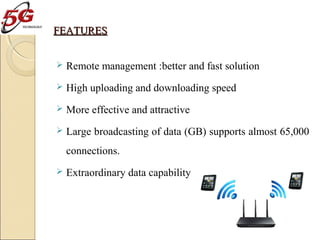
FEATURES
ADVANTAGES
APPLICATIONS
FUTURE SCOPE
CONCLUSION
REFERENCE

13/01/2014
2

MET’S SCHOOL OF ENGINEERING,MALA
OBJECTIVES

 Comprehensive study related to 5G mobile technology


Comparison of all generations of mobile technologies



To understand basic 5G mobile phone architecture

13/01/2014

MET’S SCHOOL OF ENGINEERING,MALA

3
INTRODUCTION


5G stands for 5th generation mobile Technology



Traffic on wireless networks doubling annually



4G technology will not be capable of carry this rapid increase of data
consumption



5th generation should be more intelligent technology that interconnects the
entire world without limits



5G does not exist yet but the future technology next to 4G we say as 5G.



leads to the development of WWWW(World Wide Wireless Web),real
wireless world etc.

13/01/2014

MET’S SCHOOL OF ENGINEERING,MALA

4
LITERATURE SURVEY
SI.N
O

PAPER NAME

PRESENTER NAME

1

4G:-The future
mobile technology

Jamil.M,Shaikh
S.P,Shahazad.M,
Awais.Q

2

Wireless Evolution
with 5G technology

13/01/2014

MET’S SCHOOL OF ENGINEERING,MALA

CONTENT

5
liter
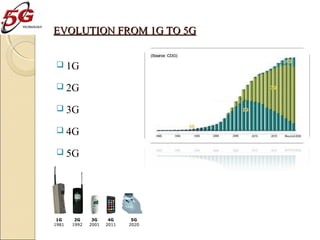
EVOLUTION FROM 1G TO 5G
 1G
 2G
 3G
 4G
 5G
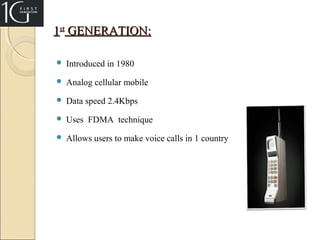
1st GENERATION:


Introduced in 1980



Analog cellular mobile



Data speed 2.4Kbps



Uses FDMA technique



Allows users to make voice calls in 1 country
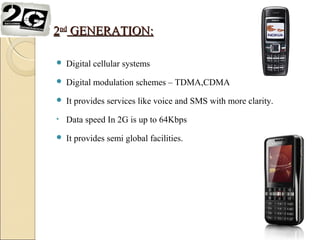
2nd GENERATION:


Digital cellular systems



Digital modulation schemes – TDMA,CDMA



It provides services like voice and SMS with more clarity.

•

Data speed In 2G is up to 64Kbps



It provides semi global facilities.
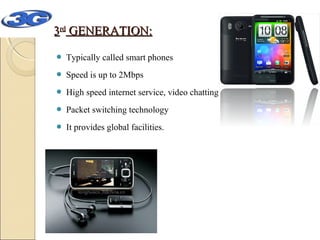
3rd GENERATION:


Typically called smart phones



Speed is up to 2Mbps



High speed internet service, video chatting



Packet switching technology



It provides global facilities.
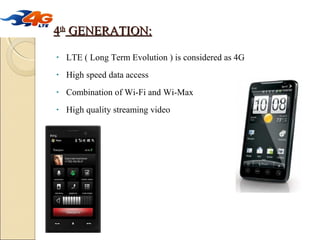
4th GENERATION:
•

LTE ( Long Term Evolution ) is considered as 4G

•

High speed data access

•

Combination of Wi-Fi and Wi-Max

•

High quality streaming video
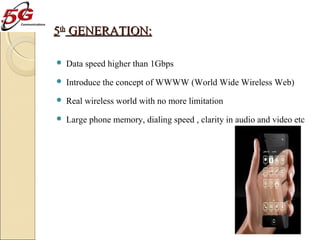
5th GENERATION:


Data speed higher than 1Gbps



Introduce the concept of WWWW (World Wide Wireless Web)



Real wireless world with no more limitation



Large phone memory, dialing speed , clarity in audio and video etc
ghtf
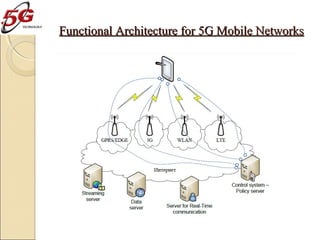
Functional Architecture for 5G Mobile Networks
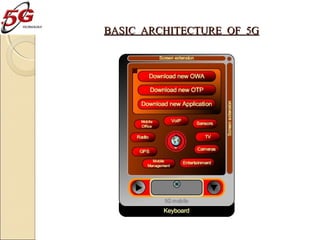
BASIC ARCHITECTURE OF 5G
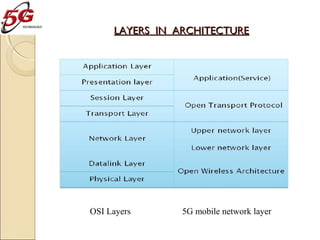
LAYERS IN ARCHITECTURE

OSI Layers

5G mobile network layer
EXPLANATION
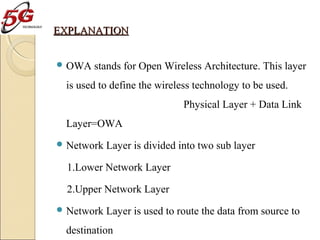
 OWA

stands for Open Wireless Architecture. This layer

is used to define the wireless technology to be used.
Physical Layer + Data Link
Layer=OWA
 Network

Layer is divided into two sub layer

1.Lower Network Layer
2.Upper Network Layer
 Network

Layer is used to route the data from source to

destination
 Open

Transport Layer perform the operation of both

transport layer and session layer.
 Transport

Layer + Session Layer=OTL

 Application

Layer is responsible for providing good

quality of service.
 Application

Layer selects the best wireless connection

for a given service.
FEATURES


Remote management :better and fast solution



High uploading and downloading speed



More effective and attractive



Large broadcasting of data (GB) supports almost 65,000
connections.



Extraordinary data capability
ADVANTAGES


Globally accessible



Dynamic information access



Available at low cost



The high quality services of 5G technology based on Policy to
avoid error



Less traffic
APPLICATIONS
 Global
 Can

fold your mobile as per your desire

 Able

to visualize lively all planets and universe

 Media


networks

independent hand over

Can access your office desktop by
being at your bedroom.
FUTURE SCOPE
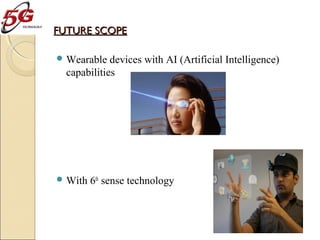
 Wearable

devices with AI (Artificial Intelligence)
capabilities

 With

6th sense technology
CONCLUSION

 5G

technology is going to be a new revolution in

wireless systems market.
 It

is going to give tough competition to computers and

laptops whose market place value will be effected.
 5G

–Include all types of advanced features which make

it become most dominant technology in near future.
REFERENCES


Aleksandar Tudzarov and Toni Janevski ,“Functional Architecture for 5G
Mobile Networks” ‘International Journal of Advanced Science and
Technology Vol. 32, July, 2011



Akhilesh Kumar Pachauri and Ompal Singh ,“5G Technology – Redefining
wireless Communication in upcoming years” International Journal of
Computer Science and Management Research Vol 1 Issue 1 Aug 2012



Dr. Anwar M. Mousa ,“Prospective of Fifth Generation Mobile
Communications” ,International Journal of Next-Generation Networks
(IJNGN) Vol.4, No.3,September 2012



Vadan Mehta,“5g Wireless Architecture”
FDSF

5G - FUTURE MOBILE TECHNOLOGY

  • 1.
    5G:FUTURE MOBILE TECHNOLOGY PRESENTED BY, ANOOPUNNIKRISHNAN.P S8 ECE-A MTAKEEC020 13/01/2014 MET’S SCHOOL OF ENGINEERING,MALA 1
  • 2.
    OVERVIEW            OBJECTIVES INTRODUCTION TO 5G LITERATURESURVEY EVOLUTION FROM 1G TO 5G ARCHITECTURE FEATURES ADVANTAGES APPLICATIONS FUTURE SCOPE CONCLUSION REFERENCE 13/01/2014 2 MET’S SCHOOL OF ENGINEERING,MALA
  • 3.
    OBJECTIVES  Comprehensive studyrelated to 5G mobile technology  Comparison of all generations of mobile technologies  To understand basic 5G mobile phone architecture 13/01/2014 MET’S SCHOOL OF ENGINEERING,MALA 3
  • 4.
    INTRODUCTION  5G stands for5th generation mobile Technology  Traffic on wireless networks doubling annually  4G technology will not be capable of carry this rapid increase of data consumption  5th generation should be more intelligent technology that interconnects the entire world without limits  5G does not exist yet but the future technology next to 4G we say as 5G.  leads to the development of WWWW(World Wide Wireless Web),real wireless world etc. 13/01/2014 MET’S SCHOOL OF ENGINEERING,MALA 4
  • 5.
    LITERATURE SURVEY SI.N O PAPER NAME PRESENTERNAME 1 4G:-The future mobile technology Jamil.M,Shaikh S.P,Shahazad.M, Awais.Q 2 Wireless Evolution with 5G technology 13/01/2014 MET’S SCHOOL OF ENGINEERING,MALA CONTENT 5
  • 6.
  • 7.
    EVOLUTION FROM 1GTO 5G  1G  2G  3G  4G  5G
  • 8.
    1st GENERATION:  Introduced in1980  Analog cellular mobile  Data speed 2.4Kbps  Uses FDMA technique  Allows users to make voice calls in 1 country
  • 9.
    2nd GENERATION:  Digital cellularsystems  Digital modulation schemes – TDMA,CDMA  It provides services like voice and SMS with more clarity. • Data speed In 2G is up to 64Kbps  It provides semi global facilities.
  • 10.
    3rd GENERATION:  Typically calledsmart phones  Speed is up to 2Mbps  High speed internet service, video chatting  Packet switching technology  It provides global facilities.
  • 11.
    4th GENERATION: • LTE (Long Term Evolution ) is considered as 4G • High speed data access • Combination of Wi-Fi and Wi-Max • High quality streaming video
  • 12.
    5th GENERATION:  Data speedhigher than 1Gbps  Introduce the concept of WWWW (World Wide Wireless Web)  Real wireless world with no more limitation  Large phone memory, dialing speed , clarity in audio and video etc
  • 13.
  • 14.
    Functional Architecture for5G Mobile Networks
  • 15.
  • 16.
    LAYERS IN ARCHITECTURE OSILayers 5G mobile network layer
  • 17.
    EXPLANATION  OWA stands forOpen Wireless Architecture. This layer is used to define the wireless technology to be used. Physical Layer + Data Link Layer=OWA  Network Layer is divided into two sub layer 1.Lower Network Layer 2.Upper Network Layer  Network Layer is used to route the data from source to destination
  • 18.
     Open Transport Layerperform the operation of both transport layer and session layer.  Transport Layer + Session Layer=OTL  Application Layer is responsible for providing good quality of service.  Application Layer selects the best wireless connection for a given service.
  • 19.
    FEATURES  Remote management :betterand fast solution  High uploading and downloading speed  More effective and attractive  Large broadcasting of data (GB) supports almost 65,000 connections.  Extraordinary data capability
  • 20.
    ADVANTAGES  Globally accessible  Dynamic informationaccess  Available at low cost  The high quality services of 5G technology based on Policy to avoid error  Less traffic
  • 21.
    APPLICATIONS  Global  Can foldyour mobile as per your desire  Able to visualize lively all planets and universe  Media  networks independent hand over Can access your office desktop by being at your bedroom.
  • 22.
    FUTURE SCOPE  Wearable deviceswith AI (Artificial Intelligence) capabilities  With 6th sense technology
  • 23.
    CONCLUSION  5G technology isgoing to be a new revolution in wireless systems market.  It is going to give tough competition to computers and laptops whose market place value will be effected.  5G –Include all types of advanced features which make it become most dominant technology in near future.
  • 24.
    REFERENCES  Aleksandar Tudzarov andToni Janevski ,“Functional Architecture for 5G Mobile Networks” ‘International Journal of Advanced Science and Technology Vol. 32, July, 2011  Akhilesh Kumar Pachauri and Ompal Singh ,“5G Technology – Redefining wireless Communication in upcoming years” International Journal of Computer Science and Management Research Vol 1 Issue 1 Aug 2012  Dr. Anwar M. Mousa ,“Prospective of Fifth Generation Mobile Communications” ,International Journal of Next-Generation Networks (IJNGN) Vol.4, No.3,September 2012  Vadan Mehta,“5g Wireless Architecture”
  • 25.