Massive Open Opportunity:
Supporting MOOCs in
Libraries
Dheeraj Singh Negi
dheerajnegi3@gmail.com
23/02/2015
OVERVIEW
 What are MOOCs?
 Libraries and MOOCs: Opportunities and Challenges
 Why librarians need to fully understand MOOCs
 How MOOCs Work
 MOOCs in Asia
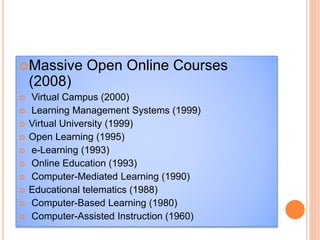
Massive Open Online Courses
(2008)
 Virtual Campus (2000)
 Learning Management Systems (1999)
 Virtual University (1999)
 Open Learning (1995)
 e-Learning (1993)
 Online Education (1993)
 Computer-Mediated Learning (1990)
 Educational telematics (1988)
 Computer-Based Learning (1980)
 Computer-Assisted Instruction (1960)
WHAT ARE MOOCS?
 MOOCs are Massive Open Online Courses that enroll
anyone wishing to attend for free. Early MOOCs, which
emerged out of the OER movement, are known as
Connectivist MOOCs [aka cMOOCs] and emphasize both
active student learning and knowledge creation using a wide
range of tools that are shared with fellow students and openly
licensed for use and adaption [i.e. community-generated
OERs]. The more widely known MOOCs, xMOOCs, rely on
video lectures by professors, some student interaction, and
online educational tools. These register students in the tens of
thousands and some have numbered as many as 160,000 in
a class – making it impossible to provide professorial
support. None provide access to institutional library
collections. They are very expensive to produce and funded
by investors or major institutions. Despite their name,
xMOOCs are not open educational resources.
 A massive open online course is an online course
aimed at unlimited participation and open access
via the web. In addition to traditional course
materials such as filmed lectures, readings, and
problem sets, many MOOCs provide interactive
user forums to support community interactions
between students, professors, and teaching
assistants (TAs). MOOCs are a recent development
in distance education which was first introduced in
2008 and emerged as a popular mode of learning in
2012.
 Early MOOCs often emphasized open-access
features, such as open licensing of content,
structure and learning goals, to promote the reuse
and remixing of resources. Some later MOOCs use
closed licenses for their course materials while
maintaining free access for students
THERE ARE MANY REASONS WHY LIBRARIANS NEED
TO FULLY UNDERSTAND MOOCS:
 Academic libraries are committed to serving students enrolled
in distance education courses and MOOCs are raising
questions around how services and collections could be
provided to students in this transformational medium – as well
as how to use MOOCs to assess online services.
 xMOOCs pose important intellectual property issues for higher
education.
 xMOOCs may serve as a disruptive innovation - leading to
questions about their impact not only on teaching, but also on
research.
 As we come to fully understand MOOCs – including where
they intersect with, or are contrary to, established library
values – they pose important questions about the role libraries
can and should play in the area of Open Education:
particularly as it refers to their role as facilitators of their
effectiveness and sustainability.
MOCCS BENEFITS
 The MOOC Guide ]lists 12 benefits:
 Appropriate for any setting that has connectivity (Web or Wi-
Fi)
 Any language or multiple languages
 Any online tools
 Escape time zones and physical boundaries
 Produce and deliver in short timeframe (e.g. for relief aid)
 Contextualized content can be shared by all
 Informal setting
 Peer-to-peer contact can trigger serendipitous learning
 Easier to cross disciplines and institutional barriers
 Lower barriers to student entry
 Enhance personal learning environment and/or network by
participating
 Improve lifelong learning skills
CHALLENGES AND CRITICISMS
 Relying on user-generated content can create a
chaotic learning environment
 Digital literacy is necessary to make use of the
online materials
 The time and effort required from participants may
exceed what students are willing to commit to a free
online course
 Once the course is released, content will be
reshaped and reinterpreted by the massive student
body, making the course trajectory difficult for
instructors to control
 Participants must self-regulate and set their own
goals
HOW MOOCS WORK
MOOCs are online courses where lectures are typically “canned,”
quizzes and testing are automated, and student participation is voluntary.
They attain large scale by reducing instructor contact with individual
students; students often rely on self-organized study and discussion
groups. An alternative model allows students to vote on which questions
should rise to the professor’s attention (e.g., Coursera). edX encourages
students to rely on each other, awarding “Karma points” to students who
correctly answer other students’ questions. As points accrue, students’
roles can expand, e.g., to a teaching assistant. Initial MOOCs have often
been from disciplines that lend themselves to quantitative assessment,
such as engineering, computer science, and math. However, MOOCs
are becoming applicable to all fields as the platforms enable assessment
methods such as peer review. MOOCs generate massive quantities of
data about learner behavior, which can be used to understand cognitive
growth and how to improve instruction. Some platforms may evolve from
course-delivery systems toward adaptive learning platforms— systems
that personalize the experience based on the learner’s performance.
MOOCs embody a convergence of technology and culture that is
creating new energy around
HOW ARE LIBRARIES INVOLVED IN
SUPPORTING MOOC COURSES?
So far Libraries appear to be serving two related roles in support of the MOOC courses
provided by their campuses. First, as always, these libraries are serving faculty by supporting
their need for material to use in their lectures and to assign for students’ independent reading.
From images to essays to software, Libraries are helping faculty to identify and locate
resources that are appropriate for their teaching needs. Second, and very closely related,
Libraries have been asked to work with faculty and campus counsel to navigate the copyright
issues raised by teaching in the open, online environment.
Libraries often have a reputation on campus as copyright experts, so they are being asked to work
with faculty to determine whether it is necessary to seek permission to use a given work in the
context of MOOC teaching, and where necessary, seek to secure permissions. In some cases
Libraries are facing significant challenges and delays in seeking licenses for uses that would have
been considered fair use or otherwise exempt in the traditional teaching context. Some publishers,
museums, and other content owners are asking extraordinarily high prices or refusing to license
for MOOC teaching, citing the for-profit nature of the platforms as well as the unprecedented
scale. Others are simply not responding to these requests. Campus counsel at one library has
advised that fair use is not an option in the context of MOOCs. As a result, some faculty are
becoming frustrated with the process of translating courses they’ve taught for years, and for
which they’ve developed tried-and-true slides, handouts, and other materials, into MOOC
offerings. Where possible, Libraries are also working to help faculty identify and locate
alternative materials that are free of copyright constraints either because they are in the public
domain or because they are made available under Creative Commons or analogous open licenses

LIBRARIES AND MOOCS: OPPORTUNITIES
 Access to resources
 Recommending resources
 Physical space for MOOC
students
 Copyright consultants to
faculty
• Research support
for faculty
• Embedded online
information literacy
tutorials
• "Ask a Librarian“
• Reaching a new
client base
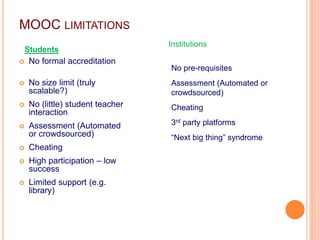
MOOC LIMITATIONS
 No formal accreditation
 No size limit (truly
scalable?)
 No (little) student teacher
interaction
 Assessment (Automated
or crowdsourced)
 Cheating
 High participation – low
success
 Limited support (e.g.
library)
No pre-requisites
Assessment (Automated or
crowdsourced)
Cheating
3rd party platforms
“Next big thing” syndrome
Students
Institutions
MOCCS IN ASIA
 Schools in India, China, Korea, and Japan provide MOOCs.[51][52]
 In India, the idea was first proposed by IISc Bangalore in the year 1999. Following
that, video-based teaching material, NPTEL was set up during 2003-2007. As of
March 2014, approximately 750 video courses and web-based courses have been
developed by the faculty members of IITs, IIMs and IISc.
 Tsinghua University Launched MOOC platform XuetangX.com on Oct. 2013,
providing more than 60 MOOCs from universities both in China and other world.
 The first MOOC in Malaysia was offered by Taylor's University in March 2013. This
MOOC can be found at https://www.openlearning.com/courses/Entrepreneurship .
The MOOC was titled "Entrepreneurship" and it attracted students from 115
different countries. Following this successful MOOC, Taylor's University launched
the second MOOC titled "Achieving Success with Emotional
Intelligence" https://www.openlearning.com/courses/Success[53] in July 2013. In
August 2013, Universitas Ciputra Entrepreneurship Online (UCEO) launched first
MOOC in Indonesia with the first course entitled Entrepreneurship Ciputra
Way.[54][55] With over 20,000 registered members, the course offered insights on
how to start a business, and was delivered in Indonesian.
REFERENCE
Educause (2012), What Campus Leaders Need to Know About
MOOCs: An EDUCAUSE Executive Briefing,
http://net.educause.edu/ir/library/pdf/PUB4005.pdf.
Librarians: Your Most Valuable MOOC Supporters (2013), OEDb:
Open Education Database, May 16, 2013,
http://oedb.org/library/features/librarians-your-most-
valuable-mooc-supporters/.
New Media Consortium and the EDUCAUSE Learning Initiative
(2013), The NMC Horizon Report: 2013 Higher Education
Edition, http://www.nmc.org/pdf/2013-horizon-report-
HE.pdf.
Pappano, L (2012), The Year of the MOOC, The New York
Times, Education Life, November 2, 2012,
http://www.nytimes.com/2012/11/04/education/edlife/ma
ssive-open-online-courses-are-multiplying-at-a-rapid-
pace.html?pagewanted=4&_r=1&pagewanted=all&.

Moocs in higher education

  • 1.
    Massive Open Opportunity: SupportingMOOCs in Libraries Dheeraj Singh Negi dheerajnegi3@gmail.com 23/02/2015
  • 3.
    OVERVIEW  What areMOOCs?  Libraries and MOOCs: Opportunities and Challenges  Why librarians need to fully understand MOOCs  How MOOCs Work  MOOCs in Asia
  • 4.
    Massive Open OnlineCourses (2008)  Virtual Campus (2000)  Learning Management Systems (1999)  Virtual University (1999)  Open Learning (1995)  e-Learning (1993)  Online Education (1993)  Computer-Mediated Learning (1990)  Educational telematics (1988)  Computer-Based Learning (1980)  Computer-Assisted Instruction (1960)
  • 5.
    WHAT ARE MOOCS? MOOCs are Massive Open Online Courses that enroll anyone wishing to attend for free. Early MOOCs, which emerged out of the OER movement, are known as Connectivist MOOCs [aka cMOOCs] and emphasize both active student learning and knowledge creation using a wide range of tools that are shared with fellow students and openly licensed for use and adaption [i.e. community-generated OERs]. The more widely known MOOCs, xMOOCs, rely on video lectures by professors, some student interaction, and online educational tools. These register students in the tens of thousands and some have numbered as many as 160,000 in a class – making it impossible to provide professorial support. None provide access to institutional library collections. They are very expensive to produce and funded by investors or major institutions. Despite their name, xMOOCs are not open educational resources.
  • 6.
     A massiveopen online course is an online course aimed at unlimited participation and open access via the web. In addition to traditional course materials such as filmed lectures, readings, and problem sets, many MOOCs provide interactive user forums to support community interactions between students, professors, and teaching assistants (TAs). MOOCs are a recent development in distance education which was first introduced in 2008 and emerged as a popular mode of learning in 2012.
  • 7.
     Early MOOCsoften emphasized open-access features, such as open licensing of content, structure and learning goals, to promote the reuse and remixing of resources. Some later MOOCs use closed licenses for their course materials while maintaining free access for students
  • 8.
    THERE ARE MANYREASONS WHY LIBRARIANS NEED TO FULLY UNDERSTAND MOOCS:  Academic libraries are committed to serving students enrolled in distance education courses and MOOCs are raising questions around how services and collections could be provided to students in this transformational medium – as well as how to use MOOCs to assess online services.  xMOOCs pose important intellectual property issues for higher education.  xMOOCs may serve as a disruptive innovation - leading to questions about their impact not only on teaching, but also on research.  As we come to fully understand MOOCs – including where they intersect with, or are contrary to, established library values – they pose important questions about the role libraries can and should play in the area of Open Education: particularly as it refers to their role as facilitators of their effectiveness and sustainability.
  • 9.
    MOCCS BENEFITS  TheMOOC Guide ]lists 12 benefits:  Appropriate for any setting that has connectivity (Web or Wi- Fi)  Any language or multiple languages  Any online tools  Escape time zones and physical boundaries  Produce and deliver in short timeframe (e.g. for relief aid)  Contextualized content can be shared by all  Informal setting  Peer-to-peer contact can trigger serendipitous learning  Easier to cross disciplines and institutional barriers  Lower barriers to student entry  Enhance personal learning environment and/or network by participating  Improve lifelong learning skills
  • 10.
    CHALLENGES AND CRITICISMS Relying on user-generated content can create a chaotic learning environment  Digital literacy is necessary to make use of the online materials  The time and effort required from participants may exceed what students are willing to commit to a free online course  Once the course is released, content will be reshaped and reinterpreted by the massive student body, making the course trajectory difficult for instructors to control  Participants must self-regulate and set their own goals
  • 11.
    HOW MOOCS WORK MOOCsare online courses where lectures are typically “canned,” quizzes and testing are automated, and student participation is voluntary. They attain large scale by reducing instructor contact with individual students; students often rely on self-organized study and discussion groups. An alternative model allows students to vote on which questions should rise to the professor’s attention (e.g., Coursera). edX encourages students to rely on each other, awarding “Karma points” to students who correctly answer other students’ questions. As points accrue, students’ roles can expand, e.g., to a teaching assistant. Initial MOOCs have often been from disciplines that lend themselves to quantitative assessment, such as engineering, computer science, and math. However, MOOCs are becoming applicable to all fields as the platforms enable assessment methods such as peer review. MOOCs generate massive quantities of data about learner behavior, which can be used to understand cognitive growth and how to improve instruction. Some platforms may evolve from course-delivery systems toward adaptive learning platforms— systems that personalize the experience based on the learner’s performance. MOOCs embody a convergence of technology and culture that is creating new energy around
  • 12.
    HOW ARE LIBRARIESINVOLVED IN SUPPORTING MOOC COURSES? So far Libraries appear to be serving two related roles in support of the MOOC courses provided by their campuses. First, as always, these libraries are serving faculty by supporting their need for material to use in their lectures and to assign for students’ independent reading. From images to essays to software, Libraries are helping faculty to identify and locate resources that are appropriate for their teaching needs. Second, and very closely related, Libraries have been asked to work with faculty and campus counsel to navigate the copyright issues raised by teaching in the open, online environment. Libraries often have a reputation on campus as copyright experts, so they are being asked to work with faculty to determine whether it is necessary to seek permission to use a given work in the context of MOOC teaching, and where necessary, seek to secure permissions. In some cases Libraries are facing significant challenges and delays in seeking licenses for uses that would have been considered fair use or otherwise exempt in the traditional teaching context. Some publishers, museums, and other content owners are asking extraordinarily high prices or refusing to license for MOOC teaching, citing the for-profit nature of the platforms as well as the unprecedented scale. Others are simply not responding to these requests. Campus counsel at one library has advised that fair use is not an option in the context of MOOCs. As a result, some faculty are becoming frustrated with the process of translating courses they’ve taught for years, and for which they’ve developed tried-and-true slides, handouts, and other materials, into MOOC offerings. Where possible, Libraries are also working to help faculty identify and locate alternative materials that are free of copyright constraints either because they are in the public domain or because they are made available under Creative Commons or analogous open licenses 
  • 13.
    LIBRARIES AND MOOCS:OPPORTUNITIES  Access to resources  Recommending resources  Physical space for MOOC students  Copyright consultants to faculty • Research support for faculty • Embedded online information literacy tutorials • "Ask a Librarian“ • Reaching a new client base
  • 14.
    MOOC LIMITATIONS  Noformal accreditation  No size limit (truly scalable?)  No (little) student teacher interaction  Assessment (Automated or crowdsourced)  Cheating  High participation – low success  Limited support (e.g. library) No pre-requisites Assessment (Automated or crowdsourced) Cheating 3rd party platforms “Next big thing” syndrome Students Institutions
  • 15.
    MOCCS IN ASIA Schools in India, China, Korea, and Japan provide MOOCs.[51][52]  In India, the idea was first proposed by IISc Bangalore in the year 1999. Following that, video-based teaching material, NPTEL was set up during 2003-2007. As of March 2014, approximately 750 video courses and web-based courses have been developed by the faculty members of IITs, IIMs and IISc.  Tsinghua University Launched MOOC platform XuetangX.com on Oct. 2013, providing more than 60 MOOCs from universities both in China and other world.  The first MOOC in Malaysia was offered by Taylor's University in March 2013. This MOOC can be found at https://www.openlearning.com/courses/Entrepreneurship . The MOOC was titled "Entrepreneurship" and it attracted students from 115 different countries. Following this successful MOOC, Taylor's University launched the second MOOC titled "Achieving Success with Emotional Intelligence" https://www.openlearning.com/courses/Success[53] in July 2013. In August 2013, Universitas Ciputra Entrepreneurship Online (UCEO) launched first MOOC in Indonesia with the first course entitled Entrepreneurship Ciputra Way.[54][55] With over 20,000 registered members, the course offered insights on how to start a business, and was delivered in Indonesian.
  • 16.
    REFERENCE Educause (2012), WhatCampus Leaders Need to Know About MOOCs: An EDUCAUSE Executive Briefing, http://net.educause.edu/ir/library/pdf/PUB4005.pdf. Librarians: Your Most Valuable MOOC Supporters (2013), OEDb: Open Education Database, May 16, 2013, http://oedb.org/library/features/librarians-your-most- valuable-mooc-supporters/. New Media Consortium and the EDUCAUSE Learning Initiative (2013), The NMC Horizon Report: 2013 Higher Education Edition, http://www.nmc.org/pdf/2013-horizon-report- HE.pdf. Pappano, L (2012), The Year of the MOOC, The New York Times, Education Life, November 2, 2012, http://www.nytimes.com/2012/11/04/education/edlife/ma ssive-open-online-courses-are-multiplying-at-a-rapid- pace.html?pagewanted=4&_r=1&pagewanted=all&.