
Management Information
Systems in Digital World
Dheeraj Singh Negi
What is MIS?
• Management of Information System ?
• System of Information Management?
• Information System for Management?
Management
information system
Management Information System (MIS) is an
integrated information system used by the managers
to perform their operations and functions. It helps
management in their Decision Making.
MIS: experts view
According to Raymond J. Coleman and M. J. Riley, “MIS
applies to all management levels; is linked to an
organization’s sub-systems; it functions to measure
performance, monitors progress, evaluates alternatives
or provides knowledge for change or corrective action;
and is flexible, both internally and externally”.
G. B. Davis defines management information system as
“an integrated man/machine system for providing
information to support the operations, management and
decision-making functions in an organization”.
Decision Making
Monitoring/ Feedback
CONCEPT OF MIS
MIS Function
MIS is set up by an organization with the prime objective
to obtain management information to be used by its
managers in decision making. Thus, MIS must perform the
following functions in order to meet its objectives.
1. Data Capturing
2. Processing of Data
3. Storage of Information
4. Retrieval of Information
5. Dissemination of Information
INFORMATION SYSTEM
An information system can be any organized
combination of people, hardware, software,
communications networks, data resources, and
policies and procedures that stores, retrieves,
transforms and disseminates information in an
organization.
Components of an IS
8
Roles of Information
system
1. Data Processing: 1950s-1960s
2. Management Reporting: 1960s-1970s
3. Decision support: 1970s-1980s
4. Strategic and End User Support: 1980s-1990s
5. Global Internetworking: 1990s-2000s
Types of Information
Systems
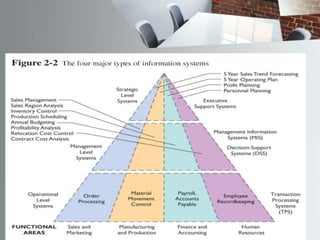
There are six types of information systems:
1. Office Information System
2. Transaction Processing System
3. Management Information System
4. Decision Support System
5. Executive Information System
6. Expert System
Office information
system
An office information system, or OIS, is an
information system that uses hardware, software and
networks to enhance work flow and facilitate
communications among employees.
An office information system, also described as office
automation; employees perform tasks electronically
using computers and other electronic devices,
instead of manually.
Transaction processing
system
A transaction processing system (TPS) is an information
system that captures and processes data generated
during an organization’s day-to-day transactions.
A transaction is a business activity such as a deposit,
payment, order or reservation. Clerical staff typically
performs the activities associated with transaction
processing.
Management
information system
Management information systems often are integrated
with transaction processing systems to:
• Extract and summarize data from TPSs
• Allow managers to monitor & direct the organization
• Provide accurate feedback
• Provide pre-specified reports on a scheduled basis
Decision support
system
An interactive information system that provides
information, models, and data manipulation tools to
help make decisions in semi-structured and
unstructured situations.
A sales manager, for example, might need to determine
how high to set yearly sales quotas based on increased
sales and lowered product costs.
Executive information
system
A special type of DSS, called an executive information
system (EIS), is designed to support the information
needs of executive management.
• Use both internal and competitive information
• User-friendly interface
Expert system
An expert system is an information system that
captures and stores the knowledge of human experts
and then imitates human reasoning and decision-
making processes for those who have less expertise.
Trends in
Information
Systems
18
Interrelationship among systems
Characteristics of MIS
1. Enhanced global competitiveness
2. Capture market opportunities
3. Support corporate strategy
4. Enhance worker productivity
5. Improve quality of goods and services
Opportunities
Conclusion
An information system(IS) is typically considered to be a
set of interrelated elements or components that
collect(input), manipulate(processes), and
disseminate (output) data and information and
provide a feedback mechanism to meet an objective.

Management information systems

  • 1.
    Management Information Systems inDigital World Dheeraj Singh Negi
  • 2.
    What is MIS? •Management of Information System ? • System of Information Management? • Information System for Management?
  • 3.
    Management information system Management InformationSystem (MIS) is an integrated information system used by the managers to perform their operations and functions. It helps management in their Decision Making.
  • 4.
    MIS: experts view Accordingto Raymond J. Coleman and M. J. Riley, “MIS applies to all management levels; is linked to an organization’s sub-systems; it functions to measure performance, monitors progress, evaluates alternatives or provides knowledge for change or corrective action; and is flexible, both internally and externally”. G. B. Davis defines management information system as “an integrated man/machine system for providing information to support the operations, management and decision-making functions in an organization”.
  • 5.
  • 6.
    MIS Function MIS isset up by an organization with the prime objective to obtain management information to be used by its managers in decision making. Thus, MIS must perform the following functions in order to meet its objectives. 1. Data Capturing 2. Processing of Data 3. Storage of Information 4. Retrieval of Information 5. Dissemination of Information
  • 7.
    INFORMATION SYSTEM An informationsystem can be any organized combination of people, hardware, software, communications networks, data resources, and policies and procedures that stores, retrieves, transforms and disseminates information in an organization.
  • 8.
  • 9.
    Roles of Information system 1.Data Processing: 1950s-1960s 2. Management Reporting: 1960s-1970s 3. Decision support: 1970s-1980s 4. Strategic and End User Support: 1980s-1990s 5. Global Internetworking: 1990s-2000s
  • 10.
    Types of Information Systems Thereare six types of information systems: 1. Office Information System 2. Transaction Processing System 3. Management Information System 4. Decision Support System 5. Executive Information System 6. Expert System
  • 11.
    Office information system An officeinformation system, or OIS, is an information system that uses hardware, software and networks to enhance work flow and facilitate communications among employees. An office information system, also described as office automation; employees perform tasks electronically using computers and other electronic devices, instead of manually.
  • 12.
    Transaction processing system A transactionprocessing system (TPS) is an information system that captures and processes data generated during an organization’s day-to-day transactions. A transaction is a business activity such as a deposit, payment, order or reservation. Clerical staff typically performs the activities associated with transaction processing.
  • 13.
    Management information system Management informationsystems often are integrated with transaction processing systems to: • Extract and summarize data from TPSs • Allow managers to monitor & direct the organization • Provide accurate feedback • Provide pre-specified reports on a scheduled basis
  • 14.
    Decision support system An interactiveinformation system that provides information, models, and data manipulation tools to help make decisions in semi-structured and unstructured situations. A sales manager, for example, might need to determine how high to set yearly sales quotas based on increased sales and lowered product costs.
  • 15.
    Executive information system A specialtype of DSS, called an executive information system (EIS), is designed to support the information needs of executive management. • Use both internal and competitive information • User-friendly interface
  • 16.
    Expert system An expertsystem is an information system that captures and stores the knowledge of human experts and then imitates human reasoning and decision- making processes for those who have less expertise.
  • 17.
  • 18.
  • 20.
  • 22.
  • 23.
    1. Enhanced globalcompetitiveness 2. Capture market opportunities 3. Support corporate strategy 4. Enhance worker productivity 5. Improve quality of goods and services Opportunities
  • 24.
    Conclusion An information system(IS)is typically considered to be a set of interrelated elements or components that collect(input), manipulate(processes), and disseminate (output) data and information and provide a feedback mechanism to meet an objective.