An overview of
Microbial metabolism
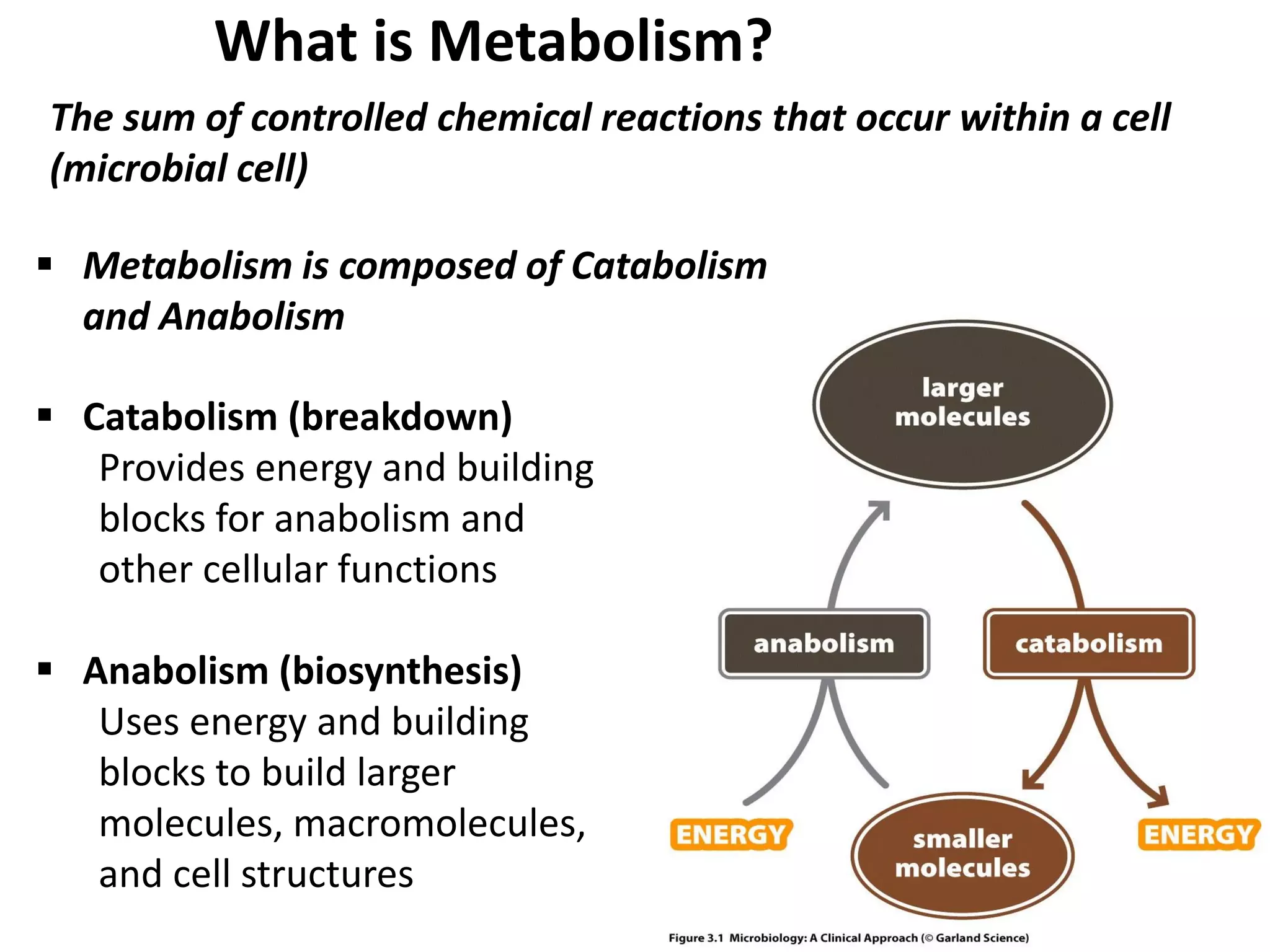
What is Metabolism?
ď‚§ Catabolism (breakdown)
Provides energy and building
blocks for anabolism and
other cellular functions
ď‚§ Anabolism (biosynthesis)
Uses energy and building
blocks to build larger
molecules, macromolecules,
and cell structures
ď‚§ Metabolism is composed of Catabolism
and Anabolism
The sum of controlled chemical reactions that occur within a cell
(microbial cell)
The role of ATP as an intermediate between
catabolism and anabolism
ď‚§ Metabolic pathway - sequence of chemical reactions
that occur in a cell
A B C D E
ď‚§ A is the initial molecule/compound (substrate)
ď‚§ E is the final molecule/compound (product)
ď‚§ B, C, and D are intermediates
ď‚§ Each step in the pathway is mediated or facilitated by
a specific catalyst called enzyme (protein)
Catabolic and anabolic reactions are organized
into series of reactions called pathways
Cells use redox reactions to extract energy from nutrient
molecules such as glucose
ď‚§ Redox reaction (oxidation-reduction reaction)
ď‚§ Redox reactions involve the transfer of electrons from an
electron donor to an electron acceptor
ď‚§ The energy of the reduced coenzyme NADH (or FADH2) is used to
make ATP in later reactions
Cells use redox reactions to extract energy from nutrient
molecules such as glucose
ď‚§ Most biological oxidations involve the loss of hydrogen atoms
(one electron plus one proton-H+) - dehydrogenation reactions
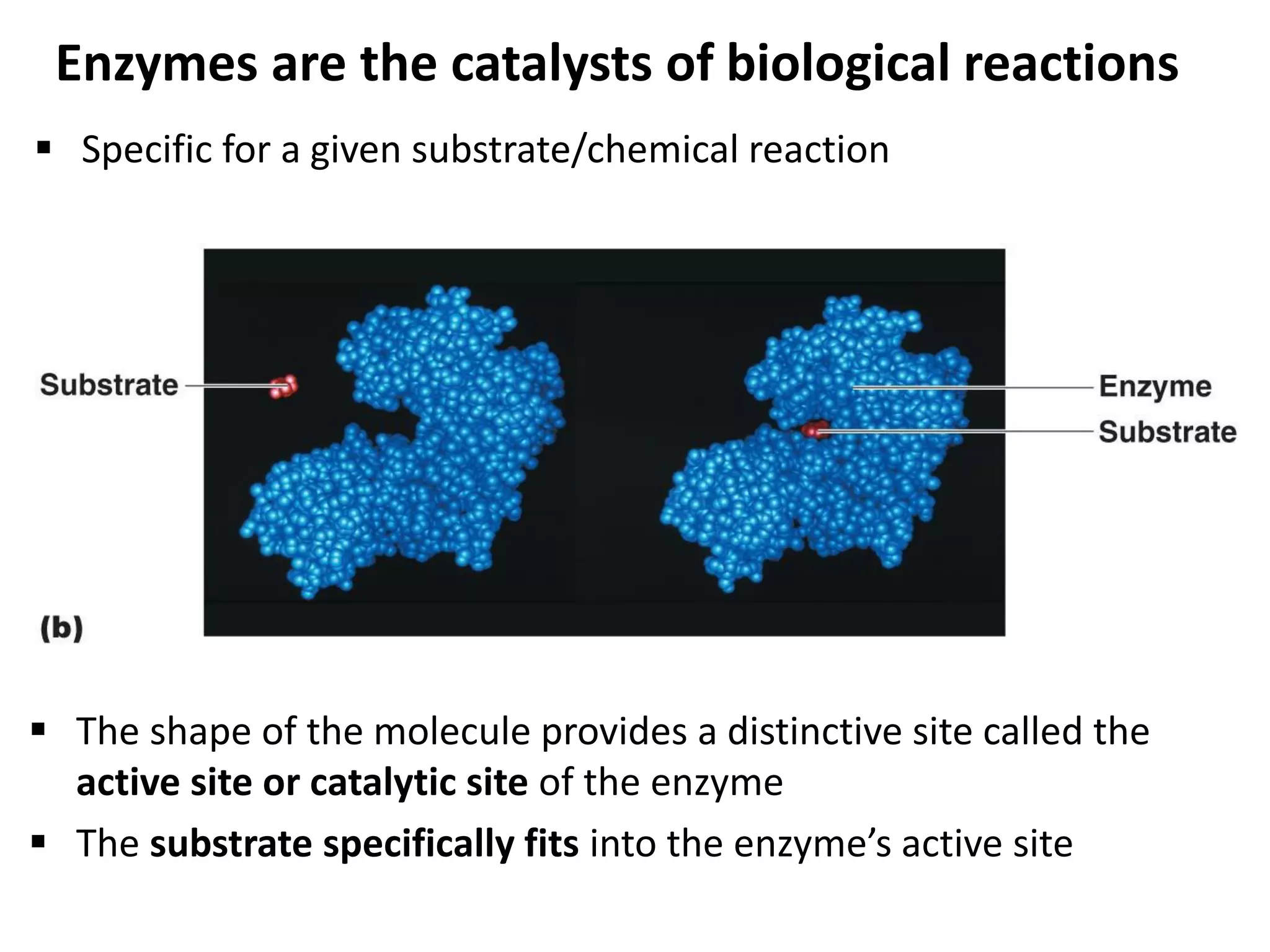
Enzymes are the catalysts of biological reactions
ď‚§ Specific for a given substrate/chemical reaction
ď‚§ The shape of the molecule provides a distinctive site called the
active site or catalytic site of the enzyme
 The substrate specifically fits into the enzyme’s active site
Examples of enzymes and their names
Enzymes can use cofactors
and coenzymes
ď‚§ Cofactors include magnesium, manganese, iron, copper, zinc,
calcium, cobalt
ď‚§ Coenzymes (NAD+, NADP+, and FAD derived from vitamins) act as
electron carriers
Enzymes lower the activation energy needed to
“trigger a chemical reaction”
ď‚§ The substrate interacts with the active site of the enzyme to form
an enzyme-substrate complex
ď‚§ The substrate is transformed into product(s)
ď‚§ The product(s) is/are released
ď‚§ The enzyme is recovered unchanged
ď‚§ Factors that influence the activity of enzymes include
ď‚§ Temperature
ď‚§ pH
ď‚§ Enzyme and substrate concentration
ď‚§ Presence/absence of inhibitors
ď‚§ Temperature and pH
denature proteins,
therefore enzymes
Inactive
ď‚§ Cells control synthesis of enzymes (amount/time of synthesis)
and their activity
Enzyme inhibitors
ď‚§ Competitive
inhibition
ď‚§ Sulfa drugs are
an example of
competitive
inhibitors
ď‚§ Sulfanilamide/
PABA
ď‚§ Inhibition can be reversible or irreversible
ď‚§ Noncompetitive
inhibition
ď‚§ Poisons such as
fluoride are an
example of
noncompetitive
inhibitors
Enzyme inhibitors
ď‚§ Inhibition can be reversible or irreversible
Feedback Inhibition
ď‚§ It is reversible
ď‚§ When the final product
accumulates
ď‚§ It begins to bind to and
inactivates the enzyme
that catalyzes the first
reaction of the pathway
ď‚§ The pathway is turned
off
Cells regulate metabolic
pathways
Carbohydrate Catabolism
ď‚§ Most microorganisms oxidize carbohydrates as the primary
source of cellular energy
ď‚§ Two general processes are used
ď‚§ Cellular respiration
ď‚§ Fermentation
ď‚§ Both cellular respiration and fermentation can share a common
pathway called glycolysis or Embden-Meyerhof pathway
Aerobic
cellular
respiration
Glucose
(C6H12O6) is
oxidized to CO2
in presence of
O2
~ 38 molecules
of ATP are
formed
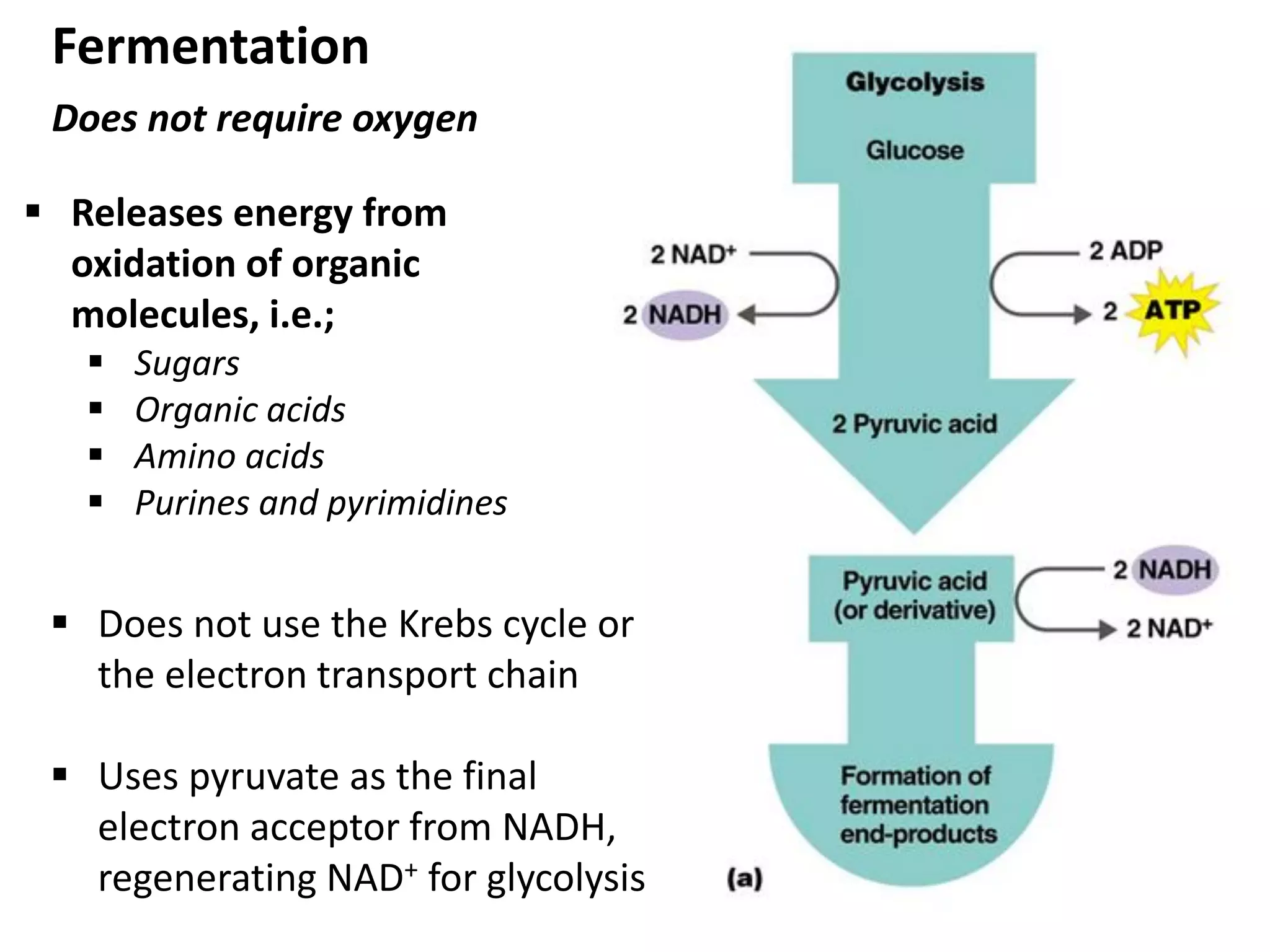
Fermentation
ď‚§ Releases energy from
oxidation of organic
molecules, i.e.;
ď‚§ Sugars
ď‚§ Organic acids
ď‚§ Amino acids
ď‚§ Purines and pyrimidines
ď‚§ Does not use the Krebs cycle or
the electron transport chain
ď‚§ Uses pyruvate as the final
electron acceptor from NADH,
regenerating NAD+ for glycolysis
Does not require oxygen
End-Products of Fermentation
ď‚§ Chemical analyses of the end-products
help identify microbes, including
pathogens in clinical specimens
Lactic acid and
alcohol Fermentation
ď‚§ Lactic acid bacteria
are Streptococcus and
Lactobacillus
ď‚§ Alcohol
fermentation
carried out by
Saccharomyces
cerevisiae (yeast)
How do we use this knowledge to distinguish between
bacteria in the lab?
Fermentation test tubes
containing mannitol
Negative control
Samples
S. epidermidis (-)
S. aureus (+)
E. coli (+) plus gas
ď‚§ Bubbles in the
Durham tube
indicate gas
formation
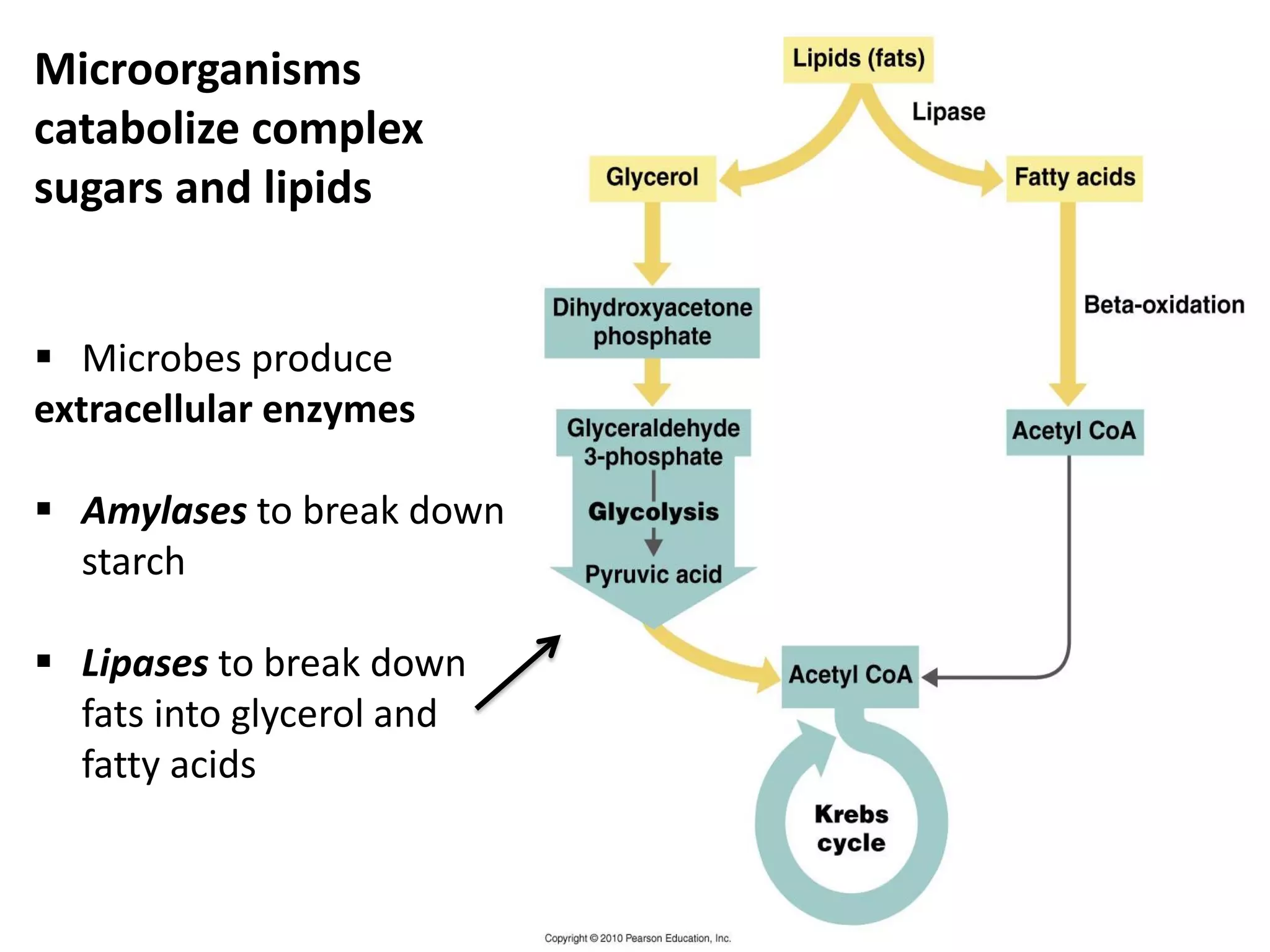
Microorganisms
catabolize complex
sugars and lipids
ď‚§ Microbes produce
extracellular enzymes
ď‚§ Amylases to break down
starch
ď‚§ Lipases to break down
fats into glycerol and
fatty acids
Microorganisms
catabolize proteins
ď‚§ Microbes produce
proteases
ď‚§ Break down proteins into
their component amino
acids, transported across
the plasma membrane
ď‚§ Amino acids are chemically
modified by deamination
reaction
How do we use this knowledge to distinguish between
bacteria in the lab?
ď‚§ Biochemical tests
are designed to detect
the presence of enzymes
ď‚§ The test tubes contain
ď‚§ glucose
ď‚§ pH indicator
ď‚§ amino acid
Negative control Sample
ď‚§ pH indicator turns to yellow if acid is produced from glucose
ď‚§ pH indicator turns to purple if alkaline products are produced from
amino acid (decarboxylation reactions)
How do we use this knowledge to distinguish between
bacteria in the lab?
ď‚§ Production of H2S
ď‚§ Salmonella (+) can be readily
distinguishable from E. coli (-)
by the production of
hydrogen sulfide
ď‚§ H2S is detected when bacteria
remove sulfur from certain
amino acids
ď‚§ Other tests take advantage of different components of the
electron transport chain (oxidase test – cytochrome oxidase)
Anabolic pathways and their link to catabolic pathways
ď‚§ ATP made during catabolic pathways is used for cellular
functions such as
ď‚§ Active transport across plasma membranes
ď‚§ Flagellar motion
ď‚§ Most of the ATP is used to synthesize new cellular components
ď‚§ Amino acids are needed to make proteins/enzymes
ď‚§ Carbohydrates needed for polysaccharides/peptidoglycan
ď‚§ Lipids are important components of cell membranes
ď‚§ Purines and pyrimidines are the building blocks of DNA and
RNA
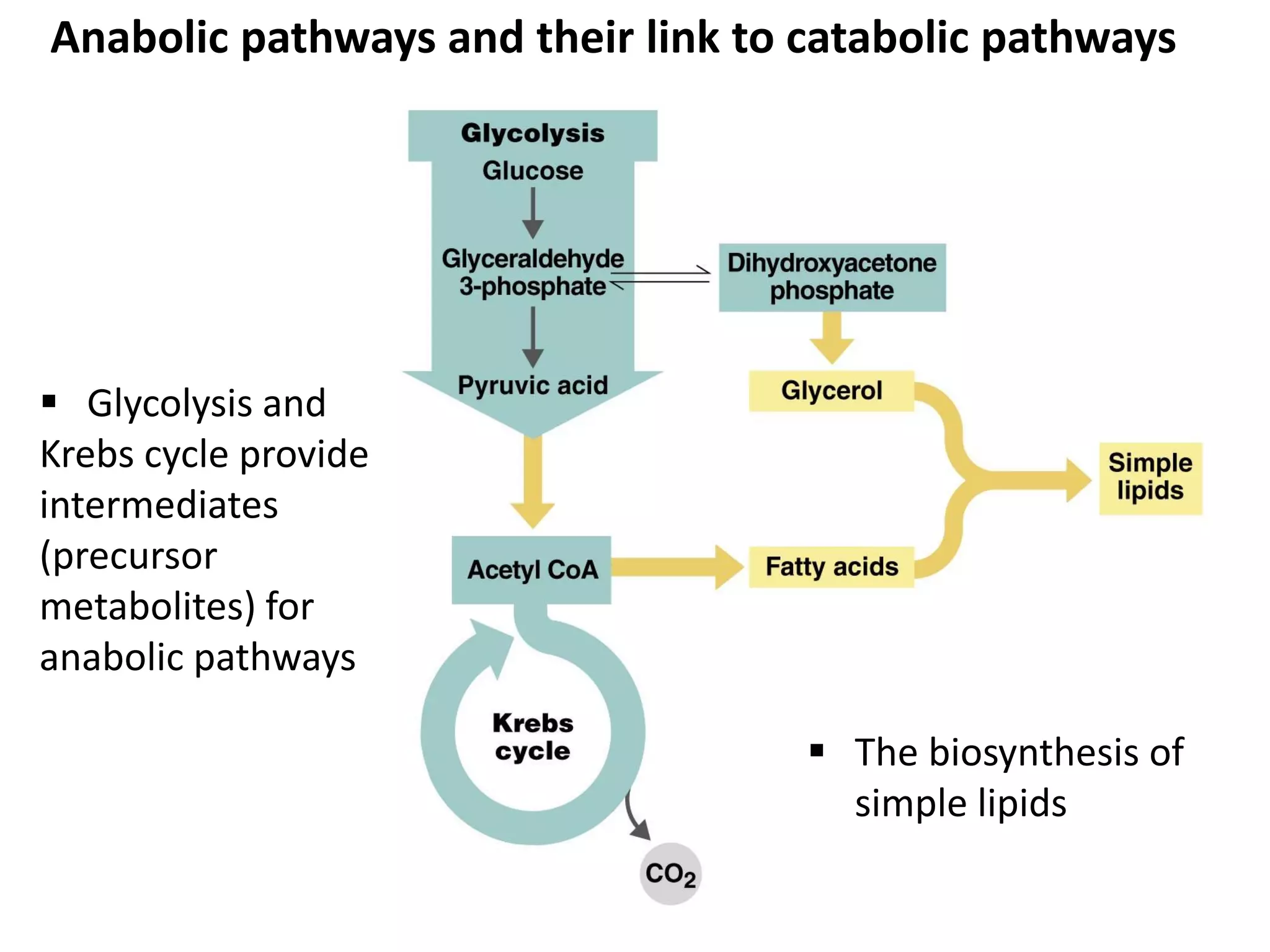
Anabolic pathways and their link to catabolic pathways
ď‚§ The biosynthesis of
simple lipids
ď‚§ Glycolysis and
Krebs cycle provide
intermediates
(precursor
metabolites) for
anabolic pathways
ď‚§ Metabolic
pathways that function
in both anabolism and
catabolism are called
amphibolic pathways
Amphibolic
pathways

4 bio265 metabolism instructor dr di bonaventura

  • 1.
  • 2.
    What is Metabolism? ď‚§Catabolism (breakdown) Provides energy and building blocks for anabolism and other cellular functions ď‚§ Anabolism (biosynthesis) Uses energy and building blocks to build larger molecules, macromolecules, and cell structures ď‚§ Metabolism is composed of Catabolism and Anabolism The sum of controlled chemical reactions that occur within a cell (microbial cell)
  • 3.
    The role ofATP as an intermediate between catabolism and anabolism
  • 4.
    ď‚§ Metabolic pathway- sequence of chemical reactions that occur in a cell A B C D E ď‚§ A is the initial molecule/compound (substrate) ď‚§ E is the final molecule/compound (product) ď‚§ B, C, and D are intermediates ď‚§ Each step in the pathway is mediated or facilitated by a specific catalyst called enzyme (protein) Catabolic and anabolic reactions are organized into series of reactions called pathways
  • 5.
    Cells use redoxreactions to extract energy from nutrient molecules such as glucose ď‚§ Redox reaction (oxidation-reduction reaction) ď‚§ Redox reactions involve the transfer of electrons from an electron donor to an electron acceptor
  • 6.
    ď‚§ The energyof the reduced coenzyme NADH (or FADH2) is used to make ATP in later reactions Cells use redox reactions to extract energy from nutrient molecules such as glucose ď‚§ Most biological oxidations involve the loss of hydrogen atoms (one electron plus one proton-H+) - dehydrogenation reactions
  • 7.
    Enzymes are thecatalysts of biological reactions  Specific for a given substrate/chemical reaction  The shape of the molecule provides a distinctive site called the active site or catalytic site of the enzyme  The substrate specifically fits into the enzyme’s active site
  • 8.
    Examples of enzymesand their names
  • 9.
    Enzymes can usecofactors and coenzymes ď‚§ Cofactors include magnesium, manganese, iron, copper, zinc, calcium, cobalt ď‚§ Coenzymes (NAD+, NADP+, and FAD derived from vitamins) act as electron carriers
  • 10.
    Enzymes lower theactivation energy needed to “trigger a chemical reaction”  The substrate interacts with the active site of the enzyme to form an enzyme-substrate complex  The substrate is transformed into product(s)  The product(s) is/are released  The enzyme is recovered unchanged
  • 11.
    ď‚§ Factors thatinfluence the activity of enzymes include ď‚§ Temperature ď‚§ pH ď‚§ Enzyme and substrate concentration ď‚§ Presence/absence of inhibitors ď‚§ Temperature and pH denature proteins, therefore enzymes Inactive ď‚§ Cells control synthesis of enzymes (amount/time of synthesis) and their activity
  • 12.
    Enzyme inhibitors ď‚§ Competitive inhibition ď‚§Sulfa drugs are an example of competitive inhibitors ď‚§ Sulfanilamide/ PABA ď‚§ Inhibition can be reversible or irreversible
  • 13.
    ď‚§ Noncompetitive inhibition ď‚§ Poisonssuch as fluoride are an example of noncompetitive inhibitors Enzyme inhibitors ď‚§ Inhibition can be reversible or irreversible
  • 14.
    Feedback Inhibition ď‚§ Itis reversible ď‚§ When the final product accumulates ď‚§ It begins to bind to and inactivates the enzyme that catalyzes the first reaction of the pathway ď‚§ The pathway is turned off Cells regulate metabolic pathways
  • 15.
    Carbohydrate Catabolism ď‚§ Mostmicroorganisms oxidize carbohydrates as the primary source of cellular energy ď‚§ Two general processes are used ď‚§ Cellular respiration ď‚§ Fermentation ď‚§ Both cellular respiration and fermentation can share a common pathway called glycolysis or Embden-Meyerhof pathway
  • 16.
    Aerobic cellular respiration Glucose (C6H12O6) is oxidized toCO2 in presence of O2 ~ 38 molecules of ATP are formed
  • 17.
    Fermentation ď‚§ Releases energyfrom oxidation of organic molecules, i.e.; ď‚§ Sugars ď‚§ Organic acids ď‚§ Amino acids ď‚§ Purines and pyrimidines ď‚§ Does not use the Krebs cycle or the electron transport chain ď‚§ Uses pyruvate as the final electron acceptor from NADH, regenerating NAD+ for glycolysis Does not require oxygen
  • 18.
    End-Products of Fermentation ď‚§Chemical analyses of the end-products help identify microbes, including pathogens in clinical specimens
  • 19.
    Lactic acid and alcoholFermentation ď‚§ Lactic acid bacteria are Streptococcus and Lactobacillus ď‚§ Alcohol fermentation carried out by Saccharomyces cerevisiae (yeast)
  • 20.
    How do weuse this knowledge to distinguish between bacteria in the lab? Fermentation test tubes containing mannitol Negative control Samples S. epidermidis (-) S. aureus (+) E. coli (+) plus gas ď‚§ Bubbles in the Durham tube indicate gas formation
  • 21.
    Microorganisms catabolize complex sugars andlipids ď‚§ Microbes produce extracellular enzymes ď‚§ Amylases to break down starch ď‚§ Lipases to break down fats into glycerol and fatty acids
  • 22.
    Microorganisms catabolize proteins ď‚§ Microbesproduce proteases ď‚§ Break down proteins into their component amino acids, transported across the plasma membrane ď‚§ Amino acids are chemically modified by deamination reaction
  • 23.
    How do weuse this knowledge to distinguish between bacteria in the lab? ď‚§ Biochemical tests are designed to detect the presence of enzymes ď‚§ The test tubes contain ď‚§ glucose ď‚§ pH indicator ď‚§ amino acid Negative control Sample ď‚§ pH indicator turns to yellow if acid is produced from glucose ď‚§ pH indicator turns to purple if alkaline products are produced from amino acid (decarboxylation reactions)
  • 24.
    How do weuse this knowledge to distinguish between bacteria in the lab?  Production of H2S  Salmonella (+) can be readily distinguishable from E. coli (-) by the production of hydrogen sulfide  H2S is detected when bacteria remove sulfur from certain amino acids  Other tests take advantage of different components of the electron transport chain (oxidase test – cytochrome oxidase)
  • 25.
    Anabolic pathways andtheir link to catabolic pathways ď‚§ ATP made during catabolic pathways is used for cellular functions such as ď‚§ Active transport across plasma membranes ď‚§ Flagellar motion ď‚§ Most of the ATP is used to synthesize new cellular components ď‚§ Amino acids are needed to make proteins/enzymes ď‚§ Carbohydrates needed for polysaccharides/peptidoglycan ď‚§ Lipids are important components of cell membranes ď‚§ Purines and pyrimidines are the building blocks of DNA and RNA
  • 26.
    Anabolic pathways andtheir link to catabolic pathways ď‚§ The biosynthesis of simple lipids ď‚§ Glycolysis and Krebs cycle provide intermediates (precursor metabolites) for anabolic pathways
  • 27.
    ď‚§ Metabolic pathways thatfunction in both anabolism and catabolism are called amphibolic pathways Amphibolic pathways