Preanaly(cal 
Variables 
in 
Coagula(on 
Tes(ng 
• Pre-­‐analy(cal 
variables 
in 
coagula(on 
tes(ng 
1. Sample 
Collec(on 
2. Site 
Selec(on 
3. Storage 
Requirements 
4. Transporta(on 
of 
Specimen 
5. Venipuncture 
vs 
line 
draws 
6. Tube 
sequence 
7. Unintended 
drug 
effects 
1
• Ideally 
Sample 
Collec(on 
the 
results 
of 
blood 
tests 
should 
accurately 
reflect 
the 
values 
in 
vivo 
• Many 
misleading 
results 
in 
blood 
coagula(on 
arise 
not 
from 
errors 
in 
tes(ng 
but 
from 
carelessness 
in 
the 
preanaly)cal 
phase. 
– Labeling 
– Improper 
collec(on 
– Fas(ng/non-­‐fas(ng 
– Sample 
collec(on 
• Slow 
draw, 
vigorous 
mixing, 
an(coagulant 
• When 
blood 
is 
withdrawn 
from 
a 
vessel, 
changes 
begin 
to 
take 
place 
in 
the 
components 
of 
blood 
coagula(on 
• Some 
occur 
almost 
immediately, 
such 
as 
platelet 
ac(va(on 
and 
the 
ini(a(on 
of 
the 
cloTng 
mechanism 
dependent 
on 
surface 
contact
Sample 
Collec(on 
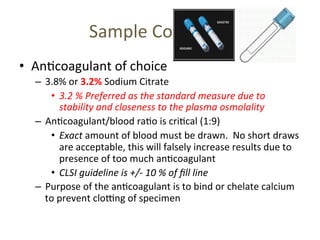
• An(coagulant 
of 
choice 
– 3.8% 
or 
3.2% 
Sodium 
Citrate 
• 3.2 
% 
Preferred 
as 
the 
standard 
measure 
due 
to 
stability 
and 
closeness 
to 
the 
plasma 
osmolality 
– An(coagulant/blood 
ra(o 
is 
cri(cal 
(1:9) 
• Exact 
amount 
of 
blood 
must 
be 
drawn. 
No 
short 
draws 
are 
acceptable, 
this 
will 
falsely 
increase 
results 
due 
to 
presence 
of 
too 
much 
an(coagulant 
• CLSI 
guideline 
is 
+/-­‐ 
10 
% 
of 
fill 
line 
– Purpose 
of 
the 
an(coagulant 
is 
to 
bind 
or 
chelate 
calcium 
to 
prevent 
cloTng 
of 
specimen
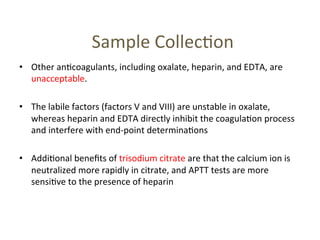
• Other 
Sample 
Collec(on 
an(coagulants, 
including 
oxalate, 
heparin, 
and 
EDTA, 
are 
unacceptable. 
• The 
labile 
factors 
(factors 
V 
and 
VIII) 
are 
unstable 
in 
oxalate, 
whereas 
heparin 
and 
EDTA 
directly 
inhibit 
the 
coagula(on 
process 
and 
interfere 
with 
end-­‐point 
determina(ons 
• Addi(onal 
benefits 
of 
trisodium 
citrate 
are 
that 
the 
calcium 
ion 
is 
neutralized 
more 
rapidly 
in 
citrate, 
and 
APTT 
tests 
are 
more 
sensi(ve 
to 
the 
presence 
of 
heparin
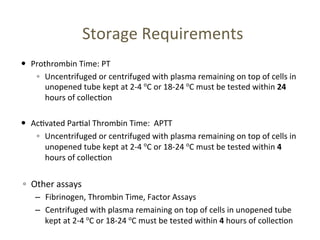
Storage 
Requirements 
— Prothrombin 
Time: 
PT 
◦ Uncentrifuged 
or 
centrifuged 
with 
plasma 
remaining 
on 
top 
of 
cells 
in 
unopened 
tube 
kept 
at 
2-­‐4 
oC 
or 
18-­‐24 
oC 
must 
be 
tested 
within 
24 
hours 
of 
collec(on 
— Ac(vated 
Par(al 
Thrombin 
Time: 
APTT 
◦ Uncentrifuged 
or 
centrifuged 
with 
plasma 
remaining 
on 
top 
of 
cells 
in 
unopened 
tube 
kept 
at 
2-­‐4 
oC 
or 
18-­‐24 
oC 
must 
be 
tested 
within 
4 
hours 
of 
collec(on 
◦ Other 
assays 
– Fibrinogen, 
Thrombin 
Time, 
Factor 
Assays 
– Centrifuged 
with 
plasma 
remaining 
on 
top 
of 
cells 
in 
unopened 
tube 
kept 
at 
2-­‐4 
oC 
or 
18-­‐24 
oC 
must 
be 
tested 
within 
4 
hours 
of 
collec(on
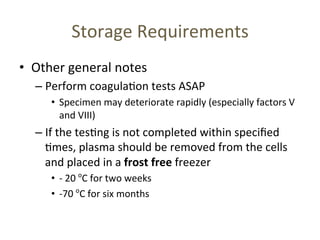
• Other 
Storage 
Requirements 
general 
notes 
– Perform 
coagula(on 
tests 
ASAP 
• Specimen 
may 
deteriorate 
rapidly 
(especially 
factors 
V 
and 
VIII) 
– If 
the 
tes(ng 
is 
not 
completed 
within 
specified 
(mes, 
plasma 
should 
be 
removed 
from 
the 
cells 
and 
placed 
in 
a 
frost 
free 
freezer 
• -­‐ 
20 
oC 
for 
two 
weeks 
• -­‐70 
oC 
for 
six 
months
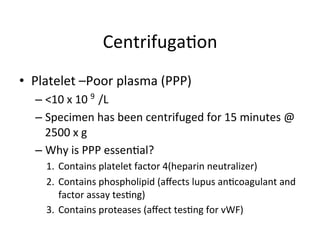
• Platelet 
Centrifuga(on 
–Poor 
plasma 
(PPP) 
– <10 
x 
10 
9 
/L 
– Specimen 
has 
been 
centrifuged 
for 
15 
minutes 
@ 
2500 
x 
g 
– Why 
is 
PPP 
essen(al? 
1. Contains 
platelet 
factor 
4(heparin 
neutralizer) 
2. Contains 
phospholipid 
(affects 
lupus 
an(coagulant 
and 
factor 
assay 
tes(ng) 
3. Contains 
proteases 
(affect 
tes(ng 
for 
vWF)
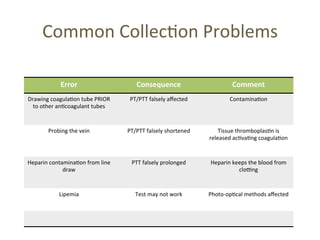
Common 
Collec(on 
Problems 
Error 
Consequence 
Comment 
Drawing 
coagula(on 
tube 
PRIOR 
to 
other 
an(coagulant 
tubes 
PT/PTT 
falsely 
affected 
Contamina(on 
Probing 
the 
vein 
PT/PTT 
falsely 
shortened 
Tissue 
thromboplas(n 
is 
released 
ac(va(ng 
coagula(on 
Heparin 
contamina(on 
from 
line 
draw 
PTT 
falsely 
prolonged 
Heparin 
keeps 
the 
blood 
from 
cloTng 
Lipemia 
Test 
may 
not 
work 
Photo-­‐op(cal 
methods 
affected
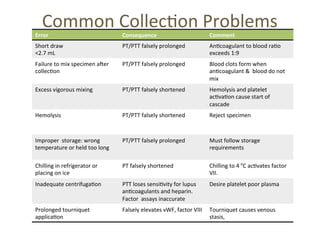
Common 
Collec(on 
Problems 
Error 
Consequence 
Comment 
Short 
draw 
<2.7 
mL 
PT/PTT 
falsely 
prolonged 
An(coagulant 
to 
blood 
ra(o 
exceeds 
1:9 
Failure 
to 
mix 
specimen 
aher 
collec(on 
PT/PTT 
falsely 
prolonged 
Blood 
clots 
form 
when 
an(coagulant 
& 
blood 
do 
not 
mix 
Excess 
vigorous 
mixing 
PT/PTT 
falsely 
shortened 
Hemolysis 
and 
platelet 
ac(va(on 
cause 
start 
of 
cascade 
Hemolysis 
PT/PTT 
falsely 
shortened 
Reject 
specimen 
Improper 
storage: 
wrong 
temperature 
or 
held 
too 
long 
PT/PTT 
falsely 
prolonged 
Must 
follow 
storage 
requirements 
Chilling 
in 
refrigerator 
or 
placing 
on 
ice 
PT 
falsely 
shortened 
Chilling 
to 
4 
oC 
ac(vates 
factor 
VII. 
Inadequate 
centrifuga(on 
PTT 
loses 
sensi(vity 
for 
lupus 
an(coagulants 
and 
heparin. 
Factor 
assays 
inaccurate 
Desire 
platelet 
poor 
plasma 
Prolonged 
tourniquet 
applica(on 
Falsely 
elevates 
vWF, 
factor 
VIII 
Tourniquet 
causes 
venous 
stasis,
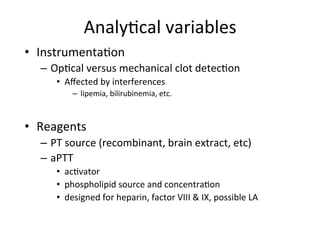
Analy(cal 
variables 
• Instrumenta(on 
– Op(cal 
versus 
mechanical 
clot 
detec(on 
• Affected 
by 
interferences 
– lipemia, 
bilirubinemia, 
etc. 
• Reagents 
– PT 
source 
(recombinant, 
brain 
extract, 
etc) 
– aPTT 
• ac(vator 
• phospholipid 
source 
and 
concentra(on 
• designed 
for 
heparin, 
factor 
VIII 
& 
IX, 
possible 
LA