ROOT
ANATOMY
EXTERNAL STRUCTURE
Organization Of Root Structure
Structure Of Individual Roots
ORGANIZATION OF ROOT SYSTEM
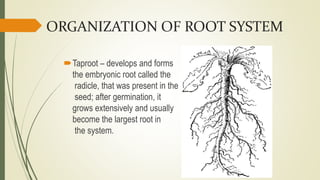
Taproot – develops and forms
the embryonic root called the
radicle, that was present in the
seed; after germination, it
grows extensively and usually
become the largest root in
the system.
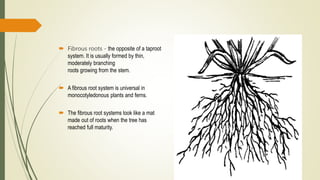
 Fibrous roots - the opposite of a taproot
system. It is usually formed by thin,
moderately branching
roots growing from the stem.
 A fibrous root system is universal in
monocotyledonous plants and ferns.
 The fibrous root systems look like a mat
made out of roots when the tree has
reached full maturity.
 Adventitious roots - roots are plant roots
that form from any non-root tissue and are
produced both during normal development.
STRUCTURE OF INDIVIDUAL ROOTS
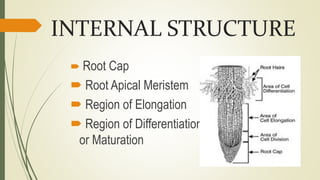
INTERNAL STRUCTURE
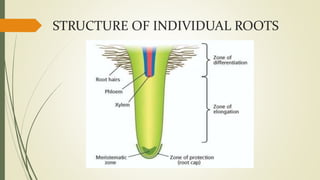
 Root Cap
 Root Apical Meristem
 Region of Elongation
 Region of Differentiation
or Maturation
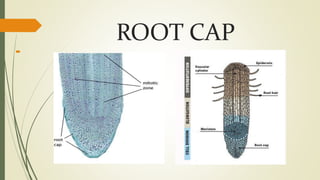
ROOT CAP

ROOT CAP
Thimble-shaped mass of parenchyma cells at the tip of each
root protects the root from mechanical injury.
 Dictyosomes or Golgi bodies release a mucilaginous
lubricant (mucigel) cells that lasts less than a week, then
these die possibly important in the perception of gravity (i.e.,
geotropism or gravitropism) amyloplasts (also called
statoliths) appear to accumulate at the bottom of cells.
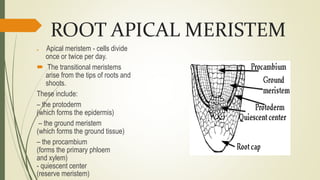
ROOT APICAL MERISTEM
 Apical meristem - cells divide
once or twice per day.
 The transitional meristems
arise from the tips of roots and
shoots.
These include:
– the protoderm
(which forms the epidermis)
– the ground meristem
(which forms the ground tissue)
– the procambium
(forms the primary phloem
and xylem)
- quiescent center
(reserve meristem)
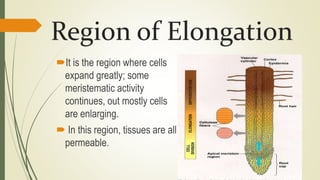
Region of Elongation
It is the region where cells
expand greatly; some
meristematic activity
continues, out mostly cells
are enlarging.
 In this region, tissues are all
permeable.
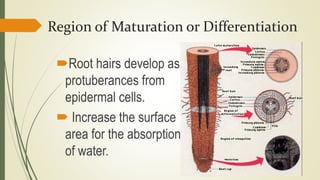
Region of Maturation or Differentiation
Root hairs develop as
protuberances from
epidermal cells.
 Increase the surface
area for the absorption
of water.
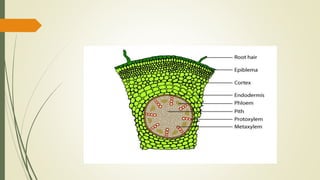
ENDODERMIS
 Is the central, innermost layer
of the cortex in land plants.
 It is a cylinder of compact living cells,
the radial walls of which are
impregnated with hydrophobic
substances to restrict the
apoplastic flow of water to the inside.
 The boundary between the
cortex and the stele.
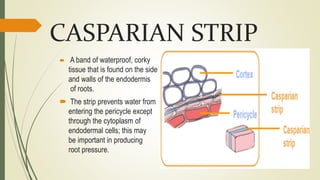
CASPARIAN STRIP
 A band of waterproof, corky
tissue that is found on the side
and walls of the endodermis
of roots.
 The strip prevents water from
entering the pericycle except
through the cytoplasm of
endodermal cells; this may
be important in producing
root pressure.
The Casparian strip is a waxy-like material or substance that
layers around the endodermis.
 Due to its hydrophobicity, water or dissolved minerals in the
water will be prevented from moving from the cortex into the
vascular cylinder and vice versa.
It will prevent anything from moving between the cells. So if any
material wants to move from the cortex to the vascular cylinder,
they now have to first move into a cell, then will be transported
cell to cell through connections between cells.
The purpose of this action or mechanism is to filter out which
materials are needed to be transported into the vascular cylinder
from those materials that are unnecessary or harmful to the
plant.
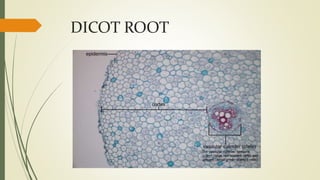
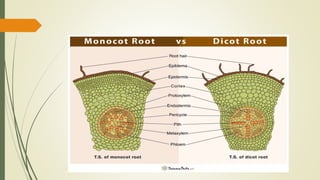
DICOT ROOT
MONOCOT
ROOT-ANATOMY.pptx
ROOT-ANATOMY.pptx

ROOT-ANATOMY.pptx

  • 1.
  • 2.
    EXTERNAL STRUCTURE Organization OfRoot Structure Structure Of Individual Roots
  • 3.
    ORGANIZATION OF ROOTSYSTEM Taproot – develops and forms the embryonic root called the radicle, that was present in the seed; after germination, it grows extensively and usually become the largest root in the system.
  • 4.
     Fibrous roots- the opposite of a taproot system. It is usually formed by thin, moderately branching roots growing from the stem.  A fibrous root system is universal in monocotyledonous plants and ferns.  The fibrous root systems look like a mat made out of roots when the tree has reached full maturity.
  • 5.
     Adventitious roots- roots are plant roots that form from any non-root tissue and are produced both during normal development.
  • 7.
  • 8.
    INTERNAL STRUCTURE  RootCap  Root Apical Meristem  Region of Elongation  Region of Differentiation or Maturation
  • 9.
  • 10.
    ROOT CAP Thimble-shaped massof parenchyma cells at the tip of each root protects the root from mechanical injury.  Dictyosomes or Golgi bodies release a mucilaginous lubricant (mucigel) cells that lasts less than a week, then these die possibly important in the perception of gravity (i.e., geotropism or gravitropism) amyloplasts (also called statoliths) appear to accumulate at the bottom of cells.
  • 11.
    ROOT APICAL MERISTEM Apical meristem - cells divide once or twice per day.  The transitional meristems arise from the tips of roots and shoots. These include: – the protoderm (which forms the epidermis) – the ground meristem (which forms the ground tissue) – the procambium (forms the primary phloem and xylem) - quiescent center (reserve meristem)
  • 12.
    Region of Elongation Itis the region where cells expand greatly; some meristematic activity continues, out mostly cells are enlarging.  In this region, tissues are all permeable.
  • 13.
    Region of Maturationor Differentiation Root hairs develop as protuberances from epidermal cells.  Increase the surface area for the absorption of water.
  • 14.
    ENDODERMIS  Is thecentral, innermost layer of the cortex in land plants.  It is a cylinder of compact living cells, the radial walls of which are impregnated with hydrophobic substances to restrict the apoplastic flow of water to the inside.  The boundary between the cortex and the stele.
  • 15.
    CASPARIAN STRIP  Aband of waterproof, corky tissue that is found on the side and walls of the endodermis of roots.  The strip prevents water from entering the pericycle except through the cytoplasm of endodermal cells; this may be important in producing root pressure.
  • 16.
    The Casparian stripis a waxy-like material or substance that layers around the endodermis.  Due to its hydrophobicity, water or dissolved minerals in the water will be prevented from moving from the cortex into the vascular cylinder and vice versa. It will prevent anything from moving between the cells. So if any material wants to move from the cortex to the vascular cylinder, they now have to first move into a cell, then will be transported cell to cell through connections between cells. The purpose of this action or mechanism is to filter out which materials are needed to be transported into the vascular cylinder from those materials that are unnecessary or harmful to the plant.
  • 17.
  • 19.