
Learning outcomes
• describe and explain the behavior of
permanent magnets, including induced
magnetism
• describe how magnetic fields arise from
moving charges, e.g. in current-carrying
straight wires, plane coils and solenoids
• Make simple electric motor and generator
Misconceptions
• All metals are magnetic materials.
• Static charges interact with the poles of
permanent magnets.
• Magnetic poles are located on the surface of a
magnet.
A brief history
1600 William Gilbert, On magnetism; magnetic materials;
poles that attract & repel; Earth’s magnetic field, compass ‘dip’
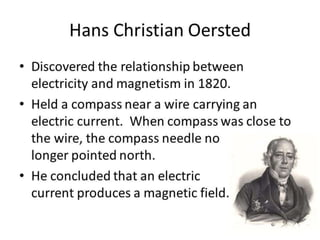
1820 Hans Christian Oersted finds that an electric current deflects
a compass needle.
1820 Andre Marie Ampère finds that parallel wires
carrying current produce forces on each other.
1820s, 1830s Michael Faraday develops the concept of
electric field and shows that
electric current + magnetism -> motion (motor effect)
motion + magnetism -> electric current (electromagnetic induction)
1860s James Clerk Maxwell (1831-1879) establishes
a mathematical description of electromagnetism.
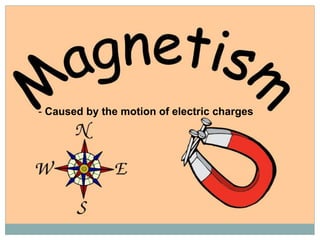
- Caused by the motion of electric charges
1. Magnets are dipoles.
PROPERTIES OF MAGNET
2. Magnets attract materials that
are magnetic in nature.
PROPERTIES OF MAGNET
a. Ferromagnetic - iron,cobalt, nickel (strongly
attracted)
b. Paramagnetic - copper ,aluminum and
transitional elements (weakly attracted)
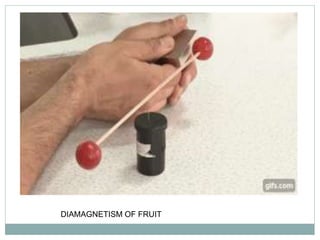
c. Diamagnetic - materials repelled by a magnet
( gold,silver,lead,copper,water)
DIAMAGNETISM OF FRUIT
3. Like poles repel. Unlike poles
attract.
PROPERTIES OF MAGNET
4. Magnets when hang freely align
in one particular direction.
PROPERTIES OF MAGNET
Remember: Magnetic south pole of the
Earth lies near the geographic north pole.
5. The closer the two magnets are
together, the stronger the force
between them.
PROPERTIES OF MAGNET
Field lines indicate both direction and magnitude
(strength) of a magnetic field. They end at poles.
Magnetic field
DEMO/activity: using magnet board – tracing magnetic field lines
area around a magnet in which the effect of
magnetism is felt.
magnetic field lines are represented by arrows that originate at the north pole of
a magnet and curve around toward the south pole. The lines are spaced closer
together near the magnet, and farther apart away from the magnet
1. PERMANENT MAGNETS
2. - do not lose their magnetic
property once they are
magnetized
TYPES OF MAGNET
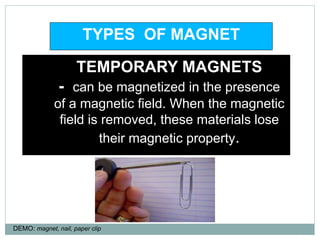
1. TEMPORARY MAGNETS
2. - can be magnetized in the presence
of a magnetic field. When the magnetic
field is removed, these materials lose
their magnetic property.
TYPES OF MAGNET
DEMO: magnet, nail, paper clip
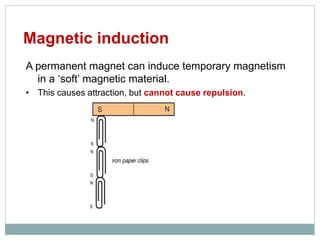
Magnetic induction
A permanent magnet can induce temporary magnetism
in a ‘soft’ magnetic material.
• This causes attraction, but cannot cause repulsion.
1. ELECTROMAGNETS
2. - When this material is exposed to an electric
current, a magnetic field is generated, making
the material behave like a magnet.
TYPES OF MAGNET
ELECTROMAGNETISM
the interaction of electric currents
or fields and magnetic fields.
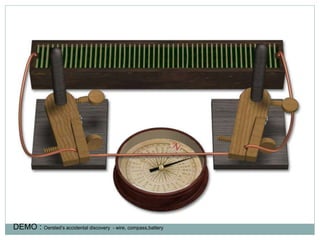
DEMO : Oersted’s accidental discovery - wire, compass,battery
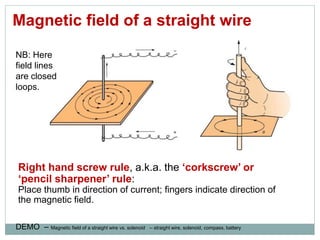
Right hand screw rule, a.k.a. the ‘corkscrew’ or
‘pencil sharpener’ rule:
Place thumb in direction of current; fingers indicate direction of
the magnetic field.
Magnetic field of a straight wire
NB: Here
field lines
are closed
loops.
DEMO – Magnetic field of a straight wire vs. solenoid -- straight wire, solenoid, compass, battery
Magnetic field of a solenoid
Right hand grip rule: Wrap fingers around solenoid in
direction of current; thumb indicates N pole.
N S
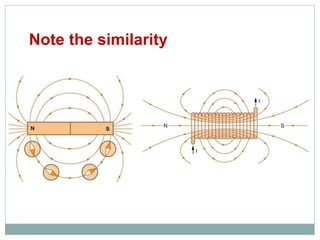
Note the similarity
FACTORS AFFECTING THE
STRENGTH OF ELECTROMAGNET
1. Activity: Electrifying electromagnetism
FACTORS AFFECTING THE
STRENGTH OF ELECTROMAGNET
Number of Loops
Metal core
Current size
ELECTRIC MOTOR
Anything that changes electricity into motion, meaning
electrical energy into mechanical energy is called an
electric motor
How do Electric Motors work?
Motors work through the principles of ELECTROMAGNETISM.
If you run electricity through a wire, it creates a magnetic field.
If you coil the wire around a rod and run electricity through the wire, it creates
a magnetic field around the rod.
One end of the rod will have a north magnetic pole and the other will have a
south pole.
Opposite poles attract one another, like poles repel. When you surround that
rod with other magnets, the rod will rotate from the attractive and repulsive
forces.
Every electric motor has two essential parts;
one stationary, and one that rotates. The
stationary part is the STATOR. Though
configurations vary, the stator is most often a
permanent magnet or row of magnets lining
the edge of the motor casing, which is usually
a round plastic drum.
Inserted into the stator is the ROTOR,
usually consisting of copper wire wound
into a coil around an axle. When electric
current flows through the coil, the
resulting magnetic field pushes against
the field created by the stator, and
makes the axle spin.
COMMUTATOR
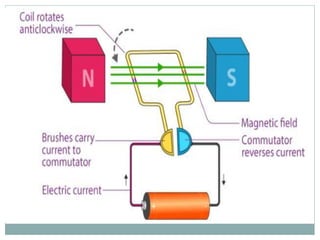
1. BASICS – An electric motor has another important component,
the commutator, which sits at one end of the coil. It is a metal ring
divided into two halves. It reverses the electrical current in the coil
each time the coil rotates half a turn. The commutator periodically
reverses the current between the rotor and the external circuit, or
the battery. This ensures that the ends of coils do not move in
opposite directions, and ensures that the axle spins in one
direction.
2. MAGNETIC POLES – BRUSHES AND TERMINALS. At one end
of the motor are the brushes and the terminals. They are at the
opposite end from where the rotor exits the motor casing. The
brushes send electrical current to the commutator and are
typically made of graphite. The terminals are the locations where
the battery attaches to the motor and sends the currents to spin
the rotor.
AC vs DC ELECTRIC MOTOR
In the AC Motor, the source of power is AC mains supply
whereas in DC motor power is obtained from batteries.
In AC motors no commutators and brushes are used
whereas in DC motors these play an important part in their
operation.
In AC motors the armature is stationary and the magnetic
field rotates whereas in DC motors it is vice versa.
 AC motors are suitable for large industrial applications
whereas DC motors are suitable for domestic applications.
SOME APPLICATIONS OF ELECTRIC MOTOR
Drills
Water Pumps
Hard Disc Drives
Washing Machines
Industrial Equipments
food processors
 vacuum cleaners
 dishwashers
 computer printers
 fax machines
 video recorders
printing presses
Automobiles
 subway systems
sewage treatment plants
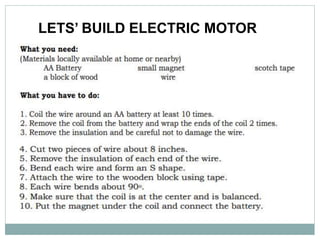
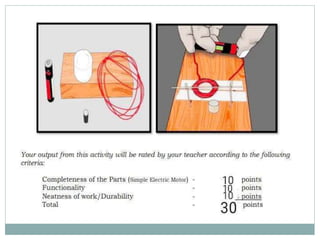
LETS’ BUILD ELECTRIC MOTOR
ELECTROMAGNETIC INDUCTION
DEMO – LOOP of wire, magnet, galvanometer/bulb
FACTORS AFFECTING INDUCED
EMF
The speed at which the wire, coil or magnet is
moved.
The number of turns on the coils of wire.
The size of the coils.
The strength of the magnetic field.
GENERATOR
-converts Mechanical Energy to Electrical Energy.
-It produces an electric current when a coil of wire is wrapped
around an iron core and rotated near a magnet.
How do Generators work?
It uses the mechanical energy supplied to it to force the movement of electric
charges present in the wire of its windings through an external electric circuit.
•A conductor coil is rotated rapidly between the poles of a horseshoe
type magnet. The conductor coil along with its core is known as an
armature.
•The armature is connected to a shaft of a mechanical energy source
such as a motor and rotated. The mechanical energy required can be
provided by engines operating on fuels or via renewable energy.
•When the coil rotates, it cuts the magnetic field which lies between the
two poles of the magnet.
•The magnetic field will interfere with the electrons in the conductor to
induce a flow of electric current inside it.
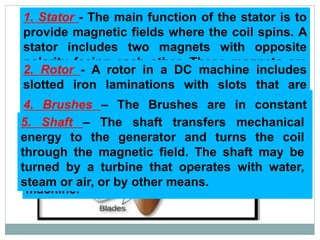
1. Stator - The main function of the stator is to
provide magnetic fields where the coil spins. A
stator includes two magnets with opposite
polarity facing each other. These magnets are
located to fit in the region of the rotor.
2. Rotor - A rotor in a DC machine includes
slotted iron laminations with slots that are
stacked to shape a cylindrical armature core.
The function of the lamination is to decrease
the loss caused due to “Eddy Current”.
3. Commutator - A commutator works like a
rectifier that changes AC voltage to DC voltage
within the armature winding. It is designed with
a copper segment, and each copper segment is
protected from each other with the help of mica
sheets. It is located on the shaft of the
machine.
4. Brushes – The Brushes are in constant
contact with the commutator and are attached
to the wires leading from the generator. The
commutator spins while the brushes remain
stationary, transferring current from the
commutator.
5. Shaft – The shaft transfers mechanical
energy to the generator and turns the coil
through the magnetic field. The shaft may be
turned by a turbine that operates with water,
steam or air, or by other means.
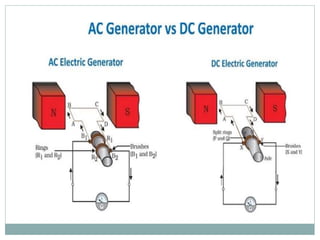
AC vs DC GENERATOR
AC generator produces AC electrical power whereas DC
generator produces DC electrical power
In DC generator the current flows in one direction whereas in
the AC generators current reverses periodically.
In DC generator split rings are used, they wear out quickly. In
AC generator slip rings are used, so they have high efficiency.
AC generators are used for small domestic applications
whereas DC generators used to power large motors.
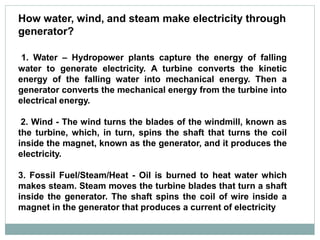
How water, wind, and steam make electricity through
generator?
1. Water – Hydropower plants capture the energy of falling
water to generate electricity. A turbine converts the kinetic
energy of the falling water into mechanical energy. Then a
generator converts the mechanical energy from the turbine into
electrical energy.
2. Wind - The wind turns the blades of the windmill, known as
the turbine, which, in turn, spins the shaft that turns the coil
inside the magnet, known as the generator, and it produces the
electricity.
3. Fossil Fuel/Steam/Heat - Oil is burned to heat water which
makes steam. Steam moves the turbine blades that turn a shaft
inside the generator. The shaft spins the coil of wire inside a
magnet in the generator that produces a current of electricity
in the Philippines.
Agus 6 (Maria Christina)
Hydroelectric Power Plant
Philippines is located at West of
Iligan City, Lanao del Norte,
Philippines.
The 150 MW Burgos Wind Farm in Ilocos Norte is
the largest wind power project in Southeast Asia and
is located within a 600-hectare site.
Datang Tuoketuo power station in China is
the largest operational coal power plant in
the world.
SOME APPLICATIONS OF GENERATOR
 Back -Up power for your house
 Stand-by power for businesses
Temporary power in a construction site
 Permanent power to a farm
Helping main source of electricity to supply the total
power required
Pop concerts, events, and exhibitions
Caravans/Camping in remote locations
 Outdoor catering facilities
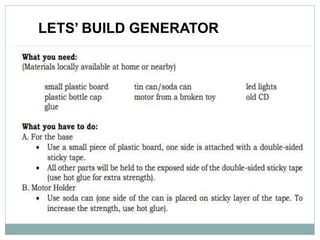
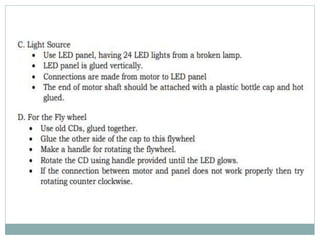
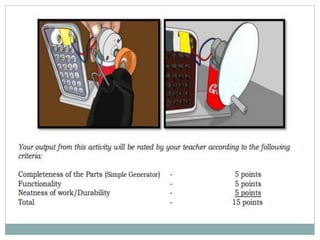
LETS’ BUILD GENERATOR
Compare and contrast the Electric Motor and Generator using the Venn diagram.
Choose the answers from the box below.
Directions: Choose the best answer from the choices in the
parenthesis.
1. Electricity is produced in the (motor, generator).
2. Electric bike, where electric current is supplied to the machine
as a result of a movement, is an example of (motor, generator)
3. The generator transforms mechanical into (radiant, electrical)
energy, whereas electric motor does the opposite.
4. Both motor and generator have stator and (commutator,
winding poles).
5. The motor converts electrical energy into (mechanical,
chemical) energy, whereas generator does the opposite.
J. Clerk Maxwell (1865), ‘A Dynamical Theory of the Electromagnetic
Field’ Phil. Trans. R. Soc. Lond.
A changing electric field induces a changing magnetic field, and
vice versa. It therefore makes sense to talk of an
‘electromagnetic field’.
Electromagnetic waves propagate in
free space at c = 3 x 10⁸ m/s.
E and B are always perpendicular to each other, and
perpendicular to the direction of propagation.
NEXT……
Electromagnetic waves

electromagnetism

  • 2.
    Learning outcomes • describeand explain the behavior of permanent magnets, including induced magnetism • describe how magnetic fields arise from moving charges, e.g. in current-carrying straight wires, plane coils and solenoids • Make simple electric motor and generator
  • 3.
    Misconceptions • All metalsare magnetic materials. • Static charges interact with the poles of permanent magnets. • Magnetic poles are located on the surface of a magnet.
  • 4.
    A brief history 1600William Gilbert, On magnetism; magnetic materials; poles that attract & repel; Earth’s magnetic field, compass ‘dip’ 1820 Hans Christian Oersted finds that an electric current deflects a compass needle. 1820 Andre Marie Ampère finds that parallel wires carrying current produce forces on each other. 1820s, 1830s Michael Faraday develops the concept of electric field and shows that electric current + magnetism -> motion (motor effect) motion + magnetism -> electric current (electromagnetic induction) 1860s James Clerk Maxwell (1831-1879) establishes a mathematical description of electromagnetism.
  • 5.
    - Caused bythe motion of electric charges
  • 6.
    1. Magnets aredipoles. PROPERTIES OF MAGNET
  • 7.
    2. Magnets attractmaterials that are magnetic in nature. PROPERTIES OF MAGNET a. Ferromagnetic - iron,cobalt, nickel (strongly attracted) b. Paramagnetic - copper ,aluminum and transitional elements (weakly attracted) c. Diamagnetic - materials repelled by a magnet ( gold,silver,lead,copper,water)
  • 8.
  • 9.
    3. Like polesrepel. Unlike poles attract. PROPERTIES OF MAGNET
  • 10.
    4. Magnets whenhang freely align in one particular direction. PROPERTIES OF MAGNET Remember: Magnetic south pole of the Earth lies near the geographic north pole.
  • 12.
    5. The closerthe two magnets are together, the stronger the force between them. PROPERTIES OF MAGNET
  • 13.
    Field lines indicateboth direction and magnitude (strength) of a magnetic field. They end at poles. Magnetic field DEMO/activity: using magnet board – tracing magnetic field lines area around a magnet in which the effect of magnetism is felt.
  • 14.
    magnetic field linesare represented by arrows that originate at the north pole of a magnet and curve around toward the south pole. The lines are spaced closer together near the magnet, and farther apart away from the magnet
  • 15.
    1. PERMANENT MAGNETS 2.- do not lose their magnetic property once they are magnetized TYPES OF MAGNET
  • 16.
    1. TEMPORARY MAGNETS 2.- can be magnetized in the presence of a magnetic field. When the magnetic field is removed, these materials lose their magnetic property. TYPES OF MAGNET DEMO: magnet, nail, paper clip
  • 17.
    Magnetic induction A permanentmagnet can induce temporary magnetism in a ‘soft’ magnetic material. • This causes attraction, but cannot cause repulsion.
  • 18.
    1. ELECTROMAGNETS 2. -When this material is exposed to an electric current, a magnetic field is generated, making the material behave like a magnet. TYPES OF MAGNET
  • 19.
    ELECTROMAGNETISM the interaction ofelectric currents or fields and magnetic fields.
  • 22.
    DEMO : Oersted’saccidental discovery - wire, compass,battery
  • 23.
    Right hand screwrule, a.k.a. the ‘corkscrew’ or ‘pencil sharpener’ rule: Place thumb in direction of current; fingers indicate direction of the magnetic field. Magnetic field of a straight wire NB: Here field lines are closed loops. DEMO – Magnetic field of a straight wire vs. solenoid -- straight wire, solenoid, compass, battery
  • 24.
    Magnetic field ofa solenoid Right hand grip rule: Wrap fingers around solenoid in direction of current; thumb indicates N pole. N S
  • 25.
  • 26.
    FACTORS AFFECTING THE STRENGTHOF ELECTROMAGNET 1. Activity: Electrifying electromagnetism
  • 27.
    FACTORS AFFECTING THE STRENGTHOF ELECTROMAGNET Number of Loops Metal core Current size
  • 28.
    ELECTRIC MOTOR Anything thatchanges electricity into motion, meaning electrical energy into mechanical energy is called an electric motor How do Electric Motors work? Motors work through the principles of ELECTROMAGNETISM. If you run electricity through a wire, it creates a magnetic field. If you coil the wire around a rod and run electricity through the wire, it creates a magnetic field around the rod. One end of the rod will have a north magnetic pole and the other will have a south pole. Opposite poles attract one another, like poles repel. When you surround that rod with other magnets, the rod will rotate from the attractive and repulsive forces.
  • 29.
    Every electric motorhas two essential parts; one stationary, and one that rotates. The stationary part is the STATOR. Though configurations vary, the stator is most often a permanent magnet or row of magnets lining the edge of the motor casing, which is usually a round plastic drum. Inserted into the stator is the ROTOR, usually consisting of copper wire wound into a coil around an axle. When electric current flows through the coil, the resulting magnetic field pushes against the field created by the stator, and makes the axle spin. COMMUTATOR 1. BASICS – An electric motor has another important component, the commutator, which sits at one end of the coil. It is a metal ring divided into two halves. It reverses the electrical current in the coil each time the coil rotates half a turn. The commutator periodically reverses the current between the rotor and the external circuit, or the battery. This ensures that the ends of coils do not move in opposite directions, and ensures that the axle spins in one direction. 2. MAGNETIC POLES – BRUSHES AND TERMINALS. At one end of the motor are the brushes and the terminals. They are at the opposite end from where the rotor exits the motor casing. The brushes send electrical current to the commutator and are typically made of graphite. The terminals are the locations where the battery attaches to the motor and sends the currents to spin the rotor.
  • 31.
    AC vs DCELECTRIC MOTOR In the AC Motor, the source of power is AC mains supply whereas in DC motor power is obtained from batteries. In AC motors no commutators and brushes are used whereas in DC motors these play an important part in their operation. In AC motors the armature is stationary and the magnetic field rotates whereas in DC motors it is vice versa.  AC motors are suitable for large industrial applications whereas DC motors are suitable for domestic applications.
  • 32.
    SOME APPLICATIONS OFELECTRIC MOTOR Drills Water Pumps Hard Disc Drives Washing Machines Industrial Equipments food processors  vacuum cleaners  dishwashers  computer printers  fax machines  video recorders printing presses Automobiles  subway systems sewage treatment plants
  • 33.
  • 35.
  • 37.
    DEMO – LOOPof wire, magnet, galvanometer/bulb
  • 38.
    FACTORS AFFECTING INDUCED EMF Thespeed at which the wire, coil or magnet is moved. The number of turns on the coils of wire. The size of the coils. The strength of the magnetic field.
  • 39.
    GENERATOR -converts Mechanical Energyto Electrical Energy. -It produces an electric current when a coil of wire is wrapped around an iron core and rotated near a magnet. How do Generators work? It uses the mechanical energy supplied to it to force the movement of electric charges present in the wire of its windings through an external electric circuit. •A conductor coil is rotated rapidly between the poles of a horseshoe type magnet. The conductor coil along with its core is known as an armature. •The armature is connected to a shaft of a mechanical energy source such as a motor and rotated. The mechanical energy required can be provided by engines operating on fuels or via renewable energy. •When the coil rotates, it cuts the magnetic field which lies between the two poles of the magnet. •The magnetic field will interfere with the electrons in the conductor to induce a flow of electric current inside it.
  • 40.
    1. Stator -The main function of the stator is to provide magnetic fields where the coil spins. A stator includes two magnets with opposite polarity facing each other. These magnets are located to fit in the region of the rotor. 2. Rotor - A rotor in a DC machine includes slotted iron laminations with slots that are stacked to shape a cylindrical armature core. The function of the lamination is to decrease the loss caused due to “Eddy Current”. 3. Commutator - A commutator works like a rectifier that changes AC voltage to DC voltage within the armature winding. It is designed with a copper segment, and each copper segment is protected from each other with the help of mica sheets. It is located on the shaft of the machine. 4. Brushes – The Brushes are in constant contact with the commutator and are attached to the wires leading from the generator. The commutator spins while the brushes remain stationary, transferring current from the commutator. 5. Shaft – The shaft transfers mechanical energy to the generator and turns the coil through the magnetic field. The shaft may be turned by a turbine that operates with water, steam or air, or by other means.
  • 42.
    AC vs DCGENERATOR AC generator produces AC electrical power whereas DC generator produces DC electrical power In DC generator the current flows in one direction whereas in the AC generators current reverses periodically. In DC generator split rings are used, they wear out quickly. In AC generator slip rings are used, so they have high efficiency. AC generators are used for small domestic applications whereas DC generators used to power large motors.
  • 43.
    How water, wind,and steam make electricity through generator? 1. Water – Hydropower plants capture the energy of falling water to generate electricity. A turbine converts the kinetic energy of the falling water into mechanical energy. Then a generator converts the mechanical energy from the turbine into electrical energy. 2. Wind - The wind turns the blades of the windmill, known as the turbine, which, in turn, spins the shaft that turns the coil inside the magnet, known as the generator, and it produces the electricity. 3. Fossil Fuel/Steam/Heat - Oil is burned to heat water which makes steam. Steam moves the turbine blades that turn a shaft inside the generator. The shaft spins the coil of wire inside a magnet in the generator that produces a current of electricity
  • 44.
    in the Philippines. Agus6 (Maria Christina) Hydroelectric Power Plant Philippines is located at West of Iligan City, Lanao del Norte, Philippines.
  • 45.
    The 150 MWBurgos Wind Farm in Ilocos Norte is the largest wind power project in Southeast Asia and is located within a 600-hectare site.
  • 46.
    Datang Tuoketuo powerstation in China is the largest operational coal power plant in the world.
  • 47.
    SOME APPLICATIONS OFGENERATOR  Back -Up power for your house  Stand-by power for businesses Temporary power in a construction site  Permanent power to a farm Helping main source of electricity to supply the total power required Pop concerts, events, and exhibitions Caravans/Camping in remote locations  Outdoor catering facilities
  • 48.
  • 51.
    Compare and contrastthe Electric Motor and Generator using the Venn diagram. Choose the answers from the box below.
  • 52.
    Directions: Choose thebest answer from the choices in the parenthesis. 1. Electricity is produced in the (motor, generator). 2. Electric bike, where electric current is supplied to the machine as a result of a movement, is an example of (motor, generator) 3. The generator transforms mechanical into (radiant, electrical) energy, whereas electric motor does the opposite. 4. Both motor and generator have stator and (commutator, winding poles). 5. The motor converts electrical energy into (mechanical, chemical) energy, whereas generator does the opposite.
  • 53.
    J. Clerk Maxwell(1865), ‘A Dynamical Theory of the Electromagnetic Field’ Phil. Trans. R. Soc. Lond. A changing electric field induces a changing magnetic field, and vice versa. It therefore makes sense to talk of an ‘electromagnetic field’. Electromagnetic waves propagate in free space at c = 3 x 10⁸ m/s. E and B are always perpendicular to each other, and perpendicular to the direction of propagation. NEXT…… Electromagnetic waves