VIROID, VIRUSOID AND
PRIONS
N.H. SHANKAR REDDY
2ND PH.D. PLANT PATHOLOGY
ANNAMALAI UNIVERSITY
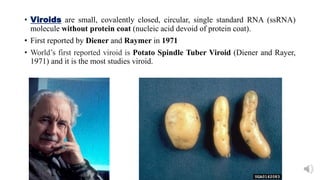
• Viroids are small, covalently closed, circular, single standard RNA (ssRNA)
molecule without protein coat (nucleic acid devoid of protein coat).
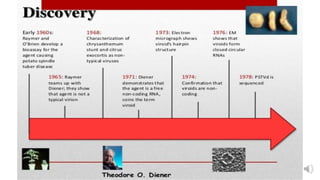
• First reported by Diener and Raymer in 1971
• World’s first reported viroid is Potato Spindle Tuber Viroid (Diener and Rayer,
1971) and it is the most studies viroid.
General properties
• They are usually smaller than plant viruses and are known to infect only plants.
• Genome size ranges form few hundred (250-401) nucleotides long, with high degree of
specificity.
• They do not code for any proteins and thus depend on the host plant or with associated
plant virus for their replication and other functions
• Viroids are only transmitted through mechanical or sap transmission, no other (vectors)
transmission type has been reported so far.
• So far 40 viroid diseases have been reported to be caused plant diseases in the world.
• The viroid moves from cell to cell through ‘Plasmodesmata’ and ‘cell division’
• The replication mechanism of viroid is ‘rolling circle mechanism’
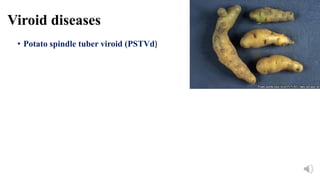
Viroid diseases
• Potato spindle tuber viroid (PSTVd)
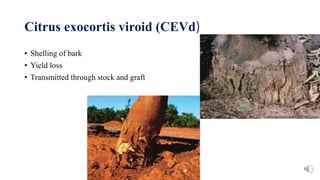
Citrus exocortis viroid (CEVd)
• Shelling of bark
• Yield loss
• Transmitted through stock and graft
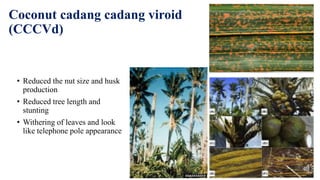
Coconut cadang cadang viroid
(CCCVd)
• Reduced the nut size and husk
production
• Reduced tree length and
stunting
• Withering of leaves and look
like telephone pole appearance
VIRUSOID
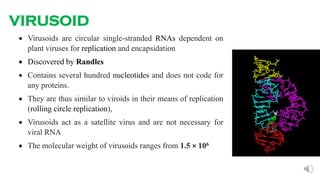
• Virusoids are circular single-stranded RNAs dependent on
plant viruses for replication and encapsidation
• Discovered by Randles
• Contains several hundred nucleotides and does not code for
any proteins.
• They are thus similar to viroids in their means of replication
(rolling circle replication),
• Virusoids act as a satellite virus and are not necessary for
viral RNA
• The molecular weight of virusoids ranges from 1.5 × 10⁶
Prions
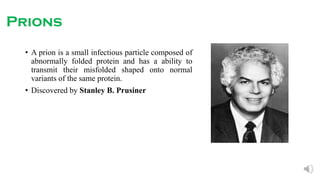
• A prion is a small infectious particle composed of
abnormally folded protein and has a ability to
transmit their misfolded shaped onto normal
variants of the same protein.
• Discovered by Stanley B. Prusiner
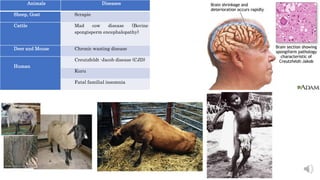
Animals Diseases
Sheep, Goat Scrapie
Cattle Mad cow disease (Bovine
spongisperm encephalopathy)
Deer and Mouse Chronic wasting disease
Human
Creutzfeldt -Jacob disease (CJD)
Kuru
Fatal familial insomnia

Viroid and virusoid

  • 1.
    VIROID, VIRUSOID AND PRIONS N.H.SHANKAR REDDY 2ND PH.D. PLANT PATHOLOGY ANNAMALAI UNIVERSITY
  • 2.
    • Viroids aresmall, covalently closed, circular, single standard RNA (ssRNA) molecule without protein coat (nucleic acid devoid of protein coat). • First reported by Diener and Raymer in 1971 • World’s first reported viroid is Potato Spindle Tuber Viroid (Diener and Rayer, 1971) and it is the most studies viroid.
  • 4.
    General properties • Theyare usually smaller than plant viruses and are known to infect only plants. • Genome size ranges form few hundred (250-401) nucleotides long, with high degree of specificity. • They do not code for any proteins and thus depend on the host plant or with associated plant virus for their replication and other functions • Viroids are only transmitted through mechanical or sap transmission, no other (vectors) transmission type has been reported so far. • So far 40 viroid diseases have been reported to be caused plant diseases in the world. • The viroid moves from cell to cell through ‘Plasmodesmata’ and ‘cell division’ • The replication mechanism of viroid is ‘rolling circle mechanism’
  • 5.
    Viroid diseases • Potatospindle tuber viroid (PSTVd)
  • 6.
    Citrus exocortis viroid(CEVd) • Shelling of bark • Yield loss • Transmitted through stock and graft
  • 7.
    Coconut cadang cadangviroid (CCCVd) • Reduced the nut size and husk production • Reduced tree length and stunting • Withering of leaves and look like telephone pole appearance
  • 8.
    VIRUSOID • Virusoids arecircular single-stranded RNAs dependent on plant viruses for replication and encapsidation • Discovered by Randles • Contains several hundred nucleotides and does not code for any proteins. • They are thus similar to viroids in their means of replication (rolling circle replication), • Virusoids act as a satellite virus and are not necessary for viral RNA • The molecular weight of virusoids ranges from 1.5 × 10⁶
  • 9.
    Prions • A prionis a small infectious particle composed of abnormally folded protein and has a ability to transmit their misfolded shaped onto normal variants of the same protein. • Discovered by Stanley B. Prusiner
  • 10.
    Animals Diseases Sheep, GoatScrapie Cattle Mad cow disease (Bovine spongisperm encephalopathy) Deer and Mouse Chronic wasting disease Human Creutzfeldt -Jacob disease (CJD) Kuru Fatal familial insomnia