1
Basics of Electrical and Electronics Engineering
Course Code: ECE1PM01A
2
UNIT-IV
Introduction to Integrated Circuits
3
Contents:
Introduction to Integrated Circuits: Analog Integrated
circuits, Basics of OPAMP: study of parameters of IC
741, inverting and non-inverting amplifier, Digital
integrated circuits: Logic Gates, Boolean algebra,
Combinational logic Circuits, De-Morgan’s theorems,
SOP, POS, K- map, Half Adder, Full Adder, flip-flops:
RS flip flop, J-K flip flop, D flip flop, shift registers
(12L)
4
Integrated Circuits
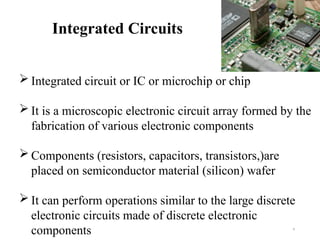
 Integrated circuit or IC or microchip or chip
 It is a microscopic electronic circuit array formed by the
fabrication of various electronic components
 Components (resistors, capacitors, transistors,)are
placed on semiconductor material (silicon) wafer
 It can perform operations similar to the large discrete
electronic circuits made of discrete electronic
components
5
IC- Integrated circuit
• ICs have three key advantages over digital circuits built from discrete
components
• Small size
• ICs are much smaller, both transistors and wires are
shrunk to micrometer sizes, compared to the centimeter
scales of discrete components
• High speed
• Communication within a chip is faster than
communication between chips on a PCB (Printed Circuit
Board)
• Low power consumption
• Logic operations within a chip take much less power
6
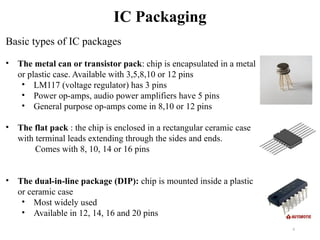
IC Packaging
Basic types of IC packages
• The metal can or transistor pack: chip is encapsulated in a metal
or plastic case. Available with 3,5,8,10 or 12 pins
• LM117 (voltage regulator) has 3 pins
• Power op-amps, audio power amplifiers have 5 pins
• General purpose op-amps come in 8,10 or 12 pins
• The flat pack : the chip is enclosed in a rectangular ceramic case
with terminal leads extending through the sides and ends.
Comes with 8, 10, 14 or 16 pins
• The dual-in-line package (DIP): chip is mounted inside a plastic
or ceramic case
• Most widely used
• Available in 12, 14, 16 and 20 pins
7
Manufacturer’s Designation for ICs
Each manufacturer uses a specific code and assigns a specific
type number to the ICs it produces. Examples are-
Fairchild
Analog Devices AD
Atmel AT
National Semiconductor LM
Motorola MC
Signetics NE
Texas Instruments CA/CD
8
Example of Analog IC
Operational
Amplifier
9
Operational Amplifier: OP-AMP
• Linear Integrated Circuit
• Linear– Output signal varies according to the input signal
• Integrated – all components are fabricated on a single chip
• Direct coupled high gain amplifier
• Versatile device – amplifies ac as well as dc signals
• Originally designed for computing mathematical functions as
addition, subtraction, multiplication and division, hence the
name
• Used for a variety of applications such as ac and dc signal
amplification, active filters, oscillators, comparators,
regulators, etc.
10
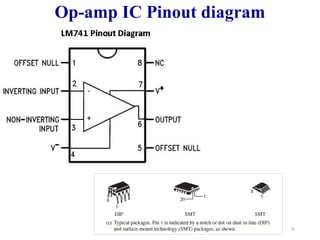
Op-amp IC Pinout diagram
11
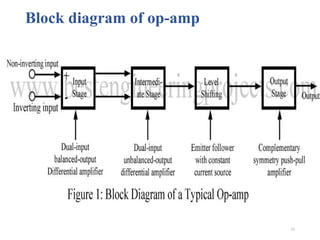
Block diagram of op-amp
12
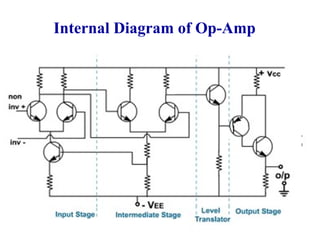
Internal Diagram of Op-Amp
13
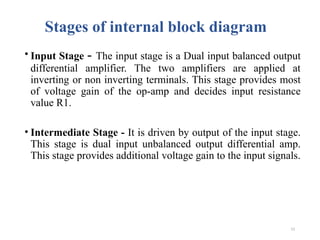
Stages of internal block diagram
• Input Stage - The input stage is a Dual input balanced output
differential amplifier. The two amplifiers are applied at
inverting or non inverting terminals. This stage provides most
of voltage gain of the op-amp and decides input resistance
value R1.
• Intermediate Stage - It is driven by output of the input stage.
This stage is dual input unbalanced output differential amp.
This stage provides additional voltage gain to the input signals.
14
Stages of internal block diagram
• Level shifting stage - This is third stage in the block diagram of
op-amp. Due to direct coupling between first two stage the input of
level shifting stage is an amplifying system with non-zero DC level.
Level shifting stage is used to bring this DC level to a zero volt with
respect to ground.
• Output Stage - This is normally complementary output stage. It
increases magnitude of voltage and rises the current supplying
capacity of the op-amp. It also provides low output resistance. The
output stage is a push pull of two transistors.
15
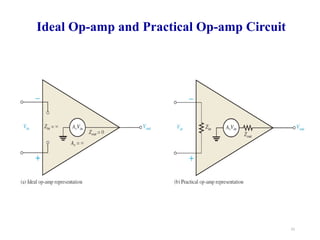
Ideal Op-amp and Practical Op-amp Circuit
16
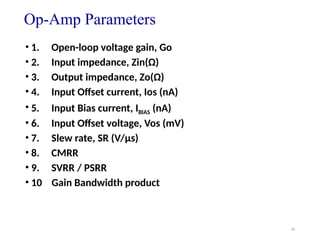
Op-Amp Parameters
• 1. Open-loop voltage gain, Go
• 2. Input impedance, Zin(Ω)
• 3. Output impedance, Zo(Ω)
• 4. Input Offset current, Ios (nA)
• 5. Input Bias current, IBIAS (nA)
• 6. Input Offset voltage, Vos (mV)
• 7. Slew rate, SR (V/μs)
• 8. CMRR
• 9. SVRR / PSRR
• 10 Gain Bandwidth product
17
Op-Amp Parameters
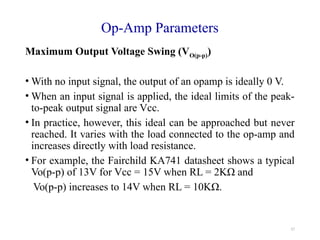
Maximum Output Voltage Swing (VO(p-p))
• With no input signal, the output of an opamp is ideally 0 V.
• When an input signal is applied, the ideal limits of the peak-
to-peak output signal are Vcc.
• In practice, however, this ideal can be approached but never
reached. It varies with the load connected to the op-amp and
increases directly with load resistance.
• For example, the Fairchild KA741 datasheet shows a typical
Vo(p-p) of 13V for Vcc = 15V when RL = 2KΩ and
Vo(p-p) increases to 14V when RL = 10KΩ.
18
Op-Amp Parameters
Open-loop voltage gain
• The open-loop voltage gain, Aol, of an op-amp is the internal
voltage gain of the device and represents the ratio of output
voltage to input voltage when there are no external
components.
• The open-loop voltage gain is set entirely by the internal
design.
• Open-loop voltage gain can range up to 200,000 (106 dB)
and is not a well-controlled parameter.
• Datasheets often refer to the open-loop voltage gain as the
large-signal voltage gain.
19
Op-Amp Parameters
Input offset voltage
• The ideal op-amp produces zero volts out for zero volts in.
• In a practical op-amp, however, a small dc voltage, VOUT(error),
appears at the output when no differential input voltage is
applied.
• Its primary cause is a slight mismatch of the base-emitter
voltages of the differential amplifier input stage of an op-amp.
• The input offset voltage, VOS, is the differential dc voltage
required between the inputs to force the output to zero volts.
• Typical values of input offset voltage are in the range of 2 mV
or less. In the ideal case, it is 0 V.
20
Op-Amp Parameters
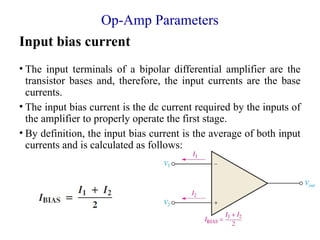
Input bias current
• The input terminals of a bipolar differential amplifier are the
transistor bases and, therefore, the input currents are the base
currents.
• The input bias current is the dc current required by the inputs of
the amplifier to properly operate the first stage.
• By definition, the input bias current is the average of both input
currents and is calculated as follows:
21
Op-Amp Parameters
Input offset current
• Ideally, the two input bias currents are equal, and thus their
difference is zero.
• In a practical op-amp, however, the bias currents are not exactly
equal.
• The input offset current, IOS, is the difference of the input bias
currents, expressed as an absolute value.
IOS = | I1 – I2 |
• Typical value is 200 nA
22
Op-Amp Parameters
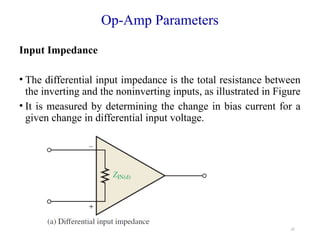
Input Impedance
• The differential input impedance is the total resistance between
the inverting and the noninverting inputs, as illustrated in Figure
• It is measured by determining the change in bias current for a
given change in differential input voltage.
23
Op-Amp Parameters
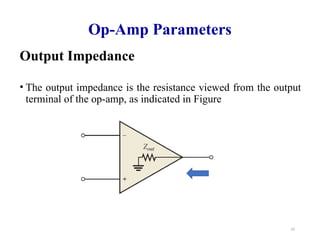
Output Impedance
• The output impedance is the resistance viewed from the output
terminal of the op-amp, as indicated in Figure
24
Op-Amp Parameters
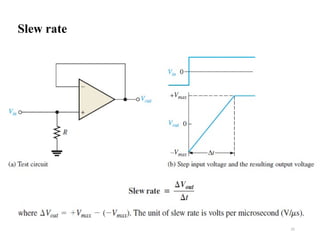
Slew rate
• The slew rate is the maximum rate of change of output voltage
for a step input voltage.
• The slew rate makes the output voltage to change at a slower
rate than the applied input.
• Max rate of change of output voltage with time. i.e. dv/dt
(max) or ΔV/Δt max expressed in (volts/µs) .
• Slew rate is usually measured in the unity gain non-inverting
amplifier configuration
• Typically it is 0.5 V/μs
25
Slew rate
26
Op-Amp Parameters
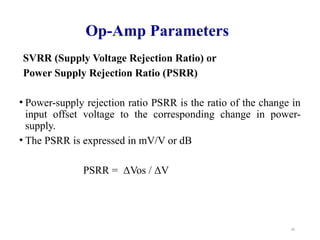
SVRR (Supply Voltage Rejection Ratio) or
Power Supply Rejection Ratio (PSRR)
• Power-supply rejection ratio PSRR is the ratio of the change in
input offset voltage to the corresponding change in power-
supply.
• The PSRR is expressed in mV/V or dB
PSRR = ΔVos / ΔV
27
Op-Amp Parameters
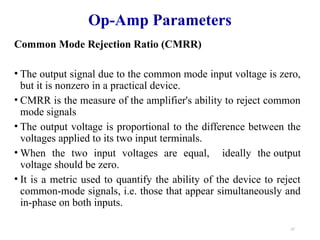
Common Mode Rejection Ratio­(CMRR)
• The output signal due to the common mode input voltage is zero,
but it is nonzero in a practical device.
• CMRR is the measure of the amplifier's ability to reject common
mode signals
• The output voltage is proportional to the difference between the
voltages applied to its two input terminals.
• When the two input voltages are equal, ideally the output
voltage should be zero.
• It is a metric used to quantify the ability of the device to reject
common-mode signals, i.e. those that appear simultaneously and
in-phase on both inputs.
28
• A signal applied to both input terminals of the op-amp is called
as common-mode signal. Usually it is an unwanted noise
voltage.
• CMRR is defined as the ratio of the open loop differential
voltage gain Aol to the common mode voltage gain Acm
CMRR = Aol / Acm
CMRR=20 log[Aol / Acm] dB
Common Mode Rejection Ratio­(CMRR)
29
Op-Amp Parameters
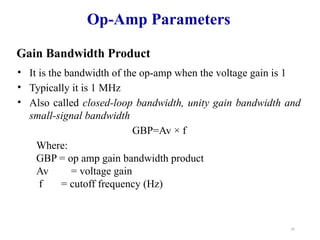
Gain Bandwidth Product
• It is the bandwidth of the op-amp when the voltage gain is 1
• Typically it is 1 MHz
• Also called closed-loop bandwidth, unity gain bandwidth and
small-signal bandwidth
GBP=Av × f
Where:
GBP = op amp gain bandwidth product
Av = voltage gain
f = cutoff frequency (Hz)
30
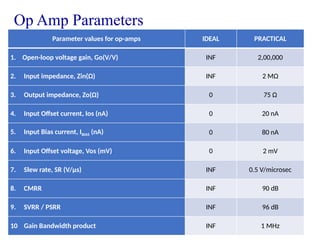
Op Amp Parameters
Parameter values for op-amps IDEAL PRACTICAL
1. Open-loop voltage gain, Go(V/V) INF 2,00,000
2. Input impedance, Zin(Ω) INF 2 MΩ
3. Output impedance, Zo(Ω) 0 75 Ω
4. Input Offset current, Ios (nA) 0 20 nA
5. Input Bias current, IBIAS (nA) 0 80 nA
6. Input Offset voltage, Vos (mV) 0 2 mV
7. Slew rate, SR (V/μs) INF 0.5 V/microsec
8. CMRR INF 90 dB
9. SVRR / PSRR INF 96 dB
10 Gain Bandwidth product INF 1 MHz
31
What is negative feedback?
• Negative feedback is the most useful concepts in OPAMP
applications.
• It is the process whereby a portion of the output voltage of
an amplifier is returned to the input with a phase angle that
opposes the input signal.
32
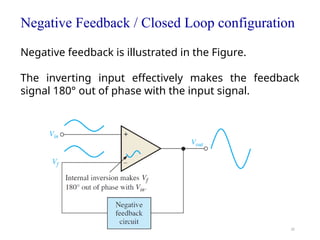
Negative Feedback / Closed Loop configuration
Negative feedback is illustrated in the Figure.
The inverting input effectively makes the feedback
signal 180° out of phase with the input signal.
33
Why Use Negative Feedback?
• The inherent open-loop voltage gain of a typical op-amp is very high
(usually greater than 100,000).
• Therefore, an extremely small input voltage drives the op-amp into its
saturated output states.
• In fact, even the input offset voltage of the op-amp can drive it into
saturation.
• For example, assume Vin = 1 mV and Aol = 100,000. Then:
VinAol = (1 mV)(100,000) = 100 V
• Since the output level of an op-amp can never reach 100 V, it is
driven deep into saturation and the output is limited to its maximum
output levels, i. e. Vcc.
• With negative feedback, the closed loop voltage gain (Acl) can be
reduced and controlled so that the op-amp can function as a linear
amplifier.
• In addition to providing a controlled, stable voltage gain, negative
feedback also provides for control of the input and output impedances
and amplifier bandwidth.
Closed-Loop Voltage Gain, Acl
• The amplifier configuration consists of the op-amp
and an external negative feedback circuit that
connects the output to the inverting input.
• The closed-loop voltage gain is the voltage gain of
an op-amp with external feedback.
• The closed-loop voltage gain is determined by the
external component values and can be precisely
controlled by them.
34
35
Virtual short and Virtual ground
• Voltage between inverting and non-inverting terminals of OP-
AMP is output voltage divided by open loop gain of OP-AMP.
• Open loop gain being very large, this voltage is very small.
Practically zero. This is virtual short.
• Both input terminals will be at the same potential. In other words
they are virtually shorted to each other.
• Virtual ground concept is NOT valid for positive feedback or open
loop operation of OPAMP.
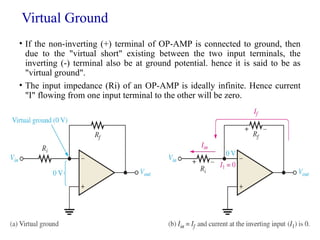
Virtual Ground
• If the non-inverting (+) terminal of OP-AMP is connected to ground, then
due to the "virtual short" existing between the two input terminals, the
inverting (-) terminal also be at ground potential. hence it is said to be as
"virtual ground".
• The input impedance (Ri) of an OP-AMP is ideally infinite. Hence current
"I" flowing from one input terminal to the other will be zero.
36
37
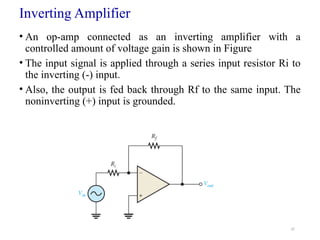
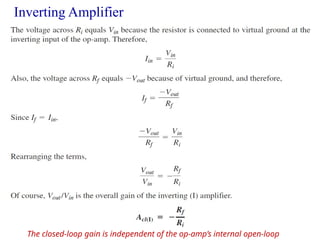
Inverting Amplifier
• An op-amp connected as an inverting amplifier with a
controlled amount of voltage gain is shown in Figure
• The input signal is applied through a series input resistor Ri to
the inverting (-) input.
• Also, the output is fed back through Rf to the same input. The
noninverting (+) input is grounded.
38
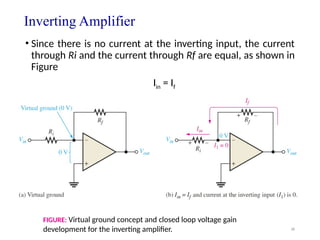
Inverting Amplifier
• Since there is no current at the inverting input, the current
through Ri and the current through Rf are equal, as shown in
Figure
Iin = If
FIGURE: Virtual ground concept and closed loop voltage gain
development for the inverting amplifier.
39
Inverting Amplifier
The closed-loop gain is independent of the op-amp’s internal open-loop
40
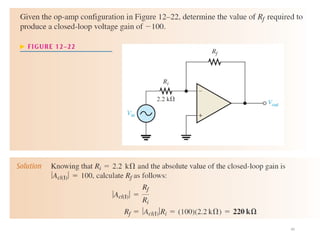
Numerical
41
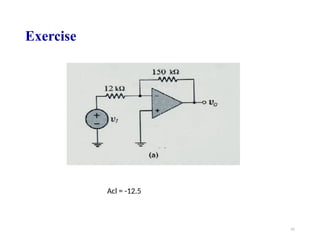
Exercise
Acl = -12.5
42
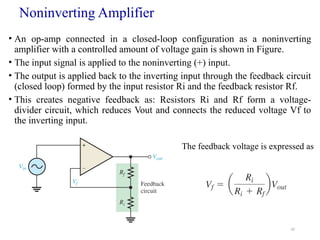
Noninverting Amplifier
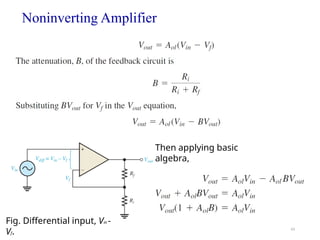
• An op-amp connected in a closed-loop configuration as a noninverting
amplifier with a controlled amount of voltage gain is shown in Figure.
• The input signal is applied to the noninverting (+) input.
• The output is applied back to the inverting input through the feedback circuit
(closed loop) formed by the input resistor Ri and the feedback resistor Rf.
• This creates negative feedback as: Resistors Ri and Rf form a voltage-
divider circuit, which reduces Vout and connects the reduced voltage Vf to
the inverting input.
The feedback voltage is expressed as
43
Noninverting Amplifier
Fig. Differential input, Vin -
Vf.
Then applying basic
algebra,
44
Noninverting Amplifier
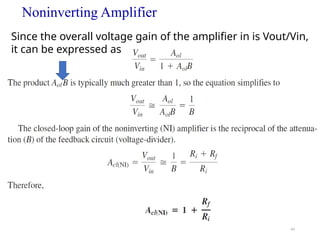
Since the overall voltage gain of the amplifier in is Vout/Vin,
it can be expressed as
45
Closed loop Gain
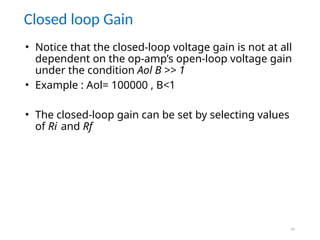
• Notice that the closed-loop voltage gain is not at all
dependent on the op-amp’s open-loop voltage gain
under the condition Aol B >> 1
• Example : Aol= 100000 , B<1
• The closed-loop gain can be set by selecting values
of Ri and Rf
46
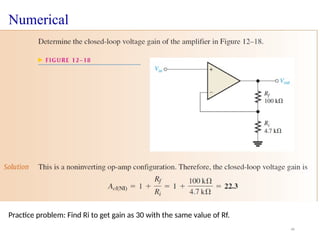
Numerical
Practice problem: Find Ri to get gain as 30 with the same value of Rf.
47
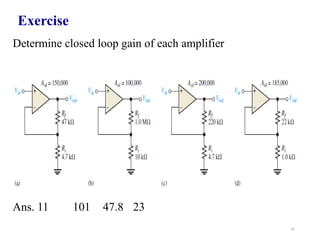
Determine closed loop gain of each amplifier
Ans. 11 101 47.8 23
Exercise
48
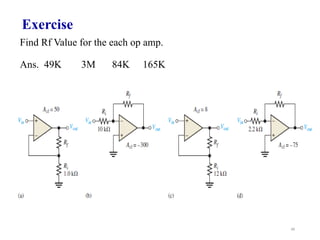
Find Rf Value for the each op amp.
Ans. 49K 3M 84K 165K
Exercise
49
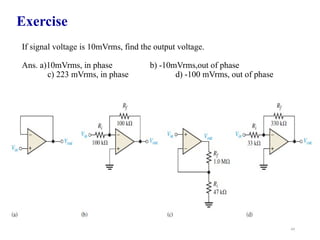
If signal voltage is 10mVrms, find the output voltage.
Ans. a)10mVrms, in phase b) -10mVrms,out of phase
c) 223 mVrms, in phase d) -100 mVrms, out of phase
Exercise
50
Exercise
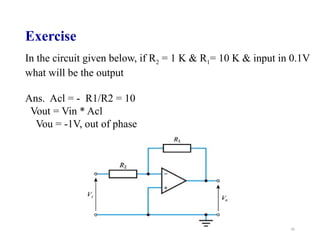
In the circuit given below, if R2 = 1 K & R1= 10 K & input in 0.1V
what will be the output
Ans. Acl = - R1/R2 = 10
Vout = Vin * Acl
Vou = -1V, out of phase
51
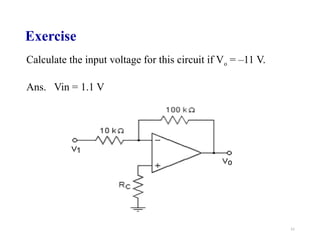
Exercise
Calculate the input voltage for this circuit if Vo = –11 V.
Ans. Vin = 1.1 V
52
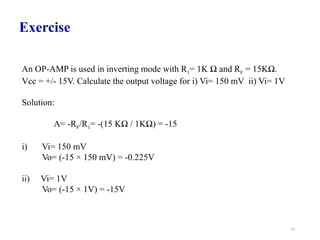
An OP-AMP is used in inverting mode with R1= 1K Ω and RF = 15KΩ.
Vcc = +/- 15V. Calculate the output voltage for i) Vi= 150 mV ii) Vi= 1V
Solution:
A= -RF/R1= -(15 KΩ / 1KΩ) = -15
i) Vi= 150 mV
Vo= (-15 × 150 mV) = -0.225V
ii) Vi= 1V
Vo= (-15 × 1V) = -15V
Exercise
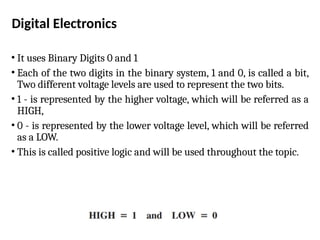
Digital Electronics
• It uses Binary Digits 0 and 1
• Each of the two digits in the binary system, 1 and 0, is called a bit,
Two different voltage levels are used to represent the two bits.
• 1 - is represented by the higher voltage, which will be referred as a
HIGH,
• 0 - is represented by the lower voltage level, which will be referred
as a LOW.
• This is called positive logic and will be used throughout the topic.
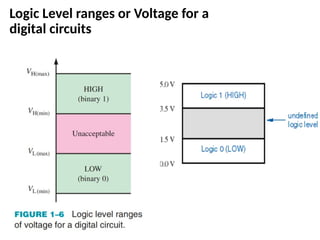
Logic Level ranges or Voltage for a
digital circuits
Basic Logic Functions
• In the 1850s, the Irish logician and mathematician George Boole developed a
mathematical system for formulating logic statements with symbols so that problems can
be written and solved in a manner similar to ordinary algebra
• The term logic is applied to digital circuits used to implement logic functions.
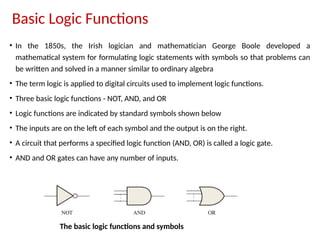
• Three basic logic functions - NOT, AND, and OR
• Logic functions are indicated by standard symbols shown below
• The inputs are on the left of each symbol and the output is on the right.
• A circuit that performs a specified logic function (AND, OR) is called a logic gate.
• AND and OR gates can have any number of inputs.
The basic logic functions and symbols
Example 1
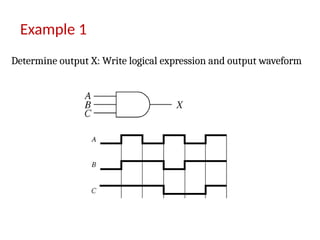
Determine output X: Write logical expression and output waveform
Logic Function NAND
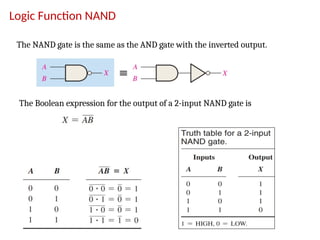
The NAND gate is the same as the AND gate with the inverted output.
The Boolean expression for the output of a 2-input NAND gate is
NOR Gate
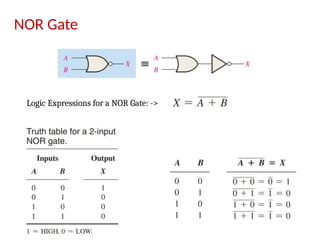
Logic Expressions for a NOR Gate: ->
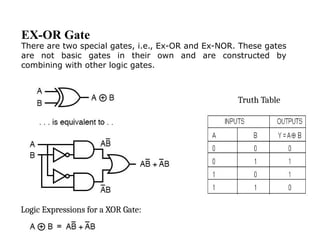
EX-OR Gate
Logic Expressions for a XOR Gate:
Truth Table
There are two special gates, i.e., Ex-OR and Ex-NOR. These gates
are not basic gates in their own and are constructed by
combining with other logic gates.
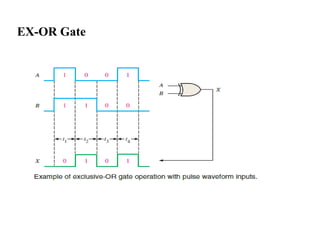
EX-OR Gate
OR Gate
AND Gate
Digital Circuits
Basically, Digital Circuits are divided into two broad
categories
 Combinational circuits
• Combinational Circuit is the type of circuit in which
output depend upon the input present at that
particular instant.
 Sequential circuits
• Sequential circuit is the type of circuit where output at
any instant of time depend upon the current input as
well as on the previous input/output.
• It consists of memory element
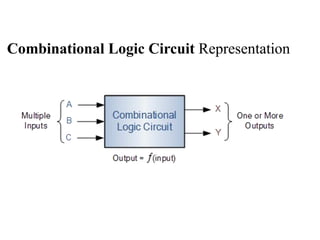
Combinational Logic Circuit Representation
Combinational Logic Circuits
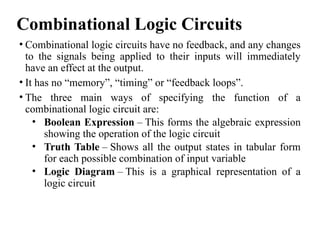
• Combinational logic circuits have no feedback, and any changes
to the signals being applied to their inputs will immediately
have an effect at the output.
• It has no “memory”, “timing” or “feedback loops”.
• The three main ways of specifying the function of a
combinational logic circuit are:
• Boolean Expression – This forms the algebraic expression
showing the operation of the logic circuit
• Truth Table – Shows all the output states in tabular form
for each possible combination of input variable
• Logic Diagram – This is a graphical representation of a
logic circuit
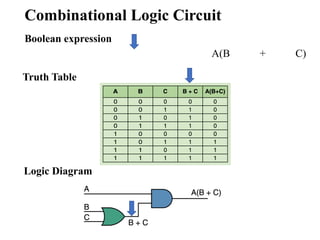
Combinational Logic Circuit
Boolean expression
A(B + C)
Truth Table
Logic Diagram
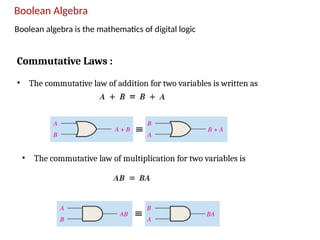
Boolean Algebra
Boolean algebra is the mathematics of digital logic
Commutative Laws :
• The commutative law of addition for two variables is written as
• The commutative law of multiplication for two variables is
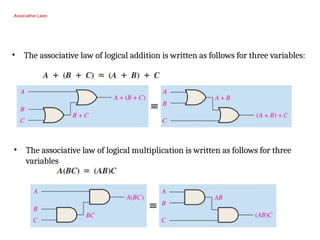
Associative Laws
• The associative law of logical addition is written as follows for three variables:
• The associative law of logical multiplication is written as follows for three
variables
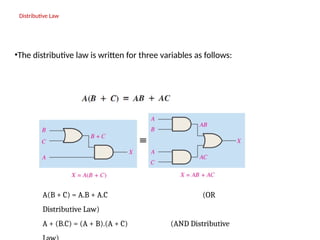
Distributive Law
•The distributive law is written for three variables as follows:
A(B + C) = A.B + A.C (OR
Distributive Law)
A + (B.C) = (A + B).(A + C) (AND Distributive
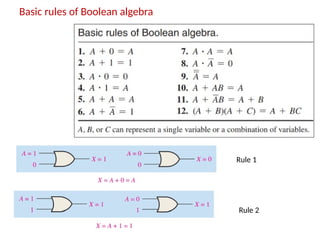
Basic rules of Boolean algebra
Rule 1
Rule 2
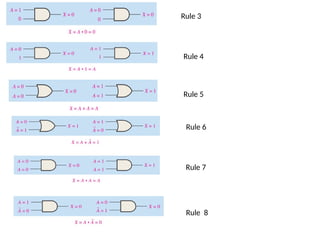
Rule 8
Rule 7
Rule 6
Rule 5
Rule 4
Rule 3
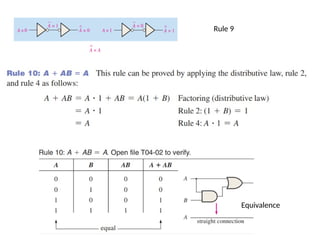
Rule 9
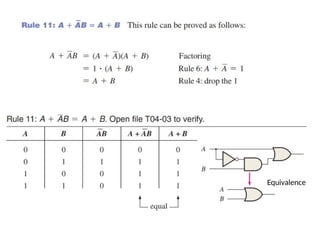
Equivalence
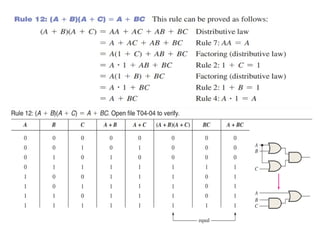
Equivalence
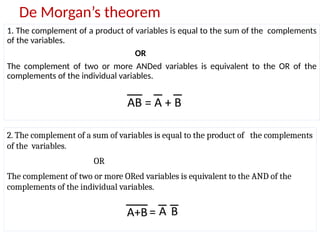
De Morgan’s theorem
1. The complement of a product of variables is equal to the sum of the complements
of the variables.
OR
The complement of two or more ANDed variables is equivalent to the OR of the
complements of the individual variables.
2. The complement of a sum of variables is equal to the product of the complements
of the variables.
OR
The complement of two or more ORed variables is equivalent to the AND of the
complements of the individual variables.
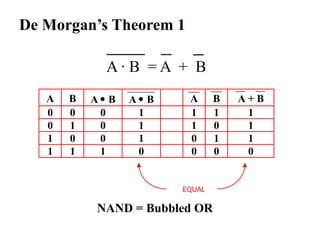
De Morgan’s Theorem 1
A B A  B A  B A B A + B
0 0 0 1 1 1 1
0 1 0 1 1 0 1
1 0 0 1 0 1 1
1 1 1 0 0 0 0
A · B = A + B
EQUAL
NAND = Bubbled OR
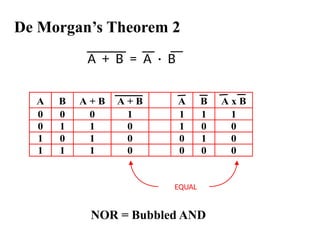
De Morgan’s Theorem 2
A + B = A · B
A B A + B A + B A B A x B
0 0 0 1 1 1 1
0 1 1 0 1 0 0
1 0 1 0 0 1 0
1 1 1 0 0 0 0
EQUAL
NOR = Bubbled AND
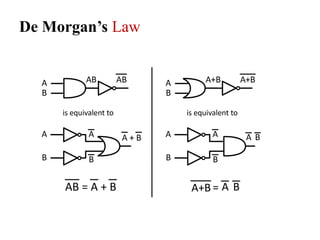
De Morgan’s Law
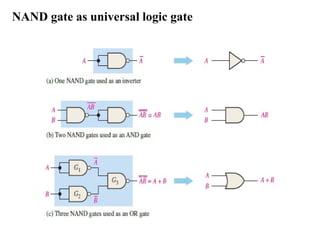
NAND gate as universal logic gate
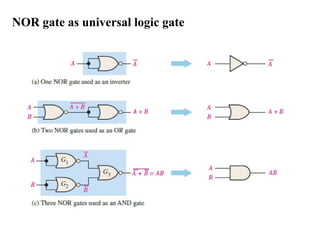
NOR gate as universal logic gate
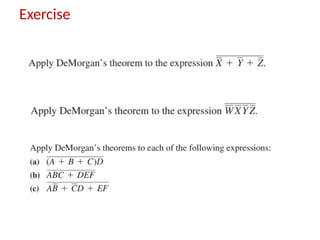
Exercise
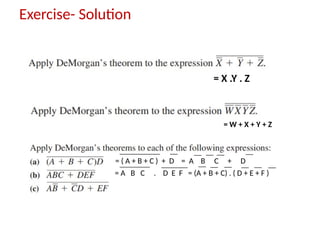
Exercise- Solution
= X .Y . Z
= W + X + Y + Z
= ( A + B + C ) + D = A B C + D
= A B C . D E F = (A + B + C) . ( D + E + F )
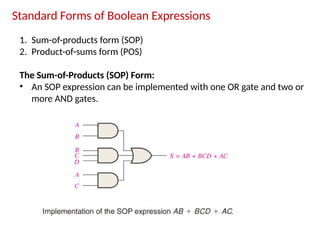
Standard Forms of Boolean Expressions
1. Sum-of-products form (SOP)
2. Product-of-sums form (POS)
The Sum-of-Products (SOP) Form:
• An SOP expression can be implemented with one OR gate and two or
more AND gates.
The Product-of-Sums (POS) Form
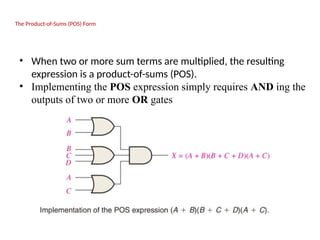
• When two or more sum terms are multiplied, the resulting
expression is a product-of-sums (POS).
• Implementing the POS expression simply requires AND ing the
outputs of two or more OR gates
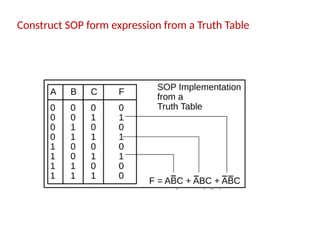
Construct SOP form expression from a Truth Table
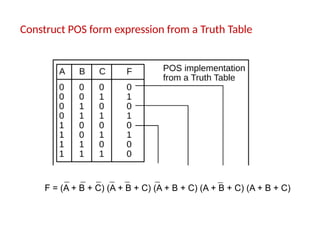
Construct POS form expression from a Truth Table
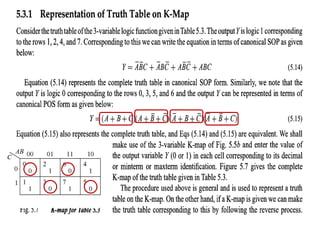
F = (A + B + C) (A + B + C) (A + B + C) (A + B + C) (A + B + C)
Canonical SOP form and POS form
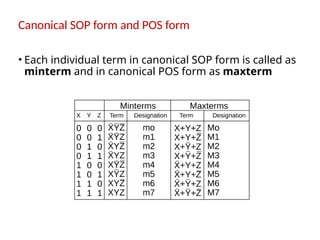
• Each individual term in canonical SOP form is called as
minterm and in canonical POS form as maxterm
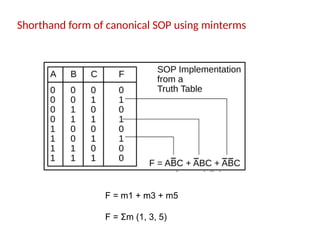
Shorthand form of canonical SOP using minterms
F = m1 + m3 + m5
F = Σm (1, 3, 5)
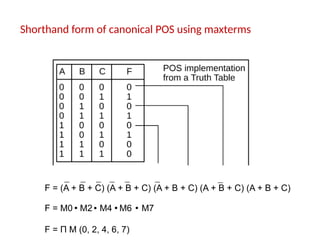
Shorthand form of canonical POS using maxterms
F = (A + B + C) (A + B + C) (A + B + C) (A + B + C) (A + B + C)
F = M0 M2 M4 M6 M7
F = Π M (0, 2, 4, 6, 7)
Simplification of Boolean expression
• The required Boolean results are transferred from a
truth table onto a two-dimensional grid where, in Karnaugh
maps, the cells are ordered in Gray code,[6][4]
and each cell
position represents one combination of input conditions,
while each cell value represents the corresponding output
value. Optimal groups of 1s or 0s are identified, which
represent the terms of a canonical form of the logic in the
original truth table.[7]
These terms can be used to write a
minimal Boolean expression representing the required logic.
The Karnaugh Map( K map) Technique
• A Karnaugh map technique provides a graphical, systematic
method for simplifying Boolean/ logic expressions
• Karnaugh map is an array of cells in which each cell represents
a binary value of the input variables
• K-map produce the simplest SOP or POS expression possible,
known as the minimum expression
• The information contained in the truth table or available in
SOP/ POS form is represented on K map
• Karnaugh maps can be used easily used as a tool to simplify
expressions with two, three, four , five variables
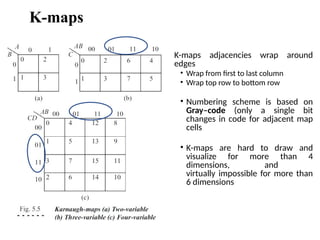
K-maps
• K-maps adjacencies wrap around
edges
• Wrap from first to last column
• Wrap top row to bottom row
• Numbering scheme is based on
Gray–code (only a single bit
changes in code for adjacent map
cells
• K-maps are hard to draw and
visualize for more than 4
dimensions, and
virtually impossible for more than
6 dimensions
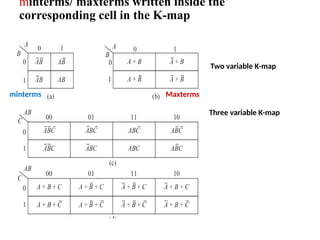
Two variable K-map
Three variable K-map
minterms/ maxterms written inside the
corresponding cell in the K-map
minterms Maxterms
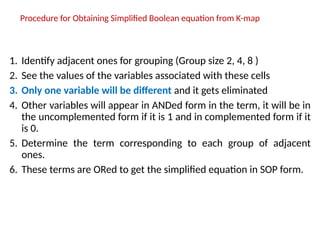
Procedure for Obtaining Simplified Boolean equation from K-map
1. Identify adjacent ones for grouping (Group size 2, 4, 8 )
2. See the values of the variables associated with these cells
3. Only one variable will be different and it gets eliminated
4. Other variables will appear in ANDed form in the term, it will be in
the uncomplemented form if it is 1 and in complemented form if it
is 0.
5. Determine the term corresponding to each group of adjacent
ones.
6. These terms are ORed to get the simplified equation in SOP form.
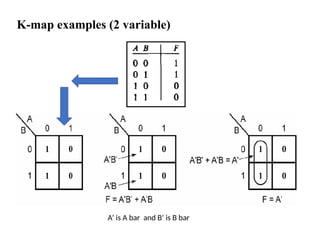
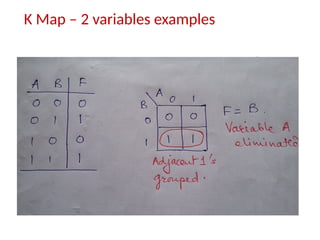
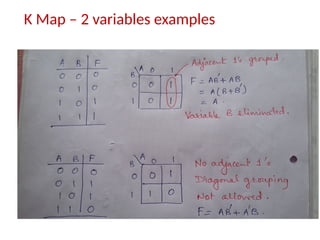
K-map examples (2 variable)
A’ is A bar and B’ is B bar
K Map – 2 variables examples
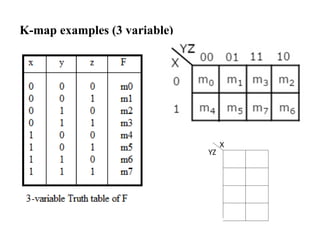
K-map examples (3 variable)
X
YZ
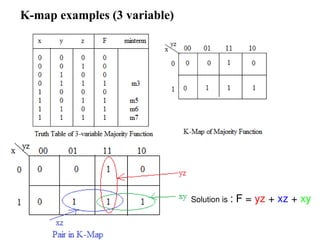
Solution is : F = yz + xz + xy
K-map examples (3 variable)
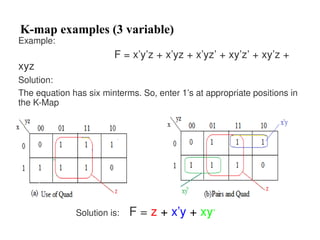
Example:
F = x’y’z + x’yz + x’yz’ + xy’z’ + xy’z +
xyz
Solution:
The equation has six minterms. So, enter 1’s at appropriate positions in
the K-Map
Solution is: F = z + x’y + xy’
K-map examples (3 variable)
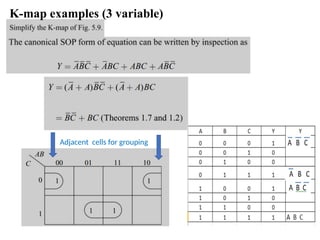
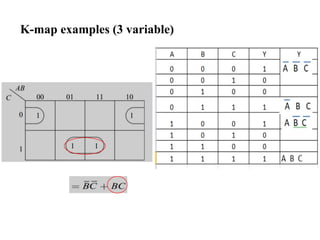
Adjacent cells for grouping
K-map examples (3 variable)
Redundant Groups
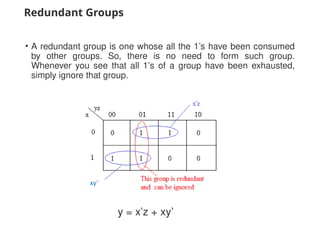
• A redundant group is one whose all the 1’s have been consumed
by other groups. So, there is no need to form such group.
Whenever you see that all 1’s of a group have been exhausted,
simply ignore that group.
y = x’z + xy’
xy’
K-map examples (3 variable)
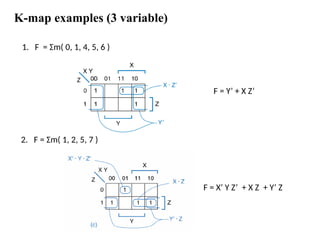
1. F = Σm( 0, 1, 4, 5, 6 )
F = Y’ + X Z’
2. F = Σm( 1, 2, 5, 7 )
F = X’ Y Z’ + X Z + Y’ Z
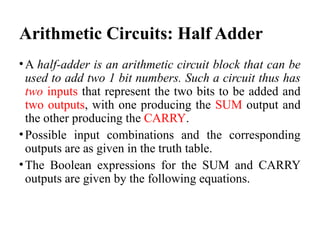
Arithmetic Circuits: Half Adder
•A half-adder is an arithmetic circuit block that can be
used to add two 1 bit numbers. Such a circuit thus has
two inputs that represent the two bits to be added and
two outputs, with one producing the SUM output and
the other producing the CARRY.
•Possible input combinations and the corresponding
outputs are as given in the truth table.
•The Boolean expressions for the SUM and CARRY
outputs are given by the following equations.
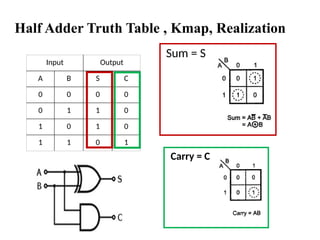
Half Adder Truth Table , Kmap, Realization
Input Output
A B S C
0 0 0 0
0 1 1 0
1 0 1 0
1 1 0 1
Sum = S
Carry = C
Full Adder
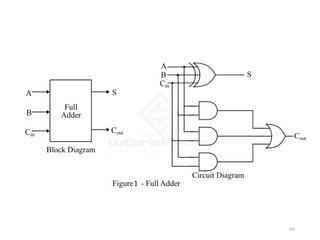
•A full adder circuit is an arithmetic circuit block that
can be used to add three bits to produce a SUM and a
CARRY output.
•Such a building block is needed in order to add binary
numbers with a large number of bits.
•The full adder circuit overcomes the limitation of the
half-adder, which can be used to add two bits only
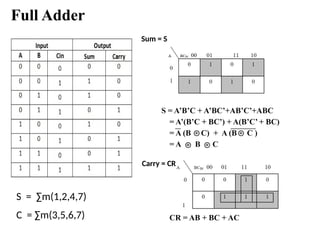
Full Adder
Sum = S
Carry = CR
S = A’B’C + A’BC’+AB’C’+ABC
= A’(B’C + BC’) + A(B’C’ + BC)
= A (B C) + A (B C )
= A B C
CR = AB + BC + AC
S = ∑m(1,2,4,7)
C = ∑m(3,5,6,7)
109
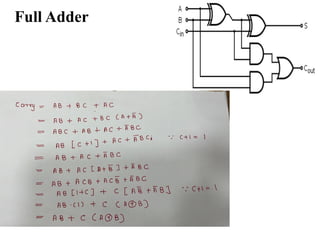
Full Adder
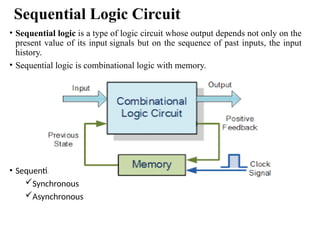
Sequential Logic Circuit
• Sequential logic is a type of logic circuit whose output depends not only on the
present value of its input signals but on the sequence of past inputs, the input
history.
• Sequential logic is combinational logic with memory.
• Sequential logic circuits are classified in 2 categories
Synchronous
Asynchronous
Clock Pulse-
CK =0 or CK=1
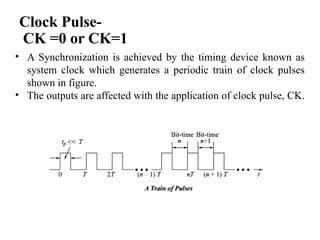
• A Synchronization is achieved by the timing device known as
system clock which generates a periodic train of clock pulses
shown in figure.
• The outputs are affected with the application of clock pulse, CK.
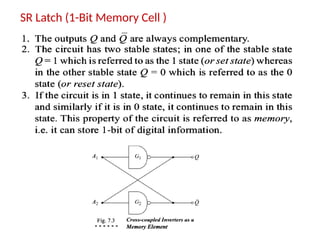
SR Latch (1-Bit Memory Cell )
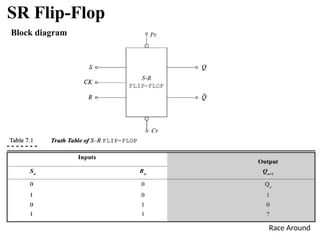
SR Flip-Flop
Block diagram
Race Around
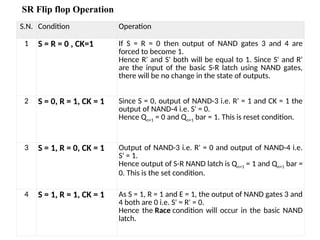
SR Flip flop Operation
S.N. Condition Operation
1 S = R = 0 , CK=1 If S = R = 0 then output of NAND gates 3 and 4 are
forced to become 1.
Hence R' and S' both will be equal to 1. Since S' and R'
are the input of the basic S-R latch using NAND gates,
there will be no change in the state of outputs.
2 S = 0, R = 1, CK = 1 Since S = 0, output of NAND-3 i.e. R' = 1 and CK = 1 the
output of NAND-4 i.e. S' = 0.
Hence Qn+1 = 0 and Qn+1 bar = 1. This is reset condition.
3 S = 1, R = 0, CK = 1 Output of NAND-3 i.e. R' = 0 and output of NAND-4 i.e.
S' = 1.
Hence output of S-R NAND latch is Qn+1 = 1 and Qn+1 bar =
0. This is the set condition.
4 S = 1, R = 1, CK = 1 As S = 1, R = 1 and E = 1, the output of NAND gates 3 and
4 both are 0 i.e. S' = R' = 0.
Hence the Race condition will occur in the basic NAND
latch.
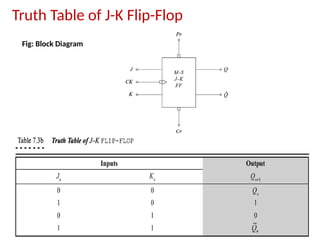
Truth Table of J-K Flip-Flop
Fig: Block Diagram
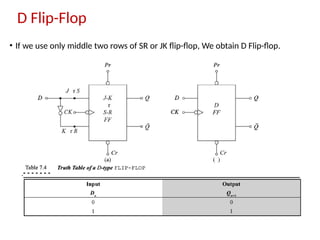
D Flip-Flop
• If we use only middle two rows of SR or JK flip-flop, We obtain D Flip-flop.
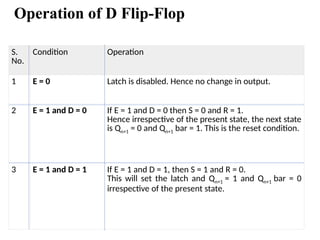
Operation of D Flip-Flop
S.
No.
Condition Operation
1 E = 0 Latch is disabled. Hence no change in output.
2 E = 1 and D = 0 If E = 1 and D = 0 then S = 0 and R = 1.
Hence irrespective of the present state, the next state
is Qn+1 = 0 and Qn+1 bar = 1. This is the reset condition.
3 E = 1 and D = 1 If E = 1 and D = 1, then S = 1 and R = 0.
This will set the latch and Qn+1 = 1 and Qn+1 bar = 0
irrespective of the present state.
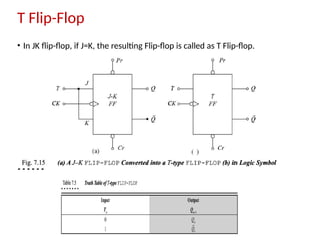
T Flip-Flop
• In JK flip-flop, if J=K, the resulting Flip-flop is called as T Flip-flop.
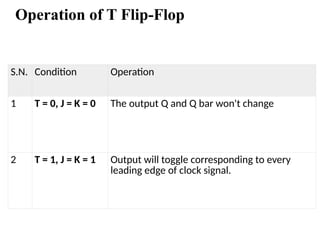
Operation of T Flip-Flop
S.N. Condition Operation
1 T = 0, J = K = 0 The output Q and Q bar won't change
2 T = 1, J = K = 1 Output will toggle corresponding to every
leading edge of clock signal.
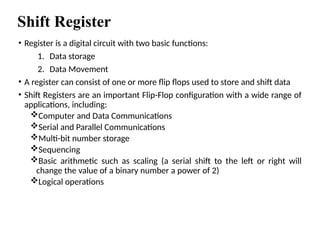
Shift Register
• Register is a digital circuit with two basic functions:
1. Data storage
2. Data Movement
• A register can consist of one or more flip flops used to store and shift data
• Shift Registers are an important Flip-Flop configuration with a wide range of
applications, including:
Computer and Data Communications
Serial and Parallel Communications
Multi-bit number storage
Sequencing
Basic arithmetic such as scaling (a serial shift to the left or right will
change the value of a binary number a power of 2)
Logical operations
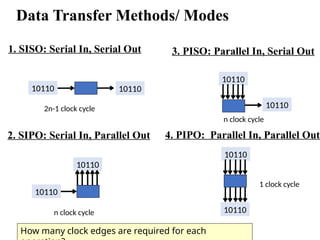
Data Transfer Methods/ Modes
1. SISO: Serial In, Serial Out
How many clock edges are required for each
10110 10110
10110
10110
10110
10110
10110
10110
2. SIPO: Serial In, Parallel Out
3. PISO: Parallel In, Serial Out
4. PIPO: Parallel In, Parallel Out
2n-1 clock cycle
n clock cycle
n clock cycle
1 clock cycle
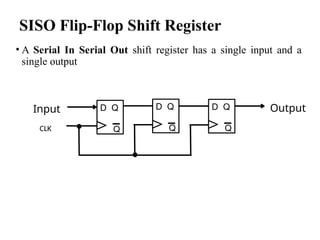
SISO Flip-Flop Shift Register
• A Serial In Serial Out shift register has a single input and a
single output
D Q
Q
D Q
Q
D Q
Q
Input Output
CLK
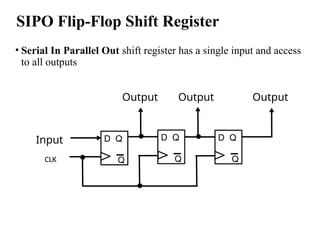
SIPO Flip-Flop Shift Register
• Serial In Parallel Out shift register has a single input and access
to all outputs
D Q
Q
D Q
Q
D Q
Q
Input
Output Output Output
CLK
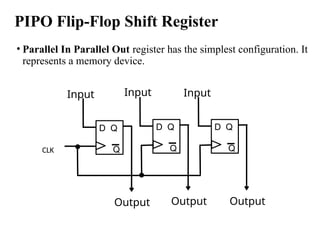
PIPO Flip-Flop Shift Register
• Parallel In Parallel Out register has the simplest configuration. It
represents a memory device.
D Q
Q
Input
Output
D Q
Q
Output
D Q
Q
Output
Input Input
CLK
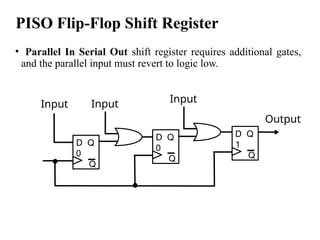
PISO Flip-Flop Shift Register
• Parallel In Serial Out shift register requires additional gates,
and the parallel input must revert to logic low.
Input
D Q
1
Q
Input
Output
Input
D Q
0
Q
D Q
0
Q
Additional links for more information:
• http://www.ee.surrey.ac.uk/Projects/CAL/digital-logic/gatesf
unc/
• https://www.electronicshub.org/half-adder-and-full-adder-ci
rcuits/
• https://youtu.be/kt8d3CYWGH4
• https://youtu.be/HZg7fNu-l24
128
THANK YOU

IC Integrated circuits ppt for undergraduate course.pptx

  • 1.
    1 Basics of Electricaland Electronics Engineering Course Code: ECE1PM01A
  • 2.
  • 3.
    3 Contents: Introduction to IntegratedCircuits: Analog Integrated circuits, Basics of OPAMP: study of parameters of IC 741, inverting and non-inverting amplifier, Digital integrated circuits: Logic Gates, Boolean algebra, Combinational logic Circuits, De-Morgan’s theorems, SOP, POS, K- map, Half Adder, Full Adder, flip-flops: RS flip flop, J-K flip flop, D flip flop, shift registers (12L)
  • 4.
    4 Integrated Circuits  Integratedcircuit or IC or microchip or chip  It is a microscopic electronic circuit array formed by the fabrication of various electronic components  Components (resistors, capacitors, transistors,)are placed on semiconductor material (silicon) wafer  It can perform operations similar to the large discrete electronic circuits made of discrete electronic components
  • 5.
    5 IC- Integrated circuit •ICs have three key advantages over digital circuits built from discrete components • Small size • ICs are much smaller, both transistors and wires are shrunk to micrometer sizes, compared to the centimeter scales of discrete components • High speed • Communication within a chip is faster than communication between chips on a PCB (Printed Circuit Board) • Low power consumption • Logic operations within a chip take much less power
  • 6.
    6 IC Packaging Basic typesof IC packages • The metal can or transistor pack: chip is encapsulated in a metal or plastic case. Available with 3,5,8,10 or 12 pins • LM117 (voltage regulator) has 3 pins • Power op-amps, audio power amplifiers have 5 pins • General purpose op-amps come in 8,10 or 12 pins • The flat pack : the chip is enclosed in a rectangular ceramic case with terminal leads extending through the sides and ends. Comes with 8, 10, 14 or 16 pins • The dual-in-line package (DIP): chip is mounted inside a plastic or ceramic case • Most widely used • Available in 12, 14, 16 and 20 pins
  • 7.
    7 Manufacturer’s Designation forICs Each manufacturer uses a specific code and assigns a specific type number to the ICs it produces. Examples are- Fairchild Analog Devices AD Atmel AT National Semiconductor LM Motorola MC Signetics NE Texas Instruments CA/CD
  • 8.
    8 Example of AnalogIC Operational Amplifier
  • 9.
    9 Operational Amplifier: OP-AMP •Linear Integrated Circuit • Linear– Output signal varies according to the input signal • Integrated – all components are fabricated on a single chip • Direct coupled high gain amplifier • Versatile device – amplifies ac as well as dc signals • Originally designed for computing mathematical functions as addition, subtraction, multiplication and division, hence the name • Used for a variety of applications such as ac and dc signal amplification, active filters, oscillators, comparators, regulators, etc.
  • 10.
  • 11.
  • 12.
  • 13.
    13 Stages of internalblock diagram • Input Stage - The input stage is a Dual input balanced output differential amplifier. The two amplifiers are applied at inverting or non inverting terminals. This stage provides most of voltage gain of the op-amp and decides input resistance value R1. • Intermediate Stage - It is driven by output of the input stage. This stage is dual input unbalanced output differential amp. This stage provides additional voltage gain to the input signals.
  • 14.
    14 Stages of internalblock diagram • Level shifting stage - This is third stage in the block diagram of op-amp. Due to direct coupling between first two stage the input of level shifting stage is an amplifying system with non-zero DC level. Level shifting stage is used to bring this DC level to a zero volt with respect to ground. • Output Stage - This is normally complementary output stage. It increases magnitude of voltage and rises the current supplying capacity of the op-amp. It also provides low output resistance. The output stage is a push pull of two transistors.
  • 15.
    15 Ideal Op-amp andPractical Op-amp Circuit
  • 16.
    16 Op-Amp Parameters • 1.Open-loop voltage gain, Go • 2. Input impedance, Zin(Ω) • 3. Output impedance, Zo(Ω) • 4. Input Offset current, Ios (nA) • 5. Input Bias current, IBIAS (nA) • 6. Input Offset voltage, Vos (mV) • 7. Slew rate, SR (V/μs) • 8. CMRR • 9. SVRR / PSRR • 10 Gain Bandwidth product
  • 17.
    17 Op-Amp Parameters Maximum OutputVoltage Swing (VO(p-p)) • With no input signal, the output of an opamp is ideally 0 V. • When an input signal is applied, the ideal limits of the peak- to-peak output signal are Vcc. • In practice, however, this ideal can be approached but never reached. It varies with the load connected to the op-amp and increases directly with load resistance. • For example, the Fairchild KA741 datasheet shows a typical Vo(p-p) of 13V for Vcc = 15V when RL = 2KΩ and Vo(p-p) increases to 14V when RL = 10KΩ.
  • 18.
    18 Op-Amp Parameters Open-loop voltagegain • The open-loop voltage gain, Aol, of an op-amp is the internal voltage gain of the device and represents the ratio of output voltage to input voltage when there are no external components. • The open-loop voltage gain is set entirely by the internal design. • Open-loop voltage gain can range up to 200,000 (106 dB) and is not a well-controlled parameter. • Datasheets often refer to the open-loop voltage gain as the large-signal voltage gain.
  • 19.
    19 Op-Amp Parameters Input offsetvoltage • The ideal op-amp produces zero volts out for zero volts in. • In a practical op-amp, however, a small dc voltage, VOUT(error), appears at the output when no differential input voltage is applied. • Its primary cause is a slight mismatch of the base-emitter voltages of the differential amplifier input stage of an op-amp. • The input offset voltage, VOS, is the differential dc voltage required between the inputs to force the output to zero volts. • Typical values of input offset voltage are in the range of 2 mV or less. In the ideal case, it is 0 V.
  • 20.
    20 Op-Amp Parameters Input biascurrent • The input terminals of a bipolar differential amplifier are the transistor bases and, therefore, the input currents are the base currents. • The input bias current is the dc current required by the inputs of the amplifier to properly operate the first stage. • By definition, the input bias current is the average of both input currents and is calculated as follows:
  • 21.
    21 Op-Amp Parameters Input offsetcurrent • Ideally, the two input bias currents are equal, and thus their difference is zero. • In a practical op-amp, however, the bias currents are not exactly equal. • The input offset current, IOS, is the difference of the input bias currents, expressed as an absolute value. IOS = | I1 – I2 | • Typical value is 200 nA
  • 22.
    22 Op-Amp Parameters Input Impedance •The differential input impedance is the total resistance between the inverting and the noninverting inputs, as illustrated in Figure • It is measured by determining the change in bias current for a given change in differential input voltage.
  • 23.
    23 Op-Amp Parameters Output Impedance •The output impedance is the resistance viewed from the output terminal of the op-amp, as indicated in Figure
  • 24.
    24 Op-Amp Parameters Slew rate •The slew rate is the maximum rate of change of output voltage for a step input voltage. • The slew rate makes the output voltage to change at a slower rate than the applied input. • Max rate of change of output voltage with time. i.e. dv/dt (max) or ΔV/Δt max expressed in (volts/µs) . • Slew rate is usually measured in the unity gain non-inverting amplifier configuration • Typically it is 0.5 V/μs
  • 25.
  • 26.
    26 Op-Amp Parameters SVRR (SupplyVoltage Rejection Ratio) or Power Supply Rejection Ratio (PSRR) • Power-supply rejection ratio PSRR is the ratio of the change in input offset voltage to the corresponding change in power- supply. • The PSRR is expressed in mV/V or dB PSRR = ΔVos / ΔV
  • 27.
    27 Op-Amp Parameters Common ModeRejection Ratio­(CMRR) • The output signal due to the common mode input voltage is zero, but it is nonzero in a practical device. • CMRR is the measure of the amplifier's ability to reject common mode signals • The output voltage is proportional to the difference between the voltages applied to its two input terminals. • When the two input voltages are equal, ideally the output voltage should be zero. • It is a metric used to quantify the ability of the device to reject common-mode signals, i.e. those that appear simultaneously and in-phase on both inputs.
  • 28.
    28 • A signalapplied to both input terminals of the op-amp is called as common-mode signal. Usually it is an unwanted noise voltage. • CMRR is defined as the ratio of the open loop differential voltage gain Aol to the common mode voltage gain Acm CMRR = Aol / Acm CMRR=20 log[Aol / Acm] dB Common Mode Rejection Ratio­(CMRR)
  • 29.
    29 Op-Amp Parameters Gain BandwidthProduct • It is the bandwidth of the op-amp when the voltage gain is 1 • Typically it is 1 MHz • Also called closed-loop bandwidth, unity gain bandwidth and small-signal bandwidth GBP=Av × f Where: GBP = op amp gain bandwidth product Av = voltage gain f = cutoff frequency (Hz)
  • 30.
    30 Op Amp Parameters Parametervalues for op-amps IDEAL PRACTICAL 1. Open-loop voltage gain, Go(V/V) INF 2,00,000 2. Input impedance, Zin(Ω) INF 2 MΩ 3. Output impedance, Zo(Ω) 0 75 Ω 4. Input Offset current, Ios (nA) 0 20 nA 5. Input Bias current, IBIAS (nA) 0 80 nA 6. Input Offset voltage, Vos (mV) 0 2 mV 7. Slew rate, SR (V/μs) INF 0.5 V/microsec 8. CMRR INF 90 dB 9. SVRR / PSRR INF 96 dB 10 Gain Bandwidth product INF 1 MHz
  • 31.
    31 What is negativefeedback? • Negative feedback is the most useful concepts in OPAMP applications. • It is the process whereby a portion of the output voltage of an amplifier is returned to the input with a phase angle that opposes the input signal.
  • 32.
    32 Negative Feedback /Closed Loop configuration Negative feedback is illustrated in the Figure. The inverting input effectively makes the feedback signal 180° out of phase with the input signal.
  • 33.
    33 Why Use NegativeFeedback? • The inherent open-loop voltage gain of a typical op-amp is very high (usually greater than 100,000). • Therefore, an extremely small input voltage drives the op-amp into its saturated output states. • In fact, even the input offset voltage of the op-amp can drive it into saturation. • For example, assume Vin = 1 mV and Aol = 100,000. Then: VinAol = (1 mV)(100,000) = 100 V • Since the output level of an op-amp can never reach 100 V, it is driven deep into saturation and the output is limited to its maximum output levels, i. e. Vcc. • With negative feedback, the closed loop voltage gain (Acl) can be reduced and controlled so that the op-amp can function as a linear amplifier. • In addition to providing a controlled, stable voltage gain, negative feedback also provides for control of the input and output impedances and amplifier bandwidth.
  • 34.
    Closed-Loop Voltage Gain,Acl • The amplifier configuration consists of the op-amp and an external negative feedback circuit that connects the output to the inverting input. • The closed-loop voltage gain is the voltage gain of an op-amp with external feedback. • The closed-loop voltage gain is determined by the external component values and can be precisely controlled by them. 34
  • 35.
    35 Virtual short andVirtual ground • Voltage between inverting and non-inverting terminals of OP- AMP is output voltage divided by open loop gain of OP-AMP. • Open loop gain being very large, this voltage is very small. Practically zero. This is virtual short. • Both input terminals will be at the same potential. In other words they are virtually shorted to each other. • Virtual ground concept is NOT valid for positive feedback or open loop operation of OPAMP.
  • 36.
    Virtual Ground • Ifthe non-inverting (+) terminal of OP-AMP is connected to ground, then due to the "virtual short" existing between the two input terminals, the inverting (-) terminal also be at ground potential. hence it is said to be as "virtual ground". • The input impedance (Ri) of an OP-AMP is ideally infinite. Hence current "I" flowing from one input terminal to the other will be zero. 36
  • 37.
    37 Inverting Amplifier • Anop-amp connected as an inverting amplifier with a controlled amount of voltage gain is shown in Figure • The input signal is applied through a series input resistor Ri to the inverting (-) input. • Also, the output is fed back through Rf to the same input. The noninverting (+) input is grounded.
  • 38.
    38 Inverting Amplifier • Sincethere is no current at the inverting input, the current through Ri and the current through Rf are equal, as shown in Figure Iin = If FIGURE: Virtual ground concept and closed loop voltage gain development for the inverting amplifier.
  • 39.
    39 Inverting Amplifier The closed-loopgain is independent of the op-amp’s internal open-loop
  • 40.
  • 41.
  • 42.
    42 Noninverting Amplifier • Anop-amp connected in a closed-loop configuration as a noninverting amplifier with a controlled amount of voltage gain is shown in Figure. • The input signal is applied to the noninverting (+) input. • The output is applied back to the inverting input through the feedback circuit (closed loop) formed by the input resistor Ri and the feedback resistor Rf. • This creates negative feedback as: Resistors Ri and Rf form a voltage- divider circuit, which reduces Vout and connects the reduced voltage Vf to the inverting input. The feedback voltage is expressed as
  • 43.
    43 Noninverting Amplifier Fig. Differentialinput, Vin - Vf. Then applying basic algebra,
  • 44.
    44 Noninverting Amplifier Since theoverall voltage gain of the amplifier in is Vout/Vin, it can be expressed as
  • 45.
    45 Closed loop Gain •Notice that the closed-loop voltage gain is not at all dependent on the op-amp’s open-loop voltage gain under the condition Aol B >> 1 • Example : Aol= 100000 , B<1 • The closed-loop gain can be set by selecting values of Ri and Rf
  • 46.
    46 Numerical Practice problem: FindRi to get gain as 30 with the same value of Rf.
  • 47.
    47 Determine closed loopgain of each amplifier Ans. 11 101 47.8 23 Exercise
  • 48.
    48 Find Rf Valuefor the each op amp. Ans. 49K 3M 84K 165K Exercise
  • 49.
    49 If signal voltageis 10mVrms, find the output voltage. Ans. a)10mVrms, in phase b) -10mVrms,out of phase c) 223 mVrms, in phase d) -100 mVrms, out of phase Exercise
  • 50.
    50 Exercise In the circuitgiven below, if R2 = 1 K & R1= 10 K & input in 0.1V what will be the output Ans. Acl = - R1/R2 = 10 Vout = Vin * Acl Vou = -1V, out of phase
  • 51.
    51 Exercise Calculate the inputvoltage for this circuit if Vo = –11 V. Ans. Vin = 1.1 V
  • 52.
    52 An OP-AMP isused in inverting mode with R1= 1K Ω and RF = 15KΩ. Vcc = +/- 15V. Calculate the output voltage for i) Vi= 150 mV ii) Vi= 1V Solution: A= -RF/R1= -(15 KΩ / 1KΩ) = -15 i) Vi= 150 mV Vo= (-15 × 150 mV) = -0.225V ii) Vi= 1V Vo= (-15 × 1V) = -15V Exercise
  • 53.
    Digital Electronics • Ituses Binary Digits 0 and 1 • Each of the two digits in the binary system, 1 and 0, is called a bit, Two different voltage levels are used to represent the two bits. • 1 - is represented by the higher voltage, which will be referred as a HIGH, • 0 - is represented by the lower voltage level, which will be referred as a LOW. • This is called positive logic and will be used throughout the topic.
  • 54.
    Logic Level rangesor Voltage for a digital circuits
  • 55.
    Basic Logic Functions •In the 1850s, the Irish logician and mathematician George Boole developed a mathematical system for formulating logic statements with symbols so that problems can be written and solved in a manner similar to ordinary algebra • The term logic is applied to digital circuits used to implement logic functions. • Three basic logic functions - NOT, AND, and OR • Logic functions are indicated by standard symbols shown below • The inputs are on the left of each symbol and the output is on the right. • A circuit that performs a specified logic function (AND, OR) is called a logic gate. • AND and OR gates can have any number of inputs. The basic logic functions and symbols
  • 56.
    Example 1 Determine outputX: Write logical expression and output waveform
  • 57.
    Logic Function NAND TheNAND gate is the same as the AND gate with the inverted output. The Boolean expression for the output of a 2-input NAND gate is
  • 58.
    NOR Gate Logic Expressionsfor a NOR Gate: ->
  • 59.
    EX-OR Gate Logic Expressionsfor a XOR Gate: Truth Table There are two special gates, i.e., Ex-OR and Ex-NOR. These gates are not basic gates in their own and are constructed by combining with other logic gates.
  • 60.
  • 61.
  • 62.
    Digital Circuits Basically, DigitalCircuits are divided into two broad categories  Combinational circuits • Combinational Circuit is the type of circuit in which output depend upon the input present at that particular instant.  Sequential circuits • Sequential circuit is the type of circuit where output at any instant of time depend upon the current input as well as on the previous input/output. • It consists of memory element
  • 63.
  • 64.
    Combinational Logic Circuits •Combinational logic circuits have no feedback, and any changes to the signals being applied to their inputs will immediately have an effect at the output. • It has no “memory”, “timing” or “feedback loops”. • The three main ways of specifying the function of a combinational logic circuit are: • Boolean Expression – This forms the algebraic expression showing the operation of the logic circuit • Truth Table – Shows all the output states in tabular form for each possible combination of input variable • Logic Diagram – This is a graphical representation of a logic circuit
  • 65.
    Combinational Logic Circuit Booleanexpression A(B + C) Truth Table Logic Diagram
  • 66.
    Boolean Algebra Boolean algebrais the mathematics of digital logic Commutative Laws : • The commutative law of addition for two variables is written as • The commutative law of multiplication for two variables is
  • 67.
    Associative Laws • Theassociative law of logical addition is written as follows for three variables: • The associative law of logical multiplication is written as follows for three variables
  • 68.
    Distributive Law •The distributivelaw is written for three variables as follows: A(B + C) = A.B + A.C (OR Distributive Law) A + (B.C) = (A + B).(A + C) (AND Distributive
  • 69.
    Basic rules ofBoolean algebra Rule 1 Rule 2
  • 70.
    Rule 8 Rule 7 Rule6 Rule 5 Rule 4 Rule 3
  • 71.
  • 72.
  • 74.
    De Morgan’s theorem 1.The complement of a product of variables is equal to the sum of the complements of the variables. OR The complement of two or more ANDed variables is equivalent to the OR of the complements of the individual variables. 2. The complement of a sum of variables is equal to the product of the complements of the variables. OR The complement of two or more ORed variables is equivalent to the AND of the complements of the individual variables.
  • 75.
    De Morgan’s Theorem1 A B A  B A  B A B A + B 0 0 0 1 1 1 1 0 1 0 1 1 0 1 1 0 0 1 0 1 1 1 1 1 0 0 0 0 A · B = A + B EQUAL NAND = Bubbled OR
  • 76.
    De Morgan’s Theorem2 A + B = A · B A B A + B A + B A B A x B 0 0 0 1 1 1 1 0 1 1 0 1 0 0 1 0 1 0 0 1 0 1 1 1 0 0 0 0 EQUAL NOR = Bubbled AND
  • 77.
  • 78.
    NAND gate asuniversal logic gate
  • 79.
    NOR gate asuniversal logic gate
  • 80.
  • 81.
    Exercise- Solution = X.Y . Z = W + X + Y + Z = ( A + B + C ) + D = A B C + D = A B C . D E F = (A + B + C) . ( D + E + F )
  • 82.
    Standard Forms ofBoolean Expressions 1. Sum-of-products form (SOP) 2. Product-of-sums form (POS) The Sum-of-Products (SOP) Form: • An SOP expression can be implemented with one OR gate and two or more AND gates.
  • 83.
    The Product-of-Sums (POS)Form • When two or more sum terms are multiplied, the resulting expression is a product-of-sums (POS). • Implementing the POS expression simply requires AND ing the outputs of two or more OR gates
  • 84.
    Construct SOP formexpression from a Truth Table
  • 85.
    Construct POS formexpression from a Truth Table F = (A + B + C) (A + B + C) (A + B + C) (A + B + C) (A + B + C)
  • 86.
    Canonical SOP formand POS form • Each individual term in canonical SOP form is called as minterm and in canonical POS form as maxterm
  • 87.
    Shorthand form ofcanonical SOP using minterms F = m1 + m3 + m5 F = Σm (1, 3, 5)
  • 88.
    Shorthand form ofcanonical POS using maxterms F = (A + B + C) (A + B + C) (A + B + C) (A + B + C) (A + B + C) F = M0 M2 M4 M6 M7 F = Π M (0, 2, 4, 6, 7)
  • 89.
    Simplification of Booleanexpression • The required Boolean results are transferred from a truth table onto a two-dimensional grid where, in Karnaugh maps, the cells are ordered in Gray code,[6][4] and each cell position represents one combination of input conditions, while each cell value represents the corresponding output value. Optimal groups of 1s or 0s are identified, which represent the terms of a canonical form of the logic in the original truth table.[7] These terms can be used to write a minimal Boolean expression representing the required logic.
  • 90.
    The Karnaugh Map(K map) Technique • A Karnaugh map technique provides a graphical, systematic method for simplifying Boolean/ logic expressions • Karnaugh map is an array of cells in which each cell represents a binary value of the input variables • K-map produce the simplest SOP or POS expression possible, known as the minimum expression • The information contained in the truth table or available in SOP/ POS form is represented on K map • Karnaugh maps can be used easily used as a tool to simplify expressions with two, three, four , five variables
  • 91.
    K-maps • K-maps adjacencieswrap around edges • Wrap from first to last column • Wrap top row to bottom row • Numbering scheme is based on Gray–code (only a single bit changes in code for adjacent map cells • K-maps are hard to draw and visualize for more than 4 dimensions, and virtually impossible for more than 6 dimensions
  • 92.
    Two variable K-map Threevariable K-map minterms/ maxterms written inside the corresponding cell in the K-map minterms Maxterms
  • 93.
    Procedure for ObtainingSimplified Boolean equation from K-map 1. Identify adjacent ones for grouping (Group size 2, 4, 8 ) 2. See the values of the variables associated with these cells 3. Only one variable will be different and it gets eliminated 4. Other variables will appear in ANDed form in the term, it will be in the uncomplemented form if it is 1 and in complemented form if it is 0. 5. Determine the term corresponding to each group of adjacent ones. 6. These terms are ORed to get the simplified equation in SOP form.
  • 95.
    K-map examples (2variable) A’ is A bar and B’ is B bar
  • 96.
    K Map –2 variables examples
  • 97.
    K Map –2 variables examples
  • 98.
    K-map examples (3variable) X YZ
  • 99.
    Solution is :F = yz + xz + xy K-map examples (3 variable)
  • 100.
    Example: F = x’y’z+ x’yz + x’yz’ + xy’z’ + xy’z + xyz Solution: The equation has six minterms. So, enter 1’s at appropriate positions in the K-Map Solution is: F = z + x’y + xy’ K-map examples (3 variable)
  • 101.
    K-map examples (3variable) Adjacent cells for grouping
  • 102.
  • 103.
    Redundant Groups • Aredundant group is one whose all the 1’s have been consumed by other groups. So, there is no need to form such group. Whenever you see that all 1’s of a group have been exhausted, simply ignore that group. y = x’z + xy’ xy’
  • 104.
    K-map examples (3variable) 1. F = Σm( 0, 1, 4, 5, 6 ) F = Y’ + X Z’ 2. F = Σm( 1, 2, 5, 7 ) F = X’ Y Z’ + X Z + Y’ Z
  • 105.
    Arithmetic Circuits: HalfAdder •A half-adder is an arithmetic circuit block that can be used to add two 1 bit numbers. Such a circuit thus has two inputs that represent the two bits to be added and two outputs, with one producing the SUM output and the other producing the CARRY. •Possible input combinations and the corresponding outputs are as given in the truth table. •The Boolean expressions for the SUM and CARRY outputs are given by the following equations.
  • 106.
    Half Adder TruthTable , Kmap, Realization Input Output A B S C 0 0 0 0 0 1 1 0 1 0 1 0 1 1 0 1 Sum = S Carry = C
  • 107.
    Full Adder •A fulladder circuit is an arithmetic circuit block that can be used to add three bits to produce a SUM and a CARRY output. •Such a building block is needed in order to add binary numbers with a large number of bits. •The full adder circuit overcomes the limitation of the half-adder, which can be used to add two bits only
  • 108.
    Full Adder Sum =S Carry = CR S = A’B’C + A’BC’+AB’C’+ABC = A’(B’C + BC’) + A(B’C’ + BC) = A (B C) + A (B C ) = A B C CR = AB + BC + AC S = ∑m(1,2,4,7) C = ∑m(3,5,6,7)
  • 109.
  • 110.
  • 111.
    Sequential Logic Circuit •Sequential logic is a type of logic circuit whose output depends not only on the present value of its input signals but on the sequence of past inputs, the input history. • Sequential logic is combinational logic with memory. • Sequential logic circuits are classified in 2 categories Synchronous Asynchronous
  • 112.
    Clock Pulse- CK =0or CK=1 • A Synchronization is achieved by the timing device known as system clock which generates a periodic train of clock pulses shown in figure. • The outputs are affected with the application of clock pulse, CK.
  • 113.
    SR Latch (1-BitMemory Cell )
  • 114.
  • 115.
    SR Flip flopOperation S.N. Condition Operation 1 S = R = 0 , CK=1 If S = R = 0 then output of NAND gates 3 and 4 are forced to become 1. Hence R' and S' both will be equal to 1. Since S' and R' are the input of the basic S-R latch using NAND gates, there will be no change in the state of outputs. 2 S = 0, R = 1, CK = 1 Since S = 0, output of NAND-3 i.e. R' = 1 and CK = 1 the output of NAND-4 i.e. S' = 0. Hence Qn+1 = 0 and Qn+1 bar = 1. This is reset condition. 3 S = 1, R = 0, CK = 1 Output of NAND-3 i.e. R' = 0 and output of NAND-4 i.e. S' = 1. Hence output of S-R NAND latch is Qn+1 = 1 and Qn+1 bar = 0. This is the set condition. 4 S = 1, R = 1, CK = 1 As S = 1, R = 1 and E = 1, the output of NAND gates 3 and 4 both are 0 i.e. S' = R' = 0. Hence the Race condition will occur in the basic NAND latch.
  • 116.
    Truth Table ofJ-K Flip-Flop Fig: Block Diagram
  • 117.
    D Flip-Flop • Ifwe use only middle two rows of SR or JK flip-flop, We obtain D Flip-flop.
  • 118.
    Operation of DFlip-Flop S. No. Condition Operation 1 E = 0 Latch is disabled. Hence no change in output. 2 E = 1 and D = 0 If E = 1 and D = 0 then S = 0 and R = 1. Hence irrespective of the present state, the next state is Qn+1 = 0 and Qn+1 bar = 1. This is the reset condition. 3 E = 1 and D = 1 If E = 1 and D = 1, then S = 1 and R = 0. This will set the latch and Qn+1 = 1 and Qn+1 bar = 0 irrespective of the present state.
  • 119.
    T Flip-Flop • InJK flip-flop, if J=K, the resulting Flip-flop is called as T Flip-flop.
  • 120.
    Operation of TFlip-Flop S.N. Condition Operation 1 T = 0, J = K = 0 The output Q and Q bar won't change 2 T = 1, J = K = 1 Output will toggle corresponding to every leading edge of clock signal.
  • 121.
    Shift Register • Registeris a digital circuit with two basic functions: 1. Data storage 2. Data Movement • A register can consist of one or more flip flops used to store and shift data • Shift Registers are an important Flip-Flop configuration with a wide range of applications, including: Computer and Data Communications Serial and Parallel Communications Multi-bit number storage Sequencing Basic arithmetic such as scaling (a serial shift to the left or right will change the value of a binary number a power of 2) Logical operations
  • 122.
    Data Transfer Methods/Modes 1. SISO: Serial In, Serial Out How many clock edges are required for each 10110 10110 10110 10110 10110 10110 10110 10110 2. SIPO: Serial In, Parallel Out 3. PISO: Parallel In, Serial Out 4. PIPO: Parallel In, Parallel Out 2n-1 clock cycle n clock cycle n clock cycle 1 clock cycle
  • 123.
    SISO Flip-Flop ShiftRegister • A Serial In Serial Out shift register has a single input and a single output D Q Q D Q Q D Q Q Input Output CLK
  • 124.
    SIPO Flip-Flop ShiftRegister • Serial In Parallel Out shift register has a single input and access to all outputs D Q Q D Q Q D Q Q Input Output Output Output CLK
  • 125.
    PIPO Flip-Flop ShiftRegister • Parallel In Parallel Out register has the simplest configuration. It represents a memory device. D Q Q Input Output D Q Q Output D Q Q Output Input Input CLK
  • 126.
    PISO Flip-Flop ShiftRegister • Parallel In Serial Out shift register requires additional gates, and the parallel input must revert to logic low. Input D Q 1 Q Input Output Input D Q 0 Q D Q 0 Q

  • 127.
    Additional links formore information: • http://www.ee.surrey.ac.uk/Projects/CAL/digital-logic/gatesf unc/ • https://www.electronicshub.org/half-adder-and-full-adder-ci rcuits/ • https://youtu.be/kt8d3CYWGH4 • https://youtu.be/HZg7fNu-l24
  • 128.