

Scheduling Algorithm in LTE
and Future Cellular Networks
Prof.Satheesh Monikandan.B
Indian Naval Academy, Ezhimala
(Indian Navy, Ministry of Defence)
sathy24@gmail.com
National Level STTP on Green Communication Network
and Simulation of Wireless Networks using NS-3
S.A.Engineering College, Chennai
02 Dec 2019
2
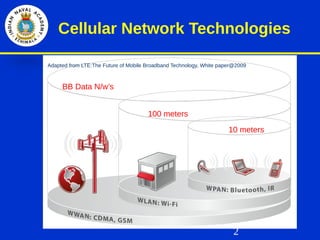
Cellular Network Technologies
Adapted from LTE:The Future of Mobile Broadband Technology, White paper@2009
10 meters
100 meters
BB Data N/w’s
3
4G MOBILE BB TECHNOLOGY
• IP solutions
• Voice, Data and Multimedia
• Anytime, Anywhere
• High Data Rates
• Faster BB Connections
• Streamed Audio and Video
• Video Messaging and Telephony
• Mobile TV and Online Gaming
4
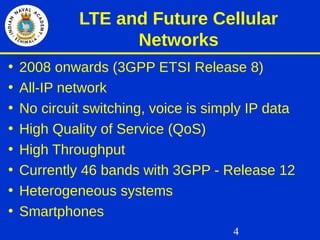
LTE and Future Cellular
Networks
• 2008 onwards (3GPP ETSI Release 8)
• All-IP network
• No circuit switching, voice is simply IP data
• High Quality of Service (QoS)
• High Throughput
• Currently 46 bands with 3GPP - Release 12
• Heterogeneous systems
• Smartphones
5
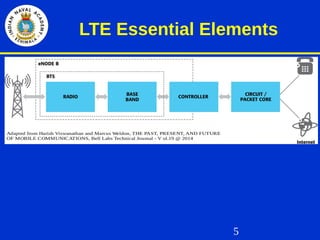
LTE Essential Elements
6
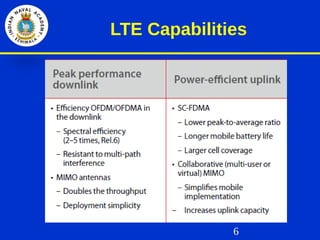
LTE Capabilities
7
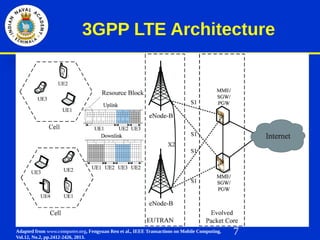
3GPP LTE Architecture
Adapted from www.computer.org, Fengyuan Ren et al., IEEE Transactions on Mobile Computing,
Vol.12, No.2, pp.2412-2426, 2013.
8
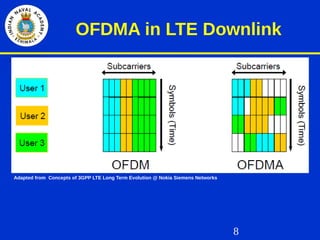
OFDMA in LTE Downlink
Adapted from Concepts of 3GPP LTE Long Term Evolution @ Nokia Siemens Networks
9
Key Technological concepts
• The MIMO Concept
• Invented at Bell Labs in 1990
• Multiple Antennas
• High capacity with more antennas
• The Small Cell Concept
• Cell Splitting
• Deployment of low power Base Stations (Hotspot)
• Microcells, Picocells, Femtocells (100mW – 5W)
• High (Indoor cellular) capacity in a small area
10
LTE Networks
• MIMO with OFDMA in the downlink and
SCFDMA in the uplink
• High levels of spectral efficiency
• End user data rates exceeding 100 Mbps
• Improvements in capacity
• Reductions in latency less than 10 ms
• Bandwidths from 1.4 MHz to 20 MHz
• FDD and TDD operation
11
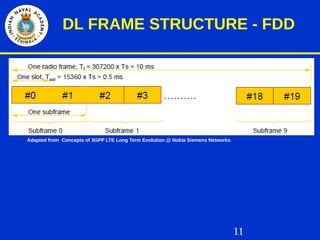
DL FRAME STRUCTURE - FDD
Adapted from Concepts of 3GPP LTE Long Term Evolution @ Nokia Siemens Networks
12
LTE DL Transport Channels
• Broadcast Channel (BCH)
• Broadcast Control Channel(BCCH)
• Downlink Shared Channel (DLSCH)
• Paging Channel (PCH)
• Paging Control Channel (PCCH)
• Multicast Channel (MCH)
• Multicast Control Channel (MCCH)
13
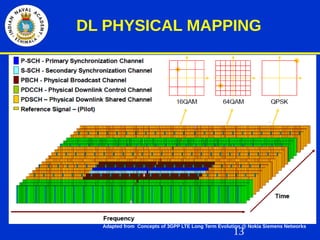
DL PHYSICAL MAPPING
Adapted from Concepts of 3GPP LTE Long Term Evolution @ Nokia Siemens Networks
14
Scheduling Algorithm in LTE
Networks
• Controlling and optimizing the network radio
resources, Resource Blocks (RBs) for the Uplink
(UL) and Downlink (DL)
• Method to distribute the available RBs to the User
Equipments (UEs) for data transmission as per QoS
demands
• Minimize the operational time and improves the
network utilization efficiency
• Works from eNB for Radio Resource Management
(RRM)
15
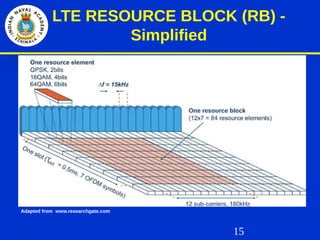
LTE RESOURCE BLOCK (RB) -
Simplified
Adapted from www.researchgate.com
16
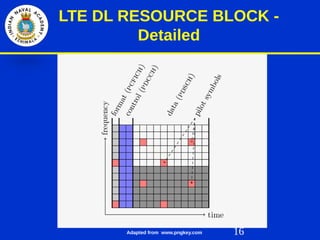
LTE DL RESOURCE BLOCK -
Detailed
Adapted from www.pngkey.com
17
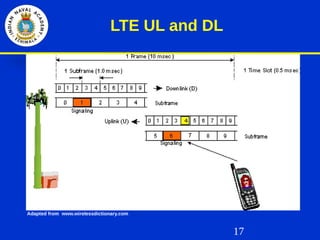
LTE UL and DL
Adapted from www.wirelessdictionary.com
18
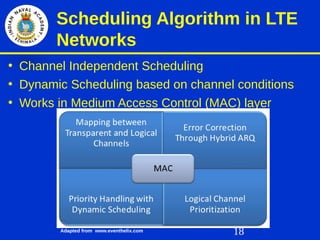
Scheduling Algorithm in LTE
Networks
• Channel Independent Scheduling
• Dynamic Scheduling based on channel conditions
• Works in Medium Access Control (MAC) layer
Adapted from www.eventhelix.com
19
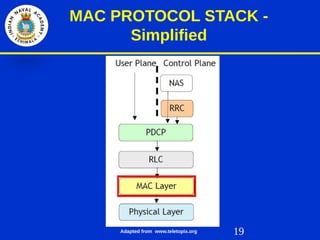
MAC PROTOCOL STACK -
Simplified
Adapted from www.teletopix.org
20
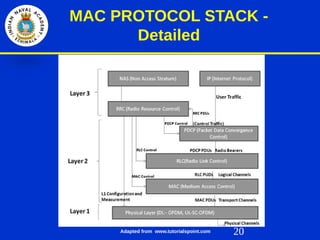
MAC PROTOCOL STACK -
Detailed
Adapted from www.tutorialspoint.com
21
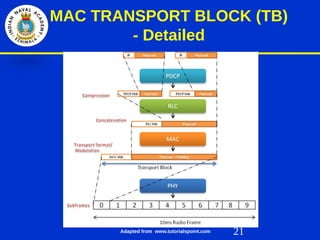
MAC TRANSPORT BLOCK (TB)
- Detailed
Adapted from www.tutorialspoint.com
22
Important Scheduling
Algorithms in LTE Networks
• Scheduling decisions within 1 ms TTI / Subframe
period
• Time to encapsulate the upper layer data into a
frame
• Data flows from MAC layer to PHY layer through
Transport Blocks (TBs)
• Signal strength determined by Channel Quality
Indicator (CQI) values
• Throughput determined by the CQI and Modulation
and Coding Scheme (MCS) adapted
23
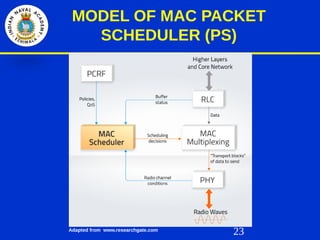
MODEL OF MAC PACKET
SCHEDULER (PS)
Adapted from www.researchgate.com
24
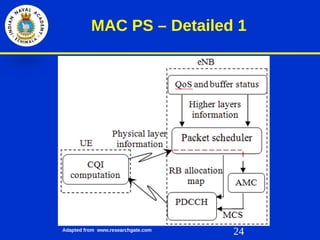
MAC PS – Detailed 1
Adapted from www.researchgate.com
25
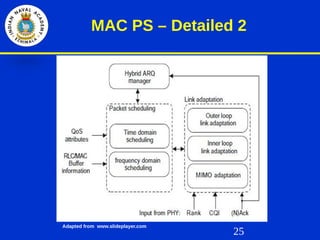
MAC PS – Detailed 2
Adapted from www.slideplayer.com
26
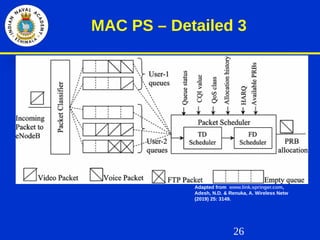
MAC PS – Detailed 3
Adapted from www.link.springer.com,
Adesh, N.D. & Renuka, A. Wireless Netw
(2019) 25: 3149.
27
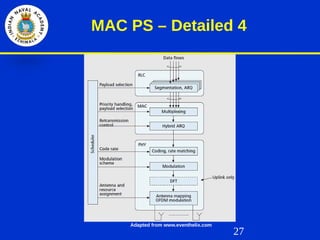
MAC PS – Detailed 4
Adapted from www.eventhelix.com
28
Traffic Types Handled by
Scheduling Algorithms

Best Effort (BE) / Non-Real Time (NRT)

Real-Time (RT)
• VoIP / Video
29
Important Scheduling
Algorithms in LTE Networks

Round Robin (RR) Scheduler
– Available RBs are shared among the UEs
cyclically without any periority

Proportional Fair (PF) Scheduler
– Aims to increase the fairness
– Calculate a scheduling priority metric
– Schedule the UE when its instantaneous channel
quality is high relative to its average channel
quality over a period of time
30
Important Scheduling
Algorithms in LTE Networks

Best Channel Quality Indicator (BCQI) Scheduler
– Aims to increase the overall network throughput
– Allocate / schedule RBs to the UEs when the
channel quality is high
• Blind Equal Throughput (BET) Scheduler
– Aims to offer equal amount of throughput to all
UEs
– Allocate / schedule RBs to the UEs based on
their past average throughput achieved
31
Important Scheduling
Algorithms in LTE Networks

QoS Unaware Schedulers
• QoS Aware Schedulers
– Mainly for RT traffic
– Employs in Time Domain (TD) and Frequency
Domain (FD)
– Priority is based on Guaranteed Bit Rate (GBR)
and Non-GBR (NGBR) services
32
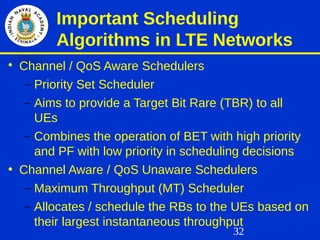
Important Scheduling
Algorithms in LTE Networks

Channel / QoS Aware Schedulers
– Priority Set Scheduler
– Aims to provide a Target Bit Rare (TBR) to all
UEs
– Combines the operation of BET with high priority
and PF with low priority in scheduling decisions
• Channel Aware / QoS Unaware Schedulers
– Maximum Throughput (MT) Scheduler
– Allocates / schedule the RBs to the UEs based on
their largest instantaneous throughput
33
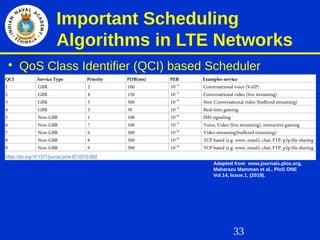
Important Scheduling
Algorithms in LTE Networks

QoS Class Identifier (QCI) based Scheduler
Adapted from www.journals.plos.org,
Maharazu Mamman et al., PloS ONE
Vol.14, Issue.1, (2019).
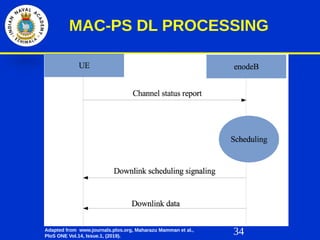
34
MAC-PS DL PROCESSING
Adapted from www.journals.plos.org, Maharazu Mamman et al.,
PloS ONE Vol.14, Issue.1, (2019).
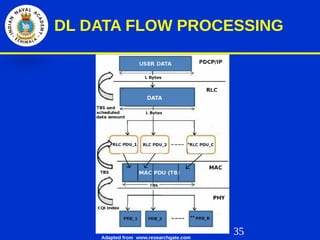
35
DL DATA FLOW PROCESSING
Adapted from www.researchgate.com
36
QoS Performance Metrics of
Scheduling Algorithms

Throughput – User Throughput & Cell Throughput

Fairness / Fairness Index (FI)
• Packet Delay (PD) / Latency
• Packet Loss Rate (PLR) / Block Error Rate (BLER)
• Buffer Occupancy (BO)
• Blocking Probabiligy (BP)
• Spectral Efficiency (SE)
• System Capacity
• Coverage
37
Objectives of Scheduling
Algorithms

Trade-off between Throughput and PD

Trade-off between Throughput and Fairness
• Better Throughput at cell-edges
38
Benefits of LTE Systems
• Provides a global ecosystem with inherent mobility
• Offers easier access and use with greater security
and privacy
• Improves speed and latency
• Delivers enhanced real-time video and multimedia
for a better overall experience
• Creates a platform to build and deploy the products
and services of today and tomorrow
• Reduces cost per bit through improved spectral
efficiency
39
Applications of Future Cellular
Networks
• Virtual Presence
• Tele-Medicine
• Tele-geoprocessing (GIS & GPS)
• Crisis management
• Online Interactive Education
• Artificial Intelligence
• Machine to Machine (M2M) Communication
• 5G Networks
40
5G Future Network
Requirements
• Very low battery power consumption
• Worldwide wireless web (WWWW)
• Low infrastructure deployment costs
• Very high data rate
• Better coverage at cell edges
• Multiple data transfer paths
• IPV6 address and accessability
• Cloud Computing
41
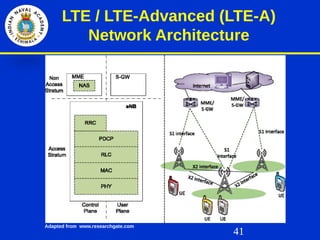
LTE / LTE-Advanced (LTE-A)
Network Architecture
Adapted from www.researchgate.com
42
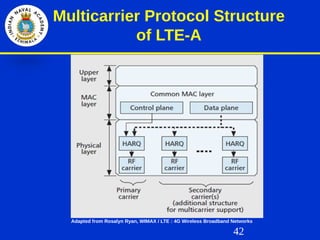
Multicarrier Protocol Structure
of LTE-A
Adapted from Rosalyn Ryan, WIMAX / LTE : 4G Wireless Broadband Networks
43
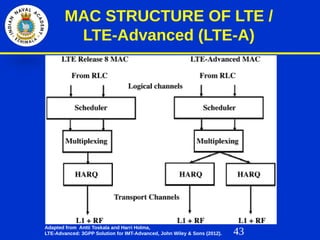
MAC STRUCTURE OF LTE /
LTE-Advanced (LTE-A)
Adapted from Antti Toskala and Harri Holma,
LTE-Advanced: 3GPP Solution for IMT-Advanced, John Wiley & Sons (2012).
44
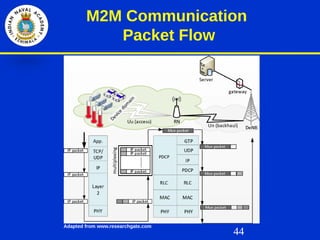
M2M Communication
Packet Flow
Adapted from www.researchgate.com
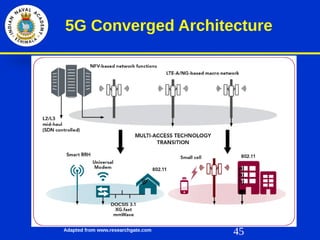
45
5G Converged Architecture
Adapted from www.researchgate.com
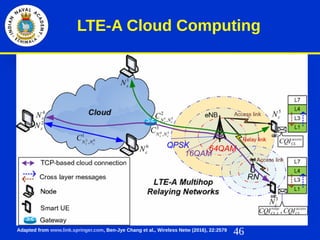
46
LTE-A Cloud Computing
Adapted from www.link.springer.com, Ben-Jye Chang et al., Wireless Netw (2016), 22:2579
47
Questions Please...
48
Thank You For Your
Patient Listening.

Scheduling Algorithms in LTE and Future Cellular Networks

  • 1.
    Scheduling Algorithm inLTE and Future Cellular Networks Prof.Satheesh Monikandan.B Indian Naval Academy, Ezhimala (Indian Navy, Ministry of Defence) sathy24@gmail.com National Level STTP on Green Communication Network and Simulation of Wireless Networks using NS-3 S.A.Engineering College, Chennai 02 Dec 2019
  • 2.
    2 Cellular Network Technologies Adaptedfrom LTE:The Future of Mobile Broadband Technology, White paper@2009 10 meters 100 meters BB Data N/w’s
  • 3.
    3 4G MOBILE BBTECHNOLOGY • IP solutions • Voice, Data and Multimedia • Anytime, Anywhere • High Data Rates • Faster BB Connections • Streamed Audio and Video • Video Messaging and Telephony • Mobile TV and Online Gaming
  • 4.
    4 LTE and FutureCellular Networks • 2008 onwards (3GPP ETSI Release 8) • All-IP network • No circuit switching, voice is simply IP data • High Quality of Service (QoS) • High Throughput • Currently 46 bands with 3GPP - Release 12 • Heterogeneous systems • Smartphones
  • 5.
  • 6.
  • 7.
    7 3GPP LTE Architecture Adaptedfrom www.computer.org, Fengyuan Ren et al., IEEE Transactions on Mobile Computing, Vol.12, No.2, pp.2412-2426, 2013.
  • 8.
    8 OFDMA in LTEDownlink Adapted from Concepts of 3GPP LTE Long Term Evolution @ Nokia Siemens Networks
  • 9.
    9 Key Technological concepts •The MIMO Concept • Invented at Bell Labs in 1990 • Multiple Antennas • High capacity with more antennas • The Small Cell Concept • Cell Splitting • Deployment of low power Base Stations (Hotspot) • Microcells, Picocells, Femtocells (100mW – 5W) • High (Indoor cellular) capacity in a small area
  • 10.
    10 LTE Networks • MIMOwith OFDMA in the downlink and SCFDMA in the uplink • High levels of spectral efficiency • End user data rates exceeding 100 Mbps • Improvements in capacity • Reductions in latency less than 10 ms • Bandwidths from 1.4 MHz to 20 MHz • FDD and TDD operation
  • 11.
    11 DL FRAME STRUCTURE- FDD Adapted from Concepts of 3GPP LTE Long Term Evolution @ Nokia Siemens Networks
  • 12.
    12 LTE DL TransportChannels • Broadcast Channel (BCH) • Broadcast Control Channel(BCCH) • Downlink Shared Channel (DLSCH) • Paging Channel (PCH) • Paging Control Channel (PCCH) • Multicast Channel (MCH) • Multicast Control Channel (MCCH)
  • 13.
    13 DL PHYSICAL MAPPING Adaptedfrom Concepts of 3GPP LTE Long Term Evolution @ Nokia Siemens Networks
  • 14.
    14 Scheduling Algorithm inLTE Networks • Controlling and optimizing the network radio resources, Resource Blocks (RBs) for the Uplink (UL) and Downlink (DL) • Method to distribute the available RBs to the User Equipments (UEs) for data transmission as per QoS demands • Minimize the operational time and improves the network utilization efficiency • Works from eNB for Radio Resource Management (RRM)
  • 15.
    15 LTE RESOURCE BLOCK(RB) - Simplified Adapted from www.researchgate.com
  • 16.
    16 LTE DL RESOURCEBLOCK - Detailed Adapted from www.pngkey.com
  • 17.
    17 LTE UL andDL Adapted from www.wirelessdictionary.com
  • 18.
    18 Scheduling Algorithm inLTE Networks • Channel Independent Scheduling • Dynamic Scheduling based on channel conditions • Works in Medium Access Control (MAC) layer Adapted from www.eventhelix.com
  • 19.
    19 MAC PROTOCOL STACK- Simplified Adapted from www.teletopix.org
  • 20.
    20 MAC PROTOCOL STACK- Detailed Adapted from www.tutorialspoint.com
  • 21.
    21 MAC TRANSPORT BLOCK(TB) - Detailed Adapted from www.tutorialspoint.com
  • 22.
    22 Important Scheduling Algorithms inLTE Networks • Scheduling decisions within 1 ms TTI / Subframe period • Time to encapsulate the upper layer data into a frame • Data flows from MAC layer to PHY layer through Transport Blocks (TBs) • Signal strength determined by Channel Quality Indicator (CQI) values • Throughput determined by the CQI and Modulation and Coding Scheme (MCS) adapted
  • 23.
    23 MODEL OF MACPACKET SCHEDULER (PS) Adapted from www.researchgate.com
  • 24.
    24 MAC PS –Detailed 1 Adapted from www.researchgate.com
  • 25.
    25 MAC PS –Detailed 2 Adapted from www.slideplayer.com
  • 26.
    26 MAC PS –Detailed 3 Adapted from www.link.springer.com, Adesh, N.D. & Renuka, A. Wireless Netw (2019) 25: 3149.
  • 27.
    27 MAC PS –Detailed 4 Adapted from www.eventhelix.com
  • 28.
    28 Traffic Types Handledby Scheduling Algorithms  Best Effort (BE) / Non-Real Time (NRT)  Real-Time (RT) • VoIP / Video
  • 29.
    29 Important Scheduling Algorithms inLTE Networks  Round Robin (RR) Scheduler – Available RBs are shared among the UEs cyclically without any periority  Proportional Fair (PF) Scheduler – Aims to increase the fairness – Calculate a scheduling priority metric – Schedule the UE when its instantaneous channel quality is high relative to its average channel quality over a period of time
  • 30.
    30 Important Scheduling Algorithms inLTE Networks  Best Channel Quality Indicator (BCQI) Scheduler – Aims to increase the overall network throughput – Allocate / schedule RBs to the UEs when the channel quality is high • Blind Equal Throughput (BET) Scheduler – Aims to offer equal amount of throughput to all UEs – Allocate / schedule RBs to the UEs based on their past average throughput achieved
  • 31.
    31 Important Scheduling Algorithms inLTE Networks  QoS Unaware Schedulers • QoS Aware Schedulers – Mainly for RT traffic – Employs in Time Domain (TD) and Frequency Domain (FD) – Priority is based on Guaranteed Bit Rate (GBR) and Non-GBR (NGBR) services
  • 32.
    32 Important Scheduling Algorithms inLTE Networks  Channel / QoS Aware Schedulers – Priority Set Scheduler – Aims to provide a Target Bit Rare (TBR) to all UEs – Combines the operation of BET with high priority and PF with low priority in scheduling decisions • Channel Aware / QoS Unaware Schedulers – Maximum Throughput (MT) Scheduler – Allocates / schedule the RBs to the UEs based on their largest instantaneous throughput
  • 33.
    33 Important Scheduling Algorithms inLTE Networks  QoS Class Identifier (QCI) based Scheduler Adapted from www.journals.plos.org, Maharazu Mamman et al., PloS ONE Vol.14, Issue.1, (2019).
  • 34.
    34 MAC-PS DL PROCESSING Adaptedfrom www.journals.plos.org, Maharazu Mamman et al., PloS ONE Vol.14, Issue.1, (2019).
  • 35.
    35 DL DATA FLOWPROCESSING Adapted from www.researchgate.com
  • 36.
    36 QoS Performance Metricsof Scheduling Algorithms  Throughput – User Throughput & Cell Throughput  Fairness / Fairness Index (FI) • Packet Delay (PD) / Latency • Packet Loss Rate (PLR) / Block Error Rate (BLER) • Buffer Occupancy (BO) • Blocking Probabiligy (BP) • Spectral Efficiency (SE) • System Capacity • Coverage
  • 37.
    37 Objectives of Scheduling Algorithms  Trade-offbetween Throughput and PD  Trade-off between Throughput and Fairness • Better Throughput at cell-edges
  • 38.
    38 Benefits of LTESystems • Provides a global ecosystem with inherent mobility • Offers easier access and use with greater security and privacy • Improves speed and latency • Delivers enhanced real-time video and multimedia for a better overall experience • Creates a platform to build and deploy the products and services of today and tomorrow • Reduces cost per bit through improved spectral efficiency
  • 39.
    39 Applications of FutureCellular Networks • Virtual Presence • Tele-Medicine • Tele-geoprocessing (GIS & GPS) • Crisis management • Online Interactive Education • Artificial Intelligence • Machine to Machine (M2M) Communication • 5G Networks
  • 40.
    40 5G Future Network Requirements •Very low battery power consumption • Worldwide wireless web (WWWW) • Low infrastructure deployment costs • Very high data rate • Better coverage at cell edges • Multiple data transfer paths • IPV6 address and accessability • Cloud Computing
  • 41.
    41 LTE / LTE-Advanced(LTE-A) Network Architecture Adapted from www.researchgate.com
  • 42.
    42 Multicarrier Protocol Structure ofLTE-A Adapted from Rosalyn Ryan, WIMAX / LTE : 4G Wireless Broadband Networks
  • 43.
    43 MAC STRUCTURE OFLTE / LTE-Advanced (LTE-A) Adapted from Antti Toskala and Harri Holma, LTE-Advanced: 3GPP Solution for IMT-Advanced, John Wiley & Sons (2012).
  • 44.
  • 45.
    45 5G Converged Architecture Adaptedfrom www.researchgate.com
  • 46.
    46 LTE-A Cloud Computing Adaptedfrom www.link.springer.com, Ben-Jye Chang et al., Wireless Netw (2016), 22:2579
  • 47.
  • 48.
    48 Thank You ForYour Patient Listening.