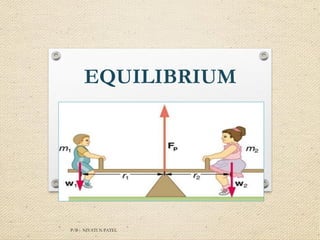
EQUILIBRIUM
P/B :- NIYATI N PATEL
EQUILIBRIUM OF RIGID
BODIES
• A rigid body will be in equilibrium if the
following two conditions are met
1. The vector sum of the forces acting on the
body must be zero
2. The net torque acting on the body must be
zero
P/B :- NIYATI N PATEL
• The 1st condition ensures that the linear
acceleration is zero (Either the body is at rest or it
is moving with uniform linear velocity)
• Under this condition, the body is said to be in
translational equilibrium
• The 2nd condition ensures that the angular
acceleration is zero (Either body is at rest or it is
moving with uniform angular velocity)
• Under this condition, the body is said to be in rotational
equilibrium
P/B :- NIYATI N PATEL
• A body satisfying both conditions is said to
be in equilibrium
• If such body is stationary, it is said to be in
static equilibrium
• If it is moving with uniform linear or angular
velocity, it is said to be in dynamic
equilibrium
P/B :- NIYATI N PATEL
Translational equilibrium
• For an object to be in translational equilibrium, the
vector sum of the forces acting on it must be zero.
• Net external force, F=0
• Stating that the vector sum of forces acting on an
object is zero is equivalent to :
fx=0, fy=0, fz=0
• It means that all the forces along the x-axis add to
zero. Same is true for forces along y and z axis.
• According to newton’s law of motion, F=ma.
• Therefore, when a body is in translation equilibrium, it
is either at rest or it is moving with constant velocity.
P/B :- NIYATI N PATEL
Types of translation equilibrium
• STABLE EQUILIBRIUM: a body is in stable
equilibrium if it returns to its equilibrium position
after it has been displaced slightly
P/B :- NIYATI N PATEL
• UNSTABLE EQUILIBRIUM: A body is in unstable
equilibrium if it does not return to its equilibrium
position and does not remain in the displaced
position after it has been displaced slightly
P/B :- NIYATI N PATEL
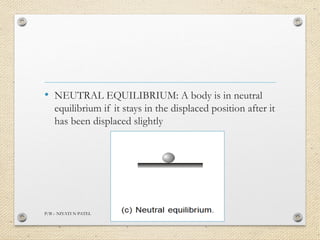
• NEUTRAL EQUILIBRIUM: A body is in neutral
equilibrium if it stays in the displaced position after it
has been displaced slightly
P/B :- NIYATI N PATEL
Rotational equilibrium
• A rigid body is said to be in rotational equilibrium if
the net external force acting on the body is zero
• When body is in rotational equilibrium , either the
body does not rotate or rorates with a constant
angular velocity.
• A body is said to be in rotational equilibrium if the
algebraic sum of moments of all the forces acting on
the body about a fixed point/ axis is zero
P/B :- NIYATI N PATEL
• Consider a rod AB of negligible mass pivoted at point 0 as
shown in figure. The rod is under the action of two
parallel force F1 & F2.
• The rod will be in rotational equilibrium if the algebraic
sum of moments of F1 & F2 about 0 is zero
• F1 ×d1 – F2 × d2 = 0
• Hense
• F1 × d1 = +t1 (Anticlockwise)
• F2 × d2 = -t2 (Clockwise)
• t1 + (-t2) = 0 or Net torque = 0
P/B :- NIYATI N PATEL

2.Equilibrium (Biomedical Physics).pdf

  • 1.
  • 2.
    EQUILIBRIUM OF RIGID BODIES •A rigid body will be in equilibrium if the following two conditions are met 1. The vector sum of the forces acting on the body must be zero 2. The net torque acting on the body must be zero P/B :- NIYATI N PATEL
  • 3.
    • The 1stcondition ensures that the linear acceleration is zero (Either the body is at rest or it is moving with uniform linear velocity) • Under this condition, the body is said to be in translational equilibrium • The 2nd condition ensures that the angular acceleration is zero (Either body is at rest or it is moving with uniform angular velocity) • Under this condition, the body is said to be in rotational equilibrium P/B :- NIYATI N PATEL
  • 4.
    • A bodysatisfying both conditions is said to be in equilibrium • If such body is stationary, it is said to be in static equilibrium • If it is moving with uniform linear or angular velocity, it is said to be in dynamic equilibrium P/B :- NIYATI N PATEL
  • 5.
    Translational equilibrium • Foran object to be in translational equilibrium, the vector sum of the forces acting on it must be zero. • Net external force, F=0 • Stating that the vector sum of forces acting on an object is zero is equivalent to : fx=0, fy=0, fz=0 • It means that all the forces along the x-axis add to zero. Same is true for forces along y and z axis. • According to newton’s law of motion, F=ma. • Therefore, when a body is in translation equilibrium, it is either at rest or it is moving with constant velocity. P/B :- NIYATI N PATEL
  • 6.
    Types of translationequilibrium • STABLE EQUILIBRIUM: a body is in stable equilibrium if it returns to its equilibrium position after it has been displaced slightly P/B :- NIYATI N PATEL
  • 7.
    • UNSTABLE EQUILIBRIUM:A body is in unstable equilibrium if it does not return to its equilibrium position and does not remain in the displaced position after it has been displaced slightly P/B :- NIYATI N PATEL
  • 8.
    • NEUTRAL EQUILIBRIUM:A body is in neutral equilibrium if it stays in the displaced position after it has been displaced slightly P/B :- NIYATI N PATEL
  • 9.
    Rotational equilibrium • Arigid body is said to be in rotational equilibrium if the net external force acting on the body is zero • When body is in rotational equilibrium , either the body does not rotate or rorates with a constant angular velocity. • A body is said to be in rotational equilibrium if the algebraic sum of moments of all the forces acting on the body about a fixed point/ axis is zero P/B :- NIYATI N PATEL
  • 10.
    • Consider arod AB of negligible mass pivoted at point 0 as shown in figure. The rod is under the action of two parallel force F1 & F2. • The rod will be in rotational equilibrium if the algebraic sum of moments of F1 & F2 about 0 is zero • F1 ×d1 – F2 × d2 = 0 • Hense • F1 × d1 = +t1 (Anticlockwise) • F2 × d2 = -t2 (Clockwise) • t1 + (-t2) = 0 or Net torque = 0 P/B :- NIYATI N PATEL