MEASLES
P/B :- DR NIYATI PATEL 1
DEFINITION
Measles is an acute viral respiratory
illness.
It is characterized by a prodrome of fever
(as high as 105°F) and malaise, cough and
conjunctivitis followed by a
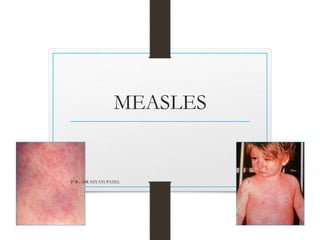
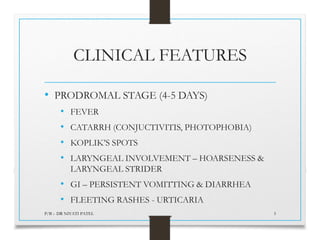
maculopapular rash
P/B :- DR NIYATI PATEL 2
EPIDEMIOLOGY
• Age – mostly children between ages of 3 and 5
years, rare during first 6 months of life because of
transferred passive immunity from mother.
• Incubation period – 8–10 days.
• Period of infectivity – From onset of prodromal period
to 4 days after appearance of rash.
P/B :- DR NIYATI PATEL 3
TRANSMISSION
• Highly infectious and spread by direct
contact or droplet infection.
• Patients suffering from measles shed
virus from their respiratory tract during
the prodromal period and for 24–48
hours after the rash appears
P/B :- DR NIYATI PATEL 4
CLINICAL FEATURES
• PRODROMAL STAGE (4-5 DAYS)
• FEVER
• CATARRH (CONJUCTIVITIS, PHOTOPHOBIA)
• KOPLIK’S SPOTS
• LARYNGEAL INVOLVEMENT – HOARSENESS &
LARYNGEAL STRIDER
• GI – PERSISTENT VOMITTING & DIARRHEA
• FLEETING RASHES - URTICARIA
P/B :- DR NIYATI PATEL 5
• EXANTHEMATOUS STAGE
• RASH- ON 5TH DAY  RED MACULES
APPEAR BEHIND EAR, HAIR LINE & POST
PART OF CHEECKS  SPREAD RAPIDLY IN
FEW HRS ALL OVER BODY FACE
SWOLLEN IN SEVERE
• MUCOUS MEMBRANE  CONJUNCTIVITIS,
RHINITIS, STOMATITIS, LARYNGITIS,
TRACHEITIS AND BRONCHITIS
P/B :- DR NIYATI PATEL 6
• STAGE OF DEFERVESCENCE
• Temperature falls by crisis in 24 to 48
hours.
• Rash fades from face downwards in same
sequence as its appearance and leaves brown
staining
P/B :- DR NIYATI PATEL 7
COMPLICATION
• Secondary bacterial otitis media
• Pneumonia
• Laryngo-trachea-bronchitis
• Hepatitis
• Blindness
P/B :- DR NIYATI PATEL 8
POST MEASLES STATE
• results from powerful immunosuppressive effect which
alters immunity and the tissue destructive effect of
measles.
• Clinical features.
• (a) Growth retardation and diarrhoea
• (b) Gingivostomatitis
• (c) Corneal ulcers mainly in malnourished children.
• (d) Other uncommon complications – Gangrene of tips of
fingers and toes, possibly abortion or prematurity if infection
occurs during pregnancy.
P/B :- DR NIYATI PATEL 9
MANAGEMENT
• Frequent fluid intake.
• Paracetamol for fever.
• Irrigation of eyes with boric lotion.
• Cough linctus to suppress the dry cough.
• Antibiotics such as amoxicillin
• Vitamin A  prevents eyes complication & reduced
respiratory infection
• Antiviral  Ribavirin & Acyclovir
• Antifungal Therapy  Fluconazole
P/B :- DR NIYATI PATEL 10
PREVENTION
• (a) Active immunization – Single dose of attenuated
live-virus vaccine for all children at the beginning of
second year of life  Measles vaccine
• (b) Passive immunization -- Immunoglobulin is
useful in debilitated patients in contact of measles
patients followed in 3 months by vaccine  MMR
Vaccine
P/B :- DR NIYATI PATEL 11
P/B :- DR NIYATI PATEL 12
P/B :- DR NIYATI PATEL 13

23.MEASLES.pdf

  • 1.
    MEASLES P/B :- DRNIYATI PATEL 1
  • 2.
    DEFINITION Measles is anacute viral respiratory illness. It is characterized by a prodrome of fever (as high as 105°F) and malaise, cough and conjunctivitis followed by a maculopapular rash P/B :- DR NIYATI PATEL 2
  • 3.
    EPIDEMIOLOGY • Age –mostly children between ages of 3 and 5 years, rare during first 6 months of life because of transferred passive immunity from mother. • Incubation period – 8–10 days. • Period of infectivity – From onset of prodromal period to 4 days after appearance of rash. P/B :- DR NIYATI PATEL 3
  • 4.
    TRANSMISSION • Highly infectiousand spread by direct contact or droplet infection. • Patients suffering from measles shed virus from their respiratory tract during the prodromal period and for 24–48 hours after the rash appears P/B :- DR NIYATI PATEL 4
  • 5.
    CLINICAL FEATURES • PRODROMALSTAGE (4-5 DAYS) • FEVER • CATARRH (CONJUCTIVITIS, PHOTOPHOBIA) • KOPLIK’S SPOTS • LARYNGEAL INVOLVEMENT – HOARSENESS & LARYNGEAL STRIDER • GI – PERSISTENT VOMITTING & DIARRHEA • FLEETING RASHES - URTICARIA P/B :- DR NIYATI PATEL 5
  • 6.
    • EXANTHEMATOUS STAGE •RASH- ON 5TH DAY  RED MACULES APPEAR BEHIND EAR, HAIR LINE & POST PART OF CHEECKS  SPREAD RAPIDLY IN FEW HRS ALL OVER BODY FACE SWOLLEN IN SEVERE • MUCOUS MEMBRANE  CONJUNCTIVITIS, RHINITIS, STOMATITIS, LARYNGITIS, TRACHEITIS AND BRONCHITIS P/B :- DR NIYATI PATEL 6
  • 7.
    • STAGE OFDEFERVESCENCE • Temperature falls by crisis in 24 to 48 hours. • Rash fades from face downwards in same sequence as its appearance and leaves brown staining P/B :- DR NIYATI PATEL 7
  • 8.
    COMPLICATION • Secondary bacterialotitis media • Pneumonia • Laryngo-trachea-bronchitis • Hepatitis • Blindness P/B :- DR NIYATI PATEL 8
  • 9.
    POST MEASLES STATE •results from powerful immunosuppressive effect which alters immunity and the tissue destructive effect of measles. • Clinical features. • (a) Growth retardation and diarrhoea • (b) Gingivostomatitis • (c) Corneal ulcers mainly in malnourished children. • (d) Other uncommon complications – Gangrene of tips of fingers and toes, possibly abortion or prematurity if infection occurs during pregnancy. P/B :- DR NIYATI PATEL 9
  • 10.
    MANAGEMENT • Frequent fluidintake. • Paracetamol for fever. • Irrigation of eyes with boric lotion. • Cough linctus to suppress the dry cough. • Antibiotics such as amoxicillin • Vitamin A  prevents eyes complication & reduced respiratory infection • Antiviral  Ribavirin & Acyclovir • Antifungal Therapy  Fluconazole P/B :- DR NIYATI PATEL 10
  • 11.
    PREVENTION • (a) Activeimmunization – Single dose of attenuated live-virus vaccine for all children at the beginning of second year of life  Measles vaccine • (b) Passive immunization -- Immunoglobulin is useful in debilitated patients in contact of measles patients followed in 3 months by vaccine  MMR Vaccine P/B :- DR NIYATI PATEL 11
  • 12.
    P/B :- DRNIYATI PATEL 12
  • 13.
    P/B :- DRNIYATI PATEL 13