March 03, 2011
StaticEquilibrium
Equilibrium and static
equilibrium
Static equilibrium
conditions
Net external force must
equal zero
Net external torque must
equal zero
Center of gravity
Solving static equilibrium
problems
3.
March 03, 2011
Staticand Dynamic
Equilibrium
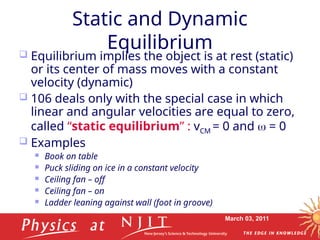
Equilibrium implies the object is at rest (static)
or its center of mass moves with a constant
velocity (dynamic)
106 deals only with the special case in which
linear and angular velocities are equal to zero,
called “static equilibrium” : vCM = 0 and = 0
Examples
Book on table
Puck sliding on ice in a constant velocity
Ceiling fan – off
Ceiling fan – on
Ladder leaning against wall (foot in groove)
4.
March 03, 2011
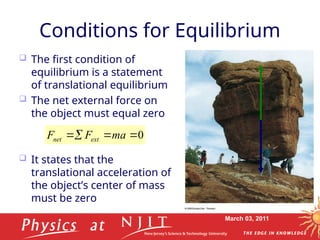
Conditionsfor Equilibrium
The first condition of
equilibrium is a statement
of translational equilibrium
The net external force on
the object must equal zero
It states that the
translational acceleration of
the object’s center of mass
must be zero
0
a
m
F
F ext
net
5.
March 03, 2011
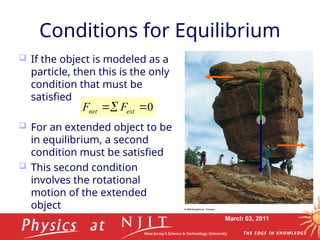
Conditionsfor Equilibrium
If the object is modeled as a
particle, then this is the only
condition that must be
satisfied
For an extended object to be
in equilibrium, a second
condition must be satisfied
This second condition
involves the rotational
motion of the extended
object
0
ext
net F
F
6.
March 03, 2011
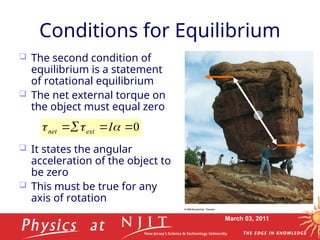
Conditionsfor Equilibrium
The second condition of
equilibrium is a statement
of rotational equilibrium
The net external torque on
the object must equal zero
It states the angular
acceleration of the object to
be zero
This must be true for any
axis of rotation
0
I
ext
net
7.
March 03, 2011
Conditionsfor Equilibrium
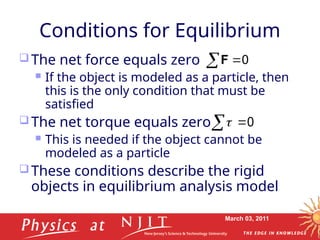
The net force equals zero
If the object is modeled as a particle, then
this is the only condition that must be
satisfied
The net torque equals zero
This is needed if the object cannot be
modeled as a particle
These conditions describe the rigid
objects in equilibrium analysis model
0
F
0
8.
March 03, 2011
EquilibriumEquations
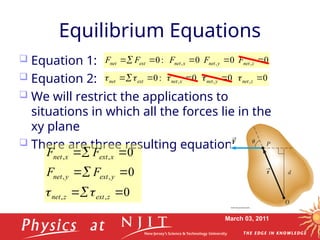
Equation 1:
Equation 2:
We will restrict the applications to
situations in which all the forces lie in the
xy plane
There are three resulting equations
0
0
0
:
0 ,
,
,
z
net
y
net
x
net
ext
net F
F
F
F
F
0
0
0
:
0 ,
,
,
z
net
y
net
x
net
ext
net
0
0
0
,
,
,
,
,
,
z
ext
z
net
y
ext
y
net
x
ext
x
net
F
F
F
F
9.
March 03, 2011
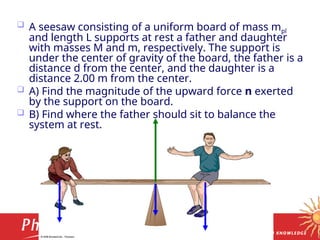
A seesaw consisting of a uniform board of mass mpl
and length L supports at rest a father and daughter
with masses M and m, respectively. The support is
under the center of gravity of the board, the father is a
distance d from the center, and the daughter is a
distance 2.00 m from the center.
A) Find the magnitude of the upward force n exerted
by the support on the board.
B) Find where the father should sit to balance the
system at rest.
10.
March 03, 2011
g
m
Mg
mg
n
g
m
Mg
mg
n
F
pl
pl
y
net
0
,
m
00
.
2
2
0
0
0
,
M
m
d
M
m
x
Mgx
mgd
Mgx
mgd
n
pl
f
d
z
net
0
0
0
,
,
,
,
,
,
z
ext
z
net
y
ext
y
net
x
ext
x
net
F
F
F
F
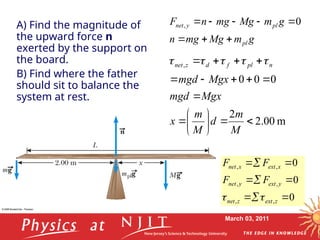
A) Find the magnitude of
the upward force n
exerted by the support on
the board.
B) Find where the father
should sit to balance the
system at rest.
11.
March 03, 2011
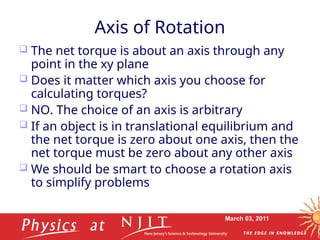
Axisof Rotation
The net torque is about an axis through any
point in the xy plane
Does it matter which axis you choose for
calculating torques?
NO. The choice of an axis is arbitrary
If an object is in translational equilibrium and
the net torque is zero about one axis, then the
net torque must be zero about any other axis
We should be smart to choose a rotation axis
to simplify problems
12.
March 03, 2011
M
m
d
M
m
x
Mgx
mgd
Mgx
mgd
n
pl
f
d
z
net
2
0
0
0
,
0
0
0
,
,
,
,
,
,
z
ext
z
net
y
ext
y
net
x
ext
x
net
F
F
F
F
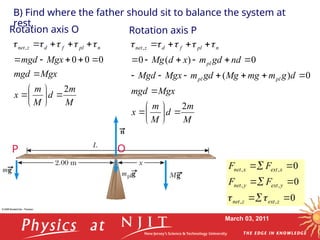
B) Find where the father should sit to balance the system at
rest.
M
m
d
M
m
x
Mgx
mgd
d
g
m
mg
Mg
gd
m
Mgx
Mgd
nd
gd
m
x
d
Mg
pl
pl
pl
n
pl
f
d
z
net
2
0
)
(
0
)
(
0
,
O
P
Rotation axis O Rotation axis P
13.
March 03, 2011
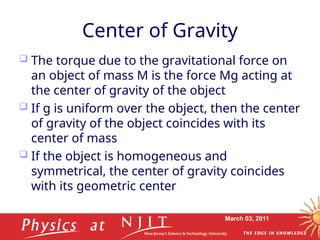
Centerof Gravity
The torque due to the gravitational force on
an object of mass M is the force Mg acting at
the center of gravity of the object
If g is uniform over the object, then the center
of gravity of the object coincides with its
center of mass
If the object is homogeneous and
symmetrical, the center of gravity coincides
with its geometric center
14.
March 03, 2011
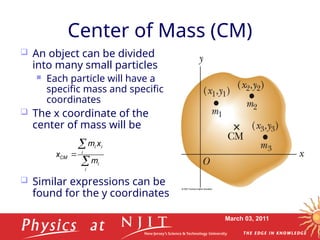
Centerof Mass (CM)
An object can be divided
into many small particles
Each particle will have a
specific mass and specific
coordinates
The x coordinate of the
center of mass will be
Similar expressions can be
found for the y coordinates
i i
i
CM
i
i
m x
x
m
15.
March 03, 2011
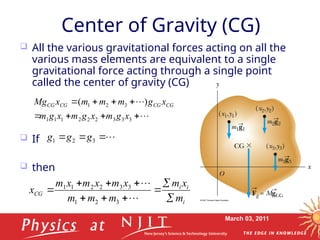
Centerof Gravity (CG)
All the various gravitational forces acting on all the
various mass elements are equivalent to a single
gravitational force acting through a single point
called the center of gravity (CG)
If
then
3
3
3
2
2
2
1
1
1
3
2
1 )
(
x
g
m
x
g
m
x
g
m
x
g
m
m
m
x
Mg CG
CG
CG
CG
3
2
1 g
g
g
i
i
i
CG
m
x
m
m
m
m
x
m
x
m
x
m
x
3
2
1
3
3
2
2
1
1
16.
March 03, 2011
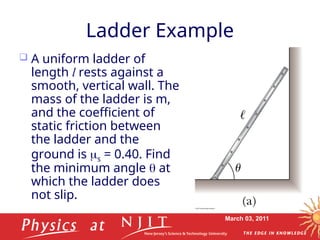
LadderExample
A uniform ladder of
length l rests against a
smooth, vertical wall. The
mass of the ladder is m,
and the coefficient of
static friction between
the ladder and the
ground is s = 0.40. Find
the minimum angle at
which the ladder does
not slip.
17.
March 03, 2011
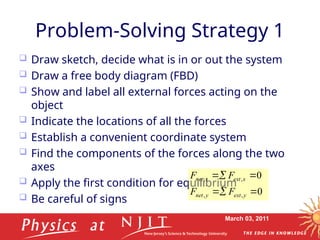
Problem-SolvingStrategy 1
Draw sketch, decide what is in or out the system
Draw a free body diagram (FBD)
Show and label all external forces acting on the
object
Indicate the locations of all the forces
Establish a convenient coordinate system
Find the components of the forces along the two
axes
Apply the first condition for equilibrium
Be careful of signs
0
0
,
,
,
,
y
ext
y
net
x
ext
x
net
F
F
F
F
18.
March 03, 2011
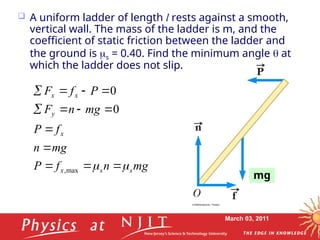
A uniform ladder of length l rests against a smooth,
vertical wall. The mass of the ladder is m, and the
coefficient of static friction between the ladder and
the ground is s = 0.40. Find the minimum angle at
which the ladder does not slip.
mg
n
f
P
mg
n
f
P
mg
n
F
P
f
F
s
s
x
x
y
x
x
max
,
0
0
mg
19.
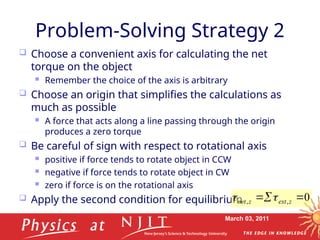
March 03, 2011
Problem-SolvingStrategy 2
Choose a convenient axis for calculating the net
torque on the object
Remember the choice of the axis is arbitrary
Choose an origin that simplifies the calculations as
much as possible
A force that acts along a line passing through the origin
produces a zero torque
Be careful of sign with respect to rotational axis
positive if force tends to rotate object in CCW
negative if force tends to rotate object in CW
zero if force is on the rotational axis
Apply the second condition for equilibrium 0
,
,
z
ext
z
net
20.
March 03, 2011
A uniform ladder of length l rests against a smooth,
vertical wall. The mass of the ladder is m, and the
coefficient of static friction between the ladder and
the ground is s = 0.40. Find the minimum angle at
which the ladder does not slip.
51
]
)
4
.
0
(
2
1
[
tan
)
2
1
(
tan
2
1
2
2
tan
cos
sin
0
cos
2
sin
0
0
1
1
min
min
min
min
min
min
s
s
s
P
g
f
n
O
mg
mg
P
mg
l
mg
Pl
mg
21.
March 03, 2011
Problem-SolvingStrategy 3
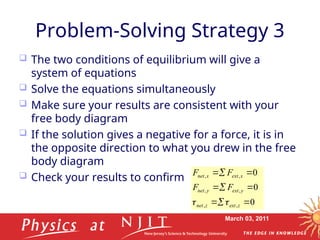
The two conditions of equilibrium will give a
system of equations
Solve the equations simultaneously
Make sure your results are consistent with your
free body diagram
If the solution gives a negative for a force, it is in
the opposite direction to what you drew in the free
body diagram
Check your results to confirm
0
0
0
,
,
,
,
,
,
z
ext
z
net
y
ext
y
net
x
ext
x
net
F
F
F
F
22.
March 03, 2011
HorizontalBeam Example
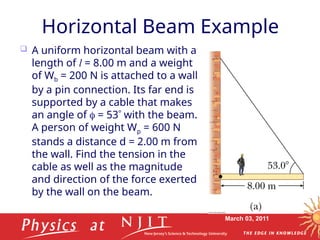
A uniform horizontal beam with a
length of l = 8.00 m and a weight
of Wb = 200 N is attached to a wall
by a pin connection. Its far end is
supported by a cable that makes
an angle of = 53 with the beam.
A person of weight Wp = 600 N
stands a distance d = 2.00 m from
the wall. Find the tension in the
cable as well as the magnitude
and direction of the force exerted
by the wall on the beam.
23.
March 03, 2011
HorizontalBeam Example
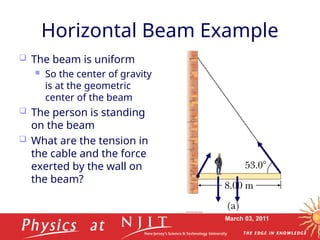
The beam is uniform
So the center of gravity
is at the geometric
center of the beam
The person is standing
on the beam
What are the tension in
the cable and the force
exerted by the wall on
the beam?
24.
March 03, 2011
HorizontalBeam Example, 2
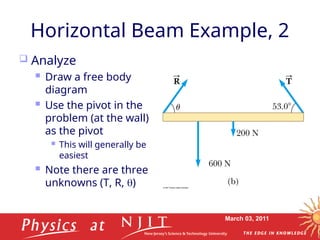
Analyze
Draw a free body
diagram
Use the pivot in the
problem (at the wall)
as the pivot
This will generally be
easiest
Note there are three
unknowns (T, R, )
25.
March 03, 2011
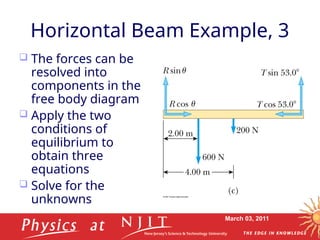
The forces can be
resolved into
components in the
free body diagram
Apply the two
conditions of
equilibrium to
obtain three
equations
Solve for the
unknowns
Horizontal Beam Example, 3
26.
March 03, 2011
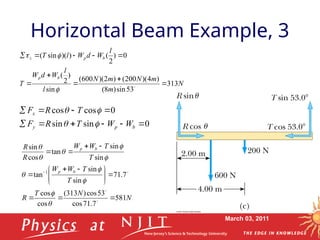
HorizontalBeam Example, 3
0
sin
sin
0
cos
cos
b
p
y
x
W
W
T
R
F
T
R
F
N
m
m
N
m
N
l
l
W
d
W
T
l
W
d
W
l
T
b
p
b
p
z
313
53
sin
)
8
(
)
4
)(
200
(
)
2
)(
600
(
sin
)
2
(
0
)
2
(
)
)(
sin
(
N
N
T
R
T
T
W
W
T
T
W
W
R
R
b
p
b
p
581
7
.
71
cos
53
cos
)
313
(
cos
cos
7
.
71
sin
sin
tan
sin
sin
tan
cos
sin
1

![March 03, 2011
A uniform ladder of length l rests against a smooth,
vertical wall. The mass of the ladder is m, and the
coefficient of static friction between the ladder and
the ground is s = 0.40. Find the minimum angle at
which the ladder does not slip.
51
]
)
4
.
0
(
2
1
[
tan
)
2
1
(
tan
2
1
2
2
tan
cos
sin
0
cos
2
sin
0
0
1
1
min
min
min
min
min
min
s
s
s
P
g
f
n
O
mg
mg
P
mg
l
mg
Pl
mg](https://image.slidesharecdn.com/physics106lecture07-251206202238-e3ed6fb2/85/physics-Particlles-equiliberium-106_lecture07-ppt-20-320.jpg)