MALARIA
P/B :- DR NIYATI PATEL (PT)
1
2
DEFINITION
 Acute febrile illness characterised by paroxysms
of fever as a result of asexual reproduction of
plasmodia within the red cells.
 Causes of malaria
 Plasmodium vivax,
 Plasmodium ovale and
 Plasmodium malariae
 Plasmodium falciparum  potentially fatal malaria.
3
TRANSMISSION
 (a) Presence of suitable anopheline mosquito,
 (B) Reservoir of malaria infection in the area,
 (C) Suitable non-immune or partly immune hosts
 (D) An environmental temperature with suitable
humidity.
 Infection is normally transmitted to
 Man by the bite of a mosquito,
 Rarely occur across the placenta
 A result of blood transfusion
 Syringe-transmitted malaria among drug addicts
4
5
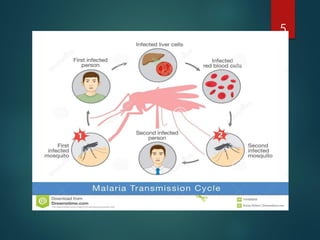
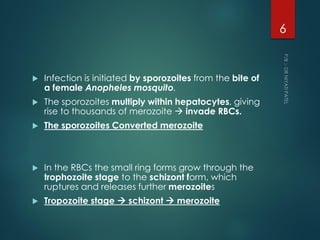
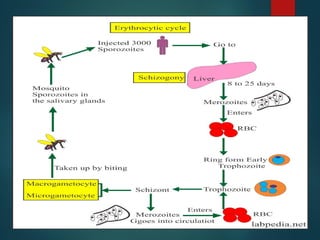
 Infection is initiated by sporozoites from the bite of
a female Anopheles mosquito.
 The sporozoites multiply within hepatocytes, giving
rise to thousands of merozoite  invade RBCs.
 The sporozoites Converted merozoite
 In the RBCs the small ring forms grow through the
trophozoite stage to the schizont form, which
ruptures and releases further merozoites
 Tropozoite stage  schizont  merozoite
6
7
 This asexual cycle in the blood
 lasts 48 hours in  P. falciparum, P. vivax and P.
ovale infections,
 lasts 72 hours in  P.malariya.
8
PATHOGENESIS
 Clinical symptoms and signs are caused by the
asexual forms of the parasite
 Invade and destroy RBCs,
 Localise in tissues and organs by binding to
endothelial cells (cytoadherence)
 Induce release of many pro-inflammatory cytokines
[e.G. Tumour necrosis factor-α (tnf-α)].
 Initiating step when merozoites invade RBCs 
trophozoite  schizont stage bind to epithelial
cells in post capillary venules  microvascular
obstruction (cytoadherent) toxins produced 
cytokine release
9
CLINICAL FEATURES
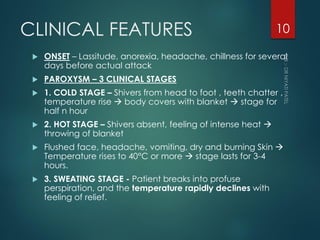
 ONSET – Lassitude, anorexia, headache, chillness for several
days before actual attack
 PAROXYSM – 3 CLINICAL STAGES
 1. COLD STAGE – Shivers from head to foot , teeth chatter ,
temperature rise  body covers with blanket  stage for
half n hour
 2. HOT STAGE – Shivers absent, feeling of intense heat 
throwing of blanket
 Flushed face, headache, vomiting, dry and burning Skin 
Temperature rises to 40°C or more  stage lasts for 3-4
hours.
 3. SWEATING STAGE - Patient breaks into profuse
perspiration, and the temperature rapidly declines with
feeling of relief.
10
11
COMPLICATIONS
 Tropical splenomegaly syndrome (TSS) – is seen in
endemic falciparum malaria  Clinical features: marked
splenomegaly, lesser degree of hepatomegaly, anaemia
and pancytopenia.
 Quartan malarial nephropathy – is associated with P.
malariae infection. Predominantly affects children
between 5-8 years of age  Clinical features : nephrotic
syndrome several weeks after onset of quartan fever 
Disease progresses slowly to end-stage kidney failure in 3-
5 years.
 Anaemia in malaria,  most common complication 
due to accelerated RBC removal by the spleen, RBC
destruction at parasite schizogony and ineffective
haemopoiesis.
12
DIAGNOSIS
 1. Clinical – Periodic fever with rigour, sweating,
anaemia and perhaps enlarged spleen.
 2. Blood film – Identification of the parasites in thick
and thin blood film  found during a spike of fever.
 Common microscopic characters of falciparum
malaria are – high concentration of parasites 
predominance of thin ring-shaped trophozoites.
 3. Malarial antigen spot test using parasite LDH – P.
falciparum antigens,
 4. Immunofluorescent microscopy and PCR.
13
MANAGEMENT
 General Management
 Admission to ICU
 Measurement of glucose and if possible lactate and arterial
blood gases
 Fluid balance – because both dehydration and
overhydration
 Treatment of convulsions with diazepam
 Attention to hypoglycemia and hyponatremia
 Parameters for monitoring treatment include twice daily
parasite counts, regular pH and blood gas measurements
and when appropriate, measurement of glucose (during iv
quinine therapy), lactate, CRP & kidney function
14
 PHARMACOLOGICAL MANAGEMENTS
 Non-severe falciparum (initial treatment): choice of three
regimens  Quinine sulphate , Atovaquone, Artemether &
Arterolane
 2nd agent follow-on treatment: choice of 3 agents 
Doxycycline , Clindamycin, sulfadoxine – pyrimethamine
 Non Falciparum  Chloroquine
 For ovale, vivax ovale & mixed infection  Primaquine
 For severe falciparum & vivax  quinine sulphate /
dihydrochloride
15
MANAGEMENT OF
SPECIFIC COMPLICATIONS
 Cerebral malaria – Antimalarial drugs + Mannitol in patients
with raised intracranial pressure.
 Hypoglycemia – Dextrose iv
 Acute renal failure – Dialysis + Nonoliguric renal failure
 Acidosis – Adequate fluid replacement + bloodTransfusion ,
Early haemodiafiltration + ventilation may be used.
 Anaemia – is mainly caused by rupture of infected cells and
haemolysis. Transfusion if Hb falls below 7.5 g/dl.
 Bacterial superinfection – Strep. pneumoniae or Salmonella
spp. is common  antimicrobial
 Jaundice – Mild jaundice is mainly caused by haemolysis 
liver involvement  viral hepatitis
16
MANAGEMENT FOR CHILDREN
(<5YRS) & PREGNANT WOMEN
 Arear where p.falciparum absent 
chloroquine phosphate
 Area where p.falciparum present 
chloroquine phosphate + proguanil
 Area where p.falciparum & p.vivax  high
risk of transmission  Mefloquine /
chloroquine + proguanil/doxycycline
17
THANK YOU
18

Malaria.pdf

  • 1.
    MALARIA P/B :- DRNIYATI PATEL (PT) 1
  • 2.
  • 3.
    DEFINITION  Acute febrileillness characterised by paroxysms of fever as a result of asexual reproduction of plasmodia within the red cells.  Causes of malaria  Plasmodium vivax,  Plasmodium ovale and  Plasmodium malariae  Plasmodium falciparum  potentially fatal malaria. 3
  • 4.
    TRANSMISSION  (a) Presenceof suitable anopheline mosquito,  (B) Reservoir of malaria infection in the area,  (C) Suitable non-immune or partly immune hosts  (D) An environmental temperature with suitable humidity.  Infection is normally transmitted to  Man by the bite of a mosquito,  Rarely occur across the placenta  A result of blood transfusion  Syringe-transmitted malaria among drug addicts 4
  • 5.
  • 6.
     Infection isinitiated by sporozoites from the bite of a female Anopheles mosquito.  The sporozoites multiply within hepatocytes, giving rise to thousands of merozoite  invade RBCs.  The sporozoites Converted merozoite  In the RBCs the small ring forms grow through the trophozoite stage to the schizont form, which ruptures and releases further merozoites  Tropozoite stage  schizont  merozoite 6
  • 7.
  • 8.
     This asexualcycle in the blood  lasts 48 hours in  P. falciparum, P. vivax and P. ovale infections,  lasts 72 hours in  P.malariya. 8
  • 9.
    PATHOGENESIS  Clinical symptomsand signs are caused by the asexual forms of the parasite  Invade and destroy RBCs,  Localise in tissues and organs by binding to endothelial cells (cytoadherence)  Induce release of many pro-inflammatory cytokines [e.G. Tumour necrosis factor-α (tnf-α)].  Initiating step when merozoites invade RBCs  trophozoite  schizont stage bind to epithelial cells in post capillary venules  microvascular obstruction (cytoadherent) toxins produced  cytokine release 9
  • 10.
    CLINICAL FEATURES  ONSET– Lassitude, anorexia, headache, chillness for several days before actual attack  PAROXYSM – 3 CLINICAL STAGES  1. COLD STAGE – Shivers from head to foot , teeth chatter , temperature rise  body covers with blanket  stage for half n hour  2. HOT STAGE – Shivers absent, feeling of intense heat  throwing of blanket  Flushed face, headache, vomiting, dry and burning Skin  Temperature rises to 40°C or more  stage lasts for 3-4 hours.  3. SWEATING STAGE - Patient breaks into profuse perspiration, and the temperature rapidly declines with feeling of relief. 10
  • 11.
  • 12.
    COMPLICATIONS  Tropical splenomegalysyndrome (TSS) – is seen in endemic falciparum malaria  Clinical features: marked splenomegaly, lesser degree of hepatomegaly, anaemia and pancytopenia.  Quartan malarial nephropathy – is associated with P. malariae infection. Predominantly affects children between 5-8 years of age  Clinical features : nephrotic syndrome several weeks after onset of quartan fever  Disease progresses slowly to end-stage kidney failure in 3- 5 years.  Anaemia in malaria,  most common complication  due to accelerated RBC removal by the spleen, RBC destruction at parasite schizogony and ineffective haemopoiesis. 12
  • 13.
    DIAGNOSIS  1. Clinical– Periodic fever with rigour, sweating, anaemia and perhaps enlarged spleen.  2. Blood film – Identification of the parasites in thick and thin blood film  found during a spike of fever.  Common microscopic characters of falciparum malaria are – high concentration of parasites  predominance of thin ring-shaped trophozoites.  3. Malarial antigen spot test using parasite LDH – P. falciparum antigens,  4. Immunofluorescent microscopy and PCR. 13
  • 14.
    MANAGEMENT  General Management Admission to ICU  Measurement of glucose and if possible lactate and arterial blood gases  Fluid balance – because both dehydration and overhydration  Treatment of convulsions with diazepam  Attention to hypoglycemia and hyponatremia  Parameters for monitoring treatment include twice daily parasite counts, regular pH and blood gas measurements and when appropriate, measurement of glucose (during iv quinine therapy), lactate, CRP & kidney function 14
  • 15.
     PHARMACOLOGICAL MANAGEMENTS Non-severe falciparum (initial treatment): choice of three regimens  Quinine sulphate , Atovaquone, Artemether & Arterolane  2nd agent follow-on treatment: choice of 3 agents  Doxycycline , Clindamycin, sulfadoxine – pyrimethamine  Non Falciparum  Chloroquine  For ovale, vivax ovale & mixed infection  Primaquine  For severe falciparum & vivax  quinine sulphate / dihydrochloride 15
  • 16.
    MANAGEMENT OF SPECIFIC COMPLICATIONS Cerebral malaria – Antimalarial drugs + Mannitol in patients with raised intracranial pressure.  Hypoglycemia – Dextrose iv  Acute renal failure – Dialysis + Nonoliguric renal failure  Acidosis – Adequate fluid replacement + bloodTransfusion , Early haemodiafiltration + ventilation may be used.  Anaemia – is mainly caused by rupture of infected cells and haemolysis. Transfusion if Hb falls below 7.5 g/dl.  Bacterial superinfection – Strep. pneumoniae or Salmonella spp. is common  antimicrobial  Jaundice – Mild jaundice is mainly caused by haemolysis  liver involvement  viral hepatitis 16
  • 17.
    MANAGEMENT FOR CHILDREN (<5YRS)& PREGNANT WOMEN  Arear where p.falciparum absent  chloroquine phosphate  Area where p.falciparum present  chloroquine phosphate + proguanil  Area where p.falciparum & p.vivax  high risk of transmission  Mefloquine / chloroquine + proguanil/doxycycline 17
  • 18.