By
Dr. SARAVANAN.V
DEFINITION
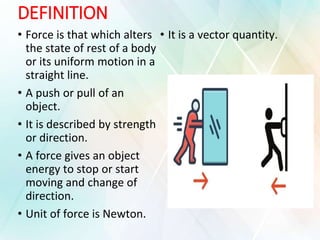
• Force is that which alters
the state of rest of a body
or its uniform motion in a
straight line.
• A push or pull of an
object.
• It is described by strength
or direction.
• A force gives an object
energy to stop or start
moving and change of
direction.
• Unit of force is Newton.
• It is a vector quantity.
COMPOSITION OF FORCE
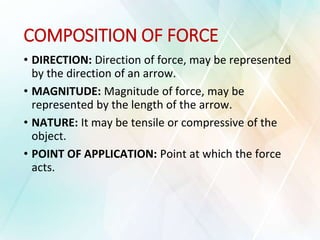
• DIRECTION: Direction of force, may be represented
by the direction of an arrow.
• MAGNITUDE: Magnitude of force, may be
represented by the length of the arrow.
• NATURE: It may be tensile or compressive of the
object.
• POINT OF APPLICATION: Point at which the force
acts.
TYPES OF FORCE
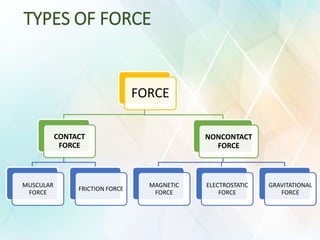
FORCE
CONTACT
FORCE
MUSCULAR
FORCE
FRICTION FORCE
NONCONTACT
FORCE
MAGNETIC
FORCE
ELECTROSTATIC
FORCE
GRAVITATIONAL
FORCE
CONTACT FORCE
MUSCULAR FORCE:
Force resulting due to the action of muscles is
called muscular force. Eg.., pushing a load requires
muscular force.
FRICTION FORCE:
Frictional force always acts in the direction
opposite to the applied force. Eg., cycling
The force that moves or attempts to move one
object on another is known as shear force.
NON-CONTACT FORCE
MAGNETIC FORCE:
The force which arise due to attraction or
repulsion between the poles of magnet is called
magnetic force.
ELECTROSTATIC FORCE:
The attractive or repulsive force arising due to
non moving charges present in the body is called
electrostatic force.
GRAVITATIONAL FORCE:
Any falling object is attracted towards earth is
called gravitational force or force of gravity.
CLASSIFICATION OF FORCE
CONCURRENT FORCE
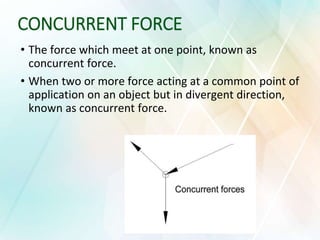
• The force which meet at one point, known as
concurrent force.
• When two or more force acting at a common point of
application on an object but in divergent direction,
known as concurrent force.
COPLANAR FORCE
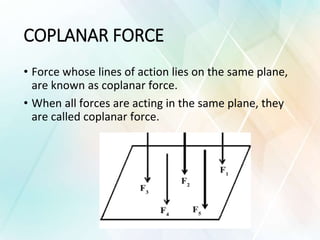
• Force whose lines of action lies on the same plane,
are known as coplanar force.
• When all forces are acting in the same plane, they
are called coplanar force.
COLLINEAR FORCE
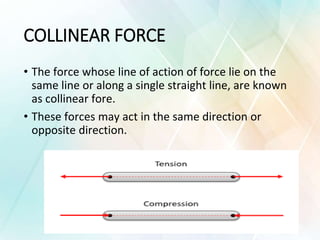
• The force whose line of action of force lie on the
same line or along a single straight line, are known
as collinear fore.
• These forces may act in the same direction or
opposite direction.
RESOLUTION OF FORCE
• The process of splitting up the given force into a
number of components, without changing its effect
on the body is called resolution of force.
• A force is generally resolved along two mutually
perpendicular directions.
ANGLE OF PULL OF MUSCLE
• Angle of force may be resolved into a vertical and a
horizontal component. Size of each depends on
angle of pull changes with every degree of joint
motion.
• Example :
The patella creates a larger moment arm (the
perpendicular distance from the line of action to the
axis of the joint). It allows joint to
rotary/angular/movement force.
The quads would be redirected towards the
joint.
DEFINITION
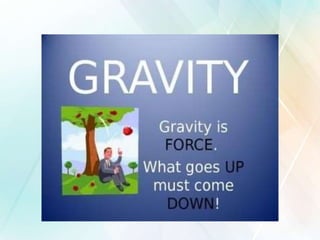
• Gravity is the force by which all bodies are attracted to
the earth.
• The force of attraction existed between all material
objects, and the magnitude of this attraction was
directly proportional to the mass of each body and
inversely proportional to the square of the distance
between them.
• The force of gravity acts continuously upon the human
body, and if unopposed the latter will fall to the
ground.
CENTER OF GRAVITY
• The center of gravity of a rigid body is the point
through which the earth’s attraction effectively acts
whatever the position of the body.
• COG is an imaginary point that the body weight can
be assumed to be concentrated and equally
distributed around which body can rotate freely in
all direction.
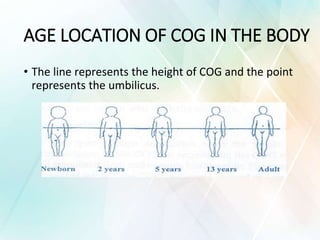
AGE LOCATION OF COG IN THE BODY
• The line represents the height of COG and the point
represents the umbilicus.
• The COG in males is higher than in female and children
because of the greater amount of weight they carry in
the upper half of the body.
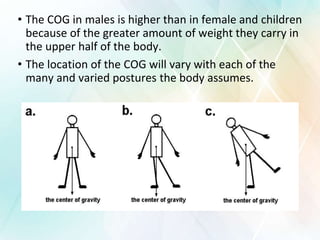
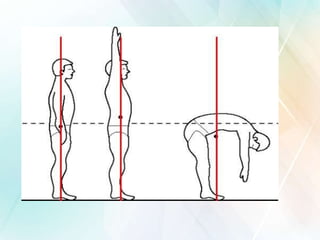
• The location of the COG will vary with each of the
many and varied postures the body assumes.
LINE OF GRAVITY
• Line of gravity is the vertical line that passes
through the COG to the ground.
• The LOG is important when determining stability.
• If LOG falls within the object/person base of
support the object is relatively stable.
• If the LOG falls outside the object/person base of
support the object.
force.pptx
force.pptx

force.pptx

  • 1.
  • 2.
    DEFINITION • Force isthat which alters the state of rest of a body or its uniform motion in a straight line. • A push or pull of an object. • It is described by strength or direction. • A force gives an object energy to stop or start moving and change of direction. • Unit of force is Newton. • It is a vector quantity.
  • 3.
    COMPOSITION OF FORCE •DIRECTION: Direction of force, may be represented by the direction of an arrow. • MAGNITUDE: Magnitude of force, may be represented by the length of the arrow. • NATURE: It may be tensile or compressive of the object. • POINT OF APPLICATION: Point at which the force acts.
  • 4.
    TYPES OF FORCE FORCE CONTACT FORCE MUSCULAR FORCE FRICTIONFORCE NONCONTACT FORCE MAGNETIC FORCE ELECTROSTATIC FORCE GRAVITATIONAL FORCE
  • 5.
    CONTACT FORCE MUSCULAR FORCE: Forceresulting due to the action of muscles is called muscular force. Eg.., pushing a load requires muscular force. FRICTION FORCE: Frictional force always acts in the direction opposite to the applied force. Eg., cycling The force that moves or attempts to move one object on another is known as shear force.
  • 6.
    NON-CONTACT FORCE MAGNETIC FORCE: Theforce which arise due to attraction or repulsion between the poles of magnet is called magnetic force. ELECTROSTATIC FORCE: The attractive or repulsive force arising due to non moving charges present in the body is called electrostatic force. GRAVITATIONAL FORCE: Any falling object is attracted towards earth is called gravitational force or force of gravity.
  • 7.
  • 8.
    CONCURRENT FORCE • Theforce which meet at one point, known as concurrent force. • When two or more force acting at a common point of application on an object but in divergent direction, known as concurrent force.
  • 9.
    COPLANAR FORCE • Forcewhose lines of action lies on the same plane, are known as coplanar force. • When all forces are acting in the same plane, they are called coplanar force.
  • 10.
    COLLINEAR FORCE • Theforce whose line of action of force lie on the same line or along a single straight line, are known as collinear fore. • These forces may act in the same direction or opposite direction.
  • 11.
    RESOLUTION OF FORCE •The process of splitting up the given force into a number of components, without changing its effect on the body is called resolution of force. • A force is generally resolved along two mutually perpendicular directions.
  • 12.
    ANGLE OF PULLOF MUSCLE • Angle of force may be resolved into a vertical and a horizontal component. Size of each depends on angle of pull changes with every degree of joint motion. • Example : The patella creates a larger moment arm (the perpendicular distance from the line of action to the axis of the joint). It allows joint to rotary/angular/movement force. The quads would be redirected towards the joint.
  • 14.
    DEFINITION • Gravity isthe force by which all bodies are attracted to the earth. • The force of attraction existed between all material objects, and the magnitude of this attraction was directly proportional to the mass of each body and inversely proportional to the square of the distance between them. • The force of gravity acts continuously upon the human body, and if unopposed the latter will fall to the ground.
  • 15.
    CENTER OF GRAVITY •The center of gravity of a rigid body is the point through which the earth’s attraction effectively acts whatever the position of the body. • COG is an imaginary point that the body weight can be assumed to be concentrated and equally distributed around which body can rotate freely in all direction.
  • 16.
    AGE LOCATION OFCOG IN THE BODY • The line represents the height of COG and the point represents the umbilicus.
  • 17.
    • The COGin males is higher than in female and children because of the greater amount of weight they carry in the upper half of the body. • The location of the COG will vary with each of the many and varied postures the body assumes.
  • 18.
    LINE OF GRAVITY •Line of gravity is the vertical line that passes through the COG to the ground. • The LOG is important when determining stability. • If LOG falls within the object/person base of support the object is relatively stable. • If the LOG falls outside the object/person base of support the object.