1
Fundamental of Nursing
Body Mechanics, Positioning &
Moving
Dr; mosa alfageh
• Define mobility , immobility
• Identify factors that effect a person's mobility
• Mention advantages of using proper body mechanics
• Demonstrate principles of body mechanics
• Describe laws of gravity that govern body balance
• Apply body mechanics rules
• Identify techniques of body mechanics used when performing work
• Classification of exercise
• Benefits of exercise
• Define bed sore
• Etiology of bedsore
• Risk factors for development of bedsore
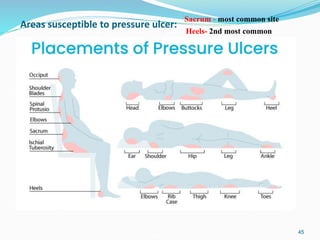
• Areas susceptible to bedsore
• Pressure ulcer staging
• Nursing care of bedsore and how to prevent it
• Purpose of patient positions
• Criteria for all patients positions
• Common position
Mobility
is a person's ability to perform activities of daily living (ADLs) job-related
activities.
Normal mobility:-
The musculoskeletal system is the supporting framework for the body. The
bone & the muscles are involved in movement & are responsible for the body's
form & shape. Central & peripheral nerves coordinate movement's complex
activity.
4
Normal physiologic function:-
1- Alignment & posture:
Maintaining up right posture requires alignment of the bones & joints & stable
center of gravity.
2- Balance :
Maintaining balance is a complex function of counteracting gravity & reflexes
to maintain posture . If person begins to fall to one side , the extensor muscles
on that side stiffens . Whereas the extensor muscles on the opposite side relax
to prevent the fall .
5
3. Coordinated movement
The cerebellum , cerebral cortex and
basal ganglia are responsible for the
central of motor functions
The cerebellum coordinates the motor
activity of movement ,
the cerebral initiates voluntary motor
activity &
basal ganglia maintain posture
Factors effecting mobility
1) Growth and development
A person’s age and musculoskeletal and nervous system development affect
posture.
2) Nutrition
Both undernutrition and overnutrition can influence body alignment and
mobility. Poorly nourished people may have muscle weakness and fatigue.
 Vitamin D deficiency causes bone deformity during growth.
 Inadequate calcium intake and vitamin D synthesis and intake increase
the risk of osteoporosis.
6
3) Muscular, Skeletal, or Nervous System Problems :
Problems with the musculoskeletal or nervous systems may involve one or
more of the following health issues
.1) CONGENITAL OR ACQUIRED POSTURALABNORMALITIES
A newborn with developmental clubfoot, older person with kyphosis are
experiencing postural abnormalities that affect their appearance and mobility.
2) PROBLEMS WITH BONE FORMATION OR MUSCLE DEVELOPMENT
Problems with bone formation may include any of the following: Congenital
problems, such as achondroplasia.
3) PROBLEMS AFFECTING JOINT MOBILITY
Inflammation and trauma can all interfere with joint mobility e.g. arthritis.
4) TRAUMA TO THE MUSCULOSKELETAL SYSTEM
Injury to the musculoskeletal system can result in fractures and soft tissue
injuries e.g. fracture and dislocations.
5) PROBLEMS AFFECTING THE CENTRAL NERVOUS SYSTEM:
A problem in any of the principal parts of the brain or spinal cord involved
with skeletal muscle control can affect mobility. A cerebrovascular accident
(stroke) 7
Factors effecting mobility
4) Problems Involving Other Body Systems
The pathology of numerous other acute and chronic illnesses may also affect
mobility. Chronic obstructive lung disease and conditions such as ascites may
alter posture.
5) Life style & habits:
Regular exercise& optimal nutrition are essential to maintain Mobility &
musculoskeletal functioning .
6) Therapeutic modalities:
Sometimes limited movement is the treatment for a medical problem.
Restrictive devices, such as casts can mobilize cretin areas of the body to
promote healing.
Bed rest is another treatment whereby mobility is restricted for therapeutic
benefits. A client may be placed on bed rest for the following reasons:
 To reduce the body's oxygen requirements.
 To decrease pain.
 To support a weak, exhausted, or febrile client.
 To avoid dislodging a deep vein thrombosis. 8
Factors effecting mobility
 Mobility:
is a person's ability to perform activities of daily living (ADLs) job-
related activities.
 Immobility:
is a person's usability to perform activities of daily living (ADLs)
job-related
9
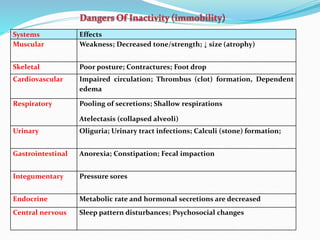
Systems Effects
Muscular Weakness; Decreased tone/strength; ↓ size (atrophy)
Skeletal Poor posture; Contractures; Foot drop
Cardiovascular Impaired circulation; Thrombus (clot) formation, Dependent
edema
Respiratory Pooling of secretions; Shallow respirations
Atelectasis (collapsed alveoli)
Urinary Oliguria; Urinary tract infections; Calculi (stone) formation;
Gastrointestinal Anorexia; Constipation; Fecal impaction
Integumentary Pressure sores
Endocrine Metabolic rate and hormonal secretions are decreased
Central nervous Sleep pattern disturbances; Psychosocial changes
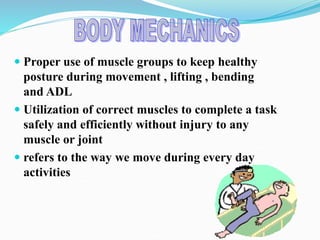
 Proper use of muscle groups to keep healthy
posture during movement , lifting , bending
and ADL
 Utilization of correct muscles to complete a task
safely and efficiently without injury to any
muscle or joint
 refers to the way we move during every day
activities
12
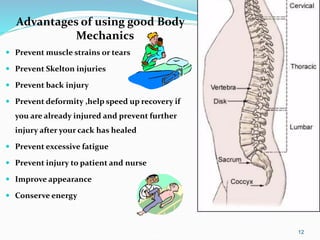
Advantages of using good Body
Mechanics
 Prevent muscle strains or tears
 Prevent Skelton injuries
 Prevent back injury
 Prevent deformity ,help speed up recovery if
you are already injured and prevent further
injury after your cack has healed
 Prevent excessive fatigue
 Prevent injury to patient and nurse
 Improve appearance
 Conserve energy
13
Laws of gravity that govern body
balance
1. Center of the gravity
2. Line of the gravity
3. Base of support
14
1. Center of gravity
• Is the point at which all body mass is centered
• The person's of gravity located in the pelvic area.
This means that approximately half the body
weight is distributed above this area , half below
it . When thinking of the body divided
horizontally
• In addition , half the body weight is to each side ,
when thinking the body divided vertically
• When lifting an object , bend at knees and hips ,
and keep the back straight by doing so , giving
extra stability . And maintain balance
15
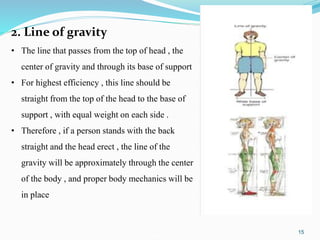
2. Line of gravity
• The line that passes from the top of head , the
center of gravity and through its base of support
• For highest efficiency , this line should be
straight from the top of the head to the base of
support , with equal weight on each side .
• Therefore , if a person stands with the back
straight and the head erect , the line of the
gravity will be approximately through the center
of the body , and proper body mechanics will be
in place
16
3. Base of support
• A person's feet provide the base of support .
• Feet apart providing stability (1.5 time
length of shoes ) the greater the support
base the more stability the person for
changing position
Proper standing?
18
Maintain a stable center of
gravity
• Keep your center of gravity
low
• Keep your back straight
Maintain a wide base of
support. This will provide you
with maximum stability while
lifting
• Keep your feet apart
• Place one foot slightly ahead of
the other
• Flex your knees
• Turn with your feet
Maintain the line of gravity . The line
of gravity should pass vertically
through the base of support
• Keep your back straight
• Keep the object being lifted close
to your body
Principles of body mechanics
19
1. Maintain a broad base of support
2. Bend at the hips and knees to get close to the person or
object
3. Use the strongest muscles
4. Use your body weight to help push, or pull
5. Carry heavy objects close to the body
6. Avoid twisting the body
7. Avoid bending for extended periods
8. Get help if the person or object is too heavy for you to
lift
Body Mechanics Rules (8):
20
1- Maintain a broad base of support
(feet 8-10 inches apart (1.5 time length of shoes ) ,
one foot slightly forward, weight balanced on
both feet and pointing toes in the direction of
movement)
Body Mechanics Rules (8):
21
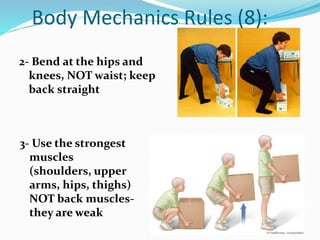
2- Bend at the hips and
knees, NOT waist; keep
back straight
3- Use the strongest
muscles
(shoulders, upper
arms, hips, thighs)
NOT back muscles-
they are weak
Body Mechanics Rules (8):
22
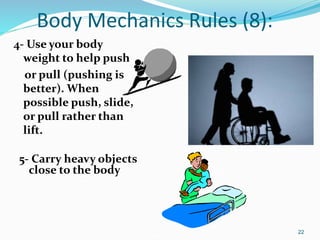
4- Use your body
weight to help push
or pull (pushing is
better). When
possible push, slide,
or pull rather than
lift.
5- Carry heavy objects
close to the body
Body Mechanics Rules (8):
23
6- Avoid twisting the body
7- Avoid bending for
extended periods
8- Get help if the
person or object is
too heavy for you to
lift
Body Mechanics Rules (8):
24
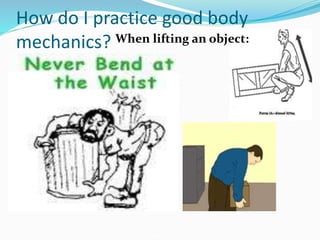
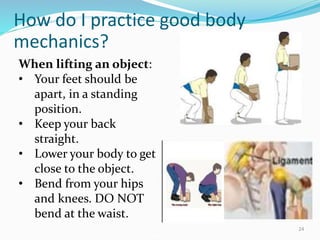
When lifting an object:
• Your feet should be
apart, in a standing
position.
• Keep your back
straight.
• Lower your body to get
close to the object.
• Bend from your hips
and knees. DO NOT
bend at the waist.
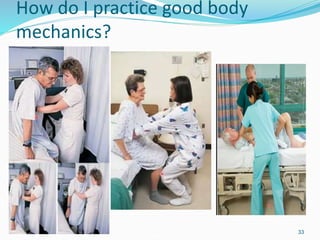
How do I practice good body
mechanics?
How do I practice good body
mechanics?
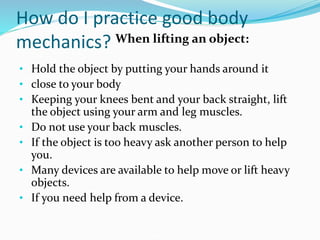
• Hold the object by putting your hands around it
• close to your body
• Keeping your knees bent and your back straight, lift
the object using your arm and leg muscles.
• Do not use your back muscles.
• If the object is too heavy ask another person to help
you.
• Many devices are available to help move or lift heavy
objects.
• If you need help from a device.
When lifting an object:
How do I practice good body
mechanics? When lifting an object:
How do I practice good body
mechanics? When lifting an object:
How do I practice good body
mechanics?
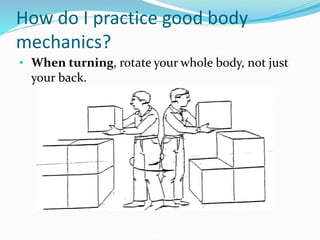
• When turning, rotate your whole body, not just
your back.
How do I practice good body
mechanics?
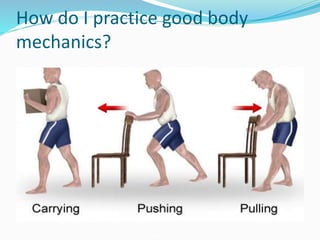
 Pushing or pulling:
• Use the weight of your body to help push or pull
an object.
• Your feet should be apart as in the standing
position.
• Keep your back straight.
• Lower your body to get close to the object. Bend
from your hips and knees.
• DO NOT bend at the waist.
• If the object or person you are pulling or pushing
is too heavy ask someone to help you.
How do I practice good body
mechanics?
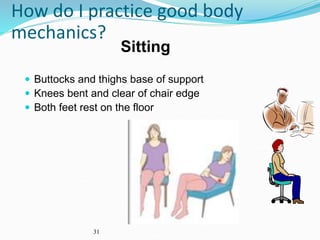
31
Sitting
 Buttocks and thighs base of support
 Knees bent and clear of chair edge
 Both feet rest on the floor
How do I practice good body
mechanics?
How do I practice good body
mechanics?
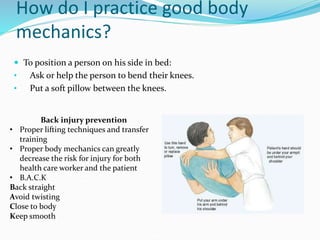
 To position a person on his side in bed:
• Ask or help the person to bend their knees.
• Put a soft pillow between the knees.
Back injury prevention
• Proper lifting techniques and transfer
training
• Proper body mechanics can greatly
decrease the risk for injury for both
health care worker and the patient
• B.A.C.K
Back straight
Avoid twisting
Close to body
Keep smooth
33
How do I practice good body
mechanics?
Types of exercise:
Exercise may be classified by the
 source of energy (aerobic & anaerobic)
 type of muscle tension (isotonic & isometric)
 Aerobic exercise: Require oxygen to use the energy provided by metabolic activities of
skeletal muscles. Vigorous, continuous muscle movement (as in walking, running, cycling) is
aerobic exercise when the person's heart rate is high enough to promote cardiovascular
conditioning.
 Anaerobic exercise: Occurs when the muscle cannot extract enough oxygen from the
blood & anaerobic pathways provide additional energy for a short time. This type of exercise is
useful in athletic endurance training. All endurance exercise can become anaerobic when
oxygen sources are deleted.
 Isotonic exercise: Is a dynamic form of exercise with constant muscle tension, muscle
contraction, & active movement. Most activities (e.g., walking running, performing ADLs) are
isotonic.
 Isometric exercise: static exercise in which the muscle undergoes tension contraction
but no change in length & no joint movement. Examples of Isometric exercise are quadriceps
muscle, maintaining strength in immobilized muscles (cast, traction) .
34
Benefits of exercise:
1. Strength the muscles, & promote joints mobility.
2. Increasing lung capacity.
3. Risk for atherosclerosis decrease.
4. Prevent constipation.
5. Enhance appetite & improve sleep quality.
6. Exercise contributes to a feeling of well-being
because activity increase circulation, promote tension
& stress release.
7. Weight loss.
35
36
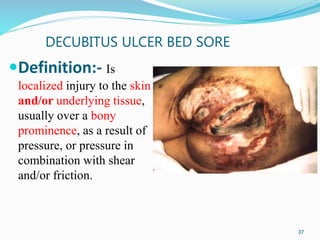
Definition:- Is
localized injury to the skin
and/or underlying tissue,
usually over a bony
prominence, as a result of
pressure, or pressure in
combination with shear
and/or friction.
37
DECUBITUS ULCER BED SORE
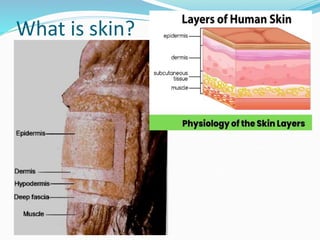
What is skin?
DECUBITUS ULCER (BED
SORE)
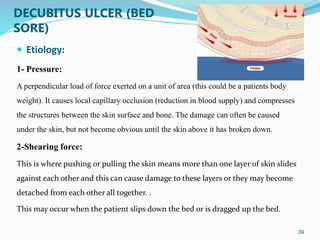
 Etiology:
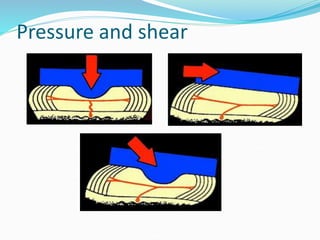
1- Pressure:
A perpendicular load of force exerted on a unit of area (this could be a patients body
weight). It causes local capillary occlusion (reduction in blood supply) and compresses
the structures between the skin surface and bone. The damage can often be caused
under the skin, but not become obvious until the skin above it has broken down.
2-Shearing force:
This is where pushing or pulling the skin means more than one layer of skin slides
against each other and this can cause damage to these layers or they may become
detached from each other all together. .
This may occur when the patient slips down the bed or is dragged up the bed.
39
40
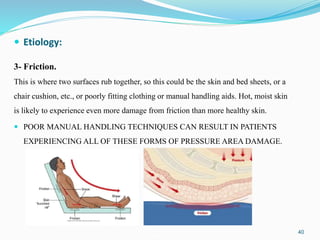
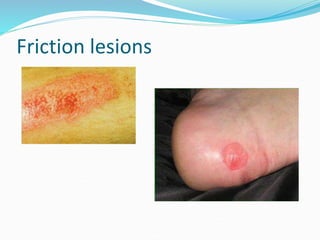
3- Friction.
This is where two surfaces rub together, so this could be the skin and bed sheets, or a
chair cushion, etc., or poorly fitting clothing or manual handling aids. Hot, moist skin
is likely to experience even more damage from friction than more healthy skin.
 POOR MANUAL HANDLING TECHNIQUES CAN RESULT IN PATIENTS
EXPERIENCING ALL OF THESE FORMS OF PRESSURE AREA DAMAGE.
 Etiology:
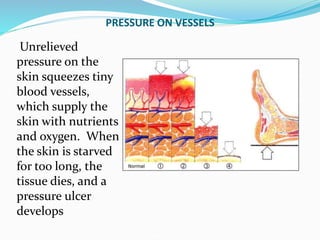
PRESSURE ON VESSELS
Unrelieved
pressure on the
skin squeezes tiny
blood vessels,
which supply the
skin with nutrients
and oxygen. When
the skin is starved
for too long, the
tissue dies, and a
pressure ulcer
develops
Pressure and shear
Friction lesions
Risk factor for developmental of pressure ulcer:
 Prolonged pressure on the tissue.
 Friction, shearing forces, trauma.
 Incontinence of urine or feces.
 Altered skin moisture:- Excessively dry, excessively moisture.
 Immobility
 Loss of protective reflexes, sensory deficit/ loss.
 Poor skin perfusion, edema.
 Malnutrition, Hypoproteinemia, anemia, vitamin deficiency.
 Advanced age, debilitation.
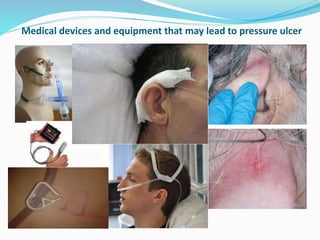
 Equipment: - Casts, traction, restraints, and chair
 Drugs that effect mobility for Ex, Sedatives
44
Areas susceptible to pressure ulcer:
45
Sacrum - most common site
Heels- 2nd most common
Medical devices and equipment that may lead to pressure ulcer
47
STAGE 1: Non-blanchable
erythema of intact skin
(EPIDERMIS)
Skin is intact and shows a non
blanchable, localized redness over a
bony prominence. Redness remains
after pressure is released.
Signs and symptoms may include pain,
(firm or soft) , (warm or cool )
compared to adjacent tissue.
STAGE 3: Full thickness tissue loss
Skin break with deep tissue involvement
down to subcutaneous layer..
Subcutaneous fat may be visible.
Bone, tendon or muscle is not exposed.
Slough may be present but does not
obscure the depth of tissue loss.
undermining and tunneling may be
present.
STAGE 2: partial thickness skin loss.
involving epidermis, dermis, or both. The ulcer
is superficial and presents as an abrasion or
blister.
Presents as a shiny or dry shallow ulcer
without slough or bruising.
This stage should not be used to describe skin
tears, tape burns, perineal dermatitis, .
Pressure Ulcer Staging
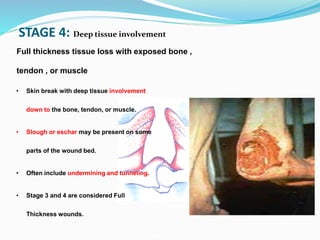
STAGE 4: Full thickness tissue loss with
exposed bone , tendon , or muscle
Skin break with deep tissue involvement
down to the bone, tendon, or muscle.
Slough or eschar may be present on some
parts of the wound bed.
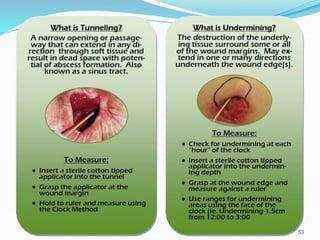
Often include undermining and tunneling.
Stage 3 and 4 are considered Full Thickness
wounds.
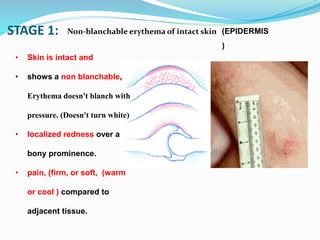
STAGE 1: Non-blanchable erythema of intact skin
• Skin is intact and
• shows a non blanchable,
Erythema doesn't blanch with
pressure. (Doesn't turn white)
• localized redness over a
bony prominence.
• pain, (firm, or soft, (warm
or cool ) compared to
adjacent tissue.
(EPIDERMIS
)
STAGE 2: partial thickness skin loss.
• involving epidermis, dermis,
or both. The ulcer is
superficial and presents as
an abrasion or
blister.
• Presents as a shiny or dry
shallow ulcer without
slough or bruising.
• This stage should not be
used to describe skin tears,
tape burns, perineal
dermatitis, .
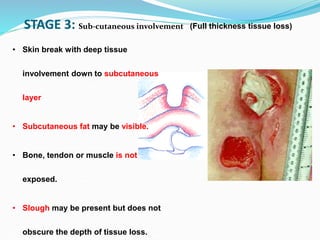
STAGE 3: Sub-cutaneous involvement
• Skin break with deep tissue
involvement down to subcutaneous
layer
• Subcutaneous fat may be visible.
• Bone, tendon or muscle is not
exposed.
• Slough may be present but does not
obscure the depth of tissue loss.
(Full thickness tissue loss)
STAGE 4: Deep tissue involvement
• Skin break with deep tissue involvement
down to the bone, tendon, or muscle.
• Slough or eschar may be present on some
parts of the wound bed.
• Often include undermining and tunneling.
• Stage 3 and 4 are considered Full
Thickness wounds.
Full thickness tissue loss with exposed bone ,
tendon , or muscle
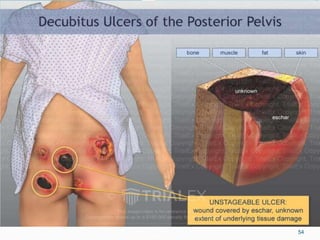
Terminology
Eschar Slough
Types of necrotic tissue
53
54
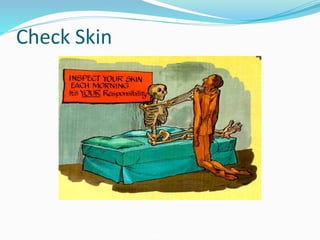
Check Skin
Assessment
In assessing the patient for potential risk for present ulcer development,
the nurses assess:
1. Assess total skin condition at least twice a day.
2. Inspect each pressure site for erythema.
3. Assess areas of erythema for blanching response.
4. Inspect for dry skin, moist, breaks in skin.
5. Evaluates level of mobility.
6. Evaluates circulatory status (peripheral pulse, Edema).
7. Assess neurologic status.
8. Determines presence of Incontinence
9. Evaluates nutritional & dehydration status.
10. Reviews the patients recorded for hematocrit, hemoglobin & blood chemistry (serum Albumin
values).
11. Notes present health problems.
56
Nursing intervention:
1- Maintain skin intact:
 Avoid massage of bony prominence.
 No breaks in skin.
2-Avoid pressure of bony prominence:
 Change position every 1 to 2 hours.
 Uses especial equipment as appropriate.
 Raises self from wheelchair every 15 min.
3-Increase Mobility:
 perform range of motion exercise.
 Adheres to turning schedule.
 Improve nutritional status.
 Demonstrates behaviors to prevent new pressure ulcer
57
Nursing intervention
4- Demonstrates improving tissue perfusion:
 Exercise to increase circulation.
 Elevates body parts such as acceptable to edema.
5-Maintain adequate nutrition status:
 Consumes balanced diet high in protein & vitamin C.
 Hemoglobin & Albumin level maintained at acceptable level
6- Maintain clean & dry skin:
 Avoid prolonged contact with water solid surfaces.
 Keep skin clean & dry.
 Uses lotion to keep skin lubricated.
 Diapers should be used with incontinent patients.
7-Experience healing of pressure ulcer:
 Avoid pressure on area
58
Nursing intervention according to stages:
Stage I pressure ulcer.
 The pressure is removed to permit increased tissue perfusion.
 Improved nutritional, fluid & electrolyte status.
 Reduction of friction & shearing forces.
 Avoidance of moisture to the skin.
 The reddened skin MUST NOT MASSAGE as increased tissue damage may result.
Stage II pressure ulcer
 Same nursing intervention for stage I.
 The ulcer gently cleansed with sterile saline solution.
 Use antiseptic solution which damage healthy tissue & delay wound healing IS AVOIDED.
 Semi permeable occlusion dressing in healing by minimizing the loss of fluids & proteins for
the body.
59
Nursing intervention according to stages:
*Stage III & IV]
 Clean & debrided the necrotic tissue.
 The nurse must prepare the patient for dressing & explain the procedure &
administer analgesia as prescribed when needed.
 After pressure ulcer is clean topical treatment is prescribed. The goal of
therapy is promote granulation; new granulation must be protected from
reinfection & damage.
.Care should be taken to prevent pressure & further trauma to areas, solution to
ulcer should not disrupt the healing processes
60
Surgical intervention:
Surgical intervention is necessary when
 the ulcer is extensive
 when potential complications such (fistula) exist
 when the ulcer doesn't response to treatment.
Surgical procedure as :
 Debridement.
 Skin graft.
61
62
Patient Positions
Patient position is a therapeutic intervention which the client repositioning in
the bed. Clients cannot always move independently and reposition themselves
in bed. Clients who cannot move independently must be repositioned every 2
hours. Repositioning must be done more often for clients who are
uncomfortable or incontinent, or who have fragile skin, poor circulation,
decreased sensation, poor nutritional status, or impaired mental status.
Purposes of patient reposition:
1. Prevent contractures.
2. Prevent pressure sores.
3. Make parts of the client's body available for treatment or procedures
4. Facilitate client's recovery e.g. postural drainage..
63
Criteria for all patients positions:
1. Provide patient privacy
2. Body alignment maintained
3. No direct contact with metal or hard surfaces
4. All body parts supported
5. Circulation maximized in all extremities
6. Pressure points padded
7. Areas of nerve compression padded
8. Respiratory expansion maximized
9. Operative site accessible
10.Avoid unnecessary hypothermia
64
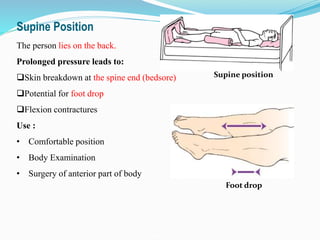
Supine Position
The person lies on the back.
Prolonged pressure leads to:
Skin breakdown at the spine end (bedsore)
Potential for foot drop
Flexion contractures
Use :
• Comfortable position
• Body Examination
• Surgery of anterior part of body
Foot drop
Supine position
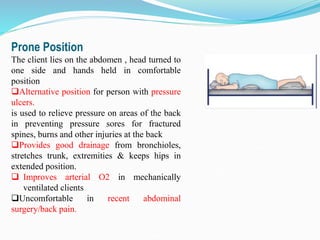
Prone Position
The client lies on the abdomen , head turned to
one side and hands held in comfortable
position
Alternative position for person with pressure
ulcers.
is used to relieve pressure on areas of the back
in preventing pressure sores for fractured
spines, burns and other injuries at the back
Provides good drainage from bronchioles,
stretches trunk, extremities & keeps hips in
extended position.
 Improves arterial O2 in mechanically
ventilated clients
Uncomfortable in recent abdominal
surgery/back pain.
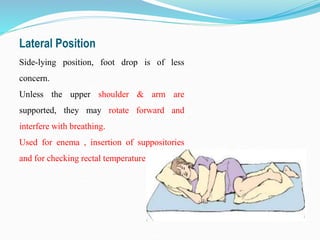
Lateral Position
Side-lying position, foot drop is of less
concern.
Unless the upper shoulder & arm are
supported, they may rotate forward and
interfere with breathing.
Used for enema , insertion of suppositories
and for checking rectal temperature
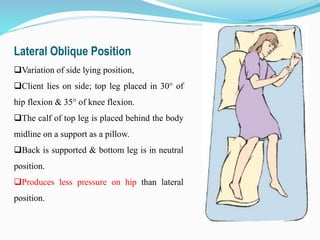
Lateral Oblique Position
Variation of side lying position,
Client lies on side; top leg placed in 30° of
hip flexion & 35° of knee flexion.
The calf of top leg is placed behind the body
midline on a support as a pillow.
Back is supported & bottom leg is in neutral
position.
Produces less pressure on hip than lateral
position.
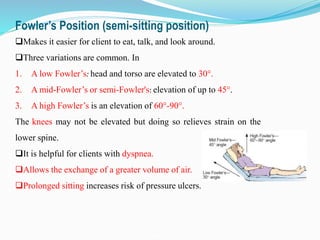
Fowler’s Position (semi-sitting position)
Makes it easier for client to eat, talk, and look around.
Three variations are common. In
1. A low Fowler’s: head and torso are elevated to 30°.
2. A mid-Fowler’s or semi-Fowler's: elevation of up to 45°.
3. A high Fowler’s is an elevation of 60°-90°.
The knees may not be elevated but doing so relieves strain on the
lower spine.
It is helpful for clients with dyspnea.
Allows the exchange of a greater volume of air.
Prolonged sitting increases risk of pressure ulcers.
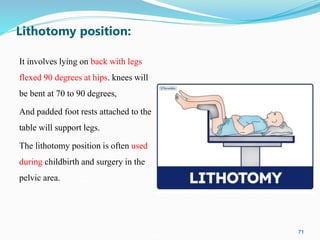
Lithotomy position:
It involves lying on back with legs
flexed 90 degrees at hips. knees will
be bent at 70 to 90 degrees,
And padded foot rests attached to the
table will support legs.
The lithotomy position is often used
during childbirth and surgery in the
pelvic area.
71
72