STATIC EQUILIBRIUM
Equilibrium
OBJECTIVES:
•To explain equilibrium
•To identify the two conditions of
equilibrium
WHAT IS EQUILIBRIUM?
IN CHEMISTRY:
• Equilibrium happens when a chemical reaction
does not convert all reactants to products: many
reactions reach a state of balance or dynamic
equilibrium in which both reactants and products
are present.
• A condition in which all influences acting cancel each other, so that a static or
balanced situation results. In physics, equilibrium results from the cancellation of
forces acting on an object.
• A condition in which all influences acting cancel each other, so that a static or
balanced situation results. In physics, equilibrium results from the cancellation of
forces acting on an object.
• A condition in which all influences acting cancel each other, so that a static or
balanced situation results. In physics, equilibrium results from the cancellation of
forces acting on an object.
• A condition in which all influences acting cancel each other, so that a static or
balanced situation results. In physics, equilibrium results from the cancellation of
forces acting on an object.
•The word equilibrium means balance.
There are three types/states of equilibrium:
stable, unstable, and neutral.
• A system is said to be in stable equilibrium
if, when displaced from equilibrium, it
experiences a net force or torque in a
direction opposite to the direction of the
displacement.
• A paperweight on a desk is an example of static
equilibrium.
• Other examples include a rock balance sculpture,
or a stack of blocks in the game of Jenga, so long
as the sculpture or stack of blocks is not in the
state of collapsing.
• Objects in motion can also be in equilibrium.
STATIC EQUILIBRIUM
• A Static object is not moving- it has no linear velocity and no angular velocity.
• An object in static equilibrium has no linear acceleration no angular acceleration ,
no motion. It is at rest or stable.
For example , while you are reading a book, your head is not moving and it’s in
static equilibrium. Even though your head is not moving several interesting
biophysical things are going on, such as multitude of electrical signals is going into
the brain from your five senses, thoughts are racing through your brain as you think,
a multitude of signals leaving your brain to control your body, blood is flowing
through your brain supplying energy, and forces are pulling your head in different
directions so you can balance it on your neck and keep it in static equilibrium.
• Static equilibrium of biological systems is
composed of rigid bodies, meaning the object in
the biological system won’t break or deform under
forces acting on them.
…. For example , my kitchen table is a rigid body. If I
place food , plates, and kitchen utensils on the
table, these applied forces don’t change the table’s
shape.
•The rigid biological systems usually
consist of a combination of animals and
inorganic objects.
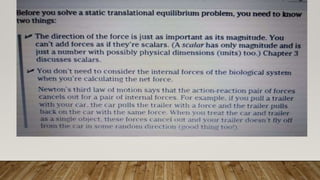
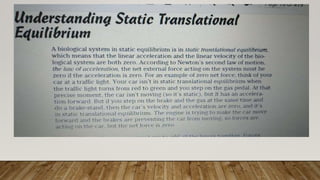
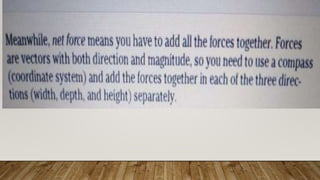
Static equilibrium means that a system is
stable and at rest. This means that the net
force must be zero – called translational
equilibrium. However, to be complete the net
torque must also be zero – called rotational
equilibrium. For complete static equilibrium,
both of these two conditions must be fulfilled.
•Static equilibrium can be split into static
translational equilibrium and static
rotational equilibrium.
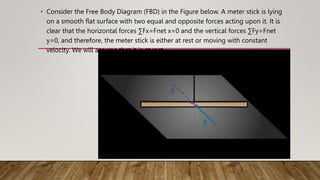
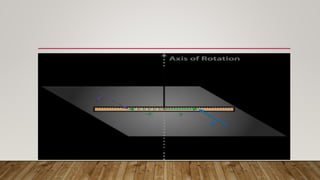
• Consider the Free Body Diagram (FBD) in the Figure below. A meter stick is lying
on a smooth flat surface with two equal and opposite forces acting upon it. It is
clear that the horizontal forces ∑Fx=Fnet x=0 and the vertical forces ∑Fy=Fnet
y=0, and therefore, the meter stick is either at rest or moving with constant
velocity. We will assume that it is at rest.
WE WILL NOW APPLY THE FORCES TO THE ENDS OF
THE METER STICK.
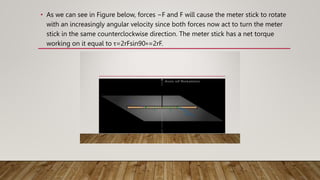
• As we can see in Figure below, forces −F and F will cause the meter stick to rotate
with an increasingly angular velocity since both forces now act to turn the meter
stick in the same counterclockwise direction. The meter stick has a net torque
working on it equal to τ=2rFsin90∘=2rF.
• It should be noted that just as an object in
translational equilibrium can be at rest or moving
with constant translational velocity, so too an
object in rotational equilibrium can be at rest or
rotating with constant angular velocity. Here,
though, we will concern ourselves only with the
special case of static equilibrium.
• Two conditions of equilibrium must be imposed to ensure than an object remains
in static equilibrium. Not only must the sum of all the forces acting upon the
object be zero, but the sum of all the torques acting upon the object must also be
zero. That is, both static translational and static rotational equilibrium conditions
must be satisfied.
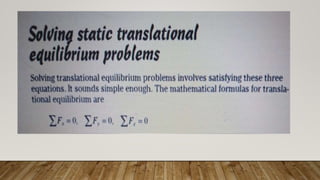
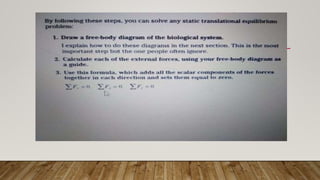
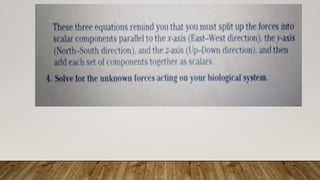
• Condition 1: ∑Fx=0,∑Fy=0, translational equilibrium
• Condition 2: ∑τ=0, rotational equilibrium
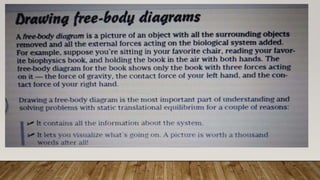
WHAT IS A FREE- BODY DIAGRAM?
• https://opentextbc.ca/universityphysicsv1openstax/chapter/12-1-conditions-for-
static-equilibrium/
• https://www.physicsclassroom.com/class/vectors/Lesson-3/Equilibrium-and-
Statics
• https://www.youtube.com/watch?v=1MFQxEdUCqk- TRANSLATIONAL
• https://www.youtube.com/watch?v=qGvFAl5CK_c - STATIC ( 1 HR +)
END OF THE PART 1

Static-Equilibrium topic for physics to learn

  • 1.
  • 2.
  • 3.
    OBJECTIVES: •To explain equilibrium •Toidentify the two conditions of equilibrium
  • 4.
  • 5.
    IN CHEMISTRY: • Equilibriumhappens when a chemical reaction does not convert all reactants to products: many reactions reach a state of balance or dynamic equilibrium in which both reactants and products are present.
  • 6.
    • A conditionin which all influences acting cancel each other, so that a static or balanced situation results. In physics, equilibrium results from the cancellation of forces acting on an object. • A condition in which all influences acting cancel each other, so that a static or balanced situation results. In physics, equilibrium results from the cancellation of forces acting on an object. • A condition in which all influences acting cancel each other, so that a static or balanced situation results. In physics, equilibrium results from the cancellation of forces acting on an object. • A condition in which all influences acting cancel each other, so that a static or balanced situation results. In physics, equilibrium results from the cancellation of forces acting on an object.
  • 7.
  • 8.
    There are threetypes/states of equilibrium: stable, unstable, and neutral. • A system is said to be in stable equilibrium if, when displaced from equilibrium, it experiences a net force or torque in a direction opposite to the direction of the displacement.
  • 9.
    • A paperweighton a desk is an example of static equilibrium. • Other examples include a rock balance sculpture, or a stack of blocks in the game of Jenga, so long as the sculpture or stack of blocks is not in the state of collapsing. • Objects in motion can also be in equilibrium.
  • 10.
  • 11.
    • A Staticobject is not moving- it has no linear velocity and no angular velocity. • An object in static equilibrium has no linear acceleration no angular acceleration , no motion. It is at rest or stable. For example , while you are reading a book, your head is not moving and it’s in static equilibrium. Even though your head is not moving several interesting biophysical things are going on, such as multitude of electrical signals is going into the brain from your five senses, thoughts are racing through your brain as you think, a multitude of signals leaving your brain to control your body, blood is flowing through your brain supplying energy, and forces are pulling your head in different directions so you can balance it on your neck and keep it in static equilibrium.
  • 12.
    • Static equilibriumof biological systems is composed of rigid bodies, meaning the object in the biological system won’t break or deform under forces acting on them. …. For example , my kitchen table is a rigid body. If I place food , plates, and kitchen utensils on the table, these applied forces don’t change the table’s shape.
  • 13.
    •The rigid biologicalsystems usually consist of a combination of animals and inorganic objects.
  • 14.
    Static equilibrium meansthat a system is stable and at rest. This means that the net force must be zero – called translational equilibrium. However, to be complete the net torque must also be zero – called rotational equilibrium. For complete static equilibrium, both of these two conditions must be fulfilled.
  • 15.
    •Static equilibrium canbe split into static translational equilibrium and static rotational equilibrium.
  • 18.
    • Consider theFree Body Diagram (FBD) in the Figure below. A meter stick is lying on a smooth flat surface with two equal and opposite forces acting upon it. It is clear that the horizontal forces ∑Fx=Fnet x=0 and the vertical forces ∑Fy=Fnet y=0, and therefore, the meter stick is either at rest or moving with constant velocity. We will assume that it is at rest.
  • 19.
    WE WILL NOWAPPLY THE FORCES TO THE ENDS OF THE METER STICK.
  • 21.
    • As wecan see in Figure below, forces −F and F will cause the meter stick to rotate with an increasingly angular velocity since both forces now act to turn the meter stick in the same counterclockwise direction. The meter stick has a net torque working on it equal to τ=2rFsin90∘=2rF.
  • 22.
    • It shouldbe noted that just as an object in translational equilibrium can be at rest or moving with constant translational velocity, so too an object in rotational equilibrium can be at rest or rotating with constant angular velocity. Here, though, we will concern ourselves only with the special case of static equilibrium.
  • 23.
    • Two conditionsof equilibrium must be imposed to ensure than an object remains in static equilibrium. Not only must the sum of all the forces acting upon the object be zero, but the sum of all the torques acting upon the object must also be zero. That is, both static translational and static rotational equilibrium conditions must be satisfied. • Condition 1: ∑Fx=0,∑Fy=0, translational equilibrium • Condition 2: ∑τ=0, rotational equilibrium
  • 28.
    WHAT IS AFREE- BODY DIAGRAM?
  • 30.
  • 31.
    END OF THEPART 1