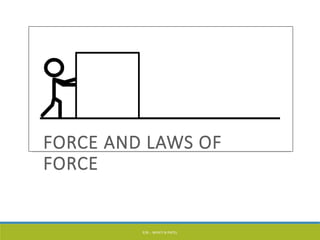
FORCE AND LAWS OF
FORCE
P/B :- NIYATI N PATEL
FORCE
oForce: It is a push or pull on an object that produces
acceleration in the body on which it acts.
oS.I. unit of force is Newton.
oForce has magnitude as well as direction vector
quantity
oNet force : the vector sum of all the forces acting on
the object
oA force can do three things on a body.
o (a) It can change the speed of a body.
o (b) It can change the direction of motion of a body.
o (c) It can change the shape of a body
P/B :- NIYATI N PATEL
Types of force
oBalanced forces: Forces are said to be balanced forces if they
nullify one another and their resultant force is zero.
oUnbalanced forces: When two opposite forces acting on a
body, move a body in the direction of the greater force or
forces which brings motion in a body are called as unbalanced
forces.
P/B :- NIYATI N PATEL
NEWTON’S LAW OF MOTION
oThree physical laws that form the basis for classical
mechanics
oThey describe the relationship between the force
acting on a body and its motion due to those forces
oThis 3 laws of motion were first given by sir issac
newton and first published on 5th july 1687
P/B :- NIYATI N PATEL
NEWTON’S FIRST LAW
oFirst law of motion: An object remains in a state of rest or
of uniform motion in a straight line unless acted upon by an
external unbalanced force.
oInertia: The natural tendency of an object to resist a
change in their state of rest or of uniform motion is called
inertia.
o - The mass of an object is a measure of its inertia.
o - S.I. unit is kg.
o - A body with greater mass has greater inertia.
oFrictional force: The force that always opposes the motion
of objects is called force of friction.
P/B :- NIYATI N PATEL
Example of 1st law
oWhen a train suddenly starts, the passengers
standing in the compartment tend to fall backward
oWhen we shake a mango tree, the mangoes fall
down
P/B :- NIYATI N PATEL
NEWTON’S SECOND LAW
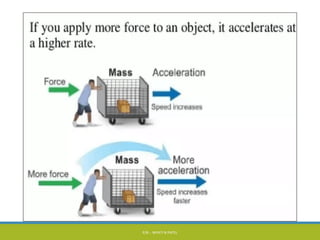
oSecond law of motion: The rate of change of momentum
of an object is proportional to the applied unbalanced force
in the direction of the force
o F = k ma (where k is a proportionality constant)
o F = ma
o (∵ k = 1, F=force, m=mass, a=acceleration)
o (m = 1 kg, a = 1m/s2)
o F=ma or a=F/m
o Its indicate that net force given on objects –> larger mass will have
smaller acceleration
P/B :- NIYATI N PATEL
oMomentum: The momentum of an object is the product of
its mass and velocity and has the same direction as that of
the velocity.
o - S.I. unit is kg m/s
o1 Newton: A force of one Newton produces an acceleration
of 1 m/s2 on an object of mass 1 kg.
o 1N = 1kg m/s2(F = ma)
P/B :- NIYATI N PATEL
NEWTON’S THIRD LAW
oThird law of motion: To every action, there is an equal and
opposite reaction and they act on two different bodies.
oAction and reactions are equal in magnitude but opposite
in direction
oExamples
oWalking: Ground force and body force
oRocket : Gas exert and expelling rocket
oGun : force exerted and bullet exerted
P/B :- NIYATI N PATEL
REACTION FORCE
oA reaction force is a force that acts in
the opposite direction to an action
force.
oFriction is the reaction force resulting
from surface interaction and adhesion
during sliding.
oReaction forces and reaction moment
are usually the result of the actions of
applied forces
P/B :- NIYATI N PATEL
TYPES OF MOTION
o The free movement of a body with respect to time is known as
motion
oAs per physics and mechanics, there are mainly 4 types of
motion, i.e.
o Rotary Motion: A special type of motion in which the object is on
rotation around a fixed axis like, a figure skater rotating on an ice rink.
o Oscillatory Motion: A repeating motion in which an object continuously
repeats in the same motion again and again like a swing.
o Linear Motion (Translatory): A one-dimensional motion on a straight
line, like an athlete running on a straight track.
o Reciprocating Motions: A repetitive and continuous up and down or
back and forth motion like a needle in a sewing machine.
P/B :- NIYATI N PATEL
oTypes of Motion as Per Directions are:
oOne Dimensional Motion
oTwo Dimensional Motion
oThree Dimensional Motion
P/B :- NIYATI N PATEL
ROTATIONAL MOTION
oRotational motion can be defined as
when an object moves along its axis
and all the parts of it move for a
different distance in a given period of
time.
oThus, if an object is under rotational
motion all of its parts will move
different distances in the same
interval of time.
oIf a single particle or a point mass
moves in a circle, it is called circular
motion
P/B :- NIYATI N PATEL
OSCILLATOARY MOTION
oOscillatory motion is simply elaborated as the
repeated motion that an object does by repeating
the same movement again and again.
oThe oscillatory motion would keep on moving
forever when there is an absence of friction but in
our real world, the motion eventually stops by
coming to equilibrium.
oIf the amplitude of oscillatory motion is extremely
small,the motion is called vibration motion
oSome of the best examples of Oscillatory Motion
are:
◦ The motion of a pendulum
◦ A boat tossing up and down a river
◦ The tuning fork
P/B :- NIYATI N PATEL
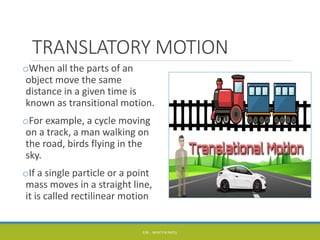
TRANSLATORY MOTION
oWhen all the parts of an
object move the same
distance in a given time is
known as transitional motion.
oFor example, a cycle moving
on a track, a man walking on
the road, birds flying in the
sky.
oIf a single particle or a point
mass moves in a straight line,
it is called rectilinear motion
P/B :- NIYATI N PATEL
FORCE OF GRAVITY
oGRAVITY: Gravity is a force by which all bodies are attracted to the
earth. (Between any two masses, any two bodies, any two particles)
oNewton concluded from experiments and observations that a force of
attraction existed between all material objects
oConsider two bodies of masses m1 and m2 that have a distance “r”
between their centers.
oAccording to newton’s law of gravitation, the magnitude of attraction
force (F) between the two bodies is
o F α m1 m2…..(1) F α 1/r2 …….(2)
o  F α m1 m2/r2 or F α G m1m2/r2 (G= Constant GF)
o SI Units – N m2 kg-2
P/B :- NIYATI N PATEL
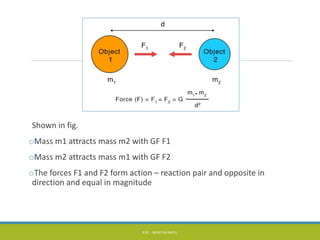
Shown in fig.
oMass m1 attracts mass m2 with GF F1
oMass m2 attracts mass m1 with GF F2
oThe forces F1 and F2 form action – reaction pair and opposite in
direction and equal in magnitude
P/B :- NIYATI N PATEL
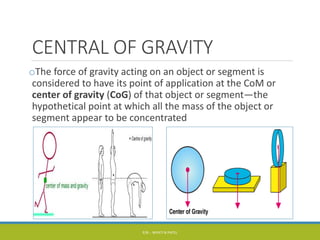
CENTRAL OF GRAVITY
oThe force of gravity acting on an object or segment is
considered to have its point of application at the CoM or
center of gravity (CoG) of that object or segment—the
hypothetical point at which all the mass of the object or
segment appear to be concentrated
P/B :- NIYATI N PATEL
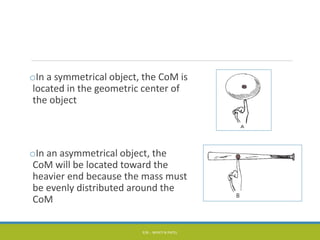
oIn a symmetrical object, the CoM is
located in the geometric center of
the object
oIn an asymmetrical object, the
CoM will be located toward the
heavier end because the mass must
be evenly distributed around the
CoM
P/B :- NIYATI N PATEL

1.Force (Biomedical Physics) (2).pdf

  • 1.
    FORCE AND LAWSOF FORCE P/B :- NIYATI N PATEL
  • 2.
    FORCE oForce: It isa push or pull on an object that produces acceleration in the body on which it acts. oS.I. unit of force is Newton. oForce has magnitude as well as direction vector quantity oNet force : the vector sum of all the forces acting on the object oA force can do three things on a body. o (a) It can change the speed of a body. o (b) It can change the direction of motion of a body. o (c) It can change the shape of a body P/B :- NIYATI N PATEL
  • 3.
    Types of force oBalancedforces: Forces are said to be balanced forces if they nullify one another and their resultant force is zero. oUnbalanced forces: When two opposite forces acting on a body, move a body in the direction of the greater force or forces which brings motion in a body are called as unbalanced forces. P/B :- NIYATI N PATEL
  • 4.
  • 5.
    NEWTON’S LAW OFMOTION oThree physical laws that form the basis for classical mechanics oThey describe the relationship between the force acting on a body and its motion due to those forces oThis 3 laws of motion were first given by sir issac newton and first published on 5th july 1687 P/B :- NIYATI N PATEL
  • 6.
    NEWTON’S FIRST LAW oFirstlaw of motion: An object remains in a state of rest or of uniform motion in a straight line unless acted upon by an external unbalanced force. oInertia: The natural tendency of an object to resist a change in their state of rest or of uniform motion is called inertia. o - The mass of an object is a measure of its inertia. o - S.I. unit is kg. o - A body with greater mass has greater inertia. oFrictional force: The force that always opposes the motion of objects is called force of friction. P/B :- NIYATI N PATEL
  • 7.
  • 8.
    Example of 1stlaw oWhen a train suddenly starts, the passengers standing in the compartment tend to fall backward oWhen we shake a mango tree, the mangoes fall down P/B :- NIYATI N PATEL
  • 9.
    NEWTON’S SECOND LAW oSecondlaw of motion: The rate of change of momentum of an object is proportional to the applied unbalanced force in the direction of the force o F = k ma (where k is a proportionality constant) o F = ma o (∵ k = 1, F=force, m=mass, a=acceleration) o (m = 1 kg, a = 1m/s2) o F=ma or a=F/m o Its indicate that net force given on objects –> larger mass will have smaller acceleration P/B :- NIYATI N PATEL
  • 10.
    oMomentum: The momentumof an object is the product of its mass and velocity and has the same direction as that of the velocity. o - S.I. unit is kg m/s o1 Newton: A force of one Newton produces an acceleration of 1 m/s2 on an object of mass 1 kg. o 1N = 1kg m/s2(F = ma) P/B :- NIYATI N PATEL
  • 11.
  • 12.
    NEWTON’S THIRD LAW oThirdlaw of motion: To every action, there is an equal and opposite reaction and they act on two different bodies. oAction and reactions are equal in magnitude but opposite in direction oExamples oWalking: Ground force and body force oRocket : Gas exert and expelling rocket oGun : force exerted and bullet exerted P/B :- NIYATI N PATEL
  • 13.
  • 14.
    REACTION FORCE oA reactionforce is a force that acts in the opposite direction to an action force. oFriction is the reaction force resulting from surface interaction and adhesion during sliding. oReaction forces and reaction moment are usually the result of the actions of applied forces P/B :- NIYATI N PATEL
  • 15.
    TYPES OF MOTION oThe free movement of a body with respect to time is known as motion oAs per physics and mechanics, there are mainly 4 types of motion, i.e. o Rotary Motion: A special type of motion in which the object is on rotation around a fixed axis like, a figure skater rotating on an ice rink. o Oscillatory Motion: A repeating motion in which an object continuously repeats in the same motion again and again like a swing. o Linear Motion (Translatory): A one-dimensional motion on a straight line, like an athlete running on a straight track. o Reciprocating Motions: A repetitive and continuous up and down or back and forth motion like a needle in a sewing machine. P/B :- NIYATI N PATEL
  • 16.
    oTypes of Motionas Per Directions are: oOne Dimensional Motion oTwo Dimensional Motion oThree Dimensional Motion P/B :- NIYATI N PATEL
  • 17.
    ROTATIONAL MOTION oRotational motioncan be defined as when an object moves along its axis and all the parts of it move for a different distance in a given period of time. oThus, if an object is under rotational motion all of its parts will move different distances in the same interval of time. oIf a single particle or a point mass moves in a circle, it is called circular motion P/B :- NIYATI N PATEL
  • 18.
    OSCILLATOARY MOTION oOscillatory motionis simply elaborated as the repeated motion that an object does by repeating the same movement again and again. oThe oscillatory motion would keep on moving forever when there is an absence of friction but in our real world, the motion eventually stops by coming to equilibrium. oIf the amplitude of oscillatory motion is extremely small,the motion is called vibration motion oSome of the best examples of Oscillatory Motion are: ◦ The motion of a pendulum ◦ A boat tossing up and down a river ◦ The tuning fork P/B :- NIYATI N PATEL
  • 19.
    TRANSLATORY MOTION oWhen allthe parts of an object move the same distance in a given time is known as transitional motion. oFor example, a cycle moving on a track, a man walking on the road, birds flying in the sky. oIf a single particle or a point mass moves in a straight line, it is called rectilinear motion P/B :- NIYATI N PATEL
  • 20.
    FORCE OF GRAVITY oGRAVITY:Gravity is a force by which all bodies are attracted to the earth. (Between any two masses, any two bodies, any two particles) oNewton concluded from experiments and observations that a force of attraction existed between all material objects oConsider two bodies of masses m1 and m2 that have a distance “r” between their centers. oAccording to newton’s law of gravitation, the magnitude of attraction force (F) between the two bodies is o F α m1 m2…..(1) F α 1/r2 …….(2) o  F α m1 m2/r2 or F α G m1m2/r2 (G= Constant GF) o SI Units – N m2 kg-2 P/B :- NIYATI N PATEL
  • 21.
    Shown in fig. oMassm1 attracts mass m2 with GF F1 oMass m2 attracts mass m1 with GF F2 oThe forces F1 and F2 form action – reaction pair and opposite in direction and equal in magnitude P/B :- NIYATI N PATEL
  • 22.
    CENTRAL OF GRAVITY oTheforce of gravity acting on an object or segment is considered to have its point of application at the CoM or center of gravity (CoG) of that object or segment—the hypothetical point at which all the mass of the object or segment appear to be concentrated P/B :- NIYATI N PATEL
  • 23.
    oIn a symmetricalobject, the CoM is located in the geometric center of the object oIn an asymmetrical object, the CoM will be located toward the heavier end because the mass must be evenly distributed around the CoM P/B :- NIYATI N PATEL