NORMAL
GROWTH AND
DEVELOPMENT
P/B :- DR NIYATI PATEL 1
INTRODUCTION
It is a process by which the fertilized ovum attains
adult size.
Growth implies changes in the size or in the values
given for certain measurements of maturity.
P/B :- DR NIYATI PATEL 2
FACTORS AFFECTING G & D
1. Genetic – A legacy of biologic potential influenced by environment.
2. Hormonal – Growth hormone and its peripheral action compounds
(somatomedins), thyroxine, insulin, sex steroids.
3. Growth factors – Nerve growth factor, cartilage factor, fibroblast
growth factor and others with undifferentiated action.
4. Trauma – Prenatal or postnatal including infection, chemical or
physical trauma or immunologic.
5. Nutritional failure – Antenatal malnutrition leads to IUGR and low
birth weight which influences growth potential throughout life.
Postnatal PEM (protein energy malnutrition), iron deficiency, trace
element deficiency, vitamin deficiency.
P/B :- DR NIYATI PATEL 3
6. Socio-economic factors – Closely influence nutrition, infection,
developmental stimulation.
7. Emotional factors – modify growth potential. Deprivation leads to
“emotional deprivation syndrome” which can stunt physical and
psychological development. Position of child in family, interaction of
parents and child, child-rearing patterns influence growth.
8. Culturopolitical factors – may limit development potential by
establishing conventional behaviour patterns and expectations and alter
schedule for acquisitions of motor and intellectual skills.
9. Intellectual stimulation and learning.
P/B :- DR NIYATI PATEL 4
GROWTH
P/B :- DR NIYATI PATEL 5
“GROWTH IS INCREASE IN SIZE OF
THE BODY OR QUANTITATIVE
GROWTH LEADING TO PHYSICAL
MATURATION”
P/B :- DR NIYATI PATEL 6
STAGES OF GROWTH
1. Ovum (0-14 days)
2. Embryo (2-9wks)
3. Fetus (9 wks to birth)
4. Newborn (first 28 days)
5. Infants ( first year of life)
6. Toddler (1-3 yrs)
7. Preschool child (3-5 yrs)
8. School child (5-9 yrs)
9. Adolescence is devided into prepubertal, pubertal & post pubertal
stages (10-19 yrs)
P/B :- DR NIYATI PATEL 7
GROWTH OF DIFFERENT
TISSUES
1. Heart beat – 4 weeks
2. Circulation- 8 weeks
3. External genitalia- 10-12 weeks
4. Bile secretion – 12 weeks
5. Fetal movement – 14 weeks
6. Early swallowing – 14 weeks
7. Meconium – 16 weeks
8. Respiration – 18 weeks
9. Phonation – 22 weeks
10. Coordinated sucking & swallowing- 34 weeks
P/B :- DR NIYATI PATEL 8
NEWBORN
1. Normal weight – 3 kgs (2.5 – 4 kgs)
2. Length – 50 cm (44-55cm)
3. Head circumference is 35 cm (33-37 cm)
4. Respiratory rate – 40 / min
5. Heart rate – 140 / minute
6. Most new borns lose up to 10% weigth initially & regain birth weight
by next 10 days
P/B :- DR NIYATI PATEL 9
GROWTH PARAMETERS-
PHYSICAL GROWTH
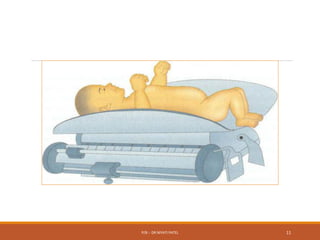
1. Weight: Sensitive growth parameter, first to decrease in acute
malnutrition.
◦ Foetus 8 weeks : 1 gm
◦ 12 weeks : 14 gm
◦ 28 weeks : 1000 gm
Birth: 2.5–3.7 kg. Less than 2.5 kg considered low birth weight.
Weight loss in first 10 days up to 10% body weight.
Thereafter, increase of 20 gm per day for first 5 months and about 15 gm
per day up to 12 months.
◦ Baby doubles birth weight at 5 months, triples at 1 year.
◦ 2nd year: gains 2.5 kg
◦ 3–5 years: gains 2 kg per year
◦ 6–12 years: gains 2–2.5 kg per year.
◦ Approximately 15 kg at 5 years, 25 kg at 10 years, 40 at 15 years.
P/B :- DR NIYATI PATEL 10
P/B :- DR NIYATI PATEL 11
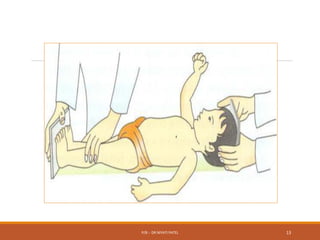
2. Height or length:
◦ Foetus 8 weeks : 2.5 cm
◦ 12 weeks : 7.5 cm
◦ 28 weeks : 35 cm
◦ Birth : 50 cm
1 year: adds on 1/2 of birth length 75 cm
2 years: adds on 1/2 of 1st year’s growth 87–88 cm
Thereafter till adolescence growth spurt about 6–8 cm per year.
Weech’s formula that can be used from 2–12 years.
◦ Age (yr) × 6 + 77 cm.
P/B :- DR NIYATI PATEL 12
P/B :- DR NIYATI PATEL 13
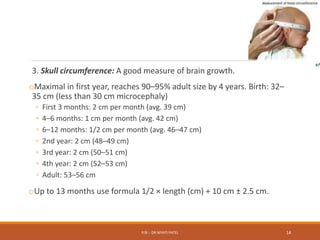
3. Skull circumference: A good measure of brain growth.
oMaximal in first year, reaches 90–95% adult size by 4 years. Birth: 32–
35 cm (less than 30 cm microcephaly)
◦ First 3 months: 2 cm per month (avg. 39 cm)
◦ 4–6 months: 1 cm per month (avg. 42 cm)
◦ 6–12 months: 1/2 cm per month (avg. 46–47 cm)
◦ 2nd year: 2 cm (48–49 cm)
◦ 3rd year: 2 cm (50–51 cm)
◦ 4th year: 2 cm (52–53 cm)
◦ Adult: 53–56 cm
oUp to 13 months use formula 1/2 × length (cm) + 10 cm ± 2.5 cm.
P/B :- DR NIYATI PATEL 14
4. Surface area: It bears constant relation to nutritional factors affecting
growth. Best calculated from normograms involving average weight and
height.
Crude methods are: (m2) = wt2 (kg) × 0.1
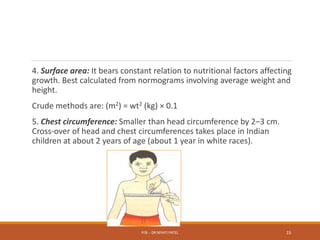
5. Chest circumference: Smaller than head circumference by 2–3 cm.
Cross-over of head and chest circumferences takes place in Indian
children at about 2 years of age (about 1 year in white races).
P/B :- DR NIYATI PATEL 15
SOMATIC GROWTH
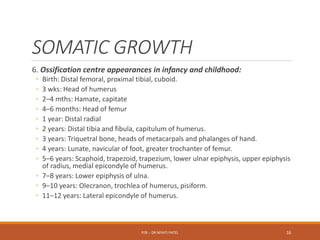
6. Ossification centre appearances in infancy and childhood:
◦ Birth: Distal femoral, proximal tibial, cuboid.
◦ 3 wks: Head of humerus
◦ 2–4 mths: Hamate, capitate
◦ 4–6 months: Head of femur
◦ 1 year: Distal radial
◦ 2 years: Distal tibia and fibula, capitulum of humerus.
◦ 3 years: Triquetral bone, heads of metacarpals and phalanges of hand.
◦ 4 years: Lunate, navicular of foot, greater trochanter of femur.
◦ 5–6 years: Scaphoid, trapezoid, trapezium, lower ulnar epiphysis, upper epiphysis
of radius, medial epicondyle of humerus.
◦ 7–8 years: Lower epiphysis of ulna.
◦ 9–10 years: Olecranon, trochlea of humerus, pisiform.
◦ 11–12 years: Lateral epicondyle of humerus.
P/B :- DR NIYATI PATEL 16
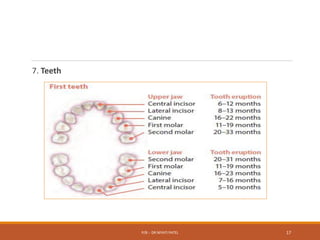
7. Teeth
P/B :- DR NIYATI PATEL 17
BOY GIRL
1. Adolescent growth spurt 13–15.5 years 11.5–14 years
2. Average increase in height 20 cm After 18 years 2.5
cms remain
8 cm After 18 years
1–2 cm remain
3. First sign of puberty Increase in length and
colour of pubic hair
Breast bud visible
or palpable
4. Age at start of puberty 12–13 years 11–12 years
8. Puberty (sexual maturity)
P/B :- DR NIYATI PATEL 18
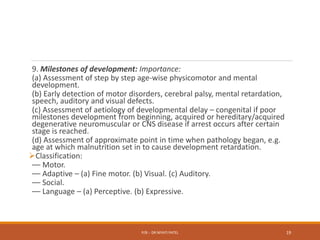
9. Milestones of development: Importance:
(a) Assessment of step by step age-wise physicomotor and mental
development.
(b) Early detection of motor disorders, cerebral palsy, mental retardation,
speech, auditory and visual defects.
(c) Assessment of aetiology of developmental delay – congenital if poor
milestones development from beginning, acquired or hereditary/acquired
degenerative neuromuscular or CNS disease if arrest occurs after certain
stage is reached.
(d) Assessment of approximate point in time when pathology began, e.g.
age at which malnutrition set in to cause development retardation.
Classification:
–– Motor.
–– Adaptive – (a) Fine motor. (b) Visual. (c) Auditory.
–– Social.
–– Language – (a) Perceptive. (b) Expressive.
P/B :- DR NIYATI PATEL 19
DEVELOPMENT
P/B :- DR NIYATI PATEL 20
“DEVELOPMENT IS MATURITY OF
FUNCTION OR QUALITATIVE GROWTH
LEADING TO MENTAL MATURATION”
P/B :- DR NIYATI PATEL 21
GROSS MOTOR
DEVELOPMENT
AGE MILESTONE
3 months
5 months
6 months
8 months
9 months
12 months
15 months
18 months
2 years
3 years
4 years
Neck holding
Rolls over
Sits in tripod fashion (sitting with ownsupport)
Sitting without support
Stands holding on (with support)
Creeps well; walks but falls; stands without support
Walks alone; creeps upstairs
Runs; explores drawers
Walks up and downstairs (2 feet/step); jumps
Rides tricycle; alternate feet going upstairs
Hops on one foot; alternate feet going downstairs
P/B :- DR NIYATI PATEL 22
P/B :- DR NIYATI PATEL 23
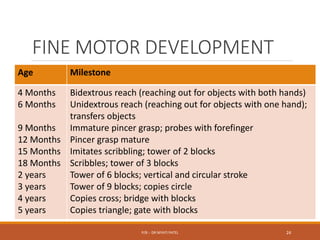
FINE MOTOR DEVELOPMENT
Age Milestone
4 Months
6 Months
9 Months
12 Months
15 Months
18 Months
2 years
3 years
4 years
5 years
Bidextrous reach (reaching out for objects with both hands)
Unidextrous reach (reaching out for objects with one hand);
transfers objects
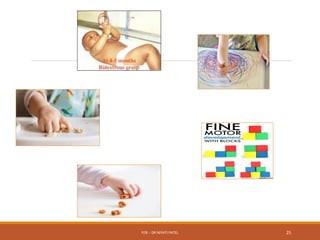
Immature pincer grasp; probes with forefinger
Pincer grasp mature
Imitates scribbling; tower of 2 blocks
Scribbles; tower of 3 blocks
Tower of 6 blocks; vertical and circular stroke
Tower of 9 blocks; copies circle
Copies cross; bridge with blocks
Copies triangle; gate with blocks
P/B :- DR NIYATI PATEL 24
P/B :- DR NIYATI PATEL 25
SOCIAL & ADAPTIVE
DEVELOPMENT
AGE MILESTONE
2 months
3 months
6 months
9 months
12 months
15 months
18 months
2 years
3 years
4 years
5 years
Social smile (smile after being talked to)
Recognizes mother; anticipates feeds
Recognizes strangers, stranger anxiety
Waves "bye bye"
Comes when called; plays simple ball game
Jargon
Copies parents in task (e.g. sweeping)
Asks for food, drink, toilet; pulls people to show toys
Shares toys; knows full name and gender
Plays cooperatively in a group; goes to toilet alone
Helps in household tasks, dresses and undresses
P/B :- DR NIYATI PATEL 26
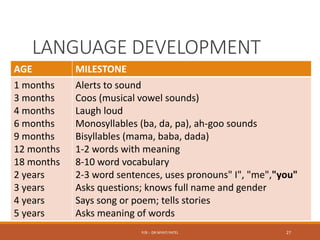
LANGUAGE DEVELOPMENT
AGE MILESTONE
1 months
3 months
4 months
6 months
9 months
12 months
18 months
2 years
3 years
4 years
5 years
Alerts to sound
Coos (musical vowel sounds)
Laugh loud
Monosyllables (ba, da, pa), ah-goo sounds
Bisyllables (mama, baba, dada)
1-2 words with meaning
8-10 word vocabulary
2-3 word sentences, uses pronouns" I", "me","you"
Asks questions; knows full name and gender
Says song or poem; tells stories
Asks meaning of words
P/B :- DR NIYATI PATEL 27
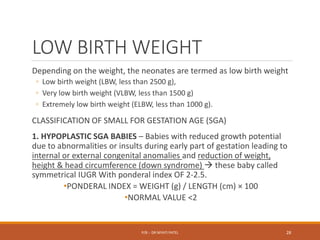
LOW BIRTH WEIGHT
Depending on the weight, the neonates are termed as low birth weight
◦ Low birth weight (LBW, less than 2500 g),
◦ Very low birth weight (VLBW, less than 1500 g)
◦ Extremely low birth weight (ELBW, less than 1000 g).
CLASSIFICATION OF SMALL FOR GESTATION AGE (SGA)
1. HYPOPLASTIC SGA BABIES – Babies with reduced growth potential
due to abnormalities or insults during early part of gestation leading to
internal or external congenital anomalies and reduction of weight,
height & head circumference (down syndrome)  these baby called
symmetrical IUGR With ponderal index OF 2-2.5.
•PONDERAL INDEX = WEIGHT (g) / LENGTH (cm) × 100
•NORMAL VALUE <2
P/B :- DR NIYATI PATEL 28
2. MALNOURISHED SGA BABIES – Babies with reduced weight due to
placental dysfunction or maternal malnutrition during later months of
gestation  Length & head circumference are normal
These baby called  asymmetric IUGR with ponderal index <2.
3. MIXED SGA – Babies with adverse influences on growth and nutrition
from the early part going on to later parts of gestation.
They have features of both hypoplastic + malnourished babies
P/B :- DR NIYATI PATEL 29
P/B :- DR NIYATI PATEL 30
MICROCEPHALY
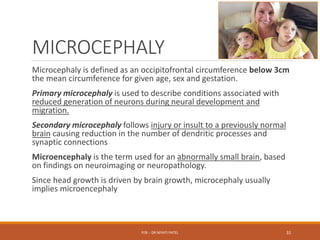
Microcephaly is defined as an occipitofrontal circumference below 3cm
the mean circumference for given age, sex and gestation.
Primary microcephaly is used to describe conditions associated with
reduced generation of neurons during neural development and
migration.
Secondary microcephaly follows injury or insult to a previously normal
brain causing reduction in the number of dendritic processes and
synaptic connections
Microencephaly is the term used for an abnormally small brain, based
on findings on neuroimaging or neuropathology.
Since head growth is driven by brain growth, microcephaly usually
implies microencephaly
P/B :- DR NIYATI PATEL 31
CAUSES OF MICROCEPHALY
o Isolated microcephaly – autosomal disorders
o Neural tube defects
o Maternal diabetes mellitus
o Infections – TORCH
o Hypothyroidism
P/B :- DR NIYATI PATEL 32
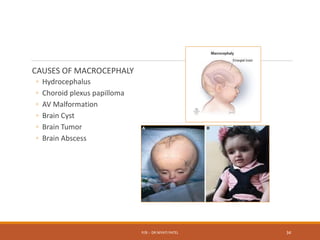
MACROCEPHALY
Macrocephaly is defined as an occipitofrontal circumference greater
than 3 cm of mean ages
Megalencephaly or enlargement of the brain parenchyma may be
familial or associated with inherited syndromes or neurometabolic
disease
Infants with benign familial megalencephaly have increased head size at
birth
Hydrocephalus, characterized by an excessive amount of CSF, may be
caused by increased production, decreased absorption or obstruction to
CSF flow
Most patients show postnatal rapid increase in head size and are
symptomatic due to underlying disease or raised intracranial pressure
(nausea, vomiting and irritability).
P/B :- DR NIYATI PATEL 33
CAUSES OF MACROCEPHALY
◦ Hydrocephalus
◦ Choroid plexus papilloma
◦ AV Malformation
◦ Brain Cyst
◦ Brain Tumor
◦ Brain Abscess
P/B :- DR NIYATI PATEL 34
THANK
YOU
P/B :- DR NIYATI PATEL 35

1. GROWTH & DEVELOPMENT.pdf

  • 1.
  • 2.
    INTRODUCTION It is aprocess by which the fertilized ovum attains adult size. Growth implies changes in the size or in the values given for certain measurements of maturity. P/B :- DR NIYATI PATEL 2
  • 3.
    FACTORS AFFECTING G& D 1. Genetic – A legacy of biologic potential influenced by environment. 2. Hormonal – Growth hormone and its peripheral action compounds (somatomedins), thyroxine, insulin, sex steroids. 3. Growth factors – Nerve growth factor, cartilage factor, fibroblast growth factor and others with undifferentiated action. 4. Trauma – Prenatal or postnatal including infection, chemical or physical trauma or immunologic. 5. Nutritional failure – Antenatal malnutrition leads to IUGR and low birth weight which influences growth potential throughout life. Postnatal PEM (protein energy malnutrition), iron deficiency, trace element deficiency, vitamin deficiency. P/B :- DR NIYATI PATEL 3
  • 4.
    6. Socio-economic factors– Closely influence nutrition, infection, developmental stimulation. 7. Emotional factors – modify growth potential. Deprivation leads to “emotional deprivation syndrome” which can stunt physical and psychological development. Position of child in family, interaction of parents and child, child-rearing patterns influence growth. 8. Culturopolitical factors – may limit development potential by establishing conventional behaviour patterns and expectations and alter schedule for acquisitions of motor and intellectual skills. 9. Intellectual stimulation and learning. P/B :- DR NIYATI PATEL 4
  • 5.
    GROWTH P/B :- DRNIYATI PATEL 5
  • 6.
    “GROWTH IS INCREASEIN SIZE OF THE BODY OR QUANTITATIVE GROWTH LEADING TO PHYSICAL MATURATION” P/B :- DR NIYATI PATEL 6
  • 7.
    STAGES OF GROWTH 1.Ovum (0-14 days) 2. Embryo (2-9wks) 3. Fetus (9 wks to birth) 4. Newborn (first 28 days) 5. Infants ( first year of life) 6. Toddler (1-3 yrs) 7. Preschool child (3-5 yrs) 8. School child (5-9 yrs) 9. Adolescence is devided into prepubertal, pubertal & post pubertal stages (10-19 yrs) P/B :- DR NIYATI PATEL 7
  • 8.
    GROWTH OF DIFFERENT TISSUES 1.Heart beat – 4 weeks 2. Circulation- 8 weeks 3. External genitalia- 10-12 weeks 4. Bile secretion – 12 weeks 5. Fetal movement – 14 weeks 6. Early swallowing – 14 weeks 7. Meconium – 16 weeks 8. Respiration – 18 weeks 9. Phonation – 22 weeks 10. Coordinated sucking & swallowing- 34 weeks P/B :- DR NIYATI PATEL 8
  • 9.
    NEWBORN 1. Normal weight– 3 kgs (2.5 – 4 kgs) 2. Length – 50 cm (44-55cm) 3. Head circumference is 35 cm (33-37 cm) 4. Respiratory rate – 40 / min 5. Heart rate – 140 / minute 6. Most new borns lose up to 10% weigth initially & regain birth weight by next 10 days P/B :- DR NIYATI PATEL 9
  • 10.
    GROWTH PARAMETERS- PHYSICAL GROWTH 1.Weight: Sensitive growth parameter, first to decrease in acute malnutrition. ◦ Foetus 8 weeks : 1 gm ◦ 12 weeks : 14 gm ◦ 28 weeks : 1000 gm Birth: 2.5–3.7 kg. Less than 2.5 kg considered low birth weight. Weight loss in first 10 days up to 10% body weight. Thereafter, increase of 20 gm per day for first 5 months and about 15 gm per day up to 12 months. ◦ Baby doubles birth weight at 5 months, triples at 1 year. ◦ 2nd year: gains 2.5 kg ◦ 3–5 years: gains 2 kg per year ◦ 6–12 years: gains 2–2.5 kg per year. ◦ Approximately 15 kg at 5 years, 25 kg at 10 years, 40 at 15 years. P/B :- DR NIYATI PATEL 10
  • 11.
    P/B :- DRNIYATI PATEL 11
  • 12.
    2. Height orlength: ◦ Foetus 8 weeks : 2.5 cm ◦ 12 weeks : 7.5 cm ◦ 28 weeks : 35 cm ◦ Birth : 50 cm 1 year: adds on 1/2 of birth length 75 cm 2 years: adds on 1/2 of 1st year’s growth 87–88 cm Thereafter till adolescence growth spurt about 6–8 cm per year. Weech’s formula that can be used from 2–12 years. ◦ Age (yr) × 6 + 77 cm. P/B :- DR NIYATI PATEL 12
  • 13.
    P/B :- DRNIYATI PATEL 13
  • 14.
    3. Skull circumference:A good measure of brain growth. oMaximal in first year, reaches 90–95% adult size by 4 years. Birth: 32– 35 cm (less than 30 cm microcephaly) ◦ First 3 months: 2 cm per month (avg. 39 cm) ◦ 4–6 months: 1 cm per month (avg. 42 cm) ◦ 6–12 months: 1/2 cm per month (avg. 46–47 cm) ◦ 2nd year: 2 cm (48–49 cm) ◦ 3rd year: 2 cm (50–51 cm) ◦ 4th year: 2 cm (52–53 cm) ◦ Adult: 53–56 cm oUp to 13 months use formula 1/2 × length (cm) + 10 cm ± 2.5 cm. P/B :- DR NIYATI PATEL 14
  • 15.
    4. Surface area:It bears constant relation to nutritional factors affecting growth. Best calculated from normograms involving average weight and height. Crude methods are: (m2) = wt2 (kg) × 0.1 5. Chest circumference: Smaller than head circumference by 2–3 cm. Cross-over of head and chest circumferences takes place in Indian children at about 2 years of age (about 1 year in white races). P/B :- DR NIYATI PATEL 15
  • 16.
    SOMATIC GROWTH 6. Ossificationcentre appearances in infancy and childhood: ◦ Birth: Distal femoral, proximal tibial, cuboid. ◦ 3 wks: Head of humerus ◦ 2–4 mths: Hamate, capitate ◦ 4–6 months: Head of femur ◦ 1 year: Distal radial ◦ 2 years: Distal tibia and fibula, capitulum of humerus. ◦ 3 years: Triquetral bone, heads of metacarpals and phalanges of hand. ◦ 4 years: Lunate, navicular of foot, greater trochanter of femur. ◦ 5–6 years: Scaphoid, trapezoid, trapezium, lower ulnar epiphysis, upper epiphysis of radius, medial epicondyle of humerus. ◦ 7–8 years: Lower epiphysis of ulna. ◦ 9–10 years: Olecranon, trochlea of humerus, pisiform. ◦ 11–12 years: Lateral epicondyle of humerus. P/B :- DR NIYATI PATEL 16
  • 17.
    7. Teeth P/B :-DR NIYATI PATEL 17
  • 18.
    BOY GIRL 1. Adolescentgrowth spurt 13–15.5 years 11.5–14 years 2. Average increase in height 20 cm After 18 years 2.5 cms remain 8 cm After 18 years 1–2 cm remain 3. First sign of puberty Increase in length and colour of pubic hair Breast bud visible or palpable 4. Age at start of puberty 12–13 years 11–12 years 8. Puberty (sexual maturity) P/B :- DR NIYATI PATEL 18
  • 19.
    9. Milestones ofdevelopment: Importance: (a) Assessment of step by step age-wise physicomotor and mental development. (b) Early detection of motor disorders, cerebral palsy, mental retardation, speech, auditory and visual defects. (c) Assessment of aetiology of developmental delay – congenital if poor milestones development from beginning, acquired or hereditary/acquired degenerative neuromuscular or CNS disease if arrest occurs after certain stage is reached. (d) Assessment of approximate point in time when pathology began, e.g. age at which malnutrition set in to cause development retardation. Classification: –– Motor. –– Adaptive – (a) Fine motor. (b) Visual. (c) Auditory. –– Social. –– Language – (a) Perceptive. (b) Expressive. P/B :- DR NIYATI PATEL 19
  • 20.
    DEVELOPMENT P/B :- DRNIYATI PATEL 20
  • 21.
    “DEVELOPMENT IS MATURITYOF FUNCTION OR QUALITATIVE GROWTH LEADING TO MENTAL MATURATION” P/B :- DR NIYATI PATEL 21
  • 22.
    GROSS MOTOR DEVELOPMENT AGE MILESTONE 3months 5 months 6 months 8 months 9 months 12 months 15 months 18 months 2 years 3 years 4 years Neck holding Rolls over Sits in tripod fashion (sitting with ownsupport) Sitting without support Stands holding on (with support) Creeps well; walks but falls; stands without support Walks alone; creeps upstairs Runs; explores drawers Walks up and downstairs (2 feet/step); jumps Rides tricycle; alternate feet going upstairs Hops on one foot; alternate feet going downstairs P/B :- DR NIYATI PATEL 22
  • 23.
    P/B :- DRNIYATI PATEL 23
  • 24.
    FINE MOTOR DEVELOPMENT AgeMilestone 4 Months 6 Months 9 Months 12 Months 15 Months 18 Months 2 years 3 years 4 years 5 years Bidextrous reach (reaching out for objects with both hands) Unidextrous reach (reaching out for objects with one hand); transfers objects Immature pincer grasp; probes with forefinger Pincer grasp mature Imitates scribbling; tower of 2 blocks Scribbles; tower of 3 blocks Tower of 6 blocks; vertical and circular stroke Tower of 9 blocks; copies circle Copies cross; bridge with blocks Copies triangle; gate with blocks P/B :- DR NIYATI PATEL 24
  • 25.
    P/B :- DRNIYATI PATEL 25
  • 26.
    SOCIAL & ADAPTIVE DEVELOPMENT AGEMILESTONE 2 months 3 months 6 months 9 months 12 months 15 months 18 months 2 years 3 years 4 years 5 years Social smile (smile after being talked to) Recognizes mother; anticipates feeds Recognizes strangers, stranger anxiety Waves "bye bye" Comes when called; plays simple ball game Jargon Copies parents in task (e.g. sweeping) Asks for food, drink, toilet; pulls people to show toys Shares toys; knows full name and gender Plays cooperatively in a group; goes to toilet alone Helps in household tasks, dresses and undresses P/B :- DR NIYATI PATEL 26
  • 27.
    LANGUAGE DEVELOPMENT AGE MILESTONE 1months 3 months 4 months 6 months 9 months 12 months 18 months 2 years 3 years 4 years 5 years Alerts to sound Coos (musical vowel sounds) Laugh loud Monosyllables (ba, da, pa), ah-goo sounds Bisyllables (mama, baba, dada) 1-2 words with meaning 8-10 word vocabulary 2-3 word sentences, uses pronouns" I", "me","you" Asks questions; knows full name and gender Says song or poem; tells stories Asks meaning of words P/B :- DR NIYATI PATEL 27
  • 28.
    LOW BIRTH WEIGHT Dependingon the weight, the neonates are termed as low birth weight ◦ Low birth weight (LBW, less than 2500 g), ◦ Very low birth weight (VLBW, less than 1500 g) ◦ Extremely low birth weight (ELBW, less than 1000 g). CLASSIFICATION OF SMALL FOR GESTATION AGE (SGA) 1. HYPOPLASTIC SGA BABIES – Babies with reduced growth potential due to abnormalities or insults during early part of gestation leading to internal or external congenital anomalies and reduction of weight, height & head circumference (down syndrome)  these baby called symmetrical IUGR With ponderal index OF 2-2.5. •PONDERAL INDEX = WEIGHT (g) / LENGTH (cm) × 100 •NORMAL VALUE <2 P/B :- DR NIYATI PATEL 28
  • 29.
    2. MALNOURISHED SGABABIES – Babies with reduced weight due to placental dysfunction or maternal malnutrition during later months of gestation  Length & head circumference are normal These baby called  asymmetric IUGR with ponderal index <2. 3. MIXED SGA – Babies with adverse influences on growth and nutrition from the early part going on to later parts of gestation. They have features of both hypoplastic + malnourished babies P/B :- DR NIYATI PATEL 29
  • 30.
    P/B :- DRNIYATI PATEL 30
  • 31.
    MICROCEPHALY Microcephaly is definedas an occipitofrontal circumference below 3cm the mean circumference for given age, sex and gestation. Primary microcephaly is used to describe conditions associated with reduced generation of neurons during neural development and migration. Secondary microcephaly follows injury or insult to a previously normal brain causing reduction in the number of dendritic processes and synaptic connections Microencephaly is the term used for an abnormally small brain, based on findings on neuroimaging or neuropathology. Since head growth is driven by brain growth, microcephaly usually implies microencephaly P/B :- DR NIYATI PATEL 31
  • 32.
    CAUSES OF MICROCEPHALY oIsolated microcephaly – autosomal disorders o Neural tube defects o Maternal diabetes mellitus o Infections – TORCH o Hypothyroidism P/B :- DR NIYATI PATEL 32
  • 33.
    MACROCEPHALY Macrocephaly is definedas an occipitofrontal circumference greater than 3 cm of mean ages Megalencephaly or enlargement of the brain parenchyma may be familial or associated with inherited syndromes or neurometabolic disease Infants with benign familial megalencephaly have increased head size at birth Hydrocephalus, characterized by an excessive amount of CSF, may be caused by increased production, decreased absorption or obstruction to CSF flow Most patients show postnatal rapid increase in head size and are symptomatic due to underlying disease or raised intracranial pressure (nausea, vomiting and irritability). P/B :- DR NIYATI PATEL 33
  • 34.
    CAUSES OF MACROCEPHALY ◦Hydrocephalus ◦ Choroid plexus papilloma ◦ AV Malformation ◦ Brain Cyst ◦ Brain Tumor ◦ Brain Abscess P/B :- DR NIYATI PATEL 34
  • 35.
    THANK YOU P/B :- DRNIYATI PATEL 35