BREAST FEEDING
P/B :- DR NIYATI PATEL 1
DEFINITION
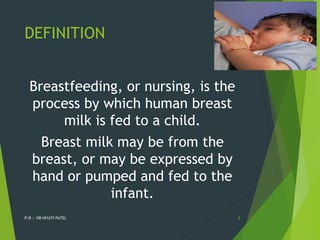
Breastfeeding, or nursing, is the
process by which human breast
milk is fed to a child.
Breast milk may be from the
breast, or may be expressed by
hand or pumped and fed to the
infant.
P/B :- DR NIYATI PATEL 2
MECHANISM
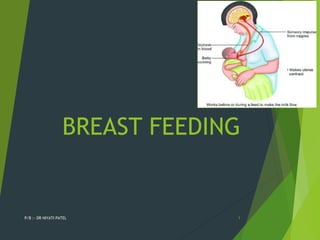
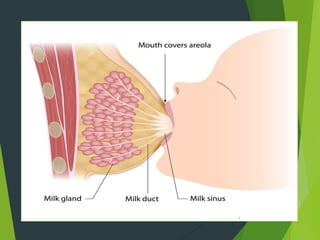
When the baby suckles its mother's
breast, a hormone
called oxytocin compels the milk to
flow from the lobules, through the
ducts (milk canals), into the sacs
(milk pools) behind and then into the
baby's mouth.
P/B :- DR NIYATI PATEL 3
P/B :- DR NIYATI PATEL 4
SUCKING
HYPOTHALAMUS
PITUITARY
GLANDS
ANTERIOR
PITUITARY GLANDS
POSTERIOR
PITUITARY GLANDS
PROLACTIN OXYTOCIN
MILK PRODUCTION MILK RELEASE
P/B :- DR NIYATI PATEL 5
INITIATION BRESTFEEDING
 Baby must be put to breast
 Within half n hour  after normal delivery
 Within four hours  after caesarean section
 BF can be initiated even when mother is sedated / IV fluids
 In the first 2-4 days, small quantity of colostrum (10-40 ml)
that is secreted is all what the baby needs
 Colostrum is rich in protein & immunoglobulin
 Colostrum replaced  transition milk (few days) mature
milk
 It increases till 6 months after delivery  later plateaus off
 Average quantity of milk is 500-800 ml/day
 Hind milk is more nutritive than fore milk
P/B :- DR NIYATI PATEL 6
REFLEXES HELPS BF
 Rooting, sucking & swallowing reflexes helps the baby in
BF
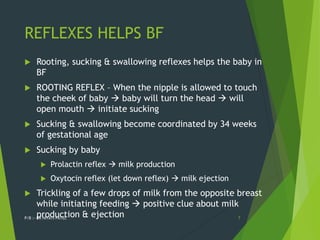
 ROOTING REFLEX – When the nipple is allowed to touch
the cheek of baby  baby will turn the head  will
open mouth  initiate sucking
 Sucking & swallowing become coordinated by 34 weeks
of gestational age
 Sucking by baby
 Prolactin reflex  milk production
 Oxytocin reflex (let down reflex)  milk ejection
 Trickling of a few drops of milk from the opposite breast
while initiating feeding  positive clue about milk
production & ejection
P/B :- DR NIYATI PATEL 7
POSITION FOR BABY
 The mother & baby both should be relaxed & comfortably
postured during BF
 The baby head should be resting on the elbow of the mother
& should support the baby with the same hand
 She should also support the breast between the index &
middle fingers of the opposite hand during feeding
 Rooming in  keeping the mother & baby in the same room
 Bedding in  keeping the mother & baby in the same bed
 Mothering in  keeping the baby on the abdomen of the
mother
 Fore milk  satisfy the thirst of the baby
 Hind milk  satisfy the nutritional demand & ensure milk
production
P/B :- DR NIYATI PATEL 8
P/B :- DR NIYATI PATEL 9
1.CRADLE POSITION
 This position is commonly used when you
are comfortable with breastfeeding and
your baby is latching well.
 cross-cradle position.
 Support your baby at breast level.
 Hold your baby belly-to-belly by wrapping your
arm around your baby so his head is just below
your elbow.
 Place the baby’s lower arm around your side and
make sure your baby’s head is tilted back slightly
as he comes to the breast.
P/B :- DR NIYATI PATEL 10
2. CROSS CRADLE POSITION
 Many moms find this position comfortable when they are
learning to breastfeed.
 Support your baby at breast level.
 Hold your baby facing you (belly-to-belly) so his face, chest
and legs are touching you.
 Support your opposite breast in a relaxed “C” hold.
 His nose is facing your nipple, with his chin touching you
first.
 As the baby opens his mouth wide, point the nipple tothe
roof of the baby’s mouth; and at the same time, tuck the
baby’s shoulders and bottom in closer to you.
 Bring the baby in quickly, filling the mouth with your
breast.
 This allows the baby to comfortably latch onto your
breast with a deep latch.
P/B :- DR NIYATI PATEL 11
3. FOOTBALL POSITION
 This hold can be helpful for moms if they
have a caesarean birth, larger breasts, a
premature baby, a baby with low muscle
tone or a baby having difficulty latching.
 Your baby is snuggled close at your side
underneath your arm in a straight line.
 His bottom is by your elbow and his nose by your
nipple.
 Your baby’s head is tilted back slightly with his
chin touching you.
 When the baby opens wide, bring the baby close
for a deep latch.
P/B :- DR NIYATI PATEL 12
4. SIDE LYING POSITION
 Some women use this position for
increased comfort after a cesarean
birth, painful episiotomy or if they have
long or heavy breasts.
 You may need help to learn this position.
 Lie on your side with your head, and back
supported.
 Your baby is facing you belly-to-belly.
 You may need a folded blanket under the baby
and a roll to his back to keep him facing you.
P/B :- DR NIYATI PATEL 13
COMMON PROBLEMS DURING BF
 1. FLAT / INVERTED NIPPLES
 Size of the nipple is not imp in breast feeding 
guide for where baby have to suck
 On attempting to pull out the nipple  it goes
deeper into the breast  inverted nipple
P/B :- DR NIYATI PATEL 14
 2. FULLNESS & ENGORGEMENT OF BREAST
 Breasts may feel full in the first week after your baby is
born.
 May notice an increase in the fullness of your breasts as
the milk “comes in”, around days 2–4 after birth.
 This is normal and a sign that your breasts are making more
milk.
 sometimes the breasts can become overfull, swollen and
tender  called engorgement
 When this happens, it may be more challenging for your
baby to latch on well and feed effectively.
P/B :- DR NIYATI PATEL 15
BURPING OF BABY
 Breastfed babies usually swallow less air and may
not need to burp as often as bottle-fed babies 
But during BF some amount of air gulps by baby 
technique for removing of this air  k/a BURPING
P/B :- DR NIYATI PATEL 16
P/B :- DR NIYATI PATEL 17
P/B :- DR NIYATI PATEL 18
BENEFITS OF BF IN BABY
 Breastmilk is custom-made for your baby. It is the normal way to
feed your baby.
 Breastmilk contains unique substances such as antibodies, live cells,
hormones and special protective growth factors.
 Breastmilk is easier to digest than commercial infant formula.
 Breastmilk contains special fatty acids not found in formula that
help your baby’s brain to develop and boost brain power.
 Antibodies in breastmilk protect your baby against common
childhood illnesses such as diarrhoea and vomiting, middle ear and
chest infections and allergies.
 The fat in breastmilk contains high levels of cholesterol.
 Breastfeeding may reduce your child’s chance of being overweight
or obese.
 Breastfeeding helps your baby to develop well-formed jaws, gums
and teeth.
 Breastfeeding may help early speech development.
 Breastfeeding offers some protection against Sudden Infant Death
Syndrome (SIDS) or crib death.
 Breastfeeding reduces your baby’s chances of getting some diseases
such as diabetes.
P/B :- DR NIYATI PATEL 19
BENEFITS OF BF IN MOTHER
 Breastfeeding provides a special time of closeness for you and
your baby, and strengthens your attachment to your baby.
 Breastfeeding saves time.
 Breastfeeding helps control mother’s bleeding after birth.
 Breastfeeding helps your uterus (womb) return to its normal size
more quickly.
 Breastfeeding provides protection against breast and ovarian
cancers and Type 2 diabetes.
 Breastfeeding helps new mothers return to their pre-pregnancy
weight more quickly.
 Breastmilk is always available,. This makes it easier “ready to
serve”, clean and at the right temperature for night feedings and
travelling.
 Mothers can continue to breastfeed after they return to work or
school.
P/B :- DR NIYATI PATEL 20
P/B :- DR NIYATI PATEL 21
 Feeding tips for providing breastmilk
 Gently shake warmed breastmilk and test the
temperature on your wrist before using it.
 Many babies take expressed breastmilk well when
fed with a cup or spoon.
 Hold your baby when feeding expressed breastmilk.
 Make feedings an enjoyable time for you and your
baby.
 Cuddle, talk to and look at your baby. Give her lots
of smiles.
 Burp your baby as needed.
 Use warmed breastmilk within one hour. Throw away
any breastmilk that your baby does not drink.
P/B :- DR NIYATI PATEL 22

17.BREAST FEEDING.pdf

  • 1.
    BREAST FEEDING P/B :-DR NIYATI PATEL 1
  • 2.
    DEFINITION Breastfeeding, or nursing,is the process by which human breast milk is fed to a child. Breast milk may be from the breast, or may be expressed by hand or pumped and fed to the infant. P/B :- DR NIYATI PATEL 2
  • 3.
    MECHANISM When the babysuckles its mother's breast, a hormone called oxytocin compels the milk to flow from the lobules, through the ducts (milk canals), into the sacs (milk pools) behind and then into the baby's mouth. P/B :- DR NIYATI PATEL 3
  • 4.
    P/B :- DRNIYATI PATEL 4
  • 5.
  • 6.
    INITIATION BRESTFEEDING  Babymust be put to breast  Within half n hour  after normal delivery  Within four hours  after caesarean section  BF can be initiated even when mother is sedated / IV fluids  In the first 2-4 days, small quantity of colostrum (10-40 ml) that is secreted is all what the baby needs  Colostrum is rich in protein & immunoglobulin  Colostrum replaced  transition milk (few days) mature milk  It increases till 6 months after delivery  later plateaus off  Average quantity of milk is 500-800 ml/day  Hind milk is more nutritive than fore milk P/B :- DR NIYATI PATEL 6
  • 7.
    REFLEXES HELPS BF Rooting, sucking & swallowing reflexes helps the baby in BF  ROOTING REFLEX – When the nipple is allowed to touch the cheek of baby  baby will turn the head  will open mouth  initiate sucking  Sucking & swallowing become coordinated by 34 weeks of gestational age  Sucking by baby  Prolactin reflex  milk production  Oxytocin reflex (let down reflex)  milk ejection  Trickling of a few drops of milk from the opposite breast while initiating feeding  positive clue about milk production & ejection P/B :- DR NIYATI PATEL 7
  • 8.
    POSITION FOR BABY The mother & baby both should be relaxed & comfortably postured during BF  The baby head should be resting on the elbow of the mother & should support the baby with the same hand  She should also support the breast between the index & middle fingers of the opposite hand during feeding  Rooming in  keeping the mother & baby in the same room  Bedding in  keeping the mother & baby in the same bed  Mothering in  keeping the baby on the abdomen of the mother  Fore milk  satisfy the thirst of the baby  Hind milk  satisfy the nutritional demand & ensure milk production P/B :- DR NIYATI PATEL 8
  • 9.
    P/B :- DRNIYATI PATEL 9
  • 10.
    1.CRADLE POSITION  Thisposition is commonly used when you are comfortable with breastfeeding and your baby is latching well.  cross-cradle position.  Support your baby at breast level.  Hold your baby belly-to-belly by wrapping your arm around your baby so his head is just below your elbow.  Place the baby’s lower arm around your side and make sure your baby’s head is tilted back slightly as he comes to the breast. P/B :- DR NIYATI PATEL 10
  • 11.
    2. CROSS CRADLEPOSITION  Many moms find this position comfortable when they are learning to breastfeed.  Support your baby at breast level.  Hold your baby facing you (belly-to-belly) so his face, chest and legs are touching you.  Support your opposite breast in a relaxed “C” hold.  His nose is facing your nipple, with his chin touching you first.  As the baby opens his mouth wide, point the nipple tothe roof of the baby’s mouth; and at the same time, tuck the baby’s shoulders and bottom in closer to you.  Bring the baby in quickly, filling the mouth with your breast.  This allows the baby to comfortably latch onto your breast with a deep latch. P/B :- DR NIYATI PATEL 11
  • 12.
    3. FOOTBALL POSITION This hold can be helpful for moms if they have a caesarean birth, larger breasts, a premature baby, a baby with low muscle tone or a baby having difficulty latching.  Your baby is snuggled close at your side underneath your arm in a straight line.  His bottom is by your elbow and his nose by your nipple.  Your baby’s head is tilted back slightly with his chin touching you.  When the baby opens wide, bring the baby close for a deep latch. P/B :- DR NIYATI PATEL 12
  • 13.
    4. SIDE LYINGPOSITION  Some women use this position for increased comfort after a cesarean birth, painful episiotomy or if they have long or heavy breasts.  You may need help to learn this position.  Lie on your side with your head, and back supported.  Your baby is facing you belly-to-belly.  You may need a folded blanket under the baby and a roll to his back to keep him facing you. P/B :- DR NIYATI PATEL 13
  • 14.
    COMMON PROBLEMS DURINGBF  1. FLAT / INVERTED NIPPLES  Size of the nipple is not imp in breast feeding  guide for where baby have to suck  On attempting to pull out the nipple  it goes deeper into the breast  inverted nipple P/B :- DR NIYATI PATEL 14
  • 15.
     2. FULLNESS& ENGORGEMENT OF BREAST  Breasts may feel full in the first week after your baby is born.  May notice an increase in the fullness of your breasts as the milk “comes in”, around days 2–4 after birth.  This is normal and a sign that your breasts are making more milk.  sometimes the breasts can become overfull, swollen and tender  called engorgement  When this happens, it may be more challenging for your baby to latch on well and feed effectively. P/B :- DR NIYATI PATEL 15
  • 16.
    BURPING OF BABY Breastfed babies usually swallow less air and may not need to burp as often as bottle-fed babies  But during BF some amount of air gulps by baby  technique for removing of this air  k/a BURPING P/B :- DR NIYATI PATEL 16
  • 17.
    P/B :- DRNIYATI PATEL 17
  • 18.
    P/B :- DRNIYATI PATEL 18
  • 19.
    BENEFITS OF BFIN BABY  Breastmilk is custom-made for your baby. It is the normal way to feed your baby.  Breastmilk contains unique substances such as antibodies, live cells, hormones and special protective growth factors.  Breastmilk is easier to digest than commercial infant formula.  Breastmilk contains special fatty acids not found in formula that help your baby’s brain to develop and boost brain power.  Antibodies in breastmilk protect your baby against common childhood illnesses such as diarrhoea and vomiting, middle ear and chest infections and allergies.  The fat in breastmilk contains high levels of cholesterol.  Breastfeeding may reduce your child’s chance of being overweight or obese.  Breastfeeding helps your baby to develop well-formed jaws, gums and teeth.  Breastfeeding may help early speech development.  Breastfeeding offers some protection against Sudden Infant Death Syndrome (SIDS) or crib death.  Breastfeeding reduces your baby’s chances of getting some diseases such as diabetes. P/B :- DR NIYATI PATEL 19
  • 20.
    BENEFITS OF BFIN MOTHER  Breastfeeding provides a special time of closeness for you and your baby, and strengthens your attachment to your baby.  Breastfeeding saves time.  Breastfeeding helps control mother’s bleeding after birth.  Breastfeeding helps your uterus (womb) return to its normal size more quickly.  Breastfeeding provides protection against breast and ovarian cancers and Type 2 diabetes.  Breastfeeding helps new mothers return to their pre-pregnancy weight more quickly.  Breastmilk is always available,. This makes it easier “ready to serve”, clean and at the right temperature for night feedings and travelling.  Mothers can continue to breastfeed after they return to work or school. P/B :- DR NIYATI PATEL 20
  • 21.
    P/B :- DRNIYATI PATEL 21
  • 22.
     Feeding tipsfor providing breastmilk  Gently shake warmed breastmilk and test the temperature on your wrist before using it.  Many babies take expressed breastmilk well when fed with a cup or spoon.  Hold your baby when feeding expressed breastmilk.  Make feedings an enjoyable time for you and your baby.  Cuddle, talk to and look at your baby. Give her lots of smiles.  Burp your baby as needed.  Use warmed breastmilk within one hour. Throw away any breastmilk that your baby does not drink. P/B :- DR NIYATI PATEL 22