Importance of Postural
Analysis in Physiotherapy
By
P. Senthil, MPT, CPS, (PhD),
Professor,
Mohamad Sathak A J College of Physiotherapy,
Chennai.
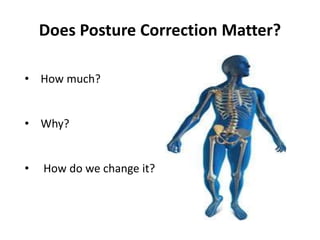
Does Posture Correction Matter?
• How much?
• Why?
• How do we change it?
What is Posture?
Posture is not a position, but a dynamic pattern of
reflexes, habits, and adaptive responses to anything
that resists you being more or less upright and
functional, such as:
• Gravity, of course!
• Awkward working conditions, which may be
unavoidable.
• Abnormal anatomy.
• Athletic challenges.
• If you start to tip over, or lose the stability you
need for a task, postural reflexes kick in and
engage muscles to pull you into a more or less
upright and/or functional position again.
• The biological systems and tricks that keep us
upright are neat — and surprisingly poorly
understood.
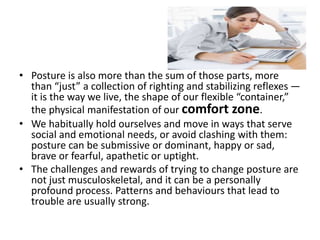
• Posture is also more than the sum of those parts, more
than “just” a collection of righting and stabilizing reflexes —
it is the way we live, the shape of our flexible “container,”
the physical manifestation of our comfort zone.
• We habitually hold ourselves and move in ways that serve
social and emotional needs, or avoid clashing with them:
posture can be submissive or dominant, happy or sad,
brave or fearful, apathetic or uptight.
• The challenges and rewards of trying to change posture are
not just musculoskeletal, and it can be a personally
profound process. Patterns and behaviours that lead to
trouble are usually strong.
Posture is the embodiment of
our comfort zone.
At worst, it can be like
a Cage.
What is “Poor Posture”?
• More precisely stated now: Poor Posture is an
unnecessary and problematic pattern of physical
responses to Postural challenges.
• Sitting for hours with your knees tucked sharply
under your chair is a classic example, and it’s a
real hazard to kneecaps— avoidable and
entirely caused by a lack of awareness of how
knees work.
• What about Postural laziness? That’s what
most people picture when they think of poor
posture.
• The avoidance of Postural challenges leads
over time to Poor Postural fitness.
• If you avoid postural challenges enough,
eventually you’ll have trouble coping with
them when you have to … and so we’re back
to the first definition (POOR POSTURE).
Factors leading to Poor Posture:
• Genetics & Hereditary
• Current/past injuries
• Job – Related
• Aging process
• Stature – height
• Psychological aspect – emotional-confidence, joy,
depression, fear, mood.
• Anatomy of women
• Pregnancy
• Culture
• Fatigue posture
Poor Posture Related Injuries
• Ligaments can permanently stretch
• Cartilages can be damaged due to abnormal friction
• Disc injuries
• Neurological problems like headaches, numbness,
tingling
• Arthritic changes in weight-bearing joints
• Decreased ROM, Strength, and Joint dysfunction.
• Continuous and long-term pain
• Work-related musculoskeletal disorders
• Cumulative Trauma cycle
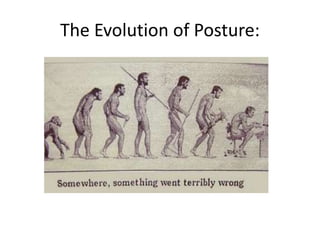
The Evolution of Posture:
Why Implement A Posture Assessment
Program?
• Critical to assesses body alignment and design
exercise prescription.
• Improve Our Professional skill level.
• Re-evaluation and measure outcome of
patient.
• Visual feedback mechanism to Patients.
• For Research proposal and Documentation.
• Referral source will be increased.
Does Posture matter?
POOR
POSTURAL
FITNESS
How to Assess Posture?
• Visual Observation method.
• Goniometric method.
• Plumb line method.
• Photographic and Digitization method.
• Radiographic method.
• Photogrammetric method.
• Posture Grid charts.
• Posture analysis software.
• 2D & 3D Video-Motion analysis.
Can you Change posture?
• Much of what we perceive as “Poor Posture”
is the result of biological adaption over
decades and is unlikely to change without a
truly heroic effort — and perhaps not even
then.
• In principle, humans can adapt to almost
anything — in fact, it’s the law.
• However, the same principle dictates that
change is slow and difficult.
Address Major systemic barriers to
success
CONCLUSION:
• Posture is almost certainly associated with
some pain problems.
• Much of so-called “Poor Posture” is actually
just postural strain and bad ergonomics.
• Poor Posture are probably the result of long-
term biological adaptation that is either
extremely difficult or impossible to change.
• Posture can affect mood, emotion and
probably pain sensitivity.
• EARLIER EVALUATION AND CORRECTION OF
POSTURAL ADAPTATION HELPS TO MAINTAIN
POSTURAL FITNESS AND PHYSICAL
CAPABILITY OF INDIVIDUALS.
Thank you

Postural analysis

  • 1.
    Importance of Postural Analysisin Physiotherapy By P. Senthil, MPT, CPS, (PhD), Professor, Mohamad Sathak A J College of Physiotherapy, Chennai.
  • 2.
    Does Posture CorrectionMatter? • How much? • Why? • How do we change it?
  • 3.
    What is Posture? Postureis not a position, but a dynamic pattern of reflexes, habits, and adaptive responses to anything that resists you being more or less upright and functional, such as: • Gravity, of course! • Awkward working conditions, which may be unavoidable. • Abnormal anatomy. • Athletic challenges.
  • 4.
    • If youstart to tip over, or lose the stability you need for a task, postural reflexes kick in and engage muscles to pull you into a more or less upright and/or functional position again. • The biological systems and tricks that keep us upright are neat — and surprisingly poorly understood.
  • 5.
    • Posture isalso more than the sum of those parts, more than “just” a collection of righting and stabilizing reflexes — it is the way we live, the shape of our flexible “container,” the physical manifestation of our comfort zone. • We habitually hold ourselves and move in ways that serve social and emotional needs, or avoid clashing with them: posture can be submissive or dominant, happy or sad, brave or fearful, apathetic or uptight. • The challenges and rewards of trying to change posture are not just musculoskeletal, and it can be a personally profound process. Patterns and behaviours that lead to trouble are usually strong.
  • 6.
    Posture is theembodiment of our comfort zone. At worst, it can be like a Cage.
  • 7.
    What is “PoorPosture”? • More precisely stated now: Poor Posture is an unnecessary and problematic pattern of physical responses to Postural challenges. • Sitting for hours with your knees tucked sharply under your chair is a classic example, and it’s a real hazard to kneecaps— avoidable and entirely caused by a lack of awareness of how knees work.
  • 8.
    • What aboutPostural laziness? That’s what most people picture when they think of poor posture. • The avoidance of Postural challenges leads over time to Poor Postural fitness. • If you avoid postural challenges enough, eventually you’ll have trouble coping with them when you have to … and so we’re back to the first definition (POOR POSTURE).
  • 9.
    Factors leading toPoor Posture: • Genetics & Hereditary • Current/past injuries • Job – Related • Aging process • Stature – height • Psychological aspect – emotional-confidence, joy, depression, fear, mood. • Anatomy of women • Pregnancy • Culture • Fatigue posture
  • 10.
    Poor Posture RelatedInjuries • Ligaments can permanently stretch • Cartilages can be damaged due to abnormal friction • Disc injuries • Neurological problems like headaches, numbness, tingling • Arthritic changes in weight-bearing joints • Decreased ROM, Strength, and Joint dysfunction. • Continuous and long-term pain • Work-related musculoskeletal disorders • Cumulative Trauma cycle
  • 11.
  • 12.
    Why Implement APosture Assessment Program? • Critical to assesses body alignment and design exercise prescription. • Improve Our Professional skill level. • Re-evaluation and measure outcome of patient. • Visual feedback mechanism to Patients. • For Research proposal and Documentation. • Referral source will be increased.
  • 13.
  • 14.
  • 15.
    How to AssessPosture? • Visual Observation method. • Goniometric method. • Plumb line method. • Photographic and Digitization method. • Radiographic method. • Photogrammetric method. • Posture Grid charts. • Posture analysis software. • 2D & 3D Video-Motion analysis.
  • 19.
    Can you Changeposture? • Much of what we perceive as “Poor Posture” is the result of biological adaption over decades and is unlikely to change without a truly heroic effort — and perhaps not even then. • In principle, humans can adapt to almost anything — in fact, it’s the law. • However, the same principle dictates that change is slow and difficult.
  • 20.
    Address Major systemicbarriers to success
  • 21.
    CONCLUSION: • Posture isalmost certainly associated with some pain problems. • Much of so-called “Poor Posture” is actually just postural strain and bad ergonomics. • Poor Posture are probably the result of long- term biological adaptation that is either extremely difficult or impossible to change. • Posture can affect mood, emotion and probably pain sensitivity.
  • 22.
    • EARLIER EVALUATIONAND CORRECTION OF POSTURAL ADAPTATION HELPS TO MAINTAIN POSTURAL FITNESS AND PHYSICAL CAPABILITY OF INDIVIDUALS.
  • 23.