Lecture 9:
DNA replication in prokaryotes
The elements of DNA replication
Readings (chapter 3)
Course 281
Lessons for life
AIMS
• Introduce the elements needed to replicate
DNA.
• Introduce the chemistry of adding new DNA
building block and form a new strand of DNA.
• Introduce the proteins and enzymes involved
in the replication of DNA.
• Introduce the function of each enzyme and
protein in the replication of DNA.
Replicating DNA
• What do we need to replicate DNA?
1. DNA template.
2. Building block of DNA.
3. Builders (proteins and enzymes).
4. 3’OH (primer).
We will go over each enzyme and its
function but lets go over each one
separately first.
DNA replication - What we need?
1. DNA template
G A
C T
A
T
T
A
G
C
G
C
A
T
C
G
C
G
G
C
T
A
A
T
T
A
G
C
A
T
C
G
A
T
C
G
5’
5’
3’
3’
C TT A C C TG G CA T A C T G T G
5’3’
G AA T G G AC C GT A T G A C A C
5’ 3’
Each strand serves as a template for replication.
Remember complementary base-pairing!
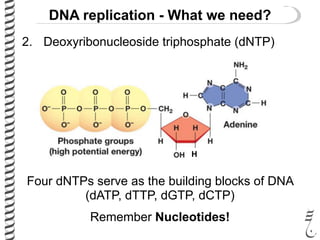
2. Deoxyribonucleoside triphosphate (dNTP)
DNA replication - What we need?
H
Four dNTPs serve as the building blocks of DNA
(dATP, dTTP, dGTP, dCTP)
Remember Nucleotides!
DNA replication - What we need?
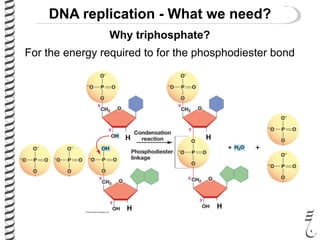
Why triphosphate?
For the energy required to for the phosphodiester bond
+
H H
H H
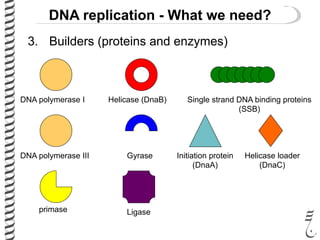
3. Builders (proteins and enzymes)
DNA replication - What we need?
DNA polymerase I
DNA polymerase III
Helicase (DnaB)
Gyrase
Single strand DNA binding proteins
(SSB)
primase Ligase
Initiation protein
(DnaA)
Helicase loader
(DnaC)
4. Primers
DNA replication - What we need?
G
C T
A
T
T
A
G
C C TG G CA T A C T G T G
5’
5’
OH-3’
3’
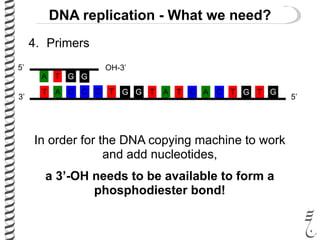
In order for the DNA copying machine to work
and add nucleotides,
a 3’-OH needs to be available to form a
phosphodiester bond!
DNA replication - What we need?
What is a Primer?
Replicating DNA
• DNA is available in the cell.
• dNTPs are in the cell.
• Copying DNA done by enzymes with the help
of proteins.
• 3’-OH is in the nucleotide structure.
We will go over the enzymes and their
functions
Replication enzymes/proteins
1. DNA polymerase (DNA Pol)
• It is the DNA copier.
• Uses the dNTPs (DNA building blocks) to
make a complementary strand to the
template.
Replication enzymes/proteins
1. DNA polymerase (DNA Pol)
• Uses the available 3’-OH of a previous
nucleotide and 5’phsphate from dNTP to
form a phosphodiester bond.
• Each time DNA Pol finds the correct
complementary dNTP and catalyzes the
reaction linking the new nucleotide.
• Remember DNA Pol needs 3’-OH
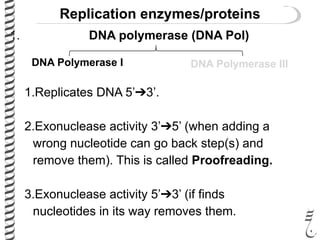
DNA polymerase (DNA Pol)
DNA Polymerase I DNA Polymerase III
Replication enzymes/proteins
1. DNA polymerase (DNA Pol)
DNA Polymerase I DNA Polymerase III
1.Replicates DNA 5’➔3’.
2.Exonuclease activity 3’➔5’ (when adding a
wrong nucleotide can go back step(s) and
remove them). This is called Proofreading.
3.Exonuclease activity 5’➔3’ (if finds
nucleotides in its way removes them.
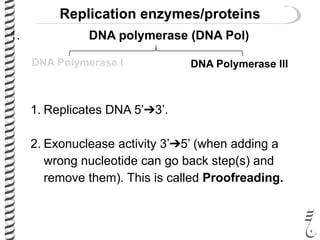
Replication enzymes/proteins
1. DNA polymerase (DNA Pol)
DNA Polymerase I DNA Polymerase III
1. Replicates DNA 5’➔3’.
2. Exonuclease activity 3’➔5’ (when adding a
wrong nucleotide can go back step(s) and
remove them). This is called Proofreading.
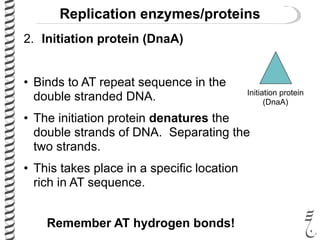
Replication enzymes/proteins
2. Initiation protein (DnaA)
• Binds to AT repeat sequence in the
double stranded DNA.
• The initiation protein denatures the
double strands of DNA. Separating the
two strands.
• This takes place in a specific location
rich in AT sequence.
Remember AT hydrogen bonds!
Initiation protein
(DnaA)
Replication enzymes/proteins
3. DNA Helicase (DnaB)
• Helicase is placed on the denatured DNA.
• Helicase untwist DNA in two direction of the
replication.
• Break hydrogen bonds between the bases and
further exposing single stranded DNA.
• Calls and recruits an enzymes called primase.
• Pushes DNA replication forward.
Helicase (DnaB)
Replication enzymes/proteins
4. DNA Helicase loader (DnaC)
• As the names suggests, this protein loads and
places the DNA helicase on the denatured
DNA.
Helicase loader
(DnaC)
Replication enzymes/proteins
5. Single strand DNA binding protein (SSB)
• Binds to single stranded DNA template.
• SSB prevent the two denatured DNA strands
from re-annealing (coming back together).
Single strand DNA binding proteins
(SSB)
Replication enzymes/proteins
6. Primase
• Primase adds a block of nucleotides (primer) to
provide the polymerase with a 3’-OH needed
for the synthesis of DNA.
• The block added is complementary to the
template.
• Primase adds a single primer on one template.
• Primase adds multiple primers on the second
template.
primase
Replication enzymes/proteins
7. Gyrase
• Gyrase is a type of topoisomerase.
• Relaxes the tension generated by the
separation of the double strands and the
untwisting of the double helix.
Gyrase
Replication enzymes/proteins
8. Ligase
• Joins to molecules that are disconnected.
• Seals the nicks in the replication process.
Ligase
Quiz
Which of the following enzymes is
responsible for untwisting the DNA during
replication
a) DNA Pol I
b) Lygase
c) Primase
d) Helicase
e) Gyrase
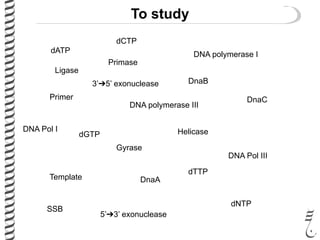
To study
Ligase
DNA polymerase I
DNA polymerase III
DNA Pol I
DNA Pol III
Gyrase
Primase
SSB
DnaA
Helicase
DnaB
DnaCPrimer
Template
dNTP
dATP
dCTP
dGTP
dTTP
5’➔3’ exonuclease
3’➔5’ exonuclease
Expectations
• You know what is needed for DNA replication
and synthesis to take place.
• You know the building blocks of DNA.
• You know the enzymes/proteins in the process
of replication.
• You know the function of each enzyme/protein.
Next lecture we will go over the process of
DNA replication and connect it with what we
learned today
For a smile
www.biocomicals.com

281 lec9 elements_ofreplication

  • 1.
    Lecture 9: DNA replicationin prokaryotes The elements of DNA replication Readings (chapter 3) Course 281
  • 2.
  • 3.
    AIMS • Introduce theelements needed to replicate DNA. • Introduce the chemistry of adding new DNA building block and form a new strand of DNA. • Introduce the proteins and enzymes involved in the replication of DNA. • Introduce the function of each enzyme and protein in the replication of DNA.
  • 4.
    Replicating DNA • Whatdo we need to replicate DNA? 1. DNA template. 2. Building block of DNA. 3. Builders (proteins and enzymes). 4. 3’OH (primer). We will go over each enzyme and its function but lets go over each one separately first.
  • 5.
    DNA replication -What we need? 1. DNA template G A C T A T T A G C G C A T C G C G G C T A A T T A G C A T C G A T C G 5’ 5’ 3’ 3’ C TT A C C TG G CA T A C T G T G 5’3’ G AA T G G AC C GT A T G A C A C 5’ 3’ Each strand serves as a template for replication. Remember complementary base-pairing!
  • 6.
    2. Deoxyribonucleoside triphosphate(dNTP) DNA replication - What we need? H Four dNTPs serve as the building blocks of DNA (dATP, dTTP, dGTP, dCTP) Remember Nucleotides!
  • 7.
    DNA replication -What we need? Why triphosphate? For the energy required to for the phosphodiester bond + H H H H
  • 8.
    3. Builders (proteinsand enzymes) DNA replication - What we need? DNA polymerase I DNA polymerase III Helicase (DnaB) Gyrase Single strand DNA binding proteins (SSB) primase Ligase Initiation protein (DnaA) Helicase loader (DnaC)
  • 9.
    4. Primers DNA replication- What we need? G C T A T T A G C C TG G CA T A C T G T G 5’ 5’ OH-3’ 3’ In order for the DNA copying machine to work and add nucleotides, a 3’-OH needs to be available to form a phosphodiester bond!
  • 10.
    DNA replication -What we need? What is a Primer?
  • 11.
    Replicating DNA • DNAis available in the cell. • dNTPs are in the cell. • Copying DNA done by enzymes with the help of proteins. • 3’-OH is in the nucleotide structure. We will go over the enzymes and their functions
  • 12.
    Replication enzymes/proteins 1. DNApolymerase (DNA Pol) • It is the DNA copier. • Uses the dNTPs (DNA building blocks) to make a complementary strand to the template.
  • 13.
    Replication enzymes/proteins 1. DNApolymerase (DNA Pol) • Uses the available 3’-OH of a previous nucleotide and 5’phsphate from dNTP to form a phosphodiester bond. • Each time DNA Pol finds the correct complementary dNTP and catalyzes the reaction linking the new nucleotide. • Remember DNA Pol needs 3’-OH
  • 14.
    DNA polymerase (DNAPol) DNA Polymerase I DNA Polymerase III Replication enzymes/proteins
  • 15.
    1. DNA polymerase(DNA Pol) DNA Polymerase I DNA Polymerase III 1.Replicates DNA 5’➔3’. 2.Exonuclease activity 3’➔5’ (when adding a wrong nucleotide can go back step(s) and remove them). This is called Proofreading. 3.Exonuclease activity 5’➔3’ (if finds nucleotides in its way removes them. Replication enzymes/proteins
  • 16.
    1. DNA polymerase(DNA Pol) DNA Polymerase I DNA Polymerase III 1. Replicates DNA 5’➔3’. 2. Exonuclease activity 3’➔5’ (when adding a wrong nucleotide can go back step(s) and remove them). This is called Proofreading. Replication enzymes/proteins
  • 17.
    Replication enzymes/proteins 2. Initiationprotein (DnaA) • Binds to AT repeat sequence in the double stranded DNA. • The initiation protein denatures the double strands of DNA. Separating the two strands. • This takes place in a specific location rich in AT sequence. Remember AT hydrogen bonds! Initiation protein (DnaA)
  • 18.
    Replication enzymes/proteins 3. DNAHelicase (DnaB) • Helicase is placed on the denatured DNA. • Helicase untwist DNA in two direction of the replication. • Break hydrogen bonds between the bases and further exposing single stranded DNA. • Calls and recruits an enzymes called primase. • Pushes DNA replication forward. Helicase (DnaB)
  • 19.
    Replication enzymes/proteins 4. DNAHelicase loader (DnaC) • As the names suggests, this protein loads and places the DNA helicase on the denatured DNA. Helicase loader (DnaC)
  • 20.
    Replication enzymes/proteins 5. Singlestrand DNA binding protein (SSB) • Binds to single stranded DNA template. • SSB prevent the two denatured DNA strands from re-annealing (coming back together). Single strand DNA binding proteins (SSB)
  • 21.
    Replication enzymes/proteins 6. Primase •Primase adds a block of nucleotides (primer) to provide the polymerase with a 3’-OH needed for the synthesis of DNA. • The block added is complementary to the template. • Primase adds a single primer on one template. • Primase adds multiple primers on the second template. primase
  • 22.
    Replication enzymes/proteins 7. Gyrase •Gyrase is a type of topoisomerase. • Relaxes the tension generated by the separation of the double strands and the untwisting of the double helix. Gyrase
  • 23.
    Replication enzymes/proteins 8. Ligase •Joins to molecules that are disconnected. • Seals the nicks in the replication process. Ligase
  • 24.
    Quiz Which of thefollowing enzymes is responsible for untwisting the DNA during replication a) DNA Pol I b) Lygase c) Primase d) Helicase e) Gyrase
  • 25.
    To study Ligase DNA polymeraseI DNA polymerase III DNA Pol I DNA Pol III Gyrase Primase SSB DnaA Helicase DnaB DnaCPrimer Template dNTP dATP dCTP dGTP dTTP 5’➔3’ exonuclease 3’➔5’ exonuclease
  • 26.
    Expectations • You knowwhat is needed for DNA replication and synthesis to take place. • You know the building blocks of DNA. • You know the enzymes/proteins in the process of replication. • You know the function of each enzyme/protein. Next lecture we will go over the process of DNA replication and connect it with what we learned today
  • 27.