DNA Replication In Eukaryotes:
Initiation
UNIVERSITY INSTITUTE OF
BIOTECHNOLOGY
Master of Sciences (Biotechnology)
Subject Name : Molecular Biology
Code :20BTT613
Presented by: Neha Attri
UID : 20MBT1089
DNA Replication
• Biological process of producing two identical
replicas of DNA from one original DNA molecule.
• Semi conservative (one parent strand and one
newly synthesized) and bidirectional.
• Stages of DNA Replication:
INITIATION
ELONGATION
TERMINATION
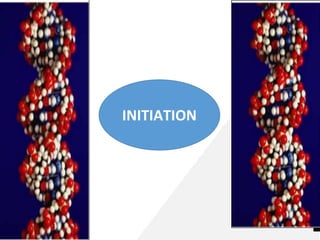
INITIATION
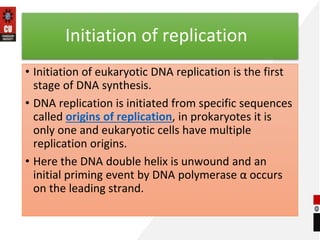
Initiation of replication
• Initiation of eukaryotic DNA replication is the first
stage of DNA synthesis.
• DNA replication is initiated from specific sequences
called origins of replication, in prokaryotes it is
only one and eukaryotic cells have multiple
replication origins.
• Here the DNA double helix is unwound and an
initial priming event by DNA polymerase α occurs
on the leading strand.
DNA replication in a eukaryotic cell:
initiation
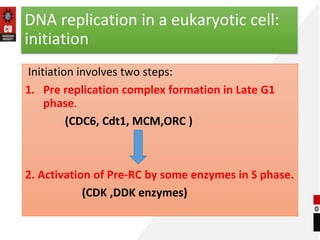
Initiation involves two steps:
1. Pre replication complex formation in Late G1
phase.
(CDC6, Cdt1, MCM,ORC )
2. Activation of Pre-RC by some enzymes in S phase.
(CDK ,DDK enzymes)
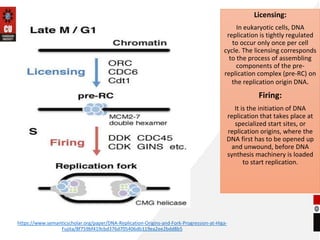
https://www.semanticscholar.org/paper/DNA-Replication-Origins-and-Fork-Progression-at-Higa-
Fujita/8f759bf419cbd376d705406db319ea2ee2bdd8b5
Licensing:
In eukaryotic cells, DNA
replication is tightly regulated
to occur only once per cell
cycle. The licensing corresponds
to the process of assembling
components of the pre-
replication complex (pre-RC) on
the replication origin DNA.
Firing:
It is the initiation of DNA
replication that takes place at
specialized start sites, or
replication origins, where the
DNA first has to be opened up
and unwound, before DNA
synthesis machinery is loaded
to start replication.
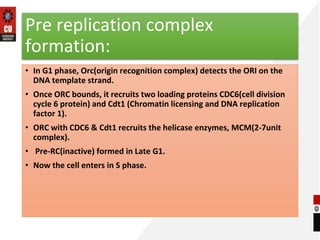
Pre replication complex
formation:
• In G1 phase, Orc(origin recognition complex) detects the ORI on the
DNA template strand.
• Once ORC bounds, it recruits two loading proteins CDC6(cell division
cycle 6 protein) and Cdt1 (Chromatin licensing and DNA replication
factor 1).
• ORC with CDC6 & Cdt1 recruits the helicase enzymes, MCM(2-7unit
complex).
• Pre-RC(inactive) formed in Late G1.
• Now the cell enters in S phase.
https://biotechkhan.wordpress.com/2014/10/10/replication-in-eukaryotes/
Activation of Pre-RC
• As the cell enters S phase, S phase–specific cyclin-dependent
protein kinase (CDK) and Cdc7/Dbf4 kinase (DDK) transform the pre-
RC into an active form by phosphorylation.
• During phosphorylation, MCM 10 binds to Pre-RC and displaces Cdt-1.
• Upon phosphorylation CDC6 & Orc along with cdt1 leave the complex.
• And where MCM upon phosphorylation binds to 2 additional
replication proteins---cell division cycle 45 (CDC45) and GINS complex
(from the Japanese go-ichi-ni-san meaning 5-1-2-3, after the four
related subunits of the complex Sld5, Psf1, Psf2 and Psf3) .
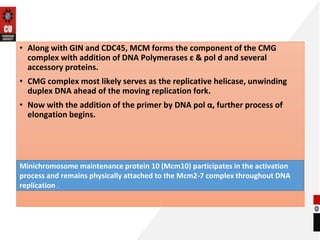
• Along with GIN and CDC45, MCM forms the component of the CMG
complex with addition of DNA Polymerases ε & pol d and several
accessory proteins.
• CMG complex most likely serves as the replicative helicase, unwinding
duplex DNA ahead of the moving replication fork.
• Now with the addition of the primer by DNA pol α, further process of
elongation begins.
Minichromosome maintenance protein 10 (Mcm10) participates in the activation
process and remains physically attached to the Mcm2-7 complex throughout DNA
replication .
https://biotechkhan.wordpress.com/2014/10/10/replication-in-eukaryotes/
References
• Stuart A McNeill
https://pubmed.ncbi.nlm.nih.gov/20070258/
• https://en.wikipedia.org/wiki/Eukaryotic_DNA_replication#:~:text=10%20References-
,Initiation,strand%20establishes%20a%20replication%20fork.
• https://biotechkhan.wordpress.com/2014/10/10/replication-in-eukaryotes/
• Molecular biology of the gene by James D. Watson, Tania A. Baker, Stephen P. Bell
Pearson Publication,5th edition.
• Mitsunori Higa, Masatoshi Fujita, K. Yoshida Published 2017Medicine, Biology Genes
https://www.semanticscholar.org/paper/DNA-Replication-Origins-and-Fork-Progression-at-
Higa-Fujita/8f759bf419cbd376d705406db319ea2ee2bdd8b5
THANK
YOU

initiation in eukaryotes during replication process

  • 1.
    DNA Replication InEukaryotes: Initiation UNIVERSITY INSTITUTE OF BIOTECHNOLOGY Master of Sciences (Biotechnology) Subject Name : Molecular Biology Code :20BTT613 Presented by: Neha Attri UID : 20MBT1089
  • 2.
    DNA Replication • Biologicalprocess of producing two identical replicas of DNA from one original DNA molecule. • Semi conservative (one parent strand and one newly synthesized) and bidirectional. • Stages of DNA Replication: INITIATION ELONGATION TERMINATION
  • 3.
  • 4.
    Initiation of replication •Initiation of eukaryotic DNA replication is the first stage of DNA synthesis. • DNA replication is initiated from specific sequences called origins of replication, in prokaryotes it is only one and eukaryotic cells have multiple replication origins. • Here the DNA double helix is unwound and an initial priming event by DNA polymerase α occurs on the leading strand.
  • 5.
    DNA replication ina eukaryotic cell: initiation Initiation involves two steps: 1. Pre replication complex formation in Late G1 phase. (CDC6, Cdt1, MCM,ORC ) 2. Activation of Pre-RC by some enzymes in S phase. (CDK ,DDK enzymes)
  • 6.
    https://www.semanticscholar.org/paper/DNA-Replication-Origins-and-Fork-Progression-at-Higa- Fujita/8f759bf419cbd376d705406db319ea2ee2bdd8b5 Licensing: In eukaryotic cells,DNA replication is tightly regulated to occur only once per cell cycle. The licensing corresponds to the process of assembling components of the pre- replication complex (pre-RC) on the replication origin DNA. Firing: It is the initiation of DNA replication that takes place at specialized start sites, or replication origins, where the DNA first has to be opened up and unwound, before DNA synthesis machinery is loaded to start replication.
  • 7.
    Pre replication complex formation: •In G1 phase, Orc(origin recognition complex) detects the ORI on the DNA template strand. • Once ORC bounds, it recruits two loading proteins CDC6(cell division cycle 6 protein) and Cdt1 (Chromatin licensing and DNA replication factor 1). • ORC with CDC6 & Cdt1 recruits the helicase enzymes, MCM(2-7unit complex). • Pre-RC(inactive) formed in Late G1. • Now the cell enters in S phase.
  • 8.
  • 9.
    Activation of Pre-RC •As the cell enters S phase, S phase–specific cyclin-dependent protein kinase (CDK) and Cdc7/Dbf4 kinase (DDK) transform the pre- RC into an active form by phosphorylation. • During phosphorylation, MCM 10 binds to Pre-RC and displaces Cdt-1. • Upon phosphorylation CDC6 & Orc along with cdt1 leave the complex. • And where MCM upon phosphorylation binds to 2 additional replication proteins---cell division cycle 45 (CDC45) and GINS complex (from the Japanese go-ichi-ni-san meaning 5-1-2-3, after the four related subunits of the complex Sld5, Psf1, Psf2 and Psf3) .
  • 10.
    • Along withGIN and CDC45, MCM forms the component of the CMG complex with addition of DNA Polymerases ε & pol d and several accessory proteins. • CMG complex most likely serves as the replicative helicase, unwinding duplex DNA ahead of the moving replication fork. • Now with the addition of the primer by DNA pol α, further process of elongation begins. Minichromosome maintenance protein 10 (Mcm10) participates in the activation process and remains physically attached to the Mcm2-7 complex throughout DNA replication .
  • 11.
  • 12.
    References • Stuart AMcNeill https://pubmed.ncbi.nlm.nih.gov/20070258/ • https://en.wikipedia.org/wiki/Eukaryotic_DNA_replication#:~:text=10%20References- ,Initiation,strand%20establishes%20a%20replication%20fork. • https://biotechkhan.wordpress.com/2014/10/10/replication-in-eukaryotes/ • Molecular biology of the gene by James D. Watson, Tania A. Baker, Stephen P. Bell Pearson Publication,5th edition. • Mitsunori Higa, Masatoshi Fujita, K. Yoshida Published 2017Medicine, Biology Genes https://www.semanticscholar.org/paper/DNA-Replication-Origins-and-Fork-Progression-at- Higa-Fujita/8f759bf419cbd376d705406db319ea2ee2bdd8b5
  • 13.