1
What is a DNA?
DNA, also known as deoxyribonucleic acid,
A fundamental molecule found in all living things
carries the genetic information in the cell contains
instructions for our body cells to perform their specific
functions. The sequence of nucleotides determines
individual hereditary characteristics
Basic unit of information in DNA is the gene
Human beings have about 25,000 to 30,000 genes
Size. Size of organism’s genome is roughly a measure of
its complexity.
Viruses 5-10 kb
E. coli 4,640 kb
Human 2,900,000 kb
(about 2.9 billion base pairs)
2
DNA Extraction
The first isolation of DNA was done in 1869
by Friedrich Miescher. Currently DNA
extraction is a routine procedure used to
isolate DNA from the nucleus of cells in
molecular biology or forensic analyses.
DNA can be extracted from different sources.
 Blood
 Semen
 Saliva
 Urine
 Hair
 Teeth
 Bone
 Tissue 3
DNA Extraction Procedures
1. Organic (Phenol-Chloroform) Extraction
2. Non-Organic (Proteinase K and Salting out)
3. Chelex (Ion Exchange Resin) Extraction
4
Organic (Phenol-Chloroform) Extraction
Cell Lysis Buffer - lyse cell membrane, pellet
nuclei.
 Resuspend nuclei, add Sodium Dodecly Sulfate
(SDS),Proteinase K. Lyse nuclear membrane and
digest protein.
 DNA released into solution is extracted with
phenol-chloroform to remove proteinaceous
material.
DNA is precipitated from the aqueous layer by
the additional of ice cold 95% ethanol and salt.
Precipitated DNA is washed with 70% ethanol,
dried under vacuum and resuspended in TE
buffer. 5
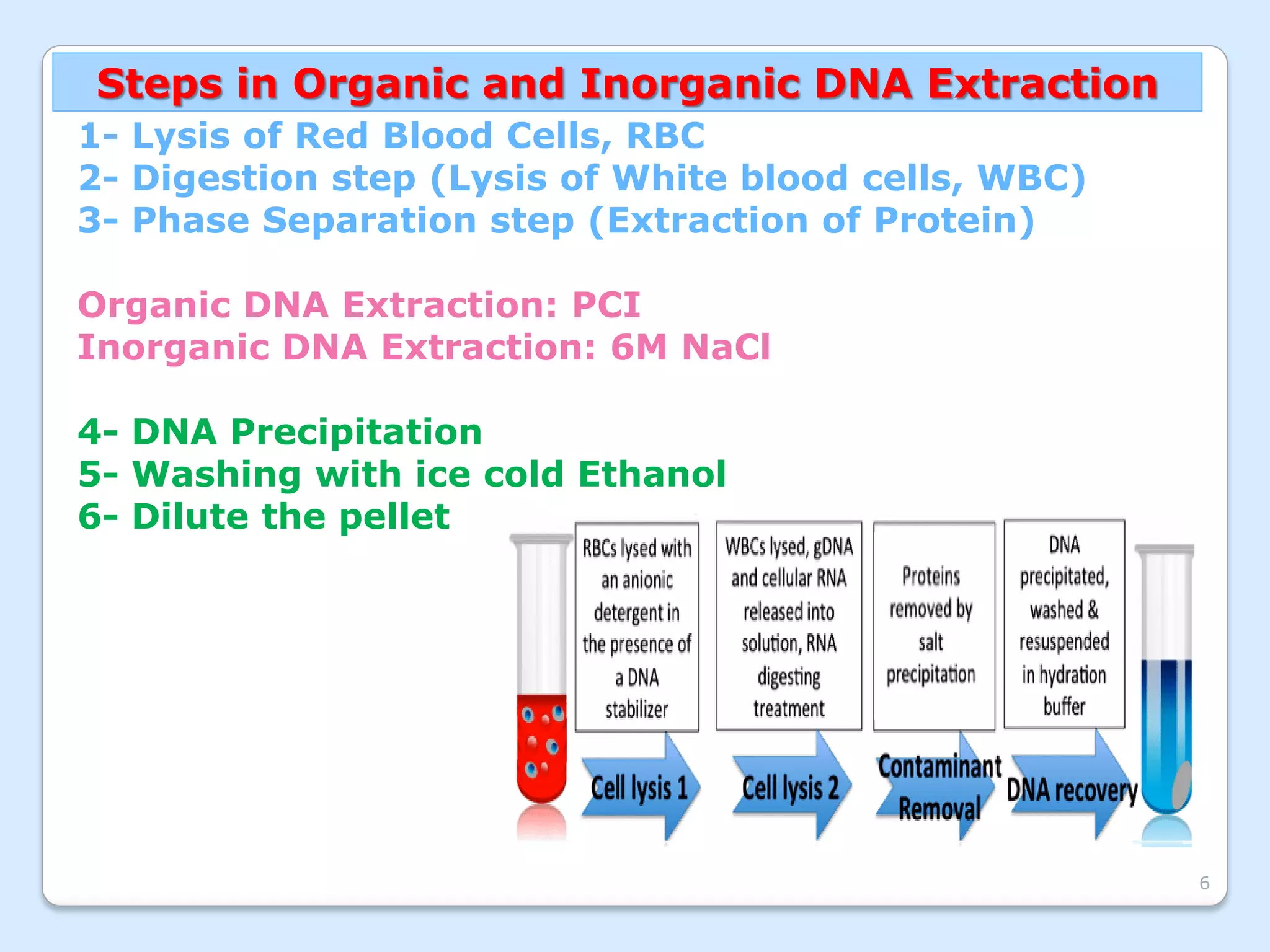
Steps in Organic and Inorganic DNA Extraction
1- Lysis of Red Blood Cells, RBC
2- Digestion step (Lysis of White blood cells, WBC)
3- Phase Separation step (Extraction of Protein)
Organic DNA Extraction: PCI
Inorganic DNA Extraction: 6M NaCl
4- DNA Precipitation
5- Washing with ice cold Ethanol
6- Dilute the pellet
6
1. Lysis of Red Blood Cells, RBC
Lysis of red blood cells
Added 800 uL of Tris EDTA buffer (Tris HCl 10mM, EDTA
2mM) in 200 uL ml of the blood. Mixed by inverting several
times.
Centrifuged at 5000 rpm for 10 min.
Discarded the supernatant.
Break the pellet formed at the bottom of the eppendorf tube
by tapping it gently. Add 1 mL TE buffer and mixed it gently.
Centrifuged at 5000 rpm for 10 min. this step may be
repeated until pallet becomes light pink.
7
2. Digestion step (Lysis of White blood cells, WBC)
Pellet obtained after lysis of RBCs re-suspended in
 400 uL Buffer TNE (Tris HCL 10mM, EDTA 2mM, NaCl
400mM),
 200L 10% SDS
 50 L Proteinase K (50 l of 10µg/uL conc.).
Homogenize the tube with gentle rotation
Samples incubate at overnight in 58 °C in shaker water bath.
Next Day
8
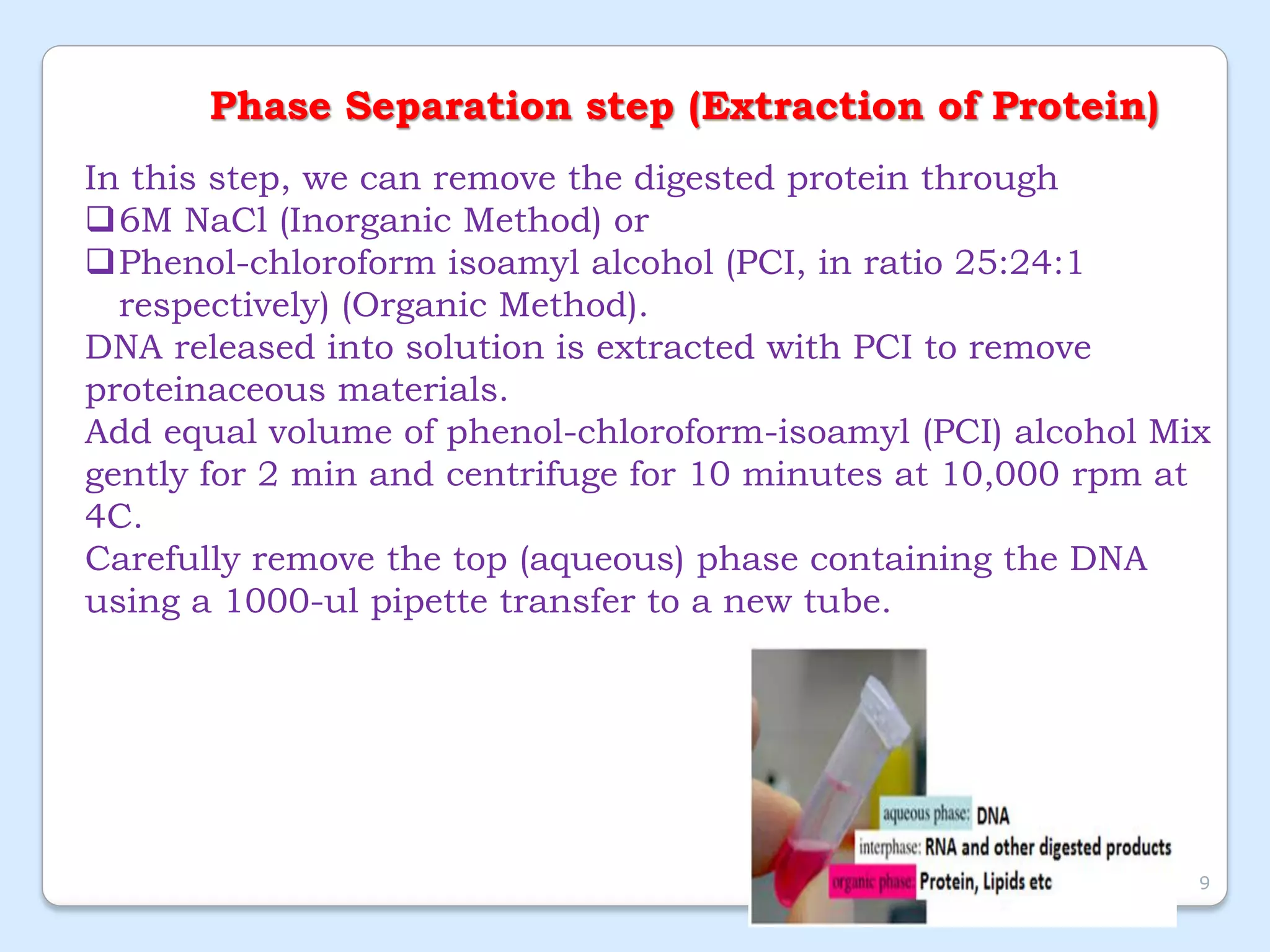
Phase Separation step (Extraction of Protein)
In this step, we can remove the digested protein through
6M NaCl (Inorganic Method) or
Phenol-chloroform isoamyl alcohol (PCI, in ratio 25:24:1
respectively) (Organic Method).
DNA released into solution is extracted with PCI to remove
proteinaceous materials.
Add equal volume of phenol-chloroform-isoamyl (PCI) alcohol Mix
gently for 2 min and centrifuge for 10 minutes at 10,000 rpm at
4C.
Carefully remove the top (aqueous) phase containing the DNA
using a 1000-ul pipette transfer to a new tube.
9
4. DNA Precipitation
Precipitate the DNA with absolute isopropanol and
inverted the tubes gently till DNA threads became
visible and then left the tubes at room temperature
for 10 minutes.
Centrifuged at 8000 rpm for 10 minutes and
discarded the supernatant carefully and white
pellet of DNA may visible at the bottom of the tube
10
5. Washing with ice cold Ethanol
Washed DNA pellet with 1 mL of 70-100% ethanol,
break and mix the pellet
Then centrifuged at 8000 rpm for 10 minutes and
discarded the supernatant carefully
Air dried the DNA pellet at room temperature for at
least 2 hours
11
6. Dilute the pellet
Add 50-100 uL of low T.E. (Tris HCl 10 mL, EDTA
0.2mM) or DEPC water
Place the tubes in a shaking water bath at 70°C for
one hour so that nucleases were inactivated.
Finally DNA will store at –20oC.
12
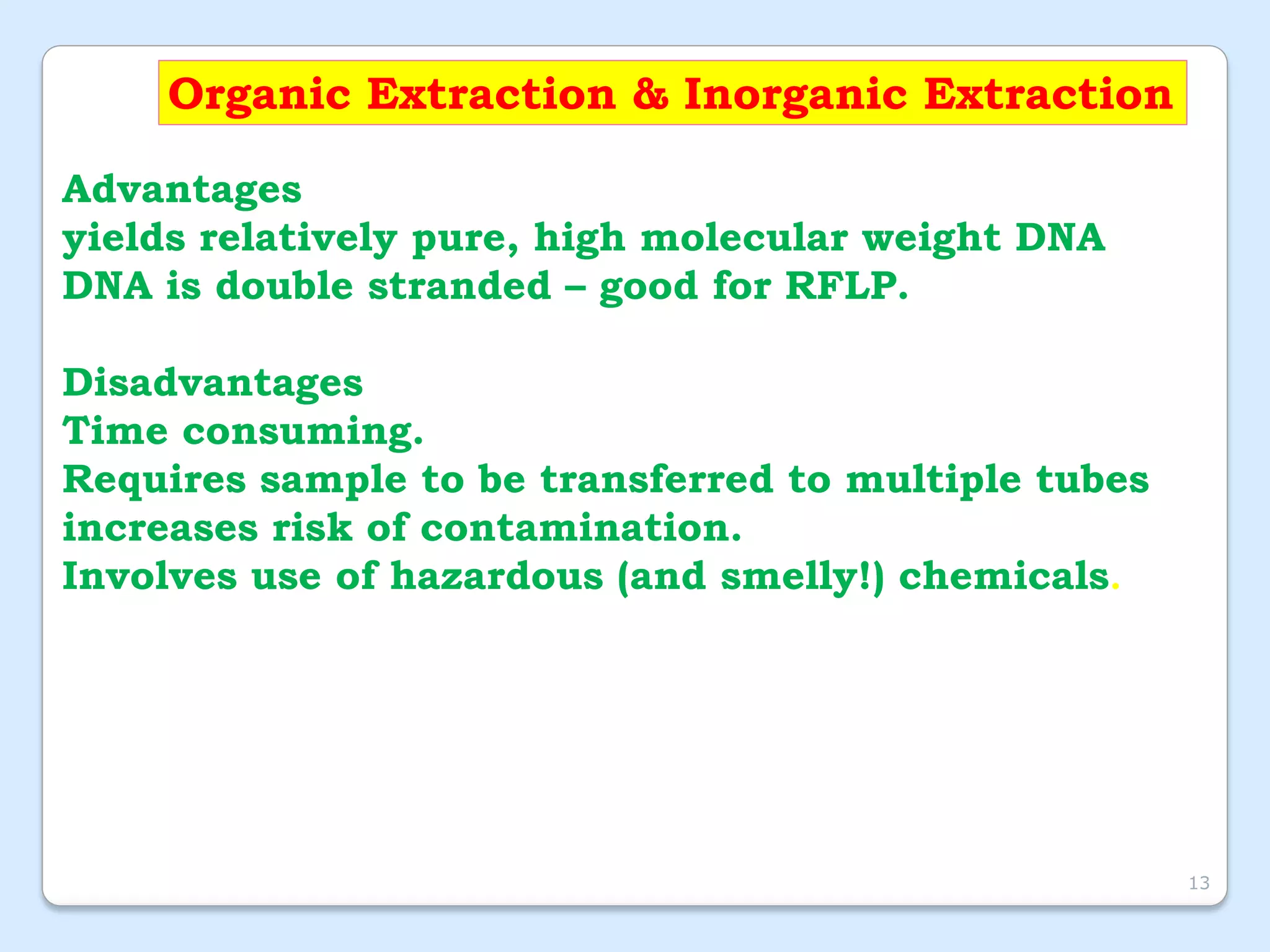
Organic Extraction & Inorganic Extraction
Advantages
yields relatively pure, high molecular weight DNA
DNA is double stranded – good for RFLP.
Disadvantages
Time consuming.
Requires sample to be transferred to multiple tubes
increases risk of contamination.
Involves use of hazardous (and smelly!) chemicals.
13
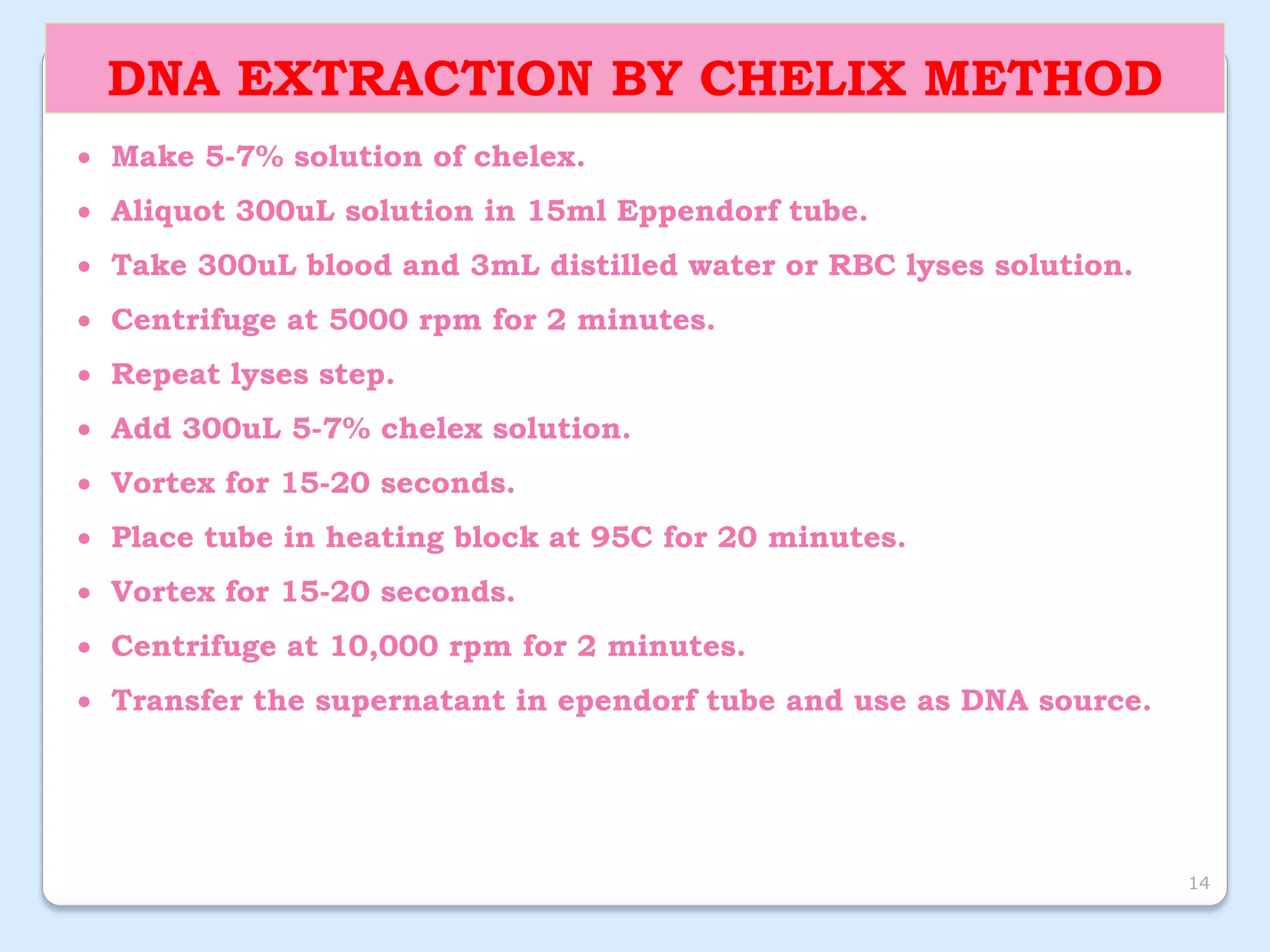
DNA EXTRACTION BY CHELIX METHOD
 Make 5-7% solution of chelex.
 Aliquot 300uL solution in 15ml Eppendorf tube.
 Take 300uL blood and 3mL distilled water or RBC lyses solution.
 Centrifuge at 5000 rpm for 2 minutes.
 Repeat lyses step.
 Add 300uL 5-7% chelex solution.
 Vortex for 15-20 seconds.
 Place tube in heating block at 95C for 20 minutes.
 Vortex for 15-20 seconds.
 Centrifuge at 10,000 rpm for 2 minutes.
 Transfer the supernatant in ependorf tube and use as DNA source.
14
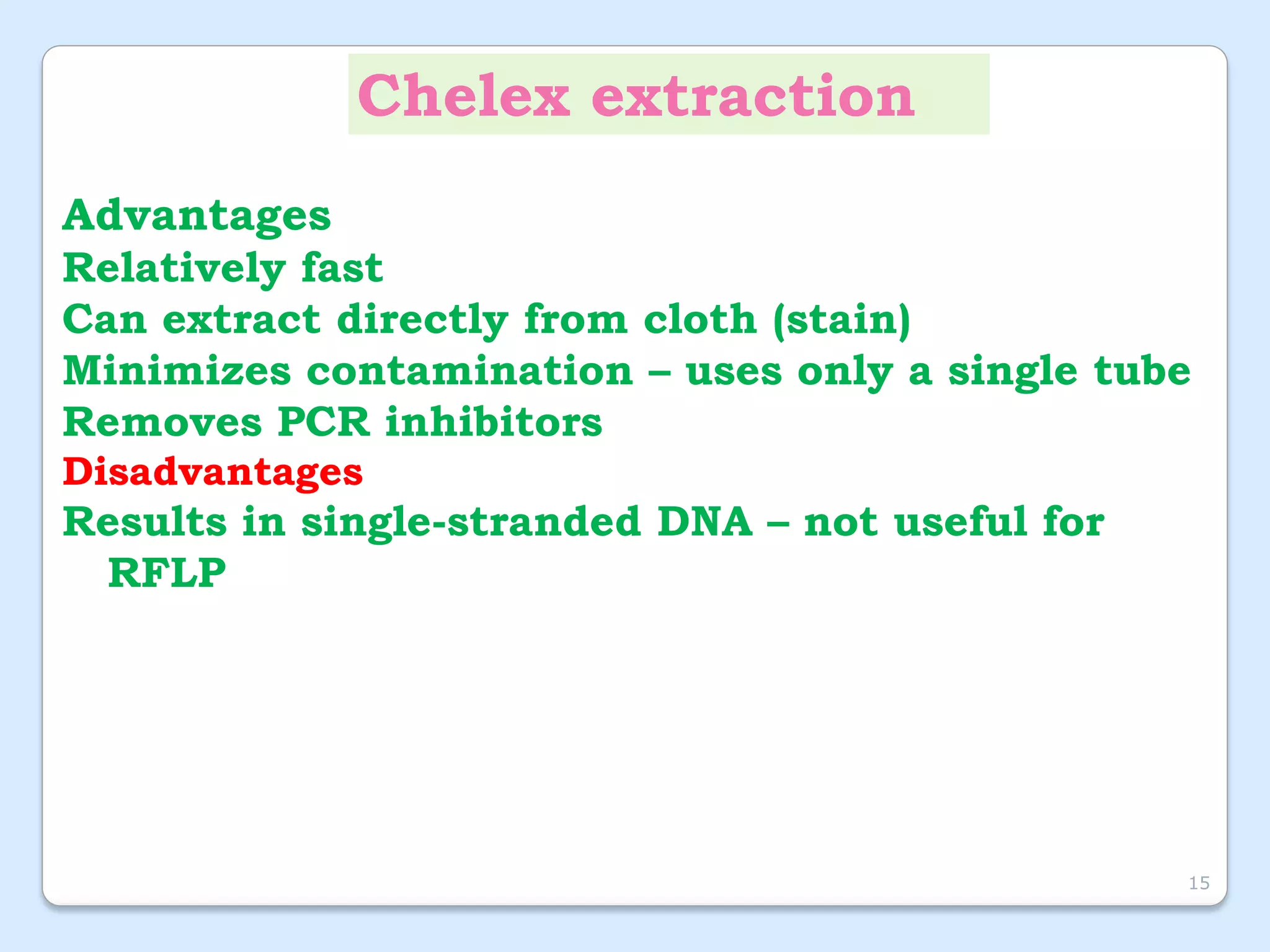
Chelex extraction
Advantages
Relatively fast
Can extract directly from cloth (stain)
Minimizes contamination – uses only a single tube
Removes PCR inhibitors
Disadvantages
Results in single-stranded DNA – not useful for
RFLP
15
16
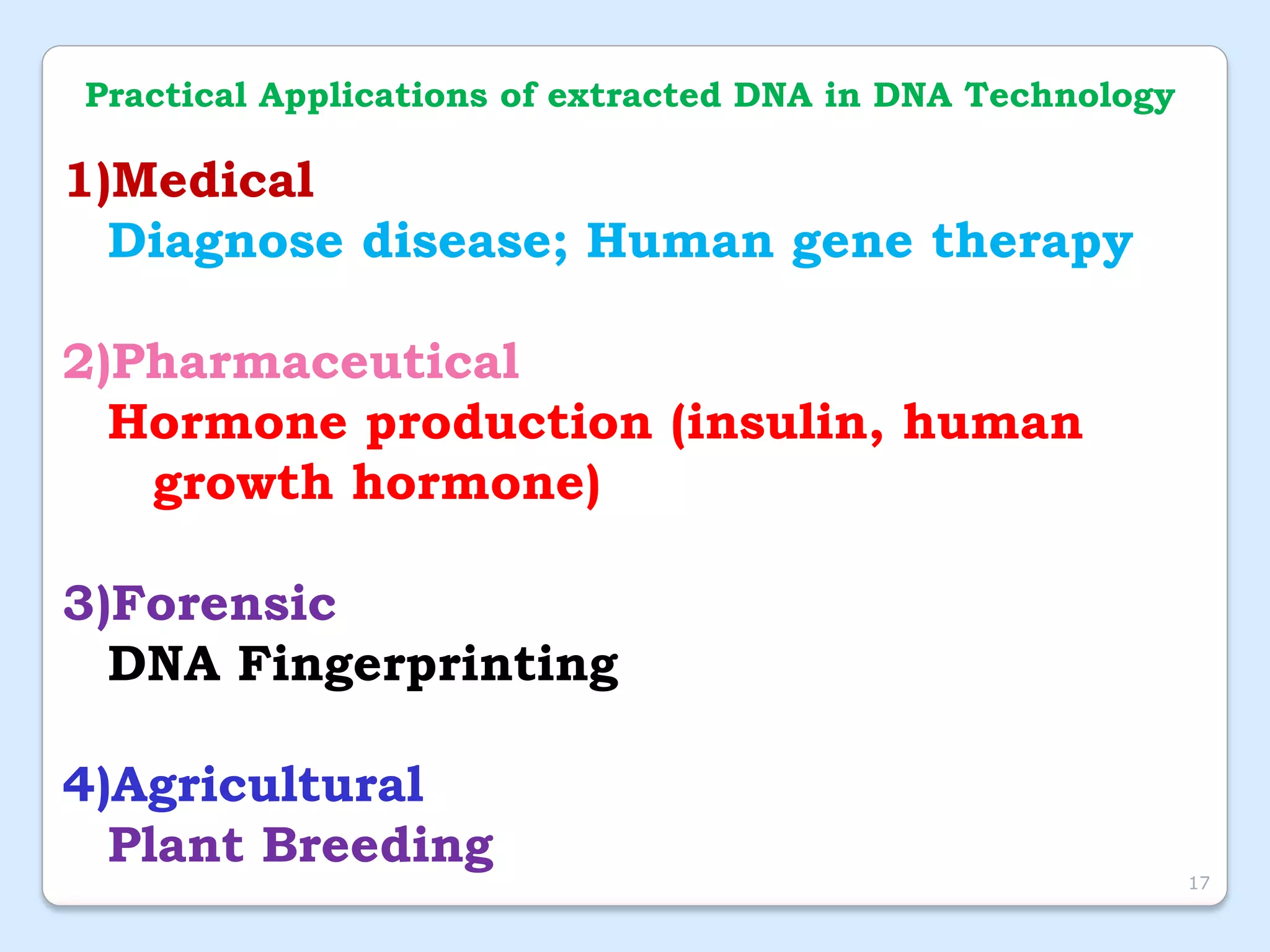
Practical Applications of extracted DNA in DNA Technology
1)Medical
Diagnose disease; Human gene therapy
2)Pharmaceutical
Hormone production (insulin, human
growth hormone)
3)Forensic
DNA Fingerprinting
4)Agricultural
Plant Breeding
17
18

DNA Extraction Methods

  • 1.
  • 2.
    What is aDNA? DNA, also known as deoxyribonucleic acid, A fundamental molecule found in all living things carries the genetic information in the cell contains instructions for our body cells to perform their specific functions. The sequence of nucleotides determines individual hereditary characteristics Basic unit of information in DNA is the gene Human beings have about 25,000 to 30,000 genes Size. Size of organism’s genome is roughly a measure of its complexity. Viruses 5-10 kb E. coli 4,640 kb Human 2,900,000 kb (about 2.9 billion base pairs) 2
  • 3.
    DNA Extraction The firstisolation of DNA was done in 1869 by Friedrich Miescher. Currently DNA extraction is a routine procedure used to isolate DNA from the nucleus of cells in molecular biology or forensic analyses. DNA can be extracted from different sources.  Blood  Semen  Saliva  Urine  Hair  Teeth  Bone  Tissue 3
  • 4.
    DNA Extraction Procedures 1.Organic (Phenol-Chloroform) Extraction 2. Non-Organic (Proteinase K and Salting out) 3. Chelex (Ion Exchange Resin) Extraction 4
  • 5.
    Organic (Phenol-Chloroform) Extraction CellLysis Buffer - lyse cell membrane, pellet nuclei.  Resuspend nuclei, add Sodium Dodecly Sulfate (SDS),Proteinase K. Lyse nuclear membrane and digest protein.  DNA released into solution is extracted with phenol-chloroform to remove proteinaceous material. DNA is precipitated from the aqueous layer by the additional of ice cold 95% ethanol and salt. Precipitated DNA is washed with 70% ethanol, dried under vacuum and resuspended in TE buffer. 5
  • 6.
    Steps in Organicand Inorganic DNA Extraction 1- Lysis of Red Blood Cells, RBC 2- Digestion step (Lysis of White blood cells, WBC) 3- Phase Separation step (Extraction of Protein) Organic DNA Extraction: PCI Inorganic DNA Extraction: 6M NaCl 4- DNA Precipitation 5- Washing with ice cold Ethanol 6- Dilute the pellet 6
  • 7.
    1. Lysis ofRed Blood Cells, RBC Lysis of red blood cells Added 800 uL of Tris EDTA buffer (Tris HCl 10mM, EDTA 2mM) in 200 uL ml of the blood. Mixed by inverting several times. Centrifuged at 5000 rpm for 10 min. Discarded the supernatant. Break the pellet formed at the bottom of the eppendorf tube by tapping it gently. Add 1 mL TE buffer and mixed it gently. Centrifuged at 5000 rpm for 10 min. this step may be repeated until pallet becomes light pink. 7
  • 8.
    2. Digestion step(Lysis of White blood cells, WBC) Pellet obtained after lysis of RBCs re-suspended in  400 uL Buffer TNE (Tris HCL 10mM, EDTA 2mM, NaCl 400mM),  200L 10% SDS  50 L Proteinase K (50 l of 10µg/uL conc.). Homogenize the tube with gentle rotation Samples incubate at overnight in 58 °C in shaker water bath. Next Day 8
  • 9.
    Phase Separation step(Extraction of Protein) In this step, we can remove the digested protein through 6M NaCl (Inorganic Method) or Phenol-chloroform isoamyl alcohol (PCI, in ratio 25:24:1 respectively) (Organic Method). DNA released into solution is extracted with PCI to remove proteinaceous materials. Add equal volume of phenol-chloroform-isoamyl (PCI) alcohol Mix gently for 2 min and centrifuge for 10 minutes at 10,000 rpm at 4C. Carefully remove the top (aqueous) phase containing the DNA using a 1000-ul pipette transfer to a new tube. 9
  • 10.
    4. DNA Precipitation Precipitatethe DNA with absolute isopropanol and inverted the tubes gently till DNA threads became visible and then left the tubes at room temperature for 10 minutes. Centrifuged at 8000 rpm for 10 minutes and discarded the supernatant carefully and white pellet of DNA may visible at the bottom of the tube 10
  • 11.
    5. Washing withice cold Ethanol Washed DNA pellet with 1 mL of 70-100% ethanol, break and mix the pellet Then centrifuged at 8000 rpm for 10 minutes and discarded the supernatant carefully Air dried the DNA pellet at room temperature for at least 2 hours 11
  • 12.
    6. Dilute thepellet Add 50-100 uL of low T.E. (Tris HCl 10 mL, EDTA 0.2mM) or DEPC water Place the tubes in a shaking water bath at 70°C for one hour so that nucleases were inactivated. Finally DNA will store at –20oC. 12
  • 13.
    Organic Extraction &Inorganic Extraction Advantages yields relatively pure, high molecular weight DNA DNA is double stranded – good for RFLP. Disadvantages Time consuming. Requires sample to be transferred to multiple tubes increases risk of contamination. Involves use of hazardous (and smelly!) chemicals. 13
  • 14.
    DNA EXTRACTION BYCHELIX METHOD  Make 5-7% solution of chelex.  Aliquot 300uL solution in 15ml Eppendorf tube.  Take 300uL blood and 3mL distilled water or RBC lyses solution.  Centrifuge at 5000 rpm for 2 minutes.  Repeat lyses step.  Add 300uL 5-7% chelex solution.  Vortex for 15-20 seconds.  Place tube in heating block at 95C for 20 minutes.  Vortex for 15-20 seconds.  Centrifuge at 10,000 rpm for 2 minutes.  Transfer the supernatant in ependorf tube and use as DNA source. 14
  • 15.
    Chelex extraction Advantages Relatively fast Canextract directly from cloth (stain) Minimizes contamination – uses only a single tube Removes PCR inhibitors Disadvantages Results in single-stranded DNA – not useful for RFLP 15
  • 16.
  • 17.
    Practical Applications ofextracted DNA in DNA Technology 1)Medical Diagnose disease; Human gene therapy 2)Pharmaceutical Hormone production (insulin, human growth hormone) 3)Forensic DNA Fingerprinting 4)Agricultural Plant Breeding 17
  • 18.