Prepared by
Blnd Ibrahim Mohammed
Supervised by
Dr. Trefa Salih Mohamad
2023-20234
Lab 3.
Introduction
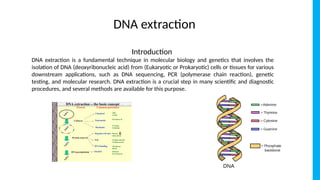
DNA extraction is a fundamental technique in molecular biology and genetics that involves the
isolation of DNA (deoxyribonucleic acid) from (Eukaryotic or Prokaryotic) cells or tissues for various
downstream applications, such as DNA sequencing, PCR (polymerase chain reaction), genetic
testing, and molecular research. DNA extraction is a crucial step in many scientific and diagnostic
procedures, and several methods are available for this purpose.
DNA extraction
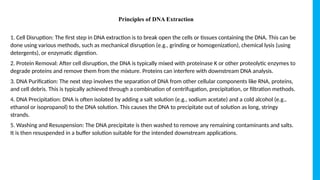
Principles of DNA Extraction
1. Cell Disruption: The first step in DNA extraction is to break open the cells or tissues containing the DNA. This can be
done using various methods, such as mechanical disruption (e.g., grinding or homogenization), chemical lysis (using
detergents), or enzymatic digestion.
2. Protein Removal: After cell disruption, the DNA is typically mixed with proteinase K or other proteolytic enzymes to
degrade proteins and remove them from the mixture. Proteins can interfere with downstream DNA analysis.
3. DNA Purification: The next step involves the separation of DNA from other cellular components like RNA, proteins,
and cell debris. This is typically achieved through a combination of centrifugation, precipitation, or filtration methods.
4. DNA Precipitation: DNA is often isolated by adding a salt solution (e.g., sodium acetate) and a cold alcohol (e.g.,
ethanol or isopropanol) to the DNA solution. This causes the DNA to precipitate out of solution as long, stringy
strands.
5. Washing and Resuspension: The DNA precipitate is then washed to remove any remaining contaminants and salts.
It is then resuspended in a buffer solution suitable for the intended downstream applications.
Common Methods for DNA Extraction
1. Phenol-Chloroform Extraction: This method involves the use of phenol and chloroform to separate DNA from cellular
components. yield high-quality DNA.
2. Salting-Out (or Salting-In) Method: This method uses a high concentration of salt (e.g., ammonium acetate) to precipitate
DNA. It's a relatively simple and widely used technique.
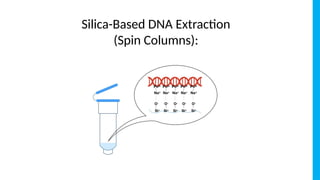
3. Silica-Based DNA Extraction (Spin Columns): In this method, DNA binds to silica membranes in the presence of chaotropic
salts. After several washing steps, the purified DNA is eluted with a low-salt buffer. Spin columns are commonly used for
plasmid DNA purification and small-scale DNA extractions.
4. Chelex Resin Extraction: This method relies on a chelating resin (e.g., Chelex 100) to bind divalent metal ions and
facilitate the release of DNA from cells. It's a quick and easy technique, often used for PCR-based applications.
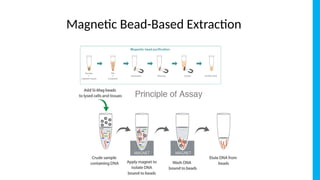
5. Magnetic Bead-Based Extraction: Magnetic beads coated with specific DNA-binding molecules are used to selectively
capture and purify DNA. This method is automation-friendly and suitable for high-throughput applications.
6. Organic Solvent Extraction (CTAB): Cetyltrimethylammonium bromide (CTAB) is used to lyse cells and separate DNA from
other components. This method is commonly used for plant DNA extraction.
Phenol-Chloroform
Extraction
Silica-Based DNA Extraction
(Spin Columns):
Chelex Resin Extraction
Magnetic Bead-Based Extraction
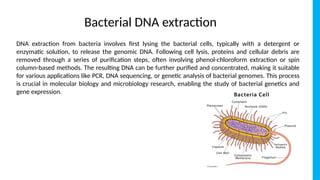
Bacterial DNA extraction
DNA extraction from bacteria involves first lysing the bacterial cells, typically with a detergent or
enzymatic solution, to release the genomic DNA. Following cell lysis, proteins and cellular debris are
removed through a series of purification steps, often involving phenol-chloroform extraction or spin
column-based methods. The resulting DNA can be further purified and concentrated, making it suitable
for various applications like PCR, DNA sequencing, or genetic analysis of bacterial genomes. This process
is crucial in molecular biology and microbiology research, enabling the study of bacterial genetics and
gene expression.
Dear students, this protocol allows a fast extraction of chromosomal DNA
so that it can be performed quickly in a practical class. Bacterial cells were
obtained by centrifugation of 1.5 ml of an overnight culture of E. coli cells
and supplied as a bacterial pellet. The first step is to incubate the bacterial
pellet with a lysis solution that will break the cell membranes and release
the nucleic acids. Proteins and cellular debris will then be removed with
the addition of a protein precipitation solution. After centrifugation we will
remain with supernatant and precipitate the nucleic acids with
isopropanol, followed by a 70% ethanol wash and finally the DNA
hydration.
1. Cellular lysis: Add 1 ml of an overnight culture to a Eppendorf tube. then Centrifuge at 10,000 RPM for 1 min.
Remove the supernatant. Add 100 μl of Lysis Solution then incubate the samples at 0°C for 10 minutes.
2. Protein precipitation Add 100 μl of Protein precipitation solution (1 min) then Centrifuge at 10,000 RPM for 1
minutes.
3. DNA Precipitation: Transfer the supernatant containing the DNA to new Eppendorf tube containing 500 μl of
isopropanol then Centrifuge at 10,000 RPM (1 minutes). Remove supernatant. Add 500 μl of 70% ethanol then
centrifuge at 10,000 RPM (1 minutes). Carefully remove all the ethanol. Watch not lose the DNA pellet, Invert
the tube and allow to dry on absorbent paper for 10 minutes.
4. Add 50 μl RNAse and incubate for 30 minutes at 37 ºC.
5. Repeat step (3).
6. Hydration of DNA: Add 500 μl of DNA hydration Solution. Resuspend by micropipette the white pellet.
Incubation at 10°C which aid in the dissolution of the DNA.
7. Store at -20°C.
Procedure
Deoxyribonuclease extraction protocols2.pptx

Deoxyribonuclease extraction protocols2.pptx

  • 1.
    Prepared by Blnd IbrahimMohammed Supervised by Dr. Trefa Salih Mohamad 2023-20234 Lab 3.
  • 2.
    Introduction DNA extraction isa fundamental technique in molecular biology and genetics that involves the isolation of DNA (deoxyribonucleic acid) from (Eukaryotic or Prokaryotic) cells or tissues for various downstream applications, such as DNA sequencing, PCR (polymerase chain reaction), genetic testing, and molecular research. DNA extraction is a crucial step in many scientific and diagnostic procedures, and several methods are available for this purpose. DNA extraction
  • 3.
    Principles of DNAExtraction 1. Cell Disruption: The first step in DNA extraction is to break open the cells or tissues containing the DNA. This can be done using various methods, such as mechanical disruption (e.g., grinding or homogenization), chemical lysis (using detergents), or enzymatic digestion. 2. Protein Removal: After cell disruption, the DNA is typically mixed with proteinase K or other proteolytic enzymes to degrade proteins and remove them from the mixture. Proteins can interfere with downstream DNA analysis. 3. DNA Purification: The next step involves the separation of DNA from other cellular components like RNA, proteins, and cell debris. This is typically achieved through a combination of centrifugation, precipitation, or filtration methods. 4. DNA Precipitation: DNA is often isolated by adding a salt solution (e.g., sodium acetate) and a cold alcohol (e.g., ethanol or isopropanol) to the DNA solution. This causes the DNA to precipitate out of solution as long, stringy strands. 5. Washing and Resuspension: The DNA precipitate is then washed to remove any remaining contaminants and salts. It is then resuspended in a buffer solution suitable for the intended downstream applications.
  • 4.
    Common Methods forDNA Extraction 1. Phenol-Chloroform Extraction: This method involves the use of phenol and chloroform to separate DNA from cellular components. yield high-quality DNA. 2. Salting-Out (or Salting-In) Method: This method uses a high concentration of salt (e.g., ammonium acetate) to precipitate DNA. It's a relatively simple and widely used technique. 3. Silica-Based DNA Extraction (Spin Columns): In this method, DNA binds to silica membranes in the presence of chaotropic salts. After several washing steps, the purified DNA is eluted with a low-salt buffer. Spin columns are commonly used for plasmid DNA purification and small-scale DNA extractions. 4. Chelex Resin Extraction: This method relies on a chelating resin (e.g., Chelex 100) to bind divalent metal ions and facilitate the release of DNA from cells. It's a quick and easy technique, often used for PCR-based applications. 5. Magnetic Bead-Based Extraction: Magnetic beads coated with specific DNA-binding molecules are used to selectively capture and purify DNA. This method is automation-friendly and suitable for high-throughput applications. 6. Organic Solvent Extraction (CTAB): Cetyltrimethylammonium bromide (CTAB) is used to lyse cells and separate DNA from other components. This method is commonly used for plant DNA extraction.
  • 5.
  • 6.
  • 7.
  • 8.
  • 9.
    Bacterial DNA extraction DNAextraction from bacteria involves first lysing the bacterial cells, typically with a detergent or enzymatic solution, to release the genomic DNA. Following cell lysis, proteins and cellular debris are removed through a series of purification steps, often involving phenol-chloroform extraction or spin column-based methods. The resulting DNA can be further purified and concentrated, making it suitable for various applications like PCR, DNA sequencing, or genetic analysis of bacterial genomes. This process is crucial in molecular biology and microbiology research, enabling the study of bacterial genetics and gene expression.
  • 10.
    Dear students, thisprotocol allows a fast extraction of chromosomal DNA so that it can be performed quickly in a practical class. Bacterial cells were obtained by centrifugation of 1.5 ml of an overnight culture of E. coli cells and supplied as a bacterial pellet. The first step is to incubate the bacterial pellet with a lysis solution that will break the cell membranes and release the nucleic acids. Proteins and cellular debris will then be removed with the addition of a protein precipitation solution. After centrifugation we will remain with supernatant and precipitate the nucleic acids with isopropanol, followed by a 70% ethanol wash and finally the DNA hydration.
  • 11.
    1. Cellular lysis:Add 1 ml of an overnight culture to a Eppendorf tube. then Centrifuge at 10,000 RPM for 1 min. Remove the supernatant. Add 100 μl of Lysis Solution then incubate the samples at 0°C for 10 minutes. 2. Protein precipitation Add 100 μl of Protein precipitation solution (1 min) then Centrifuge at 10,000 RPM for 1 minutes. 3. DNA Precipitation: Transfer the supernatant containing the DNA to new Eppendorf tube containing 500 μl of isopropanol then Centrifuge at 10,000 RPM (1 minutes). Remove supernatant. Add 500 μl of 70% ethanol then centrifuge at 10,000 RPM (1 minutes). Carefully remove all the ethanol. Watch not lose the DNA pellet, Invert the tube and allow to dry on absorbent paper for 10 minutes. 4. Add 50 μl RNAse and incubate for 30 minutes at 37 ºC. 5. Repeat step (3). 6. Hydration of DNA: Add 500 μl of DNA hydration Solution. Resuspend by micropipette the white pellet. Incubation at 10°C which aid in the dissolution of the DNA. 7. Store at -20°C. Procedure