Total DNA Extraction
Genes in a Bottle
Capture Your Unique Essence!
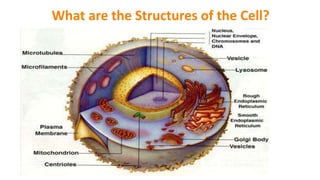
What are the Structures of the Cell?
• DNA can be extracted from either plant, animal, bacteria, virus etc.
• Mostly Chromosomal/genomic DNA. Sometimes plasmids may be
present.
Isolation of DNA is often the first step before further analysis
• DNA profiling
• Cloning/PCR
• Disease diagnosis
• DNA sequencing
• Genetically modified organisms
(GMO) –
• agriculture, pharmaceutical
• Environmental testing, biodefense
How Much DNA Do We Need?
•The RFLP procedure requires a minimum of 50 ng of high
molecular weight double stranded DNA.
•This is the equivalent of approximately 2 ul of blood.
•The PCR reactions call for on average 1 ng of DNA (single or
double stranded).
•This is the equivalent of 1/20 of 1 ul of blood.
•Many of the commercially available kits are sensitive below 1
ng of DNA (100-250 pg).
How Much DNA Can We Recover?
A Diploid Cell contains approximately 6 pg of DNA
Sperm contains approximately 3 pg of DNA
The average WBC of an adult is 5 - 10 X 106 cells per ml
of blood.
Therefore, the theoretical recovery of DNA per ul of
blood is 30 - 60 ng.
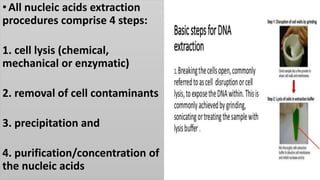
•All nucleic acids extraction
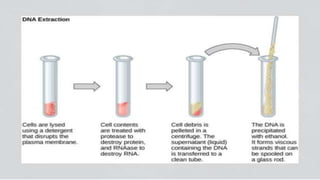
procedures comprise 4 steps:
1. cell lysis (chemical,
mechanical or enzymatic)
2. removal of cell contaminants
3. precipitation and
4. purification/concentration of
the nucleic acids
Perhaps the most basic of all procedures in molecular
biology is the purification of DNA.
The key step, the removal of proteins, can often be
carried out simply by extracting aqueous solutions of
nucleic acids with phenol and/or chloroform.
What are the Most Commonly used DNA
Extraction Procedures
Organic (Phenol-Chloroform) Extraction
Non-Organic (Proteinase K and Salting out)
Chelex (Ion Exchange Resin) Extraction
Silica Based (Silica exchange resin- Qiagen)
The method utilized may be sample dependent,
technique dependent, or analyst preference
ORGANIC EXTRACTION REAGENTS
•Phenol - often means phenol equilibrated with buffer
(such as TE) and containing 0.1% hydroxyquinoline and
0.2% b-mercaptoethanol (added as antioxidants).
•The hydoxquinoline also gives the phenol a yellow color,
making it easier to identify the phases (layers).
•This procedure takes advantage of the fact that
deproteinization is more efficient when two different
organic solvents are used instead of one.
•Chloroform - often means a 24:1 (v/v) mixture of
chloroform and isoamyl alcohol. The isoamyl alcohol is
added to help prevent foaming.
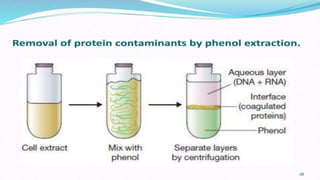
DNA purification: phenol/chloroform extraction
1:1 phenol : chloroform
or
25:24:1 phenol : chloroform : isoamyl alcohol
Phenol: denatures proteins, precipitates form at interface
between aqueous and organic layer
Chloroform: increases density of organic layer
Isoamyl alcohol: prevents foaming
The final extraction with chloroform removes any lingering
traces of phenol from the nucleic acid preparation.
Phenol is highly corrosive and can cause severe burns.
Non-Organic DNA Extraction Procedure
 Cell Lysis Buffer - lyse cell membrane, nuclei are intact, pellet
nuclei. In Tris-EDTA buffer with SDS or lysozyme.
 Resuspend nuclei in Protein Lysis Buffer containing a high
concentration of Proteinase K.
 Temperature helps denature proteins, and Proteinase K auto
digests itself
 To remove proteinaceous material, NaCl is added to a final
concentration of 2.5 M and incubated on ice.
Why Add
Protease?
Protease is added to destroy nuclear proteins
that bind DNA and cytoplasmic enzymes that
breakdown and destroy DNA.
Protease treatment increases the amount of
intact DNA that is extracted.
 The protease solution already contains
salt.
Adding
Salt
oNa+ ions of NaCI bind to the phosphate
groups of DNA molecules, neutralizing the
electric charge of the DNA molecules.
oThe addition of NaCI allows the DNA
molecules to come together instead of
repelling each other, thus making it easier
for DNA to precipitate out of solution when
alcohol is added.
•Role of EDTA
•EDTA is responsible for chelation of divalent ions.
•It stops the action of DNases found in cytoplasm of
cells.
•These DNases, DNA cutting enzymes, can destroy the
genomic DNA and reduce the yield of gDNA
considerably.
•Mg2+ is an important factor for activity of DNases.
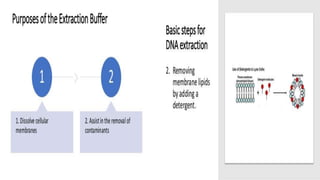
• Role of SDS in DNA extraction
• SDS which stands for 'sodium dodecyl sulfate’.
• It is strong anionic detergent that can solubilize the proteins
and lipids that form the membranes.
• It removes the negative ions from the protein and destroys its
confirmation.
• Because of loss of confirmation the protein loses its structure.
• The proteins from the cell membrane get damaged and cell gets broken.
• This will help the cell membranes and nuclear envelopes to break down
and expose the chromosomes that contain the DNA.
• In addition to removing the membrane barriers, SDS helps release the
DNA from histones and other DNA binding proteins by denaturing them.
•Role of NaCl.
•We know that DNA extraction process begins with the
mechanical separation of the nuclear contents from the rest of
the cell, which is carried out by sonication, agitation and the
addition of SDS detergents.
•To further break down cell components and then draw off the
DNA associated proteins, researchers typically add ammonium,
sodium acetate or similar salts during this stage of the
procedure.
Alcohol is trapping the water and facilitates Na+ to interact
with the PO3-, and then precipitate DNA.
• Role of Salt
 Salting-out proteins in a sample that contains DNA (usually a blood
sample) is a cheap and highly effective step in separating non-DNA
(cell walls, cellular proteins and other unwanted substances)
molecules from DNA molecules.
 Basically, it’s a procedure where one “dismantles” the cell and
precipitates (using centrifuge) parts to obtain really pure sample of
DNA with very little contaminants.
• If you add enough salt into a solution containing proteins, they will
clump together and will be easy to remove.
• You have to add enough salt to saturate the solution because the
protein would first dissolve more readily, and only after the salt
concentration is high enough will it start clumping together and
precipitating.
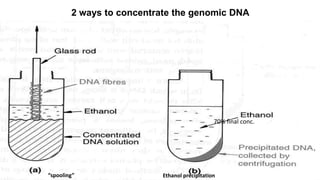
2 ways to concentrate the genomic DNA
70% final conc.
“spooling” Ethanol precipitation
DNA does not dissolve in alcohol.
The addition of cold alcohol makes the DNA clump together
and precipitate out of solution.
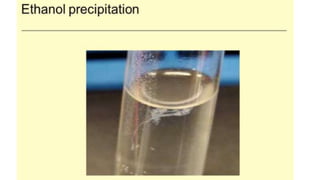
Precipitated DNA molecules appear as long pieces of fluffy,
stringy, web-like strands.
Microscopic oxygen bubbles “aggregate” , or “fuse” together,
as the DNA precipitates.
The larger, visible air bubbles “lift” the DNA out of solution,
from the aqueous into the organic phase.
What are the essential components of a DNA extraction Procedure?
1. Maximize DNA recovery
2. Remove inhibitors
3. Remove or inhibit nucleases
4. Maximize the quality of DNA
•Cells must be disrupted to release cellular materials
•Physical : breaking by mechanical force
sonication, grinding, blender, boiling, vibration etc.
•Chemical: Chemical agents or enzymes
One agent disrupts cell wall others remove cell
membrane -Detergents like SDS, EDTA, Lysozyme.
• Following cell lysis (which brings the gDNA into solution), the only
thing left to do is to purify the sample.
1. Lysis: Just Crack Them Open
• Genomic DNA (gDNA) extraction is the simpler procedure because
strong lysis is the only step necessary to release gDNA into solution.
• For yeast, plants, and bacteria, lysis involves enzymatically breaking
the strong, rigid cell wall before mechanically disrupting the plasma
membrane.
• Cell walls are usually digestible with lysozyme, which hydrolyzes cell
wall peptidoglycans, and the serine protease proteinase K.
• For certain gram-positive species, lysostaphin will further aid
enzymatic digestion.
• You may need to use different enzymes for more exotic species with
different cell wall compositions.
• Mechanical cell wall disruption represents a more universal lysis
method for gDNA extraction.
• Bead beating is popular, and you can easily do this on a vortex using
0.1 mm glass beads or 0.15 mm fine garnet beads.
• Special vortex adapters help with performing multiple extractions at
the same time with equal efficiency.
• Bead beating is faster than enzymatic lysis and generally more
thorough.
• For tough filamentous fungi (e.g. Aspergillus and Fusarium spp.),
cellular material is often snap-frozen in liquid nitrogen and milled in a
pestle and mortar followed by rapid vortexing in solution with an
appropriate lysis buffer.
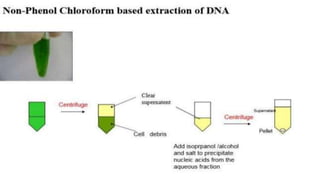
• NON Organic DNA Extraction
•Bacterial cells are cultured in liquid media until they reach a
maximum density of 2-3x10⁹ cells/ml, and then harvested.
•The E.coli chromosome is just over 4.5 MB in size,
amounting to approximately 0.005 picograms per cell.
•A typical overnight culture from a single starting colony will
contain approximately 1-2×10⁹ cells/ml.
•Theoretically, that means that 1 ml of culture should yield
about 5 µg of gDNA per 109 bacterial cells.
•Take this into account when calculating how much DNA you
need for your chosen application.
•The collected cells are lysed, often done
physically/chemically, using reagents such as lysozyme,
EDTA, lysozyme and EDTA and other detergents, etc.
•Cellular components are then removed using non-
organic extraction or silica-based technologies.
•The final step involves DNA precipitation to obtain pure
DNA at a high concentration.
•This procedure can be applied to a wide variety of
microbes and other unicellular organisms such as yeast.
Post-extraction DNA concentration
Chemical concentration by Alcohol Precipitation:
• Addition of 2 volume of ice cold 100% EtOH or 1 volume of RT
Isopropanol.
• Incubation
• High speed centrifugation
• Wash with EtOH 70% to remove salts
• Water/TE buffer for resuspension.
Physical concentration by Inverted spin low binding cellulose filter
devices (i.e. Microcon) to retain DNA after centrifugation.
Concentrating DNA Alcohol Precipitation
• The most widely used method for concentrating DNA is precipitation
with ethanol.
• The precipitate of nucleic acid, forms in the presence of moderate
concentrations of monovalent cations (Salt, such as Na+), is recovered
by centrifugation and redissolved in an appropriate buffer such as TE.
• The technique is rapid and is quantitative even with nanogram
amounts of DNA.
• DNA in ethanol precipitates better in the presence of salt.
• NaAc (or KAc) is well soluble in ethanol, as opposed to for example
NaCl, thats why it is used for precipitation.
• An ethanol precipitation with sodium acetate is a concentration/
wash step, it is not a purification step.
•Why is chilled ethanol used for DNA extraction?
• Using ice-cold ethanol and ice-cold water increases the yield of
DNA.
• Allowing cations to interact with the DNA phosphates
• Reducing repulsive forces between DNA strands
• Causing aggregation and precipitation of DNA
• Low temperatures protect the DNA by slowing down the activity
of enzymes that could break it apart.
• DNases in the cytoplasm would destroy the DNA of viruses
entering the cell.
• Cold ethanol helps the DNA to precipitate more quickly.
Concentrating DNA By Alcohol Precipitation
DNA is polar due to its highly charged phosphate backbone.
If enough ethanol is added, the electrical attraction between
phosphate groups and any positive ions present in solution
becomes strong enough to form stable ionic bonds and DNA
precipitation.
Isopropanol (1 volume) may be used in place of ethanol (2
volumes) to precipitate DNA.
Precipitation with isopropanol has the advantage that the
volume of liquid to be centrifuged is smaller.
Isopropanol is less volatile than ethanol and it is more difficult to
remove the last traces; moreover, solutes such sodium chloride
are more easily coprecipitated with DNA when isopropanol is
Concentrating DNA Alcohol Precipitation
Solutes that may be trapped in the precipitate may be
removed by washing the DNA pellet with a solution of 70%
ethanol.
Ethanol reduces the hydration shell surrounding DNA…
 To make certain that no DNA is lost during washing, add 70%
ethanol until the tube is 2/3 full. Vortex briefly, and
recentrifuged.
 After the 70% ethanol wash, the pellet does not adhere
tightly to the wall of the tube, so great care must be taken
when removing the supernatant.
Resuspension and Storage of DNA
• TE Buffer - Tris-EDTA Buffer: 10 mM Tris-HCl pH 8.0, 1 mM EDTA, or
TE-4 which is 10 mM Tris, 0.1 mM EDTA. DNA is resuspended and
stored in TE buffer.
• DNA must be stored in a slightly basic buffer to prevent depurination,
and the EDTA chelates any Mg2+ helping to inactivate DNases.
• DNA can be stored at 4oC for extended periods, however for long
term storage, -20oC is usually utilized.
• Avoid repetitive freeze thawing of DNA, since this can cause
degradation.
• The storage of DNA at 4oC is better than -20oC and storage at room
temp dried with stabilizer is even better.
 The selection of the most suitable method for DNA extraction
depends on the type of sample and the purpose of the
molecular analysis.
 There is no universal approach that would equally suit all
sample matrices and/or applications.
• Limitations to PCR include inhibitors in foods that can result in
false positives.
• Food-derived PCR inhibitors include Ca2+, fats, glycogen, and
phenolic compounds.
• The presence of proteases in cheese and milk may also inhibit
PCR
• Detection of parasites in water and food samples is often hampered
by the occurrence of organic and inorganic substances.

Lect 1. & 2.MBG 405.pptx

  • 1.
    Total DNA Extraction Genesin a Bottle Capture Your Unique Essence!
  • 2.
    What are theStructures of the Cell?
  • 3.
    • DNA canbe extracted from either plant, animal, bacteria, virus etc. • Mostly Chromosomal/genomic DNA. Sometimes plasmids may be present. Isolation of DNA is often the first step before further analysis • DNA profiling • Cloning/PCR • Disease diagnosis • DNA sequencing • Genetically modified organisms (GMO) – • agriculture, pharmaceutical • Environmental testing, biodefense
  • 4.
    How Much DNADo We Need? •The RFLP procedure requires a minimum of 50 ng of high molecular weight double stranded DNA. •This is the equivalent of approximately 2 ul of blood. •The PCR reactions call for on average 1 ng of DNA (single or double stranded). •This is the equivalent of 1/20 of 1 ul of blood. •Many of the commercially available kits are sensitive below 1 ng of DNA (100-250 pg).
  • 5.
    How Much DNACan We Recover? A Diploid Cell contains approximately 6 pg of DNA Sperm contains approximately 3 pg of DNA The average WBC of an adult is 5 - 10 X 106 cells per ml of blood. Therefore, the theoretical recovery of DNA per ul of blood is 30 - 60 ng.
  • 7.
    •All nucleic acidsextraction procedures comprise 4 steps: 1. cell lysis (chemical, mechanical or enzymatic) 2. removal of cell contaminants 3. precipitation and 4. purification/concentration of the nucleic acids
  • 9.
    Perhaps the mostbasic of all procedures in molecular biology is the purification of DNA. The key step, the removal of proteins, can often be carried out simply by extracting aqueous solutions of nucleic acids with phenol and/or chloroform.
  • 17.
    What are theMost Commonly used DNA Extraction Procedures Organic (Phenol-Chloroform) Extraction Non-Organic (Proteinase K and Salting out) Chelex (Ion Exchange Resin) Extraction Silica Based (Silica exchange resin- Qiagen) The method utilized may be sample dependent, technique dependent, or analyst preference
  • 20.
    ORGANIC EXTRACTION REAGENTS •Phenol- often means phenol equilibrated with buffer (such as TE) and containing 0.1% hydroxyquinoline and 0.2% b-mercaptoethanol (added as antioxidants). •The hydoxquinoline also gives the phenol a yellow color, making it easier to identify the phases (layers). •This procedure takes advantage of the fact that deproteinization is more efficient when two different organic solvents are used instead of one. •Chloroform - often means a 24:1 (v/v) mixture of chloroform and isoamyl alcohol. The isoamyl alcohol is added to help prevent foaming.
  • 21.
    DNA purification: phenol/chloroformextraction 1:1 phenol : chloroform or 25:24:1 phenol : chloroform : isoamyl alcohol Phenol: denatures proteins, precipitates form at interface between aqueous and organic layer Chloroform: increases density of organic layer Isoamyl alcohol: prevents foaming The final extraction with chloroform removes any lingering traces of phenol from the nucleic acid preparation. Phenol is highly corrosive and can cause severe burns.
  • 22.
    Non-Organic DNA ExtractionProcedure  Cell Lysis Buffer - lyse cell membrane, nuclei are intact, pellet nuclei. In Tris-EDTA buffer with SDS or lysozyme.  Resuspend nuclei in Protein Lysis Buffer containing a high concentration of Proteinase K.  Temperature helps denature proteins, and Proteinase K auto digests itself  To remove proteinaceous material, NaCl is added to a final concentration of 2.5 M and incubated on ice.
  • 23.
    Why Add Protease? Protease isadded to destroy nuclear proteins that bind DNA and cytoplasmic enzymes that breakdown and destroy DNA. Protease treatment increases the amount of intact DNA that is extracted.  The protease solution already contains salt.
  • 25.
    Adding Salt oNa+ ions ofNaCI bind to the phosphate groups of DNA molecules, neutralizing the electric charge of the DNA molecules. oThe addition of NaCI allows the DNA molecules to come together instead of repelling each other, thus making it easier for DNA to precipitate out of solution when alcohol is added.
  • 26.
    •Role of EDTA •EDTAis responsible for chelation of divalent ions. •It stops the action of DNases found in cytoplasm of cells. •These DNases, DNA cutting enzymes, can destroy the genomic DNA and reduce the yield of gDNA considerably. •Mg2+ is an important factor for activity of DNases.
  • 27.
    • Role ofSDS in DNA extraction • SDS which stands for 'sodium dodecyl sulfate’. • It is strong anionic detergent that can solubilize the proteins and lipids that form the membranes. • It removes the negative ions from the protein and destroys its confirmation. • Because of loss of confirmation the protein loses its structure. • The proteins from the cell membrane get damaged and cell gets broken. • This will help the cell membranes and nuclear envelopes to break down and expose the chromosomes that contain the DNA. • In addition to removing the membrane barriers, SDS helps release the DNA from histones and other DNA binding proteins by denaturing them.
  • 28.
    •Role of NaCl. •Weknow that DNA extraction process begins with the mechanical separation of the nuclear contents from the rest of the cell, which is carried out by sonication, agitation and the addition of SDS detergents. •To further break down cell components and then draw off the DNA associated proteins, researchers typically add ammonium, sodium acetate or similar salts during this stage of the procedure. Alcohol is trapping the water and facilitates Na+ to interact with the PO3-, and then precipitate DNA.
  • 29.
    • Role ofSalt  Salting-out proteins in a sample that contains DNA (usually a blood sample) is a cheap and highly effective step in separating non-DNA (cell walls, cellular proteins and other unwanted substances) molecules from DNA molecules.  Basically, it’s a procedure where one “dismantles” the cell and precipitates (using centrifuge) parts to obtain really pure sample of DNA with very little contaminants. • If you add enough salt into a solution containing proteins, they will clump together and will be easy to remove. • You have to add enough salt to saturate the solution because the protein would first dissolve more readily, and only after the salt concentration is high enough will it start clumping together and precipitating.
  • 30.
    2 ways toconcentrate the genomic DNA 70% final conc. “spooling” Ethanol precipitation
  • 32.
    DNA does notdissolve in alcohol. The addition of cold alcohol makes the DNA clump together and precipitate out of solution. Precipitated DNA molecules appear as long pieces of fluffy, stringy, web-like strands. Microscopic oxygen bubbles “aggregate” , or “fuse” together, as the DNA precipitates. The larger, visible air bubbles “lift” the DNA out of solution, from the aqueous into the organic phase.
  • 33.
    What are theessential components of a DNA extraction Procedure? 1. Maximize DNA recovery 2. Remove inhibitors 3. Remove or inhibit nucleases 4. Maximize the quality of DNA
  • 34.
    •Cells must bedisrupted to release cellular materials •Physical : breaking by mechanical force sonication, grinding, blender, boiling, vibration etc. •Chemical: Chemical agents or enzymes One agent disrupts cell wall others remove cell membrane -Detergents like SDS, EDTA, Lysozyme.
  • 35.
    • Following celllysis (which brings the gDNA into solution), the only thing left to do is to purify the sample. 1. Lysis: Just Crack Them Open • Genomic DNA (gDNA) extraction is the simpler procedure because strong lysis is the only step necessary to release gDNA into solution. • For yeast, plants, and bacteria, lysis involves enzymatically breaking the strong, rigid cell wall before mechanically disrupting the plasma membrane. • Cell walls are usually digestible with lysozyme, which hydrolyzes cell wall peptidoglycans, and the serine protease proteinase K. • For certain gram-positive species, lysostaphin will further aid enzymatic digestion.
  • 36.
    • You mayneed to use different enzymes for more exotic species with different cell wall compositions. • Mechanical cell wall disruption represents a more universal lysis method for gDNA extraction. • Bead beating is popular, and you can easily do this on a vortex using 0.1 mm glass beads or 0.15 mm fine garnet beads. • Special vortex adapters help with performing multiple extractions at the same time with equal efficiency. • Bead beating is faster than enzymatic lysis and generally more thorough. • For tough filamentous fungi (e.g. Aspergillus and Fusarium spp.), cellular material is often snap-frozen in liquid nitrogen and milled in a pestle and mortar followed by rapid vortexing in solution with an appropriate lysis buffer.
  • 38.
    • NON OrganicDNA Extraction •Bacterial cells are cultured in liquid media until they reach a maximum density of 2-3x10⁹ cells/ml, and then harvested. •The E.coli chromosome is just over 4.5 MB in size, amounting to approximately 0.005 picograms per cell. •A typical overnight culture from a single starting colony will contain approximately 1-2×10⁹ cells/ml. •Theoretically, that means that 1 ml of culture should yield about 5 µg of gDNA per 109 bacterial cells. •Take this into account when calculating how much DNA you need for your chosen application.
  • 39.
    •The collected cellsare lysed, often done physically/chemically, using reagents such as lysozyme, EDTA, lysozyme and EDTA and other detergents, etc. •Cellular components are then removed using non- organic extraction or silica-based technologies. •The final step involves DNA precipitation to obtain pure DNA at a high concentration. •This procedure can be applied to a wide variety of microbes and other unicellular organisms such as yeast.
  • 41.
    Post-extraction DNA concentration Chemicalconcentration by Alcohol Precipitation: • Addition of 2 volume of ice cold 100% EtOH or 1 volume of RT Isopropanol. • Incubation • High speed centrifugation • Wash with EtOH 70% to remove salts • Water/TE buffer for resuspension. Physical concentration by Inverted spin low binding cellulose filter devices (i.e. Microcon) to retain DNA after centrifugation.
  • 42.
    Concentrating DNA AlcoholPrecipitation • The most widely used method for concentrating DNA is precipitation with ethanol. • The precipitate of nucleic acid, forms in the presence of moderate concentrations of monovalent cations (Salt, such as Na+), is recovered by centrifugation and redissolved in an appropriate buffer such as TE. • The technique is rapid and is quantitative even with nanogram amounts of DNA. • DNA in ethanol precipitates better in the presence of salt. • NaAc (or KAc) is well soluble in ethanol, as opposed to for example NaCl, thats why it is used for precipitation. • An ethanol precipitation with sodium acetate is a concentration/ wash step, it is not a purification step.
  • 43.
    •Why is chilledethanol used for DNA extraction? • Using ice-cold ethanol and ice-cold water increases the yield of DNA. • Allowing cations to interact with the DNA phosphates • Reducing repulsive forces between DNA strands • Causing aggregation and precipitation of DNA • Low temperatures protect the DNA by slowing down the activity of enzymes that could break it apart. • DNases in the cytoplasm would destroy the DNA of viruses entering the cell. • Cold ethanol helps the DNA to precipitate more quickly.
  • 44.
    Concentrating DNA ByAlcohol Precipitation DNA is polar due to its highly charged phosphate backbone. If enough ethanol is added, the electrical attraction between phosphate groups and any positive ions present in solution becomes strong enough to form stable ionic bonds and DNA precipitation. Isopropanol (1 volume) may be used in place of ethanol (2 volumes) to precipitate DNA. Precipitation with isopropanol has the advantage that the volume of liquid to be centrifuged is smaller. Isopropanol is less volatile than ethanol and it is more difficult to remove the last traces; moreover, solutes such sodium chloride are more easily coprecipitated with DNA when isopropanol is
  • 45.
    Concentrating DNA AlcoholPrecipitation Solutes that may be trapped in the precipitate may be removed by washing the DNA pellet with a solution of 70% ethanol. Ethanol reduces the hydration shell surrounding DNA…  To make certain that no DNA is lost during washing, add 70% ethanol until the tube is 2/3 full. Vortex briefly, and recentrifuged.  After the 70% ethanol wash, the pellet does not adhere tightly to the wall of the tube, so great care must be taken when removing the supernatant.
  • 47.
    Resuspension and Storageof DNA • TE Buffer - Tris-EDTA Buffer: 10 mM Tris-HCl pH 8.0, 1 mM EDTA, or TE-4 which is 10 mM Tris, 0.1 mM EDTA. DNA is resuspended and stored in TE buffer. • DNA must be stored in a slightly basic buffer to prevent depurination, and the EDTA chelates any Mg2+ helping to inactivate DNases. • DNA can be stored at 4oC for extended periods, however for long term storage, -20oC is usually utilized. • Avoid repetitive freeze thawing of DNA, since this can cause degradation. • The storage of DNA at 4oC is better than -20oC and storage at room temp dried with stabilizer is even better.
  • 48.
     The selectionof the most suitable method for DNA extraction depends on the type of sample and the purpose of the molecular analysis.  There is no universal approach that would equally suit all sample matrices and/or applications. • Limitations to PCR include inhibitors in foods that can result in false positives. • Food-derived PCR inhibitors include Ca2+, fats, glycogen, and phenolic compounds. • The presence of proteases in cheese and milk may also inhibit PCR • Detection of parasites in water and food samples is often hampered by the occurrence of organic and inorganic substances.